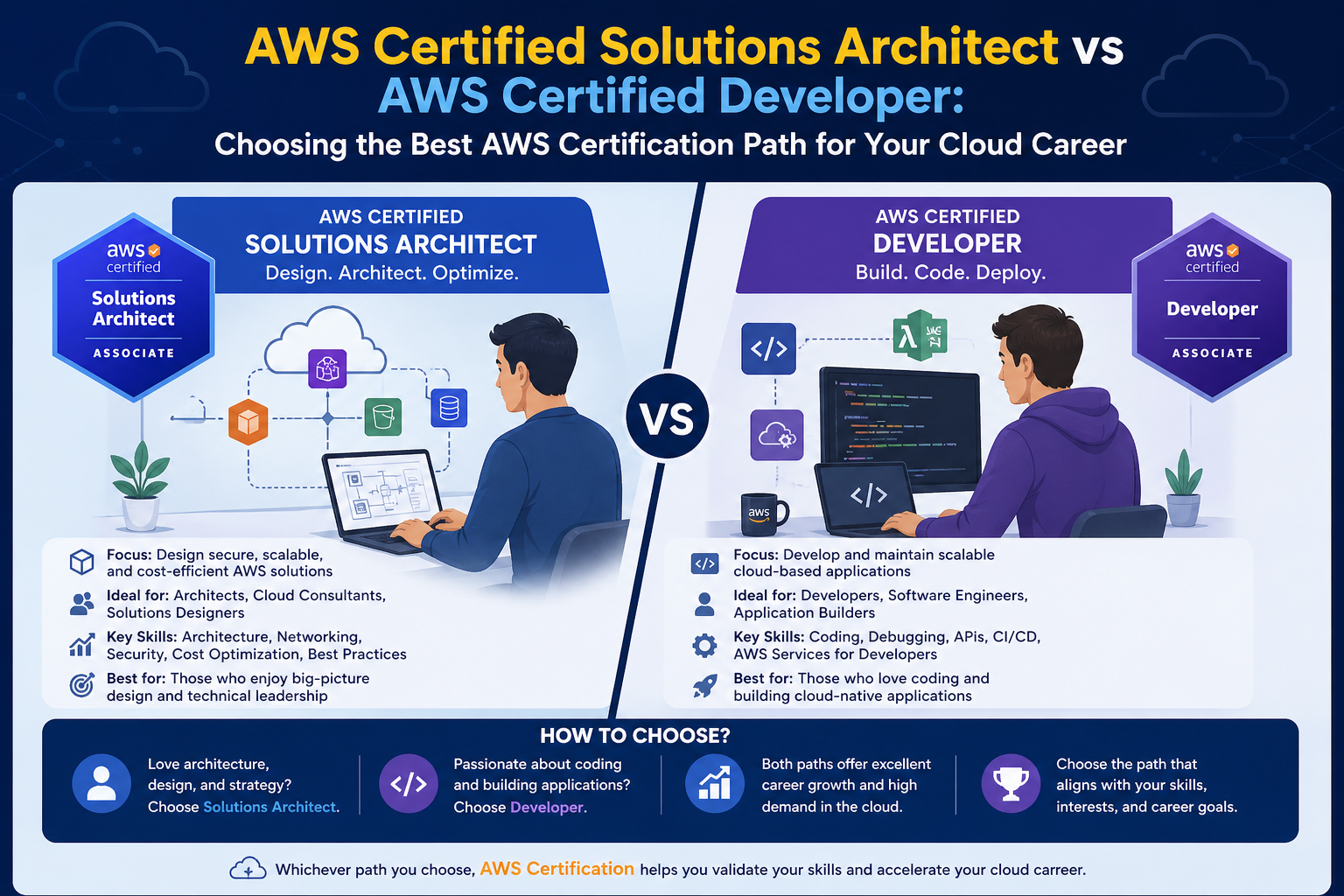
Cloud computing has transformed the technology landscape, reshaping how businesses deploy applications, manage infrastructure, secure data, and scale operations. Among cloud providers, Amazon Web Services (AWS) remains one of the most dominant platforms, powering startups, enterprises, government organizations, and global digital ecosystems. As AWS adoption continues to expand, professionals across IT, networking, software development, cybersecurity, and systems administration are increasingly pursuing AWS certifications to validate their expertise and improve career opportunities.
For many newcomers and experienced professionals alike, one of the first major decisions is choosing between the AWS Certified Solutions Architect – Associate and the AWS Certified Developer – Associate certifications. Both credentials are highly respected, both build valuable technical skills, and both can open doors to lucrative cloud careers. However, despite overlapping foundational AWS concepts, these certifications are designed for different professional pathways.
This distinction creates confusion for many aspiring cloud professionals. The word “architect” may suggest only senior design roles, while “developer” may imply only software engineers should pursue it. In reality, both certifications provide broad cloud competency, and neither certification alone guarantees a specific job title. Instead, each path emphasizes different skill sets that align with different professional strengths and career aspirations.
Understanding the strategic purpose behind each certification is essential. Choosing correctly can accelerate learning, improve exam success, and better align AWS knowledge with long-term professional goals.
Why AWS Certifications Matter Beyond Passing an Exam
AWS certifications are often misunderstood as merely résumé enhancements or exam milestones. While credentials can certainly strengthen job applications, their real value lies in structured skill development.
Preparing for AWS certifications forces candidates to learn:
- Core AWS services
- Cloud architecture principles
- Security frameworks
- Pricing models
- Deployment methods
- Scalability strategies
- Monitoring tools
- Best practices
This structured knowledge can significantly improve practical competence, even before obtaining the certification itself.
For example, someone studying for the Solutions Architect certification learns how to design systems that remain available during outages, optimize cost efficiency, and maintain security across distributed services. Meanwhile, someone preparing for the Developer certification gains hands-on familiarity with deploying code, integrating AWS APIs, automating software delivery, and troubleshooting cloud-native applications.
In many cases, the preparation journey itself creates meaningful professional growth. Employers often value the operational knowledge behind the certification as much as the credential itself.
AWS certifications also help professionals:
- Transition from traditional IT into cloud computing
- Validate self-taught skills
- Improve promotion potential
- Build confidence with AWS tools
- Establish specialization pathways
- Prepare for advanced AWS certifications
For beginners, these certifications can serve as structured roadmaps in a complex ecosystem with hundreds of AWS services.
A Broad Platform Requiring Specialization
AWS is not a single skill. It is a vast platform covering compute, storage, networking, databases, machine learning, security, DevOps, analytics, serverless computing, migration, and governance.
Because AWS is so broad, no single certification can cover every area deeply. Instead, AWS certifications are designed to validate competency within role-specific domains.
This is why choosing between Solutions Architect and Developer matters.
A professional focused on infrastructure strategy may need to understand:
- Virtual Private Cloud (VPC)
- Route 53
- Elastic Load Balancing
- EC2 design
- Disaster recovery
- Cost optimization
- Multi-region architecture
A professional focused on application creation may need stronger skills in:
- AWS SDKs
- Lambda functions
- DynamoDB integration
- API Gateway
- CI/CD pipelines
- CodeBuild
- CodeDeploy
- Elastic Beanstalk
Both roles use AWS, but they interact with AWS differently.
The architect thinks about system-wide design, governance, resilience, and scalability.
The developer focuses on application functionality, service integration, deployment automation, and software optimization.
This distinction does not mean one path is superior. It simply means each serves different professional purposes.
Who Typically Pursues AWS Certified Solutions Architect – Associate?
The Solutions Architect – Associate certification is often considered the broader and more infrastructure-oriented of the two certifications. It is commonly chosen by professionals who want to understand how AWS services fit together to create complete cloud solutions.
This certification often appeals to:
- Systems administrators
- Network engineers
- IT support professionals
- Security specialists
- Infrastructure engineers
- Technical consultants
- Aspiring cloud architects
- DevOps beginners
These individuals often come from traditional IT environments where they already understand:
- Servers
- Virtualization
- Networking
- Identity management
- Firewalls
- Load balancing
- Storage systems
For such professionals, the Solutions Architect certification acts as a bridge from on-premises infrastructure to cloud architecture.
Rather than focusing primarily on writing code, this path emphasizes designing systems that meet business requirements while balancing:
- Performance
- Security
- Availability
- Scalability
- Cost
This makes it especially useful for people who enjoy big-picture thinking.
Core Purpose of the AWS Certified Solutions Architect Exam
At its heart, the Solutions Architect certification evaluates whether a candidate can design effective AWS environments.
This includes understanding how to:
- Build resilient systems
- Design for failure recovery
- Optimize compute resources
- Select proper storage solutions
- Architect secure environments
- Reduce unnecessary spending
- Choose appropriate databases
- Implement networking effectively
This exam tests judgment as much as memorization.
A candidate may face scenarios like:
A company needs a highly available e-commerce platform across multiple regions while minimizing latency and cost.
To answer correctly, the candidate must think through:
- Which compute model works best?
- Which storage option is durable?
- Which database handles scaling?
- How should traffic be routed?
- What security model is appropriate?
- How can redundancy be maintained?
This practical decision-making focus is why many consider the Solutions Architect exam foundational for cloud careers.
Major Knowledge Domains in AWS Solutions Architect Preparation
Resilience refers to a system’s ability to remain operational despite failures.
Candidates learn:
- Multi-AZ deployments
- Auto Scaling
- Elastic Load Balancing
- Backup strategies
- Disaster recovery planning
- S3 durability
- Route 53 failover
- Decoupled architectures using SQS/SNS
This domain teaches a critical cloud principle: failure is expected, so systems must be designed accordingly.
Designing High-Performing Architectures
Performance involves selecting services that maximize speed, throughput, and scalability.
This includes:
- EC2 instance selection
- EBS performance classes
- CloudFront content delivery
- DynamoDB scaling
- Aurora optimization
- Caching strategies
- Network throughput planning
Performance architecture is not simply about choosing the most powerful service—it is about balancing speed with operational efficiency.
Designing Secure Applications and Architectures
Security remains central to AWS.
Candidates study:
- IAM roles
- Policies
- MFA
- Security groups
- Network ACLs
- KMS encryption
- Shared responsibility model
- WAF
- CloudTrail
Security knowledge is especially important because cloud misconfigurations are among the leading causes of breaches.
Designing Cost-Optimized Architectures
AWS flexibility can become expensive without strategic planning.
This domain teaches:
- Reserved Instances
- Spot Instances
- S3 lifecycle policies
- Glacier archival
- Cost Explorer
- Compute rightsizing
- Network cost management
Professionals who understand cost optimization become highly valuable because they can align technical excellence with financial efficiency.
Why the Solutions Architect Path Is Often Recommended First
Many AWS learners choose Solutions Architect first because it provides broader AWS exposure.
Advantages include:
- Wide service coverage
- Strong conceptual foundation
- Useful across many IT roles
- Better understanding of AWS infrastructure
- Preparation for advanced certifications
- Relevance for governance and consulting
Because it emphasizes architecture over programming, it may also feel more accessible to professionals without strong coding backgrounds.
However, broad does not mean easy.
The breadth itself creates complexity because candidates must understand how many AWS services interact.
The Transition from Traditional IT to Cloud Architecture
For IT professionals transitioning from:
- Windows administration
- Linux administration
- Help desk
- Networking
- Data center support
The Solutions Architect certification often feels natural because cloud infrastructure resembles familiar operational concepts, just delivered differently.
For example:
Traditional firewall rules become security groups.
Physical servers become EC2.
Storage arrays become S3/EBS.
DNS systems become Route 53.
This translation of existing knowledge into cloud-native architecture can make AWS less intimidating.
Career Outcomes from Solutions Architect Knowledge
While certification names do not guarantee titles, Solutions Architect preparation commonly supports career paths such as:
- Cloud Administrator
- Cloud Engineer
- Solutions Architect
- Systems Engineer
- Infrastructure Consultant
- Technical Account Manager
- Cloud Operations Specialist
- Security Operations Support
The broader design perspective can also help in management and advisory roles later.
The Importance of Strategic Thinking in AWS Architecture
One of the defining features of architect-focused learning is strategic decision-making.
Architects must consider:
- Current business needs
- Future growth
- Compliance
- Budget
- Performance
- User experience
- Geographic redundancy
This makes the certification especially useful for professionals who enjoy solving business problems through technology design rather than solely writing code.
Common Misconceptions About Solutions Architect Certification
It Is Only for Senior Architects
Many beginners use it as an entry point.
It Requires Deep Coding Skills
Technical understanding matters more than software development.
Passing Guarantees an Architect Job
Experience, projects, and broader competencies remain essential.
It Covers All AWS Skills
It is foundational, not exhaustive.
Building Long-Term AWS Success from the Architect Foundation
For many professionals, Solutions Architect serves as a gateway to:
- Professional-level AWS architecture
- Security specialization
- DevOps
- Networking specialty
- Governance
- Hybrid cloud strategy
Its broad perspective often makes future specialization easier because candidates first understand the ecosystem before narrowing focus.
Final Perspective on Beginning with AWS Solutions Architect
Choosing the AWS Certified Solutions Architect – Associate path can be an excellent first move for those who:
- Prefer infrastructure over programming
- Enjoy systems design
- Have networking or IT backgrounds
- Want broad AWS understanding
- Aspire toward architecture or operations roles
- Need strong cloud fundamentals
It is often less about becoming an architect immediately and more about learning how AWS systems function cohesively.
In a cloud-first world, understanding architecture principles can significantly improve technical adaptability, strategic thinking, and long-term career mobility. Whether your future involves administration, consulting, engineering, or leadership, the knowledge developed through Solutions Architect preparation can serve as a powerful foundation for navigating the evolving AWS ecosystem.
Exploring the AWS Certified Developer – Associate Path
While many cloud learners initially gravitate toward infrastructure and architecture, the AWS Certified Developer – Associate certification offers an equally powerful entry point into cloud computing—especially for professionals who want to build, deploy, automate, and maintain applications within the AWS ecosystem.
Despite its title, this certification is not limited strictly to software developers in the traditional sense. It is highly relevant for a wide range of technical professionals, including:
- Application developers
- DevOps practitioners
- QA automation engineers
- Cloud engineers
- Backend developers
- Site reliability engineers
- Technical testers
- Systems integrators
This certification focuses on how applications interact with AWS rather than how AWS infrastructure is architected from a broad strategic perspective. In simpler terms, the Developer certification emphasizes building and operating solutions inside AWS, while the Solutions Architect certification emphasizes designing those environments at a systems level.
For professionals who enjoy hands-on technical work, coding, automation, deployment pipelines, and service integrations, the Developer path can be highly rewarding.
Understanding the Real Purpose of the AWS Developer Certification
The AWS Certified Developer – Associate exam validates whether a candidate can effectively develop, deploy, debug, and maintain cloud-based applications using AWS tools and services.
This includes the ability to:
- Write code that integrates with AWS services
- Deploy applications using AWS-native tools
- Implement serverless applications
- Use SDKs and APIs
- Secure applications programmatically
- Monitor and troubleshoot applications
- Build CI/CD workflows
- Optimize cloud-native application performance
This certification goes beyond simply knowing AWS service names. It tests whether a candidate understands how developers interact with AWS in real operational environments.
A professional preparing for this exam learns how to transform AWS from a platform they understand conceptually into a platform they actively use for building software solutions.
Why the AWS Developer Certification Matters in Modern Cloud Careers
Modern businesses increasingly rely on software-driven operations:
- Mobile applications
- Web applications
- APIs
- Automation platforms
- Data pipelines
- Serverless tools
- Event-driven systems
As organizations migrate toward microservices, infrastructure-as-code, and cloud-native application development, the ability to create applications directly within AWS becomes increasingly valuable.
The Developer certification helps candidates build competencies in:
- Automation
- Deployment
- Event architecture
- Secure software design
- Cloud application lifecycle management
This can make it especially attractive to professionals who want to move beyond infrastructure and become active builders within cloud ecosystems.
Who Should Consider the AWS Developer Path First?
This path is often ideal for professionals with backgrounds in:
- Python
- JavaScript
- Java
- C#
- Node.js
- API testing
- Scripting
- CI/CD
- QA engineering
- DevOps automation
If you already enjoy writing scripts, building software, testing applications, or automating repetitive tasks, the Developer certification may align more naturally with your strengths.
This path can also be particularly useful for individuals who want to:
- Build serverless solutions
- Work in DevOps
- Deploy software faster
- Improve coding relevance in cloud careers
- Understand AWS APIs deeply
- Create automated workflows
For these professionals, AWS becomes more than infrastructure—it becomes a development platform.
Major Domains Covered in the AWS Developer – Associate Exam
Deployment is a major focus area because modern development requires more than writing code. Applications must be reliably packaged, tested, deployed, and updated.
Candidates study:
- AWS Elastic Beanstalk
- AWS CodePipeline
- AWS CodeBuild
- AWS CodeDeploy
- AWS CloudFormation
- Blue/green deployment strategies
- Version control integration
- Environment management
This domain emphasizes operational efficiency.
Instead of manually uploading code or configuring servers repeatedly, developers learn automation pipelines that reduce risk and accelerate release cycles.
This knowledge is highly valuable in organizations practicing DevOps or Agile methodologies.
Security in Development
Security in the Developer certification is not identical to security in the Architect certification.
While architects focus on system-wide controls, developers focus on implementing security directly into applications.
Key areas include:
- Secure API authentication
- IAM roles for applications
- Temporary credentials
- KMS integration
- Secrets management
- Token security
- API Gateway authorization
- Secure environment variables
This reflects a crucial principle: secure applications are built, not merely protected externally.
As software supply chain attacks and API vulnerabilities increase globally, developers who understand secure cloud coding become significantly more valuable.
Development with AWS Services
This is one of the most important domains.
Candidates must know how to use AWS programmatically.
Examples include:
- Using AWS SDKs
- Writing Lambda functions
- Storing files in S3
- Querying DynamoDB
- Sending notifications through SNS
- Managing queues with SQS
- Handling exceptions
- Optimizing retries
- Event triggers
This transforms AWS knowledge from theoretical to practical.
For example, instead of simply knowing S3 stores files, candidates learn how applications:
- Upload files
- Retrieve files
- Encrypt files
- Trigger workflows after uploads
This level of interaction is central to cloud-native development.
Refactoring for Cloud-Native Environments
Many organizations do not build from scratch—they modernize existing systems.
The Developer certification addresses this through refactoring.
Candidates learn how to:
- Migrate monolithic apps
- Introduce managed services
- Replace local storage
- Move session state
- Shift to event-driven architectures
- Integrate serverless components
This domain reflects a practical reality:
Most cloud professionals are modernizing legacy systems, not starting from zero.
Understanding refactoring prepares candidates for real-world enterprise transformation.
Monitoring and Troubleshooting
Cloud development includes responsibility for reliability.
Candidates study:
- CloudWatch
- CloudTrail
- X-Ray
- Logging
- Metrics
- Alarms
- Distributed tracing
- Error diagnosis
This is essential because cloud applications often fail in distributed, complex ways.
A developer may need to troubleshoot:
- Permission errors
- Latency spikes
- API throttling
- Misconfigured Lambda permissions
- Deployment failures
This domain reinforces operational maturity.
The Rise of Serverless and Why Developer Certification Is Increasingly Relevant
AWS Developer certification has become more strategically important due to the growth of serverless computing.
Serverless technologies such as:
- Lambda
- API Gateway
- DynamoDB
- Step Functions
- EventBridge
Allow organizations to build applications without managing servers directly.
This aligns strongly with modern software trends:
- Faster deployment
- Reduced infrastructure overhead
- Event-driven systems
- Lower operational complexity
Developers who understand these tools can often build scalable systems rapidly.
As serverless adoption grows, the Developer certification increasingly serves as a gateway into next-generation application design.
Developer Certification vs Traditional Programming
A critical misconception is that AWS Developer certification tests advanced software engineering theory.
It does not primarily focus on:
- Data structures
- Algorithms
- Complex software architecture patterns
Instead, it emphasizes:
- Cloud service integration
- Deployment
- Security implementation
- Monitoring
- Service usage
This means even intermediate coders or automation specialists can pursue it successfully.
Career Opportunities Enabled by Developer-Oriented AWS Skills
Developer-focused AWS knowledge may support roles such as:
- Cloud Developer
- DevOps Engineer
- Automation Engineer
- Serverless Engineer
- Backend Developer
- Cloud QA Engineer
- Platform Engineer
- Integration Specialist
These roles often involve building, deploying, and maintaining software rather than only designing infrastructure.
Advantages of Starting with AWS Developer Certification
Hands-On Practicality
This path can feel more tangible for builders because candidates actively think through implementation.
Automation Strength
It supports modern DevOps and CI/CD careers.
Serverless Readiness
It aligns with growing event-driven application ecosystems.
Programming Synergy
Developers can combine coding skills with cloud specialization.
Operational Relevance
Many organizations need builders more immediately than architects.
Challenges of the AWS Developer Certification
Despite its strengths, the Developer path has its own difficulties.
Service Complexity
Candidates must know practical integration details.
Programming Context
Even moderate scripting familiarity can help significantly.
Tool Diversity
CI/CD and deployment ecosystems can be overwhelming.
Security Depth
Application-layer security requires discipline.
Troubleshooting
Debugging cloud-native systems can be more complex than local development.
Common Misconceptions About AWS Developer Certification
Only Software Engineers Should Take It
False. DevOps, QA, and automation professionals can benefit greatly.
It Is Easier Than Solutions Architect
Not necessarily. Its implementation focus can be equally challenging.
It Is Only About Coding
False. Deployment, monitoring, and cloud integration are equally central.
It Leads Only to Developer Roles
False. It can support DevOps, automation, cloud engineering, and platform operations.
How Developer Knowledge Builds Long-Term AWS Growth
The Developer certification can lead naturally into:
- DevOps Engineer Professional
- AWS Security Specialty
- Advanced CI/CD
- Kubernetes
- Infrastructure as Code
- Platform Engineering
- Site Reliability Engineering
It can also complement architecture knowledge later.
Many successful AWS professionals eventually combine:
- Developer implementation skills
- Architect design skills
This hybrid combination can create highly competitive career profiles.
The Strategic Value of Building Before Designing
Some professionals benefit from learning AWS through implementation first.
Why?
Because actively building:
- Lambda functions
- Deployment pipelines
- APIs
- Monitoring systems
Can deepen understanding of how services actually behave.
This practical familiarity may later strengthen architecture decisions.
For some learners, building first and architecting later is more intuitive than architecting first.
Choosing AWS Developer Based on Work Style
This path often suits people who enjoy:
- Building
- Experimenting
- Scripting
- Deploying
- Debugging
- Integrating services
- Automation
It may be less ideal for professionals primarily interested in governance, compliance, or infrastructure strategy.
The Role of AWS Developer Certification in the DevOps Era
Modern organizations increasingly prioritize speed.
This includes:
- Faster releases
- Continuous deployment
- Infrastructure automation
- API ecosystems
- Observability
- Agile engineering
AWS Developer certification aligns strongly with these priorities.
In many environments, cloud developers are central to digital transformation.
Final Perspective on Beginning with AWS Developer – Associate
Choosing the AWS Certified Developer – Associate path can be a smart decision for those who:
- Enjoy coding or scripting
- Want to automate deployments
- Prefer hands-on technical work
- Are interested in serverless
- Aspire to DevOps or cloud engineering
- Want practical AWS integration skills
Rather than focusing primarily on designing cloud systems from a strategic distance, this certification immerses candidates in the operational side of building cloud-powered applications.
In a world increasingly shaped by software automation, API ecosystems, and cloud-native engineering, Developer certification can serve as a highly practical foundation for professionals who want to create, deploy, and optimize within AWS directly. For builders, automators, and technical implementers, it represents more than a certification—it can be the beginning of mastering cloud execution.
Making the Right Choice for Your Career, Skills, and Long-Term Cloud Success
Choosing between AWS Certified Solutions Architect – Associate and AWS Certified Developer – Associate is not simply about selecting an exam. It is a strategic career decision that can influence how you learn AWS, which skills you prioritize, how quickly you adapt to cloud environments, and which professional opportunities may become more accessible over time.
Both certifications are respected, both validate meaningful AWS knowledge, and both can create powerful career momentum. However, they are designed with different professional mindsets in mind. One focuses more on architectural design, infrastructure strategy, resilience, and business alignment. The other emphasizes software implementation, deployment, automation, integration, and operational execution.
For many aspiring cloud professionals, the biggest challenge is not understanding AWS itself—it is understanding themselves well enough to choose the certification path that best matches their background, strengths, and future ambitions.
The Core Philosophical Difference Between Architect and Developer Paths
At a high level, the distinction can be summarized simply:
Solutions Architect asks:
How should cloud systems be designed?
Developer asks:
How should cloud applications be built and operated?
This difference shapes not only exam content but also mindset.
Architect-focused professionals think in terms of:
- System design
- High availability
- Disaster recovery
- Cost optimization
- Service selection
- Governance
- Scalability
- Compliance
Developer-focused professionals think in terms of:
- Code integration
- Deployment automation
- SDK usage
- Serverless logic
- CI/CD
- Monitoring
- Debugging
- Feature delivery
Neither mindset is superior. In fact, modern cloud organizations need both.
An architect without implementation awareness may design impractical systems.
A developer without architecture awareness may build inefficient systems.
This is why many advanced cloud professionals eventually combine both skill sets.
Evaluating Your Current Background Before Choosing
Your existing experience often provides the clearest starting signal.
If You Come from Traditional IT or Infrastructure
You may naturally align with Solutions Architect if your experience includes:
- Systems administration
- Networking
- Help desk
- Security operations
- Virtualization
- Storage
- Linux/Windows administration
- Governance
These backgrounds often translate well because cloud architecture builds on familiar infrastructure concepts.
For example:
- Network segmentation becomes VPC design
- DNS management becomes Route 53
- Server provisioning becomes EC2 deployment
- Disaster recovery becomes multi-region planning
For these professionals, Solutions Architect often feels like a natural progression from physical infrastructure into cloud ecosystems.
If You Come from Development or Automation
You may align more naturally with Developer if your background includes:
- Scripting
- Programming
- APIs
- Software testing
- QA automation
- CI/CD
- Backend systems
- Integration work
These professionals often find AWS Developer more intuitive because it expands existing software-centric workflows into cloud-native environments.
Career Goal Alignment: Choosing Based on Where You Want to Go
Perhaps the most important factor is not what you do today—but what you want to do next.
When Solutions Architect May Be Better
This path often supports goals such as:
- Cloud Architect
- Cloud Consultant
- Infrastructure Engineer
- Technical Strategist
- Governance Specialist
- Security Architect
- Enterprise Architect
- Cloud Operations Manager
This route is especially valuable if you enjoy:
- Big-picture thinking
- Technical planning
- Infrastructure strategy
- Cross-service optimization
- Organizational governance
- Advisory roles
When Developer May Be Better
This path may better support goals such as:
- Cloud Developer
- DevOps Engineer
- Platform Engineer
- Automation Engineer
- Serverless Engineer
- Backend Cloud Engineer
- Integration Specialist
- Site Reliability Engineer
This route is often stronger if you enjoy:
- Building systems
- Writing scripts
- Automating pipelines
- Deploying code
- API design
- Performance troubleshooting
Which One Is Harder?
This question is common, but the answer depends heavily on personal strengths.
Why Solutions Architect Can Feel Harder
- Broader AWS service exposure
- Scenario-heavy questions
- Strategic design trade-offs
- Multi-service decision-making
- Cost/security/performance balancing
This exam often tests judgment under realistic business conditions.
Why Developer Can Feel Harder
- Practical implementation details
- CI/CD tools
- Service integration
- Deployment complexity
- Monitoring workflows
- Security within code contexts
For someone with no scripting experience, Developer may feel more technically demanding.
The Reality
Difficulty is contextual:
- Infrastructure-minded learners may prefer Architect
- Builders may prefer Developer
Neither exam should be underestimated.
Generalist vs Specialist: A Critical Strategic Consideration
A major long-term difference lies in breadth versus implementation specialization.
Solutions Architect Often Builds Generalists
Because it covers broad AWS design, many learners gain:
- Wide service familiarity
- Business design understanding
- Governance exposure
- Strategic flexibility
This can create strong adaptability.
Developer Often Builds Specialists
Because it focuses on building and deploying, learners often gain:
- Practical automation strength
- Development precision
- Operational depth
- Application-centric expertise
This can create stronger execution capability.
Your personality matters here:
Do you want to understand many systems broadly, or build deeply within systems?
Salary and Marketability Considerations
While salary varies widely by geography, experience, and industry, both certifications can improve employability.
Solutions Architect Value
Often attractive for:
- Consulting
- Enterprise transformation
- Technical sales engineering
- Governance
- Infrastructure planning
Developer Value
Often attractive for:
- Software delivery
- Startups
- DevOps
- SaaS operations
- Automation-heavy organizations
In many markets:
Architect roles may command strategic premium.
Developer roles may offer faster hands-on entry.
But certification alone rarely determines salary. Real-world projects, portfolio depth, communication ability, and complementary skills matter significantly.
Which Certification Builds Better AWS Foundations?
This is highly debated.
Argument for Solutions Architect First
- Broader AWS overview
- Better understanding of service relationships
- Stronger conceptual framework
- Easier transition into specialties later
Argument for Developer First
- Immediate practical usage
- Hands-on deployment
- Better service interaction depth
- Strong DevOps readiness
Balanced Perspective
If you lack coding confidence, Architect may be easier initially.
If you already code, Developer may feel more actionable.
Can You Eventually Pursue Both? Absolutely.
Many successful cloud professionals do not stop at one.
A common progression:
- Solutions Architect Associate
- Developer Associate
- DevOps Engineer Professional
or - Developer Associate
- Solutions Architect Associate
- Advanced specialization
Combining both certifications can create powerful hybrid capabilities:
- Design + Build
- Strategy + Execution
- Architecture + Automation
This combination is especially useful in smaller organizations where professionals wear multiple hats.
The Risk of Choosing Based Only on Popularity
Many candidates choose Solutions Architect simply because it is often marketed as the “default” AWS starting point.
This can be a mistake.
Popularity does not equal fit.
If your strengths are in:
- Python
- Automation
- APIs
- QA
- Development
Forcing yourself into an architecture-first path may slow momentum.
Likewise, a systems administrator with little coding interest may struggle unnecessarily if they begin with Developer solely because “developers earn more.”
Strategic self-awareness matters more than trends.
How Learning Style Should Influence Your Decision
Choose Solutions Architect If You Prefer:
- Conceptual understanding
- Design scenarios
- Service comparisons
- Infrastructure planning
- Business strategy
Choose Developer If You Prefer:
- Practical workflows
- Technical implementation
- Toolchains
- Debugging
- Deployment
Learning style influences retention.
People learn faster when the content aligns with how they naturally think.
Long-Term Industry Trends Affecting Both Paths
Architect Path Trends
- Multi-cloud
- Governance
- Security frameworks
- FinOps
- Zero Trust
- Hybrid cloud
Developer Path Trends
- Serverless
- DevSecOps
- CI/CD maturity
- AI integrations
- Event-driven systems
- Platform engineering
Both paths remain relevant, but their applications may evolve differently.
Building Beyond Certification
Regardless of which certification you choose, long-term success requires more than exam passing.
Important complementary growth includes:
- Hands-on labs
- Personal projects
- GitHub portfolios
- Cost awareness
- Security best practices
- Documentation reading
- Troubleshooting
- Communication skills
Certification should be viewed as a launchpad, not a finish line.
Avoiding Common Career Mistakes
Chasing Titles Instead of Skills
“Architect” sounds prestigious, but practical competence matters more.
Ignoring Hands-On Practice
Theory without labs often fades quickly.
Choosing Based on Fear
Avoiding Developers because coding seems intimidating—or avoiding Architect because strategy seems complex—can limit growth.
Expecting Instant Career Transformation
Certifications improve opportunities, but real career growth requires continued application.
A Practical Decision Framework
Ask yourself:
Choose Solutions Architect If:
- You enjoy infrastructure
- You have networking/sysadmin experience
- You prefer strategy
- You want broad AWS knowledge
- You aspire toward architecture/governance
Choose Developer If:
- You enjoy scripting/coding
- You want to build applications
- You like automation
- You are interested in DevOps
- You prefer implementation
The Most Important Truth: There Is No Universally Correct First Choice
The best certification is not automatically the one with the biggest marketing presence, the highest enrollment numbers, or the broadest industry recognition. Popularity can indicate value, but it should never be the sole deciding factor. The right certification is the one that aligns with your existing abilities, complements your learning style, supports your professional ambitions, and provides skills you can realistically apply in real-world scenarios.
It is the one that:
- Matches your strengths
- Supports your goals
- Sustains motivation
- Builds useful skills
- Encourages progression
- Expands practical confidence
- Aligns with your preferred work style
- Creates relevant career momentum
- Bridges current knowledge gaps
- Provides long-term adaptability
A certification should act as a strategic tool, not just a badge. When your chosen path reflects your natural interests and capabilities, learning becomes more sustainable. For example, a systems administrator may find greater momentum in architecture and infrastructure-focused certifications because they build upon existing operational experience. A software developer or automation engineer may progress faster with certifications that emphasize coding, deployment, and integration because these areas feel more immediately relevant.
This alignment matters because certification preparation requires time, consistency, and effort. If your chosen certification feels disconnected from your interests or daily responsibilities, motivation often declines. On the other hand, when certification content directly supports your professional curiosity, studying becomes more engaging, retention improves, and the knowledge is more likely to translate into practical capability.
Your first AWS certification should also be viewed as an investment in foundational thinking. It introduces you to how AWS approaches infrastructure, scalability, security, automation, and cloud service design. This first step shapes how you interpret the broader ecosystem, which includes:
- Compute services
- Networking
- Databases
- Identity and access management
- Monitoring
- Serverless
- Security
- DevOps
- Governance
- Cost optimization
AWS is not a single skill—it is a constantly evolving ecosystem of interconnected technologies. No first certification can teach everything, which is why your initial choice should focus on building a lens that helps you understand AWS in a way that feels both useful and sustainable.
Think of your first certification as choosing an entry door into a massive technology environment. Different doors lead to different first experiences:
- Architecture teaches design logic
- Development teaches implementation
- Security teaches protection
- Operations teaches management
None of these paths permanently limits you, but your starting point influences how confidently you move forward.
A well-chosen certification can also create progression by preparing you for future specialization. Once foundational knowledge is established, professionals often expand into:
- Advanced architecture
- DevOps engineering
- Security specialization
- Data engineering
- Machine learning
- Networking
- Governance
This is why progression matters. A certification should not only help you today—it should position you for tomorrow.
It is also important to remember that certifications should support employability through competence, not memorization alone. Employers increasingly value professionals who can:
- Solve problems
- Design responsibly
- Automate effectively
- Manage cost
- Improve security
- Adapt to changing tools
A certification that builds these competencies can provide lasting value beyond exam day.
Another critical factor is confidence. The right certification often increases confidence because it transforms uncertainty into structured knowledge. AWS can feel overwhelming due to its scale, but a certification roadmap can reduce that complexity by organizing learning into manageable categories. This confidence can encourage:
- More hands-on labs
- Better interview performance
- Stronger project execution
- Greater willingness to pursue advanced skills
Ultimately, certification decisions should reflect strategic self-awareness rather than external pressure. Career growth is rarely linear, and cloud success is not determined by following the same path as everyone else. The strongest professionals often build careers by combining personal strengths with deliberate skill development.
AWS is a vast ecosystem, and your first certification is simply your first structured lens into it. It is not your final identity, your final role, or your final opportunity—it is your starting framework. Choose the certification that helps you learn effectively, grow confidently, and move closer to the type of cloud professional you ultimately want to become. In a field defined by constant innovation, the best starting point is the one that keeps you learning, building, and evolving.
Conclusion
The decision between AWS Certified Solutions Architect – Associate and AWS Certified Developer – Associate should be based on strategic alignment rather than assumption.
If you are drawn to designing systems, understanding infrastructure, optimizing costs, and building resilient cloud environments, Solutions Architect can provide a broad and powerful foundation.
If you are energized by building applications, deploying code, automating workflows, integrating services, and creating cloud-native solutions, Developer may offer a more practical and execution-focused path.
Both certifications are valuable.
Both can accelerate cloud careers.
Both can lead to advanced specialization.
And both can eventually complement each other.
Ultimately, AWS success is less about choosing the “better” certification and more about choosing the path that best fits your current abilities while positioning you for future growth.
Cloud careers reward adaptability, continuous learning, and practical competence. Whether you begin as an architect-minded strategist or a developer-focused builder, your first AWS certification should serve as the foundation for a broader journey—not the final destination.