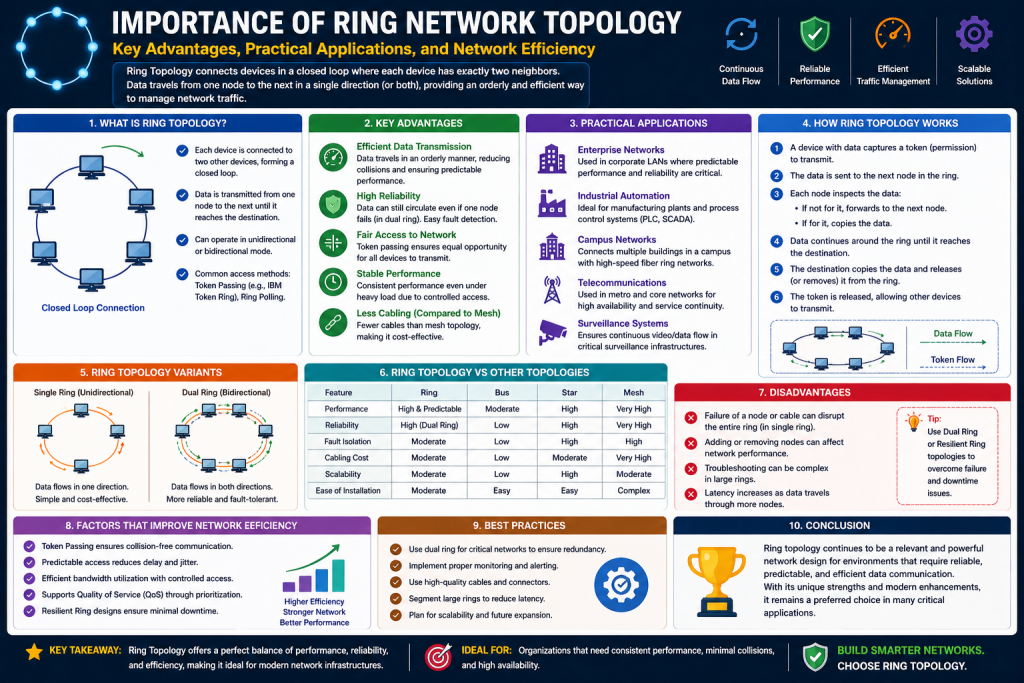
A ring network topology is a method of connecting devices in which each node is linked to exactly two others, forming a continuous circular pathway. This structure creates a closed loop where data travels in a predefined direction, passing through each device along the way. Unlike other network designs that allow multiple paths or central control points, a ring topology depends on this single continuous loop for communication between all connected devices.
The concept is relatively straightforward to visualize. Imagine a circle where each point represents a computer or network device, and each is connected to its immediate neighbors. Data enters the ring, moves from one device to the next, and continues along this path until it reaches its intended destination. This simple but structured approach was especially useful during the early days of networking when managing data flow efficiently was a major challenge.
In a basic implementation, data travels in only one direction, either clockwise or counterclockwise. Each device that receives the data examines it to determine whether it is the intended recipient. If it is not, the device forwards the data to the next node in the sequence. This process continues until the data arrives at the correct destination or completes a full loop around the network.
Ring topology gained attention because it introduced a controlled and predictable method of communication. At a time when other network designs struggled with issues like data collisions and inefficient bandwidth usage, the ring structure provided a more disciplined approach. It ensured that data moved in an orderly fashion and that each device had a defined role in maintaining the flow of information.
How Data Flows in a Ring Structure
The flow of data in a ring topology is one of its most distinctive features. Instead of allowing devices to send data freely at any time, the network enforces a strict sequence. Data moves from one node to the next in a continuous loop, creating a chain of communication that involves every device in the network.
When a device wants to send data, it must wait for the appropriate moment to do so. Once it has the opportunity, it places its data onto the network, and the data begins its journey around the ring. Each intermediate device acts as both a receiver and a transmitter, ensuring that the data continues moving along the path.
This method of transmission creates a predictable pattern. Since data always follows the same route, network behavior becomes easier to understand and manage. Administrators can anticipate how long it will take for data to travel from one point to another, which was particularly valuable in environments where timing and reliability were critical.
Another important aspect of this flow is that every device participates in the communication process. There is no central hub or controller directing traffic. Instead, each node contributes to maintaining the integrity of the network by forwarding data to the next device. This shared responsibility helps distribute the workload evenly across the network.
However, this design also means that the network is highly dependent on each individual connection. If one link fails, the entire chain can be disrupted. This reliance on continuous connectivity highlights both the strength and the vulnerability of ring topology.
The Role of Tokens in Communication
One of the defining characteristics of ring topology is the use of tokens to control data transmission. A token is a special type of data packet that circulates continuously around the network. It acts as a permission slip, allowing only the device that currently holds it to send data.
When a device receives the token, it checks whether it has any data to transmit. If it does, it temporarily captures the token and attaches its data to it. The data is then sent along the ring, passing through each node until it reaches its destination. Once the transmission is complete, the token is released back into the network so that other devices can use it.
This system ensures that only one device can transmit data at a time. By limiting access in this way, the network avoids the problem of multiple devices attempting to send data simultaneously. This was a significant improvement over earlier network designs, where such conflicts often led to data collisions and communication delays.
The token-based approach also promotes fairness. Since the token moves sequentially from one device to the next, every node gets an equal opportunity to transmit data. No single device can dominate the network or consume excessive bandwidth. This balanced access was particularly important in environments where multiple users needed reliable and consistent connectivity.
The concept can be compared to a structured discussion where only one person speaks at a time. Each participant waits for their turn, ensuring that communication remains orderly and efficient. This analogy helps illustrate how the token system maintains control over data flow in the network.
Early Implementations and Historical Context
Ring topology emerged during a time when networking technology was still in its early stages. Engineers were exploring different ways to connect devices and manage data transmission effectively. Among the various designs, ring topology stood out for its ability to address some of the key challenges faced by early networks.
One of the most notable implementations was IBM’s Token Ring network. This system used the token-based approach to regulate communication and became widely recognized as a reliable networking solution. It operated over copper cables and provided a structured method for connecting multiple devices in a ring configuration.
At that time, alternative topologies such as bus and star were also being developed. Each had its own advantages and limitations. Bus topology, for example, allowed all devices to share a single communication line, but it was prone to data collisions. Star topology relied on a central hub, which could become a single point of failure.
Ring topology offered a different approach by eliminating collisions and distributing responsibility across all nodes. This made it an attractive option for organizations seeking a more stable and predictable network environment. Although it was not as widely adopted as some other designs, it played a crucial role in shaping the evolution of networking technologies.
As technology advanced, newer solutions like Ethernet began to dominate the market. These systems offered greater flexibility, scalability, and cost efficiency. As a result, ring topology gradually became less common in modern networks. However, its influence can still be seen in the principles that guide contemporary network design.
Structural Characteristics of Ring Topology
The structure of a ring network is both simple and unique. Each device is connected to two others, creating a continuous loop with no beginning or end. This symmetry ensures that all nodes are equal in terms of their position within the network.
Because there is no central device controlling communication, the network operates in a decentralized manner. Each node is responsible for receiving data, processing it, and forwarding it to the next device. This distributed approach helps balance the workload and reduces the risk of congestion at any single point.
Another characteristic is the unidirectional flow of data in basic ring topologies. While this simplifies the design, it also means that data must travel through multiple nodes to reach its destination. In some cases, this can result in longer transmission times compared to other topologies that offer more direct paths.
To improve performance and reliability, variations of ring topology were developed. For example, dual ring configurations introduced a second loop that allowed data to travel in the opposite direction. This provided redundancy and helped maintain communication even if one part of the network failed.
Despite these enhancements, the fundamental structure of ring topology remained consistent. Its reliance on a continuous loop and sequential data flow defined its operation and distinguished it from other network designs.
Why Ring Topology Was Important
Ring topology played a significant role in the development of networking because it addressed several critical issues that earlier designs struggled with. One of the most important contributions was its ability to eliminate data collisions. By ensuring that only one device could transmit at a time, it created a more efficient and reliable communication environment.
Another key benefit was its fairness in resource allocation. The token system ensured that all devices had equal access to the network, preventing any single node from dominating bandwidth usage. This balanced approach made it suitable for environments where multiple users needed consistent performance.
The predictability of ring topology also made it valuable. Since data followed a fixed path and access was controlled, network behavior could be anticipated with greater accuracy. This was particularly useful in applications where timing and reliability were essential.
In addition, ring topology demonstrated the importance of structured communication in network design. It showed that controlling data flow could lead to significant improvements in performance and efficiency. These lessons influenced the development of later technologies and continue to be relevant today.
Foundation for Modern Networking Concepts
Although ring topology is often considered outdated, its underlying principles remain influential. The idea of controlled access to network resources, for example, is still used in various forms in modern systems. While the specific implementation may differ, the goal of preventing conflicts and ensuring fair usage continues to guide network design.
The concept of deterministic communication, where devices can predict when they will be able to transmit data, is another lasting contribution. This idea is particularly important in specialized networks that require precise timing, such as industrial control systems.
Ring topology also highlighted the importance of reliability and fault tolerance. Its vulnerabilities prompted the development of more resilient designs that could withstand failures without disrupting the entire network. These advancements have led to the robust and flexible systems used today.
By studying ring topology, one can gain a deeper understanding of how networking technologies have evolved. It serves as a reminder that even older designs can provide valuable insights and lessons for modern applications.
Equal Access to Network Resources
One of the most defining advantages of ring network topology is its ability to provide equal access to all devices connected within the network. In many other network designs, certain devices may gain more opportunities to transmit data due to their position, priority, or timing. This can create an imbalance where some nodes dominate the network while others struggle to communicate effectively. Ring topology addresses this issue through its structured design and controlled communication process.
Each device in a ring network is treated equally because the system operates on a sequential mechanism. Every node must wait its turn before transmitting data, ensuring that no single device can monopolize the network. This approach creates a fair and balanced environment where all participants have the same opportunity to send and receive information.
This fairness is especially important in environments where multiple users or systems rely on consistent performance. For example, in early office networks, employees needed reliable access to shared resources such as printers, file servers, and communication systems. Ring topology ensured that each user had an equal chance to utilize these resources without interference from others.
The equal access model also helps maintain stability in the network. Since devices cannot transmit data randomly or excessively, the overall flow of information remains controlled and predictable. This reduces the likelihood of congestion and ensures that the network operates smoothly under normal conditions.
Token-Based Communication Efficiency
The token system is central to the efficiency of ring topology. A token is a special data packet that circulates continuously around the network, granting permission to transmit data. Only the device that holds the token can send information, which introduces a high level of control over communication.
This method eliminates the uncertainty associated with networks where devices compete for access. Instead of attempting to send data simultaneously, each node waits for the token to arrive. Once it receives the token, it can transmit its data and then pass the token along to the next device.
This controlled process significantly improves efficiency. Since only one device transmits at a time, the network avoids unnecessary interruptions and conflicts. Data flows in an orderly manner, reducing delays and ensuring that transmissions are completed successfully.
Another benefit of token-based communication is its predictability. Devices can estimate how long it will take before they receive the token again, allowing for better planning and scheduling of data transmissions. This predictability was particularly valuable in early networking environments where timing and coordination were critical.
The token system also simplifies network management. Administrators do not need to implement complex mechanisms to resolve conflicts or prioritize traffic. The built-in structure of the ring topology handles these tasks automatically, making the network easier to maintain and operate.
Elimination of Data Collisions
One of the major challenges in early networking was the occurrence of data collisions. In networks where multiple devices could transmit simultaneously, data packets often interfered with each other. This resulted in corrupted information and required devices to resend their data, wasting time and bandwidth.
Ring topology effectively eliminates this problem through its controlled communication process. Since only one device can transmit at a time, there is no possibility of overlapping transmissions. This ensures that data moves through the network without interference, improving both reliability and efficiency.
The absence of collisions has a direct impact on network performance. Without the need to retransmit data, the network can utilize its bandwidth more effectively. This leads to faster communication and a more stable system overall.
In addition, eliminating collisions reduces the complexity of network protocols. In other topologies, additional mechanisms are required to detect and resolve conflicts. These mechanisms can introduce delays and increase the workload on network devices. Ring topology avoids these complications by preventing collisions from occurring in the first place.
This advantage made ring topology particularly appealing during its early adoption. At a time when hardware and processing power were limited, reducing unnecessary overhead was crucial for maintaining efficient network operations.
Predictable and Consistent Performance
Another important benefit of ring topology is its ability to deliver predictable and consistent performance. Because data follows a fixed path and access to the network is controlled, the behavior of the system becomes highly stable.
In many network designs, performance can vary depending on traffic levels and the number of active devices. Sudden spikes in activity can lead to congestion, delays, and reduced efficiency. Ring topology minimizes these fluctuations by regulating how and when devices can transmit data.
This predictability allows network administrators to plan and manage resources more effectively. They can estimate how long it will take for data to travel between nodes and ensure that critical tasks are completed within expected timeframes. This level of control is particularly valuable in applications where timing is essential.
For example, in industrial or manufacturing environments, systems often rely on precise communication to coordinate processes. A predictable network ensures that commands and data are delivered consistently, reducing the risk of errors or disruptions.
The consistent performance of ring topology also enhances user experience. Users can rely on stable connection speeds and minimal interruptions, which was especially important in early networking scenarios where reliability was a key concern.
Reduced Signal Reflection and Data Loss
Signal reflection is a phenomenon that can occur in certain network topologies, particularly those that use a shared communication medium. When signals bounce back along the transmission path, they can interfere with other data, leading to errors and potential data loss.
Ring topology minimizes this issue by using a unidirectional flow of data. Since information travels in a single direction around the loop, there is less opportunity for signals to reflect and cause interference. This results in cleaner and more reliable data transmission.
The structured path of the ring also helps maintain signal integrity. Each device receives the data, processes it, and forwards it to the next node. This step-by-step approach ensures that the signal remains strong and clear as it moves through the network.
Reducing signal reflection and data loss contributes to overall network efficiency. With fewer errors to correct, the system can focus on transmitting useful information rather than dealing with corrupted data. This improves both speed and reliability.
Efficient Use of Bandwidth
Bandwidth is a critical resource in any network, and ring topology makes efficient use of it. By controlling access through the token system, the network ensures that only one device transmits data at a time. This prevents unnecessary competition for bandwidth and allows for a more organized flow of information.
In networks where multiple devices can transmit simultaneously, bandwidth can be wasted due to collisions and retransmissions. Ring topology avoids this problem, ensuring that available capacity is used effectively.
The sequential nature of data transmission also helps maintain a steady flow of information. Instead of experiencing bursts of activity followed by periods of inactivity, the network operates at a consistent pace. This balanced usage of bandwidth contributes to overall efficiency and stability.
Additionally, the absence of collisions means that bandwidth is not consumed by error correction processes. All available resources can be dedicated to transmitting actual data, maximizing the network’s performance.
Deterministic Communication Model
Ring topology is often associated with deterministic communication, which means that the timing of data transmission can be predicted with a high degree of accuracy. This is a direct result of the token-based system and the structured flow of data.
In a deterministic network, each device knows that it will eventually receive the opportunity to transmit data. The time it takes for the token to circulate the network can be calculated based on the number of nodes and the speed of transmission. This allows for precise planning and coordination.
Deterministic communication is particularly important in specialized applications. For example, systems that require real-time data exchange, such as industrial automation or control systems, benefit from predictable timing. Ring topology provides a foundation for such applications by ensuring consistent and reliable communication.
This level of predictability also simplifies network design. Engineers can create systems that rely on specific timing intervals, knowing that the network will behave as expected. This reduces the need for complex error-handling mechanisms and improves overall efficiency.
Balanced Network Load Distribution
Another advantage of ring topology is its ability to distribute the network load evenly across all devices. Since each node participates in forwarding data, the responsibility for maintaining communication is shared among all devices.
This balanced distribution prevents any single node from becoming a bottleneck. In other topologies, central devices such as hubs or switches may experience heavy traffic, leading to congestion and reduced performance. Ring topology avoids this issue by decentralizing the communication process.
Each device contributes to the operation of the network, ensuring that the workload is spread evenly. This not only improves performance but also enhances reliability, as the network does not depend on a single point of control.
The shared responsibility model also encourages efficient use of resources. Devices are utilized more effectively, and the network can handle traffic more smoothly without overloading specific components.
Suitability for Small to Medium Networks
Ring topology is particularly well-suited for small to medium-sized networks. In such environments, the number of nodes is limited, which allows the token to circulate quickly and efficiently. This results in fast and reliable communication.
In smaller networks, the advantages of ring topology become more apparent. The controlled access, absence of collisions, and predictable performance create a stable and efficient system. These benefits can outweigh the limitations, making ring topology a practical choice in certain scenarios.
However, as the network grows larger, some of these advantages may diminish. The time required for the token to reach each device increases, which can lead to delays. Despite this, ring topology remains effective in environments where the number of nodes is manageable.
Contribution to Networking Evolution
Ring topology played a significant role in the evolution of networking technologies. Its innovative approach to managing data flow and preventing collisions influenced the development of later systems. Many of the principles introduced by ring topology continue to be relevant in modern network design.
For example, the concept of controlled access to network resources has been adapted in various forms. While modern networks may use different methods, the goal of ensuring fair and efficient communication remains the same.
The emphasis on reliability and predictability also shaped the development of advanced networking solutions. Engineers learned from the strengths of ring topology and applied these lessons to create more flexible and scalable systems.
By studying ring topology, one can gain valuable insights into the history and progression of networking. It serves as a reminder of how early innovations laid the groundwork for the sophisticated technologies used today.
Vulnerability to Network Failures
One of the most critical weaknesses of ring network topology is its sensitivity to failures. Because the network is designed as a continuous loop, every connection plays a vital role in maintaining communication. If any single link in the chain is broken, the entire network can be disrupted. This is a major concern because even a minor issue, such as a loose cable or a malfunctioning network interface card, can bring communication to a complete halt.
In a ring structure, data must pass through each node in sequence. If one node fails to receive or forward data, the chain is broken. Unlike some other topologies that allow data to take alternate routes, a basic ring topology does not provide flexibility in this regard. This lack of redundancy makes it inherently fragile.
This vulnerability becomes even more problematic in environments where uptime is critical. Organizations that rely on continuous communication cannot afford frequent disruptions. As a result, the risk associated with a single point of failure has been one of the main reasons why ring topology is rarely used in modern networks.
To address this issue, engineers introduced improvements such as dual ring configurations. These systems use two separate loops, allowing data to travel in opposite directions. If one path fails, the other can maintain communication. While this enhances reliability, it also increases complexity and cost, which can limit its practicality.
Difficulty in Troubleshooting and Maintenance
Another significant challenge associated with ring topology is the difficulty of troubleshooting problems. When a failure occurs, identifying the exact location of the issue can be time-consuming and complex. Since every node is part of the communication path, a problem in any device or connection can affect the entire network.
For example, a faulty network interface card in one computer can prevent data from passing through that node. This disruption may appear as a general network failure, making it difficult to pinpoint the source. Technicians often need to inspect each connection and device individually to locate the problem.
This process can lead to extended downtime, especially in larger networks. The time required to diagnose and fix issues can impact productivity and increase operational costs. In contrast, other topologies with centralized control points often make it easier to isolate and resolve problems.
Maintenance can also be challenging in a ring topology. Since the network must remain intact for proper operation, even routine tasks such as upgrading hardware or replacing cables may require temporarily breaking the ring. This interruption can disrupt communication and require careful coordination to minimize impact.
High Implementation and Infrastructure Costs
The cost of implementing a ring network can be higher compared to other topologies. One reason for this is the amount of cabling required. Each node must be connected to its immediate neighbors, which can result in extensive wiring, especially in environments where devices are spread across different rooms or locations.
Installing these connections may involve additional work such as drilling through walls or running cables over long distances. This increases both the time and expense of setting up the network. Proper planning is essential to ensure that all devices can be connected efficiently without excessive cost.
In some cases, advanced technologies are needed to maintain performance. For example, using fiber optic cables can help reduce signal degradation and improve data transmission quality. However, these solutions are often more expensive than traditional copper cables, further increasing the overall cost.
Historically, technologies like Fiber Distributed Data Interface were used to enhance ring networks. While effective, they were considered costly compared to alternatives such as Ethernet. As more affordable and flexible solutions became available, organizations began to move away from ring topology.
Signal Degradation and Distance Limitations
Signal degradation is another issue that affects ring topology. As data travels through multiple nodes, the strength and quality of the signal can diminish. This can lead to errors and reduced performance, particularly in larger networks where the distance between nodes is significant.
Each node in the ring processes and forwards data, which can introduce slight delays and potential signal loss. Over time, these effects accumulate, impacting the overall efficiency of the network. Maintaining signal integrity requires careful design and, in some cases, the use of repeaters or higher-quality transmission media.
Distance limitations also play a role in the effectiveness of ring topology. The longer the ring, the more nodes the data must pass through before reaching its destination. This increases latency and can slow down communication. In environments where speed is critical, this limitation can be a significant drawback.
While advanced technologies can mitigate some of these issues, they often come with additional costs and complexity. This further reduces the appeal of ring topology in modern networking scenarios.
Lack of Scalability
Scalability is a major concern for ring topology. Adding new devices to the network is not a simple process. To insert a new node, the ring must be temporarily broken, the device connected, and the loop re-established. This process can disrupt communication and requires careful planning to avoid extended downtime.
As the number of nodes increases, the complexity of managing the network also grows. Each additional device increases the time it takes for the token to circulate the ring. This means that devices must wait longer for their turn to transmit data, leading to increased latency.
In large networks, this delay can significantly impact performance. The efficiency of the token-based system diminishes as more devices are added, making ring topology less suitable for expanding environments. Organizations that anticipate growth often prefer more scalable designs that can accommodate new devices without major disruptions.
The difficulty of scaling ring topology has been one of the key factors contributing to its decline. Modern networks require flexibility and the ability to adapt quickly to changing needs, which is not easily achieved with a ring structure.
Complexity of Configuration
Setting up a ring network requires careful planning and precise configuration. Unlike simpler topologies, where devices can be connected to a central hub or switch, ring topology demands a continuous loop with properly aligned connections.
Each node must be correctly configured to receive, process, and forward data. Any misconfiguration can disrupt the entire network. This level of complexity increases the likelihood of errors during installation and maintenance.
Designing the physical layout of the network can also be challenging. Devices must be positioned in a way that allows for efficient cabling and connectivity. In some cases, this may require rearranging equipment or making structural changes to the environment.
The complexity of configuration extends to managing the token system as well. Ensuring that the token circulates correctly and that devices handle it properly requires a thorough understanding of the network’s operation. This can increase the training and expertise required for network administrators.
Limited Flexibility in Modern Environments
Modern networking environments demand flexibility, adaptability, and high performance. Ring topology, with its rigid structure and reliance on a continuous loop, struggles to meet these requirements. It does not easily support dynamic changes or the addition of new technologies.
For example, modern networks often integrate wireless devices, cloud services, and advanced routing capabilities. These features require a level of flexibility that ring topology cannot provide. The fixed path of data transmission limits the ability to optimize routes and adapt to changing conditions.
In addition, the centralized management and advanced features offered by newer technologies make them more appealing. Systems based on switching and routing provide greater control, scalability, and efficiency, which are essential for today’s complex networks.
As a result, ring topology has largely been replaced by more versatile designs. However, understanding its limitations helps highlight the improvements that have been made in modern networking.
Historical Significance and Lessons Learned
Despite its drawbacks, ring topology holds an important place in the history of networking. It introduced innovative solutions to problems that were common in early systems, such as data collisions and uneven bandwidth distribution.
The token-based approach demonstrated the value of controlled communication. By regulating access to the network, it created a more efficient and reliable system. This concept has influenced the development of many modern technologies, even if the specific implementation has changed.
Ring topology also highlighted the importance of reliability and fault tolerance. Its vulnerabilities prompted engineers to develop more robust designs that could withstand failures and maintain communication. These advancements have led to the resilient networks used today.
Studying ring topology provides valuable insights into the evolution of networking. It shows how early challenges were addressed and how those solutions paved the way for future innovations.
Relevance in Specialized Use Cases
Although ring topology is no longer common in general networking, it still has relevance in certain specialized applications. Some systems require deterministic communication, where timing and predictability are critical. The structured nature of ring topology can be beneficial in these scenarios.
For example, certain industrial and control systems use ring-like structures to ensure consistent data flow. These environments often prioritize reliability and predictability over flexibility, making ring topology a viable option.
In addition, modern technologies sometimes incorporate ring concepts in hybrid designs. These systems combine the strengths of ring topology with other approaches to create more efficient and resilient networks. This demonstrates that while the traditional form may be outdated, its principles continue to influence current solutions.
Conclusion
Ring network topology represents an important مرحلة in the evolution of computer networking. Its structured design, reliance on token-based communication, and ability to eliminate data collisions made it a powerful solution during its time. It addressed many of the challenges faced by early networks and introduced concepts that remain relevant today.
However, its limitations, including vulnerability to failures, difficulty in troubleshooting, high costs, and lack of scalability, have led to its decline in modern environments. As networking needs have evolved, more flexible and resilient designs have replaced ring topology as the preferred choice.
Even so, understanding ring topology is valuable for anyone studying networking. It provides insight into how early systems were designed and how their strengths and weaknesses influenced the development of modern technologies. By learning from these historical designs, we can better appreciate the advancements that have shaped today’s networks and continue to guide future innovations.
Continue exploring the technologies and certification concepts that matter most to you.