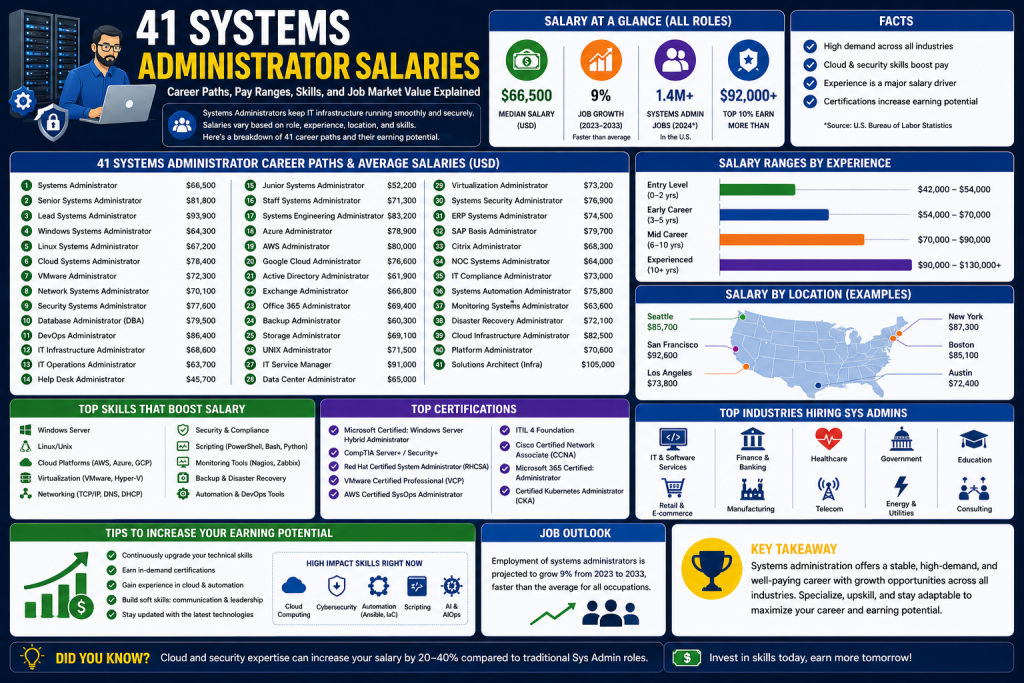
Modern organizations rely heavily on technology to operate efficiently, communicate internally, and serve their customers. Behind this technological foundation are professionals who ensure everything works as expected. Among them, systems administrators hold a critical position. They are responsible for maintaining the infrastructure that keeps businesses functioning smoothly, from servers and networks to user access and security systems. Because their role is so essential, understanding how they are compensated and what influences their salary is important for both current professionals and those considering entering the field.
In recent years, the compensation landscape for systems administrators has evolved significantly. Salaries have increased across the board, reflecting the growing dependence on digital systems and the rising complexity of IT environments. Businesses now demand more from their IT staff, and in return, they are offering better pay, especially for those who bring experience and specialized skills to the table.
The average salary for a systems administrator has climbed to a level that reflects its importance within an organization. Entry-level professionals are now starting at higher salaries than in the past, while experienced administrators can command six-figure incomes in competitive markets. This growth highlights not only the demand for skilled professionals but also the value organizations place on maintaining reliable and secure systems.
Another important trend is the widening gap between entry-level and high-end salaries. While beginners may earn a respectable income, those with years of experience, advanced certifications, and deep technical knowledge can earn significantly more. This difference emphasizes the importance of continuous learning and skill development within the field.
Location also plays a major role in salary differences. Some regions offer higher pay due to cost of living, competition among employers, and the presence of large technology companies. However, salary variations are not always tied directly to living expenses. In some cases, cities with similar costs may still offer different pay levels due to local demand and industry concentration.
Understanding these trends provides a strong foundation for evaluating career opportunities. It also helps professionals make informed decisions about where to work, which skills to develop, and how to advance in their careers.
The Core Responsibilities of a Systems Administrator
To fully appreciate why systems administrators earn what they do, it is important to understand their day-to-day responsibilities. At its core, the role revolves around maintaining and managing an organization’s IT systems. This includes hardware, software, networks, and user access.
Systems administrators are often the first line of defense when technical issues arise. If an employee cannot access a system, if a server goes down, or if a network slows to a crawl, it is typically the systems administrator who steps in to resolve the problem. Their ability to diagnose and fix issues quickly can have a direct impact on productivity and business operations.
One of their primary responsibilities is ensuring that systems remain operational and efficient. This involves monitoring performance, applying updates, and performing regular maintenance. By staying proactive, systems administrators can prevent small issues from becoming major disruptions.
They also play a key role in managing user accounts and permissions. This ensures that employees have access to the tools and information they need while keeping sensitive data secure. Proper access control is essential for both security and compliance, making this a critical part of the job.
In addition to these tasks, systems administrators often work with network infrastructure. This includes configuring routers and switches, maintaining connectivity, and ensuring that data flows smoothly across the organization. A stable network is the backbone of modern business operations, and systems administrators are responsible for keeping it running.
Another important aspect of the role is security. Systems administrators must protect systems from threats such as malware, unauthorized access, and data breaches. This involves implementing security measures, monitoring for suspicious activity, and responding to incidents when they occur.
Depending on the organization, systems administrators may also be involved in planning and implementing new technologies. This could include setting up new servers, migrating systems to the cloud, or upgrading existing infrastructure. These projects require both technical expertise and the ability to work collaboratively with other teams.
Overall, the role is dynamic and requires a combination of technical knowledge, problem-solving skills, and adaptability. No two days are exactly the same, and systems administrators must be prepared to handle a wide range of challenges.
How Salary Trends Reflect Industry Demand
The salary trends for systems administrators provide valuable insight into the broader IT industry. As businesses become more reliant on technology, the demand for skilled professionals continues to grow. This demand is one of the main drivers behind rising salaries.
One notable trend is the increase in entry-level pay. New systems administrators are starting at higher salaries than in previous years, reflecting the importance of even basic IT support roles. Organizations recognize that having competent staff at all levels is essential for maintaining operations.
At the same time, experienced systems administrators are seeing even greater increases in pay. Those with advanced skills, certifications, and a proven track record are in high demand. Employers are willing to offer competitive salaries to attract and retain these professionals, especially in markets where talent is scarce.
The gap between entry-level and high-end salaries has also widened. This means that there is significant potential for income growth within the role. By gaining experience and developing new skills, systems administrators can move from the lower end of the salary range to the higher end over time.
Geographic location remains a key factor in salary differences. Major cities and technology hubs tend to offer higher salaries due to increased competition among employers and a higher cost of living. However, not all salary differences can be explained by location alone. In some cases, local demand and industry presence play a larger role.
For example, a city with a strong technology sector may offer higher salaries even if its cost of living is relatively moderate. Conversely, a city with fewer technology companies may offer lower salaries despite having similar living costs.
These trends highlight the importance of understanding the job market when evaluating salary expectations. Systems administrators who are willing to explore different locations or industries may find opportunities for higher pay.
Factors That Influence Systems Administrator Salaries
Several key factors influence how much a systems administrator earns. Understanding these factors can help professionals identify ways to increase their income and advance their careers.
Experience is one of the most significant factors. Employers value hands-on experience because it demonstrates the ability to handle real-world challenges. Systems administrators who have worked with a variety of systems and technologies are often more effective and require less supervision.
Education can also play a role, although it is not always a strict requirement. Many systems administrators have degrees in fields such as information technology or computer science. These degrees provide a strong foundation of knowledge and can make candidates more competitive in the job market.
However, practical skills often carry more weight than formal education. Employers are primarily interested in what candidates can do, rather than just what they have studied. This makes experience and technical expertise especially important.
Technical skills are another major factor. Systems administrators who are proficient with widely used tools and technologies are more valuable to employers. This includes knowledge of operating systems, networking, and system management tools.
Certifications can also have a significant impact on salary. They provide a way to validate skills and demonstrate competence. Certifications from recognized organizations can make candidates stand out and increase their chances of securing higher-paying positions.
The industry in which a systems administrator works is another important consideration. Some industries rely more heavily on technology and are willing to pay higher salaries for skilled professionals. Others may offer lower pay but provide different benefits, such as job stability or work-life balance.
Finally, the size and type of organization can influence salary. Larger companies often have more resources and may offer higher pay, while smaller organizations may provide opportunities for broader experience and faster career growth.
The Importance of Career Growth in Systems Administration
While salary is an important aspect of any job, it is not the only factor to consider. Systems administration also offers significant opportunities for career growth and development.
For many professionals, the role serves as a starting point in the IT field. It provides a broad understanding of systems, networks, and security, which can be applied to a wide range of careers. This makes it an excellent foundation for future specialization.
As systems administrators gain experience, they may choose to focus on specific areas such as networking, cybersecurity, or cloud computing. These specialized roles often come with higher salaries and increased responsibility.
Continuous learning is essential in this field. Technology is constantly evolving, and systems administrators must keep up with new tools and trends. This may involve pursuing certifications, attending training programs, or gaining hands-on experience with new technologies.
In addition to technical skills, systems administrators also develop valuable soft skills. These include communication, problem-solving, and the ability to work under pressure. These skills are important for career advancement and can open doors to leadership roles.
Networking with other professionals and staying informed about industry trends can also help systems administrators advance their careers. By building connections and staying engaged with the community, they can discover new opportunities and gain valuable insights.
Ultimately, systems administration is more than just a job. It is a pathway to a wide range of opportunities in the technology sector. With the right combination of skills, experience, and determination, professionals in this field can achieve both financial success and career satisfaction.
Why Understanding Salary Matters for Your Future
Being aware of salary trends and expectations is an important part of career planning. It allows systems administrators to make informed decisions about job offers, negotiate better compensation, and set realistic goals for their careers.
Understanding salary ranges also helps professionals identify areas for improvement. If they are earning less than the average for their role, they can focus on gaining the skills and experience needed to increase their income.
It also provides motivation for continuous learning and development. Knowing that higher salaries are achievable encourages systems administrators to invest in their careers and pursue new opportunities.
In addition, salary awareness can help professionals evaluate different career paths. By comparing the earning potential of various roles, they can make decisions that align with their goals and priorities.
For those considering entering the field, understanding salary trends provides a realistic picture of what to expect. It highlights both the opportunities and challenges associated with the role.
In the end, knowledge is power. By understanding how systems administrator salaries work and what influences them, professionals can take control of their careers and work toward achieving their full potential.
Building the Skills That Drive Systems Administrator Salaries
While salary trends provide a broad understanding of earning potential, the real driver behind a systems administrator’s income is skill. Employers are not simply paying for a job title; they are paying for the ability to manage systems effectively, solve problems quickly, and prevent costly downtime. The more capable and reliable a systems administrator is, the more valuable they become to an organization.
Developing the right skill set is not a one-time effort. It is an ongoing process that evolves alongside technology. Systems administrators must continuously adapt to new tools, platforms, and challenges. This constant learning is one of the defining characteristics of a successful IT professional.
At the foundation of these skills is a strong understanding of operating systems. Whether working with Windows, Linux, or other platforms, systems administrators must be comfortable navigating, configuring, and troubleshooting these environments. Operating systems serve as the backbone of IT infrastructure, and a deep understanding of them is essential for managing servers and user systems effectively.
Networking knowledge is another critical area. Systems administrators need to understand how devices communicate, how data moves across networks, and how to diagnose connectivity issues. This includes familiarity with concepts such as IP addressing, routing, switching, and network protocols. Without this knowledge, it becomes difficult to maintain stable and efficient systems.
Security awareness has also become increasingly important. With the rise of cyber threats, systems administrators are expected to play a role in protecting organizational data. This involves implementing security measures, monitoring systems for suspicious activity, and responding to potential threats. A strong understanding of security principles not only improves job performance but also increases earning potential.
In addition to technical knowledge, systems administrators must develop problem-solving skills. Technology rarely behaves perfectly, and unexpected issues are a regular part of the job. The ability to think critically, analyze situations, and find effective solutions is what sets top professionals apart from the rest.
Communication skills are equally important. Systems administrators often interact with non-technical users who may not understand complex IT concepts. Being able to explain issues clearly and provide guidance in a simple, understandable way is essential for maintaining productivity and building trust within an organization.
By focusing on these core skill areas, systems administrators can position themselves for higher salaries and better career opportunities. Skill development is not just about meeting job requirements; it is about exceeding expectations and becoming indispensable.
Mastering Essential Systems Administration Tools
Beyond general skills, familiarity with specific tools and technologies plays a major role in determining salary. Employers look for systems administrators who can hit the ground running, and that often means having hands-on experience with commonly used tools.
One of the most fundamental tools in systems administration is directory services. Managing users, groups, and permissions is a daily task in many organizations. Systems administrators must be comfortable creating accounts, assigning access rights, and troubleshooting permission issues. This ensures that employees can access the resources they need while maintaining security.
Automation is another area that significantly impacts a systems administrator’s value. Performing repetitive tasks manually is inefficient and increases the risk of errors. By using scripting and automation tools, systems administrators can streamline processes, save time, and improve consistency. Automation not only enhances productivity but also demonstrates a higher level of technical proficiency.
Monitoring tools are equally important. Systems administrators need visibility into how systems are performing in real time. Monitoring tools provide data on network traffic, server performance, and system health. This information allows administrators to identify potential issues before they become serious problems.
Backup and recovery tools are also essential. Data loss can have serious consequences for any organization, and systems administrators are responsible for ensuring that backups are in place and functioning correctly. They must also be prepared to restore data quickly in the event of a failure.
Virtualization technologies have become a standard part of modern IT environments. Systems administrators often work with virtual machines, which allow multiple systems to run on a single physical server. This improves efficiency and reduces costs, but it also requires a solid understanding of how virtualization works.
Cloud platforms are another key area of focus. Many organizations are moving their systems to the cloud, and systems administrators must adapt to this shift. Managing cloud-based infrastructure requires a different set of skills compared to traditional on-premises systems, but it also opens up new opportunities for career growth.
The ability to work with these tools effectively can have a significant impact on salary. Employers are willing to pay more for professionals who can manage complex environments and contribute to the overall efficiency of their IT systems.
The Role of Certifications in Career Advancement
Certifications are one of the most effective ways for systems administrators to demonstrate their skills and increase their earning potential. They provide a standardized way to validate knowledge and show employers that a candidate has met specific industry standards.
For those just starting out, entry-level certifications can provide a strong foundation. These certifications cover basic concepts and help build confidence. They also make it easier to secure initial job opportunities by demonstrating a commitment to learning and professional development.
As systems administrators gain experience, more advanced certifications become valuable. These certifications focus on specific areas such as networking, security, or cloud computing. They allow professionals to specialize and differentiate themselves in a competitive job market.
Vendor-neutral certifications are particularly useful because they cover broad concepts that apply across different technologies. These certifications help systems administrators build a versatile skill set that can be applied in various environments.
Vendor-specific certifications, on the other hand, focus on particular products or platforms. These certifications are valuable for professionals working in organizations that rely heavily on certain technologies. They demonstrate expertise in specific tools and can lead to higher-paying roles within those environments.
The process of earning a certification requires time and effort. It involves studying, practicing, and passing an exam. However, the benefits often outweigh the challenges. Certifications can lead to better job opportunities, higher salaries, and increased job security.
Employers view certifications as a sign of dedication and competence. When comparing candidates with similar experience, a certification can be the deciding factor. It provides reassurance that the candidate has the knowledge and skills needed to perform the job effectively.
In addition to improving job prospects, certifications also contribute to personal growth. They encourage continuous learning and help systems administrators stay up to date with the latest industry trends. This ongoing development is essential in a field that evolves as quickly as information technology.
Gaining Real-World Experience That Matters
While certifications and education are important, real-world experience is often the most valuable asset for a systems administrator. Employers want to see evidence that a candidate has successfully handled real situations and can apply their knowledge in practical scenarios.
Experience can come from a variety of sources. Entry-level positions, internships, and volunteer work all provide opportunities to gain hands-on experience. Even small projects can make a difference, as they demonstrate initiative and a willingness to learn.
Working in a professional environment exposes systems administrators to a wide range of challenges. They learn how to manage systems under pressure, unexpected issues, and collaborate with other team members. These experiences build confidence and improve problem-solving abilities.
One of the key benefits of experience is familiarity with different systems and environments. The more exposure a systems administrator has, the better equipped they are to handle diverse situations. This versatility is highly valued by employers and can lead to higher salaries.
Experience also helps systems administrators develop a deeper understanding of best practices. They learn what works, what does not, and how to avoid common mistakes. This knowledge allows them to work more efficiently and deliver better results.
For those who are just starting out, gaining experience can be challenging. Many positions require prior experience, creating a cycle that can be difficult to break. However, there are ways to overcome this obstacle. Building a home lab, contributing to open-source projects, and volunteering for local organizations are all effective ways to gain practical experience.
Networking with other professionals can also open doors to new opportunities. By connecting with others in the field, systems administrators can learn from their experiences and discover potential job openings.
Ultimately, experience is what transforms theoretical knowledge into practical skill. It is the foundation of a successful career in systems administration and a key factor in achieving higher salaries.
The Importance of Specialization and Continuous Learning
As systems administrators progress in their careers, specialization becomes increasingly important. While a broad understanding of IT systems is valuable, focusing on a specific area can lead to higher salaries and more advanced roles.
There are many areas to choose from, including networking, cybersecurity, cloud computing, and automation. Each of these fields offers unique challenges and opportunities. By developing expertise in one or more of these areas, systems administrators can differentiate themselves and increase their value.
Specialization often requires additional training and certifications. It may also involve gaining experience with specific tools and technologies. While this requires effort, the rewards can be significant in terms of both salary and career growth.
Continuous learning is essential for maintaining and expanding skills. Technology is constantly evolving, and systems administrators must keep up with new developments. This may involve attending training sessions, reading industry publications, or experimenting with new tools.
Learning is not limited to technical skills. Systems administrators can also benefit from developing soft skills such as leadership, communication, and project management. These skills are important for advancing into higher-level positions and taking on greater responsibilities.
Staying curious and proactive is key to success in this field. Systems administrators who actively seek out new knowledge and challenges are more likely to achieve their career goals. They are also better prepared to adapt to changes and take advantage of new opportunities.
Employers value professionals who invest in their own development. It shows initiative and a commitment to excellence. This can lead to promotions, salary increases, and greater job satisfaction.
In the end, specialization and continuous learning are what set successful systems administrators apart. They transform a basic role into a dynamic and rewarding career, with opportunities for growth and advancement at every stage.
Choosing the Right Industry for Higher Systems Administrator Salaries
While skills, certifications, and experience are major drivers of income, the industry a systems administrator works in can significantly influence salary potential and career growth. Not all industries value IT roles in the same way. Some treat systems administrators as central to their operations, while others see them as support staff. This difference affects not only compensation but also opportunities for advancement.
Technology-focused companies are among the most rewarding environments for systems administrators. These organizations depend entirely on reliable and scalable systems, which places IT professionals at the core of their business. In such environments, systems administrators are often involved in decision-making processes, infrastructure planning, and innovation. This level of involvement can lead to higher salaries and faster career progression.
Telecommunications is another industry where systems administrators are highly valued. These companies manage large-scale networks that must remain operational at all times. Even a brief outage can have significant financial and reputational consequences. As a result, systems administrators in this field often receive competitive compensation. However, the work can be demanding, requiring quick responses to issues and the ability to work under pressure.
The finance and insurance sectors also offer strong earning potential. These industries rely heavily on secure and efficient systems to manage transactions, protect sensitive data, and ensure compliance with regulations. Systems administrators working in these environments are expected to maintain high levels of reliability and security. In return, they are often compensated well, especially if they have expertise in security and compliance.
Healthcare is another growing field for systems administrators. Hospitals, clinics, and healthcare organizations depend on technology to manage patient records, coordinate care, and support medical equipment. While salaries in this sector may vary, the demand for skilled IT professionals continues to rise as healthcare systems become more digital.
Government and public sector roles provide a different set of advantages. While salaries may not always match those in the private sector, these positions often offer stability, benefits, and work-life balance. Systems administrators in government roles may also have the opportunity to work on large-scale projects that impact entire communities.
Choosing the right industry depends on individual priorities. Those seeking the highest possible salary may prefer private-sector roles in technology or finance. Others may value stability, benefits, or the opportunity to contribute to public services. Understanding these differences allows systems administrators to align their career choices with their goals.
How Location and Market Demand Shape Salary Opportunities
Geographic location continues to play a significant role in determining salary levels for systems administrators. Different regions have varying levels of demand for IT professionals, and this demand directly influences compensation.
Large metropolitan areas and technology hubs tend to offer the highest salaries. These regions often have a high concentration of companies that rely on advanced IT infrastructure. Competition among employers for skilled professionals drives salaries upward. In addition, the cost of living in these areas is typically higher, which contributes to increased pay.
However, higher salaries do not always mean better financial outcomes. In some cases, the increased cost of housing, transportation, and daily expenses can offset the benefits of a higher income. Systems administrators must consider both salary and cost of living when evaluating job opportunities.
Smaller cities and rural areas may offer lower salaries, but they often come with a lower cost of living. This can result in a similar or even better overall quality of life. In addition, these regions may have less competition for jobs, making it easier to secure a position.
Remote work has also begun to change the impact of location on salaries. Many organizations now allow systems administrators to work from anywhere, which opens up new opportunities. Professionals can live in lower-cost areas while earning salaries based on higher-paying markets. This flexibility has become an important factor in career planning.
Market demand within a specific location also affects salaries. Areas with a shortage of skilled IT professionals may offer higher pay to attract talent. Conversely, regions with a large supply of qualified candidates may have lower salary levels due to increased competition.
Understanding these dynamics helps systems administrators make informed decisions about where to work. By considering both salary and living costs, they can find opportunities that provide the best overall value.
Strategies to Increase Your Salary as a Systems Administrator
Increasing salary as a systems administrator requires a strategic approach. It is not enough to simply gain experience over time. Professionals must actively work to improve their skills, expand their knowledge, and position themselves for better opportunities.
One of the most effective strategies is continuous skill development. Learning new technologies and staying up to date with industry trends makes systems administrators more valuable to employers. This includes gaining experience with cloud platforms, automation tools, and security practices.
Certifications remain an important part of this strategy. They provide a clear way to demonstrate expertise and can lead to higher-paying roles. Systems administrators should choose certifications that align with their career goals and the technologies used in their desired industry.
Another key strategy is seeking out challenging projects. Taking on complex tasks or leading initiatives within an organization can demonstrate capability and initiative. These experiences not only build skills but also make a strong case for salary increases or promotions.
Networking is another powerful tool for career advancement. Building relationships with other professionals can lead to new opportunities, mentorship, and valuable insights. Attending industry events, participating in online communities, and connecting with colleagues can all contribute to career growth.
Negotiation skills also play a role in increasing salary. Systems administrators should be prepared to discuss their value and justify their compensation. This includes understanding market rates, highlighting achievements, and clearly communicating their contributions to the organization.
Changing employers can sometimes be the fastest way to increase salary. While staying with one company offers stability, moving to a new organization can provide access to better pay and new opportunities. However, this decision should be made carefully, considering factors such as job satisfaction and long-term goals.
Finally, specialization can significantly impact earning potential. Systems administrators who develop expertise in high-demand areas such as cybersecurity or cloud computing often command higher salaries. By focusing on a specific niche, professionals can differentiate themselves and increase their value.
The Transition from Systems Administrator to Advanced Roles
For many professionals, systems administration is just the beginning of a larger career journey. The skills and experience gained in this role provide a strong foundation for transitioning into more advanced positions.
One common career path is moving into network engineering. Systems administrators who develop strong networking skills can transition into roles focused on designing and managing complex networks. These positions often come with higher salaries and greater responsibility.
Cybersecurity is another popular path. With the increasing importance of data protection, organizations are investing heavily in security. Systems administrators who gain expertise in this area can move into roles such as security analyst or security engineer, which often offer higher pay.
Cloud computing has also created new opportunities. As more organizations migrate to cloud-based systems, there is a growing demand for professionals who can manage and optimize these environments. Systems administrators with cloud experience can transition into roles such as cloud engineer or cloud architect.
DevOps is another emerging field that combines development and operations. Systems administrators who learn automation, scripting, and continuous integration practices can move into DevOps roles. These positions focus on improving efficiency and collaboration within IT teams and often offer competitive salaries.
Leadership roles are also an option for experienced systems administrators. Positions such as IT manager or infrastructure manager involve overseeing teams and making strategic decisions. These roles require not only technical expertise but also strong communication and management skills.
Each of these paths offers unique opportunities and challenges. The key is to identify personal interests and strengths, then pursue the skills and experience needed to transition into the desired role.
Balancing Salary with Job Satisfaction and Growth
While salary is an important factor, it should not be the only consideration when evaluating a career. Job satisfaction, work-life balance, and opportunities for growth are equally important.
A high-paying job may come with long hours, high stress, or limited opportunities for advancement. On the other hand, a slightly lower-paying position may offer a better work environment, more flexibility, and opportunities to learn new skills.
Systems administrators should consider what matters most to them. Some may prioritize financial growth, while others may value stability or work-life balance. There is no single right answer, and priorities may change over time.
Company culture is another important factor. Working in an environment that supports learning, collaboration, and innovation can have a significant impact on job satisfaction. Systems administrators should look for organizations that value their contributions and provide opportunities for growth.
Professional development opportunities are also important. Employers that invest in training and education can help systems administrators advance their careers. This not only benefits the employee but also improves the overall performance of the organization.
Ultimately, the goal is to find a balance between salary and other factors. A fulfilling career is one that provides both financial stability and personal satisfaction.
Conclusion
Systems administration is a dynamic and rewarding career with strong earning potential and numerous opportunities for growth. Salaries have increased in recent years, reflecting the growing importance of technology in modern organizations. However, income levels can vary widely based on factors such as industry, location, skills, certifications, and experience.
Professionals who want to maximize their earning potential must take an active role in their career development. This includes building technical skills, gaining hands-on experience, earning certifications, and staying informed about industry trends. It also involves making strategic decisions about where to work and which opportunities to pursue.
At the same time, it is important to consider factors beyond salary. Job satisfaction, work-life balance, and opportunities for growth all contribute to a successful and fulfilling career. By taking a balanced approach, systems administrators can achieve both financial success and personal fulfillment.
As technology continues to evolve, the demand for skilled systems administrators is likely to remain strong. Those who are willing to learn, adapt, and take initiative will find themselves well-positioned for long-term success in this field.
Continue exploring the technologies and certification concepts that matter most to you.