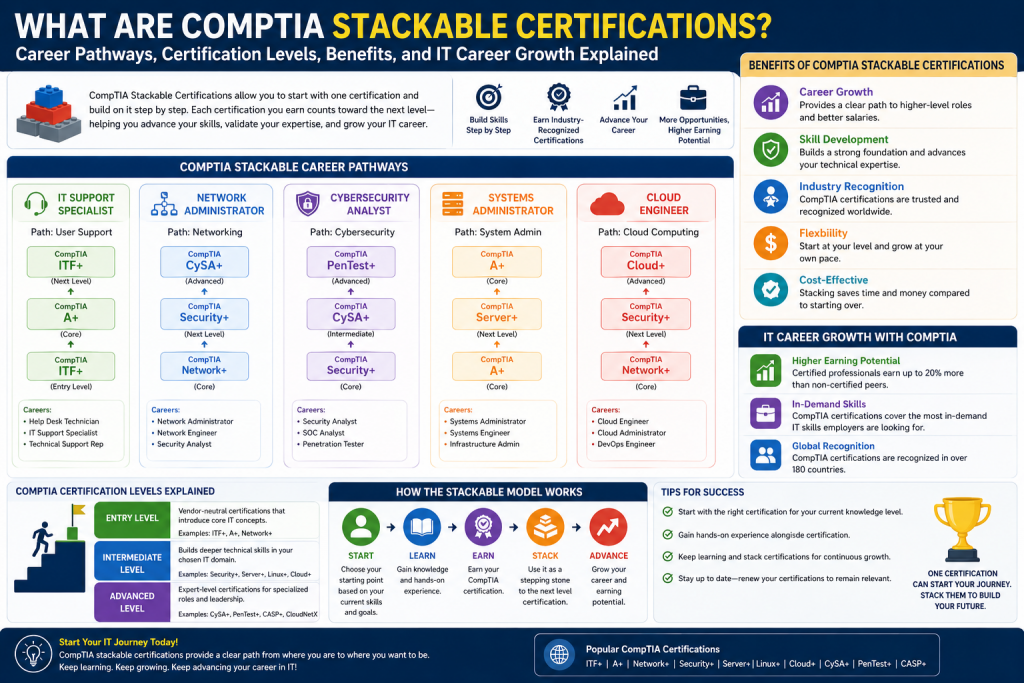
The modern information technology industry is built on continuous learning, adaptable skill development, and practical specialization. As technology infrastructures become more complex and interconnected, employers increasingly seek professionals who possess not only isolated technical skills but also broad, layered expertise that demonstrates the ability to manage multiple domains effectively. This is one of the major reasons certifications remain highly valuable in IT. They provide measurable proof of knowledge, validate professional commitment, and often create pathways to better employment opportunities.
Among the many certification providers in the IT world, CompTIA stands out because of its vendor-neutral approach. Instead of focusing on one company’s products or ecosystem, CompTIA certifications emphasize foundational and transferable skills that can apply across many technologies, organizations, and environments. This broad applicability has made CompTIA certifications particularly attractive to beginners, mid-career professionals, and even experienced specialists who want to validate diverse technical competencies.
However, CompTIA’s value extends beyond individual certifications like A+, Network+, Security+, Linux+, Cloud+, CySA+, or CASP+. To better reflect real-world professional progression, CompTIA introduced stackable certifications—a system that recognizes IT professionals for earning combinations of certifications that collectively demonstrate expanded knowledge, specialization, and career maturity.
CompTIA stackable certifications transform separate certifications into structured career achievements. Rather than seeing each credential as a disconnected milestone, stackables show how multiple certifications work together to create stronger professional identities. They help candidates demonstrate progression from foundational knowledge to advanced capabilities while aligning with practical job roles in infrastructure, cybersecurity, cloud, and support.
For aspiring IT professionals, stackable certifications offer a roadmap for strategic career growth. For employers, they provide a clearer way to evaluate broader competencies. For experienced professionals, they create structured recognition for accumulated expertise.
What CompTIA Stackable Certifications Are
CompTIA stackable certifications are composite credentials awarded when a candidate earns specific combinations of active CompTIA certifications. These combinations are intentionally designed around skill progression and career alignment.
Rather than requiring separate exams for stackable credentials, CompTIA automatically grants these designations when candidates hold qualifying certifications that are current and active. This means the stackable itself is not an independent certification exam but a recognition of how multiple certifications combine to demonstrate broader expertise.
For example, an IT professional who earns both CompTIA A+ and Network+ may qualify for a stackable certification that highlights operational and networking competence. Another individual who combines Security+, CySA+, and advanced security certifications may qualify for stackables reflecting deeper cybersecurity expertise.
This system rewards strategic learning. Instead of collecting certifications randomly, candidates can intentionally pursue combinations that align with specific career paths.
The stackable model acknowledges an important truth about IT careers: professional growth rarely happens in isolated silos. A systems administrator often needs networking knowledge. A network engineer benefits from security understanding. A cybersecurity analyst may need cloud awareness. Stackable certifications recognize this layered reality.
Why CompTIA Introduced Stackable Certifications
CompTIA’s stackable system was created to solve several challenges in modern professional development.
First, employers often struggle to interpret certification lists. A resume with several CompTIA certifications may appear impressive, but not every hiring manager understands how those certifications complement one another. Stackables simplify this by translating combinations into broader professional identities.
Second, IT careers are increasingly multidisciplinary. Today’s professionals often work across infrastructure, security, cloud, and support environments. Employers value people who can bridge these areas rather than operate in narrow technical silos.
Third, certification pathways can sometimes feel fragmented. A beginner may earn A+, then wonder whether to pursue Network+, Security+, or Linux+. Stackables help connect those choices into clearer progression frameworks.
Finally, stackables support long-term professional branding. They allow individuals to market themselves not just as certification holders, but as professionals with cohesive, expanding expertise.
By creating stackables, CompTIA essentially built a career architecture around its certification ecosystem.
How Stackable Certifications Reflect Real-World Career Progression
Most IT careers develop incrementally. Professionals often begin with support or technical troubleshooting roles, then gradually move into administration, networking, cloud operations, or cybersecurity.
A typical progression may look like this:
- Entry-level support
- Technical operations
- Systems or network administration
- Security operations
- Advanced architecture or enterprise roles
Each stage requires broader knowledge than the one before it. CompTIA stackables map directly to this reality by recognizing certification combinations that align with these transitions.
For example, someone beginning with A+ demonstrates understanding of endpoint support, troubleshooting, operating systems, and user assistance. Adding Network+ introduces infrastructure and connectivity concepts. Adding Security+ expands into risk management and security principles. Together, these certifications form a profile far stronger than any one credential alone.
This progression closely mirrors how many IT careers develop in practical workplace settings. A+ often serves as the foundation because it focuses on the essential technical skills needed to support devices, diagnose hardware and software issues, assist users, and understand operating system functionality. These are critical entry-level capabilities that build confidence and operational awareness. However, modern IT environments extend far beyond individual devices. Once Network+ is added, the professional begins understanding how those devices communicate across local and wide-area networks, how protocols function, how connectivity problems are diagnosed, and how infrastructure supports business operations.
Security+ then builds another critical layer by introducing cybersecurity fundamentals such as threat awareness, access control, risk mitigation, compliance concepts, and security architecture principles. This means the professional is no longer simply solving technical issues—they are also considering how systems, networks, and users operate securely.
Together, these certifications can represent a well-rounded early-career IT professional capable of supporting systems, understanding infrastructure, and contributing to security-conscious operations. This broader capability may improve employability because many organizations increasingly value professionals who can bridge technical support, networking, and security rather than operate solely within one narrow domain.
Stackables therefore reflect not just educational progress but employability growth.
The Three Primary Stackable Certification Tiers
CompTIA organizes many stackable certifications into broader experience categories that correspond to career maturity.
Specialist Level
Specialist stackables generally support early-career professionals with approximately zero to two years of experience. These credentials emphasize foundational technical readiness and broad operational capability.
Professionals at this level may work in:
- Help desk
- Desktop support
- Technical support
- Junior systems roles
- Basic network support
Specialist stackables help validate that a candidate is moving beyond isolated entry-level understanding into broader technical competency.
Professional Level
Professional stackables typically align with candidates who have around two to five years of experience and are expanding into larger administrative or technical responsibilities.
These professionals may work in:
- Systems administration
- Network operations
- Security analysis
- Cloud support
- Infrastructure coordination
Professional-level stackables often combine multiple technical competencies in ways that support greater independence and complexity.
Expert Level
Expert stackables target experienced professionals with advanced responsibilities. These credentials often support leadership, specialized engineering, or strategic security roles.
Typical expert-level roles include:
- Security architect
- Advanced threat analyst
- Senior infrastructure engineer
- Enterprise security consultant
This level signals deeper maturity and often aligns with higher compensation opportunities.
Vendor-Neutral Certifications and Their Strategic Advantage
One of CompTIA’s defining strengths is that its certifications are vendor-neutral. This means they are not restricted to one technology platform, one cloud provider, or one hardware ecosystem.
This matters because most real-world IT environments are mixed. Companies may use:
- Windows and Linux
- AWS and Azure
- Cisco and Juniper
- On-premises and cloud systems
A vendor-neutral professional can adapt more easily than someone trained only in one ecosystem.
Stackable certifications magnify this advantage because they combine broad competencies. Instead of proving knowledge in only one niche, stackables show versatility.
For example:
- A+ = endpoint and support
- Network+ = infrastructure and networking
- Security+ = security principles
Together, these create a multidimensional professional profile.
This flexibility is especially useful for:
- Career changers
- IT generalists
- Managed service providers
- Consultants
- Small business IT staff
How Stackables Improve Resume Strength
Certifications can help resumes stand out, but stackable certifications can improve how those credentials are interpreted.
Instead of a recruiter seeing separate certifications without context, stackables package them into recognizable capability clusters.
This can:
- Improve hiring manager understanding
- Strengthen ATS keyword alignment
- Enhance LinkedIn credibility
- Clarify career progression
- Demonstrate intentional learning
For example, “CompTIA Secure Infrastructure Specialist” communicates broader strategic capability more effectively than simply listing three separate certifications with no narrative.
This is particularly helpful when HR personnel are screening resumes before technical managers review them.
The Professional Psychology of Certification Stacking
Beyond technical validation, stackable certifications can positively influence professional motivation. Career growth often feels more achievable when professionals can visualize milestones.
Instead of pursuing certifications endlessly without structure, stackables create intermediate achievements.
This can:
- Increase motivation
- Improve planning
- Reduce decision fatigue
- Encourage progression
- Support confidence
Professionals often find it easier to commit to long-term certification journeys when they understand how each step contributes to larger goals.
CompTIA Stackables vs Standalone Certifications
Standalone certifications remain valuable. Each individual certification proves competency in a specific area. However, stackables create added meaning by combining them strategically.
Standalone certification:
- Proves one domain of knowledge
Stackable certification:
- Demonstrates integrated capability across multiple domains
This distinction is important because most IT jobs require multiple competencies simultaneously.
A security analyst may need:
- Networking understanding
- Security knowledge
- Systems awareness
A cloud administrator may need:
- Networking
- Infrastructure
- Security
- Virtualization concepts
Stackables better represent these realities.
Who Benefits Most from CompTIA Stackable Certifications
Stackable certifications can benefit nearly every stage of IT professional development.
Beginners
Those entering IT can use stackables to create structured progression instead of guessing which certification comes next.
Career Changers
Professionals moving from unrelated fields into IT can use stackables to build broader credibility faster.
Mid-Career Professionals
Those seeking promotions can use stackables to demonstrate expanded competency.
Security Professionals
Cybersecurity specialists can leverage advanced stackables for specialized recognition.
Consultants and Freelancers
Broader certifications often improve client trust and service credibility.
The Long-Term Career Value
CompTIA stackable certifications are not just educational achievements. They are career assets that can support:
- Job interviews
- Salary negotiations
- Internal promotions
- Career pivots
- Professional branding
As IT continues evolving, adaptability becomes increasingly valuable. Professionals who can combine support, networking, cloud, and security competencies often have stronger resilience in changing job markets.
Stackables help represent this adaptability.
Understanding How CompTIA Certification Paths Are Structured
Once you understand the purpose behind CompTIA stackable certifications, the next major step is learning how these credentials are actually built. CompTIA’s stackable model is not based on random certification combinations. Each pathway is intentionally designed to align with realistic technical roles, practical job responsibilities, and long-term professional development.
This structured design reflects how IT careers naturally evolve in professional environments. Rather than assuming that one certification alone can prepare someone for increasingly complex responsibilities, CompTIA recognizes that most technical roles require layered expertise. For example, a systems administrator may need endpoint troubleshooting knowledge, networking fundamentals, security awareness, and sometimes cloud or Linux experience. Stackable certifications acknowledge these real-world overlaps by grouping certifications that collectively represent stronger role readiness.
Each stackable pathway is built to support logical progression. Foundational certifications often serve as entry points, while more advanced certifications expand capability into broader or more specialized functions. This means a candidate can move from beginner-level support toward infrastructure, cybersecurity, or cloud-oriented roles without abandoning previous learning investments. Instead, each certification becomes part of a larger professional framework.
This intentional structure also benefits employers by translating certification combinations into more understandable competency profiles. Rather than evaluating unrelated certifications separately, organizations can better interpret how a candidate’s credentials support specific responsibilities. Ultimately, CompTIA’s stackable system functions like a career architecture model—helping professionals build expertise strategically while ensuring certification pathways mirror the practical demands of modern IT operations, security environments, and evolving enterprise technologies.
CompTIA certifications are often compared to building blocks because each one develops a specific technical competency. A+ focuses on endpoint support and troubleshooting. Network+ develops networking fundamentals. Security+ introduces security principles. Linux+ emphasizes operating systems administration. Cloud+ supports cloud operations. CySA+ builds defensive cybersecurity analytics. CASP+ advances enterprise security strategy.
Individually, these certifications hold value. But when strategically combined, they create broader professional identities that map more effectively to actual career paths.
For example, a help desk technician may initially focus on A+ for hardware, software, and troubleshooting fundamentals. However, by adding Network+, they become more prepared for infrastructure support. Adding Security+ can further position them for security-conscious operational roles. Rather than simply holding three unrelated certifications, they develop into a secure infrastructure professional.
This layered progression is central to CompTIA’s stackable framework.
Why Strategic Certification Pairing Matters
Choosing certifications without a roadmap can lead to fragmented learning. Some professionals collect credentials based on trends, employer recommendations, or curiosity, but this can create a resume filled with certifications that do not clearly support one another.
CompTIA stackables solve this by emphasizing synergy.
Strategic certification pairing helps:
- Build coherent career narratives
- Improve employer understanding
- Align learning with job roles
- Increase promotion potential
- Reduce wasted certification effort
- Strengthen specialization
For example, pairing A+ with Linux+ makes more sense for systems support than pairing A+ with an unrelated advanced security credential too early.
This doesn’t mean unconventional paths are impossible, but stackables create optimized progression models.
Early-Career Stackable Certifications
The first major category of stackables often serves entry-level or developing professionals. These combinations are particularly valuable because they transform foundational certifications into stronger role identities.
CompTIA IT Operations Specialist (CIOS)
This stackable typically combines:
- CompTIA A+
- CompTIA Network+
This path is often ideal for:
- Help desk technicians
- Desktop support professionals
- IT support specialists
- Junior network support staff
A+ proves the candidate understands hardware, operating systems, troubleshooting, and end-user support. Network+ adds networking fundamentals, protocols, troubleshooting, and infrastructure awareness.
Together, these certifications create a more versatile operations professional.
This combination is particularly valuable because many entry-level IT jobs increasingly require networking awareness, even when the role is support-focused.
CompTIA Systems Support Specialist (CSSS)
This stackable commonly combines:
- CompTIA A+
- CompTIA Linux+
This pathway is often useful for:
- Technical support specialists
- Junior Linux administrators
- Support engineers
- Mixed-environment support teams
This combination reflects the growing relevance of Linux across enterprise systems, cloud environments, and server infrastructures.
For candidates targeting data center, DevOps-adjacent, or systems-heavy environments, Linux+ can significantly expand support credibility.
Infrastructure-Focused Professional Stackables
As IT professionals advance, infrastructure roles often require deeper combinations of systems, networking, and administration.
CompTIA Network Infrastructure Professional (CNIP)
Typically combines:
- CompTIA Network+
- CompTIA Server+
This path supports:
- Network administrators
- Infrastructure technicians
- Server support professionals
- Systems coordinators
Network+ provides network architecture and troubleshooting, while Server+ expands into server deployment, storage, virtualization, and enterprise hardware.
This combination reflects environments where infrastructure professionals must manage both connectivity and backend systems.
CompTIA Linux Network Professional (CLNP)
Typically combines:
- CompTIA Network+
- CompTIA Linux+
This path may fit:
- Linux network administrators
- Infrastructure engineers
- Technical operations specialists
- Managed hosting professionals
Linux remains central to many enterprise systems, networking appliances, and cloud platforms. Combining Linux and networking creates stronger infrastructure flexibility.
Cloud-Oriented Stackable Certifications
Cloud adoption has transformed IT operations, and CompTIA recognized this by creating pathways that align traditional infrastructure knowledge with cloud management.
CompTIA Cloud Admin Professional (CCAP)
Commonly combines:
- CompTIA Network+
- CompTIA Cloud+
This stackable supports:
- Cloud administrators
- Hybrid infrastructure specialists
- Cloud support engineers
- Infrastructure analysts
Network+ remains highly relevant because cloud systems still depend heavily on networking principles. Cloud+ expands into virtualization, cloud deployment, resource management, and cloud operations.
This stackable is especially useful for organizations transitioning from traditional infrastructure to hybrid cloud models.
Cybersecurity Stackable Certifications
Cybersecurity is one of the most strategically valuable areas within CompTIA’s certification ecosystem. Stackables in this category often reflect progressive defensive and strategic expertise.
CompTIA Secure Infrastructure Specialist (CSIS)
Usually combines:
- CompTIA A+
- CompTIA Network+
- CompTIA Security+
This is one of the most recognized foundational security stackables.
Ideal roles include:
- Security-focused support staff
- Junior SOC analysts
- IT security specialists
- Security-aware administrators
This stackable demonstrates:
- Endpoint understanding
- Networking awareness
- Security fundamentals
This is particularly valuable because security professionals often need foundational knowledge before moving into advanced analytics.
CompTIA Security Analytics Professional (CSAP)
Typically combines:
- CompTIA Security+
- CompTIA CySA+
This stackable often supports:
- Security analysts
- Threat detection specialists
- SOC professionals
- Vulnerability analysts
Security+ establishes baseline security knowledge, while CySA+ builds practical defensive operations, threat intelligence, incident response, and analytics.
This combination is often more operational than managerial.
CompTIA Security Analytics Expert
Commonly combines:
- CompTIA Security+
- CompTIA CySA+
- CASP+
This path aligns with:
- Senior security analysts
- Security architects
- Enterprise defenders
- Advanced cybersecurity consultants
CASP+ elevates strategic security, enterprise integration, and advanced implementation.
This progression reflects movement from security fundamentals to analysis to advanced architecture.
The Importance of Certification Sequencing
One of the most overlooked aspects of stackable certifications is sequencing.
The order in which certifications are earned can significantly impact:
- Learning efficiency
- Knowledge retention
- Exam readiness
- Career transitions
For example:
Logical progression
A+ → Network+ → Security+
Less efficient progression
CASP+ → A+ → Linux+
CompTIA stackables are strongest when professionals build foundational knowledge before specialization.
This sequencing matters because advanced certifications often assume prior understanding.
How to Choose the Right Stackable Path
Not every stackable path fits every professional. Strategic planning should consider:
Career Goals
Do you want:
- Support
- Networking
- Security
- Cloud
- Systems
- Leadership
Current Experience
Beginners may benefit from A+ pathways, while experienced administrators may skip directly into Network+, Linux+, or Security+.
Industry Demand
Cybersecurity and cloud often offer strong demand, but infrastructure remains critical.
Learning Style
Some professionals prefer broad foundational growth first, while others specialize early.
Stackables and Resume Narrative
A major advantage of stackables is storytelling.
Compare:
Candidate A:
- A+
- Network+
- Security+
Candidate B:
- CompTIA Secure Infrastructure Specialist
While technically similar, Candidate B often presents a clearer professional identity.
This matters because recruiters often spend seconds scanning resumes.
Stackables can:
- Simplify messaging
- Clarify expertise
- Improve keyword strength
- Strengthen professional branding
Certification ROI and Efficiency
Because stackables are earned automatically through qualifying certifications, they can improve return on investment without requiring separate exam fees.
This means:
- More resume value
- More career signaling
- Better branding
- No additional stackable exam
For professionals balancing cost, this creates significant efficiency.
Avoiding Common Certification Planning Mistakes
Chasing trends only
Not every trending certification fits your goals.
Ignoring foundations
Skipping foundational knowledge can weaken long-term capability.
Over-specializing too early
Broad competence often creates stronger early-career flexibility.
Letting certifications expire
Stackables often depend on active certifications.
Industry Perception of Stackables
While some employers focus primarily on core certifications, stackables can still add strategic value by framing combinations more effectively.
They may be particularly useful for:
- HR screening
- Internal promotions
- LinkedIn branding
- Professional portfolios
For technical hiring managers, stackables often reinforce—not replace—individual certification understanding.
Long-Term Strategic Growth
A powerful benefit of stackables is scalability.
A beginner may start with:
A+ → Network+
Then grow into:
A+ → Network+ → Security+
Then expand into:
Security+ → CySA+ → CASP+
This progression supports increasingly advanced professional narratives.
Understanding How to Qualify for CompTIA Stackable Certifications
After learning what CompTIA stackable certifications are and how certification pathways are structured, the next major step is understanding how these credentials are actually earned, maintained, and leveraged over time. Many IT professionals initially assume that stackable certifications require separate applications, additional exams, or unique registration processes. In reality, the process is often far more streamlined—but it still requires strategic awareness.
Unlike standalone certifications that are earned by passing individual exams, stackable certifications are generally awarded automatically when a candidate holds the required combination of qualifying CompTIA certifications. This means professionals do not usually need to submit extra paperwork or pay for a separate “stackable” exam. Instead, CompTIA’s system recognizes when specific active certifications align with predefined pathways and then grants the associated stackable credential. This automation can make the process more efficient, but it also means professionals must understand which certification combinations actually qualify and how those combinations align with their intended career goals.
Strategic awareness is critical because not every certification pairing produces the same career value. Some stackables are optimized for IT operations, others for systems support, infrastructure, cloud administration, or cybersecurity analytics. Professionals who plan intentionally can maximize both educational investment and professional branding by selecting certifications that contribute to broader stackable pathways.
Additionally, earning the certifications is only one part of the equation. Maintenance through Continuing Education, renewal deadlines, and recertification policies often determines whether those stackable credentials remain relevant over time. A professional who earns qualifying certifications but allows one to expire may weaken the long-term value of the broader stackable designation.
Leveraging stackable certifications effectively also involves resume strategy, LinkedIn optimization, interview positioning, and career planning. When used correctly, stackables can help professionals present themselves not merely as certification collectors, but as individuals building structured, progressive expertise. This distinction can be particularly valuable in competitive job markets where employers increasingly seek candidates with layered, cross-functional technical capability rather than isolated knowledge alone.
CompTIA stackable certifications are awarded automatically when a professional earns the required combination of qualifying CompTIA certifications and keeps those certifications active. This means there is usually no separate “stackable certification exam.” Instead, stackables function as recognition credentials that reflect broader competency once specific certification combinations are achieved.
This system creates both opportunity and responsibility. The opportunity is that professionals can gain additional credentials without paying for entirely new exams. The responsibility is that all required certifications generally need to remain current according to CompTIA’s Continuing Education policies.
This is an important distinction because earning certifications once is not always enough for long-term stackable recognition. Certification maintenance often plays a central role.
The Importance of Active Certification Status
CompTIA certifications are often subject to expiration cycles depending on when they were earned and under which policy structure they fall. Modern CompTIA certifications typically require renewal through Continuing Education or recertification pathways. This renewal structure reflects the rapidly changing nature of technology, where cybersecurity threats evolve, networking standards shift, cloud platforms expand, and infrastructure practices modernize. By requiring periodic updates, CompTIA helps ensure that certified professionals maintain current, relevant knowledge rather than relying solely on outdated skills earned years earlier.
For stackable certifications, this matters because inactive certifications may interrupt stackable eligibility. Since stackable credentials are built on combinations of qualifying certifications, allowing one or more required certifications to expire can weaken the professional value of the broader credential pathway. For example, a candidate who previously qualified for a secure infrastructure or analytics-focused stackable may need to renew specific certifications to preserve that designation’s relevance.
This makes certification management an important part of long-term career planning. Professionals should regularly monitor renewal deadlines, Continuing Education Unit requirements, and recertification options to protect both individual certifications and larger stackable pathways. Staying proactive can help avoid credential gaps that may affect resume strength, promotion opportunities, or employer confidence. In practical terms, maintaining active certifications is not just administrative upkeep—it is an investment in sustained credibility, career continuity, and competitive relevance in a constantly evolving IT marketplace.
For example:
- If a professional earned A+, Network+, and Security+ but allowed one credential to expire, their broader stackable recognition may be affected.
- If all qualifying certifications remain active, the stackable designation can remain valid.
This system ensures that stackables reflect current competency rather than outdated knowledge.
Technology evolves rapidly. Networking standards change. Cybersecurity threats evolve. Cloud architectures shift. Operating systems advance. CompTIA’s renewal requirements help ensure stackable credentials continue representing relevant skills rather than historical achievements alone.
Good-for-Life Certifications vs Continuing Education Certifications
Some older CompTIA certifications were issued under “good-for-life” models, meaning they did not expire. However, newer certification structures often require Continuing Education participation.
This distinction can create confusion for long-time professionals.
Older Good-for-Life Certifications
- May remain individually valid
- May not automatically align with current stackable pathways
- Could require updated certification for some stackable eligibility
Current CE-Based Certifications
- Require periodic renewal
- Better align with active stackable structures
- Reflect more current skill standards
For professionals holding older certifications, reviewing current CompTIA account status is often essential for understanding stackable qualifications.
How the Continuing Education Program Works
CompTIA’s Continuing Education (CE) program is designed to keep professionals current without necessarily forcing them to retake every exam from scratch.
Renewal may involve:
- Earning CEUs (Continuing Education Units)
- Completing approved training
- Passing higher-level certifications
- Participating in relevant professional development
This structure allows certifications to evolve alongside career growth.
For example, earning an advanced certification may renew lower-tier certifications in some pathways. This can create efficiency for professionals who continue progressing.
Benefits of CE include:
- Reduced need for repetitive entry-level retesting
- Encouragement of ongoing learning
- Alignment with industry shifts
- Preservation of stackable pathways
Why Certification Maintenance Matters for Career Credibility
Many professionals focus heavily on earning certifications but underestimate the importance of maintaining them.
Expired certifications can affect:
- Resume competitiveness
- Promotion opportunities
- Employer trust
- Contract eligibility
- Compliance roles
- Stackable recognition
In highly regulated industries or security-sensitive environments, active credentials may be particularly important.
For example:
- Government roles
- Defense contracting
- Managed security services
- Enterprise compliance environments
Maintaining stackable certifications can therefore support not only branding but operational employability.
Employer Perception of Stackable Certifications
Employers vary in how deeply they understand CompTIA stackables, but stackables often provide value in several ways.
Human Resources and Recruiters
Non-technical screening teams may find stackables easier to interpret than disconnected certification lists.
Hiring Managers
Technical leaders may focus more on individual certifications but still appreciate stackables as evidence of broader progression.
Internal Promotions
Stackables may help employees demonstrate structured advancement beyond isolated technical learning.
Consulting and Freelance Work
Broader credentials can strengthen client trust.
In many cases, stackables are not replacements for practical experience, but they can enhance how experience and certifications are perceived together.
CompTIA Stackables and Salary Potential
No certification guarantees salary increases on its own, but certification combinations can improve earning potential by strengthening qualifications for broader or more advanced roles.
Stackables may support salary growth by:
- Expanding role eligibility
- Supporting promotions
- Increasing specialization
- Demonstrating commitment
- Improving negotiation leverage
For example:
A+ alone may support entry-level support roles.
A+ + Network+ + Security+ may support infrastructure or security-focused support roles with broader compensation potential.
Similarly:
Security+ + CySA+ + CASP+ may align with more advanced security opportunities.
Salary outcomes still depend on:
- Experience
- Geography
- Industry
- Employer size
- Role complexity
However, stackables can improve positioning.
Using Stackables for Career Transitioning
One of the strongest strategic uses of CompTIA stackables is career mobility.
Support to Networking
A+ → Network+
Networking to Security
Network+ → Security+
Infrastructure to Cloud
Network+ → Cloud+
Security Fundamentals to Advanced Security
Security+ → CySA+ → CASP+
These pathways can help professionals pivot without starting over.
For career changers, this is particularly useful. Instead of abandoning previous certifications, stackables allow previous achievements to contribute toward future pathways.
The Strategic Role of Stackables in Personal Branding
Professional branding matters more than many IT professionals realize. Recruiters, hiring managers, and even peers often evaluate not only skills but also clarity.
Stackables can improve:
- Resume structure
- Certification grouping
- LinkedIn headlines
- Professional bios
- Portfolio presentation
For example, “Secure Infrastructure Specialist” may communicate more effectively than three disconnected certifications to some audiences.
This branding advantage becomes more important in competitive markets.
Balancing Certifications with Experience
While stackables are valuable, certifications alone are rarely enough.
Professionals should balance:
- Certifications
- Hands-on labs
- Real-world projects
- Internships
- Professional networking
- Home labs
- Open-source contributions
Stackables strengthen professional narratives, but practical competence remains essential.
A candidate with stackables plus demonstrable experience often outperforms one with certifications alone.
Common Long-Term Strategy Models
General IT Operations Model
A+ → Network+ → Security+
Systems Administration Model
A+ → Linux+ → Server+
Cloud Operations Model
Network+ → Cloud+ → Security+
Cybersecurity Analyst Model
Security+ → CySA+ → CASP+
Hybrid Infrastructure Security Model
A+ → Network+ → Security+ → Cloud+
These pathways are not rigid but can provide strategic guidance.
Avoiding Certification Burnout
A common issue among ambitious professionals is over-certification without application.
Symptoms may include:
- Collecting certifications without role advancement
- Studying without hands-on reinforcement
- Chasing prestige over strategy
- Losing renewal control
To avoid burnout:
- Align certifications with goals
- Build practical projects
- Focus on progression
- Use stackables as structure
Stackables can actually reduce burnout by providing coherent pathways.
Digital Transformation and the Future of Stackables
As organizations increasingly integrate cloud computing, artificial intelligence, zero trust security models, hybrid infrastructure, and large-scale automation into daily operations, the boundaries between traditional IT roles continue to blur. Modern enterprises rarely operate within isolated technical environments anymore. Instead, they depend on interconnected systems where networking, cybersecurity, cloud architecture, data governance, and automation frameworks must function together seamlessly. This growing complexity means employers are placing greater value on professionals who can understand how multiple disciplines interact rather than focusing exclusively on one narrow specialization.
For example, cloud deployments now require not only infrastructure knowledge but also security policy awareness, identity management, compliance considerations, and automation skills for deployment and monitoring. Similarly, AI systems often rely on secure data pipelines, scalable cloud platforms, and governance controls that bridge several technical areas. As zero trust strategies become more common, professionals must understand networking, endpoint security, authentication, and policy enforcement together.
This evolution strongly supports the long-term relevance of stackable-style career development because layered certifications can better represent multidimensional expertise. Professionals who combine infrastructure, cloud, automation, and security competencies may be better positioned for roles such as cloud security engineer, hybrid systems architect, or enterprise operations strategist. In an increasingly integrated technology landscape, adaptable professionals with cross-domain capabilities may enjoy stronger resilience, broader career mobility, and greater long-term market value.
Monitoring Your Certification Progress
Professionals should periodically review:
- Certification expiration dates
- CE requirements
- Stackable eligibility
- Career goals
- Industry trends
This proactive approach helps maximize long-term ROI.
Practical Next Steps for New Candidates
For those starting from scratch:
Choose foundational certification:
- A+
- Network+
- Security+
Select target pathway:
- Support
- Networking
- Security
- Cloud
Plan stackable progression
Track CE requirements early
Build practical experience alongside certifications
This approach prevents random credential accumulation.
Conclusion
CompTIA stackable certifications represent far more than marketing labels or grouped credentials. They are structured professional development tools that help transform isolated certifications into cohesive career pathways. By rewarding strategic combinations of knowledge, CompTIA stackables better reflect how real IT careers evolve—from foundational support skills to advanced infrastructure, cloud, or cybersecurity expertise.
Their value lies in several major advantages: they improve resume clarity, support long-term career planning, strengthen employer perception, encourage continuous learning, and often increase the return on certification investment without requiring separate stackable exams. When maintained properly through Continuing Education and aligned with practical experience, stackables can serve as meaningful indicators of both professional growth and current technical relevance.
For beginners, they offer direction. For mid-career professionals, they support progression. For advanced specialists, they reinforce layered expertise. Most importantly, they encourage intentionality—helping IT professionals move beyond random certification collection and toward strategic career architecture.
In a technology landscape defined by constant change, adaptability is one of the most valuable professional assets. CompTIA stackable certifications help showcase that adaptability by proving not only what you know individually, but how your skills combine to support broader responsibilities and future growth. For professionals serious about building sustainable, flexible, and marketable IT careers, understanding and leveraging stackable certifications can be a highly effective long-term strategy.
Continue exploring the technologies and certification concepts that matter most to you.