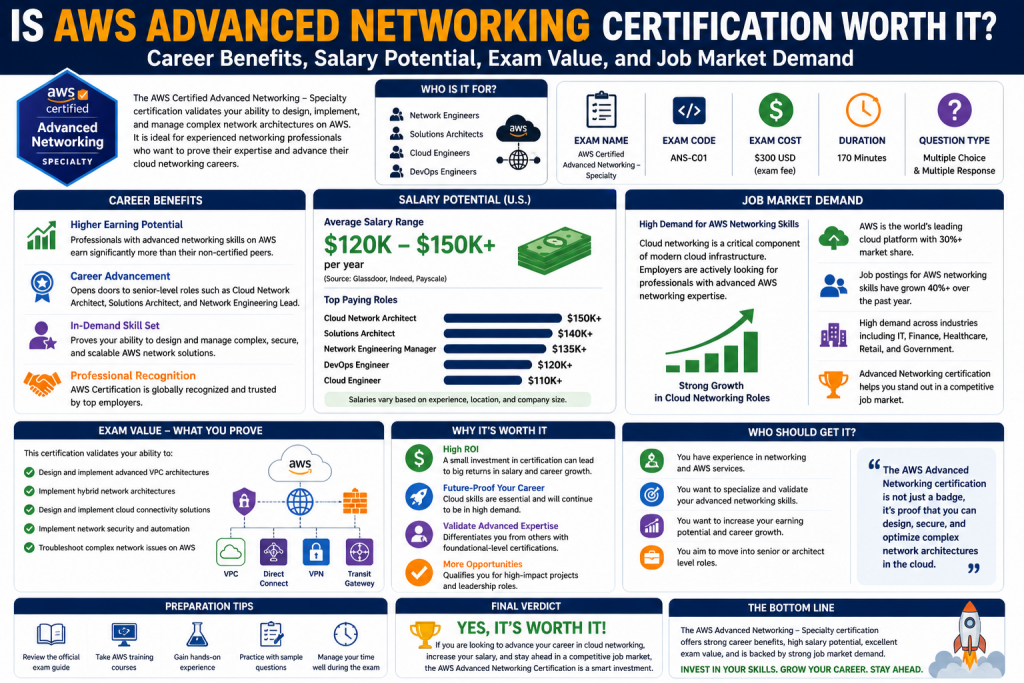
Cloud computing has fundamentally transformed how organizations design, deploy, and manage infrastructure. As businesses continue migrating critical applications, workloads, and services to the cloud, networking has become one of the most essential technical disciplines in ensuring performance, security, scalability, and resilience. While cloud adoption initially emphasized compute and storage, networking now sits at the center of enterprise cloud strategy because every workload depends on reliable connectivity, traffic optimization, hybrid architecture, and secure communication between environments.
Among public cloud providers, Amazon Web Services (AWS) remains one of the most dominant platforms in enterprise adoption. Its extensive service portfolio, global infrastructure footprint, and maturity have made it a primary choice for startups, governments, and multinational corporations alike. This dominance has created strong demand for professionals who not only understand cloud fundamentals but can also architect sophisticated networking environments within AWS ecosystems.
As organizations build increasingly complex infrastructures involving hybrid cloud, multi-region deployments, edge computing, and security-focused segmentation, traditional networking skills alone are often not enough. Employers now seek professionals who can bridge conventional networking expertise with AWS-native services such as Amazon VPC, Direct Connect, Transit Gateway, Route 53, Elastic Load Balancing, and hybrid connectivity models.
This is where the AWS Advanced Networking Specialty certification becomes particularly relevant. Positioned as one of AWS’s highest-level specialty certifications, it targets experienced networking professionals who want to validate expert-level cloud networking skills. Unlike foundational or associate-level certifications, this certification is designed for those already comfortable with networking concepts and looking to prove advanced capability in AWS-specific design, implementation, security, and optimization.
For many professionals, the question is not simply whether AWS certifications are useful, but whether this particular specialty certification delivers enough value to justify the investment of time, money, and preparation. Because advanced certifications require significant commitment, candidates often want to know if the certification improves job prospects, enhances credibility, supports salary growth, or provides meaningful technical advancement.
To answer that, it is important first to understand what the certification actually covers, who it is designed for, how difficult it is, and what knowledge base is expected before pursuing it.
What Is the AWS Advanced Networking Specialty Certification?
The AWS Advanced Networking Specialty certification is an expert-level credential designed for IT professionals responsible for designing and implementing complex networking solutions on AWS. It focuses heavily on large-scale network architectures, hybrid cloud systems, secure connectivity, automation, and troubleshooting in enterprise environments.
This certification is intended for professionals who already possess extensive networking experience. AWS generally recommends candidates have several years of hands-on networking experience, including direct exposure to AWS services and cloud-based infrastructure. The certification assumes a deep understanding of both traditional and cloud networking, making it significantly more advanced than entry-level AWS credentials.
Unlike foundational certifications that focus primarily on terminology, basic service familiarity, or broad cloud concepts, AWS Advanced Networking is designed for individuals who can apply architectural judgment in real-world enterprise scenarios. Candidates are expected to understand not only how networking technologies function independently, but also how they interact across hybrid infrastructures that may include data centers, branch offices, security controls, edge locations, and globally distributed cloud environments. This means experience with routing, switching, DNS, VPNs, load balancing, and network security is often essential before pursuing the certification.
Professionals preparing for this exam are typically already involved in responsibilities such as designing network topologies, troubleshooting performance issues, implementing secure connectivity, or managing infrastructure modernization initiatives. The certification’s advanced scope reflects the growing complexity of cloud networking, where traditional principles must be adapted to virtualized, software-defined, and highly scalable AWS ecosystems. For many candidates, success requires not only theoretical knowledge but also practical familiarity with enterprise-grade networking challenges. This makes the certification particularly valuable for seasoned professionals seeking to validate specialized expertise rather than newcomers exploring cloud for the first time.
Rather than testing basic cloud concepts, this certification validates whether candidates can manage advanced tasks such as:
- Designing hybrid architectures that integrate on-premises infrastructure with AWS
- Implementing secure and scalable AWS networking
- Managing interconnectivity between multiple VPCs and regions
- Automating networking deployments
- Designing for performance optimization
- Implementing secure access controls and compliance frameworks
- Troubleshooting complex network failures
This makes the certification especially valuable for senior engineers, architects, and infrastructure specialists working in enterprise or consulting environments.
Why Advanced Networking Skills Matter in AWS
Networking in AWS extends far beyond configuring simple virtual private clouds. Modern organizations often operate highly distributed systems with interconnected applications across multiple availability zones, regions, offices, and customer-facing platforms.
For example, a company may need to:
- Connect headquarters to AWS securely
- Extend data center resources into cloud environments
- Maintain low-latency communication between workloads
- Segment traffic for compliance
- Protect applications against DDoS attacks
- Support IPv6 migration
- Automate infrastructure changes
- Route global traffic intelligently
These tasks require mastery of both networking fundamentals and AWS-specific services.
AWS networking professionals must understand not only routing and switching principles but also software-defined networking concepts, cloud-native security controls, and large-scale design methodologies.
Because network failures can impact uptime, user experience, and business continuity, organizations increasingly prioritize advanced networking expertise as part of broader digital transformation strategies.
Who Should Consider This Certification?
The AWS Advanced Networking Specialty certification is not typically suitable for beginners. It is most beneficial for professionals with established networking or cloud experience who want to specialize further.
Ideal candidates often include:
- Network engineers transitioning to cloud
- Cloud architects specializing in infrastructure
- DevOps engineers managing hybrid deployments
- Security engineers focused on cloud segmentation
- Systems architects handling enterprise migrations
- Consulting professionals deploying AWS for clients
For professionals with certifications such as CCNA, CCNP, or CompTIA Network+, this AWS specialty can serve as a strategic extension into cloud networking.
Those who already hold AWS associate or professional certifications may also use this specialty to deepen their specialization.
Recommended Knowledge Before Pursuing the Certification
Although AWS does not enforce mandatory prerequisites, candidates typically perform better when they already possess:
- Strong TCP/IP knowledge
- Routing and switching expertise
- DNS and DHCP understanding
- VPN configuration experience
- BGP familiarity
- Network security principles
- AWS VPC experience
- Hybrid cloud deployment knowledge
- Automation and scripting skills
Without this background, preparation can become significantly more difficult.
This certification expects candidates to move beyond memorization into architectural judgment. Questions often involve selecting optimal solutions based on scalability, cost, security, and operational complexity.
Core AWS Services Covered
A major component of preparation involves mastering AWS networking services, including:
- Amazon VPC
- Transit Gateway
- Direct Connect
- Site-to-Site VPN
- Route 53
- Elastic Load Balancing
- CloudFront
- AWS Global Accelerator
- Network Firewall
- Security Groups
- NACLs
- PrivateLink
Understanding how these services interact in real-world deployments is essential.
For example, knowing when to choose Transit Gateway over VPC peering, or Direct Connect over VPN, can significantly impact architecture outcomes.
Exam Structure and Domain Breakdown
The AWS Advanced Networking Specialty exam is comprehensive and scenario-driven. It evaluates practical networking judgment across multiple technical domains.
The primary exam areas include:
- Designing hybrid network architectures
- Designing and implementing AWS networks
- Network automation
- Integration with application services
- Security and compliance
- Monitoring, troubleshooting, and optimization
The exam emphasizes design decisions over memorization. Candidates are often tested on enterprise scenarios involving multiple services, business requirements, and operational constraints.
This means understanding best practices is critical.
Exam Difficulty and Preparation Reality
This certification is widely regarded as one of the more challenging AWS exams because it combines advanced networking with AWS-specific complexity.
Difficulty often comes from:
- Broad technical scope
- Deep service integration
- Scenario-heavy questions
- Security considerations
- Hybrid architecture complexity
- Time pressure
Candidates with only AWS familiarity but limited networking depth may struggle.
Likewise, traditional network engineers without AWS exposure may also face challenges.
Successful preparation usually includes:
- Hands-on labs
- Practice exams
- AWS documentation review
- Whitepapers
- Networking refreshers
- Architecture case studies
Many candidates spend months preparing, depending on prior experience.
Certification Cost and Financial Commitment
The exam itself carries a premium cost compared to lower-tier certifications. Beyond exam fees, candidates may also invest in:
- Practice tests
- Online courses
- Training platforms
- Labs
- Study guides
This means total investment can be substantial.
However, because specialty certifications often target higher-income technical roles, many professionals view this as a career investment rather than an expense.
Employers may also reimburse certification costs, particularly in consulting or enterprise cloud teams.
Benefits Beyond Passing the Exam
While certification validates knowledge, the preparation journey itself can strengthen practical skills in:
- Network architecture
- Security planning
- Cloud migration
- Performance optimization
- Infrastructure resilience
- Troubleshooting methodology
This can improve job performance even before new roles or salary gains materialize.
For consultants and architects, the certification may also enhance credibility when working with clients.
Common Misconceptions About AWS Advanced Networking
Some professionals assume this certification guarantees immediate salary increases or job offers. In reality, certification is most powerful when combined with practical experience.
Others believe it is only relevant for AWS-exclusive environments. In practice, hybrid and multi-cloud strategies often make AWS networking expertise broadly useful.
Another misconception is that it replaces traditional networking certifications. Instead, it often complements them.
Is This Certification Primarily Technical or Strategic?
It is both.
Technically, it validates implementation and troubleshooting.
Strategically, it demonstrates architecture-level thinking.
This dual value makes it especially attractive for professionals seeking senior engineering or architecture pathways.
How AWS Advanced Networking Impacts Career Advancement
Earning an advanced technical certification is rarely just about passing an exam. For most professionals, certifications are strategic career decisions tied directly to job opportunities, earning potential, industry relevance, and long-term specialization. This is especially true for the AWS Advanced Networking Specialty certification, which sits at a higher tier than foundational and associate-level credentials and is often pursued by professionals seeking to move beyond operational roles into architecture, consulting, or enterprise design leadership.
As cloud adoption accelerates globally, organizations are no longer simply “moving to the cloud.” They are redesigning infrastructure around performance, resilience, security, compliance, and scale. This shift has elevated networking from a support function to a strategic pillar of business operations. In AWS environments, networking decisions affect application availability, hybrid connectivity, disaster recovery, zero-trust security, user experience, and operational cost.
Because of this, professionals who can design and manage advanced AWS networking solutions often hold significant value in technical teams. The AWS Advanced Networking Specialty certification can act as a validation of that expertise, helping professionals position themselves for more specialized and senior-level opportunities.
However, its true career value depends on how it aligns with real-world job functions, employer expectations, and broader market demand.
Why Employers Value AWS Advanced Networking Expertise
Organizations increasingly operate in distributed digital ecosystems involving:
- Hybrid cloud infrastructure
- Remote workforce connectivity
- Multi-region application deployments
- Compliance-driven segmentation
- Cloud security frameworks
- Edge services
- Disaster recovery networks
These environments require more than cloud familiarity. They require deep networking expertise capable of ensuring secure communication, optimized traffic flow, and architectural resilience.
When employers evaluate candidates for senior cloud networking positions, they often prioritize demonstrated capability in:
- Large-scale network design
- Cloud-native architecture
- Secure hybrid deployment
- AWS-specific service implementation
- Performance optimization
- Infrastructure automation
This is where the AWS Advanced Networking Specialty credential becomes relevant. It signals that the professional has pursued advanced validation in one of the most technically complex areas of cloud infrastructure.
For consulting firms, managed service providers, enterprise cloud teams, and digital transformation organizations, this certification may also strengthen client trust by demonstrating proven expertise.
Key Career Paths That Benefit Most
Not every IT role requires advanced AWS networking specialization. The certification offers the greatest value when aligned with specific career pathways where cloud networking architecture directly influences outcomes. Because this certification is highly specialized, its strongest return typically appears in positions where designing, securing, optimizing, or troubleshooting complex cloud and hybrid infrastructures is a primary responsibility rather than an occasional task.
Professionals working in roles that directly shape enterprise connectivity strategy often benefit most because advanced AWS networking knowledge can influence architecture quality, scalability, security posture, and operational resilience. This includes environments where businesses depend on seamless integration between on-premises systems, cloud services, remote users, branch offices, and globally distributed applications. In such scenarios, networking decisions are not isolated technical tasks—they are strategic business enablers.
The certification can be especially impactful for professionals seeking progression into senior infrastructure, architecture, consulting, or transformation-focused roles where cloud networking expertise differentiates them from broader IT generalists. It may also be valuable for specialists aiming to bridge traditional enterprise networking backgrounds with modern AWS cloud design capabilities. Rather than serving as a universal credential for all IT professionals, AWS Advanced Networking is most effective when pursued by individuals whose career trajectory involves high-level cloud network planning, secure connectivity design, automation, or enterprise-scale infrastructure modernization.
Additionally, professionals in organizations undergoing digital transformation, data center modernization, or global expansion may find this certification particularly useful because these initiatives often require secure large-scale connectivity planning. As enterprises adopt hybrid and multi-environment strategies, networking professionals capable of managing traffic flow, policy enforcement, disaster recovery connectivity, and performance optimization become increasingly valuable. This certification can also support individuals pursuing advisory or leadership-oriented technical paths, where architectural credibility influences strategic decision-making. In these cases, advanced AWS networking knowledge is not simply a technical enhancement—it can become a career-defining specialization that supports broader influence, larger project ownership, and stronger alignment with future-focused infrastructure demands.
Some of the most relevant roles include:
Cloud Network Engineer
This is one of the most direct role alignments. Cloud Network Engineers design, deploy, secure, and maintain AWS network infrastructure. Responsibilities often include VPC architecture, hybrid connectivity, routing design, traffic engineering, and monitoring.
Professionals in this role may oversee:
- Transit Gateway deployment
- Direct Connect integration
- Route optimization
- VPN architecture
- Firewall policies
- Global traffic distribution
Because these responsibilities map closely to certification domains, the AWS Advanced Networking Specialty can significantly strengthen role credibility.
Solutions Architect
Architects designing enterprise AWS environments often need networking depth to ensure that applications, data, and services interact securely and efficiently.
While general architecture certifications validate broad AWS design, networking specialization demonstrates deeper capability in handling sophisticated infrastructure challenges.
This can be especially useful for architects working with:
- Financial services
- Healthcare
- Government
- Large-scale SaaS
- Manufacturing
- Global logistics
In these industries, networking complexity can be mission-critical.
DevOps Engineer
Modern DevOps increasingly intersects with networking because automation, CI/CD pipelines, infrastructure as code, and distributed applications all depend on network-aware design.
DevOps professionals with advanced networking knowledge may contribute more effectively to:
- Deployment automation
- Secure service connectivity
- Kubernetes networking
- API gateway strategies
- Zero downtime releases
- Observability systems
This certification can complement DevOps pathways by expanding infrastructure design competence.
Security Engineer
Security is deeply connected to network architecture. Segmentation, access control, threat mitigation, and secure traffic patterns are central to modern security engineering.
AWS Advanced Networking can support security professionals managing:
- Zero trust frameworks
- Secure hybrid environments
- DDoS defense
- WAF deployment
- Network segmentation
- Compliance controls
Consulting and Professional Services
Consultants implementing AWS migrations or designing enterprise transformations often benefit significantly from this certification. Clients frequently prioritize vendors who demonstrate advanced credentials, especially when projects involve large-scale migrations or regulated industries.
In consulting, credibility can directly influence business opportunities. Organizations investing heavily in cloud transformation often seek assurance that the professionals guiding architecture decisions possess validated expertise, particularly when migrations involve sensitive workloads, complex compliance obligations, or mission-critical systems. An advanced networking specialty certification can help consultants demonstrate that they understand not only AWS fundamentals, but also the sophisticated networking strategies required for secure hybrid integration, scalable multi-region deployment, and resilient enterprise connectivity.
This can be especially valuable during pre-sales discussions, solution design workshops, or competitive bidding processes where certifications may strengthen stakeholder confidence. Consulting firms may also leverage advanced-certified staff as differentiators when marketing cloud transformation services to enterprise customers. In sectors such as healthcare, finance, manufacturing, or government, where downtime, compliance, and security failures can carry major consequences, advanced networking expertise can become a deciding factor in vendor selection.
Beyond external credibility, the certification may also improve a consultant’s internal role within delivery teams by positioning them for higher-complexity projects, architecture leadership, or strategic advisory responsibilities. Over time, this can expand both project scope and career trajectory, making the certification valuable not only for technical knowledge but also for professional positioning in highly competitive consulting environments.
Salary Potential and Compensation Influence
One of the most common reasons professionals pursue advanced certifications is increased earning potential. While certifications alone do not guarantee higher pay, specialized credentials can improve competitiveness in higher-paying technical markets. AWS Advanced Networking can contribute to compensation growth because it supports movement into premium roles that often command stronger salaries than generalist cloud positions.
This is particularly true in organizations where networking complexity directly impacts business performance, regulatory compliance, uptime, and customer experience. Employers often place higher value on professionals who can architect resilient hybrid infrastructures, optimize global connectivity, reduce latency, and secure mission-critical systems because these capabilities influence operational success at a strategic level. As a result, professionals with advanced networking specialization may qualify for roles involving greater responsibility, such as lead cloud architect, senior network engineer, infrastructure consultant, or enterprise solutions designer.
In consulting and managed services environments, advanced certifications may also strengthen billing value or justify placement on larger enterprise projects, which can indirectly influence compensation opportunities. Professionals who combine AWS Advanced Networking with complementary experience in security, automation, DevOps, or architecture may position themselves even more competitively, especially when pursuing leadership-track technical roles. While salary outcomes vary by region, industry, and experience, specialization often increases access to higher-value positions where compensation reflects not just technical knowledge, but the ability to design and manage sophisticated cloud ecosystems.
Compensation impact depends on factors such as:
- Geography
- Industry
- Years of experience
- Existing certifications
- Employer size
- Consulting vs internal enterprise
- Security clearance requirements
Generally, professionals who combine networking expertise with AWS specialization may position themselves for better-paying opportunities than those with only broad cloud knowledge.
This is particularly true in sectors where downtime, compliance, and secure architecture are financially critical.
Competitive Differentiation in the Job Market
Cloud certifications are increasingly common. Many candidates hold foundational or associate-level AWS credentials, making differentiation more difficult.
The AWS Advanced Networking Specialty can help professionals stand out because:
- It is more technically specialized
- It is less commonly held
- It signals deeper expertise
- It aligns with enterprise complexity
- It demonstrates commitment to specialization
For hiring managers, specialty certifications may indicate that a candidate can address more sophisticated infrastructure challenges.
This does not replace experience, but it can strengthen perception in competitive applicant pools.
Hybrid Cloud and Enterprise Migration Relevance
Many organizations are not fully cloud-native. Instead, they operate hybrid environments where on-premises systems integrate with AWS infrastructure.
This creates strong demand for professionals who understand both traditional networking and AWS cloud architecture.
AWS Advanced Networking is particularly relevant in hybrid scenarios involving:
- Data center integration
- Legacy application extension
- MPLS transitions
- Branch connectivity
- SD-WAN adaptation
- Compliance boundaries
Professionals with these capabilities may be especially valuable during digital transformation initiatives.
Industry Sectors Where the Certification May Carry Greater Weight
Certain industries rely more heavily on sophisticated networking due to operational demands.
Examples include:
Finance
Financial institutions often require low latency, security, redundancy, and compliance.
Healthcare
Healthcare environments prioritize privacy, secure data exchange, and hybrid integration.
Government
Public sector deployments may emphasize segmentation, compliance, and secure architecture.
E-commerce
Global traffic distribution and scalability are crucial.
Technology Consulting
Client-facing credibility can significantly matter.
Professionals targeting these sectors may experience stronger ROI from advanced networking specialization.
How It Complements Traditional Networking Certifications
For professionals already holding networking certifications such as CCNA, CCNP, or Network+, AWS Advanced Networking can represent a strategic modernization of skills.
Traditional certifications focus heavily on vendor-specific hardware or foundational networking.
AWS Advanced Networking adds:
- Cloud-native design
- Virtual networking
- Hybrid cloud
- Elastic scalability
- Software-defined architecture
This combination can create a highly competitive profile.
Rather than replacing traditional networking knowledge, AWS specialization often extends it into cloud-relevant enterprise use cases.
Recruiter and Employer Perception
Recruiters often use certifications as screening tools, particularly in large applicant pools.
An advanced AWS specialty may improve discoverability for roles involving:
- Cloud networking
- Infrastructure architecture
- Security engineering
- Technical consulting
For employers, advanced certifications may also reduce perceived onboarding risk because they suggest baseline domain familiarity.
Potential Limitations
While the certification offers advantages, it is not universally necessary.
Professionals in roles focused on:
- Basic help desk
- Entry-level cloud support
- Software-only development
- General IT administration
may not immediately benefit from this level of specialization.
Additionally, without hands-on experience, certification may carry less practical value.
Professional Growth Beyond Salary
Career advancement is not only financial.
AWS Advanced Networking may also support:
- Promotion eligibility
- Leadership credibility
- Client trust
- Architectural confidence
- Expanded project scope
- Consulting authority
For many professionals, these factors can be as valuable as salary changes.
Long-Term Relevance in a Changing Cloud Landscape
Cloud technology evolves rapidly, but networking remains foundational.
While tools, interfaces, and services may change, principles such as:
- Connectivity
- Security
- Routing
- Segmentation
- Resilience
- Optimization
remain essential.
This makes advanced networking knowledge relatively durable compared to narrower platform-specific skills.
Building a Premium Technical Identity
Professionals often reach a stage where general knowledge becomes less valuable than strategic specialization.
AWS Advanced Networking can help define a premium niche identity, particularly when combined with:
- Security
- Automation
- DevOps
- Architecture
- Consulting
This can influence not only immediate opportunities but broader career trajectory.
Evaluating Whether AWS Advanced Networking Is a Smart Investment
By the time professionals consider pursuing the AWS Advanced Networking Specialty certification, they are usually beyond beginner-level certification decisions. They are often balancing career strategy, time investment, technical specialization, and return on investment rather than simply asking whether any certification is useful. At this stage, the real question becomes whether this advanced specialty credential meaningfully contributes to long-term career progression, earning power, credibility, and technical capability—or whether the same effort would be better spent elsewhere.
This is an important distinction because advanced certifications are expensive not only financially but also in time, mental energy, and opportunity cost. Preparing for a difficult specialty exam can take months, and for many working professionals, that means evenings, weekends, and sacrificing other learning opportunities.
To determine whether AWS Advanced Networking is truly worth it, professionals must evaluate it through multiple lenses:
- Career alignment
- Financial ROI
- Technical relevance
- Employer demand
- Difficulty level
- Comparison to alternatives
- Practical long-term value
The answer is not identical for everyone. For some, this certification can be transformative. For others, it may offer marginal value depending on role, industry, and existing expertise.
The Financial ROI: Is the Cost Justified?
At face value, the certification exam itself represents a premium-level expense compared to many entry and associate certifications. However, the exam fee is often only one part of the true investment. Candidates frequently also spend money on:
- Practice exams
- Advanced AWS labs
- Study platforms
- Official documentation time
- Bootcamps
- Supplemental networking refreshers
Beyond direct financial costs, there are also indirect expenses that many professionals underestimate. Preparing for an advanced specialty certification often requires significant personal time, which may include evenings, weekends, or reduced availability for freelance work, overtime, or other professional development opportunities. Some candidates also invest in cloud sandbox environments to gain hands-on experience with complex networking scenarios. For working professionals, employer support can offset some expenses, but self-funded candidates should evaluate both monetary and time commitments carefully before pursuing certification.
- Practice exams
- Advanced AWS labs
- Study platforms
- Official documentation time
- Bootcamps
- Supplemental networking refreshers
This means total certification preparation costs can become substantial.
From a pure ROI perspective, the certification tends to provide the strongest return when it contributes to one or more of the following outcomes:
- Promotion into senior cloud or networking roles
- Increased salary
- Consulting credibility
- Access to architecture positions
- Greater project ownership
- Improved technical authority
For professionals already in AWS-heavy organizations, certification may strengthen advancement opportunities internally. For consultants, it can improve marketability and customer trust. For job seekers, it may improve competitiveness in technically demanding roles.
However, ROI weakens when candidates pursue it without clear role alignment. If a professional’s day-to-day responsibilities do not involve advanced networking architecture, the practical return may be limited.
Time Investment vs Practical Reward
One of the largest hidden costs is preparation time.
AWS Advanced Networking is not generally considered a quick-win certification. Candidates often need to invest heavily in:
- AWS service mastery
- Hybrid architecture design
- Security frameworks
- Routing strategy
- DNS design
- Automation
- Troubleshooting
For professionals with strong Cisco or enterprise networking backgrounds, AWS service adaptation may be the biggest challenge.
For AWS practitioners with limited networking depth, networking fundamentals may become the primary hurdle.
This means candidates should ask:
Will the knowledge I gain directly support my current or target role?
If yes, preparation itself can create major value beyond certification.
If not, the same study effort might produce better returns elsewhere.
How Difficult Is the AWS Advanced Networking Specialty?
Difficulty is a major consideration because not all certifications demand the same cognitive load.
AWS Advanced Networking is often viewed as one of AWS’s more technically challenging specialty certifications due to the combination of:
- Advanced networking theory
- AWS-specific services
- Enterprise architecture scenarios
- Security complexity
- Troubleshooting depth
- Automation expectations
The exam does not simply ask what a service does. It often asks which architecture best solves a nuanced business problem under multiple constraints such as cost, performance, compliance, and resilience.
This complexity makes it especially challenging for professionals who rely solely on memorization.
Success generally requires:
- Deep conceptual understanding
- Applied architecture judgment
- Service integration awareness
- Scenario interpretation
Because of this, many candidates find the certification highly respected precisely because it is difficult.
Comparing AWS Advanced Networking to Other AWS Certifications
One of the smartest strategic questions professionals can ask is:
Would another AWS certification provide better value first?
This depends heavily on career stage.
AWS Cloud Practitioner
Best for beginners. Broad but foundational. Not comparable in technical depth.
AWS Solutions Architect Associate
Excellent for broad AWS architecture understanding. Often provides stronger baseline ROI for general cloud careers.
AWS Developer Associate
More application-focused. Better for software and cloud development roles.
AWS SysOps Administrator
Operational and infrastructure-focused but less networking-specialized.
AWS Solutions Architect Professional
Broader architecture prestige and often more universally recognized.
AWS DevOps Engineer Professional
Ideal for automation-heavy and CI/CD-focused roles.
AWS Advanced Networking Specialty
Most beneficial for networking-centric specialization.
For many professionals, AWS Advanced Networking is best pursued after establishing broad AWS competency.
Comparing AWS Advanced Networking to Traditional Networking Certifications
Traditional networking certifications like CCNA, CCNP, and Network+ still carry substantial value.
Their strengths include:
- Foundational routing and switching
- Vendor-specific enterprise environments
- Hardware familiarity
- Broader networking basics
AWS Advanced Networking differs by emphasizing:
- Cloud-native design
- AWS architecture
- Virtual networking
- Hybrid integration
- Cloud automation
For professionals lacking foundational networking expertise, traditional certifications may provide stronger early-stage value.
For experienced network engineers moving cloudward, AWS Advanced Networking may offer stronger modernization.
Pros of Pursuing AWS Advanced Networking
This certification offers several major advantages when strategically aligned.
Deep Specialization
It validates expertise in a technically demanding niche.
Enterprise Relevance
Large organizations increasingly need hybrid and advanced cloud networking.
Career Differentiation
It can distinguish candidates from generalist AWS professionals.
Consulting Value
Advanced specialties can improve client confidence.
Skill Expansion
Preparation strengthens practical understanding.
Strategic Positioning
It supports movement into architecture, leadership, and design roles.
Cons and Potential Drawbacks
Despite its strengths, the certification is not universally ideal.
High Difficulty
Preparation can be demanding.
Narrower Scope
It is specialized rather than broad.
Experience Dependency
Without practical experience, certification value may be reduced.
Not Always Required
Many AWS roles do not require this level of networking specialization.
Opportunity Cost
Time spent here could potentially support broader certifications.
Who Benefits Most?
This certification tends to offer strongest value to:
- Senior network engineers
- Cloud networking architects
- Hybrid cloud specialists
- DevOps engineers with infrastructure depth
- Security architects
- AWS consultants
It may offer lower value for:
- Entry-level IT professionals
- Help desk roles
- Software-only engineers
- General administrators without architecture focus
The Reputation Factor
Advanced certifications often contribute to professional branding.
Holding AWS Advanced Networking may signal:
- Technical seriousness
- Advanced specialization
- Architecture maturity
- Commitment to growth
This can matter particularly in competitive consulting or enterprise ecosystems.
Market Trends and Future Relevance
Cloud networking complexity is likely to increase, not decrease.
Emerging priorities include:
- Zero trust
- Global resilience
- Multi-region architecture
- Hybrid modernization
- Edge integration
- Compliance segmentation
These trends suggest networking specialization may remain highly relevant.
Is It Better for Internal Promotion or External Job Search?
Often both—but context matters.
Internal:
Can support credibility, promotions, and advanced project assignments.
External:
May improve competitiveness, especially in cloud networking roles.
Its impact is strongest when recruiters or hiring managers specifically value AWS architecture depth.
When It May Not Be Worth It Yet
If a professional lacks:
- Networking fundamentals
- AWS baseline knowledge
- Practical architecture exposure
Then pursuing broader foundational certifications first may provide better sequencing.
Timing matters.
Strategic Certification Sequencing
For many professionals, the best path may look like:
- Networking fundamentals
- AWS associate-level certification
- Professional-level architecture or DevOps
- AWS Advanced Networking Specialty
This sequence often maximizes both understanding and ROI.
Personal Career Strategy Matters Most
No certification is inherently worth it in isolation.
Its value depends on:
- Career goals
- Technical interests
- Current experience
- Employer expectations
- Market specialization
The AWS Advanced Networking Specialty is most valuable when it serves a defined strategic purpose.
Conclusion
The AWS Advanced Networking Specialty certification is absolutely worth pursuing for the right professional—but it is not universally the best next step for everyone.
For experienced network engineers, hybrid cloud architects, DevOps infrastructure specialists, and enterprise consultants, it can deliver strong returns through deeper specialization, improved credibility, stronger job positioning, and alignment with increasingly sophisticated cloud environments.
Its greatest strengths include:
- Advanced technical validation
- Cloud networking specialization
- Career differentiation
- Enterprise relevance
- Long-term strategic value
However, it demands significant preparation, strong prior knowledge, and clear career alignment. Without those elements, its ROI may be weaker than broader or more foundational certifications.
In practical terms, AWS Advanced Networking is best viewed not as a beginner credential or resume booster, but as a precision tool for professionals intentionally building expertise in one of cloud computing’s most critical and technically demanding disciplines.
If your career path involves designing, securing, automating, or optimizing complex AWS and hybrid network infrastructures, this certification can be a highly valuable investment.
If your path is still developing, broader AWS or networking foundations may be the smarter first move.
Ultimately, the certification is worth it when it matches your direction—and for the right candidate, it can be one of the most strategically powerful credentials in advanced cloud infrastructure.
Continue exploring the technologies and certification concepts that matter most to you.