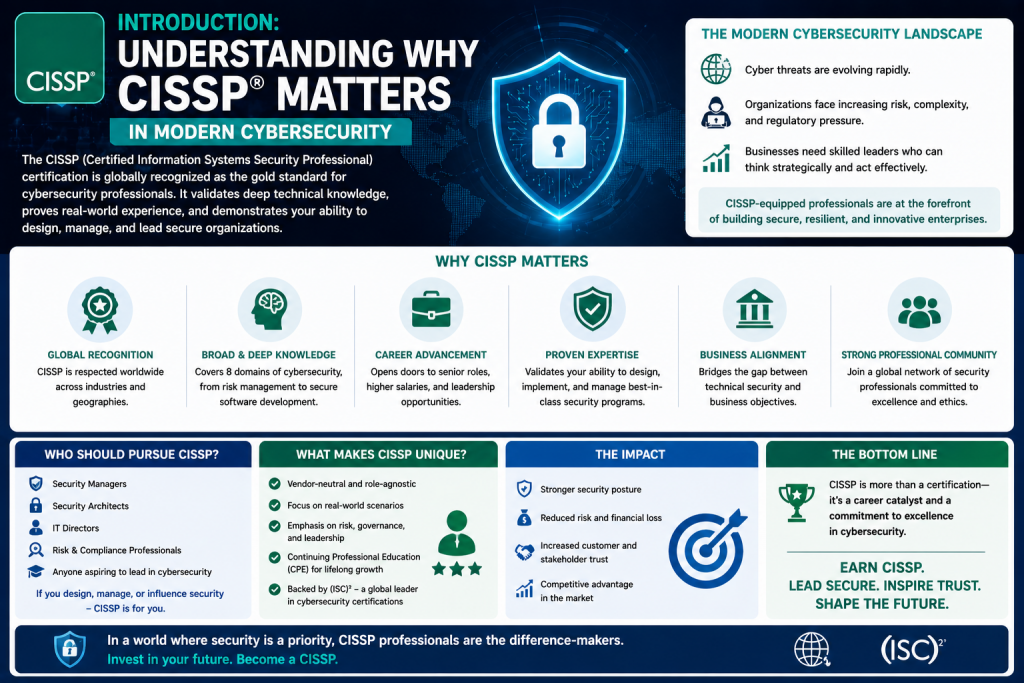
The Certified Information Systems Security Professional, commonly known as CISSP, has long been considered one of the most respected and prestigious certifications in the cybersecurity world. Issued by ISC2, this credential is widely recognized across industries, governments, consulting firms, and multinational enterprises as proof that a professional possesses advanced expertise in designing, implementing, managing, and leading information security programs. For decades, CISSP has represented a major milestone for security professionals who want to move beyond technical implementation and into strategic cybersecurity leadership.
In an era where cyberattacks have become more frequent, more sophisticated, and more financially devastating, organizations are under enormous pressure to strengthen security governance. Businesses no longer need only technical specialists who can configure firewalls or monitor logs—they need experienced professionals who can create policies, manage enterprise risk, oversee security architecture, align security with business strategy, and lead teams through crisis. CISSP was designed specifically to validate this higher level of capability.
For many professionals, earning CISSP is not simply about passing an exam. It is a career-defining progression that demonstrates readiness for leadership roles such as security manager, security architect, compliance director, security consultant, governance lead, or Chief Information Security Officer. Employers often view CISSP as a signal that a candidate possesses both technical depth and managerial maturity. This distinction is critical because cybersecurity leadership requires more than understanding tools—it demands strategic thinking, policy development, risk prioritization, and communication with executives.
The global respect associated with CISSP comes from its comprehensive scope. Rather than focusing on one narrow specialty, it evaluates broad competence across security governance, architecture, operational security, software development security, and business continuity. This breadth reflects real-world expectations. Security leaders are expected to understand multiple dimensions of enterprise defense, from technical implementation to legal and compliance implications.
CISSP has also remained relevant because it evolves with the industry. As organizations increasingly adopt cloud platforms, zero trust models, hybrid workforces, artificial intelligence systems, and software-defined infrastructure, security challenges continue to expand. ISC2 regularly updates the certification framework to ensure that CISSP reflects current business and technical realities. This adaptability has helped preserve its status as a gold standard rather than a legacy credential.
Professionals often pursue CISSP because it offers benefits beyond knowledge validation. It can significantly strengthen employability, increase salary potential, improve consulting credibility, support promotion into management, and satisfy requirements for certain government or defense positions. In highly competitive job markets, where employers may receive hundreds of applications for security leadership positions, CISSP can act as an important differentiator.
At the same time, CISSP is not an entry-level certification. It is intentionally rigorous and designed for professionals who already possess meaningful cybersecurity experience. This reinforces its reputation. When employers see CISSP on a résumé, they often associate it with real-world experience rather than theoretical familiarity alone.
This first stage of the CISSP journey begins with understanding exactly what the certification is, why it matters, who it is designed for, and how it can reshape a cybersecurity career. Before diving into exam strategies or domain-specific preparation, candidates need a clear picture of the broader professional significance of CISSP and the mindset required to succeed.
What CISSP Actually Represents
CISSP is fundamentally different from many technical certifications because it validates enterprise security leadership rather than isolated technical specialization. It confirms that a candidate understands how to build, govern, and sustain security programs across an organization.
This means the certification measures competence in multiple dimensions, including governance, architecture, operational resilience, compliance, and risk management. A CISSP-certified professional is expected to think beyond individual tools and instead understand how security integrates into broader business priorities.
For example, while a technical engineer may focus on configuring access controls, a CISSP-level professional must evaluate whether those controls align with business risk tolerance, regulatory requirements, and operational continuity. This distinction is central to the certification’s purpose.
CISSP demonstrates that a professional can:
Develop enterprise security strategies
Manage organizational risk
Design secure infrastructure frameworks
Support governance and compliance objectives
Oversee incident response programs
Guide business continuity planning
Evaluate software and development security
Manage identity and access governance
This broad perspective is why CISSP often appeals to professionals seeking leadership opportunities rather than purely operational positions.
The Difference Between Technical Security and Security Leadership
A common misconception is that CISSP is simply a harder technical exam. In reality, it is often more accurate to view CISSP as a leadership and strategy certification with technical depth.
Many cybersecurity professionals begin their careers in hands-on roles such as:
Network administration
System administration
Security operations
Vulnerability management
Technical support
Cloud infrastructure
These positions are essential, but leadership roles require a broader set of capabilities. Security leaders must make decisions that impact policy, governance, compliance, budgeting, and organizational resilience.
For example, a systems administrator may know how to implement encryption, but a CISSP-level leader must determine:
Which encryption standards best align with compliance obligations
How encryption impacts operational performance
How key management should be governed
How encryption policy supports enterprise security objectives
This expanded strategic lens is one of the biggest transitions candidates experience while preparing for CISSP.
Why Employers Value CISSP
Organizations increasingly view cybersecurity as a business-critical function rather than a technical support discipline. Security incidents now influence stock prices, legal exposure, customer trust, operational continuity, and brand reputation. As a result, employers seek professionals who can lead security strategically.
CISSP often signals that a candidate has reached this level.
Hiring managers frequently associate CISSP with:
Leadership readiness
Governance understanding
Policy development capability
Regulatory awareness
Strategic decision-making
Cross-functional communication skills
In consulting and enterprise hiring, CISSP can also help reassure stakeholders that a candidate has met internationally recognized standards.
For organizations subject to strict regulations or security frameworks, CISSP may be particularly valuable because it reflects broad awareness of compliance and governance structures.
Additionally, some public sector or defense-related roles specifically recognize CISSP as meeting qualification requirements, making it especially relevant for professionals pursuing security positions in regulated industries.
Who Should Consider Pursuing CISSP
CISSP is generally best suited for professionals who already have practical experience and want to elevate their career trajectory.
Ideal candidates often include:
Security analysts transitioning into management
Network engineers moving into architecture
Compliance specialists expanding into enterprise governance
Security consultants seeking credibility
Systems administrators advancing toward security leadership
IT managers responsible for organizational security strategy
Because CISSP covers both technical and managerial concepts, candidates often benefit most when they already understand operational IT or cybersecurity environments.
For many professionals, CISSP becomes a bridge between mid-level technical expertise and senior strategic influence.
Experience Requirements and Professional Credibility
One of the defining features of CISSP is its experience requirement. ISC2 generally requires five years of cumulative paid work experience in relevant cybersecurity domains. This requirement reinforces the certification’s advanced status.
A degree or approved credential may substitute for one year, but the emphasis on practical experience remains significant.
This structure matters because it protects CISSP’s credibility. Unlike certifications that can be earned primarily through study alone, CISSP is designed to reflect both knowledge and applied professional maturity.
For professionals without sufficient experience, the Associate of ISC2 pathway offers an alternative. Candidates can pass the exam first and then complete required experience over time.
This pathway allows ambitious professionals to begin their CISSP journey early while preserving the certification’s reputation for experience-backed competence.
The Career Impact of CISSP
For many cybersecurity professionals, CISSP serves as a turning point. It often opens doors to positions that may otherwise remain inaccessible.
Common career advancements after CISSP may include:
Information Security Manager
Security Architect
Cybersecurity Consultant
Governance Risk and Compliance Manager
Director of Security
Chief Information Security Officer
Enterprise Security Engineer
Because CISSP demonstrates strategic breadth, it can also support transitions across industries. A CISSP holder may work in healthcare, finance, manufacturing, cloud technology, government, or consulting with broader portability than many specialized certifications.
This flexibility can be especially valuable in a rapidly evolving cybersecurity job market.
Financial and Professional Return on Investment
Although earning CISSP requires significant effort, many professionals view it as a high-value investment due to its potential career and salary benefits.
CISSP can contribute to:
Higher compensation potential
Leadership eligibility
Promotion opportunities
Broader consulting authority
Greater employer trust
Enhanced professional reputation
The certification’s long-standing prestige often makes it a worthwhile strategic credential for professionals focused on long-term advancement.
However, the true value often extends beyond compensation. CISSP preparation can fundamentally reshape how candidates think about security—from technical problem-solving to enterprise-wide strategic protection.
The Importance of Mindset Before Preparation
Before studying specific concepts, aspiring CISSP candidates benefit from understanding that the exam frequently tests decision-making philosophy rather than pure memorization.
Candidates must often answer from the perspective of:
Risk reduction
Business continuity
Governance alignment
Legal responsibility
Strategic leadership
This means technical answers are not always the best answers. The correct response may instead prioritize policy, governance, or organizational objectives.
For example, a technical professional might instinctively choose the most secure technical option, while CISSP may favor the option that best balances security with business practicality.
This shift can be challenging, but it is central to CISSP success.
How CISSP Changes Professional Thinking
Many professionals report that studying for CISSP alters how they approach cybersecurity entirely.
Rather than focusing narrowly on systems, they begin to think in terms of:
Organizational ecosystems
Risk frameworks
Policy hierarchies
Strategic resilience
Operational governance
Executive communication
This broader mindset often provides value even before certification is earned. The preparation process itself can improve professional maturity and strategic capability.
Building a Long-Term Security Career Through CISSP
CISSP is often not the final destination—it can become the foundation for future specialization.
After CISSP, professionals may pursue advanced concentrations or complementary credentials in areas such as:
Cloud security
Architecture
Management
Software security
Risk governance
This makes CISSP not only a certification but also a strategic platform for sustained career growth.
For professionals serious about becoming enterprise security leaders, CISSP frequently serves as one of the most important credentials they will ever pursue.
Understanding the CISSP Exam Structure and What Has Changed
Once professionals understand why CISSP is so respected and how it can shape long-term cybersecurity leadership, the next critical step is understanding the exam itself. CISSP is not simply a knowledge check—it is a carefully designed professional evaluation intended to determine whether a candidate can think, prioritize, and make decisions like an experienced security leader. Many candidates underestimate this distinction, focusing heavily on memorization while failing to prepare for the broader managerial and strategic thinking the exam demands.
The CISSP examination has evolved significantly over the years to remain aligned with real-world cybersecurity expectations. Earlier versions were longer, more exhausting, and often emphasized broad knowledge recall over adaptive precision. However, ISC2 modernized the exam structure to improve efficiency while preserving rigor. These changes reflect the reality that cybersecurity leaders must not only possess knowledge but also demonstrate judgment under pressure.
Today, CISSP uses a Computerized Adaptive Testing format for many English-language candidates. This system dynamically adjusts question difficulty based on performance. Rather than presenting every candidate with the same fixed sequence, the exam evaluates responses in real time and adjusts subsequent questions to better measure competence. If a candidate consistently demonstrates strong understanding, the system may present more difficult questions to validate expertise. If weaknesses appear, it may adjust accordingly.
This adaptive approach means the exam is often shorter than older formats, but not easier. In fact, many professionals consider it more mentally demanding because each question may carry greater evaluative weight. Candidates cannot simply rely on endurance; they must maintain concentration, judgment, and strategic reasoning from start to finish.
The modern CISSP exam typically includes between 100 and 150 questions and must generally be completed within three hours. The passing score remains 700 out of 1,000 points. Questions may include traditional multiple-choice formats, but candidates should also expect advanced item types such as drag-and-drop scenarios or hotspot interactions. These newer formats are designed to test practical understanding rather than passive recall.
One of the most important realities about CISSP is that the exam often feels different from many technical certification exams. Instead of asking what a firewall port does or which protocol uses a specific number, CISSP frequently asks candidates to identify the best course of action from a leadership perspective. This often means evaluating business priorities, governance obligations, and risk implications simultaneously.
For example, a technically correct solution may not always be the best CISSP answer if it ignores governance, policy, or organizational strategy. Candidates are often tested on what a security manager, architect, or executive should prioritize—not just what an engineer could technically implement.
This difference explains why even highly skilled technical professionals can struggle if they approach CISSP with purely operational thinking. Success requires candidates to think like decision-makers responsible for balancing security, cost, compliance, and business continuity.
The Eight-Domain Framework: Building a Comprehensive Security Mindset
CISSP’s structure is built around eight major knowledge areas that collectively represent enterprise cybersecurity leadership. While individual technical certifications may focus narrowly on penetration testing, networking, or cloud deployment, CISSP’s breadth reflects the reality that senior security professionals must understand interconnected systems of governance and protection.
These areas encompass security governance, risk, architecture, operational controls, and software assurance. Collectively, they create a framework for enterprise-level security thinking.
This structure is essential because cybersecurity leadership rarely operates in isolated silos. A governance decision may influence architecture. Architecture may impact operations. Operations may affect software development. Software vulnerabilities may alter compliance obligations. CISSP’s framework teaches candidates to think holistically.
Understanding this interconnectedness is one of the biggest advantages CISSP offers. It encourages professionals to stop viewing security as disconnected technical tasks and instead see it as an integrated business discipline.
Security and Risk Leadership
One of the heaviest areas of CISSP emphasizes governance, policy, ethics, compliance, and enterprise risk management. This reflects the increasing reality that organizations face legal, regulatory, and reputational consequences from poor security decisions.
Security leaders must understand how to:
Establish governance frameworks
Define acceptable risk
Develop policies and standards
Align security with business objectives
Address legal obligations
Manage third-party risk
Support executive accountability
This focus often surprises technically oriented candidates, but it reflects how modern organizations operate. Security is no longer purely technical—it is a governance issue with board-level implications.
Asset Protection and Data Responsibility
Modern enterprises rely on data as one of their most valuable assets. CISSP emphasizes that protecting information requires more than technical controls; it requires lifecycle governance.
Candidates must understand classification, ownership, retention, privacy, and handling standards. This means considering how data is stored, processed, transmitted, archived, and destroyed responsibly.
This perspective is increasingly relevant in environments shaped by privacy regulations, cloud transformation, and third-party ecosystems.
Architecture and Engineering Principles
Security architecture remains a cornerstone of CISSP because leadership professionals must understand how systems are designed securely from the ground up.
This includes:
Security models
System resilience
Cryptography concepts
Physical security principles
Secure engineering practices
Trusted computing
Rather than simply configuring tools, candidates are expected to understand why architectural decisions influence resilience.
Network and Communication Security
Even though CISSP is not a networking certification, communication security remains critical because enterprise defense depends heavily on secure data movement.
Professionals must understand secure design principles related to network segmentation, transport security, and infrastructure resilience. This includes appreciating strategic implications rather than memorizing isolated protocol facts alone.
Identity and Access Governance
Identity has become central to modern cybersecurity, particularly with zero trust models and cloud-first environments. CISSP emphasizes authentication, authorization, identity governance, and access control strategy.
Candidates must think beyond password policies and instead understand enterprise identity frameworks that support least privilege, accountability, and scalable governance.
Assessment and Validation
Security leaders must validate controls regularly. This includes audits, testing strategies, vulnerability assessments, and assurance processes.
CISSP expects candidates to understand how organizations measure effectiveness, identify weaknesses, and maintain trust.
Operational Security
Security operations represents the daily reality of protection, detection, and response. Candidates must understand monitoring, incident response, disaster recovery, and business continuity.
This domain is particularly important because leadership decisions during operational crises often define organizational resilience.
Software Development Security
As organizations increasingly depend on software, CISSP recognizes that insecure code can undermine even well-designed infrastructure.
Candidates must understand secure development lifecycle principles, software risk, testing, and change management.
This reflects the broader industry shift toward DevSecOps and secure-by-design philosophy.
How to Prepare Strategically Rather Than Memorizing
Many CISSP candidates initially assume that purchasing books and memorizing terminology will be enough. In reality, this strategy often proves insufficient.
Because CISSP evaluates judgment, effective preparation usually requires layered learning:
Reading for conceptual understanding
Practice exams for strategic reasoning
Scenario analysis for managerial judgment
Study groups for perspective expansion
Flashcards for terminology reinforcement
Real-world application mapping
Candidates should focus heavily on why concepts matter, not just what they are.
For example, rather than memorizing that a control exists, candidates should understand:
Why it is used
When it is prioritized
What business risk it addresses
How governance influences it
This strategic orientation often separates successful candidates from those who struggle.
The Importance of Practice Questions
Practice exams can be valuable, but only when used correctly. Many candidates misuse practice questions by focusing solely on score improvement.
Instead, practice questions should be treated as decision-making laboratories. Every incorrect answer is an opportunity to understand:
Why the right answer is best
Why the wrong answer seemed tempting
What strategic principle applies
How ISC2 frames priorities
This process helps candidates internalize the CISSP mindset.
Time Management During Preparation
Because CISSP covers broad material, preparation often requires structured planning.
A common mistake is overinvesting in favorite technical topics while neglecting governance or software security.
Balanced preparation often involves:
Weekly domain rotation
Mixed practice sessions
Periodic full-length simulation
Weakness reassessment
Managerial scenario review
This approach helps prevent knowledge silos.
Mental Readiness for Exam Day
CISSP’s challenge is not only intellectual—it is psychological. Adaptive testing, broad questions, and ambiguous scenarios can create anxiety.
Candidates benefit from preparing mentally by accepting that:
Some questions will feel uncertain
Two answers may seem plausible
Managerial thinking matters
Risk reduction often guides decisions
Policy may outweigh technical action
This psychological readiness can improve confidence significantly.
Common Pitfalls That Derail Candidates
Several recurring mistakes affect CISSP candidates:
Thinking too technically
Ignoring governance
Over-memorizing terminology
Neglecting software concepts
Misunderstanding business priorities
Rushing through scenario questions
Avoiding weaker domains
Recognizing these pitfalls early can improve preparation quality dramatically.
Why CISSP Preparation Often Improves Career Performance Before Certification
One overlooked benefit of CISSP is that preparation itself often enhances professional effectiveness.
As candidates study governance, architecture, and operational resilience, they frequently become better at:
Communicating with leadership
Understanding compliance
Evaluating enterprise risk
Supporting strategic initiatives
Leading teams
This means CISSP study may deliver career value even before exam success.
Building Toward Long-Term Certification Success
Passing CISSP rarely comes from isolated cramming. It often reflects a deliberate progression:
Understanding exam philosophy
Learning broad concepts
Practicing managerial reasoning
Strengthening weak areas
Simulating pressure
Adopting leadership perspective
Candidates who approach CISSP as professional transformation rather than simple test preparation often achieve stronger outcomes.
From Certification to Career Transformation: Maximizing CISSP for Long-Term Success
Earning the Certified Information Systems Security Professional credential is often described as a major professional milestone, but in reality, passing the exam is only one stage in a much broader journey. CISSP is not merely a certificate to place on a résumé—it is a professional framework that can shape leadership opportunities, strategic influence, career mobility, and long-term cybersecurity credibility. For many professionals, the true value of CISSP begins after certification, when the knowledge, recognition, and mindset developed during preparation start translating into real-world advancement.
By the time a candidate earns CISSP, they have generally demonstrated not only technical knowledge but also governance awareness, strategic thinking, and enterprise-level security maturity. This combination is what distinguishes CISSP from many narrower certifications. It signals to employers, clients, regulators, and executive stakeholders that the individual can think beyond immediate technical problems and contribute to larger organizational security strategy.
This distinction is increasingly important because cybersecurity has become a boardroom issue. Security leaders are now expected to advise executives on business risk, influence digital transformation, support regulatory compliance, protect customer trust, and guide organizations through crisis. As cyberattacks continue to impact global business operations, CISSP-certified professionals are often positioned to lead these efforts.
For this reason, CISSP is frequently viewed as a bridge between operational cybersecurity and executive influence. Professionals who once focused primarily on administration, engineering, or analysis may find that CISSP opens pathways into management, architecture, governance, or consulting. The credential can act as validation that they are prepared to move from implementing controls to shaping organizational direction.
However, maximizing CISSP requires intentional strategy. Certification alone does not guarantee career acceleration. Professionals who benefit most from CISSP are typically those who actively leverage it—through continued education, strategic networking, specialization, leadership development, and practical application.
Leveraging CISSP for Career Advancement
One of the most immediate benefits of CISSP is expanded access to senior cybersecurity opportunities. Many employers use CISSP as a benchmark for advanced positions, particularly those involving governance, architecture, or enterprise security management.
Common post-CISSP roles include:
Information Security Manager
Security Architect
Governance, Risk, and Compliance Director
Chief Information Security Officer
Security Consultant
Enterprise Risk Strategist
Cloud Security Leader
Security Program Manager
Because CISSP is internationally respected, it often increases geographic and industry mobility. A professional may transition from healthcare security into finance, consulting, manufacturing, or government more easily because CISSP demonstrates broad strategic capability rather than narrow technical specialization.
This flexibility can be especially valuable in a market where cybersecurity roles are diversifying rapidly.
For professionals already in leadership, CISSP may strengthen authority internally by validating expertise through an externally recognized standard. This can influence promotion potential, cross-functional trust, and strategic visibility.
Salary Potential and Market Perception
Compensation is not the only reason to pursue CISSP, but it is often a significant consideration. Across many regions, CISSP holders are associated with higher earning potential than peers without comparable advanced certifications.
This is often because organizations perceive CISSP-certified professionals as capable of overseeing broader security responsibilities, reducing strategic risk, and supporting executive objectives.
Salary growth influenced by CISSP may depend on:
Industry sector
Geographic location
Leadership responsibility
Cloud and compliance exposure
Management scope
Specialization depth
In regulated sectors such as finance, healthcare, and defense, CISSP may be especially valuable because organizations often prioritize professionals who can align technical security with governance obligations.
Beyond salary, CISSP can also influence consulting rates, contract opportunities, and speaking credibility.
CISSP and Government or Regulatory Opportunities
In many environments, CISSP carries added significance because it aligns with public sector or regulatory expectations. Certain defense, infrastructure, or government-aligned roles may specifically recognize CISSP as meeting established workforce frameworks.
This can create access to opportunities that may otherwise require additional qualification pathways.
For professionals pursuing government contracting, compliance leadership, or critical infrastructure security, CISSP can therefore offer both strategic and practical advantages.
The Importance of Maintaining CISSP Through Continuing Professional Education
Unlike certifications that end after passing, CISSP requires active maintenance. Professionals must complete Continuing Professional Education credits and pay annual maintenance fees to remain in good standing.
While some view this as administrative overhead, it actually reinforces CISSP’s strategic value. Cybersecurity evolves rapidly, and ongoing education ensures certified professionals remain informed about emerging technologies, governance frameworks, legal shifts, and threat trends.
Maintaining CISSP effectively encourages long-term professional relevance.
CPE activities may include:
Training programs
Industry conferences
Teaching or mentoring
Research publication
Security webinars
Professional association engagement
This structure supports continuous development rather than static qualification.
Specialization Pathways After CISSP
For many professionals, CISSP becomes a foundation for deeper specialization.
ISC2 and related ecosystems offer pathways that allow certified professionals to expand into focused leadership areas such as:
Security architecture
Security engineering
Security management
Cloud security
Software lifecycle security
Risk governance
For example, a CISSP-certified professional moving heavily into cloud transformation may pursue cloud-focused credentials. A governance leader may expand into management-oriented certifications. An architect may deepen expertise through infrastructure specialization.
This layered approach can create highly differentiated professional profiles.
Building Leadership Beyond Certification
Technical knowledge and certification credibility are valuable, but true cybersecurity leadership also requires broader business capability.
CISSP-certified professionals often gain the greatest career acceleration when they develop complementary strengths such as:
Executive communication
Budget strategy
Policy writing
Stakeholder management
Business continuity leadership
Vendor governance
Cross-department collaboration
Cybersecurity increasingly intersects with legal teams, finance departments, human resources, software engineering, and executive boards. Professionals who can communicate across these domains often rise faster than those who remain purely technical.
CISSP provides a foundation, but leadership growth often requires active expansion beyond exam material.
Networking and Professional Visibility
Another underappreciated component of CISSP success is professional network development.
Certification can create opportunities to connect with:
Security leaders
Hiring managers
Consultants
Industry peers
Conference communities
Mentorship networks
Professional visibility can lead to job opportunities, partnerships, consulting engagements, and broader market awareness.
Many CISSP professionals increase their impact by participating in conferences, writing, mentoring, or contributing to governance initiatives.
This visibility often amplifies the certification’s value.
Avoiding Career Stagnation After CISSP
A common misconception is that earning CISSP guarantees indefinite professional advantage. In reality, cybersecurity evolves too quickly for any credential alone to ensure long-term relevance.
Professionals who stagnate after CISSP may eventually lose competitive edge if they fail to adapt to:
Cloud-native security
Zero trust frameworks
AI governance
Software supply chain security
Privacy regulation
Operational resilience demands
The most successful CISSP professionals treat certification as a platform for growth rather than an endpoint.
Continuous adaptation remains essential.
Real-World Application: Translating CISSP into Organizational Impact
Ultimately, the greatest value of CISSP comes from how it is applied.
Certified professionals may influence organizations by:
Designing stronger governance models
Improving incident response maturity
Enhancing regulatory readiness
Strengthening architectural resilience
Reducing enterprise risk
Guiding digital transformation securely
Leading executive security planning
These practical outcomes are what truly define CISSP success.
Certification may open the door, but strategic execution sustains long-term value.
The Personal Development Side of CISSP
Beyond career progression, many CISSP holders report that the process changes how they think professionally.
They often become better at:
Risk prioritization
Decision-making
Strategic planning
Leadership communication
Long-term systems thinking
This cognitive transformation may be one of CISSP’s most meaningful benefits.
Rather than viewing cybersecurity as isolated controls, certified professionals increasingly understand it as an ecosystem of governance, architecture, operations, and trust.
Preparing for Executive-Level Roles
For professionals aspiring toward director or CISO positions, CISSP can be particularly important because it aligns strongly with enterprise leadership competencies.
While no certification alone guarantees executive readiness, CISSP frequently supports progression by reinforcing:
Governance maturity
Policy competence
Strategic breadth
Risk literacy
Leadership credibility
As organizations increasingly seek security leaders who understand both technology and business, CISSP often remains one of the most recognized stepping stones.
Long-Term Industry Relevance
Cybersecurity will continue evolving as organizations face new technologies, shifting regulatory environments, and increasingly sophisticated threat landscapes, but CISSP’s broad strategic framework helps maintain its long-term relevance. Rather than concentrating primarily on temporary technical tools, vendor-specific platforms, or rapidly changing implementation details, CISSP emphasizes governance, enterprise security architecture, leadership, policy, and risk management principles that remain valuable even as technologies change.
This strategic orientation allows CISSP-certified professionals to adapt more effectively across multiple generations of security transformation, whether organizations are moving from on-premises infrastructure to cloud ecosystems, adopting zero trust frameworks, integrating artificial intelligence, or responding to new compliance demands. Because the certification is rooted in foundational concepts such as governance, business continuity, legal responsibility, and organizational resilience, it often retains professional value longer than highly specialized certifications tied to a specific product, platform, or technical niche. While technical certifications can become outdated as tools evolve, CISSP’s enterprise-focused approach often ages better because it prepares professionals to lead through change rather than simply operate within a single technical moment.
This adaptability is one of the key reasons CISSP continues to be respected across industries—it validates not only current competence but also the ability to guide organizations strategically through future cybersecurity challenges. As businesses increasingly prioritize integrated security leadership over isolated technical specialization, professionals with CISSP are often better positioned to bridge the gap between executive priorities and technical execution. They can help organizations interpret emerging risks, align cybersecurity investments with strategic business objectives, and develop governance frameworks that remain resilient even when technology stacks change dramatically. This broader professional perspective can be especially valuable in large enterprises where digital transformation initiatives, mergers, cloud migrations, and global compliance pressures require adaptable leadership rather than narrow technical expertise alone. CISSP’s focus on enduring principles gives certified professionals a stronger foundation for sustained relevance, helping them remain influential even as the cybersecurity landscape continues to transform.
This does not mean CISSP replaces technical evolution—it means it can serve as a durable leadership credential while professionals continue adapting technically.
That durability is one reason CISSP remains respected decades after its introduction.
Building a Sustainable Security Legacy
For many professionals, success is not measured solely by salary or title but by influence. CISSP-certified leaders often help shape:
Organizational policy
Industry best practices
Risk culture
Governance maturity
Mentorship ecosystems
This broader impact can define a career legacy.
Professionals who use CISSP to support ethical leadership, organizational trust, and sustainable resilience may ultimately derive the greatest value from the certification.
Conclusion: CISSP as a Strategic Career Catalyst
The CISSP journey does not end when the exam is passed—it begins there. Certification represents entry into a higher level of cybersecurity responsibility where strategic thinking, governance leadership, and enterprise resilience become central.
For experienced professionals, CISSP can act as a powerful catalyst for transformation. It can open doors to leadership roles, strengthen credibility, expand earning potential, and support long-term adaptability. More importantly, it can reshape how professionals think about cybersecurity itself.
The most successful CISSP holders are not those who simply earn the credential, but those who actively apply it—using its principles to lead organizations, guide transformation, reduce risk, and build sustainable security programs.
In a digital era where cybersecurity leadership is increasingly essential, CISSP remains one of the most influential and respected credentials available. For those committed to long-term success, it is more than a certification—it is a professional roadmap toward leadership, resilience, and lasting impact.
Continue exploring the technologies and certification concepts that matter most to you.