In today’s interconnected digital landscape, organizations are no longer operating within clearly defined network boundaries. The rise of cloud computing, mobile devices, and remote work has fundamentally changed how users interact with corporate systems. Employees now access resources from various locations, often using personal or unmanaged devices, which significantly increases the potential attack surface. As a result, traditional security mechanisms that rely solely on perimeter defenses and static credentials are no longer sufficient.
Passwords alone have proven to be a weak line of defense. Cybercriminals frequently exploit password vulnerabilities through phishing attacks, brute-force attempts, and credential stuffing. Even when users follow best practices, such as creating complex passwords, those credentials can still be compromised. This has created an urgent need for more adaptive and intelligent security solutions that go beyond simple authentication.
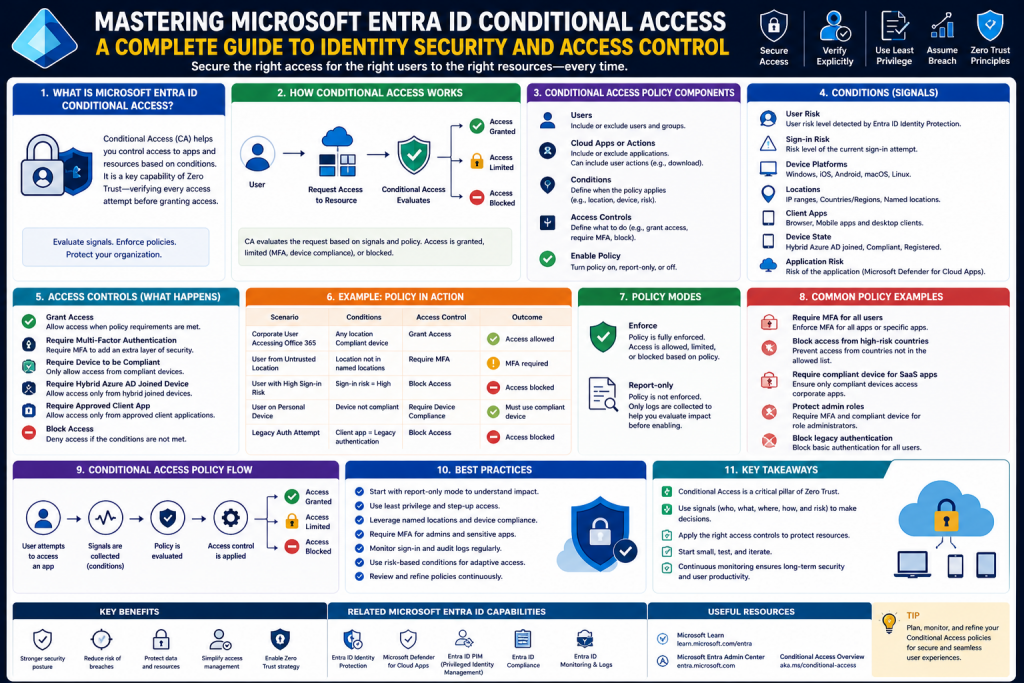
Microsoft Entra ID Conditional Access addresses this challenge by introducing a dynamic, policy-based approach to access control. Instead of granting or denying access based solely on a username and password, Conditional Access evaluates multiple factors in real time. These factors include the user’s identity, device status, location, and risk level. By analyzing this context, the system can make more informed decisions about whether to allow access, require additional verification, or block the request entirely.
This approach ensures that security measures are applied where they are needed most while minimizing unnecessary friction for legitimate users. It represents a shift from reactive security to proactive and adaptive protection, enabling organizations to respond effectively to modern threats.
What is Microsoft Entra ID Conditional Access
Microsoft Entra ID Conditional Access is a policy-driven security capability that acts as a decision-making engine for access requests. It evaluates each sign-in attempt in real time and applies predefined policies to determine the appropriate outcome. These outcomes can include granting access, requiring additional authentication steps, or denying access altogether.
The concept of Conditional Access is rooted in the idea that access decisions should not be static. Instead, they should be based on the context of each request. For example, a user logging in from a trusted device within a corporate network may be granted immediate access. However, the same user attempting to log in from an unfamiliar device in a different country may be required to complete multifactor authentication or may even be blocked.
This flexibility allows organizations to enforce security policies that align with their specific needs and risk tolerance. It also enables them to protect sensitive data without creating unnecessary barriers for users.
Conditional Access is an integral part of the broader identity and access management ecosystem within Microsoft Entra ID. It works alongside other security features, such as identity protection and device management, to provide a comprehensive approach to securing access.
The Shift Toward Context-Aware Security
Traditional access control systems were designed for a time when users operated within a controlled network environment. In such settings, once a user was authenticated and granted access to the network, they were often trusted implicitly. This model is commonly referred to as perimeter-based security.
However, the modern workplace has rendered this model obsolete. With users accessing resources from various locations and devices, the concept of a secure perimeter no longer holds. Organizations must now assume that threats can originate from both outside and inside the network.
Context-aware security addresses this challenge by evaluating each access request based on its unique characteristics. Instead of relying on a single factor, such as a password, it considers multiple signals to determine the level of risk associated with a request.
Conditional Access embodies this approach by continuously analyzing contextual information. This includes user behavior, device compliance, geographic location, and real-time risk assessments. By doing so, it can identify unusual or suspicious activity and respond accordingly.
This shift toward context-aware security is essential for protecting modern IT environments. It allows organizations to move beyond static rules and adopt a more dynamic and intelligent approach to access control.
Core Components of Conditional Access
Conditional Access is built on several key components that work together to enforce security policies. Understanding these components is essential for grasping how the system operates.
One of the primary components is users and groups. Administrators can define which users, groups, or roles a policy applies to. This allows for targeted enforcement of security measures based on organizational structure.
Another important component is cloud applications and services. Conditional Access policies can be applied to specific applications, ensuring that sensitive resources are protected with appropriate controls.
Conditions are also a critical element. These include factors such as location, device platform, sign-in risk, and client application type. Conditions provide the context needed to evaluate each access request.
Access controls determine the actions that are taken based on the evaluation. These actions can include requiring multifactor authentication, enforcing device compliance, or blocking access.
Session controls extend security beyond the initial login. They can enforce restrictions during an active session, such as limiting access to certain features or requiring periodic reauthentication.
Together, these components create a flexible and powerful framework for managing access in a variety of scenarios.
How Conditional Access Works in Real Time
When a user attempts to sign in to an application or service, Conditional Access immediately begins evaluating the request. This process involves collecting and analyzing a range of signals to determine the appropriate response.
The first step is identity verification. The system confirms the user’s credentials and retrieves information about their role, group membership, and permissions. This establishes the baseline for the access request.
Next, the system examines the device being used. It checks whether the device is managed by the organization and whether it meets security requirements. Devices that are not compliant may trigger additional controls or be denied access.
Location is another important factor. Conditional Access can detect where the login attempt is originating from and compare it to known or trusted locations. Unusual locations may increase the perceived risk of the request.
Risk assessment plays a significant role in the evaluation process. Using advanced analytics, the system determines whether the sign-in attempt appears suspicious. This could be based on factors such as unusual login patterns or known attack indicators.
Once all these signals are collected, Conditional Access compares them against the defined policies. Based on this evaluation, it decides whether to allow access, require additional verification, or block the request.
This entire process happens in real time, ensuring that security decisions are both fast and effective.
The Role of Multifactor Authentication
Multifactor authentication is one of the most important tools used by Conditional Access to enhance security. It requires users to provide additional proof of identity beyond just a password, making it much harder for attackers to gain unauthorized access.
Conditional Access allows organizations to apply multifactor authentication selectively. Instead of requiring it for every login, policies can specify when it is necessary. This ensures that users are not burdened with unnecessary authentication steps while still maintaining a high level of security.
For example, a user logging in from a trusted device in a familiar location may not need to complete multifactor authentication. However, if the same user attempts to log in from an unfamiliar device or location, they may be required to verify their identity using a second factor.
This adaptive approach improves both security and user experience. It ensures that additional verification is required only when the risk level justifies it.
Device Compliance and Security
Devices play a crucial role in the security of modern IT environments. An unsecured or compromised device can serve as an entry point for attackers, even if the user’s credentials are valid. Conditional Access addresses this risk by evaluating the security posture of devices during the login process.
Organizations can define compliance policies that specify the requirements a device must meet to be considered secure. These requirements may include having encryption enabled, running up-to-date antivirus software, and installing the latest security updates.
Conditional Access integrates with endpoint management solutions to enforce these policies. If a device does not meet the required standards, access can be restricted or denied.
This ensures that only secure devices are used to access sensitive resources, reducing the risk of data breaches and other security incidents.
Location-Based Access Control
Location is another key factor in Conditional Access policies. Organizations can define trusted locations, such as corporate offices or specific geographic regions, and apply different security requirements based on where a login attempt originates.
For example, access requests from trusted locations may be granted with minimal restrictions, while requests from unfamiliar or high-risk locations may require additional verification or be blocked entirely.
This capability is particularly useful for preventing unauthorized access from regions known for high levels of cybercrime. It also allows organizations to enforce geographic restrictions based on regulatory requirements.
By incorporating location into access decisions, Conditional Access adds an additional layer of protection against potential threats.
Risk-Based Decision Making
One of the most powerful features of Conditional Access is its ability to make decisions based on risk. Instead of treating all access requests equally, it evaluates the likelihood that a request is malicious and applies appropriate controls.
Risk assessment is based on a variety of factors, including user behavior, device characteristics, and known threat indicators. Advanced analytics and machine learning are used to identify patterns that may indicate suspicious activity.
For example, a login attempt from a new device in a different country may be flagged as high risk. In such cases, Conditional Access may require multifactor authentication or block the request altogether.
This risk-based approach allows organizations to respond dynamically to potential threats, providing a higher level of security than traditional methods.
Balancing Security and User Experience
One of the key challenges in implementing security measures is ensuring that they do not negatively impact user productivity. Overly strict policies can lead to frustration and reduced efficiency, while overly lenient policies can expose the organization to risk.
Conditional Access addresses this challenge by applying security measures intelligently. It uses contextual information to determine when additional controls are necessary, allowing users to work seamlessly under normal conditions.
For example, a user working from a trusted device in a familiar location may be granted immediate access without additional verification. However, if the same user attempts to access the system from a public network, additional security measures may be applied.
This adaptive approach ensures that security does not come at the expense of usability.
Foundation for Advanced Security Strategies
Conditional Access serves as a foundation for more advanced security strategies. It can be integrated with other tools and technologies to create a comprehensive security framework.
For example, it can be used to enforce stricter controls for external users, ensuring that partners and vendors have limited access to sensitive resources. It can also be combined with device management solutions to enforce compliance across a wide range of devices.
In addition, Conditional Access can work alongside threat detection systems to respond automatically to potential security incidents. This creates a proactive security posture that is capable of adapting to evolving threats.
Closing Perspective on Conditional Access Fundamentals
Microsoft Entra ID Conditional Access represents a significant advancement in access control technology. By combining real-time evaluation, contextual awareness, and policy-driven enforcement, it provides a powerful and flexible solution for modern security challenges.
It moves beyond the limitations of traditional methods and embraces a more intelligent approach to protecting access. By evaluating each request individually and applying appropriate controls, it ensures that the right users have access to the right resources under the right conditions.
As organizations continue to evolve and adopt new technologies, Conditional Access will play an increasingly important role in securing their digital environments. It provides the tools needed to navigate the complexities of modern access management while maintaining a strong focus on both security and user experience.
Deep Dive into Conditional Access Policy Structure
Microsoft Extra ID Conditional Access policies are the backbone of how access decisions are enforced in modern identity-driven security environments. While the concept of Conditional Access is straightforward at a high level, its real strength lies in how policies are structured and combined to create highly specific and adaptive access controls.
Each policy is essentially a set of if-then rules. If certain conditions are met, then a specific control is applied. These policies are evaluated every time a user attempts to access a protected resource. What makes this powerful is the flexibility to combine multiple signals and define precise outcomes.
Policies are not isolated. Multiple Conditional Access policies can apply to a single sign-in attempt, and all relevant policies are evaluated together. This means administrators must design policies carefully to avoid conflicts or unintended access behaviors. A well-designed policy framework ensures that security is layered, consistent, and predictable.
Another important aspect is policy scope. Policies can target specific users, groups, roles, or even all users within an organization. This allows organizations to gradually roll out security controls, starting with high-risk users or sensitive systems before expanding coverage.
Policy naming and organization also play a critical role. As the number of policies grows, clear naming conventions and documentation become essential for maintainability. Without proper structure, managing Conditional Access can quickly become complex.
Users, Roles, and Group Targeting
One of the first decisions in any Conditional Access policy is determining who it applies to. Microsoft Entra ID provides flexible options for targeting users, including individual accounts, security groups, and directory roles.
Targeting specific users allows for precise control, but it is not scalable in large environments. Instead, most organizations rely on groups to manage policy scope. By assigning users to groups based on department, role, or risk level, administrators can apply policies more efficiently.
Directory roles are particularly useful for securing privileged accounts. Administrators, for example, have elevated permissions and represent a higher risk if compromised. Conditional Access policies can enforce stricter controls for these roles, such as requiring multifactor authentication for every login or restricting access to managed devices only.
Another important consideration is excluding certain accounts from policies. Emergency access accounts, sometimes referred to as break-glass accounts, are typically excluded to ensure that administrators can regain access in case of misconfiguration. However, these accounts must be protected with strong credentials and monitored closely.
Guest users and external identities can also be targeted. These users often require different security controls compared to internal employees. Conditional Access allows organizations to enforce stricter requirements for external users, ensuring that access is tightly controlled.
Cloud Applications and Resource Protection
Conditional Access policies can be applied to specific cloud applications and services. This allows organizations to prioritize protection for critical resources while applying lighter controls to less sensitive systems.
Applications can include Microsoft services such as email, collaboration tools, and storage platforms, as well as third-party applications integrated with Microsoft Entra ID. By selecting specific applications within a policy, administrators can tailor security requirements based on the sensitivity of the data being accessed.
For example, an organization may require multifactor authentication for access to financial systems but allow standard authentication for internal communication tools. This ensures that security efforts are focused where they matter most.
It is also possible to apply policies to all cloud applications. This approach provides comprehensive coverage but may require careful tuning to avoid excessive restrictions. Many organizations start with broad policies and then refine them over time.
Another important feature is the ability to protect specific actions within applications. For example, downloading sensitive files or accessing administrative functions may trigger additional controls. This level of granularity enhances security without limiting overall usability.
Conditions and Signal Evaluation
Conditions are at the heart of Conditional Access policies. They define the context in which a policy is applied and are based on various signals collected during a sign-in attempt.
One of the most commonly used conditions is location. Administrators can define trusted locations, such as corporate offices or known IP ranges, and apply different controls based on whether a login attempt originates from these locations. This helps reduce the risk of unauthorized access from unfamiliar regions.
Device platform is another important condition. Policies can differentiate between operating systems such as Windows, macOS, iOS, and Android. This allows organizations to enforce platform-specific requirements, ensuring that only supported and secure devices are used.
Client application type is also considered. This includes whether the user is accessing a service through a web browser, mobile app, or legacy protocol. Legacy authentication methods, which do not support modern security features, can be blocked to prevent exploitation.
Sign-in risk and user risk are advanced conditions that rely on analytics and machine learning. These signals evaluate the likelihood that a login attempt or user account has been compromised. High-risk scenarios can trigger stricter controls, such as requiring password resets or blocking access entirely.
By combining these conditions, organizations can create highly specific policies that adapt to different scenarios. This ensures that security measures are applied precisely where they are needed.
Access Controls and Enforcement Actions
Once conditions are evaluated, Conditional Access applies access controls to enforce the desired outcome. These controls determine what happens when a policy is triggered.
One of the most common controls is requiring multifactor authentication. This adds an extra layer of security by requiring users to verify their identity using a second factor. Conditional Access allows MFA to be enforced selectively, ensuring that it is used when risk levels justify it.
Device compliance is another key control. Policies can require that devices meet specific security standards before access is granted. Non-compliant devices may be blocked or granted limited access.
Blocking access is the most restrictive control. It is typically used in high-risk scenarios where the likelihood of compromise is significant. While effective, this control must be used carefully to avoid disrupting legitimate users.
Another important control is requiring approved applications. This ensures that users access resources only through trusted and secure applications. It is particularly useful for protecting data on mobile devices.
Session controls extend enforcement beyond the initial login. These controls can limit user actions within a session, such as restricting downloads or enforcing time-based access. This provides an additional layer of protection for sensitive data.
Session Management and Continuous Evaluation
Conditional Access does not stop at the moment of login. Session management plays a crucial role in maintaining security throughout the user’s interaction with a system.
Session controls allow administrators to define how long a session remains active and when reauthentication is required. For example, users may be required to sign in again after a certain period or when accessing sensitive resources.
Continuous evaluation is another important concept. Conditional Access can monitor user activity during a session and respond to changes in risk. If suspicious behavior is detected, the system can take immediate action, such as prompting for additional authentication or terminating the session.
This dynamic approach ensures that security remains effective even after access has been granted. It reduces the risk of attackers maintaining access over extended periods.
Session management also helps balance security and usability. By adjusting session durations and reauthentication requirements, organizations can provide a seamless user experience while maintaining strong protection.
Integration with Endpoint Management
Conditional Access integrates closely with endpoint management solutions to enforce device compliance. This integration allows organizations to ensure that only secure and properly managed devices can access corporate resources.
Endpoint management tools provide detailed information about device health, including security settings, installed software, and update status. Conditional Access uses this information to determine whether a device meets the required standards.
For example, a policy may require that devices have encryption enabled and the latest security updates installed. Devices that do not meet these criteria may be blocked from accessing sensitive applications.
This integration is particularly important in environments where users bring their own devices. By enforcing compliance policies, organizations can maintain security without restricting flexibility.
It also enables scenarios such as conditional access for mobile devices, where access is granted only if the device is enrolled and meets security requirements. This ensures that corporate data is protected regardless of where it is accessed.
Securing External and Guest Access
External users, such as partners, vendors, and contractors, often need access to organizational resources. However, these users typically present a higher risk because they are not directly managed by the organization.
Conditional Access provides tools to secure external access effectively. Policies can enforce stricter controls for guest users, such as requiring multifactor authentication for every login or restricting access to specific applications.
Access can also be limited based on conditions such as location or device compliance. This ensures that external users can only access resources under controlled circumstances.
Another important consideration is monitoring and auditing. Conditional Access logs provide visibility into external user activity, allowing organizations to detect and respond to potential security issues.
By applying targeted policies, organizations can enable collaboration with external users while maintaining strong security.
Advanced Use Cases and Real-World Scenarios
Conditional Access supports a wide range of advanced use cases that address real-world security challenges. These scenarios demonstrate the flexibility and power of the system.
One common use case is protecting privileged accounts. Administrators can enforce strict policies that require multifactor authentication, restrict access to managed devices, and limit access to trusted locations. This reduces the risk of compromise for high-value accounts.
Another scenario is securing remote work. Conditional Access can ensure that employees working from home or on the go meet security requirements before accessing corporate resources. This includes verifying device compliance and applying location-based controls.
Organizations can also use Conditional Access to protect sensitive data. Policies can restrict access to specific applications or actions, such as downloading confidential files. This helps prevent data leakage and unauthorized sharing.
Risk-based access control is another powerful use case. By evaluating sign-in risk in real time, Conditional Access can apply additional controls when suspicious activity is detected. This allows organizations to respond dynamically to potential threats.
These examples highlight how Conditional Access can be tailored to meet diverse security needs.
Policy Testing and Deployment Strategies
Implementing Conditional Access requires careful planning and testing to ensure that policies work as intended. Misconfigured policies can lead to access issues or security gaps, making a structured deployment approach essential.
One of the best practices is to use a report-only mode during initial testing. This allows administrators to see how policies would affect users without actually enforcing them. By analyzing the results, they can identify potential issues and make adjustments.
Pilot groups are another important strategy. Instead of applying policies to all users at once, organizations can start with a small group of users. This provides an opportunity to test policies in a controlled environment and gather feedback.
Gradual rollout is key to successful deployment. Policies can be expanded incrementally, ensuring that any issues are addressed before they impact a larger user base.
Monitoring and logging are also critical. Conditional Access provides detailed logs that show how policies are applied and what decisions are made. These logs help administrators troubleshoot issues and refine policies over time.
By following a structured approach, organizations can implement Conditional Access effectively while minimizing disruption.
Closing Perspective on Advanced Capabilities
Microsoft Extra ID Conditional Access is far more than a simple access control mechanism. Its true strength lies in its ability to combine multiple signals, enforce dynamic policies, and adapt to changing conditions in real time.
By leveraging its advanced capabilities, organizations can create a security framework that is both robust and flexible. From protecting privileged accounts to securing external access, Conditional Access provides the tools needed to address a wide range of challenges.
As organizations continue to evolve, the importance of intelligent access control will only grow. Conditional Access offers a scalable and adaptable solution that can meet these demands, ensuring that security remains strong without compromising user productivity.
This deeper understanding of policy structure, enforcement mechanisms, and real-world applications sets the stage for exploring optimization strategies, best practices, and long-term security planning.
Optimization Strategies for Conditional Access Policies
As organizations mature in their use of Microsoft Entrance ID Conditional Access, the focus shifts from initial deployment to optimization. Creating policies is only the beginning; refining them over time is what ensures long-term effectiveness. Optimization involves continuously evaluating how policies perform, identifying gaps, and adjusting configurations to align with evolving security needs.
One of the most important strategies is reducing policy overlap. When multiple policies apply to the same users and applications, unintended conflicts can occur. These conflicts may result in overly restrictive access or, in some cases, unintended access allowances. To prevent this, organizations should regularly review their policies and consolidate where possible.
Another optimization technique is prioritizing high-impact scenarios. Not all systems and users carry the same level of risk. By focusing on protecting critical applications, privileged accounts, and sensitive data, organizations can maximize the effectiveness of their security efforts. This targeted approach ensures that resources are allocated where they are needed most.
Policy tuning is also essential. As user behavior and organizational requirements change, policies must be updated to reflect these changes. For example, a company that expands into new geographic regions may need to adjust location-based policies to avoid blocking legitimate access.
Automation can further enhance optimization. By leveraging dynamic groups and automated risk detection, organizations can ensure that policies remain relevant without requiring constant manual intervention. This allows security teams to focus on strategic improvements rather than routine maintenance.
Monitoring, Logging, and Continuous Improvement
Effective security is not a one-time implementation but an ongoing process. Monitoring and logging play a crucial role in maintaining the effectiveness of Conditional Access policies. By analyzing access logs, organizations can gain valuable insights into how policies are being applied and identify potential issues.
Conditional Access logs provide detailed information about each sign-in attempt, including which policies were evaluated and what decisions were made. This visibility allows administrators to understand the impact of their policies and detect anomalies.
Continuous improvement involves using this data to refine policies over time. For example, if logs show frequent access denials for legitimate users, it may indicate that a policy is too restrictive. Conversely, if suspicious activity is not being flagged, additional controls may be needed.
Another important aspect is alerting. By setting up alerts for high-risk sign-ins or unusual activity, organizations can respond quickly to potential threats. This proactive approach helps prevent security incidents before they escalate.
Regular audits are also essential. Periodic reviews of Conditional Access policies ensure that they remain aligned with organizational goals and compliance requirements. These audits provide an opportunity to remove outdated policies and introduce new ones as needed.
Integrating Conditional Access with Broader Security Ecosystems
Conditional Access does not operate in isolation. Its effectiveness is greatly enhanced when integrated with other security tools and systems. This integration creates a comprehensive security ecosystem that provides multiple layers of protection.
Identity protection systems play a key role in this ecosystem. By analyzing user behavior and detecting anomalies, these systems provide risk signals that Conditional Access can use to make informed decisions. This combination enables real-time, risk-based access control.
Endpoint security solutions also contribute valuable information about device health and compliance. By integrating these solutions with Conditional Access, organizations can ensure that only secure devices are granted access to sensitive resources.
Security information and event management systems further enhance visibility. By aggregating logs from multiple sources, these systems provide a centralized view of security events. This allows organizations to detect patterns and respond to threats more effectively.
Cloud application security tools add another layer of protection by monitoring user activity within applications. Conditional Access can enforce restrictions based on this activity, ensuring that data is used appropriately.
This interconnected approach ensures that security measures are not isolated but work together to provide comprehensive protection.
Supporting Zero Trust Security Architecture
Conditional Access is a fundamental component of a Zero Trust security model. Zero Trust is based on the principle that no user or device should be trusted by default, regardless of their location. Every access request must be verified, and trust must be earned continuously.
Conditional Access enforces this principle by evaluating each sign-in attempt based on multiple factors. It ensures that access is granted only when specific conditions are met, reducing the risk of unauthorized access.
One of the key aspects of Zero Trust is continuous verification. Conditional Access supports this by monitoring user activity throughout a session and responding to changes in risk. This ensures that security is maintained even after access is granted.
Least privilege access is another important principle. Conditional Access helps enforce this by allowing organizations to define precise policies that limit access to only what is necessary. This reduces the potential impact of compromised accounts.
By aligning with Zero Trust principles, Conditional Access provides a strong foundation for modern security strategies. It enables organizations to move away from traditional perimeter-based models and adopt a more resilient approach.
Enhancing User Experience Without Compromising Security
While security is the primary goal of Conditional Access, user experience remains an important consideration. A system that is too restrictive can lead to frustration and decreased productivity, while a system that is too lenient can expose the organization to risk.
Conditional Access strikes a balance by applying controls intelligently. By using contextual information, it ensures that additional authentication steps are required only when necessary. This minimizes disruptions for legitimate users.
Single sign-on capabilities further enhance user experience. By allowing users to access multiple applications with a single set of credentials, it reduces the need for repeated logins. Conditional Access ensures that this convenience does not come at the expense of security.
Adaptive authentication is another key feature. By adjusting requirements based on risk levels, it provides a seamless experience under normal conditions while maintaining strong protection in high-risk scenarios.
User education also plays a role. By helping users understand why certain security measures are in place, organizations can improve acceptance and compliance. Clear communication reduces confusion and ensures that users follow best practices.
Addressing Common Challenges and Misconfigurations
Implementing Conditional Access is not without challenges. One of the most common issues is policy misconfiguration. Incorrectly configured policies can lead to unintended consequences, such as blocking legitimate users or leaving gaps in security.
To address this, organizations should adopt a structured approach to policy design. This includes defining clear objectives, testing policies thoroughly, and documenting configurations. By following best practices, they can minimize the risk of errors.
Another challenge is managing complexity. As the number of policies grows, it becomes more difficult to maintain a clear overview. Using consistent naming conventions and grouping related policies can help simplify management.
User resistance is another potential issue. Some users may find additional authentication steps inconvenient. Addressing this requires a balance between security and usability, as well as effective communication about the importance of these measures.
Legacy systems can also pose challenges. Older applications that do not support modern authentication methods may need to be updated or replaced. Conditional Access can block legacy authentication to improve security, but this may require careful planning.
By proactively addressing these challenges, organizations can ensure a smoother implementation and operation of Conditional Access.
Future Trends in Conditional Access and Identity Security
The field of identity security is constantly evolving, and Conditional Access continues to adapt to new challenges and technologies. One of the key trends is the increasing use of artificial intelligence and machine learning. These technologies enable more accurate risk assessments and faster response times.
Behavioral analytics is another emerging area. By analyzing patterns of user behavior, systems can detect anomalies that may indicate compromised accounts. Conditional Access can use these insights to apply appropriate controls.
Passwordless authentication is gaining traction as well. By eliminating the reliance on passwords, organizations can reduce the risk of credential-based attacks. Conditional Access can support passwordless methods by enforcing additional verification when needed.
Integration with emerging technologies, such as Internet of Things devices, is also becoming important. As more devices connect to corporate networks, ensuring their security becomes a priority. Conditional Access can play a role in managing access for these devices.
Regulatory requirements are also shaping the future of identity security. Organizations must ensure that their access control measures comply with data protection laws and industry standards. Conditional Access provides the flexibility needed to meet these requirements.
These trends highlight the importance of staying up to date with advancements in security technology. By embracing innovation, organizations can maintain a strong security posture.
Building a Long-Term Conditional Access Strategy
A successful Conditional Access implementation requires more than just technical configuration. It requires a long-term strategy that aligns with organizational goals and adapts to changing conditions.
This strategy should begin with a clear understanding of risk. Organizations must identify their most critical assets and the threats they face. This information forms the basis for policy design.
Collaboration between IT, security, and business teams is essential. By working together, these teams can ensure that policies meet both security and operational requirements. This collaborative approach helps avoid conflicts and ensures that policies are practical.
Training and awareness are also important. Administrators must be familiar with Conditional Access features and best practices, while users should understand how security measures affect them. Ongoing education ensures that everyone is prepared to support the organization’s security goals.
Regular reviews and updates are necessary to keep policies relevant. As technology and business needs evolve, policies must be adjusted accordingly. This ensures that security measures remain effective over time.
By adopting a strategic approach, organizations can maximize the benefits of Conditional Access and build a resilient security framework.
Conclusion
Microsoft Entra ID Conditional Access represents a transformative approach to managing access in modern IT environments. It moves beyond traditional security models by introducing a dynamic, context-aware system that evaluates every access request in real time. By considering factors such as user identity, device compliance, location, and risk level, it ensures that access decisions are both intelligent and adaptive.
Throughout its implementation and ongoing use, Conditional Access provides organizations with the tools needed to address a wide range of security challenges. From protecting sensitive data and securing remote work to enabling collaboration with external users, it offers a flexible and scalable solution. Its integration with broader security ecosystems further enhances its effectiveness, creating a comprehensive defense against evolving threats.
Equally important is its ability to balance security with user experience. By applying controls selectively and intelligently, it minimizes disruptions while maintaining strong protection. This ensures that users can remain productive without compromising the organization’s security posture.
As the digital landscape continues to evolve, the importance of identity-driven security will only grow. Conditional Access provides a strong foundation for this future, supporting advanced strategies such as Zero Trust and risk-based authentication. By continuously optimizing policies, monitoring activity, and adapting to new challenges, organizations can ensure that their security measures remain effective and resilient.
In the end, Conditional Access is more than just a feature. It is a critical component of modern cybersecurity, enabling organizations to protect their resources while empowering users to work securely and efficiently.
Continue exploring the technologies and certification concepts that matter most to you.