Cloud computing has become a foundational element of modern information technology. Organizations of all sizes are moving away from traditional infrastructure and toward cloud-based systems that provide flexibility, scalability, and efficiency. However, adopting cloud computing is not just about choosing services. It also involves deciding how those services are deployed and managed.
Cloud deployment models define the structure of a cloud environment. They determine where infrastructure is located, who owns it, who can access it, and how it is maintained. These decisions have a direct impact on cost, performance, security, and operational complexity.
Every organization has different priorities. Some focus on reducing costs, while others prioritize control and data protection. Some need rapid scalability, while others require strict compliance with regulations. Because of these varying needs, multiple cloud deployment models exist to accommodate different scenarios.
Understanding these models is essential for making informed decisions. A poorly chosen deployment model can lead to inefficiencies, security risks, and unnecessary expenses. On the other hand, the right model can enhance productivity, improve system reliability, and support long-term growth.
This article explores the four most widely used cloud deployment models: public cloud, private cloud, community cloud, and hybrid cloud. Each model offers unique benefits and challenges, and understanding them will help you determine which approach best suits your organization.
What is Cloud Deployment
Cloud deployment refers to the configuration of cloud infrastructure and services that are delivered over the internet. It involves the setup of hardware and software systems that enable users to access computing resources remotely.
These resources can include applications, storage, processing power, and networking capabilities. Instead of maintaining physical servers on-site, organizations can use cloud platforms to access these resources on demand.
Cloud services are often categorized into three main service models. Software as a Service allows users to access applications through a web browser without installing them locally. Platform as a Service provides tools and environments for developers to build and deploy applications. Infrastructure as a Service offers virtualized hardware resources such as servers and storage.
While service models define what is delivered, deployment models define how and where those services are hosted. This distinction is important because it influences how resources are controlled, secured, and managed.
When selecting a deployment model, organizations must consider several factors. These include available budget, technical expertise, data sensitivity, regulatory requirements, and expected workload. Network performance and reliability also play a critical role, as cloud services depend heavily on internet connectivity.
A well-designed cloud deployment strategy aligns technology with business goals. It ensures that resources are used efficiently while maintaining the desired level of performance and security.
Overview of Cloud Deployment Models
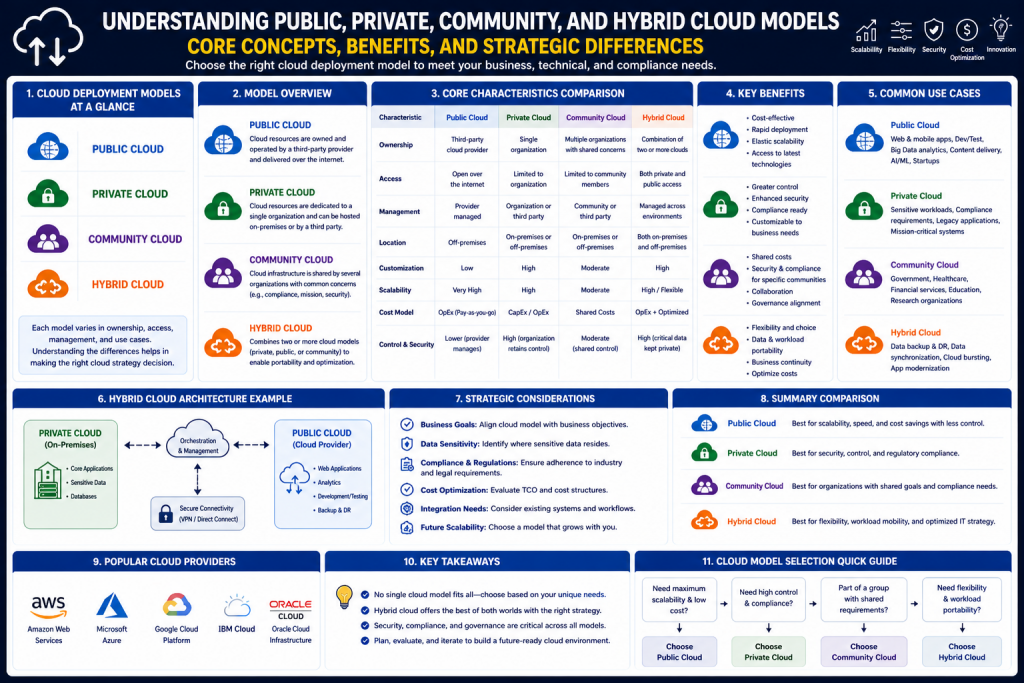
There are four primary cloud deployment models that organizations commonly use. These are public cloud, private cloud, community cloud, and hybrid cloud. Each model represents a different approach to managing and delivering cloud services.
Public cloud environments are shared among multiple users and managed by external providers. Private cloud environments are dedicated to a single organization and offer greater control. Community clouds are shared among organizations with similar needs and objectives. Hybrid clouds combine elements of different models to create a flexible and customized solution.
These models are not mutually exclusive. Many organizations use a combination of them to address different requirements. For example, a business might store sensitive data in a private cloud while using a public cloud for less critical applications.
Choosing the right model requires a clear understanding of business needs and technical constraints. It also involves evaluating the trade-offs between cost, control, and complexity.
Public Cloud Deployment
Public cloud deployment is one of the most widely adopted models in cloud computing. In this model, cloud services are delivered over the internet using shared infrastructure. The infrastructure is owned and managed by a third-party provider, which handles maintenance, updates, and security.
Organizations that use public cloud services do not need to invest in physical hardware. Instead, they can access computing resources on demand. This reduces the complexity of managing IT systems and allows businesses to focus on their core activities.
Public cloud platforms are designed to support large numbers of users. Resources are distributed across multiple data centers, ensuring high availability and resilience. This makes public cloud an ideal choice for applications that require reliability and scalability.
Another important aspect of public cloud deployment is its pricing model. Users typically pay only for the resources they consume. This eliminates the need for large upfront investments and allows organizations to manage costs more effectively.
Public cloud services are widely used for web applications, data storage, development environments, and testing platforms. They are particularly beneficial for startups and small businesses that need access to advanced technology without significant financial investment.
Benefits of Public Cloud Deployment
One of the most significant advantages of public cloud deployment is ease of use. The cloud provider manages the infrastructure, including hardware maintenance, software updates, and security patches. This reduces the workload for internal IT teams and simplifies operations.
Cost efficiency is another major benefit. Organizations do not need to purchase expensive hardware or maintain data centers. Instead, they can pay for resources as needed. This flexibility makes it easier to scale operations without incurring unnecessary costs.
Public cloud platforms also offer high performance and reliability. Providers invest heavily in infrastructure to ensure that services remain available and responsive. This level of performance is often difficult to achieve with traditional on-premises systems.
Scalability is a defining feature of public cloud environments. Organizations can quickly adjust resources based on demand. This is particularly useful for businesses with fluctuating workloads, such as e-commerce platforms or seasonal services.
Accessibility is another advantage. Users can access cloud services from anywhere with an internet connection. This supports remote work and enables collaboration across different locations.
Challenges of Public Cloud Deployment
Despite its many advantages, public cloud deployment also has limitations. One of the primary concerns is reduced control over infrastructure. Organizations must rely on the provider to manage systems, which may not always align with specific requirements.
Security and privacy are also important considerations. Although providers implement strong security measures, data is stored on shared infrastructure. Organizations must ensure that proper safeguards are in place to protect sensitive information.
Limited customization can be another drawback. Public cloud platforms are designed to serve a broad range of users, which can restrict the ability to tailor services to specific needs. Organizations with unique requirements may find this limiting.
Performance can also be affected by network conditions. Since public cloud services depend on internet connectivity, slow or unreliable networks can impact user experience.
Compliance requirements may pose additional challenges. Certain industries have strict regulations regarding data storage and processing. Organizations must ensure that their chosen cloud provider meets these requirements.
When to Use Public Cloud
Public cloud deployment is well suited for organizations that prioritize cost savings and scalability. It is ideal for applications that do not require strict control over infrastructure.
Businesses that experience variable demand can benefit from the flexibility of public cloud services. They can scale resources up during peak periods and reduce them when demand decreases.
Public cloud is also a good option for development and testing environments. It allows developers to quickly create and deploy applications without worrying about infrastructure management.
Organizations that want to focus on innovation rather than maintenance can benefit from the simplicity of public cloud platforms. By outsourcing infrastructure management, they can allocate more resources to strategic initiatives.
In many cases, public cloud serves as a starting point for cloud adoption. As organizations grow and their needs evolve, they may explore other deployment models to address specific requirements.
Real World Examples of Public Cloud Usage
Public cloud services are used in a wide range of industries. Online storage platforms allow users to store and access files from anywhere. Streaming services rely on cloud infrastructure to deliver content to millions of users simultaneously. E-commerce websites use public cloud platforms to handle large volumes of traffic during peak shopping periods.
Educational institutions use public cloud services to provide online learning platforms. Healthcare organizations use them to store and analyze patient data, although they must ensure compliance with regulations. Financial institutions use public cloud for non-sensitive workloads while maintaining stricter controls for critical data.
These examples demonstrate the versatility of public cloud deployment. It can support a wide variety of applications and use cases, making it a key component of modern IT strategies.
Private Cloud Deployment
Private cloud deployment is designed for organizations that require a higher level of control, security, and customization than what public cloud environments typically offer. In this model, cloud infrastructure is dedicated to a single organization and is not shared with other users. This exclusivity allows businesses to design and manage their environment according to their specific needs.
A private cloud can be hosted on-premises within an organization’s own data center or managed by a third-party provider in a dedicated environment. Regardless of where it is hosted, the defining characteristic is that the infrastructure is used by only one organization.
The technologies used in private clouds are similar to those found in public clouds. Virtualization, automation, and resource pooling are all key components. However, the ownership and control of these resources make private cloud environments fundamentally different.
Organizations that operate private clouds often have strict requirements for data protection, compliance, and system performance. Industries such as finance, healthcare, and government frequently rely on private cloud solutions to meet regulatory standards.
Key Characteristics of Private Cloud
Private cloud environments are defined by their exclusivity and control. Only authorized users within the organization can access the resources. This controlled access reduces the risk of unauthorized activity and enhances security.
Another important characteristic is customization. Organizations can tailor their infrastructure to meet specific operational requirements. This includes configuring hardware, selecting software, and implementing specialized security measures.
Private clouds also offer predictable performance. Since resources are not shared with other users, there is less variability in system performance. This makes private cloud an attractive option for applications that require consistent and reliable operation.
Integration is another key feature. Private clouds can be closely integrated with existing systems and workflows. This allows organizations to create a seamless environment that supports their business processes.
Benefits of Private Cloud Deployment
One of the primary advantages of private cloud deployment is increased control. Organizations have full authority over their infrastructure, including configuration, security policies, and access management. This level of control is particularly important for businesses that handle sensitive data.
Security is another major benefit. Private cloud environments can be designed with multiple layers of protection, including firewalls, encryption, and identity management systems. Organizations can implement security measures that align with their specific requirements.
Customization is a significant advantage as well. Businesses can develop and deploy solutions that are tailored to their needs. This flexibility allows them to optimize performance and efficiency.
Compliance is easier to achieve in a private cloud environment. Organizations can ensure that their systems meet regulatory standards by implementing appropriate controls and monitoring mechanisms.
Private clouds also support better resource utilization. Organizations can allocate resources based on priority and ensure that critical applications receive the necessary capacity.
Challenges of Private Cloud Deployment
Despite its advantages, private cloud deployment comes with several challenges. One of the most significant is cost. Building and maintaining a private cloud requires substantial investment in hardware, software, and personnel.
Organizations must also have the technical expertise to manage the environment. This includes skills in virtualization, networking, security, and system administration. Hiring and retaining skilled professionals can be expensive.
Maintenance is another challenge. Unlike public cloud environments where the provider handles updates and repairs, private cloud systems require ongoing management. This includes patching software, monitoring performance, and addressing issues.
Scalability can be more limited compared to public cloud. Expanding capacity often requires purchasing additional hardware, which can take time and increase costs.
Another consideration is energy consumption and physical space. On-premises private clouds require data centers, which consume power and require cooling systems.
When to Use Private Cloud
Private cloud deployment is ideal for organizations that require high levels of security and control. It is particularly suitable for industries with strict regulatory requirements.
Businesses that handle sensitive information, such as financial records or personal data, can benefit from the enhanced security of private cloud environments.
Private cloud is also a good choice for organizations with predictable workloads. Since resources are dedicated, performance remains consistent over time.
Companies that require customized solutions may prefer private cloud. The ability to tailor infrastructure and applications provides greater flexibility.
Organizations with sufficient resources and technical expertise are best positioned to implement private cloud solutions effectively.
Community Cloud Deployment
Community cloud deployment is a model in which multiple organizations share a cloud environment that is designed to meet their common needs. These organizations typically belong to the same industry or have similar objectives.
In a community cloud, infrastructure is shared among participants, but access is restricted to members of the community. This creates a balance between collaboration and security.
Community clouds are often used in sectors where organizations must adhere to similar regulations or standards. By sharing infrastructure, they can reduce costs while maintaining compliance.
This model encourages cooperation among participants. Organizations can share resources, knowledge, and best practices, leading to improved efficiency.
Key Characteristics of Community Cloud
Community cloud environments are defined by shared ownership and governance. Participating organizations collaborate to establish policies and manage resources.
Security is a shared responsibility. All members must adhere to agreed-upon standards to ensure the integrity of the system.
Cost sharing is another defining feature. Expenses related to infrastructure and maintenance are distributed among participants, making it more affordable than private cloud.
Community clouds also support collaboration. Organizations can work together on projects and share data in a controlled environment.
Benefits of Community Cloud Deployment
One of the main benefits of community cloud is cost efficiency. By sharing infrastructure, organizations can reduce expenses compared to maintaining separate systems.
Security is enhanced through standardized practices. Since all participants follow the same guidelines, it is easier to maintain a consistent level of protection.
Collaboration is another advantage. Organizations can share information and resources, leading to improved outcomes.
Community clouds also support compliance. Shared standards help ensure that all participants meet regulatory requirements.
This model can foster innovation by enabling organizations to work together on common challenges.
Challenges of Community Cloud Deployment
Community cloud deployment requires strong coordination among participants. Establishing and maintaining shared policies can be complex.
Security can be a concern if participants do not adhere to agreed standards. A weakness in one organization can affect the entire community.
Data isolation is another challenge. Ensuring that sensitive information is properly separated requires careful planning.
Limited availability is also a factor. Community cloud solutions are less common, which can make them harder to implement.
Governance can become complicated as the number of participants increases. Decision-making processes must be clearly defined to avoid conflicts.
When to Use Community Cloud
Community cloud deployment is suitable for organizations that share similar goals and requirements. It is often used in industries such as healthcare, education, and government.
Organizations that need to collaborate while maintaining security can benefit from this model.
Community cloud is also a good option for groups that want to reduce costs without sacrificing control.
It is particularly useful when multiple organizations must comply with the same regulations.
Real World Examples of Community Cloud Usage
Government agencies often use community cloud platforms to share information and coordinate services. Educational institutions may collaborate on research projects using shared infrastructure.
This shared approach allows organizations with similar objectives to pool resources while maintaining a controlled and secure environment tailored to their needs.
In the public sector, different government departments can use a community cloud to streamline communication and improve service delivery. For example, departments responsible for health, transportation, and public safety can access shared data systems to make faster and more informed decisions. This level of coordination enhances efficiency and reduces duplication of effort, which is especially important when managing large-scale operations or responding to emergencies.
In the education sector, universities and research institutions benefit from community clouds by gaining access to shared computing power and storage. This is particularly useful for data-intensive research projects that require significant processing capabilities. By collaborating on a common platform, institutions can share findings, tools, and methodologies more effectively, accelerating innovation and discovery.
Community clouds also support standardization across organizations. By following the same policies and frameworks, participants can ensure consistency in data handling, security practices, and compliance requirements. This is especially valuable in regulated environments where maintaining uniform standards is critical.
Overall, the use of community cloud platforms fosters collaboration, improves efficiency, and enables organizations to achieve shared goals while optimizing costs and resources.
Healthcare providers can use community clouds to exchange patient data securely while complying with regulations.
These examples highlight the value of collaboration and shared resources in community cloud environments.
Hybrid Cloud Deployment
Hybrid cloud deployment combines two or more cloud environments into a single, integrated system. Most commonly, this involves a mix of public and private cloud environments, although community cloud components can also be included. The goal of hybrid cloud is to leverage the strengths of each deployment model while minimizing their limitations.
In a hybrid cloud environment, different workloads are distributed across different platforms based on their requirements. Sensitive data and critical applications may be hosted in a private cloud, while less sensitive operations can run in a public cloud. This approach allows organizations to maintain control where necessary while still benefiting from scalability and cost efficiency.
Hybrid cloud is not simply about using multiple clouds. It requires proper integration and coordination between environments. Data must be able to move securely between systems, and applications must function seamlessly across platforms. This level of integration makes hybrid clouds more complex but also more powerful.
Organizations often adopt hybrid cloud strategies to achieve flexibility. By not relying on a single deployment model, they can adapt to changing business needs and technological advancements. This adaptability is one of the main reasons hybrid cloud has become increasingly popular.
Key Characteristics of Hybrid Cloud
Hybrid cloud environments are defined by their ability to connect and integrate multiple cloud systems. This integration allows data and applications to move between environments as needed.
It ensures that organizations are not restricted to a single platform and can dynamically choose where workloads should run based on performance, cost, or security requirements.
This level of integration is typically achieved through secure networking, standardized APIs, and orchestration tools that manage communication between environments. These technologies enable seamless data transfer while maintaining consistency and reliability across systems. As a result, applications can operate smoothly even when their components are distributed across different cloud platforms.
Another important aspect of integration is automation. Many hybrid cloud environments use automated processes to manage workload distribution, monitor system performance, and handle scaling. This reduces the need for manual intervention and improves operational efficiency.
Integration also supports better resource utilization. Organizations can optimize their infrastructure by shifting workloads to environments that offer the best performance or lowest cost at any given time. This flexibility helps avoid over-provisioning and reduces waste.
Overall, the ability to integrate multiple cloud systems is what makes hybrid cloud powerful. It allows organizations to build adaptable, efficient, and resilient IT environments that can respond quickly to changing business needs.
Another key characteristic is workload distribution. Organizations can assign tasks to different environments based on factors such as security, performance, and cost. This ensures that each workload is handled in the most appropriate way.
Hybrid cloud also offers scalability across environments. If demand increases, organizations can expand into public cloud resources without overloading private infrastructure.
Security remains a central feature. Sensitive data can be kept within private environments, while less critical operations can utilize shared resources. This layered approach enhances overall protection.
Flexibility is perhaps the most defining trait. Hybrid cloud allows organizations to design systems that meet their specific requirements rather than conforming to a single model.
Benefits of Hybrid Cloud Deployment
One of the most significant advantages of hybrid cloud is flexibility. Organizations can choose where to place workloads based on their needs. This allows for a more efficient use of resources.
Scalability is another major benefit. Hybrid cloud enables businesses to expand their capacity quickly by utilizing public cloud resources when demand increases. This prevents bottlenecks and ensures consistent performance.
Cost optimization is also a key advantage. Organizations can use private cloud for stable workloads and public cloud for variable demand. This approach helps balance costs while maintaining performance.
Improved security is another benefit. By keeping sensitive data in private environments, organizations can reduce exposure to potential threats. At the same time, they can take advantage of public cloud capabilities for less critical tasks.
Business continuity and disaster recovery are enhanced in hybrid cloud environments. Data can be replicated across multiple systems, ensuring that operations can continue even if one environment fails.
Challenges of Hybrid Cloud Deployment
Despite its advantages, hybrid cloud deployment introduces complexity. Managing multiple environments requires advanced tools and skilled personnel. Organizations must ensure that systems are properly integrated and maintained.
Security can also be more complicated. Data moving between environments must be protected, and consistent security policies must be enforced across all platforms.
Cost management can become challenging if resources are not carefully monitored. Without proper planning, organizations may end up paying for unnecessary services.
Data consistency is another concern. Ensuring that information remains synchronized across different environments requires careful coordination.
Compliance can also be more difficult to manage. Organizations must ensure that all environments meet regulatory requirements, which can vary depending on where data is stored.
When to Use Hybrid Cloud
Hybrid cloud deployment is ideal for organizations that need both flexibility and control. It is particularly useful for businesses with diverse workloads that have different requirements.
. In many cases, not all applications and data can be treated the same way, and hybrid cloud allows organizations to place each workload in the most suitable environment.
For example, mission-critical applications that require high security and strict compliance can be hosted in a private cloud, while less sensitive workloads such as testing, development, or customer-facing services can run in a public cloud. This separation ensures that organizations maintain control where it matters most while still benefiting from the scalability and cost efficiency of public cloud resources.
Hybrid cloud is also valuable for organizations undergoing digital transformation. Instead of migrating all systems at once, businesses can gradually move workloads to the cloud while keeping legacy systems operational. This reduces risk and allows for a smoother transition.
Additionally, hybrid cloud supports innovation by providing access to advanced tools and services available in public cloud environments. At the same time, it preserves the stability and reliability of existing infrastructure. This balance makes hybrid cloud an effective solution for organizations looking to modernize their IT systems without compromising control or security.
Companies that handle sensitive data but also require scalability can benefit from hybrid cloud. They can store critical information in private environments while using the public cloud for less sensitive operations.
Hybrid cloud is also suitable for organizations that are transitioning from traditional infrastructure to cloud-based systems. It allows them to migrate gradually rather than making a complete shift at once.
Businesses that experience fluctuating demand can use hybrid cloud to manage peak workloads without overinvesting in infrastructure.
Organizations that require strong disaster recovery capabilities can also benefit from hybrid cloud, as it allows data to be distributed across multiple environments.
Real World Examples of Hybrid Cloud Usage
Many large organizations use hybrid cloud to balance performance, cost, and security. For example, a financial institution might store sensitive customer data in a private cloud while using public cloud services for customer-facing applications.
This approach allows the organization to maintain strict control over critical information while still benefiting from the scalability and accessibility of public cloud platforms.
In addition to financial institutions, other industries also rely heavily on hybrid cloud strategies. Retail companies often use hybrid environments to manage fluctuating demand, especially during peak shopping seasons. Core systems such as inventory management may remain in a private cloud, while web applications and online storefronts run on public cloud infrastructure to handle increased traffic.
Healthcare organizations also benefit from hybrid cloud deployment. Patient records and confidential medical data can be stored securely in private environments, while public cloud resources are used for research, data analysis, and collaboration among medical professionals. This separation ensures compliance with strict privacy regulations while still enabling innovation.
Another advantage of hybrid cloud in large organizations is improved disaster recovery and business continuity. By distributing data and applications across multiple environments, companies can ensure that operations continue even if one system fails. This resilience makes hybrid cloud an attractive option for organizations that cannot afford downtime.
Retail companies often use hybrid cloud to handle seasonal demand. During peak shopping periods, they can scale operations using public cloud resources while maintaining core systems in private environments.
Healthcare organizations may use hybrid cloud to store patient records securely while leveraging public cloud for research and analytics.
Technology companies often adopt hybrid cloud to support development and testing environments. Developers can use public cloud resources for experimentation while keeping production systems secure in private environments.
These examples demonstrate how hybrid cloud can be adapted to meet a wide range of business needs.
Comparing All Four Deployment Models
Each cloud deployment model offers unique advantages and challenges. Public cloud provides scalability and cost efficiency but offers less control. Private cloud offers control and security but requires significant investment. Community cloud enables collaboration and cost sharing but requires coordination. Hybrid cloud combines the strengths of multiple models but introduces complexity.
When evaluating these models, organizations must go beyond basic features and consider how each option aligns with their long-term strategy. For example, a startup with limited resources may prioritize the affordability and flexibility of public cloud, while a large enterprise handling sensitive data may lean toward private cloud for greater control and compliance. The decision is rarely based on a single factor, and often involves balancing trade-offs between cost, performance, and security.
Operational complexity is another important consideration. Public cloud environments are relatively simple to deploy and manage, but they may not meet specialized requirements. Private cloud environments, while highly customizable, demand skilled personnel and ongoing maintenance. Community cloud introduces shared responsibility, which requires strong governance and clear agreements among participants. Hybrid cloud, while powerful, require careful integration to ensure smooth communication between different environments.
Scalability and performance also vary across models. Public cloud excels in handling unpredictable workloads, while private cloud provides consistent performance for stable operations. Hybrid cloud allows organizations to combine these strengths, but only if resources are properly allocated and managed.
Ultimately, the choice of deployment model should reflect the organization’s goals, technical capabilities, and regulatory requirements. A thoughtful approach ensures that the selected model not only meets current needs but also supports future growth and innovation.
Choosing the right model depends on an organization’s priorities. Businesses must consider factors such as budget, security requirements, technical expertise, and workload characteristics.
In many cases, organizations do not rely on a single model. Instead, they use a combination of deployment types to create a balanced and efficient system.
Understanding the differences between these models is essential for designing a cloud strategy that meets both current and future needs.
Future Trends in Cloud Deployment
Cloud deployment models continue to evolve as technology advances. Organizations are increasingly adopting multi-cloud strategies, which involve using multiple public cloud providers.
. This approach allows businesses to avoid dependence on a single vendor, reducing the risk of service outages and vendor lock-in. By distributing workloads across different providers, organizations can improve resilience and ensure that critical applications remain available even if one platform experiences issues.
Multi-cloud strategies also enable businesses to take advantage of the unique strengths of different providers. Some platforms may offer better pricing for storage, while others excel in analytics, artificial intelligence, or global network coverage. By carefully selecting services from multiple providers, organizations can optimize performance and cost efficiency.
Another important factor driving the adoption of multi-cloud is regulatory compliance. In some regions, data must be stored within specific geographic boundaries. Using multiple cloud providers allows organizations to meet these requirements while still maintaining flexibility in their operations.
However, managing a multi-cloud environment introduces additional complexity. Organizations must implement consistent security policies across all platforms, ensure data compatibility, and monitor performance effectively. This often requires advanced management tools and skilled personnel.
Despite these challenges, the benefits of multi-cloud are significant. It provides greater flexibility, improves fault tolerance, and allows organizations to build more robust and adaptable systems. As cloud technologies continue to develop, multi-cloud strategies are expected to become even more common, playing a key role in modern IT infrastructure.
Automation and artificial intelligence are playing a larger role in managing cloud environments. These technologies help optimize resource allocation and improve performance.
Edge computing is also influencing cloud deployment. By processing data closer to its source, organizations can reduce latency and improve responsiveness.
Security remains a top priority. As threats become more sophisticated, organizations must implement advanced security measures across all cloud environments.
Sustainability is another emerging concern. Cloud providers are investing in energy-efficient data centers to reduce environmental impact.
These trends indicate that cloud deployment will continue to adapt to meet the changing needs of businesses.
Conclusion
Cloud deployment models play a crucial role in shaping how organizations use cloud technology. Each model offers distinct advantages and challenges, making it important to choose the right approach based on specific requirements.
Public cloud provides accessibility, scalability, and cost efficiency, making it suitable for a wide range of applications. Private cloud offers greater control and security, making it ideal for sensitive workloads. Community cloud supports collaboration among organizations with shared goals, while hybrid cloud provides flexibility by combining multiple models.
Selecting the right deployment model requires careful consideration of factors such as cost, security, performance, and compliance. Organizations must also evaluate their technical capabilities and long-term objectives.
As cloud technology continues to evolve, deployment models will become more sophisticated. Organizations that understand these models will be better equipped to adapt and succeed in a rapidly changing technological landscape.
By carefully analyzing their needs and leveraging the strengths of each model, businesses can build cloud environments that support innovation, efficiency, and growth.
Continue exploring the technologies and certification concepts that matter most to you.