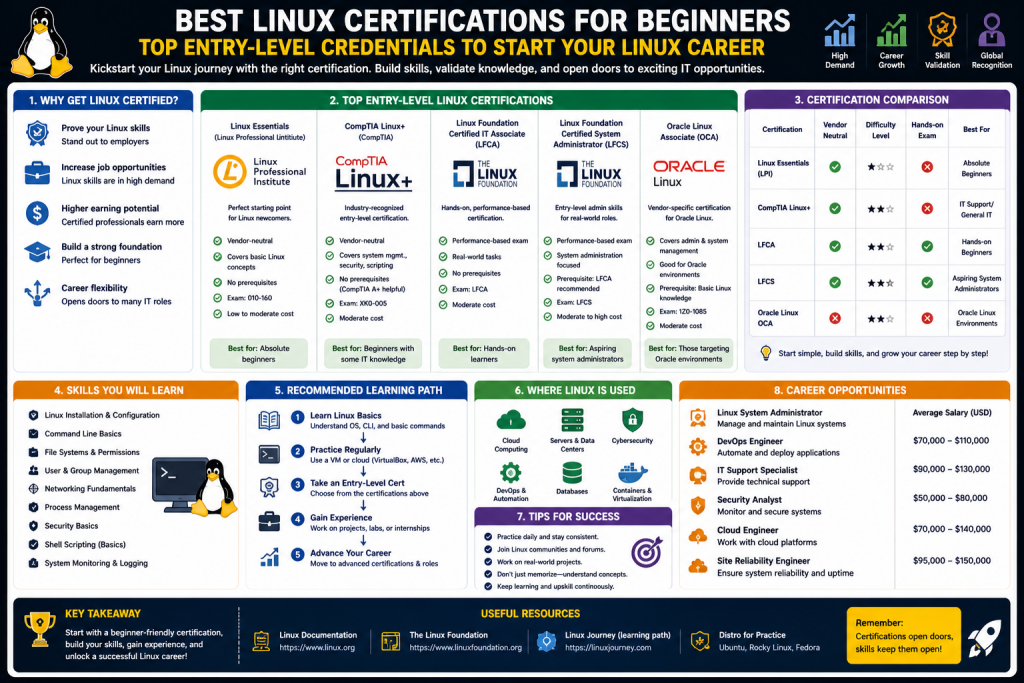
Linux has become one of the most important operating systems in the world of information technology. From powering enterprise servers and cloud infrastructure to running embedded systems and cybersecurity tools, Linux plays a critical role in modern computing environments. For anyone entering the IT industry, understanding Linux is no longer optional. It is a fundamental skill that can open doors to a wide range of career opportunities.
Many organizations rely on Linux because it is stable, secure, and highly customizable. Unlike proprietary operating systems, Linux is open-source, which means its source code is freely available. This allows developers and organizations to modify and adapt the system according to their needs. As a result, Linux has become the backbone of many mission-critical systems.
For beginners, however, Linux can seem intimidating. The command-line interface, unfamiliar file structures, and vast ecosystem can make it difficult to know where to start. This is where certifications come into play. They provide a structured path for learning and help individuals build confidence step by step.
Linux certifications are designed to validate your skills and knowledge. They demonstrate to employers that you have a certain level of competency and can handle real-world tasks. Whether you are aiming to become a system administrator, network engineer, or cybersecurity specialist, Linux certifications can serve as a strong foundation for your career.
Why Linux Certifications Matter for Beginners
Starting a career in IT often involves navigating a wide range of technologies and tools. Without proper guidance, it is easy to feel overwhelmed. Linux certifications offer a clear and organized way to learn essential concepts and skills.
One of the main advantages of certifications is credibility. Employers often use certifications as a benchmark to evaluate candidates. When you hold a recognized Linux certification, it signals that you have undergone structured training and have met specific standards.
Another important benefit is skill development. Certifications are not just about passing exams; they are about gaining practical knowledge. Most Linux certification programs include hands-on tasks that mimic real-world scenarios. This ensures that you are not only learning theory but also developing the ability to apply your knowledge in practical situations.
Certifications also help in building discipline and consistency. Preparing for an exam requires dedication and a structured study plan. This process helps you develop habits that are essential for long-term success in the IT field.
For beginners, certifications can also provide direction. The IT industry is vast, and it can be difficult to decide which path to take. Linux certifications expose you to different aspects of the operating system, helping you identify your interests and strengths.
Understanding the Linux Learning Path
Before diving into specific certifications, it is important to understand the typical learning path for Linux. Most professionals start with basic concepts and gradually move toward more advanced topics.
At the beginner level, the focus is on understanding the fundamentals. This includes learning how to navigate the file system, use basic commands, and understand how Linux differs from other operating systems. You also learn about open-source principles and the Linux community.
As you progress, you begin to explore more complex topics such as system administration, networking, and security. This involves tasks like managing users, configuring services, and troubleshooting issues. These skills are essential for most IT roles.
At the advanced level, the focus shifts to specialization. You may choose to focus on areas such as cloud computing, DevOps, or cybersecurity. Advanced certifications often require a deep understanding of Linux and the ability to perform complex tasks.
Understanding this progression is important because it helps you choose the right certification at the right time. Starting with a beginner-friendly certification ensures that you build a strong foundation before moving on to more challenging material.
LPI Linux Essentials Overview
One of the best starting points for beginners is the Linux Essentials certification. It is specifically designed for individuals who have little to no experience with Linux and want to gain a basic understanding of the operating system.
This certification focuses on introducing the core concepts of Linux in a simple and accessible way. It does not require any prior knowledge, making it ideal for students, career changers, and IT beginners.
The Linux Essentials certification covers a wide range of topics, including the history of Linux, the open-source model, and the role of Linux in modern computing. It also introduces basic command-line operations, file management, and system navigation.
One of the key objectives of this certification is to make Linux less intimidating. By breaking down complex concepts into manageable pieces, it helps learners build confidence and develop a positive learning experience.
The Linux Community and Open Source Culture
A unique aspect of Linux is its strong connection to the open-source community. Unlike proprietary software, Linux is developed and maintained by a global community of contributors. This collaborative approach has led to rapid innovation and continuous improvement.
Understanding the open-source culture is an important part of learning Linux. It involves concepts such as transparency, collaboration, and shared knowledge. These principles are reflected in the way Linux is developed and distributed.
The Linux Essentials certification introduces learners to this culture, helping them understand how open-source projects work. This knowledge is valuable not only for technical skills but also for professional development.
Being part of the Linux community can provide numerous benefits. It allows you to learn from experienced professionals, contribute to projects, and stay updated with the latest developments. It also helps you build a network of like-minded individuals who share your interests.
Navigating a Linux System
One of the first skills you need to learn in Linux is how to navigate the system. Unlike graphical operating systems, Linux relies heavily on the command line. This allows for greater control and flexibility but can be challenging for beginners.
The Linux Essentials certification teaches you how to move through directories, list files, and manage file structures. You learn commands such as changing directories, creating files, and removing files.
Understanding the file system hierarchy is also important. Linux uses a structured directory system where each directory has a specific purpose. Learning this structure helps you locate files and understand how the system is organized.
Navigation is a fundamental skill that forms the basis for more advanced tasks. Once you are comfortable with basic navigation, you can start exploring more complex operations such as scripting and automation.
The Power of the Command Line
The command line is one of the most powerful features of Linux. It allows you to perform tasks quickly and efficiently without relying on graphical interfaces. While it may seem difficult at first, mastering the command line is essential for anyone working with Linux.
Through Linux Essentials, you learn how to use basic commands and understand their syntax. You also learn how to combine commands to perform more complex tasks. This includes using pipes and redirection to manipulate data.
The command line also introduces you to the concept of scripting. While scripting is covered in more detail in advanced certifications, having a basic understanding at this stage is beneficial.
Developing command-line skills can significantly improve your productivity. It allows you to automate tasks, manage systems remotely, and troubleshoot issues more effectively.
Understanding the Linux Operating System
To work effectively with Linux, you need to understand how the operating system functions. This includes learning about the kernel, system processes, and resource management.
The Linux Essentials certification provides an overview of these concepts, helping you understand how different components interact. You learn about processes, how they are created, and how they are managed.
Understanding system performance is also important. You learn how to monitor system resources and identify potential issues. This knowledge is essential for maintaining system stability and efficiency.
This foundational understanding prepares you for more advanced topics such as system administration and performance tuning.
Security and File Permissions
Security is a critical aspect of any operating system, and Linux is no exception. One of the key security features in Linux is its file permission system. This system controls who can read, write, and execute files.
The Linux Essentials certification introduces you to file permissions and how they work. You learn how to assign permissions and understand the different levels of access.
User management is another important topic. You learn how to create users, assign roles, and manage access to resources. This is essential for maintaining a secure and organized system.
Understanding basic security principles is crucial for anyone working in IT. It helps you protect systems from unauthorized access and ensures that data remains secure.
Building Confidence with Linux Basics
Completing a beginner certification like Linux Essentials is a significant milestone. It gives you the confidence to explore Linux further and take on more challenging tasks.
At this stage, it is important to practice regularly. Setting up a Linux environment and experimenting with commands can help reinforce your learning. The more you practice, the more comfortable you will become.
You should also start exploring real-world applications of Linux. This includes tasks such as setting up a web server, managing users, and configuring basic services. These activities help you understand how Linux is used in professional environments.
Building confidence is key to progressing in your Linux journey. With a strong foundation, you are better prepared to tackle more advanced certifications and responsibilities.
Preparing for the Next Step
After completing Linux Essentials, the next step is to continue building your skills. This may involve pursuing more advanced certifications or gaining hands-on experience.
It is important to set clear goals and create a study plan. Identify the areas you want to focus on and allocate time for learning and practice. Consistency is essential for success.
You should also consider exploring additional resources such as online courses, tutorials, and community forums. These resources can provide valuable insights and help you deepen your understanding.
The journey to mastering Linux is a continuous process. Each step builds on the previous one, bringing you closer to your career goals.
Advancing Your Linux Skills with Intermediate Certifications
After building a solid foundation with beginner-level knowledge, the next step in your Linux journey is to expand your understanding and develop practical, job-ready skills. At this stage, you move beyond basic concepts and begin working with real-world scenarios that reflect the responsibilities of IT professionals. Intermediate certifications are designed to bridge the gap between theoretical knowledge and hands-on expertise.
This phase is critical because it shapes how effectively you can apply Linux in professional environments. Instead of simply understanding commands and concepts, you begin to use them to solve problems, manage systems, and support business operations. The focus shifts from learning what Linux is to learning how Linux is used in real organizations.
Introduction to CompTIA Linux+
One of the most popular certifications at this level is CompTIA Linux+. It is widely recognized across the IT industry and is considered a strong validation of practical Linux skills. Unlike entry-level certifications, Linux+ dives deeper into system administration tasks and operational responsibilities.
Linux+ is designed to be vendor-neutral, meaning it does not focus on a specific Linux distribution. This makes it highly versatile because the skills you learn can be applied across different environments, whether you are working with Ubuntu, CentOS, Debian, or other distributions.
This certification is ideal for individuals who want to pursue roles such as system administrator, technical support specialist, or network administrator. It builds on foundational knowledge and introduces more complex topics that are essential for managing Linux systems in professional settings.
System Management and Administration Skills
A major component of Linux+ is system management. This involves installing, configuring, and maintaining Linux systems to ensure they operate efficiently. You learn how to manage software packages, update systems, and handle system services.
System administration also includes managing processes. You will learn how to monitor running processes, control system performance, and troubleshoot issues that affect system stability. These skills are essential for maintaining uptime and ensuring that systems run smoothly.
Another important aspect is storage management. Linux+ covers topics such as disk partitioning, file systems, and mounting drives. Understanding how to manage storage is crucial for handling data effectively and preventing system failures.
These system management skills form the backbone of many IT roles. Whether you are working in a small business or a large enterprise, the ability to manage Linux systems is highly valuable.
Scripting, Automation, and Efficiency
As IT environments grow more complex, automation becomes increasingly important. Linux+ introduces you to scripting, which allows you to automate repetitive tasks and improve efficiency.
Scripting involves writing simple programs that execute commands automatically. This can include tasks such as backing up data, monitoring system performance, or managing user accounts. By automating these tasks, you can save time and reduce the risk of human error.
Learning scripting also helps you understand how Linux systems operate at a deeper level. It encourages logical thinking and problem-solving, which are essential skills for any IT professional.
Automation is particularly important in modern environments such as cloud computing and DevOps. Organizations rely on automation to manage large-scale systems, and having these skills can significantly enhance your career prospects.
Containers and Virtualization Concepts
Modern IT infrastructure relies heavily on virtualization and containerization. Linux+ introduces these concepts, helping you understand how they work and why they are important.
Virtualization allows multiple operating systems to run on a single physical machine. This improves resource utilization and reduces hardware costs. You learn how to work with virtual machines and understand their role in IT environments.
Containers, on the other hand, provide a lightweight way to run applications. They package applications and their dependencies together, ensuring consistency across different environments. This is especially useful in development and deployment processes.
Understanding containers and virtualization is essential for working in cloud environments. These technologies are widely used by organizations to build scalable and flexible systems.
Security Practices in Linux Environments
Security is a top priority in any IT environment, and Linux+ places significant emphasis on this area. You learn how to protect systems from threats and ensure that data remains secure.
This includes managing user permissions, configuring firewalls, and implementing access controls. You also learn about encryption and secure communication protocols, which are essential for protecting sensitive information.
Another important aspect is vulnerability management. You learn how to identify potential security risks and take steps to mitigate them. This proactive approach helps prevent security breaches and ensures system integrity.
Security skills are highly valued in the IT industry. With the increasing number of cyber threats, organizations are looking for professionals who can safeguard their systems and data.
Troubleshooting and Problem Solving
One of the most important skills you develop through Linux+ is troubleshooting. In real-world environments, systems rarely operate perfectly, and issues are bound to arise. Being able to identify and resolve problems quickly is a key responsibility for IT professionals.
Linux+ teaches you how to diagnose issues related to hardware, software, and networking. You learn how to analyze logs, identify errors, and implement solutions. This process requires critical thinking and a systematic approach.
Troubleshooting also involves understanding how different components interact. By knowing how systems are connected, you can pinpoint the root cause of a problem more effectively.
Developing strong troubleshooting skills not only improves your technical abilities but also increases your confidence in handling complex situations.
Real-World Applications of Linux+
The knowledge gained from Linux+ can be applied in a wide range of real-world scenarios. For example, you might be responsible for setting up and maintaining servers, managing user accounts, or configuring network services.
In a corporate environment, Linux systems are often used to host applications, manage databases, and support internal operations. Your ability to manage these systems can have a direct impact on business performance.
Linux+ also prepares you for roles in technical support. You may need to assist users, resolve issues, and ensure that systems are functioning properly. These responsibilities require both technical knowledge and communication skills.
By working on real-world tasks, you gain practical experience that goes beyond theoretical learning. This experience is invaluable when applying for jobs and advancing your career.
Transitioning to LPIC-1 Certification
After completing Linux+, many professionals choose to pursue the LPIC-1 certification. While both certifications cover similar topics, LPIC-1 is often considered more detailed and challenging.
LPIC-1 requires passing two exams, which allows for a deeper exploration of Linux concepts. It focuses on real-world system administration tasks and validates your ability to manage Linux systems effectively.
This certification is also vendor-neutral, making it applicable across different distributions. It is recognized globally and is often preferred by employers who are looking for candidates with strong Linux skills.
Transitioning to LPIC-1 involves building on the knowledge gained from Linux+ and expanding it further. It requires a greater level of understanding and more hands-on practice.
Core Topics Covered in LPIC-1
LPIC-1 covers a wide range of topics that are essential for Linux professionals. These include system architecture, installation, and package management. You learn how to configure systems and ensure that they meet operational requirements.
Another key area is command-line proficiency. While this is introduced in beginner certifications, LPIC-1 takes it to a more advanced level. You learn how to use complex commands and combine them to perform sophisticated tasks.
Networking is also an important component. You learn how to configure network settings, manage connections, and troubleshoot network issues. These skills are essential for maintaining communication between systems.
Security is covered in greater detail as well. You learn how to implement advanced security measures and protect systems from threats.
The Value of Vendor-Neutral Certifications
Both Linux+ and LPIC-1 are vendor-neutral certifications, which means they are not tied to a specific Linux distribution. This provides several advantages for learners and professionals.
Vendor-neutral certifications focus on general principles and skills that can be applied across different environments. This makes them highly flexible and relevant in a wide range of situations.
They also provide a broader understanding of Linux. Instead of focusing on a single distribution, you learn concepts that are common to all Linux systems. This helps you adapt to different environments more easily.
For beginners and intermediate learners, vendor-neutral certifications are often the best choice. They provide a strong foundation that can be built upon with more specialized certifications later.
Developing Hands-On Experience
At this stage in your Linux journey, hands-on experience becomes even more important. While certifications provide structured learning, practical experience is what truly solidifies your skills.
Setting up your own lab environment is one of the best ways to gain experience. You can use virtual machines or cloud platforms to create a safe space for experimentation. This allows you to practice without the risk of affecting real systems.
Working on projects is another effective way to learn. For example, you can set up a web server, configure a database, or create a backup system. These projects help you apply your knowledge in practical scenarios.
Hands-on experience also prepares you for certification exams. Many exams include performance-based questions that require you to demonstrate your skills.
Building Confidence and Professional Readiness
As you progress through intermediate certifications, you begin to develop confidence in your abilities. You are no longer just learning concepts; you are applying them to solve real problems.
This confidence is important when entering the job market. Employers are looking for candidates who can handle responsibilities and contribute to their organizations. Having practical skills and certifications gives you a competitive edge.
Professional readiness also involves soft skills such as communication and teamwork. In many roles, you will need to collaborate with others and explain technical concepts to non-technical stakeholders.
By combining technical expertise with soft skills, you can position yourself as a well-rounded professional.
Preparing for Advanced Linux Roles
Completing intermediate certifications like Linux+ and LPIC-1 sets the stage for more advanced opportunities. You may choose to specialize in areas such as system engineering, cybersecurity, or cloud computing.
Advanced roles often require a deeper understanding of Linux and the ability to manage complex systems. This includes tasks such as configuring enterprise services, optimizing performance, and implementing advanced security measures.
Preparation for these roles involves continuous learning and practice. You should stay updated with industry trends and explore new technologies.
Certifications are just one part of the journey. Real-world experience, projects, and ongoing education are equally important.
Advancing Toward Professional-Level Linux Expertise
As you move beyond intermediate certifications, your journey with Linux begins to take a more specialized and professional direction. At this stage, you are no longer just learning how systems work—you are learning how to design, manage, and optimize them in real-world environments. Advanced certifications validate your ability to handle complex tasks and demonstrate that you are ready to take on greater responsibilities in IT roles.
This phase is where your foundational knowledge and intermediate skills come together. You begin to think like a systems engineer or a senior administrator, focusing on efficiency, scalability, and reliability. The certifications covered in this section are designed to help you transition into those roles.
Deep Dive into LPIC-2 Certification
The LPIC-2 certification is a natural progression after completing LPIC-1. It is designed for professionals who already have a solid understanding of Linux and want to expand their expertise in system administration and network management.
LPIC-2 is more advanced and requires passing two exams. It focuses heavily on practical skills, ensuring that candidates can perform real-world tasks effectively. This certification is particularly valuable for those who want to work as Linux engineers or senior system administrators.
One of the main goals of LPIC-2 is to validate your ability to manage small to medium-sized networks. This includes configuring services, maintaining systems, and ensuring that everything operates smoothly. It also emphasizes troubleshooting and problem-solving, which are essential skills at this level.
Managing Core Linux Services
A significant portion of LPIC-2 focuses on managing core Linux services. These services are the backbone of most IT infrastructures and are essential for communication and data sharing.
You learn how to configure and manage services such as web servers, file servers, and network services. This includes setting up and maintaining protocols like DNS, DHCP, SSH, FTP, and NFS. Each of these services plays a critical role in ensuring that systems can communicate and function effectively.
Understanding how these services work allows you to build and maintain reliable systems. It also helps you identify and resolve issues more efficiently, as you gain insight into how different components interact.
Managing services also involves ensuring that they are secure and optimized. This requires a combination of technical knowledge and practical experience.
Advanced Networking Concepts
Networking is a key component of LPIC-2. At this level, you are expected to have a deeper understanding of how networks operate and how to configure them in a Linux environment.
This includes topics such as routing, network troubleshooting, and advanced configuration. You learn how to manage network interfaces, configure firewalls, and ensure secure communication between systems.
Advanced networking skills are essential for many IT roles. Whether you are managing servers, working in cloud environments, or supporting enterprise systems, a strong understanding of networking is crucial.
LPIC-2 also emphasizes the importance of monitoring and maintaining network performance. This involves identifying bottlenecks, optimizing configurations, and ensuring that systems remain responsive.
System Maintenance and Performance Optimization
At the professional level, maintaining system performance becomes a major responsibility. LPIC-2 teaches you how to monitor systems, identify issues, and implement solutions to improve performance.
This includes analyzing system logs, managing resources, and optimizing configurations. You learn how to ensure that systems run efficiently and can handle increasing workloads.
Performance optimization also involves planning for scalability. As organizations grow, their systems need to handle more users and data. Being able to design systems that can scale effectively is a valuable skill.
System maintenance is not just about fixing problems—it is about preventing them. By implementing best practices and monitoring systems regularly, you can minimize downtime and ensure reliability.
Security at an Advanced Level
Security becomes even more critical as you move into advanced roles. LPIC-2 builds on basic security concepts and introduces more sophisticated techniques for protecting systems.
You learn how to secure network services, manage access controls, and implement advanced security measures. This includes configuring firewalls, using encryption, and monitoring for suspicious activity.
Advanced security also involves understanding potential vulnerabilities and taking proactive steps to mitigate risks. This requires staying updated with the latest threats and best practices.
In many organizations, security is a top priority. Having strong security skills can make you a valuable asset and open up opportunities in specialized roles such as cybersecurity.
Introduction to Red Hat Certified System Administrator
While vendor-neutral certifications provide a broad understanding of Linux, vendor-specific certifications focus on particular distributions. One of the most recognized certifications in this category is the Red Hat Certified System Administrator.
This certification is based on Red Hat Enterprise Linux, a widely used distribution in enterprise environments. It is designed to validate your ability to perform system administration tasks in a real-world setting.
The Red Hat certification path is known for its practical approach. Instead of relying heavily on multiple-choice questions, exams often require you to perform tasks on a live system. This ensures that you have hands-on skills and can apply your knowledge effectively.
Real-World Skills with RHCSA
The Red Hat Certified System Administrator certification focuses on practical skills that are directly applicable in professional environments. You learn how to manage users, configure storage, and maintain system security.
One of the key aspects of this certification is its emphasis on hands-on experience. You are expected to perform tasks such as setting up services, managing processes, and troubleshooting issues.
This practical approach makes RHCSA highly respected in the industry. Employers value candidates who can demonstrate real-world skills and handle responsibilities effectively.
The certification also prepares you for more advanced roles within the Red Hat ecosystem. It serves as a foundation for higher-level certifications and specialized areas.
Vendor-Specific vs Vendor-Neutral Certifications
At this stage, it is important to understand the difference between vendor-specific and vendor-neutral certifications. Both have their advantages, and choosing the right path depends on your career goals.
Vendor-neutral certifications provide a broad understanding of Linux concepts. They are ideal for building a strong foundation and gaining flexibility across different environments.
Vendor-specific certifications, on the other hand, focus on particular distributions. They provide in-depth knowledge and are often aligned with specific job roles.
Combining both types of certifications can be beneficial. It allows you to develop a well-rounded skill set and adapt to different situations.
Career Opportunities with Linux Certifications
Linux certifications can open up a wide range of career opportunities. As you progress through different levels, you become qualified for more advanced roles.
At the beginner level, you may start as a technical support specialist or junior system administrator. As you gain experience and certifications, you can move into roles such as system administrator, network engineer, or DevOps engineer.
Advanced certifications can lead to senior positions, such as Linux engineer or infrastructure architect. These roles involve designing and managing complex systems and require a high level of expertise.
Linux skills are also in demand in emerging fields such as cloud computing and cybersecurity. Many cloud platforms rely on Linux, and cybersecurity tools often run on Linux systems.
The Role of Linux in Modern Technologies
Linux plays a central role in many modern technologies. It is the foundation of cloud computing, containerization, and DevOps practices.
Cloud platforms use Linux to provide scalable and flexible infrastructure. Understanding Linux is essential for working with these platforms and managing cloud-based systems.
Containers and orchestration tools also rely heavily on Linux. These technologies are used to build and deploy applications efficiently, making them a key part of modern development processes.
Linux is also widely used in cybersecurity. Many security tools and frameworks are built on Linux, and professionals in this field need a strong understanding of the operating system.
Continuous Learning and Skill Development
The field of Linux is constantly evolving, and continuous learning is essential for staying relevant. New technologies, tools, and best practices are introduced regularly, and keeping up with these changes is important.
You can continue learning by exploring advanced topics, taking additional certifications, and working on projects. Engaging with the Linux community can also provide valuable insights and opportunities.
Reading documentation, participating in forums, and attending events are effective ways to stay updated. These activities help you expand your knowledge and connect with other professionals.
Continuous learning is not just about acquiring new skills—it is about maintaining and improving your existing knowledge. This ensures that you remain competitive in the job market.
Building a Long-Term Career in Linux
Building a successful career in Linux requires more than just certifications. It involves gaining experience, developing skills, and staying committed to learning.
Creating a portfolio of projects can showcase your abilities and demonstrate your expertise. This can include setting up servers, configuring networks, or developing scripts.
Networking with professionals in the industry can also be beneficial. It can lead to job opportunities, mentorship, and collaboration.
Setting clear career goals and working toward them is important. Whether you want to specialize in system administration, cloud computing, or cybersecurity, having a plan can guide your efforts.
Overcoming Challenges in the Linux Journey
Learning Linux can be challenging, especially at advanced levels. You may encounter complex concepts, difficult problems, and steep learning curves.
Overcoming these challenges requires persistence and a willingness to learn. Breaking down complex topics into smaller parts can make them more manageable.
Practicing regularly and seeking help when needed can also make a difference. There are many resources available, including online communities and documentation.
Challenges are a natural part of the learning process. Each obstacle you overcome helps you grow and become more proficient.
Conclusion
The journey through Linux certifications is a progressive and rewarding experience. Starting from beginner-level concepts and moving toward advanced expertise, each stage builds on the previous one, creating a strong foundation for a successful career in IT.
Certifications such as Linux Essentials, Linux+, LPIC-1, LPIC-2, and Red Hat Certified System Administrator provide a structured path for learning and skill development. They help you gain knowledge, develop practical abilities, and demonstrate your competence to employers.
As you advance, the focus shifts from basic understanding to real-world application. You learn how to manage systems, optimize performance, secure environments, and solve complex problems. These skills are essential for working in modern IT environments.
Linux is a powerful and versatile operating system that plays a critical role in many technologies. Mastering Linux can open up a wide range of opportunities, from system administration and networking to cloud computing and cybersecurity.
Success in this field requires continuous learning, hands-on experience, and a commitment to growth. By staying curious, practicing regularly, and pursuing new challenges, you can build a strong and lasting career in Linux.
Your journey does not end with certifications—it evolves with your experience and ambition. With dedication and persistence, Linux can become one of your most valuable skills in the ever-changing world of technology.
Continue exploring the technologies and certification concepts that matter most to you.