Wireless communication has transformed the way people interact with technology and with each other. From smartphones and laptops to smart home systems and wearable devices, nearly every modern innovation relies on the ability to transmit data without physical connections. At the center of this transformation lies the concept of wireless channels, which serve as the invisible pathways that carry information through the air.
Unlike wired communication, which depends on physical cables, wireless communication uses electromagnetic waves to transmit signals. These waves travel through space, allowing devices to connect over short and long distances. Wireless channels organize these waves into structured frequency ranges so that multiple devices and technologies can operate simultaneously without causing interference.
Understanding wireless channels is essential for anyone studying networking, especially those preparing for certifications or working in IT environments. They are the foundation upon which wireless technologies such as Wi-Fi, Bluetooth, and cellular networks are built.
What Is a Wireless Channel
A wireless channel is a specific portion of the electromagnetic spectrum used to transmit data between devices. The electromagnetic spectrum consists of a wide range of frequencies, from very low frequencies used for radio communication to extremely high frequencies such as gamma rays.
In networking, wireless channels typically fall within the radio frequency range. Each channel represents a defined frequency range that devices can use to send and receive signals. These channels help organize the spectrum so that multiple communications can occur without overlapping in a way that causes interference.
A simple way to understand wireless channels is to think about television broadcasting. Each television channel operates on a different frequency and provides different content. Similarly, wireless channels separate different types of communication so they do not interfere with each other.
For example, a Wi-Fi network may operate on one channel, while a Bluetooth device operates on another. Even within Wi-Fi, multiple channels exist to allow different networks to function independently within the same area.
The Role of Frequency in Wireless Channels
Frequency plays a central role in defining wireless channels. It refers to the number of cycles a wave completes in one second and is measured in hertz. Higher frequencies generally allow for faster data transmission but have shorter range, while lower frequencies can travel longer distances but may support lower data rates.
Wireless channels are created by dividing frequency bands into smaller segments. Each segment represents a channel that devices can use for communication. This segmentation helps reduce interference and ensures efficient use of the available spectrum.
Different technologies use different frequency bands based on their requirements. For example, short-range communication technologies often use higher frequencies, while long-range communication systems rely on lower frequencies for better coverage.
How Wireless Channels Enable Communication
Wireless channels act as communication pathways between devices. When a device wants to send data, it converts digital information into a radio signal. This signal is transmitted over a specific frequency channel and travels through the air until it reaches the receiving device.
The receiving device then converts the signal back into digital data that can be understood and used. For this process to work effectively, both devices must be tuned to the same channel or compatible channels.
In environments where many devices operate simultaneously, multiple channels are used to distribute traffic. This prevents congestion and improves performance. Advanced technologies can automatically select the best channel based on current conditions, ensuring optimal communication.
Types of Wireless Channels
Wireless channels can be categorized based on the technologies that use them. Each technology is designed for specific use cases and operates within particular frequency ranges.
Bluetooth Channels
Bluetooth technology is widely used for short-range communication between devices such as headphones, keyboards, and smartphones. It operates in the 2.4 GHz frequency band, which is shared with other technologies like Wi-Fi.
To minimize interference, Bluetooth uses a technique known as frequency hopping. This method involves rapidly switching between different channels within the band. By doing so, Bluetooth devices can avoid congested frequencies and maintain stable connections.
Bluetooth channels are designed for low power consumption, making them ideal for portable and battery-powered devices. Although the data rates are lower compared to Wi-Fi, Bluetooth provides sufficient performance for tasks such as audio streaming and device synchronization.
Cellular Network Channels
Cellular networks provide wide-area communication for mobile devices. These networks operate across a variety of frequency bands, each with its own characteristics.
Lower frequency bands offer better coverage and can penetrate obstacles such as buildings. Higher frequency bands provide faster data speeds but have shorter range. By combining multiple bands, cellular networks can deliver both coverage and performance.
Modern cellular technologies use advanced techniques to manage channels efficiently. These include dynamic allocation, where channels are assigned based on demand, and carrier aggregation, which combines multiple channels to increase data throughput.
As wireless communication continues to evolve, newer technologies are being introduced that utilize even higher frequencies. These advancements aim to support increasing data demands and improve overall network performance.
Wi-Fi Channels
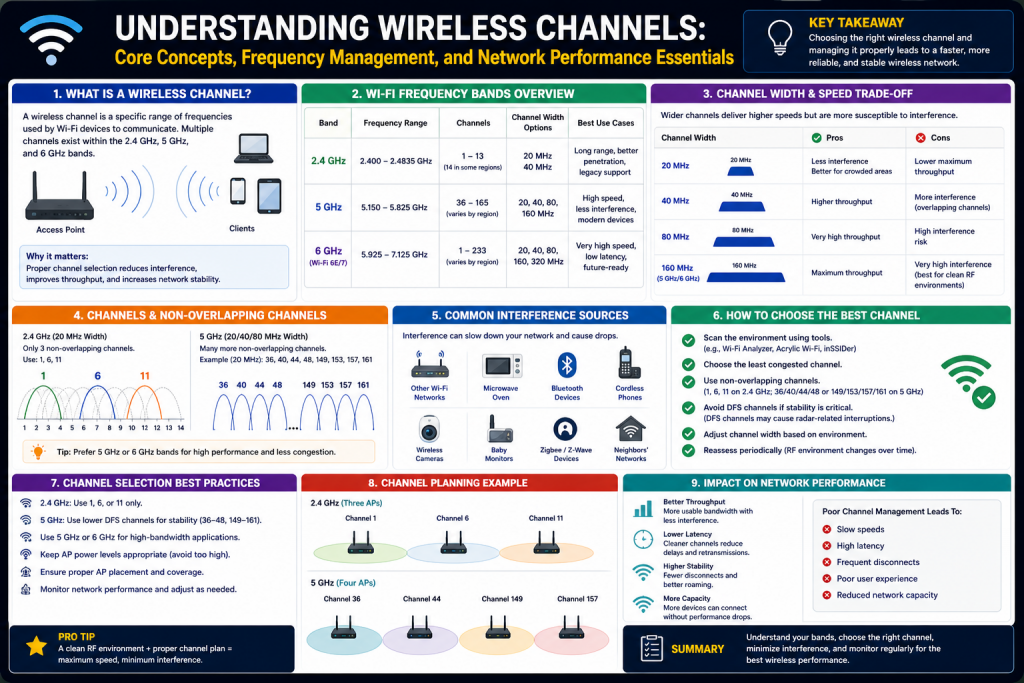
Wi-Fi is one of the most commonly used wireless technologies, providing internet access in homes, offices, and public spaces. It operates primarily in the 2.4 GHz and 5 GHz frequency bands, with newer standards introducing the 6 GHz band.
The 2.4 GHz band offers wider coverage but is more prone to interference due to the large number of devices that use it. The 5 GHz band provides higher data rates and less interference but has a shorter range. The 6 GHz band expands available channels, reducing congestion and improving performance.
Wi-Fi channels are divided into smaller frequency segments, allowing multiple networks to operate within the same area. Choosing the right channel is important for minimizing interference and maximizing performance.
Channel Interference and Its Impact
Interference is one of the most significant challenges in wireless communication. It occurs when multiple devices attempt to use the same or overlapping channels, causing signals to disrupt each other.
There are several types of interference that can affect wireless channels. Co-channel interference happens when multiple devices use the same channel, while adjacent-channel interference occurs when signals from nearby channels overlap.
Interference can lead to slower data speeds, increased latency, and connection drops. In severe cases, it can render a network unusable.
To address interference, wireless technologies use various strategies. These include selecting less congested channels, adjusting transmission power, and using advanced signal processing techniques. Network administrators often perform site surveys to identify sources of interference and optimize channel selection.
Factors Affecting Wireless Channel Performance
Several factors influence the performance of wireless channels. Understanding these factors is essential for designing and maintaining efficient networks.
Physical Obstacles
Walls, floors, and other physical barriers can weaken wireless signals. Materials such as concrete and metal are particularly effective at blocking signals, reducing coverage and performance.
Distance
The strength of a wireless signal decreases as the distance between devices increases. This can result in slower data rates and reduced reliability.
Environmental Conditions
Environmental factors such as weather, temperature, and electromagnetic noise can impact wireless communication. For example, heavy rain can affect certain frequency ranges, while electronic devices can introduce interference.
Device Density
In areas with many devices, such as offices or public spaces, competition for channels increases. This can lead to congestion and reduced performance.
Channel Width
Channel width determines how much data can be transmitted at once. Wider channels allow for higher data rates but may be more susceptible to interference. Narrower channels provide better stability but lower throughput.
Techniques for Improving Channel Efficiency
To ensure efficient use of wireless channels, various techniques are employed. These techniques help reduce interference, improve performance, and enhance reliability.
Channel Selection
Choosing the right channel is critical for minimizing interference. Many devices automatically select channels based on current conditions, while network administrators can manually configure channels for optimal performance.
Frequency Hopping
Frequency hopping involves switching between channels to avoid interference. This technique is commonly used in Bluetooth communication.
Channel Bonding
Channel bonding combines multiple channels into a single wider channel, increasing data throughput. This technique is widely used in modern Wi-Fi standards.
Beamforming
Beamforming focuses the wireless signal in a specific direction, improving signal strength and reducing interference. This technique enhances performance, especially in environments with many devices.
Importance of Understanding Wireless Channels
A solid understanding of wireless channels is essential for anyone working with networking technologies. It enables professionals to design efficient networks, troubleshoot issues, and optimize performance.
Wireless channels are not just technical concepts; they have real-world implications for everyday technology use. Poor channel management can result in slow internet speeds, dropped connections, and frustrated users.
On the other hand, effective channel management can significantly improve user experience by providing faster, more reliable connections.
The Growing Demand for Wireless Connectivity
As technology continues to evolve, the demand for wireless connectivity is increasing rapidly. The rise of smart devices, cloud computing, and streaming services has placed greater demands on wireless networks.
This growing demand highlights the importance of efficient channel utilization. With limited spectrum available, it is essential to use wireless channels effectively to meet the needs of modern applications.
New technologies are being developed to address these challenges, including advanced Wi-Fi standards and next-generation cellular networks. These innovations aim to provide higher data rates, lower latency, and improved reliability.
Preparing for Advanced Topics
Understanding the fundamentals of wireless channels provides a strong foundation for exploring more advanced topics. These include regulatory frameworks, compliance requirements, and network deployment strategies.
Wireless communication is a complex and dynamic field, with new developments emerging regularly. Staying informed about these changes is essential for maintaining effective and secure networks.
By mastering the basics of wireless channels, learners can build the knowledge needed to tackle more advanced concepts and challenges in networking.
Introduction to Wireless Regulation
Wireless communication relies on a shared and limited resource known as the electromagnetic spectrum. Because this spectrum is used by a wide variety of technologies, including broadcasting systems, aviation communication, emergency services, and consumer devices, it must be carefully controlled. Without regulation, signals could overlap and interfere with one another, leading to unreliable communication and potential safety risks.
Regulation ensures that wireless channels are used efficiently, fairly, and safely. It provides structure to how frequencies are allocated, who can use them, and under what conditions. For networking professionals, understanding regulatory frameworks is just as important as understanding the technical aspects of wireless communication.
Why Wireless Channels Require Regulation
The electromagnetic spectrum is finite, meaning there is only a limited number of frequencies available for use. As the number of wireless devices increases, competition for these frequencies becomes more intense. Without proper management, this competition could lead to congestion and interference.
Regulation helps prevent these issues by dividing the spectrum into different bands and assigning them to specific purposes. This ensures that critical services such as emergency communication and aviation systems are protected from interference.
Another reason for regulation is safety. Wireless devices emit electromagnetic radiation, and while most devices operate within safe limits, improper use could pose risks. Regulatory standards ensure that devices operate within safe power levels and do not cause harm to users or the environment.
International Coordination of Wireless Spectrum
Wireless communication is not limited by national borders. Signals can travel across countries and even continents, making international coordination essential. Without global cooperation, different countries could use the same frequencies for conflicting purposes, leading to widespread interference.
International organizations play a key role in managing the global spectrum. They establish guidelines for frequency allocation and ensure that countries follow consistent standards. These guidelines help maintain compatibility between devices and networks worldwide.
Global coordination also supports technological innovation. By standardizing frequency usage, manufacturers can design devices that work across multiple regions, reducing costs and improving accessibility.
National Regulatory Authorities
While international organizations provide guidelines, individual countries are responsible for enforcing regulations within their borders. National regulatory authorities manage the allocation of frequencies, issue licenses, and ensure compliance with technical standards.
These authorities play a critical role in maintaining order within the spectrum. They monitor usage, investigate interference issues, and enforce penalties for violations. Their work ensures that wireless communication remains reliable and efficient.
National regulators also adapt global guidelines to local conditions. Factors such as population density, geography, and technological development influence how frequencies are used within a country.
Frequency Allocation and Spectrum Management
One of the primary responsibilities of regulatory bodies is frequency allocation. This involves dividing the electromagnetic spectrum into bands and assigning each band to a specific use.
Some bands are reserved for public services, such as emergency communication and defense systems. Others are allocated for commercial use, including cellular networks, broadcasting, and internet services. There are also unlicensed bands that can be used by the public without obtaining special permission, provided certain conditions are met.
Spectrum management is an ongoing process. As new technologies emerge, regulators must reassess how frequencies are allocated to ensure efficient use. This may involve reallocating bands, introducing new rules, or encouraging the adoption of more efficient technologies.
Licensing and Spectrum Auctions
In many cases, access to certain frequency bands requires a license. Licensing ensures that only authorized entities can use specific channels, reducing the risk of interference.
Governments often use auctions to distribute these licenses. Companies bid for the right to use particular frequency bands, with the highest bidder typically securing the license. This process helps allocate the spectrum to organizations that can make the most effective use of it.
Spectrum auctions can generate significant revenue for governments while promoting competition among service providers. However, they can also create challenges, as high costs may limit access for smaller companies.
Technical Standards and Compliance Requirements
Regulatory authorities establish technical standards to ensure that wireless devices operate safely and efficiently. These standards cover a wide range of factors, including transmission power, frequency range, and signal emissions.
Devices must meet these standards before they can be sold or used. Manufacturers are required to test their products and obtain certification from regulatory bodies. This certification process verifies that the device complies with all relevant requirements.
Compliance with technical standards is essential for preventing interference and ensuring compatibility between devices. It also protects users by ensuring that devices operate within safe limits.
Power Limits and Signal Control
One of the key aspects of wireless regulation is controlling transmission power. Power limits are set to prevent signals from interfering with other devices and to ensure efficient use of the spectrum.
Higher transmission power can increase coverage but also raises the risk of interference. Lower power reduces interference but may limit range. Regulators establish power limits to balance these factors.
Devices must be designed to operate within these limits, and network administrators must configure them accordingly. Failure to comply with power regulations can result in penalties and degraded network performance.
Reserved and Restricted Frequency Bands
Not all frequency bands are available for general use. Some are reserved for specific purposes, such as emergency communication, military operations, and scientific research.
Emergency channels are critical for public safety and must remain free from interference. These channels are used by police, fire departments, and medical services to coordinate responses during emergencies.
Scientific research also requires protected frequency bands. For example, radio astronomy relies on detecting faint signals from space, which could be disrupted by interference from commercial devices.
By reserving certain bands for specialized uses, regulators ensure that essential services can operate without disruption.
Unlicensed Spectrum and Public Use
In addition to licensed bands, there are also unlicensed frequency ranges that can be used by the public. These bands are commonly used for technologies such as Wi-Fi and Bluetooth.
Unlicensed spectrum allows for widespread access to wireless communication without the need for individual licenses. However, devices operating in these bands must adhere to strict rules to minimize interference.
These rules include limits on transmission power and requirements for using specific technologies that reduce interference. While unlicensed spectrum promotes accessibility, it can become crowded in areas with many devices.
Compliance Challenges for Organizations
Meeting regulatory requirements can be challenging, especially for organizations that operate across multiple regions. Each country may have its own set of rules, requiring careful planning and coordination.
Keeping up with changing regulations is another major challenge. As technology evolves, new standards and requirements are introduced. Organizations must stay informed and adapt their operations accordingly.
Non-compliance can have serious consequences, including fines, legal action, and damage to reputation. In some cases, it may even result in the suspension of operations.
To address these challenges, organizations often establish dedicated compliance teams. These teams monitor regulatory changes, ensure adherence to standards, and coordinate with authorities.
Impact of Regulation on Network Design
Regulatory requirements have a direct impact on how wireless networks are designed and deployed. For example, limits on transmission power may require additional infrastructure to achieve desired coverage.
Frequency availability also influences network design. In areas with limited spectrum, networks may experience congestion, requiring advanced techniques to optimize performance.
Regulations can also affect the placement of equipment. For instance, certain locations may have restrictions on antenna installation or transmission levels.
Despite these challenges, regulation plays a vital role in ensuring that networks operate reliably and efficiently. It provides a framework that supports both innovation and stability.
Managing Cross-Border Interference
Wireless signals do not stop at national borders, which can lead to cross-border interference. This is particularly relevant in regions where countries are located close to one another.
To address this issue, neighboring countries often coordinate their frequency usage. Agreements are established to ensure that signals from one country do not interfere with those of another.
Cross-border coordination is essential for maintaining reliable communication, especially in areas such as aviation and maritime operations.
Monitoring and Enforcement
Regulatory authorities are responsible for monitoring the use of the spectrum and enforcing compliance. This involves tracking frequency usage, investigating interference complaints, and taking action against violations.
Monitoring is carried out using specialized equipment that can detect unauthorized transmissions and identify sources of interference. This allows regulators to respond quickly to issues and maintain order within the spectrum.
Enforcement actions may include warnings, fines, or legal proceedings. In severe cases, equipment may be confiscated, and licenses may be revoked.
The Role of Compliance in Network Reliability
Compliance is not just about following rules; it is also essential for maintaining network reliability. By adhering to regulations, organizations can reduce interference, improve performance, and ensure consistent operation.
Compliance also builds trust with users and stakeholders. It demonstrates a commitment to safety, quality, and professionalism.
For network administrators, understanding regulatory requirements is a key part of their role. It enables them to design and manage networks that meet both technical and legal standards.
Adapting to Technological Advancements
As wireless technology continues to evolve, regulatory frameworks must adapt to accommodate new developments. Innovations such as advanced Wi-Fi standards and next-generation cellular networks require new frequency allocations and updated rules.
Regulators must balance the need for innovation with the need for stability. This involves introducing new policies while ensuring that existing systems continue to function effectively.
Organizations must also adapt to these changes by updating their infrastructure and processes. Staying informed about technological trends and regulatory updates is essential for long-term success.
Preparing for Compliance in Real-World Scenarios
In practical terms, compliance involves a combination of planning, implementation, and monitoring. Organizations must assess their requirements, select appropriate technologies, and ensure that all equipment meets regulatory standards.
Regular audits and reviews help identify potential issues and ensure ongoing compliance. Documentation is also important, as it provides evidence of adherence to regulations and supports troubleshooting efforts.
Training plays a key role in preparing staff for compliance. Employees must understand both the technical and regulatory aspects of their work to ensure that networks are managed effectively.
.Introduction to Wireless Deployment
Deploying wireless technology is more than simply installing hardware and turning it on. It requires a careful balance between performance, compliance, security, and long-term maintenance. Wireless channels play a central role in this process because they determine how effectively devices communicate and how well a network performs under different conditions.
In real-world environments, networks must support a wide range of devices, from smartphones and laptops to IoT sensors and enterprise systems. Each of these devices relies on properly configured wireless channels to function reliably. Without proper planning and management, networks can suffer from interference, poor coverage, and security vulnerabilities.
Understanding how to install and configure wireless systems with channel management in mind is essential for building efficient and reliable networks.
Pre-Installation Planning and Site Assessment
Before installing any wireless equipment, thorough planning is required. This stage determines how well the network will perform and whether it will meet both technical and regulatory requirements.
A key part of planning is conducting a site survey. This involves analyzing the physical environment to identify potential challenges such as walls, floors, and sources of interference. Materials like concrete and metal can significantly weaken wireless signals, while electronic devices may introduce noise that affects performance.
During the site survey, it is also important to evaluate user density. Areas with a high number of devices require careful channel planning to avoid congestion. For example, an office environment with hundreds of users will need more sophisticated channel allocation than a small home network.
Another important consideration is frequency selection. Different frequency bands offer different advantages. Lower frequencies provide better coverage, while higher frequencies offer faster speeds. Choosing the right band depends on the specific requirements of the network.
Regulatory compliance must also be considered at this stage. Understanding local rules regarding frequency usage, transmission power, and equipment certification helps prevent issues later in the deployment process.
Equipment Selection and Compatibility
Selecting the right equipment is critical for successful wireless deployment. Devices must support the required frequency bands and channel configurations. Compatibility between devices ensures seamless communication and optimal performance.
Modern wireless equipment often includes advanced features such as automatic channel selection and interference detection. These features simplify deployment and improve efficiency, especially in complex environments.
It is also important to verify that all equipment meets regulatory standards. Certified devices are tested to ensure they operate within approved limits and do not cause harmful interference. Using uncertified equipment can lead to compliance issues and degraded network performance.
Scalability should also be considered when choosing equipment. Networks often grow over time, and selecting devices that can support future expansion helps avoid costly upgrades.
Installation of Wireless Devices
The installation process involves physically placing and configuring wireless devices to achieve optimal coverage and performance. Proper placement is one of the most important factors in determining network quality.
Access points should be positioned to provide even coverage across the intended area. Placing them too close together can cause interference, while placing them too far apart can create coverage gaps. A balanced approach ensures consistent connectivity.
Height and orientation also play a role in signal propagation. Mounting access points at appropriate heights and angles helps maximize coverage and minimize obstructions.
Channel selection is a critical step during installation. Assigning channels strategically reduces interference and improves performance. In environments with multiple access points, channels should be distributed to avoid overlap.
Power settings must be configured carefully. Increasing transmission power can extend coverage but may also cause interference with neighboring networks. Lower power settings reduce interference but may require additional access points to maintain coverage.
Channel Configuration and Optimization
Once the hardware is installed, configuring wireless channels becomes a key task. Proper channel configuration ensures efficient use of the spectrum and minimizes interference.
Automatic channel selection is commonly used in modern networks. Devices scan the environment and choose the least congested channel. While this approach is convenient, manual configuration may be necessary in complex environments.
Channel width is another important factor. Wider channels allow for higher data rates but increase the risk of interference. Narrower channels provide better stability but lower throughput. Finding the right balance depends on network requirements.
Advanced techniques such as channel bonding can be used to combine multiple channels for increased performance. However, this approach requires careful planning to avoid interference with other networks.
Regular monitoring and adjustment of channel settings help maintain optimal performance. As new devices are added or environmental conditions change, channel configurations may need to be updated.
Managing Interference in Wireless Networks
Interference is one of the most common challenges in wireless networking. It can originate from other wireless devices, electronic equipment, or environmental factors.
To manage interference, it is important to identify its sources. Tools such as spectrum analyzers can help detect interfering signals and determine their origin.
Once interference is identified, several strategies can be used to mitigate it. Changing channels, adjusting power levels, and repositioning devices are common approaches. In some cases, upgrading to newer technologies with better interference management capabilities may be necessary.
Interference management is an ongoing process. As environments change and new devices are introduced, networks must adapt to maintain performance.
Security Considerations in Wireless Networks
Security is a critical aspect of wireless networking. Because wireless signals travel through the air, they are more vulnerable to unauthorized access compared to wired connections.
Encryption is the primary method for securing wireless communication. Strong encryption protocols protect data from being intercepted and ensure that only authorized users can access the network.
Authentication mechanisms are also important. These mechanisms verify the identity of users and devices before granting access. This helps prevent unauthorized connections and reduces the risk of security breaches.
Regular updates are essential for maintaining security. Firmware updates address vulnerabilities and improve performance. Network administrators should ensure that all devices are kept up to date.
Monitoring network activity is another key security measure. Detecting unusual behavior can help identify potential threats and allow for timely response.
Compliance During Installation and Operation
Compliance with regulatory requirements is not limited to the planning stage. It must be maintained throughout the installation and operation of the network.
During installation, it is important to ensure that all configurations adhere to approved frequency ranges and power limits. Documentation provided by equipment manufacturers can help verify compliance.
Ongoing operation requires continuous monitoring to ensure that the network remains within regulatory limits. Changes in configuration or environment may affect compliance, making regular checks.
Maintaining detailed records of configurations and changes is also important. These records provide evidence of compliance and can be useful during audits or troubleshooting.
Monitoring and Maintenance of Wireless Networks
Once a wireless network is deployed, it requires ongoing maintenance to ensure optimal performance and reliability. Monitoring tools can provide insights into network usage, performance, and potential issues.
Regular audits help identify problems such as interference, misconfiguration, and security vulnerabilities. Addressing these issues promptly prevents them from affecting users.
Performance metrics such as signal strength, data rates, and latency should be monitored regularly. These metrics provide valuable information for optimizing network performance.
Preventive maintenance is also important. This includes updating firmware, replacing outdated equipment, and reviewing configurations to ensure they remain effective.
Documentation and Record Keeping
Proper documentation is an essential part of wireless network management. It provides a record of configurations, changes, and compliance activities.
Documentation should include details such as channel assignments, power settings, and device locations. This information يساعد in troubleshooting and ensures consistency across the network.
Keeping accurate records also supports compliance efforts. In the event of an audit or investigation, documentation can demonstrate that the network meets regulatory requirements.
Training and Skill Development
Managing wireless networks requires a combination of technical and regulatory knowledge. Training programs help ensure that staff have the skills needed to perform their roles effectively.
Technical training focuses on installation, configuration, and troubleshooting. Compliance training covers regulatory requirements and best practices for maintaining adherence.
Ongoing education is important as technology continues to evolve. Staying informed about new developments helps professionals adapt to changing requirements and maintain high standards.
Best Practices for Long-Term Success
Following best practices can significantly improve the performance and reliability of wireless networks. These practices include careful planning, regular monitoring, and continuous improvement.
Using standardized configurations helps maintain consistency and reduces the risk of errors. Regular reviews ensure that configurations remain effective as conditions change.
Collaboration between technical and compliance teams is also important. This ensures that all aspects of the network are aligned with both performance goals and regulatory requirements.
Investing in modern technologies can provide additional benefits. Newer systems often include advanced features that improve efficiency and simplify management.
Adapting to Future Wireless Technologies
The wireless landscape is constantly evolving. New technologies are being developed to meet increasing demand for connectivity and data.
. As more devices become connected through the Internet of Things, networks are required to handle significantly higher traffic volumes while maintaining speed and reliability. This growth has led to the development of advanced wireless standards that improve efficiency, reduce latency, and increase overall capacity.
One major trend shaping the future of wireless communication is the expansion of frequency usage. New spectrum bands are being opened to accommodate growing demand, allowing networks to operate with less congestion. At the same time, technologies such as smarter channel allocation and dynamic frequency selection are helping devices automatically adapt to their environment for better performance.
Another important development is the focus on energy efficiency. As wireless networks expand, reducing power consumption becomes essential for sustainability. Modern devices are designed to use energy more efficiently while still delivering high performance.
Security is also becoming more critical as wireless communication grows. With more sensitive data being transmitted over the air, stronger encryption methods and better authentication systems are being implemented to protect users.
Overall, the evolution of wireless technology is driven by the need for faster, more reliable, and more secure communication, ensuring that networks can support future innovations and increasing global connectivity.
Emerging standards offer higher data rates, lower latency, and improved reliability. These advancements require updated approaches to channel management and network design.
Organizations must be prepared to adapt to these changes. This includes upgrading infrastructure, updating policies, and training staff on new technologies.
Flexibility and adaptability are key to staying competitive in a rapidly changing environment.
Conclusion
Wireless channels are a fundamental component of network deployment and operation. They influence every aspect of wireless communication, from performance and coverage to security and compliance.
Successful implementation requires careful planning, proper installation, and ongoing management. By understanding how to configure and optimize wireless channels, organizations can build networks that are both efficient and reliable.
Security and compliance play a critical role in maintaining the integrity of wireless systems. Protecting data and adhering to regulations ensures that networks operate safely and effectively.
As technology continues to advance, the importance of wireless channels will only grow. By following best practices and staying informed about new developments, network professionals can ensure that their systems remain robust and future-ready.
Continue exploring the technologies and certification concepts that matter most to you.