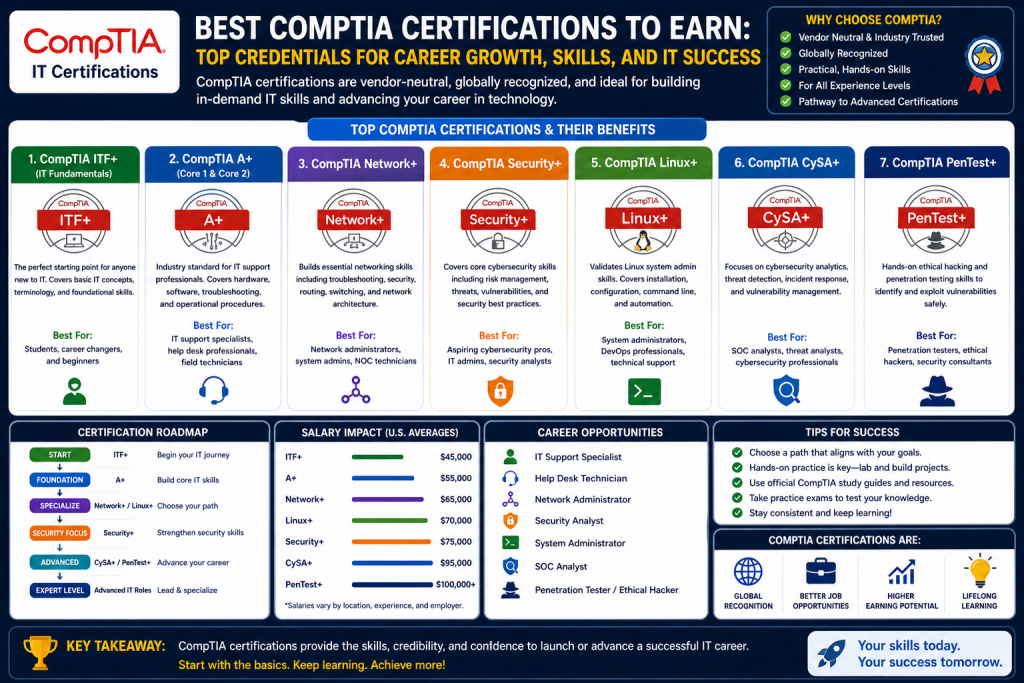
In the modern technology landscape, certifications have become one of the most reliable ways to demonstrate knowledge, validate skills, and stand out in a competitive job market. While experience and hands-on work remain critical, certifications provide structured proof that an individual understands specific concepts and can apply them in real-world scenarios. For employers, they serve as a standardized benchmark when evaluating candidates.
Among the many certification providers available today, CompTIA holds a unique position. Unlike vendors that focus on their own platforms or tools, CompTIA takes a broader approach. Its certifications are designed to measure a professional’s understanding of concepts that apply across different technologies and environments. This vendor-neutral philosophy makes CompTIA certifications highly versatile and widely respected.
As organizations continue to adopt hybrid infrastructures, multi-cloud environments, and diverse technology stacks, the need for professionals who understand general principles rather than just specific tools has grown significantly. CompTIA certifications meet this need by equipping learners with foundational and intermediate knowledge that can be applied in various roles.
For anyone planning to enter or grow within the IT field in 2026, understanding the value of CompTIA certifications is an important first step. Whether you are exploring IT for the first time or looking to build a long-term career, these certifications provide a structured pathway to success.
Why Certifications Matter in IT Careers
The IT industry evolves rapidly, with new technologies, frameworks, and tools emerging every year. In such an environment, it can be difficult for professionals to prove that their knowledge is current and relevant. Certifications address this challenge by offering a formal way to validate skills.
One of the primary benefits of certifications is credibility. When a hiring manager sees a recognized certification on a resume, it provides reassurance that the candidate has met a certain standard. This can be especially important for entry-level professionals who may not yet have extensive work experience.
Certifications also help bridge the gap between theory and practice. Many certification exams are designed to test not only knowledge but also the ability to apply that knowledge in practical situations. This ensures that certified professionals are prepared to handle real-world tasks.
Another important advantage is career mobility. With the right certifications, professionals can transition between roles or specialize in new areas. For example, someone working in technical support might move into networking or cybersecurity by earning additional certifications.
In addition, certifications often lead to better job opportunities and higher salaries. Employers are willing to invest in individuals who have demonstrated a commitment to learning and professional development. This makes certifications a valuable long-term investment.
The Unique Value of CompTIA’s Vendor-Neutral Approach
One of the defining characteristics of CompTIA certifications is their vendor-neutral nature. This means that they are not tied to any specific company, product, or platform. Instead, they focus on universal concepts that apply across different technologies.
This approach offers several advantages. First, it provides flexibility. Professionals who earn CompTIA certifications are not limited to working with a single vendor’s tools. They can adapt to different environments and technologies, which is increasingly important in modern IT infrastructures.
Second, it encourages a deeper understanding of core principles. Instead of memorizing how to perform tasks in a specific system, learners develop a broader knowledge base. This makes it easier to learn new tools and technologies in the future.
Third, vendor-neutral certifications are often more accessible for beginners. They do not require prior experience with a specific platform, making them an ideal starting point for those new to IT.
Finally, CompTIA certifications are widely recognized across the industry. Employers value them because they represent a balanced combination of theoretical knowledge and practical skills.
Overview of CompTIA Certification Paths
CompTIA offers a wide range of certifications that cater to different stages of an IT career. These certifications are often grouped into categories based on skill level and specialization.
At the foundational level, there are certifications designed for beginners who are exploring the field. These provide an introduction to key concepts and help individuals determine their interests.
At the core level, certifications focus on essential IT skills such as hardware, networking, and security. These are often considered the building blocks of an IT career.
Beyond that, there are specialized certifications that allow professionals to focus on specific areas such as cybersecurity, cloud computing, or project management. These certifications are typically more advanced and require a deeper understanding of the subject matter.
This structured approach makes it easier for learners to progress from basic knowledge to advanced expertise. It also allows professionals to tailor their learning journey based on their career goals.
Starting Your IT Journey as a Beginner
For individuals who are new to IT, the first step can feel overwhelming. There are many different paths to choose from, and it is not always clear where to begin. CompTIA addresses this challenge by offering certifications specifically designed for beginners.
These entry-level certifications focus on introducing fundamental concepts in a way that is easy to understand. They provide a broad overview of the IT landscape, helping learners gain a basic understanding of how different technologies work together.
Starting with a beginner-friendly certification can help build confidence and provide a solid foundation for future learning. It also allows individuals to explore different areas of IT before committing to a specific specialization.
Exploring Tech+ as a First Step
Tech+ is one of the most accessible certifications for beginners. It is designed for individuals who are considering a career in IT but are not yet sure which path to take.
This certification covers a wide range of topics, including basic computing concepts, networking fundamentals, security principles, and software development. The goal is to provide a high-level understanding of the IT field.
One of the key benefits of Tech+ is that it acts as a career exploration tool. By learning about different areas of IT, individuals can identify which topics interest them the most. This can help guide future decisions about education and career paths.
Another advantage is that Tech+ does not require prior experience. It is designed to be approachable for beginners, making it an excellent starting point for those who are new to technology.
Preparing for Tech+ typically involves studying basic concepts and completing introductory training courses. Because the certification focuses on foundational knowledge, the learning process is straightforward and manageable.
Identifying Your Interests in IT
One of the most important aspects of starting a career in IT is identifying your interests. The field is broad, with many different roles and specializations. Without a clear sense of direction, it can be difficult to choose the right path.
Certifications like Tech+ help address this challenge by exposing learners to a variety of topics. As you study, you may find that certain areas capture your attention more than others.
For example, you might enjoy learning about how networks are structured and how devices communicate. This could indicate an interest in networking. Alternatively, you might be drawn to topics related to protecting systems and data, suggesting a potential interest in cybersecurity.
Understanding your preferences early on can save time and effort. It allows you to focus on areas that align with your strengths and interests, making the learning process more enjoyable and effective.
Building a Strong Foundation with A+
Once you have decided to pursue a career in IT, the next step is to build a solid foundation. A+ is widely regarded as one of the most important certifications for this purpose.
A+ covers a comprehensive range of topics that are essential for entry-level IT roles. These include hardware, software, networking basics, security, and troubleshooting. By mastering these areas, you gain the skills needed to perform common IT tasks.
The certification is divided into two exams, each focusing on different aspects of IT knowledge. Together, they provide a well-rounded understanding of how technology systems operate.
One of the strengths of A+ is its practical focus. The certification emphasizes real-world skills, ensuring that candidates are prepared to handle actual job responsibilities. This makes it highly relevant for positions such as help desk technician or IT support specialist.
Key Topics Covered in A+
A+ includes a wide variety of topics, reflecting the diverse nature of entry-level IT roles. Understanding these topics is essential for success in the certification exams and in the workplace.
Hardware is a major component of A+. This includes understanding computer components, peripherals, and mobile devices. Candidates learn how to install, configure, and troubleshoot hardware issues.
Operating systems are another important area. This involves working with different systems, managing files, and performing basic administrative tasks.
Networking fundamentals are also covered. This includes understanding how devices connect, basic network configurations, and troubleshooting connectivity issues.
Security is a key focus as well. Candidates learn about common threats, best practices for protecting systems, and basic security protocols.
Finally, A+ emphasizes troubleshooting. This involves diagnosing problems, identifying solutions, and implementing fixes. These skills are critical for any IT role.
Challenges of the A+ Certification
Although A+ is designed for beginners, it is not an easy certification. The breadth of topics covered can be challenging, especially for those who are new to IT.
One of the main difficulties is the need to understand multiple areas of technology. Candidates must be comfortable with hardware, software, networking, and security concepts.
Another challenge is the exam format. In addition to multiple-choice questions, the exams include performance-based questions that simulate real-world scenarios. These require practical problem-solving skills.
To overcome these challenges, it is important to adopt a structured approach to studying. Breaking the material into manageable sections and practicing regularly can make the process more effective.
Effective Preparation Strategies
Preparing for a certification requires time, effort, and consistency. Having a clear plan can make the process more manageable and increase your chances of success.
Start by setting realistic goals. Determine how much time you can dedicate to studying each day and create a schedule that fits your routine. Consistency is more important than intensity.
Use a variety of learning resources. Combining video lessons, reading materials, and hands-on practice can provide a deeper understanding of the topics.
Practice exams are particularly useful. They help you become familiar with the exam format and identify areas where you need improvement.
Hands-on experience is also essential. Setting up a small lab or using virtual environments can help you apply what you have learned.
Finally, stay motivated by tracking your progress. Celebrating small achievements can keep you focused and engaged.
The Long-Term Benefits of Starting with CompTIA
Starting your IT career with CompTIA certifications provides a strong foundation for future growth. These certifications are designed to build knowledge progressively, allowing you to advance at your own pace.
As you gain experience, you can move on to more specialized certifications in areas such as networking, cybersecurity, or cloud computing. Each step builds on the previous one, creating a clear path for career development.
In addition to technical skills, certifications also help develop soft skills such as problem-solving, critical thinking, and time management. These are valuable in any professional setting.
Employers recognize the value of CompTIA certifications, making them a powerful tool for career advancement. Whether you are seeking your first job or aiming for a promotion, these credentials can help you achieve your goals.
Advancing Beyond the Basics
Once you have established a solid foundation in IT through beginner certifications, the next step is to move into more specialized areas. This is where your career begins to take shape. Instead of learning general concepts across multiple domains, you start focusing on a particular discipline that aligns with your interests and long-term goals.
For many professionals, this stage involves choosing between areas such as networking, cybersecurity, cloud computing, or systems administration. Each of these paths offers unique challenges and opportunities, and the certifications you pursue will influence the roles you qualify for.
CompTIA provides several certifications that act as a bridge between foundational knowledge and advanced expertise. These certifications are designed to deepen your understanding while still maintaining a vendor-neutral perspective. This ensures that your skills remain adaptable, regardless of the technologies used by different organizations.
Two of the most important areas to consider at this stage are networking and cybersecurity. These fields are essential to modern IT infrastructure and offer strong career prospects in 2026 and beyond.
Understanding the Role of Networking in IT
Networking is one of the core pillars of information technology. It involves connecting devices, systems, and services so that they can communicate and share data. Without networks, modern businesses would not be able to function efficiently.
Every organization, regardless of size, relies on networks to support its operations. From internal communication systems to cloud-based services, networking plays a critical role in ensuring that everything runs smoothly.
Professionals who specialize in networking are responsible for designing, implementing, and maintaining these systems. They ensure that data flows securely and efficiently, troubleshoot connectivity issues, and optimize network performance.
As businesses continue to expand their digital presence, the demand for skilled networking professionals remains high. This makes networking certifications a valuable investment for those looking to build a stable and rewarding career.
Building Networking Expertise with Network+
Network+ is one of the most important certifications for individuals who want to specialize in networking. It is designed to validate the skills needed to support and manage networks in a variety of environments.
Unlike certifications that focus on specific vendors, Network+ covers general networking concepts that apply across different platforms. This makes it an excellent choice for professionals who want flexibility in their careers.
The certification covers a wide range of topics, including network architecture, protocols, security, troubleshooting, and operations. By mastering these areas, candidates gain the knowledge needed to work with different types of networks.
One of the strengths of Network+ is its practical focus. The certification emphasizes real-world scenarios, ensuring that candidates are prepared to handle common networking tasks. This includes configuring devices, monitoring performance, and resolving issues.
Earning Network+ can open the door to roles such as network administrator, network technician, and IT support specialist. It also provides a foundation for more advanced certifications in networking and related fields.
Core Concepts Covered in Network+
Network+ covers several key concepts that are essential for understanding how networks operate. These concepts form the basis of many IT roles and are critical for building a strong technical skill set.
One of the main areas of focus is network architecture. This involves understanding how networks are designed, including different topologies and configurations. Candidates learn how to plan and implement networks that meet organizational needs.
Another important area is network protocols. These are the rules that govern how data is transmitted between devices. Understanding protocols is essential for ensuring reliable communication.
Network security is also a major component. Candidates learn how to protect networks from threats, implement security measures, and respond to incidents. This knowledge is increasingly important as cyber threats continue to evolve.
Troubleshooting is another key skill. Network professionals must be able to identify and resolve issues quickly to minimize downtime. Network+ teaches systematic approaches to diagnosing and fixing problems.
Finally, the certification covers network operations. This includes monitoring performance, managing resources, and ensuring that networks run efficiently.
The Importance of Hands-On Practice in Networking
While theoretical knowledge is important, networking is a highly practical field. To succeed, you need to be able to apply what you have learned in real-world situations.
Hands-on practice is essential for developing these skills. This can involve setting up a home lab, using simulation software, or working with virtual environments. These experiences allow you to experiment with different configurations and gain a deeper understanding of how networks function.
Practical experience also helps build confidence. When you encounter similar scenarios in the workplace, you will be better prepared to handle them effectively.
Employers value candidates who have both theoretical knowledge and practical experience. By combining certification study with hands-on practice, you can make yourself a more competitive candidate.
Transitioning from Networking to Security
As you gain experience in networking, you may find yourself interested in security. This is a natural progression, as many security concepts are built on networking fundamentals.
Cybersecurity involves protecting systems, networks, and data from unauthorized access and attacks. It requires a deep understanding of how networks operate, as well as the ability to identify vulnerabilities and implement defenses.
For professionals who want to move into cybersecurity, CompTIA offers certifications that build on the knowledge gained from Network+. These certifications focus on security principles and practices, preparing candidates for roles in this rapidly growing field.
Introduction to Cybersecurity Careers
Cybersecurity has become one of the most critical areas in IT. As organizations rely more heavily on digital systems, the need to protect these systems has increased significantly.
Cybersecurity professionals are responsible for safeguarding data, preventing breaches, and responding to incidents. Their work is essential for maintaining trust and ensuring the continuity of business operations.
There are many different roles within cybersecurity, ranging from entry-level positions to advanced engineering and leadership roles. This diversity makes it an attractive field for individuals with different interests and skill levels.
In 2026, the demand for cybersecurity professionals continues to grow. Organizations across all industries are investing in security measures, creating numerous job opportunities.
Developing Security Skills with Security+
Security+ is one of the most popular certifications for individuals entering the cybersecurity field. It is designed to validate foundational security skills and knowledge.
The certification covers a wide range of topics, including threat management, cryptography, identity management, and risk assessment. By mastering these areas, candidates gain the ability to protect systems and respond to security incidents.
One of the key advantages of Security+ is its focus on real-world applications. The certification emphasizes practical skills, ensuring that candidates are prepared to handle actual security challenges.
Security+ is often considered a baseline requirement for many cybersecurity roles. It is recognized by employers and government organizations, making it a valuable credential.
Key Areas Covered in Security+
Security+ includes several important areas that are essential for cybersecurity professionals. Understanding these topics is critical for success in the certification and in the workplace.
Threat management is a major focus. This involves identifying different types of threats, understanding how they operate, and implementing measures to mitigate them.
Cryptography is another important area. Candidates learn how encryption works and how it is used to protect data. This knowledge is essential for securing communications and sensitive information.
Identity and access management is also covered. This involves controlling who can access systems and ensuring that only authorized users are allowed.
Risk management is another key topic. Candidates learn how to assess risks, prioritize them, and implement strategies to reduce potential impact.
Finally, Security+ emphasizes incident response. This involves detecting security incidents, responding effectively, and recovering from attacks.
Challenges of the Security+ Certification
Security+ is more advanced than entry-level certifications, and it presents several challenges. The breadth of topics can be difficult to master, especially for those who are new to cybersecurity.
One of the main challenges is understanding complex concepts such as encryption and threat analysis. These topics require careful study and practice.
Another challenge is the practical nature of the exam. Candidates must demonstrate their ability to apply knowledge in real-world scenarios. This requires a deep understanding of the material.
To overcome these challenges, it is important to use a variety of study methods. Combining theoretical learning with hands-on practice can improve understanding and retention.
Career Opportunities in Networking and Cybersecurity
Earning certifications in networking and cybersecurity can open up a wide range of career opportunities. These fields offer strong job prospects and the potential for career growth.
In networking, roles such as network administrator, network engineer, and systems administrator are common. These positions involve managing and maintaining network infrastructure.
In cybersecurity, roles such as security analyst, security administrator, and incident responder are in high demand. These positions focus on protecting systems and responding to threats.
As you gain experience, you can move into more advanced roles such as network architect or security engineer. These positions involve designing complex systems and implementing advanced solutions.
Preparing for Intermediate Certifications
Preparing for certifications like Network+ and Security+ requires a more focused approach than beginner certifications. The material is more complex, and the expectations are higher.
Start by reviewing the exam objectives and creating a study plan. Break the material into manageable sections and set realistic goals.
Use a combination of resources, including books, video courses, and practice exams. This will help reinforce your understanding.
Hands-on practice is especially important at this stage. Setting up labs or using virtual environments can provide valuable experience.
Finally, take practice exams to assess your readiness. These exams can help identify areas where you need improvement.
Building a Path Toward Specialization
As you complete intermediate certifications, you will begin to develop a clearer sense of your career path. Whether you choose networking, cybersecurity, or another area, the certifications you earn will guide your progression.
Continuing to build on your knowledge and skills is essential for long-term success. By pursuing additional certifications and gaining practical experience, you can move into more advanced roles and take on greater responsibilities.
The journey from beginner to specialist requires dedication and effort, but the rewards are significant. With the right certifications and experience, you can build a successful and fulfilling career in IT.
Moving Into Advanced IT Roles
After building a strong foundation and gaining intermediate-level expertise in areas like networking and cybersecurity, the next stage of an IT career involves specialization and leadership. At this level, professionals are expected not only to understand systems but also to design, secure, and optimize them at scale.
Advanced certifications play a crucial role in this phase. They validate deep technical knowledge, strategic thinking, and the ability to handle complex environments. These certifications are often pursued by professionals with several years of experience who are looking to advance into senior roles.
CompTIA offers a range of advanced certifications that cater to experienced professionals. These certifications focus on specialized skills and real-world problem-solving, making them highly valuable for career progression.
At this stage, the focus shifts from learning basic concepts to mastering advanced techniques and applying them in dynamic environments. Professionals are expected to take on responsibilities such as designing architectures, leading teams, and making critical decisions.
Specializing in Cybersecurity at an Advanced Level
Cybersecurity continues to be one of the most critical areas in IT. As threats become more sophisticated, organizations need highly skilled professionals who can protect their systems and data.
Advanced cybersecurity certifications are designed for individuals who already have a solid understanding of security principles. These certifications focus on specialized areas such as penetration testing, vulnerability management, and security architecture.
Professionals at this level are responsible for identifying weaknesses, implementing defenses, and ensuring that systems remain secure against evolving threats. Their work often involves a combination of technical expertise and strategic planning.
Two of the most important advanced cybersecurity certifications offered by CompTIA are PenTest+ and Advanced Security Practitioner.
Developing Offensive Security Skills with PenTest+
PenTest+ is focused on penetration testing, which involves simulating cyberattacks to identify vulnerabilities in systems and networks. This certification is ideal for professionals who want to specialize in offensive security.
Penetration testers play a critical role in cybersecurity. By thinking like attackers, they can uncover weaknesses before they are exploited by malicious actors. This proactive approach helps organizations strengthen their defenses.
The certification covers a wide range of topics, including planning and scoping assessments, conducting vulnerability scans, exploiting weaknesses, and reporting findings. Candidates must demonstrate their ability to perform these tasks in real-world scenarios.
One of the key aspects of PenTest+ is its emphasis on practical skills. The certification requires candidates to apply their knowledge in hands-on situations, making it highly relevant for real-world work.
Professionals who earn PenTest+ often pursue roles such as penetration tester, ethical hacker, or security consultant. These roles require a deep understanding of systems and the ability to identify and exploit vulnerabilities.
Mastering Enterprise Security with Advanced Security Practitioner
The Advanced Security Practitioner certification is designed for experienced cybersecurity professionals who are responsible for designing and implementing security solutions at an enterprise level.
Unlike PenTest+, which focuses on offensive security, this certification emphasizes defensive strategies and overall security architecture. It is ideal for professionals who want to move into leadership roles.
The certification covers topics such as risk management, security architecture, cryptographic techniques, and incident response. Candidates must demonstrate their ability to assess security requirements and implement appropriate solutions.
Professionals with this certification are often involved in developing security policies, managing teams, and ensuring compliance with regulations. Their role is critical in maintaining the overall security posture of an organization.
Earning this certification can open the door to roles such as security architect, senior security engineer, or cybersecurity manager.
Expanding into Cloud Computing
Cloud computing has become a fundamental part of modern IT infrastructure. Organizations are increasingly relying on cloud services to store data, run applications, and support business operations.
As a result, there is a growing demand for professionals who understand cloud technologies. CompTIA offers a certification that focuses on cloud computing concepts and practices.
Cloud certifications are particularly valuable because they address the complexities of managing hybrid and multi-cloud environments. These environments often involve multiple providers and require a deep understanding of how different systems interact.
Professionals in this field must be able to design, deploy, and manage cloud solutions while ensuring security and performance.
Building Cloud Expertise with Cloud+
Cloud+ is designed to validate the skills needed to work with cloud technologies. It covers a broad range of topics, including cloud architecture, deployment, security, and operations.
One of the key advantages of Cloud+ is its vendor-neutral approach. This allows professionals to work with different cloud platforms without being tied to a specific provider.
The certification focuses on real-world scenarios, ensuring that candidates can apply their knowledge in practical situations. This includes tasks such as configuring cloud environments, managing resources, and troubleshooting issues.
Cloud+ is suitable for professionals who have some experience in IT and want to transition into cloud-related roles. It provides a strong foundation for working in environments that use multiple cloud services.
Roles associated with this certification include cloud administrator, cloud engineer, and systems engineer.
Understanding the Importance of Multi-Cloud Skills
Modern organizations rarely rely on a single cloud provider. Instead, they use a combination of services from different providers to meet their needs. This approach is known as multi-cloud.
Multi-cloud environments offer flexibility and redundancy, but they also introduce complexity. Professionals must understand how to integrate different systems and ensure that they work together effectively.
Having vendor-neutral cloud knowledge is a significant advantage in these environments. It allows professionals to adapt to different platforms and manage diverse systems.
Certifications like Cloud+ are particularly valuable because they focus on these universal skills. They prepare professionals to handle the challenges of multi-cloud environments and deliver effective solutions.
Managing IT Projects with Project+
Technical skills are essential in IT, but they are not the only requirement for success. Many roles also require the ability to manage projects, coordinate teams, and deliver results.
Project management is a critical skill in IT, especially for professionals who want to move into leadership positions. CompTIA offers a certification that focuses on these skills.
Project+ is designed for individuals who manage small to medium-sized projects. It covers the knowledge needed to plan, execute, and complete projects successfully.
Unlike some project management certifications, Project+ does not focus on a single methodology. Instead, it provides a broad understanding of different approaches and how to apply them in various situations.
Key Concepts in Project Management
Project+ covers several important concepts that are essential for managing IT projects. These include planning, scheduling, resource management, and risk management.
Planning involves defining the scope of a project, setting goals, and identifying the steps needed to achieve them. This is the foundation of any successful project.
Scheduling is another critical aspect. It involves creating timelines, setting deadlines, and ensuring that tasks are completed on time.
Resource management focuses on allocating people, tools, and materials effectively. This ensures that projects are completed efficiently.
Risk management involves identifying potential issues and developing strategies to address them. This helps minimize disruptions and keep projects on track.
By mastering these concepts, professionals can improve their ability to deliver successful outcomes.
The Growing Role of Leadership in IT
As professionals advance in their careers, they often take on leadership roles. These roles require more than technical expertise. They involve guiding teams, making decisions, and aligning technology with business goals.
Leadership skills are essential for roles such as IT manager, project manager, and technical lead. Certifications like Project+ help develop these skills by providing a framework for managing projects and teams.
Effective leaders are able to communicate clearly, solve problems, and adapt to changing circumstances. They also play a key role in fostering collaboration and ensuring that teams work effectively.
Developing these skills can significantly enhance career prospects and open up new opportunities.
Emerging Expert-Level Certifications
As the IT industry continues to evolve, there is a growing need for certifications that cater to highly experienced professionals. CompTIA has recognized this need and is introducing a new set of advanced certifications.
These certifications are designed for experts who want to deepen their knowledge and take on specialized roles. They focus on cutting-edge technologies and advanced concepts.
The introduction of these certifications represents an important step forward. It provides experienced professionals with new opportunities to validate their skills and advance their careers.
Exploring Future Opportunities in Data and AI
One of the most exciting areas in IT is data and artificial intelligence. These fields are transforming industries by enabling organizations to analyze data and make informed decisions.
Advanced certifications in this area are designed for professionals who want to work with data, develop models, and implement AI solutions. These roles require a combination of technical skills and analytical thinking.
Professionals in this field may work as data engineers, data analysts, or AI specialists. Their work involves processing large amounts of data and extracting valuable insights.
As demand for these skills continues to grow, certifications in data and AI are becoming increasingly valuable.
Advancing Cloud Networking Expertise
Cloud networking is another area that is gaining importance. As organizations move their infrastructure to the cloud, the need for professionals who understand cloud networking increases.
Advanced certifications in this area focus on designing and managing complex network architectures. This includes integrating on-premises systems with cloud environments and ensuring secure communication.
Professionals in this field must have a deep understanding of both networking and cloud technologies. This combination of skills is highly sought after in the job market.
Strengthening Cybersecurity at the Highest Level
At the highest level of cybersecurity, professionals are responsible for overseeing an organization’s entire security strategy. This includes designing frameworks, managing teams, and ensuring compliance with regulations.
Advanced certifications in this area focus on strategic thinking and leadership. They prepare professionals to handle complex challenges and make critical decisions.
These roles require a combination of technical expertise and business awareness. Professionals must understand both the technical and organizational aspects of security.
Preparing for Advanced Certifications
Preparing for advanced certifications requires a different approach than earlier stages. The material is more complex, and the expectations are higher.
Start by gaining practical experience. Advanced certifications often assume that candidates have several years of hands-on experience.
Use specialized training resources that focus on advanced topics. These may include labs, simulations, and case studies.
Collaboration can also be helpful. Working with peers or joining study groups can provide new perspectives and insights.
Finally, stay updated with industry trends. Advanced certifications often cover emerging technologies, so it is important to keep learning.
Building a Long-Term Career Strategy
A successful IT career is built on continuous learning and adaptation. Certifications are an important part of this process, but they should be combined with practical experience and skill development.
As you progress, it is important to set long-term goals. This might include moving into leadership roles, specializing in a particular field, or exploring new technologies.
Regularly reviewing your progress and adjusting your plans can help ensure that you stay on track. This proactive approach can lead to greater success and satisfaction.
Conclusion
CompTIA certifications provide a comprehensive pathway for IT professionals at every stage of their careers. From foundational knowledge to advanced expertise, these certifications help individuals build skills, validate their abilities, and achieve their goals.
At the advanced level, certifications such as PenTest+, Advanced Security Practitioner, Cloud+, and Project+ play a critical role in career progression. They allow professionals to specialize, take on leadership roles, and handle complex challenges.
As technology continues to evolve, the importance of continuous learning cannot be overstated. By staying committed to professional development and pursuing relevant certifications, you can remain competitive and adapt to changing demands.
Whether your goal is to become a cybersecurity expert, a cloud specialist, or an IT leader, the right certifications can help you get there. With dedication, effort, and the right learning path, you can build a successful and rewarding career in the ever-changing world of information technology.
Continue exploring the technologies and certification concepts that matter most to you.