The internet appears simple on the surface, but beneath that simplicity lies a complex system that allows devices across the world to communicate efficiently. One of the most important components of this system is the Domain Name System, often referred to as DNS. It acts as a translator, converting human-friendly website names into numerical IP addresses that computers use to identify each other.
When a user enters a website address into a browser, they are not directly connecting to that site. Instead, a process begins in the background that involves multiple steps and several types of servers. DNS ensures that this process is fast, reliable, and mostly invisible to the user. Without it, navigating the internet would require memorizing long strings of numbers instead of simple domain names.
At the core of this system is a hierarchical structure that organizes how information is stored and retrieved. This structure allows DNS to scale globally, handling billions of requests every day without collapsing under pressure. At the very top of this hierarchy are root DNS servers, which serve as the starting point for nearly every domain lookup.
The Hierarchical Structure of DNS
DNS is organized in a way that resembles an inverted tree. At the top of this tree are the root servers. Below them are top-level domain servers, and beneath those are authoritative name servers that hold the actual records for specific domains. This layered approach ensures that no single server is responsible for storing all information about the internet.
Top-level domains include common extensions such as .com, .org, and .net. Each of these domains contains its own set of records and subdomains. For example, a website address can include multiple levels, such as a subdomain, a domain name, and a top-level domain. Each part plays a role in guiding a DNS query to its final destination.
The hierarchical design makes the system efficient and scalable. Instead of searching a massive database for every request, DNS queries move step by step through the hierarchy. Each level provides guidance on where to go next, reducing the amount of data any single server needs to handle.
Root DNS servers are positioned at the top of this structure. They do not store detailed information about individual websites. Instead, they provide directions to the next level, pointing queries toward the appropriate top-level domain servers. This makes them essential for initiating the DNS resolution process.
What Root DNS Servers Do
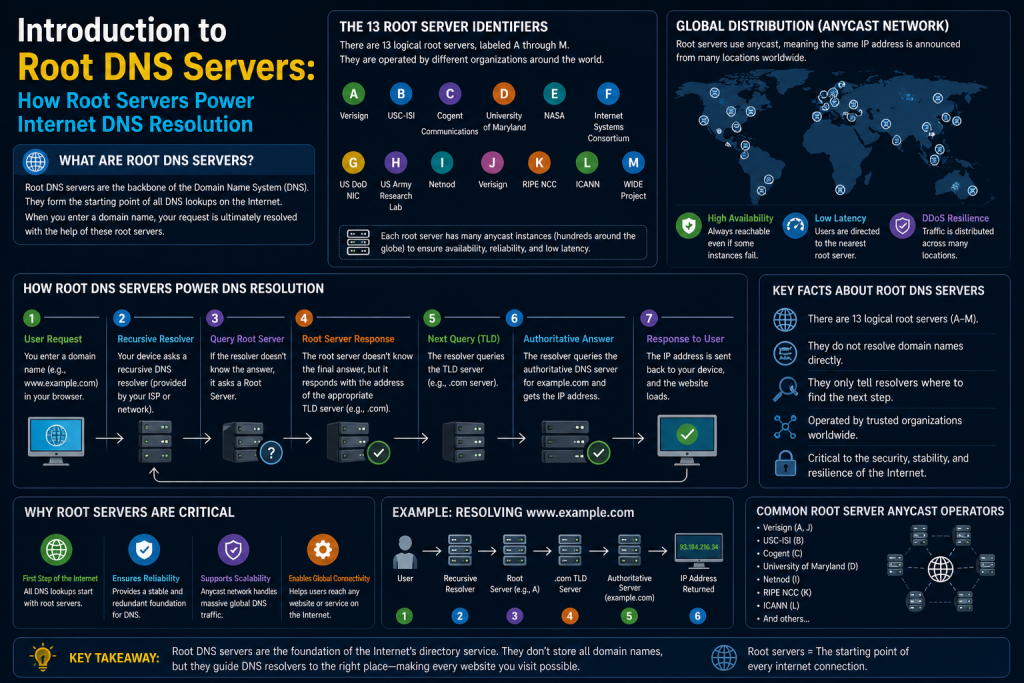
Root DNS servers act as the entry point into the DNS system. When a DNS resolver does not have the answer to a query, it starts by contacting a root server. The root server responds with information about where to find the next piece of the puzzle, typically directing the resolver to a top-level domain server.
These servers maintain a dataset known as the root zone. This file contains information about all top-level domains and their corresponding name servers. It does not include specific domain records, but it provides the necessary references to locate them.
The role of root servers is similar to that of a directory guide. They do not provide the final destination, but they ensure that queries are sent in the right direction. This approach allows the DNS system to remain efficient even as the number of websites continues to grow.
Because they sit at the top of the hierarchy, root DNS servers are critical to the functioning of the internet. Every DNS lookup that cannot be resolved locally will eventually rely on them to begin the resolution process. Their reliability and performance are therefore essential for maintaining seamless internet access.
The Global Distribution of Root Servers
Although there are only thirteen root server names, the actual infrastructure behind them is far more extensive. Each root server is supported by multiple physical machines located in different parts of the world. This distribution ensures that users can access root servers quickly, regardless of their geographic location.
The technology that enables this distribution is known as anycast routing. With anycast, multiple servers share the same IP address. When a request is sent to that address, the network automatically directs it to the nearest or most efficient server. This reduces latency and improves response times.
Anycast also enhances reliability. If one server becomes unavailable due to maintenance or an attack, other servers using the same address can handle the traffic. This redundancy ensures that the DNS system remains operational even under adverse conditions.
The global presence of root servers is essential for handling the massive volume of DNS queries generated every day. By spreading the load across many locations, the system can operate efficiently while minimizing delays for users.
How DNS Resolution Begins
The DNS resolution process starts when a user enters a domain name into a browser. The device first checks its local cache to see if it already has the IP address for that domain. If the information is not available locally, the request is sent to a recursive resolver.
The recursive resolver acts as an intermediary between the user and the DNS system. It is responsible for finding the correct IP address by querying different servers in the hierarchy. If the resolver does not already have the answer cached, it begins the resolution process by contacting a root DNS server.
When the root server receives the query, it does not provide the final answer. Instead, it responds with a referral to the appropriate top-level domain server. For example, if the request is for a domain ending in .com, the root server will direct the resolver to a .com top-level domain server.
The resolver then continues the process by querying the top-level domain server, which provides further guidance. Eventually, the resolver reaches an authoritative name server that holds the actual IP address for the domain. This information is then returned to the user’s device, allowing the connection to be established.
The Role of Caching in DNS Efficiency
Caching plays a significant role in improving the performance of the DNS system. When a resolver obtains the IP address for a domain, it stores that information for a specified period of time. This duration is determined by the time-to-live value associated with the record.
By caching responses, resolvers can quickly answer repeated queries without contacting root servers or other parts of the hierarchy. This reduces the number of requests that need to be processed and speeds up the browsing experience for users.
Caching also reduces the load on root DNS servers. Since many users request the same popular domains, cached responses can handle a large portion of traffic. This allows root servers to focus on handling new or less frequent queries.
The efficiency gained through caching is one of the reasons DNS can operate at such a large scale. Without it, root servers would be overwhelmed by the sheer volume of requests generated by users around the world.
Why Root DNS Servers Are Essential
Root DNS servers are fundamental to the operation of the internet. They provide the starting point for DNS resolution, ensuring that queries are directed to the correct part of the hierarchy. Without them, the process of locating websites would be much more complicated and less reliable.
Their importance goes beyond simple functionality. Root servers also contribute to the stability and resilience of the internet. By distributing their infrastructure globally and using advanced routing techniques, they ensure that DNS services remain available even under challenging conditions.
The design of root servers reflects a balance between simplicity and efficiency. By focusing on directing queries rather than storing detailed data, they can handle a large volume of requests without becoming a bottleneck. This approach allows the DNS system to scale effectively as the internet continues to grow.
Challenges Faced by Root DNS Servers
Despite their robust design, root DNS servers face several challenges. One of the most significant is the sheer volume of traffic they must handle. With billions of devices connected to the internet, the number of DNS queries continues to increase.
Another challenge is the threat of malicious attacks. Root servers are attractive targets for attackers because of their critical role in the DNS system. Distributed denial-of-service attacks, for example, aim to overwhelm servers with traffic, potentially disrupting their ability to respond to legitimate requests.
To address these challenges, root server operators implement various security measures. These include traffic filtering, rate limiting, and collaboration with other organizations to detect and respond to threats. The distributed nature of root servers also helps mitigate the impact of attacks by ensuring that no single point of failure exists.
Maintaining the integrity of the root zone is another important responsibility. Changes to this dataset must be carefully managed to prevent errors or inconsistencies. Strict procedures and verification processes are in place to ensure that updates are accurate and secure.
The Growing Importance of Root DNS Servers
As the internet continues to expand, the role of root DNS servers becomes increasingly important. The rise of new technologies, such as cloud computing and connected devices, has led to a significant increase in DNS traffic. Root servers must adapt to handle this growth while maintaining high levels of performance and reliability.
The increasing complexity of internet services also presents new challenges. Modern applications often rely on multiple domains and services, generating more DNS queries than ever before. Root servers must support this complexity without introducing delays or disruptions.
Future developments in networking and security may require changes to how root servers operate. However, their fundamental role as the starting point of DNS resolution is unlikely to change. They will continue to serve as a critical component of the internet’s infrastructure.
How Root DNS Servers Operate Within the DNS Resolution Process
The operation of root DNS servers becomes clearer when examined within the full DNS resolution workflow. Every time a user attempts to visit a website, a sequence of interactions takes place behind the scenes. These interactions are structured, efficient, and designed to minimize delay while maintaining accuracy. Root DNS servers play a foundational role in initiating this sequence.
When a domain name is entered into a browser, the system does not immediately know where to send the request. The device first checks its own local cache to see if it has recently resolved the same domain. If the answer is not found locally, the request is forwarded to a recursive resolver, typically managed by an internet service provider or a network administrator.
The recursive resolver is responsible for doing the heavy lifting. It systematically queries different DNS servers to find the correct IP address. If the resolver does not already have the information stored in its cache, it begins by reaching out to a root DNS server. This step is essential because the resolver needs a starting point to navigate the DNS hierarchy.
Upon receiving the query, the root server does not attempt to resolve the full domain name. Instead, it examines the top-level domain portion of the request. It then responds with a referral, directing the resolver to the appropriate top-level domain server. This response includes the addresses of servers responsible for handling that specific domain extension.
The resolver then contacts the top-level domain server, which provides another referral, this time pointing to the authoritative name server for the requested domain. Finally, the authoritative server returns the actual IP address. This information is passed back to the user’s device, completing the resolution process.
Root DNS servers are critical in this sequence because they provide the initial direction. Without their guidance, the resolver would not know where to begin searching for the requested information. Their role is not to provide answers, but to ensure that the process starts correctly and efficiently.
Understanding the Root Zone and Its Management
At the heart of root DNS server functionality lies the root zone. This is a specialized database that contains the information necessary to locate top-level domain servers. It includes details about each top-level domain and the authoritative servers responsible for managing them.
The root zone is carefully maintained to ensure accuracy and consistency. Any errors in this dataset could lead to widespread disruptions in DNS resolution. Because of this, changes to the root zone are handled with extreme caution and involve multiple layers of verification.
The management of the root zone is overseen by organizations responsible for maintaining the integrity of the DNS system. These organizations follow strict procedures to validate updates and ensure that all changes are legitimate. This process helps protect the system from accidental misconfigurations as well as malicious tampering.
When a new top-level domain is introduced, it must be added to the root zone. This involves updating the database and distributing the changes to root DNS servers around the world. The update process is gradual, allowing servers to synchronize their data without causing disruptions.
The careful management of the root zone highlights its importance. It serves as the central reference point for the entire DNS hierarchy, guiding queries from the very first step of the resolution process.
Change Management and Update Procedures
Updating the root zone is not a routine or casual task. Each change must go through a well-defined process to ensure that it does not negatively impact the global internet. This process includes planning, verification, testing, and implementation.
Before any update is applied, it must be verified for authenticity. This involves checking that the request comes from a trusted source and that the data is accurate. Verification helps prevent unauthorized changes that could disrupt DNS functionality.
Testing is another critical step. Updates are typically tested in controlled environments before being deployed to production systems. This allows administrators to identify potential issues and resolve them before they affect users.
Once testing is complete, the update is scheduled for deployment. This is often done during maintenance windows to minimize the impact on users. After the update is applied, systems are monitored closely to ensure that everything is functioning as expected.
In case of unexpected problems, a rollback procedure is essential. This allows administrators to revert to a previous version of the root zone quickly, restoring normal operations. Having a clear rollback plan is a key part of maintaining system stability.
Documentation and approval are also important components of the process. Every change must be recorded, including the reason for the update and the steps taken to implement it. Approval from authorized personnel ensures accountability and oversight.
Security Measures Protecting Root DNS Servers
Given their critical role, root DNS servers are a major focus for security efforts. Protecting these servers is essential to maintaining the stability and reliability of the internet. Various measures are in place to safeguard them from threats.
One of the primary threats is distributed denial-of-service attacks. These attacks attempt to overwhelm servers with a large volume of traffic, making them unable to respond to legitimate requests. Root servers are designed to handle high traffic loads, but additional protections are necessary to mitigate these attacks.
Traffic filtering and rate limiting are commonly used to manage incoming requests. These techniques help identify suspicious patterns and block malicious traffic before it can cause harm. By controlling the flow of requests, servers can maintain their performance even during an attack.
Another important security measure is the use of DNS Security Extensions. This technology adds a layer of authentication to DNS responses, ensuring that the information provided is genuine and has not been altered. Digital signatures are used to verify the integrity of data as it moves through the DNS system.
Collaboration between organizations also plays a key role in security. Operators of root DNS servers share information about threats and coordinate their responses. This collective effort helps strengthen the overall resilience of the system.
Physical security is another consideration. Root server infrastructure is often located in secure facilities with controlled access. Protecting the hardware is just as important as securing the software and network components.
The Importance of Redundancy and Reliability
Redundancy is a fundamental principle in the design of root DNS servers. The system is built to ensure that no single failure can disrupt the entire network. This is achieved through the use of multiple server instances distributed across different locations.
Each root server name is associated with numerous physical servers. These servers operate independently but share the same configuration and data. If one server becomes unavailable, others can continue to handle requests without interruption.
Anycast routing enhances this redundancy by directing traffic to the nearest available server. This not only improves performance but also ensures that requests can be rerouted quickly if a server goes offline. The result is a highly resilient system capable of maintaining service under a wide range of conditions.
Reliability is critical because DNS is a foundational service. If DNS resolution fails, users cannot access websites, send emails, or use many online services. Root DNS servers play a key role in maintaining this reliability by ensuring that the resolution process can always begin.
Continuous monitoring is used to maintain high levels of reliability. Operators track performance metrics and identify potential issues before they escalate. This proactive approach helps prevent outages and ensures consistent service.
Performance Optimization and Efficiency
Handling the immense volume of DNS queries requires careful optimization. Root DNS servers are designed to respond quickly and efficiently, minimizing delays in the resolution process. Several techniques are used to achieve this level of performance.
One of the most important techniques is caching. While root servers themselves do not rely heavily on caching, the broader DNS system uses it extensively. By reducing the number of queries that reach root servers, caching helps maintain their efficiency.
Load balancing is another key factor. Traffic is distributed across multiple servers to prevent any single instance from becoming overloaded. This ensures that all servers operate within their capacity and can respond promptly to requests.
Network optimization also plays a role. By strategically placing server instances in different regions, operators can reduce latency and improve response times for users. This global distribution ensures that users receive fast and reliable service regardless of their location.
Efficient software design contributes to performance as well. Root DNS servers use optimized code and protocols to process queries بسرعة and accurately. This allows them to handle large volumes of traffic without compromising on speed or reliability.
Challenges in Scaling with Internet Growth
The rapid growth of the internet presents ongoing challenges for root DNS servers. As more users and devices come online, the number of DNS queries continues to increase. This growth requires constant adaptation to ensure that the system can handle the additional load.
The rise of mobile devices, cloud services, and connected technologies has significantly increased the demand for DNS resolution. Each of these technologies generates its own set of queries, adding to the overall volume of traffic.
Scaling the infrastructure to meet this demand involves adding more server instances and optimizing existing systems. This requires careful planning and coordination to ensure that performance remains consistent.
Another challenge is maintaining security while scaling. As the system grows, it becomes a larger target for attackers. Implementing robust security measures is essential to protect against evolving threats.
Balancing performance, security, and scalability is an ongoing task. Root DNS server operators must continuously evaluate their systems and make improvements to keep pace with the changing internet landscape.
The Role of Root Servers in Modern Networking
In modern networking environments, root DNS servers continue to play a vital role. They are involved in every DNS resolution process that requires external lookup, making them a constant presence in network operations.
For network administrators and engineers, understanding how root servers function is essential. It helps them troubleshoot DNS issues, optimize performance, and design efficient network architectures.
Root servers also support emerging technologies by providing a stable foundation for DNS resolution. Whether it is cloud computing, streaming services, or smart devices, all rely on DNS to function properly.
As networking continues to evolve, the importance of root DNS servers remains unchanged. They serve as the starting point for connecting users to the resources they need, ensuring that the internet remains accessible and reliable.
Evolving Challenges and the Future of Root DNS Servers
As the internet continues to expand in scale and complexity, root DNS servers must evolve to meet new demands. These servers were originally designed in an era when the number of connected devices and websites was significantly smaller than it is today. Over time, however, the rapid growth of digital services, mobile technologies, and global connectivity has placed increasing pressure on the DNS infrastructure.
One of the most significant drivers of this growth is the rise of connected devices. From smartphones and laptops to smart home systems and industrial sensors, billions of devices now rely on DNS to communicate. Each of these devices generates DNS queries, contributing to the overall volume of traffic that root servers must indirectly support. While caching reduces the number of direct queries reaching root servers, the overall system must still be designed to handle this exponential growth.
Another important factor is the expansion of cloud computing. Modern applications often rely on distributed cloud services that operate across multiple regions. These services generate frequent DNS lookups as they dynamically scale resources, balance loads, and maintain availability. Root DNS servers play a foundational role in ensuring that these lookups can begin efficiently, even as the complexity of cloud environments continues to increase.
The increasing reliance on digital services also raises expectations for performance and reliability. Users expect instant access to websites and applications, with minimal latency and no downtime. Root DNS servers must support this expectation by maintaining fast response times and consistent availability, even under heavy load conditions.
The Impact of Emerging Technologies
Emerging technologies are reshaping how the internet operates, and root DNS servers must adapt accordingly. One such technology is the Internet of Things, which connects everyday objects to the internet. These devices often operate with limited resources and rely heavily on DNS for communication. As the number of IoT devices grows, the DNS system must handle a higher volume of queries while maintaining efficiency.
Artificial intelligence and machine learning are also influencing network behavior. These technologies enable dynamic decision-making in areas such as traffic management and security. While they can improve efficiency, they also introduce new patterns of DNS usage that root servers must accommodate.
Another development is the increasing use of encrypted communication protocols. Technologies that enhance privacy and security often rely on DNS to function properly. As these protocols become more widespread, root DNS servers must continue to provide a reliable foundation for secure communication.
The adoption of new naming systems and domain structures may also impact how DNS operates. While the core principles of the system remain stable, updates and improvements are sometimes necessary to support new use cases. Root servers must be flexible enough to adapt to these changes without compromising stability.
Strengthening Security in a Changing Landscape
Security remains one of the most critical concerns for root DNS servers. As cyber threats become more sophisticated, protecting the DNS infrastructure requires constant vigilance and innovation. Root servers are particularly important targets because of their role in the resolution process.
One of the key strategies for enhancing security is the use of DNS Security Extensions. This technology helps ensure that DNS responses are authentic and have not been tampered with. By using digital signatures, DNSSEC allows resolvers to verify the integrity of the information they receive.
In addition to DNSSEC, root server operators implement a variety of defensive measures. These include advanced monitoring systems that detect unusual traffic patterns, as well as automated tools that respond to potential threats in real time. By identifying and mitigating attacks quickly, operators can minimize their impact.
Collaboration is another essential aspect of DNS security. Organizations responsible for root servers work together to share information about threats and coordinate responses. This collective approach strengthens the overall resilience of the system and helps prevent widespread disruptions.
Physical security also plays a role in protecting root server infrastructure. Data centers housing root servers are equipped with access controls, surveillance systems, and environmental protections. These measures ensure that the hardware supporting DNS operations remains secure and reliable.
Maintaining Stability Through Global Coordination
The stability of root DNS servers depends on careful coordination among multiple organizations. Each root server is operated by a different entity, and these entities must work together to ensure consistent performance and reliability.
This coordination extends to the management of the root zone. Updates to the root zone must be synchronized across all root servers to ensure that they provide consistent information. This process requires precise timing and verification to prevent discrepancies that could affect DNS resolution.
Communication between operators is essential for addressing issues and implementing improvements. Regular meetings, shared protocols, and collaborative planning help maintain alignment across the global network of root servers. This level of coordination ensures that the system operates as a unified whole, despite being distributed across many locations.
Standardization also contributes to stability. By following established protocols and best practices, root server operators can ensure compatibility and consistency. This reduces the risk of errors and helps maintain the reliability of the DNS system.
Performance Optimization in a High-Demand Environment
As demand for DNS services grows, optimizing performance becomes increasingly important. Root DNS servers must be able to handle large volumes of queries quickly and efficiently. Achieving this requires a combination of advanced technology and strategic planning.
One of the key factors in performance optimization is geographic distribution. By placing server instances in different regions, operators can reduce the distance between users and servers. This reduces latency and improves response times, enhancing the overall user experience.
Anycast routing continues to play a central role in performance optimization. By directing traffic to the nearest available server, anycast ensures that queries are handled efficiently. It also helps balance the load across multiple servers, preventing congestion and maintaining consistent performance.
Hardware and software improvements also contribute to efficiency. Modern servers are equipped with powerful processors and optimized software that can handle high volumes of traffic بسرعة and accurately. Continuous upgrades ensure that root DNS servers remain capable of meeting increasing demands.
Monitoring and analytics provide valuable insights into system performance. By analyzing traffic patterns and identifying potential bottlenecks, operators can make informed decisions about resource allocation and system improvements. This proactive approach helps maintain optimal performance even as conditions change.
Preparing for Future Growth
The future of root DNS servers will be shaped by ongoing growth in internet usage and technological innovation. Preparing for this future requires a forward-looking approach that anticipates challenges and develops solutions in advance.
One area of focus is scalability. Root DNS servers must be able to expand their capacity to handle increasing traffic. This may involve adding new server instances, improving infrastructure, and adopting new technologies that enhance efficiency.
Another important consideration is adaptability. As new technologies emerge, root servers must be able to integrate with them seamlessly. This requires flexibility in design and a willingness to evolve in response to changing requirements.
Sustainability is also becoming a consideration in infrastructure planning. As data centers consume significant amounts of energy, efforts are being made to improve efficiency and reduce environmental impact. Root DNS server operators may adopt greener technologies and practices to support long-term sustainability.
Education and awareness are equally important. As more organizations and individuals rely on DNS, understanding how the system works becomes increasingly valuable. Training and knowledge sharing can help ensure that the next generation of network professionals is prepared to manage and support DNS infrastructure.
The Human Element Behind Root DNS Servers
While technology plays a central role in the operation of root DNS servers, the human element is equally important. Skilled professionals are responsible for designing, maintaining, and securing these systems. Their expertise ensures that the DNS infrastructure continues to function effectively.
Engineers and administrators monitor server performance, respond to incidents, and implement improvements. Their work often goes unnoticed, but it is essential for maintaining the reliability of the internet. Collaboration among these professionals helps address challenges and share best practices.
Policy makers and governing bodies also play a role in shaping the DNS landscape. They establish guidelines and regulations that influence how root servers are managed. Their decisions can impact everything from security standards to the introduction of new top-level domains.
The combination of technical expertise and organizational coordination creates a strong foundation for DNS operations. This human-driven approach ensures that the system can adapt to changing conditions and continue to meet the needs of users worldwide.
Long-Term Importance of Root DNS Servers
Root DNS servers have been a cornerstone of the internet since its early development, and their importance continues to grow. As more aspects of daily life move online, the reliability of DNS becomes increasingly critical. From communication and commerce to education and entertainment, countless activities depend on seamless internet access.
The design of root servers allows them to handle this responsibility effectively. Their distributed architecture, efficient operation, and strong security measures ensure that they can support the demands of a global network. Even as the internet evolves, the fundamental role of root servers remains unchanged.
Looking ahead, root DNS servers will continue to serve as the starting point for digital communication. Their ability to adapt to new challenges and technologies will determine how effectively the internet can grow and evolve. Maintaining their stability and performance is essential for the future of global connectivity.
Conclusion
Root DNS servers are a foundational element of the internet, quietly enabling every online interaction. They provide the starting point for DNS resolution, guiding queries through a structured hierarchy until the correct destination is found. Their design emphasizes efficiency, reliability, and scalability, allowing them to support a rapidly growing digital world.
Throughout the evolution of the internet, root DNS servers have demonstrated remarkable resilience. Their global distribution, use of advanced routing techniques, and strong security measures ensure that they can withstand challenges and continue operating under demanding conditions. At the same time, ongoing innovation and collaboration among operators help them adapt to new technologies and emerging threats.
As the internet expands and becomes even more integrated into everyday life, the importance of root DNS servers will only increase. They will continue to play a critical role in connecting users to information, services, and each other. Understanding their function highlights the complexity behind the seemingly simple act of accessing a website and underscores the importance of maintaining a stable and secure DNS infrastructure for the future.
Continue exploring the technologies and certification concepts that matter most to you.