The world of networking continues to evolve as new technologies reshape how systems are designed, deployed, and managed. Certifications must evolve alongside these changes to remain meaningful and aligned with real-world requirements. The updated CCNA v1.1 (200-301) exam represents another step in that ongoing evolution.
This updated version introduces refinements that reflect the increasing importance of cloud computing, automation, and artificial intelligence in modern networking environments. While the structure of the exam remains familiar, the added topics signal a clear shift toward more advanced and future-focused skills.
For aspiring networking professionals, understanding these updates is essential. The CCNA certification is often the first major step into the IT industry, and preparing with the most current information ensures that candidates are building relevant and practical knowledge.
Timeline and Transition to the New Exam Version
Every certification update comes with a transition period, allowing candidates to adjust their preparation strategies. The previous version of the CCNA 200-301 exam remains available until August 19, 2024. After that, the updated CCNA v1.1 exam becomes the only available option starting August 20, 2024.
This transition window provides flexibility for learners. Those who are already well-prepared may choose to attempt the existing exam before it is retired. On the other hand, individuals who are just beginning their journey are better off focusing on the updated version to ensure their knowledge aligns with current industry expectations.
Planning around these dates is important because it can influence study timelines, resource selection, and overall preparation strategy.
Purpose Behind the CCNA v1.1 Update
Certification updates are driven by the need to stay relevant. Networking is no longer limited to configuring routers and switches. Today’s professionals must understand a wide range of technologies, including cloud services, automation tools, and intelligent systems.
The CCNA v1.1 update reflects this reality. It introduces concepts that go beyond traditional networking, preparing candidates for environments where networks are integrated with software platforms and managed through centralized systems.
The inclusion of automation and artificial intelligence highlights how networking roles are expanding. Engineers are now expected to think beyond manual configurations and embrace tools that improve efficiency and scalability.
By aligning the exam with these trends, the certification continues to serve as a reliable benchmark for entry-level networking skills.
Core Areas Covered in the CCNA Exam
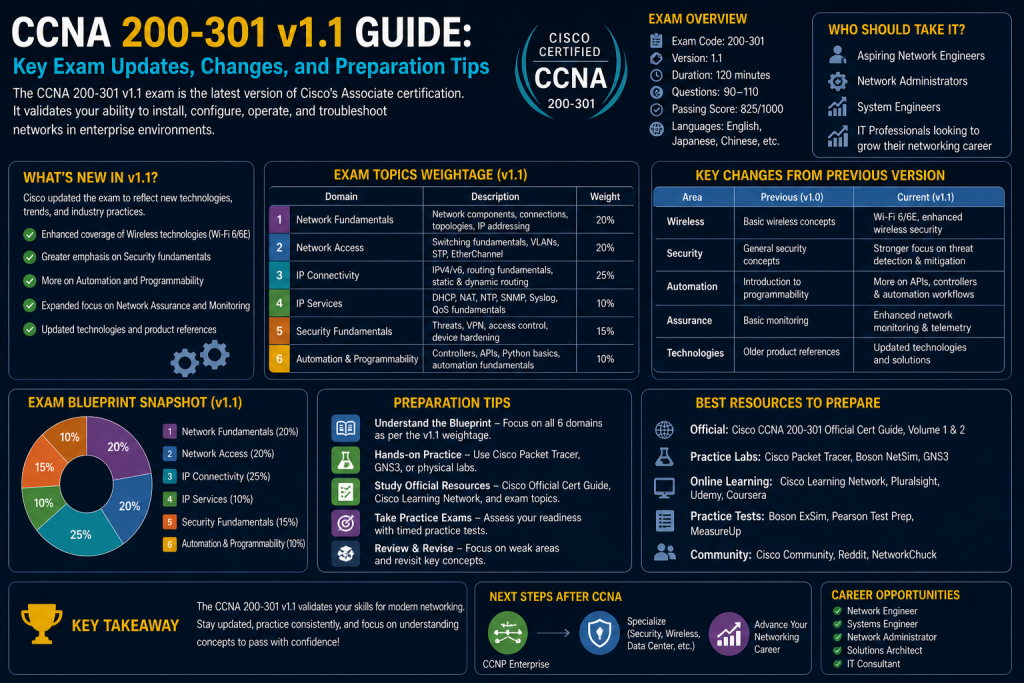
Despite the updates, the CCNA exam still focuses on foundational knowledge areas that are essential for any networking professional. These core areas ensure that candidates develop a well-rounded understanding of networking principles.
Network fundamentals form the base of the exam. This area covers essential concepts such as networking models, IP addressing, and how devices communicate within a network. A strong grasp of these basics is necessary before moving on to more advanced topics.
Network access focuses on how devices connect and communicate within local networks. It includes switching concepts, VLANs, and wireless networking. Understanding these topics is crucial for building and managing efficient local networks.
IP connectivity deals with routing and the movement of data between networks. This includes routing protocols and path selection processes. These concepts are central to ensuring that data reaches its destination correctly.
IP services cover additional network functionalities such as DHCP, DNS, and network management tools. These services support the overall operation and efficiency of networks.
Security fundamentals emphasize protecting network infrastructure from threats. Candidates learn about secure access methods, device hardening, and basic security practices.
Automation and programmability introduce modern approaches to network management. This area focuses on how automation tools and software-based solutions are transforming traditional networking tasks.
Enhancements in Spanning Tree Protocol Knowledge
One of the areas receiving additional attention in the updated exam is spanning tree protocol. This protocol plays a critical role in preventing network loops and ensuring stable communication within switched networks.
The updated exam expands on basic concepts by introducing additional protective mechanisms. Candidates are expected to understand how features such as root guard, loop guard, and BPDU-related protections contribute to network stability.
These enhancements are important because modern networks are more complex and require stronger safeguards against misconfigurations and unexpected behavior. By learning these concepts, candidates gain the ability to design and maintain more resilient networks.
Understanding how spanning tree operates at a deeper level also helps in troubleshooting network issues, making it a valuable skill for real-world scenarios.
Modern Approaches to Network Device Management
Traditional network management methods involved accessing devices individually through console connections or remote protocols. While these methods are still relevant, they are no longer sufficient for managing large and complex networks.
The updated CCNA exam reflects the shift toward centralized and cloud-based management solutions. Candidates are now expected to understand how devices can be managed through cloud platforms and centralized controllers.
This approach offers several advantages, including improved scalability, easier configuration management, and better visibility into network performance. Administrators can manage multiple devices from a single interface, reducing the need for manual intervention.
Understanding these modern management techniques is essential for anyone working in today’s networking environments.
The Rise of Cloud Networking Concepts
Cloud computing has become a fundamental part of IT infrastructure. Organizations are increasingly adopting cloud-based solutions to improve flexibility and reduce costs.
The updated CCNA exam introduces candidates to cloud networking concepts, ensuring they understand how cloud environments interact with traditional networks. This includes knowledge of cloud-managed devices and how they are configured and monitored.
Cloud networking requires a different mindset compared to traditional setups. Instead of managing physical devices directly, administrators often work with virtual resources and centralized management platforms.
By learning these concepts, candidates are better prepared for roles that involve hybrid or fully cloud-based environments.
Automation as a Core Networking Skill
Automation is transforming the way networks are managed. Tasks that once required manual configuration can now be performed automatically using scripts and specialized tools.
The CCNA v1.1 exam emphasizes the importance of automation by including foundational concepts in this area. Candidates are expected to understand how automation improves efficiency and reduces errors.
Automation also enables faster deployment of network configurations, making it easier to scale operations. For example, instead of configuring each device individually, administrators can apply changes across multiple devices simultaneously.
Learning automation concepts at an early stage helps candidates build skills that are highly valued in the industry.
Introduction to Artificial Intelligence in Networking
Artificial intelligence is playing an increasingly important role in networking. It allows systems to analyze data, identify patterns, and make decisions with minimal human intervention.
The updated CCNA exam introduces basic AI concepts, helping candidates understand how these technologies are applied in networking environments. This includes areas such as predictive analysis and anomaly detection.
AI can help identify potential issues before they become serious problems, improving network reliability and performance. It can also optimize traffic flow and enhance overall efficiency.
While the exam does not require deep expertise in AI, having a foundational understanding provides a significant advantage in modern IT roles.
Comparing Traditional and Modern Network Management
The evolution of network management is one of the key themes in the updated CCNA exam. Traditional methods relied heavily on manual processes and device-by-device configuration.
Modern approaches focus on centralized management and automation. Tools and platforms allow administrators to control entire networks from a single interface, making operations more efficient and consistent.
This shift reduces the likelihood of errors and improves overall network performance. It also allows organizations to respond more quickly to changes and challenges.
Understanding both traditional and modern approaches is important because many organizations still use a combination of both. Candidates must be able to adapt to different environments and requirements.
Effective Study Strategies for CCNA v1.1
Preparing for the updated CCNA exam requires a structured and disciplined approach. Candidates should begin by reviewing the exam objectives to identify key topics and areas of focus.
Using updated study materials is essential. Resources that reflect the new exam content ensure that candidates are learning the most relevant information.
Hands-on practice is one of the most effective ways to reinforce learning. Working with simulators or real networking equipment helps bridge the gap between theory and practical application.
Regular revision is also important. Revisiting topics multiple times helps improve retention and understanding. Creating a study schedule can help maintain consistency and ensure steady progress.
Practice exams are another valuable tool. They help candidates become familiar with the exam format and identify areas where improvement is needed.
Importance of Staying Updated in Networking
The networking field is constantly changing, and professionals must keep up with new developments to remain competitive. Certifications like CCNA play a crucial role in validating current knowledge and skills.
The updated CCNA v1.1 exam reflects the latest trends in the industry, making it a valuable credential for anyone entering the field. By staying updated, candidates demonstrate their commitment to learning and professional growth.
Continuous learning is essential in IT. Even after earning a certification, professionals should continue to explore new technologies and expand their skill sets.
This mindset not only improves career prospects but also ensures long-term success in a rapidly evolving industry.
Building a Strong Career with CCNA
The CCNA certification is widely recognized as a stepping stone into the networking field. It provides a solid foundation that can lead to various career opportunities.
With the updated exam content, candidates are better prepared for modern networking roles. The inclusion of cloud, automation, and AI concepts ensures that certified professionals have a well-rounded skill set.
Employers value candidates who understand both traditional networking principles and emerging technologies. This combination makes CCNA-certified individuals attractive in the job market.
Earning the CCNA certification requires dedication and effort, but the benefits are significant. It opens doors to new opportunities and provides a strong base for further career advancement.
Final Thoughts on Preparing for CCNA v1.1
Preparing for the CCNA v1.1 exam is not just about passing a test. It is about building knowledge and skills that will be useful throughout a networking career.
The updates introduced in this version reflect the direction of the industry. By understanding these changes and preparing effectively, candidates can position themselves for success.
A combination of theoretical knowledge, practical experience, and consistent study habits is the key to achieving certification. With the right approach, passing the exam becomes an achievable goal.
The journey to becoming a certified networking professional begins with preparation, and understanding the updated CCNA exam is an important first step.
Understanding the Expanded Scope of Networking Skills
As networking continues to evolve, the expectations placed on entry-level professionals are becoming more sophisticated. The updated CCNA v1.1 exam reflects this shift by expanding the scope of knowledge required from candidates. While foundational topics remain essential, there is a stronger emphasis on how these fundamentals are applied in modern, real-world environments.
Networking is no longer limited to isolated systems. Today’s networks are interconnected, dynamic, and often distributed across multiple environments, including on-premises data centers and cloud platforms. This means that professionals must not only understand how individual components work but also how they interact within larger ecosystems.
The updated exam encourages candidates to think beyond configuration and focus on problem-solving, adaptability, and integration. These skills are critical for managing modern networks effectively.
Advanced Understanding of Switching and Network Stability
Switching remains a core topic in the CCNA exam, but the updated version requires a deeper understanding of how switches maintain stability and prevent disruptions. Modern networks rely heavily on switching technologies, making it essential for candidates to understand both basic operations and advanced protective mechanisms.
Spanning tree protocol continues to play a key role in preventing loops, but the updated exam introduces additional concepts that enhance network resilience. Candidates are expected to understand how protective features work together to maintain a stable topology.
These features help prevent issues such as broadcast storms, which can severely impact network performance. By learning how to implement and manage these protections, candidates gain valuable skills that are directly applicable in professional environments.
Understanding how switches behave under different conditions also helps in troubleshooting. This ability to diagnose and resolve issues is a critical skill for any network engineer.
Deeper Insights into Network Device Management
Managing network devices has become more complex as networks grow in size and complexity. The updated CCNA exam reflects this by placing greater emphasis on different management approaches and access methods.
Candidates must understand traditional management protocols such as remote access and secure communication methods. These include technologies that allow administrators to configure and monitor devices from a distance.
In addition to traditional methods, the exam also covers modern management approaches that rely on centralized systems. These systems provide a unified interface for managing multiple devices, making it easier to maintain consistency across the network.
Understanding the advantages and limitations of different management methods is important. Each approach has its own use cases, and professionals must be able to choose the most appropriate solution based on the situation.
The Role of Secure Access in Network Administration
Security is a fundamental aspect of network management. The updated CCNA exam reinforces the importance of secure access methods, ensuring that candidates understand how to protect network devices from unauthorized access.
Secure communication protocols are essential for maintaining the integrity and confidentiality of network data. Candidates must understand how these protocols work and why they are preferred over less secure alternatives.
Authentication systems also play a key role in network security. These systems ensure that only authorized users can access network resources. By implementing proper authentication mechanisms, organizations can reduce the risk of security breaches.
Understanding security fundamentals is not just about passing the exam. It is about developing habits and practices that contribute to safer and more reliable networks.
Cloud-Managed Networking and Its Impact
One of the most significant additions to the CCNA v1.1 exam is the inclusion of cloud-managed networking. This reflects a major shift in how networks are designed and operated.
Cloud-managed networking allows administrators to control and monitor devices through cloud-based platforms. This approach offers greater flexibility and scalability compared to traditional methods.
Candidates must understand how cloud-managed systems work and how they differ from locally managed networks. This includes knowledge of how devices connect to cloud platforms and how configurations are applied remotely.
The ability to manage networks through the cloud is becoming increasingly important, especially as organizations adopt hybrid and multi-cloud environments. Learning these concepts prepares candidates for modern networking roles.
Comparing Traditional Infrastructure with Modern Solutions
The transition from traditional network infrastructure to modern solutions is a key theme in the updated exam. Traditional networks rely heavily on manual configuration and physical hardware, while modern networks incorporate automation and virtualization.
Candidates must understand the differences between these approaches and how they impact network design and management. Traditional methods offer direct control but can be time-consuming and difficult to scale.
Modern solutions, on the other hand, provide greater efficiency and flexibility. They allow administrators to manage networks more easily and respond quickly to changes.
Understanding both approaches is important because many organizations use a combination of traditional and modern technologies. Professionals must be able to work in diverse environments and adapt to different systems.
Introduction to Network Automation Tools
Automation tools are becoming an essential part of network management. The updated CCNA exam introduces candidates to the basic concepts behind these tools and how they are used in real-world scenarios.
Automation tools help simplify complex tasks by allowing administrators to create scripts and workflows. These scripts can perform repetitive tasks automatically, reducing the need for manual intervention.
Candidates are expected to understand how automation improves efficiency and reduces the risk of errors. They should also be familiar with basic concepts such as data formats and interfaces used in automation.
Learning about automation tools provides a strong foundation for more advanced studies in network programmability and software-defined networking.
Understanding APIs and Their Role in Networking
Application programming interfaces play a significant role in modern networking. They allow different systems and applications to communicate with each other, enabling automation and integration.
The updated CCNA exam introduces candidates to the concept of APIs and how they are used in networking environments. Understanding APIs is important for working with automation tools and cloud platforms.
APIs allow administrators to interact with network devices programmatically, making it possible to automate tasks and retrieve information efficiently. This capability is essential for managing large and complex networks.
By learning about APIs, candidates gain insight into how modern networks are controlled and monitored.
Wireless Networking and Management Evolution
Wireless networking continues to be an important part of the CCNA exam. The updated version places additional emphasis on how wireless networks are managed and secured.
Candidates must understand how wireless devices connect to networks and how controllers are used to manage access points. This includes knowledge of different management methods and how they impact network performance.
Wireless networks present unique challenges, such as interference and security risks. Understanding how to address these challenges is essential for maintaining reliable connectivity.
The updated exam ensures that candidates are prepared to work with both wired and wireless networks in modern environments.
The Growing Importance of Monitoring and Troubleshooting
Monitoring and troubleshooting are critical skills for network professionals. The updated CCNA exam emphasizes the importance of these skills by including topics related to network performance and issue resolution.
Candidates must understand how to identify and diagnose network problems. This includes analyzing symptoms, identifying root causes, and implementing solutions.
Monitoring tools play a key role in this process. They provide visibility into network performance and help administrators detect issues early.
Effective troubleshooting requires both knowledge and experience. By practicing these skills, candidates can become more confident in their ability to manage real-world networks.
Integrating Security into Everyday Networking Tasks
Security is no longer a separate aspect of networking. It is integrated into every part of network design and management. The updated CCNA exam reflects this by incorporating security concepts into multiple areas.
Candidates must understand how to implement basic security measures, such as controlling access to devices and protecting data in transit. These measures help prevent unauthorized access and ensure the integrity of network operations.
Security also involves monitoring for potential threats and responding to incidents. While advanced security topics are covered in higher-level certifications, the CCNA provides a strong foundation in this area.
By integrating security into everyday tasks, professionals can create safer and more reliable networks.
Real-World Application of CCNA Knowledge
One of the goals of the updated CCNA exam is to ensure that candidates can apply their knowledge in real-world scenarios. This means going beyond theoretical understanding and developing practical skills.
Hands-on experience is essential for achieving this goal. Working with network simulators or physical equipment allows candidates to practice configurations and troubleshoot issues.
Real-world scenarios often involve unexpected challenges. By practicing different situations, candidates can develop the problem-solving skills needed to handle these challenges effectively.
The ability to apply knowledge in practical situations is what sets successful candidates apart.
Building Confidence Through Practice and Consistency
Preparing for the CCNA v1.1 exam requires consistent effort and dedication. Candidates should develop a study plan that covers all exam topics and allows time for revision and practice.
Consistency is key to retaining information and building confidence. Regular study sessions help reinforce concepts and improve understanding.
Practice exams are a valuable tool for assessing readiness. They provide insight into strengths and weaknesses, allowing candidates to focus on areas that need improvement.
Building confidence is an important part of exam preparation. By staying consistent and practicing regularly, candidates can approach the exam with greater assurance.
Adapting to the Future of Networking
The updates introduced in the CCNA v1.1 exam highlight the direction in which networking is heading. Technologies such as cloud computing, automation, and artificial intelligence are becoming increasingly important.
Candidates who understand these trends are better prepared for future challenges. The ability to adapt to new technologies is a valuable skill in the IT industry.
Learning does not stop after earning a certification. Professionals must continue to update their knowledge and skills to stay relevant.
The CCNA certification provides a strong foundation, but ongoing learning is essential for long-term success.
Strengthening Career Opportunities with Updated Skills
The updated CCNA exam ensures that candidates are equipped with skills that are in demand. Employers are looking for professionals who understand modern networking technologies and can adapt to changing environments.
By earning the CCNA certification, candidates demonstrate their commitment to learning and professional development. This can open doors to various career opportunities in networking and IT.
The inclusion of modern topics in the exam makes the certification even more valuable. It shows that certified professionals are prepared for current and future challenges.
Building a successful career in networking requires a combination of knowledge, skills, and experience. The CCNA certification is an important step in that journey.
Final Perspective on Mastering CCNA v1.1 Topics
Mastering the topics covered in the CCNA v1.1 exam requires a balanced approach that combines theoretical knowledge with practical experience. Candidates must be willing to invest time and effort into their preparation.
Understanding the expanded topics and how they relate to real-world scenarios is essential. This includes not only learning new concepts but also applying them in practical situations.
With the right preparation strategy, candidates can successfully navigate the updated exam and achieve their certification goals. The knowledge gained during this process will serve as a strong foundation for future growth in the networking field.
Bringing All CCNA Concepts Together
As candidates approach the final stage of preparing for the CCNA v1.1 exam, it becomes important to connect all previously learned concepts into a unified understanding. Networking is not a collection of isolated topics. Instead, it is a system where each component interacts with others to create a functioning environment.
Understanding how network fundamentals relate to routing, switching, security, and automation is essential. For example, configuring a network device is not just about entering commands. It requires an understanding of how those configurations affect traffic flow, performance, and security.
The updated CCNA exam expects candidates to think in this integrated way. Questions are designed to test not only knowledge but also the ability to apply that knowledge in realistic scenarios. This means candidates must go beyond memorization and focus on comprehension.
Building this level of understanding requires consistent revision and practice. By revisiting topics and connecting them together, candidates can develop a deeper and more practical grasp of networking.
Developing a Practical Lab-Based Approach
One of the most effective ways to prepare for the CCNA exam is through hands-on practice. Theory alone is not enough to build the skills required for real-world networking tasks. Practical experience helps reinforce concepts and improves problem-solving abilities.
Using network simulators or physical lab setups allows candidates to experiment with configurations and observe their effects. This type of learning is especially valuable for understanding complex topics such as routing, switching, and network troubleshooting.
Lab practice also helps candidates become familiar with command-line interfaces and device behavior. This familiarity can reduce anxiety during the exam and improve confidence when answering scenario-based questions.
Setting up a regular lab practice routine can make a significant difference in preparation. Even simple exercises, when repeated consistently, can lead to a strong understanding of networking concepts.
Strengthening Troubleshooting Skills
Troubleshooting is a critical skill for any networking professional. The CCNA exam places a strong emphasis on identifying and resolving network issues. Candidates must be able to analyze problems and determine the most effective solutions.
Effective troubleshooting begins with understanding how networks are supposed to function. When something goes wrong, this knowledge helps identify where the issue might be occurring.
Candidates should practice diagnosing common problems such as connectivity issues, misconfigurations, and performance bottlenecks. This can be done through lab exercises or practice scenarios.
Developing a systematic approach to troubleshooting is important. Instead of guessing, candidates should learn to follow logical steps, such as checking configurations, verifying connections, and analyzing network behavior.
Strong troubleshooting skills not only help in passing the exam but also play a vital role in real-world networking jobs.
Understanding Exam Format and Question Types
Familiarity with the exam format is an important part of preparation. The CCNA v1.1 exam includes a variety of question types designed to test different aspects of knowledge and skills.
Candidates can expect multiple-choice questions, scenario-based questions, and interactive simulations. Each type requires a different approach, and practicing these formats can improve performance.
Scenario-based questions are particularly important because they test the ability to apply knowledge in realistic situations. These questions often require careful reading and analysis before selecting an answer.
Time management is another key factor. Candidates must be able to complete the exam within the given time while maintaining accuracy. Practicing with timed exams can help develop this skill.
Understanding the structure of the exam helps reduce uncertainty and allows candidates to focus on answering questions effectively.
Creating an Effective Study Plan
A well-structured study plan is essential for success in the CCNA exam. Without a clear plan, it is easy to lose focus or overlook important topics.
Candidates should start by breaking down the exam objectives into manageable sections. Each section can then be studied individually, ensuring thorough coverage of all topics.
Setting realistic goals is important. Instead of trying to cover too much in a short time, candidates should focus on steady progress. Regular study sessions are more effective than last-minute cramming.
Incorporating different study methods can also improve learning. Reading, watching instructional videos, and practicing in labs provide a balanced approach.
Periodic review sessions help reinforce knowledge and prevent forgetting. Revisiting previously studied topics ensures that information remains fresh and accessible.
Importance of Practice Exams and Self-Assessment
Practice exams are one of the most valuable tools for CCNA preparation. They provide an opportunity to test knowledge under exam-like conditions and identify areas that need improvement.
Taking practice exams regularly helps candidates become familiar with the types of questions they will encounter. It also helps build confidence and reduce exam anxiety.
Self-assessment is an important part of this process. After completing a practice exam, candidates should review their answers and understand any mistakes. This helps reinforce correct information and clarify misunderstandings.
Tracking progress over time can also be helpful. By monitoring scores and performance, candidates can see how much they have improved and where they need to focus their efforts.
Using practice exams effectively can significantly increase the chances of success.
Managing Exam Stress and Staying Focused
Preparing for a certification exam can be stressful, especially as the exam date approaches. Managing this stress is important for maintaining focus and performing well.
One way to reduce stress is through proper planning. Having a clear study plan and sticking to it can create a sense of control and confidence.
Taking breaks is also important. Continuous studying without rest can lead to burnout and reduced productivity. Short breaks help refresh the mind and improve concentration.
Maintaining a healthy routine, including proper sleep and nutrition, can also have a positive impact on performance. A well-rested mind is better able to process information and solve problems.
Staying focused on the goal and maintaining a positive mindset can help candidates overcome challenges and stay motivated throughout their preparation.
Real-World Applications of CCNA Skills
The knowledge gained during CCNA preparation extends far beyond the exam itself. These skills are directly applicable in real-world networking environments.
Professionals use CCNA-level knowledge to configure devices, manage networks, and troubleshoot issues. These tasks are essential for maintaining reliable and efficient communication systems.
Understanding modern networking concepts such as automation and cloud management also prepares candidates for emerging roles. As technology continues to evolve, these skills become increasingly valuable.
Employers often look for candidates who can demonstrate both theoretical knowledge and practical ability. The CCNA certification serves as proof of this capability.
By focusing on real-world applications, candidates can see the value of their learning and stay motivated throughout their preparation.
Building a Continuous Learning Mindset
Earning the CCNA certification is an important milestone, but it is not the end of the learning journey. The field of networking is constantly changing, and professionals must continue to update their knowledge.
Developing a continuous learning mindset is essential for long-term success. This involves staying informed about new technologies, trends, and best practices.
After earning the CCNA certification, candidates may choose to pursue more advanced certifications or specialize in specific areas such as security or cloud networking.
Engaging with the networking community can also be beneficial. Participating in forums, attending events, and sharing knowledge with others can provide new insights and opportunities.
Continuous learning helps professionals remain competitive and adapt to the evolving demands of the industry.
Career Opportunities After CCNA Certification
The CCNA certification opens the door to a wide range of career opportunities. It is often considered an entry-level certification, but it provides a strong foundation for various roles in IT.
Common job roles include network technician, network administrator, and support engineer. These positions involve tasks such as configuring devices, monitoring network performance, and resolving issues.
As professionals gain experience, they can move into more advanced roles such as network engineer or systems engineer. The skills developed during CCNA preparation provide a solid base for these career paths.
The inclusion of modern topics in the updated exam also makes candidates more attractive to employers. Knowledge of automation, cloud networking, and AI concepts aligns with current industry demands.
Building a successful career requires both certification and experience. The CCNA certification is an important first step in that journey.
Final Review Strategies Before the Exam
As the exam date approaches, candidates should focus on reviewing key concepts and reinforcing their understanding. This is not the time to learn entirely new topics but to strengthen existing knowledge.
Reviewing notes, revisiting important concepts, and practicing lab exercises can help solidify understanding. Candidates should also focus on areas where they feel less confident.
Taking a final practice exam can provide a realistic assessment of readiness. This helps identify any remaining gaps and allows for last-minute adjustments.
It is also important to prepare logistically for the exam. This includes understanding the exam process, ensuring all requirements are met, and planning the exam day.
A calm and confident approach can make a significant difference in performance.
Maintaining Confidence on Exam Day
Confidence plays a crucial role in exam success. Candidates who trust their preparation are more likely to perform well under pressure.
On exam day, it is important to stay calm and focused. Reading questions carefully and managing time effectively can help avoid unnecessary mistakes.
If a question seems difficult, it is better to move on and return to it later if time allows. Maintaining a steady pace ensures that all questions are attempted.
Believing in one’s preparation and staying composed can make a significant difference in achieving a positive outcome.
Conclusion
The CCNA v1.1 (200-301) exam represents more than just a certification update. It reflects the changing landscape of networking and the growing importance of modern technologies such as cloud computing, automation, and artificial intelligence.
Preparing for this exam requires a balanced approach that combines theoretical knowledge, practical experience, and consistent effort. By understanding the updated topics and applying them in real-world scenarios, candidates can build a strong foundation for their networking careers.
The journey to earning the CCNA certification may be challenging, but it is also highly rewarding. It opens doors to new opportunities, enhances professional credibility, and provides the skills needed to succeed in the IT industry.
With dedication, proper planning, and a commitment to continuous learning, candidates can not only pass the exam but also thrive in the ever-evolving world of networking.
Continue exploring the technologies and certification concepts that matter most to you.