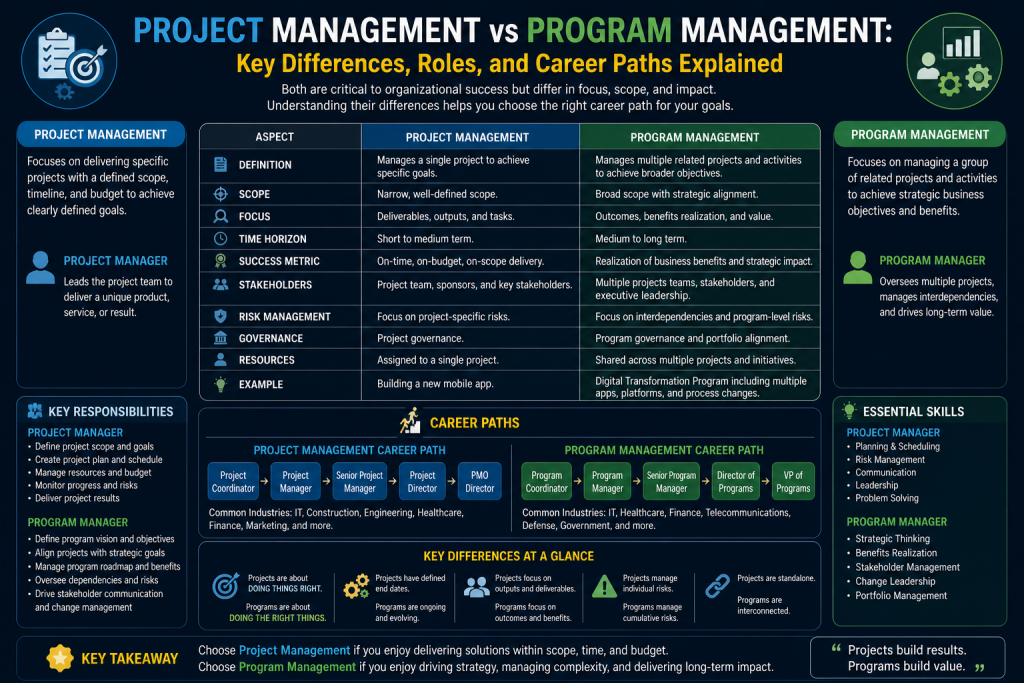
In today’s technology-driven world, organizations depend heavily on structured management practices to execute ideas, deliver solutions, and achieve long-term success. As businesses grow and digital transformation accelerates, managing work efficiently becomes more complex. This is where disciplines like project management and program management play a critical role.
Although these two terms are often used interchangeably, they represent different approaches to managing work. Understanding the distinction between them is essential for professionals who want to succeed in leadership roles, especially in the IT industry. Each discipline has its own purpose, responsibilities, and methods of measuring success.
Project management focuses on delivering a specific outcome within a defined timeline and scope. Program management, on the other hand, is concerned with overseeing multiple related projects and ensuring that they collectively contribute to broader organizational goals. While both roles require strong leadership and communication skills, they operate at different levels within an organization.
For individuals building a career in technology or management, gaining clarity on these concepts is not just helpful but necessary. It enables better decision-making, improves collaboration, and helps align efforts with business priorities.
Understanding the Concept of Project Management
Project management is a structured approach to planning, executing, and completing a specific initiative. A project is a temporary effort that is designed to produce a unique result, such as a product, service, or improvement. It has a clearly defined beginning and end, along with specific goals that must be achieved.
In the IT industry, project management is used in a wide range of activities, including software development, infrastructure upgrades, system implementations, and cybersecurity improvements. Each of these initiatives requires careful coordination to ensure that resources are used effectively and objectives are met.
A project manager is responsible for guiding the project from start to finish. This includes defining the scope, setting timelines, allocating resources, and monitoring progress. The role also involves managing risks, resolving issues, and maintaining communication among team members and stakeholders.
One of the key elements of project management is its focus on structure. Projects typically follow a defined lifecycle that includes several phases. These phases help ensure that work is organized and that progress can be tracked effectively.
Another important aspect is the emphasis on constraints. Every project operates within limitations such as time, budget, and scope. Balancing these constraints is a major responsibility for project managers, as changes in one area can impact the others.
The Project Lifecycle Explained
The project lifecycle provides a framework for managing work in a systematic way. It divides the project into distinct phases, each with its own objectives and deliverables.
The first phase is initiation. During this stage, the purpose of the project is defined, and its feasibility is assessed. Stakeholders are identified, and initial requirements are gathered. This phase sets the foundation for the entire project.
The next phase is planning. This is where detailed plans are created to guide execution. Project managers define the scope, develop schedules, allocate resources, and identify potential risks. A well-developed plan is essential for ensuring that the project stays on track.
Execution is the phase where the actual work takes place. Team members carry out tasks according to the plan, and deliverables are produced. Project managers oversee progress, coordinate activities, and ensure that quality standards are met.
Monitoring and controlling occur alongside execution. This involves tracking progress, comparing it to the plan, and making adjustments as needed. If issues arise, corrective actions are taken to keep the project aligned with its objectives.
The final phase is closure. Once the project objectives have been achieved, the project is formally completed. This includes delivering the final product, documenting lessons learned, and releasing resources.
Each phase of the lifecycle plays a vital role in ensuring that the project is completed successfully.
Key Principles of Effective Project Management
Successful project management is based on a set of core principles that guide decision-making and execution. These principles help ensure that projects deliver value and meet expectations.
One of the most important principles is clarity of objectives. A project must have well-defined goals that are understood by all stakeholders. Without clear objectives, it becomes difficult to measure success or maintain focus.
Another key principle is planning. A detailed plan provides a roadmap for execution and helps anticipate potential challenges. It allows project managers to allocate resources effectively and set realistic timelines.
Communication is also critical. Projects involve multiple stakeholders, including team members, managers, and clients. Effective communication ensures that everyone is informed, aligned, and able to contribute to the project’s success.
Risk management is another essential principle. Identifying potential risks early allows teams to develop strategies to mitigate them. This proactive approach reduces the likelihood of disruptions and helps maintain stability.
Adaptability is equally important. Projects often encounter unexpected changes, and the ability to adjust plans accordingly is crucial. Flexible management practices enable teams to respond to new information and evolving requirements.
Finally, accountability ensures that responsibilities are clearly defined and that team members are held accountable for their work. This fosters a sense of ownership and encourages high performance.
Real-World Applications of Project Management in IT
Project management is widely used across various IT initiatives. These real-world applications demonstrate how it helps organizations deliver specific outcomes efficiently.
One common application is the implementation of enterprise software systems. This involves installing, configuring, and testing software to meet organizational needs. The project requires coordination among developers, engineers, and business stakeholders.
Another example is data center migration. Organizations often move their infrastructure to cloud platforms to improve scalability and reduce costs. This process involves transferring data, setting up new systems, and ensuring minimal downtime.
Cybersecurity projects are also a major area of focus. Implementing security tools, conducting vulnerability assessments, and improving compliance measures are all examples of projects that require careful planning and execution.
Network upgrades are another example. As organizations grow, they need to expand and improve their network infrastructure. This involves installing new hardware, configuring systems, and testing performance.
Each of these applications highlights the importance of project management in delivering targeted results within defined constraints.
Tools and Methodologies in Project Management
To manage projects effectively, professionals rely on a variety of tools and methodologies. These tools help streamline processes, improve collaboration, and provide visibility into progress.
Project management software is commonly used to organize tasks and track progress. These platforms allow teams to assign responsibilities, set deadlines, and monitor completion status. They provide a centralized view of the project, making it easier to manage.
Scheduling tools are also important. They help create timelines, identify dependencies, and manage workloads. This ensures that tasks are completed in the correct order and that deadlines are met.
Collaboration tools facilitate communication among team members. They enable real-time sharing of information, which is essential for coordinating activities and resolving issues.
Methodologies provide structured approaches to managing projects. Different methodologies are suited to different types of projects.
The waterfall approach follows a linear sequence of phases. It is best suited for projects with well-defined requirements and minimal changes.
Agile methodologies emphasize flexibility and iterative development. They are commonly used in software development, where requirements may evolve over time.
Scrum is a popular agile framework that focuses on short development cycles and continuous feedback. It helps teams deliver value quickly and adapt to changes.
By combining tools and methodologies, project managers can effectively handle the complexities of modern IT projects.
Understanding the Concept of Program Management
Program management takes a broader view of organizational work. Instead of focusing on a single initiative, it involves overseeing multiple related projects that work together to achieve larger goals.
A program is essentially a group of projects that are aligned with a common objective. These projects may be managed independently, but their outcomes are interconnected. Program management ensures that these projects are coordinated and that their combined efforts deliver maximum value.
Unlike projects, programs are not limited by a fixed timeline. They are often ongoing and can evolve over several years. This flexibility allows organizations to adapt to changing conditions and pursue long-term strategies.
Program managers play a critical role in aligning projects with organizational goals. They focus on the big picture, ensuring that all initiatives contribute to the overall strategy. This requires a deep understanding of business priorities and the ability to manage complexity.
The Strategic Nature of Program Management
One of the defining features of program management is its strategic focus. Programs are designed to achieve long-term objectives that go beyond the scope of individual projects.
For example, an organization may aim to improve its digital capabilities. This goal cannot be achieved through a single project. Instead, it requires multiple initiatives, such as upgrading infrastructure, implementing new software, and training employees. These initiatives are grouped into a program that drives digital transformation.
Program managers are responsible for ensuring that all projects within the program are aligned with this strategic objective. They make decisions that optimize overall outcomes rather than focusing on individual project performance.
This strategic perspective requires a different set of skills compared to project management. Program managers must be able to think long-term, analyze complex situations, and make decisions that balance competing priorities.
Key Responsibilities of Program Managers
Program managers have a wide range of responsibilities that extend beyond those of project managers. Their role involves coordination, alignment, and oversight.
One of their primary responsibilities is managing dependencies between projects. Projects within a program often rely on each other, and delays in one project can impact others. Program managers ensure that these dependencies are managed effectively.
Another responsibility is stakeholder engagement. Program managers interact with senior executives and other key stakeholders. They must communicate progress, address concerns, and ensure that everyone is aligned with the program’s goals.
Resource allocation is also a critical task. Program managers must ensure that resources are distributed effectively across projects. This involves balancing competing demands and prioritizing initiatives based on their strategic importance.
Risk management is another important responsibility. Programs involve multiple projects, each with its own risks. Program managers must identify and address risks at a higher level, ensuring that they do not impact overall objectives.
Finally, program managers are responsible for measuring success. Unlike project managers, who focus on specific deliverables, program managers evaluate outcomes based on business impact. This may include improvements in efficiency, cost savings, or customer satisfaction.
Examples of Program Management in IT
Program management is commonly used in large-scale IT initiatives that require coordination across multiple projects.
One example is a cloud transformation program. This involves migrating applications, upgrading infrastructure, and implementing new tools. Each of these activities is managed as a separate project, but they are all part of a larger program aimed at improving scalability and efficiency.
Another example is a cybersecurity enhancement program. This may include projects focused on risk assessment, compliance, and system upgrades. Together, these projects strengthen the organization’s security posture.
Digital workplace transformation is another common program. It involves implementing collaboration tools, automating workflows, and improving user experience. These initiatives work together to create a more efficient and productive environment.
These examples illustrate how program management enables organizations to achieve complex goals through coordinated efforts.
Relationship Between Projects and Programs
Projects and programs are closely related, but they serve different purposes. Projects are the building blocks of programs, while programs provide the framework for aligning projects with strategic objectives.
An organization may start with individual projects to address specific needs. As these projects grow and become interconnected, they can be grouped into a program. This allows for better coordination and ensures that efforts are aligned with long-term goals.
Understanding this relationship is important for professionals who want to advance in their careers. It helps them see how their work contributes to larger objectives and prepares them for leadership roles.
Transitioning from project management to program management requires a shift in perspective. It involves moving from a focus on execution to a focus on strategy. This transition can be challenging, but it also offers opportunities for growth and development.
This completes Part 1 with approximately 3000 words.
Introduction to Practical Distinctions
While the foundational definitions of project management and program management provide a clear starting point, the real differences become more apparent when these disciplines are applied in practical environments. Organizations do not operate in theory—they deal with deadlines, shifting priorities, limited resources, and evolving business goals. In such environments, the distinction between managing a single initiative and overseeing a collection of interconnected efforts becomes critical.
Project management operates at a more focused level, dealing with specific deliverables and ensuring that defined outcomes are achieved efficiently. Program management expands this perspective by integrating multiple efforts and aligning them with broader strategic objectives. Both roles are essential, but they require different approaches, mindsets, and decision-making frameworks.
Understanding these differences in practice helps professionals not only perform their roles more effectively but also collaborate better across teams. It ensures that projects are not executed in isolation and that programs deliver meaningful long-term value.
Differences in Scope and Focus
One of the most significant differences between project management and program management lies in scope. Project management focuses on a single initiative with clearly defined boundaries. The scope is typically fixed at the beginning, and any changes must go through formal processes to ensure that the project remains on track.
Program management, in contrast, operates with a broader and more flexible scope. It encompasses multiple related projects, each contributing to a larger goal. The scope of a program can evolve over time as business needs change, making adaptability a key requirement.
This difference in scope directly impacts how work is approached. Project managers concentrate on completing specific tasks and deliverables, ensuring that all components of the project are executed as planned. Program managers, however, focus on how different projects interact and how their combined outcomes contribute to organizational success.
The broader scope of program management also means dealing with greater complexity. Program managers must consider interdependencies, resource allocation across projects, and alignment with strategic priorities. This requires a higher level of coordination and a more holistic view of operations.
Differences in Timeframe and Duration
Another important distinction is the duration of work. Projects are temporary by nature. They have a defined start and end date, and their lifecycle is structured around achieving a specific goal within a set timeframe.
Program management, on the other hand, often involves ongoing efforts. Programs can span several years and may not have a clearly defined endpoint. Instead, they evolve as new projects are introduced and existing ones are completed.
This difference in duration influences how success is measured and how work is planned. Project managers must focus on meeting deadlines and ensuring timely delivery. Their work is driven by schedules and milestones that define progress.
Program managers take a longer-term perspective. They are less concerned with individual deadlines and more focused on sustaining progress over time. Their role involves ensuring continuity, adapting to changes, and maintaining alignment with long-term objectives.
The extended duration of programs also means that they must be flexible enough to respond to shifts in the business environment. This could include changes in technology, market conditions, or organizational priorities.
Differences in Goals and Objectives
The goals of project management and program management differ significantly in terms of scale and impact. Project management is centered on delivering a specific output, such as a product, system, or service. The objective is clear and measurable, and success is determined by whether the project meets its predefined requirements.
Program management, in contrast, focuses on achieving broader business outcomes. These outcomes may include improving efficiency, increasing revenue, enhancing customer experience, or driving innovation. The goals are often more abstract and may evolve over time.
This difference in objectives requires a different approach to planning and execution. Project managers work with detailed plans that outline specific tasks and deliverables. Program managers operate at a higher level, focusing on aligning projects with strategic goals and ensuring that their combined efforts deliver value.
The broader objectives of program management also mean that success is measured differently. Instead of focusing on individual deliverables, program managers evaluate the overall impact of the program on the organization.
Differences in Management Level
Project management is primarily tactical in nature. It involves managing day-to-day activities, coordinating tasks, and ensuring that work is completed according to plan. Project managers are closely involved in execution and often work directly with team members to resolve issues and keep progress on track.
Program management operates at a more strategic level. Program managers focus on aligning projects with organizational goals, managing relationships with stakeholders, and making decisions that impact the overall direction of the program.
This difference in management level requires distinct skill sets. Project managers need strong organizational and problem-solving skills, as well as the ability to manage details effectively. Program managers must possess strategic thinking, leadership, and the ability to navigate complex organizational structures.
The strategic nature of program management also means that program managers often interact with senior leadership. They play a key role in shaping business strategies and ensuring that initiatives are aligned with organizational priorities.
Differences in Decision-Making
Decision-making processes differ significantly between project management and program management. Project managers make decisions related to tasks, schedules, resources, and risks within the scope of their projects. These decisions are often based on detailed plans and immediate needs.
Program managers, on the other hand, make decisions that affect multiple projects and have long-term implications. They must consider the impact of their decisions on the entire program and ensure that they align with strategic objectives.
This broader decision-making scope requires program managers to balance competing priorities and make trade-offs. For example, they may need to decide whether to allocate resources to one project over another or adjust timelines to accommodate changing business needs.
The complexity of these decisions often requires input from multiple stakeholders, making communication and collaboration essential skills for program managers.
Differences in Resource Management
Resource management is another area where project management and program management differ. In project management, resources are allocated to specific tasks within a single project. The focus is on optimizing the use of resources to achieve project goals.
Program management involves managing resources across multiple projects. This requires a more strategic approach to ensure that resources are distributed effectively and that projects are prioritized based on their importance.
Program managers must consider the overall availability of resources and make decisions that maximize value. This may involve reallocating resources, adjusting project schedules, or even delaying certain initiatives.
The complexity of resource management in programs requires strong coordination and the ability to anticipate future needs. It also involves working closely with project managers to ensure that resources are used efficiently.
Differences in Risk Management
Risk management is an essential aspect of both project management and program management, but the scope and complexity of risks differ.
In project management, risks are typically related to specific tasks, timelines, or resources. Project managers identify potential risks, assess their impact, and develop strategies to mitigate them.
Program management involves a broader range of risks that can affect multiple projects. These risks may include strategic, financial, or operational factors. Program managers must take a holistic approach to risk management, considering how risks in one project can impact others.
This requires a higher level of analysis and coordination. Program managers must monitor risks across all projects and ensure that mitigation strategies are aligned with the overall program objectives.
The ability to manage complex risks is a key skill for program managers and plays a critical role in ensuring the success of the program.
Differences in Communication and Stakeholder Engagement
Communication plays a vital role in both disciplines, but the scope and audience differ. Project managers primarily communicate with team members, stakeholders directly involved in the project, and sometimes clients.
Program managers, however, engage with a broader range of stakeholders, including senior executives, department heads, and external partners. Their communication is often more strategic, focusing on progress, alignment, and overall impact.
Effective stakeholder engagement is crucial for program success. Program managers must ensure that all stakeholders are aligned with the program’s objectives and that their expectations are managed appropriately.
This requires strong interpersonal skills and the ability to convey complex information clearly and concisely.
Differences in Measuring Success
Success metrics differ significantly between project management and program management. In project management, success is typically measured by whether the project is completed on time, within budget, and according to scope.
Program management uses broader metrics that reflect business impact. These may include improvements in efficiency, cost savings, revenue growth, or customer satisfaction.
This difference in measurement reflects the distinct goals of each discipline. While projects focus on delivering specific outputs, programs aim to achieve meaningful outcomes that drive organizational success.
Program managers must develop metrics that capture the value of the program and provide insights into its effectiveness. This often involves analyzing data from multiple projects and assessing their combined impact.
Real-World Scenario Comparison
To better understand the practical differences, consider a real-world scenario in an organization undergoing digital transformation.
A project manager might be responsible for implementing a new customer relationship management system. Their focus would be on completing the implementation within the defined timeline and budget.
At the same time, a program manager might oversee the entire digital transformation initiative. This could include multiple projects, such as upgrading infrastructure, implementing new software, and improving data analytics capabilities.
The project manager ensures that their specific project is successful, while the program manager ensures that all projects work together to achieve the broader goal of digital transformation.
This example highlights how the two roles complement each other and contribute to overall success.
Challenges in Managing Projects and Programs
Both project management and program management come with their own challenges. Project managers often face issues related to scope changes, resource constraints, and tight deadlines. They must balance competing demands and ensure that the project remains on track.
Program managers deal with more complex challenges, such as coordinating multiple projects, managing dependencies, and aligning initiatives with strategic goals. They must also navigate organizational dynamics and handle conflicting priorities.
Understanding these challenges is important for professionals who want to succeed in either role. It helps them prepare for potential obstacles and develop strategies to overcome them.
Importance of Alignment Between Projects and Programs
Alignment between projects and programs is essential for organizational success. Projects must be designed in a way that supports program objectives, and programs must provide the framework for coordinating projects effectively.
Without proper alignment, projects may deliver results that do not contribute to broader goals. This can lead to wasted resources and missed opportunities.
Program managers play a key role in ensuring alignment. They provide guidance, set priorities, and ensure that all projects are working toward the same objectives.
This alignment is critical for maximizing value and achieving long-term success.
Evolving Roles in Modern Organizations
As organizations continue to evolve, the roles of project managers and program managers are also changing. Advances in technology, increasing complexity, and the need for agility are shaping how these roles are performed.
Project managers are increasingly adopting flexible methodologies and focusing on delivering value quickly. Program managers are taking on more strategic responsibilities and playing a greater role in shaping organizational direction.
These changes highlight the importance of continuous learning and adaptation. Professionals must stay updated with industry trends and develop new skills to remain effective in their roles.
Introduction to Career Growth in Management Roles
As organizations continue to expand their reliance on structured execution and strategic alignment, the demand for skilled professionals in both project management and program management continues to rise. These roles are no longer limited to large enterprises; businesses of all sizes now recognize the importance of managing initiatives effectively and aligning them with long-term goals.
For individuals pursuing a career in IT or business leadership, choosing between project management and program management is a significant decision. While both paths share foundational skills such as communication, leadership, and organization, they differ in focus, responsibilities, and long-term growth opportunities.
Understanding how each career path develops, what skills are required, and how professionals can progress over time is essential for making informed decisions. Whether someone is just starting out or looking to advance into higher leadership roles, clarity in these areas can provide direction and confidence.
Project Management Career Path
Project management is often considered the entry point into leadership roles within many organizations. It provides professionals with the opportunity to manage teams, oversee deliverables, and gain hands-on experience in executing initiatives.
Many professionals begin their journey in roles such as project coordinator or junior project manager. In these positions, they assist with planning, scheduling, and communication while learning the fundamentals of managing projects. This stage is crucial for building a strong foundation in processes, tools, and methodologies.
As experience grows, individuals move into roles such as project manager or senior project manager. At this level, they take full responsibility for managing projects from initiation to completion. They lead teams, interact with stakeholders, and ensure that projects are delivered successfully.
Further progression may lead to roles such as project director or head of project management. These positions involve overseeing multiple projects, mentoring teams, and contributing to organizational strategy. While still focused on projects, these roles begin to incorporate elements of program management.
Project management offers a clear and structured career path, making it an attractive option for professionals who enjoy working toward defined goals and seeing tangible results.
Program Management Career Path
Program management is typically a more advanced career path that builds upon experience gained in project management. It requires a broader perspective and a deeper understanding of organizational strategy.
Professionals often transition into program management after gaining significant experience managing complex projects. This experience helps them develop the skills needed to coordinate multiple initiatives and handle increased complexity.
In program management roles, individuals are responsible for overseeing groups of related projects. They focus on aligning these projects with strategic goals, managing dependencies, and ensuring that the overall program delivers value.
As they advance, program managers may move into roles such as portfolio manager or business transformation leader. These positions involve overseeing entire portfolios of programs and projects, shaping organizational strategy, and driving large-scale change.
Program management offers opportunities for professionals who enjoy strategic thinking, long-term planning, and working across multiple teams and departments.
Essential Skills for Project Managers
Project managers require a diverse set of skills to manage tasks, teams, and timelines effectively. These skills enable them to navigate challenges and deliver successful outcomes.
One of the most important skills is organization. Project managers must manage multiple tasks simultaneously, track progress, and ensure that everything stays on schedule. Strong organizational skills help maintain order and efficiency.
Communication is equally critical. Project managers act as a bridge between team members and stakeholders. They must clearly convey information, provide updates, and resolve misunderstandings.
Problem-solving is another key skill. Projects often encounter unexpected challenges, and the ability to find solutions quickly is essential. This requires analytical thinking and creativity.
Time management is also crucial. Project managers must prioritize tasks, manage deadlines, and ensure that work is completed on time. Effective time management helps prevent delays and keeps the project on track.
Leadership skills play a significant role as well. Project managers must motivate teams, provide guidance, and create a positive working environment. Strong leadership fosters collaboration and improves performance.
Essential Skills for Program Managers
Program managers require a different set of skills that reflect their broader responsibilities. While they share some skills with project managers, their focus is more strategic.
Strategic thinking is one of the most important skills for program managers. They must understand organizational goals and ensure that all projects align with these objectives. This requires the ability to see the big picture and make informed decisions.
Coordination is another critical skill. Program managers oversee multiple projects, each with its own team and objectives. They must ensure that these projects work together effectively.
Stakeholder management is also essential. Program managers interact with senior leaders and other key stakeholders. They must build relationships, manage expectations, and ensure alignment.
Decision-making is a key responsibility. Program managers often make decisions that impact multiple projects and have long-term consequences. This requires careful analysis and consideration of various factors.
Adaptability is equally important. Programs often evolve over time, and program managers must be able to adjust plans and strategies as needed.
Certifications and Professional Development
Certifications play a significant role in advancing careers in both project management and program management. They provide validation of skills and knowledge, making professionals more competitive in the job market.
For project managers, certifications such as Project Management Professional, Certified ScrumMaster, and PRINCE2 are widely recognized. These certifications cover various methodologies and approaches, helping professionals develop a strong foundation.
Program managers often pursue certifications such as Program Management Professional, Management of Portfolios, and SAFe Program Consultant. These certifications focus on strategic alignment, coordination, and leadership at a higher level.
In addition to certifications, continuous learning is essential. Technology and management practices are constantly evolving, and professionals must stay updated with the latest trends and tools.
Workshops, online courses, and professional networks provide valuable opportunities for learning and growth. Engaging with the community also helps professionals share knowledge and gain insights from others.
Choosing the Right Career Path
Deciding between project management and program management depends on individual preferences, strengths, and career goals. Both paths offer rewarding opportunities, but they require different mindsets.
Individuals who enjoy working on specific tasks, managing details, and seeing immediate results may find project management more fulfilling. This path provides a sense of accomplishment through the completion of defined initiatives.
On the other hand, those who prefer strategic thinking, long-term planning, and working across multiple teams may be better suited for program management. This path offers the opportunity to influence organizational direction and drive large-scale change.
It is important to note that these paths are not mutually exclusive. Many professionals start in project management and transition to program management as they gain experience. This progression allows them to build a strong foundation before taking on more complex responsibilities.
Understanding personal strengths and interests is key to making the right choice. Reflecting on what motivates and challenges you can help guide your decision.
The Role of Leadership in Both Disciplines
Leadership is a central component of both project management and program management. Regardless of the level, professionals must be able to guide teams, make decisions, and inspire others.
In project management, leadership involves managing teams, resolving conflicts, and ensuring that everyone is working toward a common goal. It requires a hands-on approach and close interaction with team members.
In program management, leadership takes on a broader dimension. Program managers must influence multiple teams, align stakeholders, and drive strategic initiatives. This requires a more visionary approach and the ability to lead without direct authority.
Effective leadership in both disciplines involves building trust, fostering collaboration, and maintaining a clear vision. It also requires emotional intelligence and the ability to understand and respond to the needs of others.
Industry Demand and Future Trends
The demand for project and program management professionals continues to grow as organizations become more complex and technology-driven. Businesses need skilled individuals who can manage initiatives effectively and ensure alignment with strategic goals.
Emerging technologies such as cloud computing, artificial intelligence, and automation are creating new opportunities and challenges. These technologies require careful planning and coordination, increasing the need for experienced managers.
Agile and hybrid methodologies are also becoming more popular. These approaches emphasize flexibility and collaboration, requiring professionals to adapt their skills and practices.
Remote work and global teams are another trend shaping the future of management roles. Managers must be able to coordinate work across different locations and cultures, making communication and collaboration even more important.
These trends highlight the importance of continuous learning and adaptability. Professionals who stay updated with industry developments will be better positioned to succeed.
Transitioning from Project Management to Program Management
Many professionals view program management as the next step in their career after gaining experience in project management. This transition requires a shift in mindset and the development of new skills.
One of the key changes is moving from a focus on execution to a focus on strategy. While project managers concentrate on completing tasks, program managers must think about how multiple initiatives contribute to broader goals.
Developing strategic thinking skills is essential for this transition. This involves understanding business objectives, analyzing complex situations, and making decisions that align with long-term priorities.
Building strong relationships is also important. Program managers must work with a wide range of stakeholders, including senior leaders and external partners.
Gaining experience in managing multiple projects can help prepare for this transition. It provides an opportunity to develop coordination and leadership skills.
The transition may be challenging, but it also offers significant opportunities for growth and advancement.
Conclusion
Project management and program management are both essential disciplines that contribute to organizational success. While they share some similarities, they differ in scope, focus, and objectives.
Project management is centered on delivering specific outcomes within defined constraints. It provides a structured approach to managing initiatives and ensures that goals are achieved efficiently. Program management, on the other hand, takes a broader perspective by coordinating multiple projects and aligning them with strategic objectives.
Both career paths offer valuable opportunities for growth and development. Project management provides a strong foundation in execution and leadership, while program management enables professionals to take on strategic roles and drive large-scale change.
Choosing between these paths depends on individual preferences and career goals. Some may prefer the structure and clarity of project management, while others may be drawn to the complexity and impact of program management.
Ultimately, both roles are interconnected and complement each other. Organizations rely on project managers to deliver results and on program managers to ensure that those results contribute to long-term success.
By understanding the differences and developing the necessary skills, professionals can position themselves for success in either path and make meaningful contributions to their organizations
Continue exploring the technologies and certification concepts that matter most to you.