In modern networking environments, the demand for speed, reliability, and scalability continues to grow at a rapid pace. Organizations rely heavily on their networks to support business operations, cloud computing, virtualization, and real-time communication. As traffic increases, a single network connection often becomes insufficient, leading to congestion, latency, and potential downtime. This is where port aggregation becomes an essential solution.
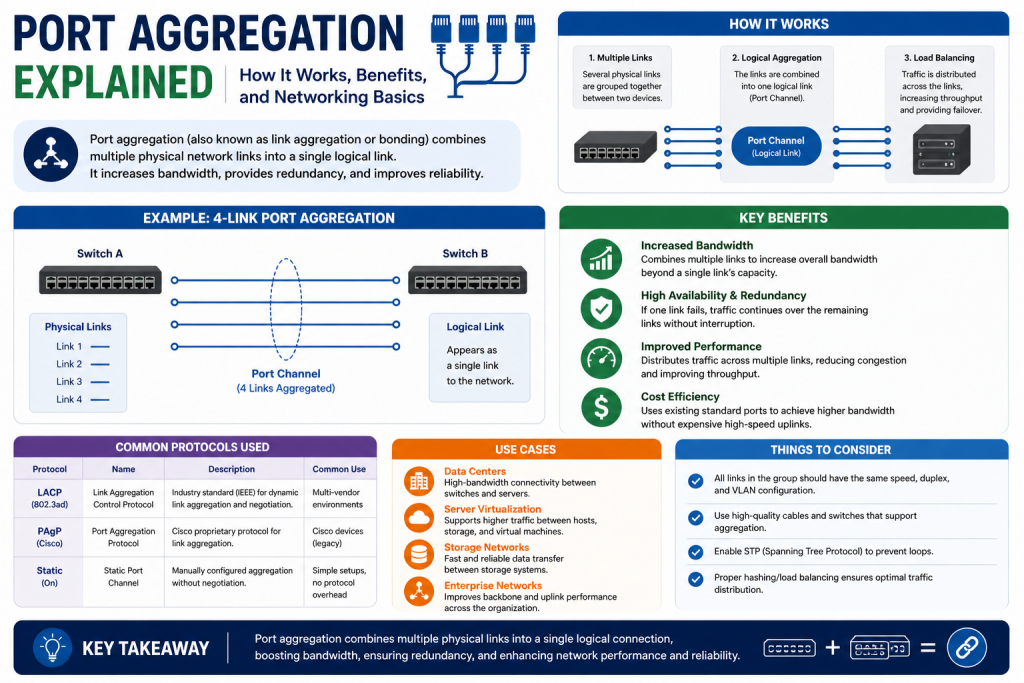
Port aggregation is a technique used to combine multiple physical network links into a single logical connection. Instead of relying on one cable or interface, several links work together as a unified channel. This approach enhances bandwidth, improves fault tolerance, and optimizes overall network performance.
At a high level, port aggregation allows network devices such as switches, routers, and servers to communicate more efficiently by distributing traffic across multiple connections. This not only increases throughput but also ensures that network operations continue even if one link fails.
The importance of port aggregation extends across various environments, including enterprise networks, data centers, and service provider infrastructures. It is also a fundamental concept for networking certifications and plays a key role in designing resilient network architectures.
Understanding the Basics of Port Aggregation
To fully grasp port aggregation, it is important to understand how it transforms multiple physical connections into a single logical interface. Each physical port involved in the aggregation contributes to the overall capacity of the link. These ports are grouped together and managed as one entity.
This grouped connection is commonly referred to as a Link Aggregation Group or LAG. From the perspective of network devices, the LAG behaves like a single high-capacity link rather than multiple independent connections.
When data is transmitted across an aggregated link, it is divided and distributed among the available physical links. This process is handled by load balancing algorithms, which determine how traffic flows through the network.
The key idea is that multiple smaller connections can collectively provide the performance and reliability of a much larger connection. This makes port aggregation a practical and cost-effective solution for improving network capabilities.
How Port Aggregation Works in Practice
Port aggregation operates by binding several physical interfaces into a logical channel. This channel is assigned a unique identifier and is treated as a single interface for configuration and management purposes.
When a device sends data through an aggregated link, it does not simply split a single data stream evenly across all links. Instead, it uses specific criteria to decide which packets go through which link. These criteria are defined by load balancing algorithms.
For example, traffic may be distributed based on:
- Source and destination IP addresses
- MAC addresses
- TCP or UDP port numbers
This ensures that packets belonging to the same session follow the same path, preventing issues such as out-of-order delivery.
On the receiving end, the device reassembles the traffic seamlessly, making it appear as if it arrived through a single connection. This entire process is transparent to applications and users.
The Multi-Lane Highway Analogy
A simple way to understand port aggregation is by comparing it to a highway system.
Imagine a narrow road with only one lane. All vehicles must pass through that single lane, which often leads to traffic congestion. If an accident occurs, the entire flow of traffic may come to a halt.
Now consider a multi-lane highway. Vehicles can spread across several lanes, reducing congestion and improving travel time. If one lane is blocked, traffic can still move through the remaining lanes.
Port aggregation works in a similar manner. Each network link acts as a lane, and data packets are like vehicles traveling across the network. By providing multiple paths, port aggregation ensures smoother and more efficient data transmission.
Key Advantages of Port Aggregation
Port aggregation offers several significant benefits that make it a widely adopted solution in modern networks.
Increased Bandwidth Capacity
One of the most obvious advantages of port aggregation is the ability to increase bandwidth. By combining multiple links, the total available bandwidth becomes the sum of all individual connections.
For instance, if four links each provide 1 Gbps of bandwidth, the aggregated link can theoretically offer up to 4 Gbps. This increased capacity is particularly useful in environments with high data transfer requirements.
Improved Fault Tolerance
Another major benefit is fault tolerance. In a traditional setup with a single link, a failure can disrupt communication entirely. With port aggregation, if one link fails, the remaining links continue to carry traffic.
This redundancy ensures that network services remain available, minimizing downtime and maintaining operational continuity.
Efficient Load Balancing
Port aggregation distributes traffic across multiple links, preventing any single link from becoming a bottleneck. This improves overall network performance and ensures efficient utilization of resources.
Load balancing also helps maintain consistent performance during peak traffic periods, making it ideal for high-demand environments.
Simplified Network Management
Despite involving multiple physical links, port aggregation simplifies network management by presenting them as a single logical interface. Administrators can configure and monitor the aggregated link as one entity.
This reduces complexity and makes it easier to apply policies, security settings, and performance optimizations.
Cost-Effective Scalability
Upgrading network infrastructure to higher-speed interfaces can be expensive. Port aggregation provides a cost-effective alternative by utilizing existing hardware.
Organizations can achieve higher bandwidth and redundancy without significant investments in new equipment.
Link Aggregation and Port Aggregation Terminology
In networking discussions, the terms link aggregation and port aggregation are often used interchangeably. While they refer to the same general concept, there are slight differences in usage.
Link aggregation is a broader term that describes the process of combining multiple network links into a single logical connection. It encompasses various protocols and implementations.
Port aggregation typically refers to the specific configuration of physical ports on networking devices to achieve link aggregation.
In practice, both terms are widely accepted and understood to mean the same thing.
Protocols Supporting Port Aggregation
To implement port aggregation effectively, networking devices rely on specific protocols that manage and coordinate the aggregated links.
Two primary protocols are used for this purpose.
Link Aggregation Control Protocol
Link Aggregation Control Protocol, commonly known as LACP, is an open standard defined by the IEEE. It is widely supported across different vendors and is commonly used in modern networks.
LACP automates the process of forming and managing aggregated links. It allows devices to negotiate which ports should be included in the aggregation and how traffic should be distributed.
One of the key features of LACP is its ability to monitor link health. If a link becomes unstable or fails, LACP automatically adjusts the configuration to maintain optimal performance.
Port Aggregation Protocol
Port Aggregation Protocol, or PAgP, is a proprietary protocol developed by Cisco. It serves a similar purpose as LACP but is limited to Cisco devices.
PAgP simplifies the configuration process by automatically grouping compatible ports into an aggregated link. While effective, its use is restricted to environments where Cisco equipment is deployed.
Logical Interfaces and Port Channels
When multiple ports are aggregated, they are represented as a single logical interface known as a port channel. This interface acts as the central point for configuration and management.
Network administrators assign settings such as IP addresses, VLAN configurations, and security policies to the port channel rather than individual ports.
This abstraction simplifies network design and reduces the likelihood of configuration errors. It also makes it easier to manage large and complex networks.
Load Balancing Techniques in Aggregated Links
Load balancing plays a crucial role in the effectiveness of port aggregation. It determines how traffic is distributed across the available links.
Different techniques are used to achieve this distribution.
Some common methods include:
- Hash-based algorithms that use IP or MAC addresses
- Layer-based distribution methods focusing on Layer 2, Layer 3, or Layer 4 information
- Round-robin approaches that cycle through links
Each method has its own advantages and is chosen based on the network environment and traffic patterns.
Proper load balancing ensures that all links are utilized efficiently and prevents uneven distribution of traffic.
Common Use Cases for Port Aggregation
Port aggregation is widely used in various networking scenarios.
Data Center Environments
In data centers, large volumes of data are transferred between servers, storage systems, and networking devices. Port aggregation helps increase bandwidth and ensures reliable connectivity.
It is often used to connect switches and servers, providing high-speed communication and redundancy.
Enterprise Networks
Organizations use port aggregation to connect different layers of their network infrastructure. This includes connections between core, distribution, and access layers.
Aggregated links improve performance and ensure that critical applications remain accessible.
Server Connectivity
High-performance servers often require multiple network connections to handle heavy workloads. Port aggregation allows these servers to achieve higher throughput and improved reliability.
Backbone Network Connections
Core network devices require high-capacity and reliable connections. Port aggregation is commonly used to connect these devices, ensuring efficient data flow across the network.
Manual and Automatic Aggregation Methods
Port aggregation can be configured manually or automatically.
Manual Configuration
In manual mode, administrators explicitly define which ports are part of the aggregation. This approach requires careful configuration to ensure consistency across devices.
While manual configuration provides greater control, it can be time-consuming and prone to errors.
Automatic Configuration with Protocols
Protocols such as LACP and PAgP automate the process of forming aggregated links. They handle negotiation, monitoring, and adjustment of link configurations.
Automatic configuration reduces administrative overhead and improves reliability.
Limitations and Considerations
Despite its many benefits, port aggregation has certain limitations.
No Increase in Single Flow Speed
Port aggregation does not increase the speed of a single data stream. Instead, it distributes multiple streams across different links.
This means that individual sessions may still be limited by the bandwidth of a single link.
Configuration Complexity
Improper configuration can lead to issues such as uneven traffic distribution or link failures. It is important to ensure consistency across all devices involved.
Hardware Compatibility
Not all networking devices support port aggregation. Compatibility must be verified before implementation.
Importance in Modern Network Design
Port aggregation is a fundamental component of modern network design. As organizations continue to rely on digital infrastructure, the need for scalable and reliable networking solutions becomes increasingly important.
By combining multiple links into a single logical connection, port aggregation addresses key challenges related to bandwidth, reliability, and performance.
It is widely used in cloud computing, virtualization, and large-scale enterprise networks, making it an essential skill for networking professionals.
Introduction to Advanced Port Aggregation Concepts
After understanding the foundational ideas behind port aggregation, the next step is to explore how it is implemented in real-world networks. While the concept of combining multiple links into a single logical connection is straightforward, the actual configuration and management require careful planning and technical knowledge.
This section focuses on the protocols that power port aggregation, how to configure them, and how networks dynamically adapt to changes. It also explains the operational modes, negotiation processes, and practical deployment scenarios that make port aggregation effective in modern environments.
Understanding these deeper concepts is essential for network engineers who want to design scalable and resilient infrastructures.
Deep Dive into Link Aggregation Control Protocol
Link Aggregation Control Protocol, commonly known as LACP, is one of the most widely used protocols for implementing port aggregation. It is defined by IEEE standards and is supported by most networking vendors, making it a preferred choice in multi-vendor environments.
LACP simplifies the process of creating aggregated links by automating negotiation between devices. Instead of manually configuring each port, LACP dynamically determines which links can be bundled together.
When two devices connect using LACP, they exchange special control packets known as LACP Data Units. These packets carry information about the device, port priority, and operational state. Based on this information, the devices decide which links should be active members of the aggregation group.
LACP also introduces the concept of active and passive modes. In active mode, a device actively sends LACP packets to initiate the aggregation process. In passive mode, a device waits for the other side to initiate communication.
For a successful LACP connection, at least one side must operate in active mode. If both sides are passive, the aggregation will not form.
Key Features of LACP
LACP provides several features that enhance network performance and reliability.
One of its most important capabilities is dynamic link monitoring. LACP continuously checks the status of each link in the aggregation group. If a link fails or becomes unstable, it is automatically removed from the group.
Traffic is then redistributed across the remaining links without disrupting network operations. This ensures high availability and seamless failover.
Another key feature is link prioritization. LACP allows administrators to assign priorities to ports. If there are more available links than allowed in the aggregation group, LACP selects the highest-priority links to remain active.
LACP also supports maximum active links. This means you can configure a limit on how many links are actively used, while others remain as backups. These standby links can quickly replace failed active links when needed.
Understanding LACP States and Timers
LACP operates using different states that define how ports behave within an aggregation group.
Ports can be in states such as individual, standby, or active. Active ports participate in traffic forwarding, while standby ports are ready to take over if an active link fails.
LACP also uses timers to control how frequently control packets are sent. There are typically two timer modes.
In fast mode, LACP packets are sent every second, allowing quick detection of link failures. In slow mode, packets are sent every 30 seconds, reducing overhead but increasing detection time.
Choosing the appropriate timer depends on the network environment and the need for rapid failover.
Deep Dive into Port Aggregation Protocol
Port Aggregation Protocol, or PAgP, is a Cisco-developed protocol designed to automate port aggregation in Cisco environments. While it serves a similar purpose as LACP, it is proprietary and only works with Cisco devices.
PAgP simplifies the creation of EtherChannel groups by automatically identifying compatible ports and bundling them together.
Like LACP, PAgP uses negotiation to form aggregated links. Devices exchange PAgP packets to determine whether a link should be included in the group.
PAgP operates in two primary modes.
In auto mode, the port listens for PAgP packets but does not initiate communication. In desirable mode, the port actively attempts to form an aggregation.
For a successful connection, at least one port must be in desirable mode. If both ports are set to auto, the aggregation will not be established.
Comparing LACP and PAgP
While both LACP and PAgP achieve the same goal, there are important differences between them.
LACP is an open standard, making it suitable for multi-vendor environments. It offers greater flexibility and compatibility across different devices.
PAgP, on the other hand, is limited to Cisco equipment. It may offer tighter integration in Cisco networks but lacks the versatility of LACP.
In most modern networks, LACP is the preferred choice due to its widespread support and standardization.
However, in environments where only Cisco devices are used, PAgP can still be a viable option.
Steps to Configure Port Aggregation with LACP
Configuring port aggregation using LACP involves several steps. While the exact commands may vary depending on the device, the overall process remains consistent.
The first step is to identify the ports that will be included in the aggregation group. These ports must have similar characteristics, such as speed, duplex settings, and VLAN configuration.
Next, access the device’s command-line interface. This is typically done through a terminal application or direct console connection.
Once inside the CLI, enter configuration mode to begin setting up the aggregation.
Specify the range of interfaces that will be grouped together. This allows you to apply the configuration to multiple ports simultaneously.
After selecting the interfaces, enable LACP by assigning them to a channel group and specifying the mode. Active mode initiates negotiation, while passive mode responds to it.
Once the ports are configured, create a logical interface known as a port channel. This interface represents the aggregated link.
You can then apply additional settings to the port channel, such as IP addressing, VLAN configuration, and trunking options.
Finally, save the configuration and verify that the aggregation is functioning correctly using diagnostic commands.
Configuring Logical Interfaces and Port Channels
The logical interface is a critical component of port aggregation. It acts as the central point for managing the aggregated links.
When configuring a port channel, administrators can assign it a description to identify its purpose. This is particularly useful in large networks with multiple aggregation groups.
For Layer 3 devices, an IP address can be assigned to the port channel, allowing it to function as a routed interface.
For Layer 2 devices, the port channel can be configured for VLAN membership or trunking. This enables it to carry traffic for multiple VLANs across the network.
All member ports inherit the configuration of the port channel, ensuring consistency across the aggregation group.
VLAN and Trunking Considerations
When using port aggregation in networks with VLANs, it is important to ensure proper configuration.
If the aggregated link is used as a trunk, it must allow the appropriate VLANs. Both ends of the connection must have matching VLAN configurations to avoid communication issues.
Incorrect VLAN settings can lead to traffic being dropped or misrouted. Therefore, consistency is crucial when configuring trunk ports within an aggregation group.
Administrators should also verify that all member ports have identical VLAN settings before forming the aggregation.
Load Balancing Behavior in Real Networks
Load balancing in port aggregation is not always evenly distributed. The distribution depends on the algorithm used and the nature of the traffic.
For example, if most traffic originates from a single source and destination, it may all be assigned to a single link. This can result in uneven utilization of available bandwidth.
To address this, administrators can adjust load balancing methods based on different parameters, such as Layer 3 or Layer 4 information.
Understanding traffic patterns is essential for optimizing load balancing and ensuring efficient use of all links.
Monitoring Aggregated Links
Monitoring is a crucial aspect of maintaining port aggregation.
Network administrators use various tools and commands to check the status of aggregated links. These tools provide information about active ports, standby ports, and overall link health.
Regular monitoring helps identify issues such as failed links, misconfigurations, or performance bottlenecks.
Advanced monitoring tools can also analyze traffic patterns and provide insights into load balancing efficiency.
Testing and Validation of Configuration
After configuring port aggregation, it is important to validate that everything is working correctly.
One common method is to simulate a link failure by disconnecting one of the cables. The network should automatically reroute traffic through the remaining links.
If traffic continues without interruption, it indicates that fault tolerance is functioning properly.
Administrators should also verify that all ports are correctly grouped and that the logical interface is operational.
Testing ensures that the network is prepared to handle real-world scenarios and unexpected failures.
Common Configuration Mistakes
Port aggregation can fail if certain requirements are not met.
One common mistake is mismatched configurations between devices. All member ports must have identical settings, including speed, duplex, and VLAN configuration.
Another issue is incorrect mode selection. If both devices are set to passive or auto mode, the aggregation will not form.
Using incompatible hardware or outdated software can also lead to problems. It is important to ensure that all devices support the chosen protocol.
Handling Link Failures and Recovery
One of the strengths of port aggregation is its ability to handle link failures gracefully.
When a link fails, the protocol automatically removes it from the aggregation group. Traffic is redistributed across the remaining links.
If the failed link is restored, it can rejoin the group without manual intervention.
This dynamic behavior ensures continuous network operation and minimizes downtime.
Scalability Considerations
Port aggregation is highly scalable and can be adapted to different network sizes.
In small networks, a few aggregated links may be sufficient. In larger environments, multiple aggregation groups can be used to connect different parts of the network.
However, there are limits to the number of ports that can be included in a single aggregation group. These limits depend on the device and protocol being used.
Planning is essential to ensure that the network can scale effectively without exceeding these limits.
Security Considerations in Aggregated Links
While port aggregation improves performance and reliability, it also introduces certain security considerations.
Administrators must ensure that only authorized devices can participate in aggregation. Misconfigured links could potentially allow unauthorized access.
Proper VLAN configuration and access control policies should be applied to the port channel to maintain network security.
Monitoring tools can also help detect unusual activity or misconfigurations that may pose security risks.
Real-World Deployment Scenarios
In real-world environments, port aggregation is used in various ways.
In data centers, it connects servers to switches, providing high-speed and redundant connections.
In enterprise networks, it links access switches to distribution switches, ensuring reliable communication across the network.
Service providers use port aggregation to handle large volumes of traffic and maintain high availability.
Each scenario requires careful planning and configuration to achieve optimal performance.
Introduction to Optimization and Troubleshooting
Port aggregation provides powerful advantages in networking, but achieving optimal performance requires more than just configuration. Networks are dynamic environments where traffic patterns change, hardware ages, and new applications introduce unexpected demands. Even a well-designed aggregated link can experience inefficiencies if it is not properly monitored and maintained.
This section focuses on best practices, troubleshooting techniques, performance optimization strategies, and real-world considerations. It also explores how administrators can ensure long-term stability and efficiency in networks that rely on port aggregation.
Understanding these aspects is essential for maintaining a reliable and high-performing network infrastructure.
Importance of Proper Planning and Design
Successful implementation of port aggregation begins with careful planning. Without a clear design strategy, even the most advanced configurations can fail to deliver expected results.
Administrators must first analyze network requirements, including bandwidth demands, redundancy needs, and expected growth. This helps determine how many links should be aggregated and where aggregation should be applied.
It is also important to ensure that all devices involved support the chosen aggregation protocol. Compatibility issues can lead to unstable connections or complete failure of the aggregation group.
Another critical factor is selecting the right ports. All ports in an aggregation group must have identical characteristics, such as speed and duplex settings. Mixing different configurations can lead to performance issues and instability.
Planning also involves considering future scalability. Networks should be designed in a way that allows additional links to be added without major disruptions.
Ensuring Configuration Consistency
Consistency is one of the most important principles in port aggregation. Every port in an aggregation group must have the same configuration settings.
This includes:
- Speed and duplex settings
- VLAN assignments
- Trunking configurations
- Security policies
Even a minor mismatch can prevent the aggregation from forming or cause unpredictable behavior.
For example, if one port is configured for a different VLAN than the others, traffic may not flow correctly. Similarly, mismatched duplex settings can lead to collisions and degraded performance.
Administrators should always verify configurations on both ends of the connection to ensure alignment. Consistency not only ensures proper operation but also simplifies troubleshooting.
Monitoring and Maintenance Strategies
Once port aggregation is deployed, continuous monitoring is essential. Networks are not static, and conditions can change over time.
Monitoring tools allow administrators to track the status of aggregated links, including:
- Active and inactive ports
- Traffic distribution
- Error rates
- Link utilization
Regular monitoring helps identify potential issues before they impact network performance.
Maintenance activities should include periodic checks of configurations, firmware updates, and performance analysis. Keeping devices updated ensures compatibility and reduces the risk of bugs or vulnerabilities.
Proactive maintenance helps maintain stability and ensures that the network continues to operate efficiently.
Testing and Validation Techniques
Testing is a critical step in ensuring that port aggregation works as intended. After configuration, administrators should validate the setup through controlled tests.
One effective method is to simulate link failure. By disconnecting one of the links, administrators can verify whether traffic is automatically rerouted through the remaining links.
Another approach is to generate network traffic and observe how it is distributed across the aggregated links. This helps confirm that load balancing is functioning correctly.
Validation should also include checking the logical interface to ensure it is operational and properly configured.
Regular testing ensures that the network is prepared for real-world scenarios and can handle unexpected failures without disruption.
Troubleshooting Physical Connectivity Issues
When problems arise, the first step is to check physical connections. Many issues stem from simple hardware problems rather than configuration errors.
Administrators should verify that all cables are properly connected and functioning. Faulty or damaged cables can disrupt communication and cause links to drop.
It is also important to check for hardware indicators such as link lights. These indicators can provide valuable information about the status of each port.
Replacing cables or switching ports can help isolate and resolve physical connectivity issues.
Identifying and Resolving Misconfigurations
Misconfiguration is one of the most common causes of port aggregation problems. Even experienced administrators can make mistakes when configuring multiple ports.
Common misconfiguration issues include:
- Incorrect aggregation modes
- Mismatched VLAN settings
- Inconsistent speed or duplex configurations
To resolve these issues, administrators should review configurations on all devices involved. Comparing settings side by side can help identify discrepancies.
Using diagnostic commands can also provide insights into the status of the aggregation group. These commands often display information about active ports, errors, and configuration mismatches.
Correcting misconfigurations ensures that the aggregation group functions as intended.
Dealing with Compatibility Challenges
Compatibility issues can arise when devices from different vendors are used in the same network. While protocols like LACP are designed to work across vendors, differences in implementation can still cause problems.
Administrators should ensure that all devices support the same standards and versions. Firmware updates may be required to achieve compatibility.
In some cases, using vendor-specific features can lead to conflicts. Sticking to standard protocols and configurations can help avoid these issues.
Testing compatibility before deployment is essential for preventing unexpected problems.
Addressing Performance Degradation
Performance degradation in aggregated links can occur for several reasons. One common cause is uneven load balancing.
If traffic is not distributed evenly, some links may become overloaded while others remain underutilized. This reduces overall efficiency and can lead to bottlenecks.
To address this issue, administrators can adjust load balancing algorithms. Changing the criteria used for traffic distribution can improve balance and utilization.
Another factor to consider is hardware limitations. If network devices cannot handle the volume of traffic, performance will suffer regardless of configuration.
Upgrading hardware or optimizing network design may be necessary to resolve performance issues.
Understanding Load Balancing Limitations
While load balancing is a key feature of port aggregation, it is not perfect. The way traffic is distributed depends on the algorithm used and the nature of the traffic.
For example, if most traffic consists of a single large data flow, it may be assigned to one link. This means that the full bandwidth of the aggregation group is not utilized.
Administrators should understand these limitations and design networks accordingly. In some cases, additional techniques such as traffic segmentation may be used to improve distribution.
Recognizing the limitations of load balancing helps set realistic expectations and guides optimization efforts.
Using Diagnostic Tools and Techniques
A variety of tools are available to assist with troubleshooting and optimization.
Packet analysis tools can capture and analyze network traffic, providing insights into how data flows across aggregated links.
Log monitoring systems can track events and errors, helping administrators identify issues quickly.
Built-in diagnostic commands on network devices can display detailed information about aggregation groups, including port status and configuration details.
Using these tools effectively allows administrators to diagnose and resolve issues more efficiently.
Security Considerations in Port Aggregation
Security is an important aspect of any network design, including those using port aggregation.
Aggregated links must be properly secured to prevent unauthorized access. This includes implementing access control policies and ensuring that only trusted devices can participate in the aggregation group.
Misconfigured aggregation can create vulnerabilities, such as unintended network access or traffic leakage between VLANs.
Regular security audits and monitoring can help identify and address potential risks.
Scalability and Future Growth
Port aggregation is a scalable solution, but it must be implemented with future growth in mind.
As network demands increase, additional links may need to be added to existing aggregation groups. Administrators should ensure that devices support expansion and that configurations can accommodate new links.
Planning for scalability also involves considering the overall network architecture. Aggregation should be used strategically to support growth without introducing complexity.
A well-designed network can adapt to changing requirements while maintaining performance and reliability.
Real-World Challenges and Solutions
In real-world environments, networks face a variety of challenges that can impact port aggregation.
High traffic volumes, changing application requirements, and hardware limitations all play a role in network performance.
Administrators must be prepared to adapt to these challenges by adjusting configurations, upgrading equipment, and optimizing traffic flow.
Experience and continuous learning are key to effectively managing these environments.
Best Practices for Long-Term Success
To ensure long-term success with port aggregation, administrators should follow best practices.
These include:
- Regularly reviewing and updating configurations
- Monitoring network performance and addressing issues proactively
- Maintaining consistency across all devices
- Testing configurations after changes
- Keeping documentation up to date
Following these practices helps maintain stability and ensures that the network continues to perform at its best.
The Role of Documentation
Documentation is often overlooked but plays a critical role in network management.
Detailed records of configurations, topology, and changes make it easier to troubleshoot issues and implement updates.
Documentation also helps new team members understand the network and reduces the risk of errors.
Keeping documentation accurate and up to date is an essential part of managing port aggregation.
Continuous Improvement and Learning
Networking is a constantly evolving field. New technologies, protocols, and best practices continue to emerge.
Administrators should stay informed about these developments and continuously improve their skills.
Learning from past experiences and adapting to new challenges ensures that networks remain efficient and reliable.
Port aggregation is just one piece of the larger networking landscape, but mastering it provides a strong foundation for advanced concepts.
Conclusion
Port aggregation is a powerful and essential technique in modern networking. By combining multiple physical links into a single logical connection, it delivers increased bandwidth, improved fault tolerance, and efficient load balancing.
Across all three sections, we explored the fundamentals, configuration methods, protocols, best practices, and troubleshooting techniques associated with port aggregation. From understanding how aggregated links work to optimizing their performance in real-world environments, each aspect plays a crucial role in building a reliable network.
While port aggregation offers significant benefits, it also requires careful planning, consistent configuration, and ongoing monitoring. Administrators must understand its limitations and be prepared to address challenges such as uneven load balancing, compatibility issues, and performance degradation.
When implemented correctly, port aggregation enhances network resilience and scalability, making it a vital component of enterprise networks, data centers, and high-performance systems.
Mastering port aggregation not only improves technical expertise but also enables the design of robust and efficient network infrastructures capable of meeting the demands of modern digital environments.
Continue exploring the technologies and certification concepts that matter most to you.