As digital transformation accelerates across industries, organizations are increasingly relying on cloud computing to store data, run applications, and deliver services. While this shift brings flexibility and scalability, it also introduces new security challenges. Cyber threats are becoming more sophisticated, targeting cloud environments where vast amounts of sensitive information are stored. This growing risk has made cloud security a top priority for businesses of all sizes.
Cloud security engineering has emerged as a critical discipline within information technology. It focuses on protecting cloud-based systems, applications, and data from unauthorized access, breaches, and other security threats. Professionals in this field are responsible for building secure infrastructures that allow organizations to operate efficiently without compromising safety.
The demand for cloud security engineers has surged in recent years as companies move their operations to platforms like AWS, Microsoft Azure, and Google Cloud. With this demand comes competitive salaries and strong career growth opportunities. Organizations are willing to invest heavily in skilled professionals who can safeguard their cloud environments and ensure compliance with industry regulations.
This section explores the fundamentals of cloud security engineering, including the role, responsibilities, and importance of this profession in today’s technology-driven world.
What is a Cloud Security Engineer
A cloud security engineer is an IT professional who specializes in securing cloud-based systems and services. Their primary responsibility is to protect cloud environments from cyber threats while ensuring that systems remain functional and efficient. They play a crucial role in designing, implementing, and maintaining security measures that prevent unauthorized access and data breaches.
Unlike traditional security roles that focus on on-premises infrastructure, cloud security engineers work within dynamic and distributed environments. These environments require a different approach to security, as resources are often shared, scalable, and accessible over the internet. Engineers must understand how cloud services operate and how to secure them effectively.
The role of a cloud security engineer often overlaps with other positions, such as cloud security architect, DevSecOps engineer, or cloud infrastructure security engineer. Regardless of the title, the core objective remains the same: to ensure that cloud systems are protected against potential risks.
To succeed in this role, professionals need a strong foundation in both cloud computing and cybersecurity. They must be familiar with cloud platforms, security frameworks, and best practices. Additionally, they need to stay updated on emerging threats and evolving technologies.
The Growing Importance of Cloud Security
The importance of cloud security has increased significantly as more organizations adopt cloud technologies. Businesses are storing sensitive data, including customer information, financial records, and intellectual property, in cloud environments. This makes these systems attractive targets for cybercriminals.
Data breaches can have serious consequences, including financial losses, reputational damage, and legal penalties. As a result, organizations are prioritizing security and investing in skilled professionals who can protect their assets. Cloud security engineers play a key role in this effort by identifying vulnerabilities, implementing safeguards, and responding to incidents.
Another factor contributing to the importance of cloud security is the complexity of modern IT environments. Many organizations use a combination of public, private, and hybrid cloud solutions. Managing security across these environments requires specialized knowledge and expertise.
Regulatory requirements also drive the need for strong cloud security. Industries such as healthcare, finance, and government are subject to strict regulations that mandate the protection of sensitive data. Cloud security engineers ensure that systems comply with these regulations, helping organizations avoid penalties and maintain trust.
Core Responsibilities of Cloud Security Engineers
Cloud security engineers are responsible for a wide range of tasks that contribute to the overall security of an organization’s cloud infrastructure. One of their primary responsibilities is designing secure architectures. This involves creating systems that are resilient to attacks and capable of handling potential threats.
They also implement security controls to protect cloud environments. These controls include configuring access permissions, setting up firewalls, enabling encryption, and deploying monitoring tools. Proper configuration is essential to prevent unauthorized access and ensure data integrity.
Monitoring and threat detection are critical aspects of the role. Engineers use various tools to track activity within cloud systems and identify suspicious behavior. When potential threats are detected, they investigate and respond to incidents to minimize damage.
Another important responsibility is ensuring compliance with industry standards and regulations. This involves conducting audits, maintaining documentation, and implementing policies that align with legal requirements. Compliance is essential for organizations that handle sensitive data.
Collaboration is a key part of the job. Cloud security engineers work closely with developers, DevOps teams, and IT staff to integrate security into every stage of the development process. This approach ensures that security is considered from the beginning rather than added later.
Skills Required for Cloud Security Engineering
To excel as a cloud security engineer, professionals need a diverse set of skills. Technical expertise is essential, particularly in cloud platforms such as AWS, Azure, and Google Cloud. Engineers must understand how these platforms operate and how to secure them effectively.
Knowledge of identity and access management is crucial. Engineers must design systems that ensure users have appropriate access levels while minimizing the risk of unauthorized activity. This involves implementing authentication mechanisms and managing permissions.
Networking skills are also important. Understanding how data flows within cloud environments helps engineers identify potential vulnerabilities and implement effective security measures. This includes configuring virtual networks, firewalls, and security groups.
Another key skill is threat detection and response. Engineers must be able to analyze logs, investigate alerts, and respond quickly to incidents. This requires familiarity with monitoring tools and security information and event management systems.
Automation is becoming increasingly important in cloud security. Engineers who can automate processes such as deployment, monitoring, and compliance checks are highly valued. Automation improves efficiency and reduces the likelihood of human error.
Soft skills are also important. Cloud security engineers must be able to communicate effectively with different teams and explain complex concepts in a clear and understandable way. Problem-solving and critical thinking are essential for identifying and addressing security challenges.
Tools and Technologies Used in Cloud Security
Cloud security engineers rely on a variety of tools and technologies to perform their tasks. These tools help them monitor systems, detect threats, and implement security measures.
Cloud-native security tools are commonly used to manage access and monitor activity. These tools provide built-in capabilities for securing cloud environments and detecting potential threats. They are designed to work seamlessly with specific cloud platforms.
Infrastructure-as-code tools are used to automate the deployment of cloud resources. These tools allow engineers to define configurations in code, ensuring consistency and reducing the risk of misconfigurations. Automation also makes it easier to scale systems and apply updates.
Monitoring and logging tools are essential for tracking activity within cloud environments. These tools collect and analyze data to identify unusual behavior and potential security incidents. Engineers use this information to investigate and respond to threats.
Networking and firewall tools are used to control traffic flow and prevent unauthorized access. These tools help engineers create secure boundaries within cloud environments and protect sensitive data.
DevSecOps tools integrate security into the development process. They allow engineers to identify vulnerabilities early and ensure that applications are secure before deployment. This approach helps reduce risks and improve overall security.
Understanding Salary Potential
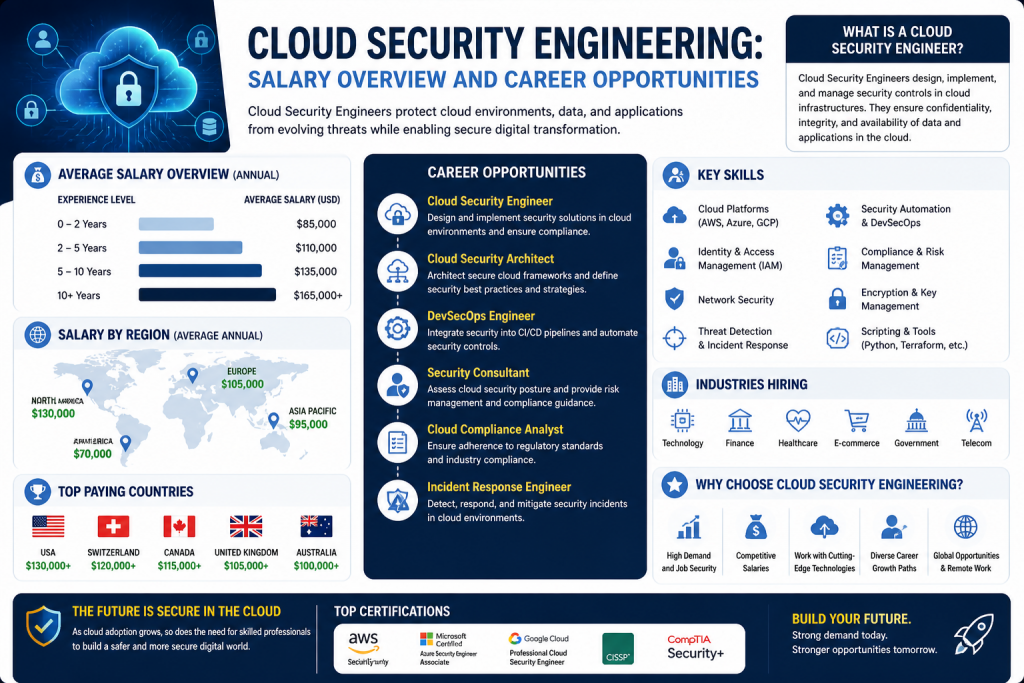
Cloud security engineers are among the highest-paid professionals in the IT industry. Their salaries reflect the complexity of their work and the importance of their role. On average, cloud security engineers earn around $152,000 per year in the United States, though this figure can vary depending on several factors.
Entry-level positions typically offer salaries between $90,000 and $115,000. These roles involve assisting with security tasks, monitoring systems, and learning from experienced professionals. As engineers gain experience, their responsibilities and salaries increase.
Mid-level professionals, with three to five years of experience, can earn between $115,000 and $145,000. At this stage, they are responsible for designing secure systems, conducting threat assessments, and ensuring compliance with regulations.
Senior-level engineers, with more than six years of experience, often earn $145,000 to $180,000 or more. These professionals lead security initiatives, mentor junior staff, and work closely with leadership to align security strategies with business goals.
In addition to base salaries, many organizations offer bonuses, stock options, and other benefits. These perks can significantly increase total compensation and make the role even more attractive.
Factors That Influence Salaries
Several factors influence how much a cloud security engineer can earn. Experience is one of the most significant factors. As professionals gain more experience and develop advanced skills, their earning potential increases.
Location also plays a major role. Salaries tend to be higher in cities with a high demand for technology professionals and a higher cost of living. However, remote work is changing this dynamic, allowing professionals to earn competitive salaries regardless of location.
Certifications can have a significant impact on salary. Earning recognized credentials demonstrates expertise and can make candidates more attractive to employers. Certifications related to cloud security and cybersecurity are particularly valuable.
Industry is another important factor. Organizations in sectors such as finance, healthcare, and government often pay higher salaries due to strict regulatory requirements and the sensitive nature of their data.
Automation skills are increasingly important. Engineers who can automate security processes are highly sought after and often command higher salaries. Automation improves efficiency and reduces the risk of human error.
Security clearance can also influence salary, particularly in government and defense roles. Professionals with active clearance may receive higher compensation due to the additional responsibilities and requirements.
Career Path and Advancement Opportunities
Cloud security engineering offers a clear path for career advancement. Entry-level professionals can progress to mid-level and senior roles as they gain experience and develop their skills. Each stage brings increased responsibilities and higher salaries.
Many professionals eventually move into leadership roles, such as security manager or director. These positions involve overseeing security teams, developing strategies, and ensuring that security goals align with business objectives.
Another common career path is moving into cloud security architecture. Architects design large-scale systems and make strategic decisions about security frameworks and technologies. These roles often come with higher salaries and greater influence within the organization.
Specialization is also an option. Professionals can focus on areas such as compliance, threat intelligence, or incident response. Specialization allows individuals to develop deep expertise and stand out in the job market.
Continuous learning is essential for career growth. The field of cloud security is constantly evolving, with new technologies and threats emerging regularly. Staying up to date with industry trends and best practices is crucial for maintaining competitiveness.
The Future of Cloud Security Engineering
The future of cloud security engineering looks promising. As more organizations adopt cloud technologies, the demand for skilled professionals is expected to continue growing. This trend is driven by the need to protect sensitive data and ensure compliance with regulations.
Emerging technologies such as artificial intelligence and machine learning are also shaping the field. These technologies can help detect threats more quickly and improve security measures. Cloud security engineers will need to adapt to these changes and develop new skills.
The rise of remote work is another factor influencing the field. Organizations are increasingly hiring professionals from different locations, creating more opportunities for cloud security engineers worldwide.
As cyber threats become more sophisticated, the role of cloud security engineers will become even more critical. Organizations will continue to invest in security, making this a stable and rewarding career choice.
Salary Trends Across Cities and Regions
While cloud security engineers are well compensated across the board, salary levels can vary significantly depending on geographic location. In the United States, major technology hubs consistently offer the highest pay due to strong demand and higher living costs. Cities such as San Francisco, Seattle, and New York often lead the market, with salaries reaching well above the national average.
However, a closer look at salary data reveals a more nuanced picture. Mid-sized cities are increasingly becoming competitive in terms of compensation. Locations like Denver, Portland, and Boston offer salaries that are not far behind traditional tech hubs. This shift is largely driven by the rise of remote work and the decentralization of tech talent. Companies are no longer limited to hiring within specific regions, allowing them to build distributed teams across multiple cities.
Another important trend is the consistency of salary growth across regions. Even in smaller markets, cloud security engineers can earn strong salaries compared to other IT roles. While the absolute numbers may be lower than in major cities, the difference is often offset by a lower cost of living. This makes certain regions particularly attractive for professionals seeking a balance between income and lifestyle.
In addition, companies are increasingly offering location-independent salaries for remote roles. This means that engineers can earn competitive wages regardless of where they live. While not all organizations follow this model, it is becoming more common as businesses adapt to a global workforce.
Understanding Salary Ranges and Variations
One of the most notable aspects of cloud security engineer salaries is the wide range between entry-level and senior positions. In many cities, the difference between the lowest and highest salaries can exceed $50,000 or even $70,000. This variation reflects differences in experience, skill level, and specialization.
Entry-level professionals typically focus on supporting tasks such as monitoring systems, responding to alerts, and assisting with security audits. These roles provide valuable experience but come with lower salaries compared to more advanced positions. As engineers gain experience, they take on more complex responsibilities, such as designing secure architectures and leading security initiatives.
Mid-level engineers are often responsible for implementing security solutions, conducting risk assessments, and ensuring compliance with industry standards. Their salaries reflect their growing expertise and ability to handle more complex tasks. At this stage, professionals may also begin to specialize in specific areas of cloud security.
Senior engineers command the highest salaries due to their extensive experience and leadership responsibilities. They are often involved in strategic decision-making, mentoring junior staff, and overseeing large-scale security projects. Their ability to manage risk at an organizational level makes them highly valuable to employers.
The wide salary range also highlights the importance of continuous learning and skill development. Engineers who invest in their education and stay updated on industry trends are more likely to move into higher-paying roles.
Impact of Industry on Compensation
The industry in which a cloud security engineer works can have a significant impact on their salary. Certain sectors place a higher emphasis on security due to the sensitive nature of their data and the strict regulations they must follow. As a result, these industries tend to offer higher compensation.
The financial sector is one of the highest-paying industries for cloud security engineers. Banks, investment firms, and fintech companies handle large volumes of sensitive financial data, making them prime targets for cyberattacks. To mitigate these risks, they invest heavily in security and are willing to pay top salaries for skilled professionals.
Healthcare is another industry with strong demand for cloud security expertise. Hospitals, insurance providers, and healthcare organizations must protect patient data and comply with regulations such as HIPAA. This creates a need for engineers who can design secure systems and ensure compliance.
Government and defense sectors also offer competitive salaries, particularly for roles that require security clearance. These positions often involve protecting critical infrastructure and sensitive information, making them both challenging and rewarding.
Technology companies, including software providers and cloud service providers, are also major employers of cloud security engineers. While salaries in this sector are competitive, they may vary depending on the company’s size and focus.
Role of Certifications in Salary Growth
Certifications play a crucial role in the career development of cloud security engineers. They serve as proof of expertise and demonstrate a professional’s commitment to their field. Employers often use certifications as a benchmark when evaluating candidates, and holding relevant credentials can lead to higher salaries.
Advanced certifications focused on cloud security are particularly valuable. They validate skills in areas such as identity management, threat detection, and compliance. Professionals with these certifications are often considered more qualified for senior roles and leadership positions.
Vendor-specific certifications are highly regarded, especially for professionals who work primarily with a particular cloud platform. These certifications demonstrate a deep understanding of the platform’s security features and best practices.
Vendor-neutral certifications are also important, as they provide a broader perspective on cloud security. These credentials are especially useful for professionals working in multicloud environments, where knowledge of multiple platforms is required.
In addition to increasing earning potential, certifications can open doors to new opportunities. They can help professionals stand out in a competitive job market and qualify for roles that require specialized expertise.
Multicloud Expertise and Its Value
As organizations adopt multiple cloud platforms, the demand for engineers with multicloud expertise is growing. Multicloud environments involve using services from more than one cloud provider, which adds complexity to security management. Engineers must understand how to secure each platform while ensuring consistency across the entire environment.
Professionals with experience in multiple cloud platforms are highly sought after because they can work in diverse environments. They are able to design security solutions that integrate seamlessly across different systems, making them valuable assets to organizations.
Multicloud expertise also increases earning potential. Engineers who can manage complex environments are often offered higher salaries due to their specialized skills. This trend is expected to continue as more organizations adopt multicloud strategies.
In addition to technical knowledge, multicloud engineers need strong problem-solving skills. They must be able to identify and address security challenges that arise from integrating different platforms. This requires a deep understanding of both cloud architecture and cybersecurity principles.
Importance of Automation in Cloud Security
Automation has become a key component of modern cloud security. As cloud environments grow in size and complexity, manual processes are no longer sufficient to manage security effectively. Automation allows engineers to streamline tasks, reduce errors, and respond to threats more quickly.
Engineers who are skilled in automation tools are in high demand. Tools such as infrastructure-as-code platforms and continuous integration pipelines enable professionals to automate deployment, monitoring, and compliance processes. This not only improves efficiency but also ensures consistency across environments.
Automation also plays a critical role in incident response. Automated systems can detect and respond to threats in real time, minimizing the impact of security incidents. This capability is particularly important in large organizations with complex infrastructures.
In addition to improving security, automation can also reduce operational costs. By automating routine tasks, organizations can allocate resources more effectively and focus on strategic initiatives. This makes automation skills highly valuable for cloud security engineers.
Compliance and Regulatory Requirements
Compliance is a major factor in cloud security, particularly for organizations operating in regulated industries. Regulations such as HIPAA, PCI-DSS, and SOC 2 require companies to implement specific security measures to protect sensitive data. Failure to comply with these regulations can result in significant penalties.
Cloud security engineers play a crucial role in ensuring compliance. They are responsible for implementing policies, conducting audits, and maintaining documentation that demonstrates adherence to regulatory requirements. This often involves working closely with legal and compliance teams.
Compliance also influences salary levels. Engineers who have experience with regulatory frameworks are often paid more due to their specialized knowledge. Organizations value professionals who can navigate complex compliance requirements and ensure that systems meet legal standards.
In addition to technical skills, compliance work requires attention to detail and strong organizational abilities. Engineers must be able to track changes, document processes, and ensure that all requirements are met consistently.
Security Clearance and Specialized Roles
In certain sectors, particularly government and defense, security clearance is a key requirement for cloud security engineers. Clearance allows professionals to access classified information and work on sensitive projects. Obtaining clearance can be a lengthy process, but it can significantly increase earning potential.
Roles that require security clearance often come with higher salaries and additional benefits. These positions may involve working on critical infrastructure, national security projects, or advanced research initiatives. While the responsibilities can be demanding, the rewards are substantial.
Specialized roles within cloud security also offer opportunities for higher pay. For example, engineers who focus on threat intelligence, penetration testing, or incident response may command higher salaries due to their expertise. These roles require advanced skills and a deep understanding of cybersecurity principles.
Specialization allows professionals to develop niche expertise and stand out in the job market. It also provides opportunities for career growth and advancement into leadership positions.
Remote Work and Its Influence on Salaries
The rise of remote work has had a significant impact on cloud security engineer salaries. Many organizations now offer remote or hybrid work options, allowing professionals to work from anywhere. This has expanded the talent pool and created new opportunities for engineers worldwide.
Remote work has also influenced salary structures. Some companies offer location-based pay, while others provide standardized salaries regardless of location. This variation can affect earning potential, depending on the organization’s policies.
For professionals, remote work offers greater flexibility and the ability to choose where they live. This can lead to a better work-life balance and improved quality of life. However, it also requires strong communication and time management skills.
From an employer’s perspective, remote work allows access to a broader range of talent. This can lead to more competitive hiring practices and increased demand for skilled professionals.
Building a High-Income Career in Cloud Security
Achieving a high salary as a cloud security engineer requires a combination of technical expertise, experience, and strategic career planning. Professionals must continuously develop their skills and stay updated on industry trends to remain competitive.
One of the most effective ways to increase earning potential is through continuous learning. This includes earning certifications, attending training programs, and staying informed about new technologies and threats. Engineers who invest in their education are more likely to advance in their careers.
Networking is another important factor. Building connections with other professionals in the field can lead to new opportunities and insights. Participating in industry events, online communities, and professional organizations can help engineers expand their network.
Gaining hands-on experience is also essential. Working on real-world projects allows professionals to develop practical skills and demonstrate their expertise. Employers value candidates who can apply their knowledge in real-world scenarios.
Finally, professionals should be proactive in seeking opportunities for growth. This may involve taking on challenging projects, pursuing leadership roles, or transitioning into specialized areas of cloud security.
Experience Levels and Their Impact on Earnings
Experience is one of the most powerful drivers of salary growth in cloud security engineering. As professionals move from entry-level roles to senior and leadership positions, their responsibilities expand significantly, and so does their earning potential. Employers place a high value on hands-on experience because it reflects a candidate’s ability to handle real-world security challenges.
At the entry level, cloud security engineers typically focus on foundational tasks. These may include monitoring cloud environments for suspicious activity, assisting in security audits, reviewing configurations, and responding to low-risk alerts. During this stage, professionals are building their technical knowledge and learning how cloud systems operate in a production environment. While salaries at this level are lower compared to more advanced roles, they still tend to be competitive when compared to other entry-level IT positions.
As engineers progress into mid-level roles, they begin to take on more complex responsibilities. They may design and implement security controls, conduct vulnerability assessments, and ensure compliance with industry standards. At this stage, engineers are expected to work more independently and contribute to decision-making processes. Their ability to manage projects and collaborate with cross-functional teams becomes increasingly important.
Senior-level professionals are responsible for leading security initiatives and shaping an organization’s cloud security strategy. They often oversee teams, mentor junior engineers, and work closely with leadership to align security goals with business objectives. Their role may also include handling major incidents, conducting risk assessments, and making high-level architectural decisions. Because of the level of expertise required, senior engineers command the highest salaries in the field.
Experience not only increases technical proficiency but also builds confidence and credibility. Employers are willing to pay a premium for professionals who have demonstrated their ability to protect complex systems and respond effectively to security threats.
Essential Tools for Cloud Security Engineers
Cloud security engineers rely on a wide range of tools to perform their duties effectively. These tools help them monitor systems, detect threats, enforce policies, and automate processes. Familiarity with these technologies is essential for success in the field.
Cloud-native security tools are among the most important resources. These tools are provided by cloud service platforms and are designed to integrate seamlessly with their environments. They help engineers manage identity and access, monitor activity, and detect potential threats. Understanding how to use these tools effectively is a fundamental skill for any cloud security professional.
Infrastructure-as-code tools are another critical component. These tools allow engineers to define and manage cloud resources using code rather than manual configuration. This approach ensures consistency and reduces the risk of misconfigurations, which are a common cause of security incidents. By automating deployments, engineers can maintain secure environments at scale.
Monitoring and logging tools play a key role in threat detection and incident response. These tools collect data from various sources and provide insights into system activity. Engineers use this information to identify unusual behavior, investigate incidents, and take corrective action.
Networking and firewall tools are used to control traffic and protect cloud environments from unauthorized access. These tools enable engineers to define security boundaries and enforce policies that regulate how data flows within the system.
DevSecOps tools integrate security into the development process. They allow engineers to identify vulnerabilities early and ensure that applications are secure before they are deployed. This proactive approach helps reduce risks and improve overall security posture.
Certifications That Boost Career Growth
Certifications are a valuable asset for cloud security engineers. They validate a professional’s skills and demonstrate their commitment to continuous learning. Employers often view certifications as evidence of expertise, which can lead to higher salaries and better job opportunities.
There are several certifications that are particularly relevant to cloud security. Platform-specific certifications focus on securing environments within a particular cloud provider. These credentials demonstrate a deep understanding of the platform’s features and best practices.
Vendor-neutral certifications provide a broader perspective on cloud security. They cover concepts that apply across multiple platforms, making them valuable for professionals working in multicloud environments. These certifications often focus on security architecture, governance, and compliance.
Entry-level certifications are useful for individuals who are new to the field. They provide a foundation in cloud computing and cybersecurity principles, helping professionals build the knowledge needed to advance in their careers.
Advanced certifications are designed for experienced professionals. They require a deep understanding of cloud security and often involve complex scenarios and problem-solving tasks. Earning these certifications can significantly boost earning potential and open doors to senior roles.
In addition to increasing salary, certifications can enhance a professional’s credibility and reputation. They signal to employers and peers that the individual is knowledgeable and dedicated to their field.
Developing High-Value Skills
To maximize earning potential, cloud security engineers must develop high-value skills that are in demand. These skills go beyond basic technical knowledge and include advanced capabilities that contribute to an organization’s security strategy.
One of the most important skills is automation. Engineers who can automate security processes are highly sought after because they can improve efficiency and reduce errors. Automation allows organizations to manage large and complex environments more effectively.
Another valuable skill is threat intelligence. Understanding how attackers operate and staying informed about emerging threats enables engineers to anticipate risks and implement proactive measures. This knowledge is essential for protecting systems from advanced cyberattacks.
Cloud architecture is also a critical skill. Engineers who can design secure and scalable systems are highly valued. This involves understanding how different components interact and how to implement security measures at each layer.
Communication and collaboration skills are equally important. Cloud security engineers must work with various teams, including developers, operations staff, and management. Being able to explain complex concepts in a clear and concise manner is essential for effective collaboration.
Problem-solving and critical thinking are key attributes. Engineers must be able to analyze situations, identify vulnerabilities, and develop solutions to address them. These skills are particularly important during incident response, where quick and effective decision-making is required.
Strategies to Increase Salary
Increasing salary as a cloud security engineer requires a proactive approach. Professionals must take deliberate steps to enhance their skills, gain experience, and position themselves for higher-paying roles.
One effective strategy is to pursue advanced certifications. These credentials demonstrate expertise and can make candidates more competitive in the job market. Employers often associate certifications with higher skill levels and are willing to offer better compensation.
Gaining experience with multiple cloud platforms can also boost earning potential. Multicloud expertise is highly valued because it allows engineers to work in diverse environments. Professionals who can manage complex systems are often offered higher salaries.
Building a strong portfolio of projects is another important step. Demonstrating practical experience through real-world projects can showcase a professional’s abilities and make them more attractive to employers.
Networking can also play a significant role in career advancement. Connecting with other professionals in the field can lead to new opportunities and insights. Industry events, online communities, and professional organizations are great places to build connections.
Seeking roles in high-paying industries is another strategy. Sectors such as finance, healthcare, and government often offer higher salaries due to their strict security requirements. Transitioning into these industries can lead to increased earning potential.
The Role of Continuous Learning
Continuous learning is essential in the field of cloud security. Technology evolves rapidly, and new threats emerge regularly. Professionals must stay updated on the latest developments to remain effective in their roles.
Learning can take many forms, including formal education, online courses, and self-study. Engineers should regularly update their knowledge of cloud platforms, security tools, and best practices. This helps them stay ahead of potential threats and maintain their competitive edge.
Participating in training programs and workshops can provide valuable hands-on experience. These opportunities allow professionals to learn from experts and gain practical skills that can be applied in real-world scenarios.
Reading industry publications and following security research can also help engineers stay informed. Understanding emerging trends and vulnerabilities enables professionals to anticipate challenges and develop effective solutions.
Continuous learning not only improves technical skills but also enhances career prospects. Employers value professionals who are committed to their development and willing to adapt to changing technologies.
Transitioning Into Leadership Roles
As cloud security engineers gain experience, many choose to transition into leadership roles. These positions involve overseeing teams, developing strategies, and ensuring that security goals align with business objectives.
Leadership roles require a different set of skills compared to technical positions. In addition to technical expertise, professionals must have strong management and communication skills. They must be able to guide teams, make decisions, and handle complex challenges.
Security managers and directors are responsible for setting policies, managing budgets, and coordinating with other departments. They play a key role in shaping an organization’s security strategy and ensuring that it is implemented effectively.
Another leadership path is becoming a cloud security architect. Architects focus on designing large-scale systems and making high-level decisions about security frameworks and technologies. These roles often come with higher salaries and greater influence within the organization.
Transitioning into leadership requires preparation and experience. Professionals should seek opportunities to take on additional responsibilities, mentor others, and develop their management skills.
Challenges in Cloud Security Careers
While cloud security engineering offers many benefits, it also comes with challenges. One of the biggest challenges is keeping up with the rapidly changing technology landscape. Engineers must constantly update their skills and knowledge to stay effective.
Another challenge is managing the complexity of cloud environments. As organizations adopt multiple platforms and services, securing these systems becomes more difficult. Engineers must navigate this complexity and ensure that all components are properly protected.
The threat landscape is also constantly evolving. Cybercriminals are developing new techniques and targeting cloud environments in increasingly sophisticated ways. Engineers must stay vigilant and adapt to these changes.
Workload and pressure can also be significant. Security incidents require immediate attention, and engineers may need to respond quickly to prevent damage. This can lead to high levels of stress, particularly in critical situations.
Despite these challenges, many professionals find the field rewarding. The opportunity to solve complex problems and protect valuable assets makes cloud security engineering a fulfilling career.
Future Outlook for Cloud Security Engineers
The future of cloud security engineering is bright. As more organizations adopt cloud technologies, the demand for skilled professionals will continue to grow. This trend is expected to create numerous job opportunities and drive salary growth.
Emerging technologies such as artificial intelligence and machine learning are expected to play a significant role in cloud security. These technologies can help automate threat detection and improve response times. Engineers will need to develop skills in these areas to stay relevant.
The increasing focus on data privacy and compliance will also drive demand for cloud security expertise. Organizations must ensure that they meet regulatory requirements and protect sensitive information.
Remote work is likely to remain a significant factor in the industry. This will create opportunities for professionals to work with organizations around the world and access a wider range of job opportunities.
Overall, cloud security engineering is expected to remain a stable and lucrative career choice. Professionals who invest in their skills and adapt to changing technologies will be well positioned for success.
Conclusion
Cloud security engineering has become one of the most critical roles in modern information technology. As organizations continue to rely on cloud platforms, the need for skilled professionals who can protect these environments is greater than ever. This demand has led to strong salary growth and a wide range of career opportunities.
Salaries in this field are influenced by multiple factors, including experience, location, industry, certifications, and technical skills. Professionals who invest in continuous learning, develop high-value skills, and gain practical experience can significantly increase their earning potential.
The field also offers diverse career paths, from technical roles to leadership positions. Whether focusing on architecture, compliance, or incident response, cloud security engineers have numerous opportunities to grow and specialize.
While the role comes with challenges, including evolving threats and complex environments, it is also highly rewarding. The ability to protect critical systems and contribute to an organization’s success makes this a meaningful career.
Looking ahead, the future of cloud security engineering is promising. With the continued expansion of cloud technologies and the increasing importance of cybersecurity, professionals in this field can expect strong demand, competitive salaries, and long-term career stability.
Continue exploring the technologies and certification concepts that matter most to you.