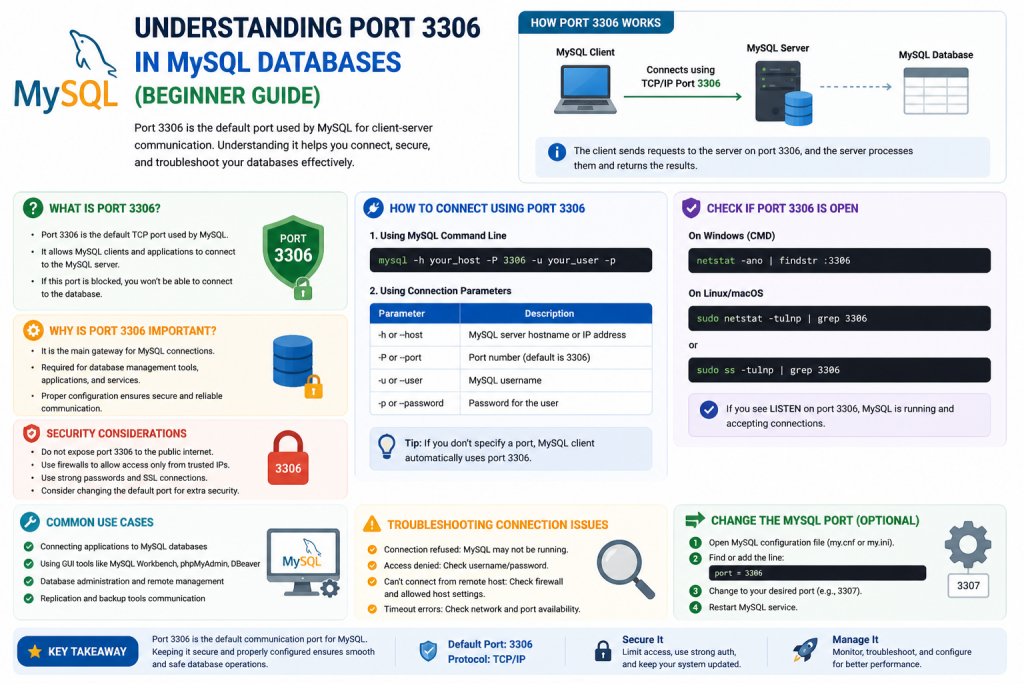
MySQL port 3306 is widely recognized as the default communication endpoint used by the MySQL database management system. It serves as the primary channel through which applications, services, and tools connect to a MySQL server in order to perform database operations. Whenever an application needs to read data, insert records, update information, or delete entries from a MySQL database, it typically sends requests through this port.
In modern computing environments, databases rarely operate in isolation. Instead, they function as part of larger systems that include web servers, application servers, and client interfaces. These systems rely on network communication to interact with databases, and port 3306 plays a central role in enabling this interaction. It acts as a bridge between the application layer and the data storage layer, ensuring that information flows smoothly and securely.
The concept of a default port is important because it simplifies configuration. Developers and system administrators can rely on a standard port number instead of having to define one manually for every deployment. This consistency reduces complexity and helps ensure compatibility across different systems and environments.
Understanding Network Ports
To fully appreciate the role of port 3306, it is essential to understand what a network port is and how it functions. A port is a logical identifier used in networking to distinguish between different services running on the same device. While an IP address identifies a machine on a network, a port number identifies a specific application or service on that machine.
Ports are part of the transport layer in the networking model and are used by protocols such as TCP and UDP. They allow multiple services to operate simultaneously without interfering with each other. For example, a single server can host a web server, an email server, and a database server, each using a different port.
Port numbers range from 0 to 65535 and are divided into categories. Well-known ports, which range from 0 to 1023, are reserved for commonly used services. Although port 3306 falls slightly outside this range, it is still widely recognized as the standard port for MySQL and is treated as a de facto well-known port in practice.
When a client application wants to communicate with a server, it specifies both the server’s IP address and the port number. This combination ensures that the request is directed to the correct service. Without ports, it would be impossible to run multiple networked applications on the same device efficiently.
Overview of MySQL
MySQL is an open-source relational database management system that organizes data into structured tables. It uses Structured Query Language, commonly known as SQL, to manage and manipulate data. Over the years, MySQL has become one of the most popular database systems in the world, particularly in web development.
The success of MySQL can be attributed to several factors. It is free to use, highly scalable, and capable of handling large volumes of data. It also offers strong performance and reliability, making it suitable for both small projects and large enterprise applications.
MySQL operates on a client-server architecture. The server component is responsible for managing the database, processing queries, and returning results. The client component, which can be an application or a tool, sends requests to the server. These requests are transmitted over a network, typically using port 3306.
This architecture allows MySQL to support distributed systems, where the database server and the client application may reside on different machines. It also enables multiple clients to connect to the same database simultaneously, making it ideal for collaborative and multi-user environments.
How Port 3306 Enables Database Communication
Port 3306 plays a crucial role in enabling communication between clients and the MySQL server. When a client application wants to access the database, it initiates a connection to the server’s IP address on port 3306. This connection request is the first step in establishing communication.
Once the server receives the request, it performs an authentication process. The client must provide valid credentials, such as a username and password, to gain access. If the credentials are correct, the server establishes a session with the client.
During this session, the client can send SQL queries to the server. These queries are transmitted over port 3306 and processed by the server. The server then sends the results back to the client using the same port. This exchange continues until the session is terminated.
The use of a dedicated port ensures that database traffic is separated from other types of network traffic. This separation improves performance and makes it easier to manage and secure the system.
The Role of TCP in MySQL Connections
MySQL communication over port 3306 primarily relies on the Transmission Control Protocol. TCP is a connection-oriented protocol that provides reliable data transfer between devices. It ensures that data is delivered accurately and in the correct order.
When a client connects to a MySQL server using TCP, a connection is established through a process known as the three-way handshake. This process involves the exchange of synchronization and acknowledgment messages to confirm that both the client and server are ready to communicate.
Once the connection is established, TCP handles the transmission of data packets. It uses mechanisms such as error checking, retransmission, and flow control to ensure that data is delivered without loss or corruption. This reliability is essential for database operations, where even minor errors can have significant consequences.
Although it is technically possible to use UDP for communication on port 3306, it is rarely used in practice. UDP is faster but does not provide the same level of reliability as TCP. Because database interactions require accuracy and consistency, TCP is the preferred protocol.
Types of Applications That Use Port 3306
A wide variety of applications depend on port 3306 to interact with MySQL databases. These applications span multiple industries and use cases, reflecting the versatility of MySQL as a database system.
Web applications are among the most common users of MySQL. When a user interacts with a website, such as by logging in, submitting a form, or browsing content, the application often needs to retrieve or store data in a database. These interactions are handled through port 3306.
Content management systems rely heavily on MySQL to manage website content. They store information such as articles, user data, and settings in databases and retrieve this information dynamically to generate web pages.
Enterprise applications also use MySQL to manage large volumes of data. These applications include systems for resource planning, customer relationship management, and data analytics. Port 3306 enables seamless communication between different components of these systems.
Database administration tools use port 3306 to connect to MySQL servers for tasks such as configuration, monitoring, and backup. These tools provide administrators with the ability to manage databases efficiently and ensure their reliability.
SQL as the Language of Communication
Structured Query Language is the primary method of interacting with MySQL databases. It provides a standardized way to perform operations on data, making it an essential tool for developers and database administrators.
When a client connects to a MySQL server through port 3306, it sends SQL commands to the server. These commands can be used to perform a wide range of operations, from simple data retrieval to complex data manipulation.
For example, a query can be used to retrieve all records from a table, filter data based on specific conditions, or join multiple tables to produce meaningful results. SQL also supports operations for inserting new data, updating existing records, and deleting unwanted information.
The server processes these commands and returns the results to the client. This interaction forms the foundation of database-driven applications and highlights the importance of port 3306 in facilitating communication.
Core Database Operations in MySQL
MySQL supports a set of fundamental operations commonly referred to as CRUD, which stands for Create, Read, Update, and Delete. These operations represent the basic actions that can be performed on data within a database.
Create operations involve adding new records to the database. This is typically done using SQL commands that insert data into tables. Read operations retrieve data from the database and are often used to display information to users.
Update operations modify existing data. This can include changing values in a record or updating multiple records based on specific criteria. Delete operations remove data that is no longer needed, helping to maintain the accuracy and relevance of the database.
All of these operations are carried out through SQL commands sent over port 3306. This consistent method of communication ensures that applications can interact with the database in a reliable and predictable manner.
Importance of Default Ports in Networking
Default ports play a significant role in simplifying network communication. They provide a standard reference point that developers and administrators can use when configuring systems. For MySQL, port 3306 serves this purpose.
Using a default port reduces the need for additional configuration and makes it easier to set up applications. It also helps ensure compatibility, as most tools and frameworks are designed to use the default port unless specified otherwise.
Default ports also make troubleshooting easier. When an issue arises, administrators can quickly identify whether the problem is related to the port configuration. This can save time and reduce the complexity of diagnosing network problems.
However, there are situations where using a non-default port may be beneficial. For example, changing the port can help improve security by making it less predictable. This can reduce the risk of automated attacks that target well-known ports.
How MySQL Fits into Modern Web Architecture
In modern web architecture, MySQL is often part of a multi-tier system that includes a client layer, an application layer, and a data layer. Port 3306 plays a key role in connecting the application layer to the data layer.
When a user interacts with a web application, their request is processed by the application server. The server then communicates with the MySQL database to retrieve or store data. This communication occurs over port 3306.
The data retrieved from the database is used to generate dynamic content, which is then sent back to the user. This process happens quickly and seamlessly, allowing users to interact with applications in real time.
This architecture highlights the importance of efficient and reliable communication between components. Port 3306 ensures that data can be accessed quickly and accurately, supporting the performance and functionality of modern applications.
Introduction to Security in MySQL Port 3306
While port 3306 is essential for enabling communication between applications and MySQL databases, it also introduces potential security risks if not properly managed. Because this port is widely known and commonly used, it can become a target for attackers who attempt to exploit vulnerabilities in database systems.
Security is a critical consideration in any environment where sensitive data is stored or transmitted. MySQL databases often contain valuable information such as user credentials, financial records, and application data. If unauthorized users gain access to this information, the consequences can be severe, including data breaches, financial loss, and damage to reputation.
Understanding how to secure port 3306 is therefore an essential skill for database administrators and developers. It involves not only configuring the database correctly but also implementing best practices for authentication, encryption, and network protection.
Does MySQL Port 3306 Use Encryption
By default, MySQL does not encrypt data transmitted over port 3306. This means that information exchanged between the client and server is sent in plain text, making it vulnerable to interception by malicious actors. If an attacker is able to capture network traffic, they may be able to read sensitive data such as usernames, passwords, and query results.
To address this issue, MySQL provides support for Secure Sockets Layer and its successor, Transport Layer Security. These protocols enable encrypted communication between the client and server, ensuring that data remains confidential during transmission.
When encryption is enabled, both the client and the server must be configured to use SSL or TLS. This involves generating certificates, configuring the server to require secure connections, and ensuring that clients are properly set up to use encryption.
Although enabling encryption adds an extra layer of complexity, it significantly improves the security of MySQL connections. It is especially important in environments where data is transmitted over public or untrusted networks.
Authentication and Access Control
Authentication is the process of verifying the identity of a user or application attempting to connect to a MySQL server. When a connection request is made over port 3306, the server checks the provided credentials against its internal user database.
MySQL uses a combination of usernames, passwords, and host-based access controls to determine whether a connection should be allowed. Users can be granted specific privileges that define what actions they are permitted to perform on the database.
Access control is an important aspect of security because it ensures that users can only access the data and perform the operations that they are authorized to. For example, a user who only needs to read data should not be granted permission to modify or delete it.
Properly managing user accounts and privileges helps reduce the risk of unauthorized access and limits the potential damage in case of a security breach.
Common Vulnerabilities Associated with Port 3306
Because port 3306 is widely used, it is often targeted by attackers looking to exploit weaknesses in MySQL systems. Some of the most common vulnerabilities include SQL injection, weak passwords, and misconfigured access controls.
SQL injection is a technique where an attacker inserts malicious SQL code into an application’s input fields. If the application does not properly validate or sanitize user input, this code can be executed by the database, potentially allowing the attacker to access or modify data.
Weak passwords are another major vulnerability. If users choose simple or easily guessable passwords, attackers can use automated tools to attempt to gain access through brute-force attacks. This risk is increased if there are no limits on the number of login attempts.
Misconfigured access controls can also expose databases to unauthorized users. For example, allowing connections from any host or granting excessive privileges to users can create opportunities for exploitation.
Understanding SQL Injection Attacks
SQL injection is one of the most serious threats to MySQL databases. It occurs when an application fails to properly handle user input, allowing an attacker to manipulate SQL queries.
For example, if a login form does not validate input correctly, an attacker could enter a specially crafted string that alters the query logic. This could allow them to bypass authentication or retrieve sensitive data.
Preventing SQL injection requires careful coding practices. Developers should use parameterized queries or prepared statements, which separate SQL code from user input. This ensures that input is treated as data rather than executable code.
Input validation and sanitization are also important. By restricting the types of input that can be accepted, developers can reduce the risk of malicious data being processed.
Brute Force Attacks on Port 3306
Brute force attacks involve systematically trying different combinations of usernames and passwords until a valid combination is found. Because port 3306 is the default port for MySQL, attackers often target it when attempting to gain unauthorized access.
These attacks can be automated using tools that generate large numbers of login attempts in a short period of time. If the server does not have protections in place, it may be possible for an attacker to eventually guess the correct credentials.
To defend against brute force attacks, it is important to enforce strong password policies. Passwords should be complex, unique, and regularly updated. Additionally, limiting the number of failed login attempts and implementing account lockouts can help prevent repeated attempts.
Monitoring login activity and setting up alerts for suspicious behavior can also help detect and respond to attacks in a timely manner.
The Importance of Strong Passwords
Strong passwords are a fundamental component of database security. A strong password is one that is difficult to guess and resistant to brute-force attacks. It typically includes a combination of uppercase and lowercase letters, numbers, and special characters.
Using unique passwords for different accounts is also important. If the same password is used across multiple systems, a breach in one system could compromise others.
In addition to creating strong passwords, it is important to store them securely. MySQL uses hashing techniques to store passwords, which helps protect them in case of unauthorized access to the database.
Regularly updating passwords and avoiding common patterns can further enhance security and reduce the risk of compromise.
Network-Level Security Measures
Securing port 3306 is not limited to the database itself. Network-level security measures play a crucial role in protecting MySQL systems from external threats.
Firewalls can be used to restrict access to port 3306, allowing only trusted IP addresses to connect. This reduces the attack surface and prevents unauthorized users from attempting to connect to the database.
Virtual private networks can also be used to secure communication between clients and servers. By creating a private network, organizations can ensure that data is transmitted securely and is not exposed to the public internet.
Segmentation of network resources is another effective strategy. By isolating the database server from other parts of the network, organizations can limit the impact of potential security breaches.
Using Non-Default Ports for Security
Although port 3306 is the default for MySQL, it is possible to configure the server to use a different port. This practice, often referred to as security through obscurity, can help reduce the likelihood of automated attacks.
Many attackers target well-known ports because they are commonly used. By changing the port number, administrators can make it more difficult for attackers to identify the service.
However, using a non-default port should not be relied upon as the sole security measure. It should be combined with other best practices such as strong authentication, encryption, and network protection.
Monitoring and Logging MySQL Activity
Monitoring and logging are essential for maintaining the security of MySQL systems. By keeping track of database activity, administrators can identify suspicious behavior and respond to potential threats.
MySQL provides logging features that record information about connections, queries, and errors. These logs can be analyzed to detect unusual patterns, such as repeated failed login attempts or unexpected queries.
Regularly reviewing logs helps ensure that any issues are identified early. Automated monitoring tools can also be used to provide real-time alerts, allowing administrators to take immediate action when necessary.
Securing Client and Server Communication
Ensuring secure communication between clients and the MySQL server is a key aspect of protecting port 3306. In addition to enabling encryption, it is important to verify the identity of both parties involved in the connection.
Using certificates and secure authentication methods helps establish trust between the client and server. This prevents unauthorized entities from intercepting or impersonating legitimate connections.
It is also important to keep software up to date. Regular updates often include security patches that address known vulnerabilities. Keeping both the server and client software updated helps reduce the risk of exploitation.
Best Practices for Protecting Port 3306
Protecting port 3306 requires a combination of technical measures and good practices. These include enabling encryption, enforcing strong passwords, and restricting access through firewalls.
Regular security audits can help identify potential weaknesses and ensure that best practices are being followed. Training developers and administrators on secure coding and configuration practices is also important.
Backup and recovery plans should be in place to ensure that data can be restored in case of a security incident. This helps minimize downtime and reduce the impact of data loss.
By taking a proactive approach to security, organizations can significantly reduce the risks associated with using port 3306.
Introduction to Advanced MySQL Port Usage
Port 3306 is not only the default communication channel for MySQL but also a key component in more advanced database configurations. As systems grow in complexity, the way this port is used, managed, and optimized becomes increasingly important. Organizations often run multiple services, scale applications across servers, and deploy containerized environments, all of which rely on proper port configuration.
Understanding advanced usage scenarios helps developers and administrators make better decisions about performance, scalability, and reliability. It also ensures that MySQL can adapt to modern infrastructure, including cloud environments and distributed systems.
This section explores how port 3306 functions in more complex setups, including running multiple instances, avoiding conflicts, and optimizing performance in real-world deployments.
Running Multiple MySQL Instances
In some environments, it is necessary to run more than one MySQL instance on the same machine. This can be useful for testing, development, or hosting multiple applications with separate database environments.
Since only one service can use a specific port at a time, running multiple instances requires configuring each instance to use a different port. For example, one instance may use port 3306 while another uses port 3307 or another available port.
Each instance must also have its own configuration files, data directories, and system resources. This separation ensures that the instances do not interfere with each other and can operate independently.
Running multiple instances provides flexibility but also introduces additional complexity. Administrators must carefully manage resources such as memory and CPU to ensure that all instances perform efficiently.
Understanding Port Conflicts
Port conflicts occur when more than one service attempts to use the same port simultaneously. Since a port can only be bound to a single service at a time, this situation prevents one or more services from starting or functioning correctly.
For MySQL, a port conflict may arise if another database service or application is already using port 3306. This can happen in development environments where multiple tools are installed or in systems where services are not properly configured.
Resolving port conflicts typically involves identifying the service using the port and either stopping it or reconfiguring one of the services to use a different port. Tools that display active network connections can help diagnose these issues.
Preventing port conflicts requires careful planning and documentation of port usage within a system. This is especially important in environments with multiple services and applications.
Configuring MySQL to Use a Different Port
Although port 3306 is the default, MySQL can be configured to use a different port if needed. This is done by modifying the MySQL configuration file and specifying a new port number.
Changing the port may be necessary in cases where multiple instances are running or when there is a need to avoid conflicts with other services. It can also be used as an additional security measure, making it less predictable for attackers to locate the database service.
After changing the port, all client applications must be updated to connect using the new port number. This includes connection strings, configuration files, and any tools that interact with the database.
While using a non-default port can provide some benefits, it should be combined with other security practices to ensure comprehensive protection.
MySQL Port 3306 in Containerized Environments
Modern applications often use containerization technologies to package and deploy software. In these environments, MySQL may run داخل containers, and port 3306 plays a key role in enabling communication between containers and external systems.
Containers typically isolate applications, but they can expose ports to allow communication. When a MySQL container is deployed, port 3306 is often mapped to a port on the host machine. This allows other containers or external applications to connect to the database.
In multi-container setups, such as those used in microservices architectures, different services may communicate with MySQL over internal networks. Proper port configuration ensures that these connections are efficient and secure.
Managing ports in containerized environments requires careful planning to avoid conflicts and ensure that services can communicate effectively.
Role of Port 3306 in Distributed Systems
In distributed systems, applications and databases are spread across multiple servers or locations. Port 3306 enables communication between these components, allowing data to be shared and synchronized.
For example, a web application may run on several servers to handle high traffic, while a centralized MySQL database stores all the data. Each application server connects to the database عبر port 3306 to perform operations.
Replication is another important feature in distributed systems. MySQL supports replication, where data from one server is copied to another. This process also relies on network communication, often using port 3306.
Distributed systems require reliable and efficient communication, making the proper configuration of port 3306 essential for performance and scalability.
Performance Considerations for Port 3306
The performance of MySQL connections can be influenced by how port 3306 is configured and used. Factors such as network latency, bandwidth, and server capacity all play a role in determining how quickly data can be transmitted.
Optimizing performance involves reducing unnecessary network overhead and ensuring that connections are efficient. Connection pooling is one technique used to improve performance. It allows applications to reuse existing connections instead of creating new ones for each request.
Load balancing can also improve performance by distributing traffic across multiple database servers. This reduces the load on individual servers and ensures that resources are used efficiently.
Monitoring network performance and identifying bottlenecks can help administrators make informed decisions about optimizing port usage.
Integration with Web Frameworks and Programming Languages
Port 3306 is commonly used by web frameworks and programming languages to connect to MySQL databases. These frameworks provide built-in support for database connectivity, making it easier for developers to integrate MySQL into their applications.
Programming languages such as Python, Node.js, and Go offer libraries and drivers that handle the complexity of connecting to MySQL. These tools manage the communication over port 3306, allowing developers to focus on application logic.
Web frameworks often include features for managing database connections, handling queries, and ensuring security. They simplify the process of interacting with MySQL while maintaining efficient communication.
Understanding how these tools use port 3306 helps developers build more reliable and scalable applications.
Backup and Recovery Over Port 3306
Database backup and recovery are critical for maintaining data integrity. Tools used for backup often connect to MySQL عبر port 3306 to extract data and create backups.
Regular backups ensure that data can be restored in case of system failures, data corruption, or security incidents. Automated backup solutions can be configured to run at scheduled intervals, minimizing the risk of data loss.
Recovery processes also rely on port 3306 to restore data to the database. This may involve importing backup files or synchronizing data from other sources.
Ensuring that backup and recovery processes are properly configured and tested is essential for maintaining a reliable database system.
Monitoring and Troubleshooting Port 3306
Effective monitoring is key to maintaining the health of MySQL systems. By tracking the activity on port 3306, administrators can identify issues such as connection failures, slow queries, or unusual traffic patterns.
Monitoring tools provide insights into how the database is being used and help detect potential problems before they escalate. Metrics such as connection count, response time, and error rates can be used to evaluate performance.
Troubleshooting issues related to port 3306 often involves checking network connectivity, verifying configuration settings, and reviewing logs. Identifying the root cause of a problem is essential for implementing effective solutions.
Regular monitoring and proactive maintenance help ensure that MySQL systems remain stable and efficient.
Best Practices for Managing Port 3306
Managing port 3306 effectively requires a combination of technical knowledge and practical strategies. Some key best practices include maintaining proper configuration, securing access, and monitoring performance.
In addition to these fundamentals, administrators should ensure that the MySQL service is only exposed to the networks and systems that genuinely need access. Restricting connectivity through firewall rules or private networking significantly reduces the attack surface and helps prevent unauthorized connection attempts.
Another important practice is regularly reviewing configuration settings to ensure they align with current operational needs. As systems evolve, outdated configurations can introduce inefficiencies or security gaps. Keeping the MySQL server and related software up to date is equally important, as updates often include performance improvements and critical security patches.
Performance tuning also plays a major role in managing port 3306. This includes optimizing connection limits, using connection pooling to reduce overhead, and monitoring query performance to identify bottlenecks. Logging and analytics tools can provide valuable insights into traffic patterns and unusual activity, allowing administrators to take proactive measures.
Documentation should not be overlooked. Maintaining clear records of port usage, configurations, and access policies makes troubleshooting easier and ensures consistency across environments. Together, these practices create a stable, secure, and efficient foundation for managing MySQL communication.
Using firewalls to restrict access to trusted sources helps reduce the risk of unauthorized connections. Keeping software updated ensures that known vulnerabilities are addressed.
Documenting port configurations and maintaining clear records can help prevent conflicts and simplify troubleshooting. Regular testing of connections and performance helps identify potential issues early.
Training team members on best practices and ensuring that they follow established guidelines contributes to a more secure and reliable environment.
Future Trends and Evolving Use Cases
As technology continues to evolve, the role of port 3306 in MySQL environments is also changing. Cloud computing, containerization, and microservices architectures are influencing how databases are deployed and managed.
. In modern cloud platforms, databases are often offered as managed services, where much of the underlying infrastructure is abstracted away. Even in these environments, port 3306 remains the standard entry point for database connections, although access is typically controlled through security groups, private endpoints, or service gateways rather than direct exposure to the public internet.
Containerization has further transformed how port 3306 is used. In container-based deployments, applications and databases run in isolated environments, and ports are mapped dynamically between containers and host systems. This allows multiple services to coexist without conflict while still enabling communication through well-defined interfaces. Orchestration tools automatically manage these connections, ensuring that services can scale up or down as needed without manual reconfiguration.
Microservices architectures add another layer of complexity by breaking applications into smaller, independent components. Each service may interact with a database through port 3306, often over internal networks designed for high performance and security. This shift emphasizes the importance of efficient connection handling, service discovery, and secure communication, making port management a critical aspect of modern application design.
In cloud environments, managed database services often abstract the underlying infrastructure, but port 3306 remains a key component for connectivity. These services provide additional features such as automatic scaling, backups, and security enhancements.
Microservices architectures rely on efficient communication between services, making proper port management essential. As applications become more distributed, the importance of reliable database connectivity continues to grow.
Staying informed about these trends helps organizations adapt to changing requirements and make the most of their MySQL deployments.
Conclusion
MySQL port 3306 is far more than just a default port number. It is a fundamental element that enables communication between applications and databases, supporting everything from simple queries to complex distributed systems.
In advanced environments, port 3306 must be carefully managed to ensure performance, scalability, and reliability. This includes handling multiple instances, avoiding conflicts, and optimizing network communication.
By following best practices and understanding how port 3306 operates in different scenarios, developers and administrators can build robust and efficient systems. Whether in traditional setups or modern cloud-based architectures, the proper use of port 3306 remains essential for successful database management.
Continue exploring the technologies and certification concepts that matter most to you.