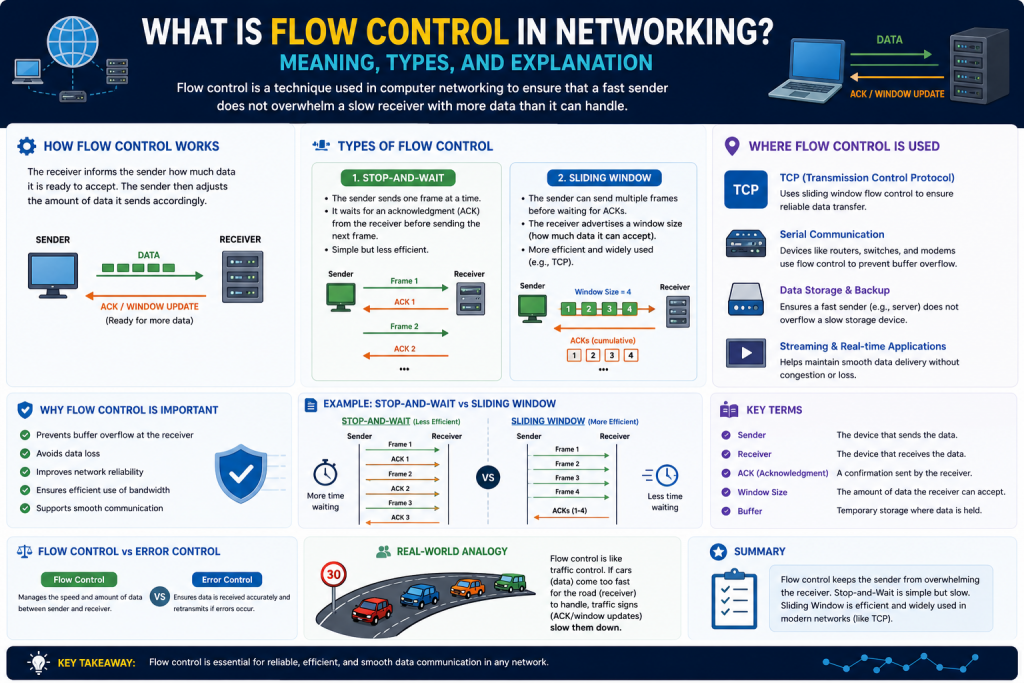
Low control is a core concept in computer networking that focuses on regulating how data moves between devices. In any communication system, data travels from a sender to a receiver, but both ends rarely operate at the same speed or efficiency. Without proper regulation, a fast sender could easily overwhelm a slower receiver, resulting in lost data, congestion, and reduced performance. Flow control solves this problem by ensuring that data is transmitted at a rate the receiver can handle.
Modern networks rely heavily on stable and predictable communication. From simple web browsing to real-time video streaming and cloud computing, all applications depend on efficient data delivery. Flow control acts as a safeguard that maintains this efficiency by preventing bottlenecks and ensuring smooth transmission.
Understanding flow control is essential for network administrators, engineers, and anyone working with IT infrastructure. It provides the foundation for designing networks that can handle varying workloads while maintaining reliability and performance.
Why Flow Control Is Essential in Networking
In a typical network environment, devices exchange large volumes of data continuously. These devices can include servers, routers, switches, and end-user systems. Each device has its own processing capacity and memory limitations, which means not all devices can handle incoming data at the same rate.
Without flow control, a sender might transmit data as quickly as possible, regardless of the receiver’s ability to process it. This mismatch can cause buffers to overflow, leading to packet loss. When packets are lost, they often need to be retransmitted, which increases network traffic and creates further congestion.
Flow control prevents this chain reaction by introducing coordination between sender and receiver. It ensures that data transmission is adjusted dynamically based on the receiver’s condition. This leads to better utilization of network resources and a more stable communication environment.
Another reason flow control is important is that it helps maintain fairness in the network. When multiple devices share the same network, uncontrolled data transmission from one device can negatively impact others. Flow control helps distribute bandwidth more evenly, preventing any single device from dominating the network.
Core Principles of Flow Control
Flow control operates on a few fundamental principles that guide how data transmission is managed. These principles are consistent across different technologies and implementations.
The first principle is awareness. The sender must have some level of awareness of the receiver’s capacity. This is usually achieved through signaling mechanisms that allow the receiver to communicate its status.
The second principle is regulation. Once the sender knows the receiver’s capacity, it adjusts its transmission rate accordingly. This adjustment can involve slowing down, pausing, or resuming data transfer.
The third principle is adaptability. Network conditions can change rapidly due to varying traffic loads and device performance. Flow control mechanisms must be able to adapt to these changes in real time to maintain efficiency.
Together, these principles ensure that data transmission remains balanced and efficient, regardless of the complexity of the network.
Sender and Receiver Interaction
The interaction between sender and receiver is at the heart of flow control. This interaction determines how data is transmitted, received, and processed.
The sender is responsible for generating data and sending it across the network. It may operate at high speeds, especially in modern networks that support gigabit or even terabit data rates. However, this speed is only beneficial if the receiver can keep up.
The receiver must accept incoming data, temporarily store it, and process it. This process takes time and depends on the receiver’s hardware and current workload. If the receiver is busy or has limited resources, it may struggle to handle incoming data at high speeds.
Flow control mechanisms enable communication between these two entities. The receiver can send signals indicating whether it is ready to receive more data or needs the sender to slow down. The sender responds to these signals by adjusting its transmission rate.
This interaction creates a feedback loop that helps maintain balance. It ensures that data flows smoothly without overwhelming any part of the system.
Understanding Buffers and Their Role
Buffers are an essential component of flow control. A buffer is a temporary storage area where incoming data is held before it is processed. Buffers allow receivers to handle short bursts of high-speed data without immediately becoming overwhelmed.
When data arrives at a receiver, it is placed in the buffer. The receiver then processes the data at its own pace. If the incoming data rate exceeds the processing rate, the buffer begins to fill up.
The size of the buffer determines how much data it can hold. Larger buffers can accommodate more data, providing greater flexibility during high traffic periods. However, buffers are not infinite. If they become full, any additional data may be dropped.
This is where flow control becomes critical. By monitoring buffer levels, the receiver can determine when it is approaching capacity. It can then signal the sender to reduce or pause transmission, preventing buffer overflow.
Effective buffer management is key to maintaining data integrity and avoiding packet loss. It ensures that data is processed in an orderly manner and that the network remains stable.
Consequences of Poor Flow Control
When flow control is not implemented or is configured incorrectly, several issues can arise. These issues can significantly impact network performance and reliability.
One of the most common problems is packet loss. When buffers overflow, incoming packets are discarded. This leads to incomplete data transmission and requires retransmission, which increases network traffic.
Another issue is increased latency. As the network becomes congested, data takes longer to reach its destination. This delay can affect time-sensitive applications such as video conferencing and online gaming.
Network congestion is another consequence of poor flow control. When multiple devices transmit data without coordination, the network can become overloaded. This reduces overall efficiency and can cause widespread performance degradation.
In extreme cases, poor flow control can lead to system instability. Devices may become overwhelmed, leading to crashes or failures. This highlights the importance of properly implementing and managing flow control mechanisms.
Basic Flow Control Techniques
There are several techniques used to implement flow control in networks. Each technique is designed to address specific challenges and optimize data transmission.
One common technique is pause-based control. In this approach, the receiver can send a signal to the sender requesting a temporary توقف in transmission. This allows the receiver to process the data already in its buffer before accepting more.
Another technique involves rate limiting. Instead of sending data at maximum speed, the sender limits its transmission rate based on predefined parameters. This helps prevent sudden bursts of data that could overwhelm the receiver.
Window-based control is another approach commonly used in networking protocols. In this method, the receiver specifies how much data it can accept at a given time. The sender is only allowed to transmit data within this limit. As the receiver processes data, it updates the window size, allowing more data to be sent.
These techniques can be used individually or in combination, depending on the network environment and requirements.
Flow Control and Network Efficiency
Flow control plays a significant role in improving network efficiency. By regulating data transmission, it ensures that network resources are used effectively.
One of the key benefits is reduced packet loss. When data is transmitted at a manageable rate, there is less chance of buffers overflowing. This reduces the need for retransmissions and conserves bandwidth.
Flow control also helps maintain consistent performance. In networks with varying traffic loads, it ensures that data flows smoothly without sudden spikes or drops in performance.
Another advantage is better resource utilization. Networks have limited bandwidth and processing capacity. Flow control ensures that these resources are used efficiently, preventing waste and maximizing throughput.
While flow control may introduce slight delays, these delays are usually minimal compared to the benefits it provides. In most cases, it is better to slow down transmission slightly than to risk losing data and causing congestion.
Real-World Applications of Flow Control
Flow control is used in a wide range of networking scenarios. It is an integral part of both simple and complex systems.
In local area networks, flow control helps manage communication between devices such as computers, printers, and servers. It ensures that data is transmitted smoothly even when multiple devices are active.
In data centers, flow control is critical for handling large volumes of data. It helps maintain performance and reliability in environments where high-speed communication is essential.
Flow control is also important in cloud computing, where data is transmitted across distributed systems. It ensures that data is delivered efficiently and without loss, even in highly dynamic environments.
Additionally, flow control supports applications that require real-time communication. By maintaining consistent data flow, it helps ensure that these applications perform reliably.
Flow Control in Modern Network Design
As networks continue to evolve, the importance of flow control remains unchanged. Modern networks are more complex than ever, with increasing demands for speed, reliability, and scalability.
Flow control is a key component of network design. It helps ensure that networks can handle high traffic volumes without becoming congested. It also supports advanced features such as quality of service, which prioritizes certain types of traffic.
In high-speed networks, flow control becomes even more critical. The faster the data transmission, the greater the risk of overwhelming receivers. Proper flow control mechanisms are essential for maintaining stability in these environments.
Network designers must carefully consider flow control when planning and implementing systems. This includes selecting appropriate techniques, configuring devices correctly, and monitoring performance regularly.
Introduction to Advanced Flow Control Mechanisms
In modern networking, flow control goes beyond basic sender and receiver coordination. As networks grow in size and complexity, more advanced mechanisms are required to ensure efficient communication. These mechanisms are designed to handle high-speed data transmission, diverse traffic types, and varying performance requirements.
Advanced flow control techniques are particularly important in environments such as enterprise networks and data centers, where multiple devices communicate simultaneously and large volumes of data are exchanged continuously. In such environments, simple flow control methods may not be sufficient to prevent congestion and maintain performance.
This section explores some of the most widely used flow control mechanisms, focusing on how they operate, where they are used, and how they contribute to overall network efficiency.
IEEE 802.3x Pause Frames
One of the most commonly used flow control mechanisms in Ethernet networks is IEEE 802.3x pause frames. This technique allows a receiving device to temporarily halt the transmission of data from a sender.
Pause frames operate at the data link layer, which means they are independent of higher-level protocols. When a receiver detects that its buffer is nearing capacity, it sends a pause frame to the sender. This frame contains a timer value that specifies how long the sender should stop transmitting data.
During this pause period, the receiver processes the data already in its buffer. Once it is ready to receive more data, normal transmission resumes. This simple yet effective mechanism helps prevent buffer overflow and reduces the likelihood of packet loss.
Pause frames are particularly useful in environments where traffic patterns are unpredictable. For example, in networks with bursty traffic, sudden spikes in data transmission can overwhelm receivers. Pause frames provide a way to manage these spikes without requiring complex configurations.
However, pause frames also have limitations. Because they stop all traffic on a link, they can affect multiple data flows simultaneously. This can lead to inefficiencies, especially in networks where different types of traffic have different priorities.
Priority-Based Flow Control
To address the limitations of pause frames, priority-based flow control was introduced. This mechanism allows more granular control over data transmission by enabling selective pausing of traffic based on priority levels.
In priority-based flow control, network traffic is divided into different classes, each assigned a specific priority. These priorities are typically defined using tagging mechanisms within the data frame. For example, time-sensitive data such as voice or video may be assigned a higher priority than standard data transfers.
When the receiver experiences congestion, it can pause only the lower-priority traffic while allowing high-priority traffic to continue flowing. This ensures that critical applications are not disrupted, even during periods of high network load.
This approach is particularly valuable in data center environments, where certain applications require lossless communication. Storage systems and real-time processing applications depend on consistent and reliable data delivery. Priority-based flow control helps meet these requirements by ensuring that important traffic is always given precedence.
While this method improves efficiency, it also requires careful configuration. Network administrators must define appropriate priority levels and ensure that all devices in the network support the same configuration. Misconfiguration can lead to unexpected behavior and reduced performance.
Data Center Bridging Exchange
Data Center Bridging Exchange plays a supporting role in flow control by enabling devices to share configuration information automatically. Although it is not a flow control mechanism itself, it is essential for coordinating other techniques such as pause frames and priority-based flow control.
This protocol allows network devices to exchange information about their capabilities and settings. For example, devices can communicate which flow control features they support and how they are configured. This ensures that all devices operate with compatible settings, reducing the risk of misconfiguration.
In large networks, manual configuration of flow control settings can be time-consuming and error-prone. Data Center Bridging Exchange simplifies this process by automating the exchange of information. This leads to more consistent configurations and improved network reliability.
By ensuring that devices are aligned in their flow control strategies, this protocol helps maintain smooth communication and prevents issues that could arise from incompatible settings.
How Flow Control Operates in Practice
While the mechanisms described above vary in complexity, they all follow the same basic principles. Flow control is fundamentally about communication between sender and receiver, combined with effective buffer management.
When a sender has data to transmit, it begins sending packets to the receiver. The receiver stores these packets in its buffer and processes them as quickly as possible. If the sender transmits data at a rate that matches the receiver’s processing capacity, the system operates smoothly.
However, if the sender transmits data too quickly, the receiver’s buffer begins to fill up. At this point, flow control mechanisms come into play. The receiver sends a signal to the sender, requesting a reduction in transmission rate or a temporary pause.
The sender responds to this signal by adjusting its behavior. This may involve slowing down the rate of data transmission or توقف sending data altogether for a short period. Once the receiver has processed enough data and its buffer has sufficient space, normal transmission resumes.
This dynamic process ensures that data flows efficiently without overwhelming any part of the system.
Buffer Management Strategies
Buffer management is a critical aspect of flow control. Effective management ensures that data is handled efficiently and that the risk of overflow is minimized.
One important factor in buffer management is buffer size. Larger buffers can accommodate more data, providing greater flexibility during periods of high traffic. However, excessively large buffers can introduce latency, as data may spend more time waiting to be processed.
Another important consideration is how buffers are allocated. In some systems, buffers are shared among multiple data flows. In others, each flow has its own dedicated buffer. The choice of allocation strategy can impact performance and efficiency.
Flow control mechanisms rely on accurate monitoring of buffer usage. By tracking how much of the buffer is in use, the receiver can determine when to send flow control signals. This proactive approach helps prevent overflow and ensures smooth data transmission.
Flow Control and Ethernet Networks
Ethernet is one of the most widely used networking technologies, and flow control plays a key role in its operation. Ethernet networks are designed to handle high-speed data transmission, making efficient flow control essential.
In Ethernet networks, flow control mechanisms such as pause frames and priority-based control are commonly used. These mechanisms help manage traffic and prevent congestion, especially in environments with high data volumes.
One of the key advantages of Ethernet flow control is its simplicity. Mechanisms like pause frames are easy to implement and require minimal configuration. This makes them suitable for a wide range of applications, from small office networks to large data centers.
At the same time, Ethernet flow control can be enhanced with more advanced techniques. For example, priority-based control allows networks to handle different types of traffic more effectively. This combination of simplicity and flexibility makes Ethernet flow control a powerful tool for managing network performance.
Enhancing Quality of Service with Flow Control
Quality of service is an important consideration in modern networks. It involves prioritizing certain types of traffic to ensure that critical applications receive the resources they need.
Flow control contributes to quality of service by regulating how data is transmitted. By controlling the rate of transmission, it ensures that high-priority traffic is not delayed by congestion.
For example, in a network that supports voice and video communication, flow control can help ensure that these applications receive sufficient bandwidth. By prioritizing their traffic and managing overall data flow, the network can deliver a smooth and reliable user experience.
This is particularly important in environments where multiple applications compete for resources. Flow control helps maintain balance, ensuring that all applications perform as expected.
Impact on Network Performance
Flow control has a significant impact on overall network performance. When implemented correctly, it improves efficiency, reduces congestion, and enhances reliability.
One of the main benefits is reduced packet loss. By preventing buffer overflow, flow control ensures that data is not lost during transmission. This reduces the need for retransmissions, which can consume bandwidth and increase latency.
Another benefit is improved throughput. By maintaining a steady flow of data, flow control allows networks to operate at optimal capacity. This leads to faster data transfer and better utilization of resources.
Flow control also helps maintain low latency. While some mechanisms may introduce slight delays, these are usually minimal compared to the delays caused by congestion and retransmissions.
Overall, flow control contributes to a more stable and efficient network environment.
Challenges in Implementing Flow Control
Despite its benefits, flow control can be challenging to implement. Networks often include devices from multiple vendors, each with its own configuration options and default settings. Ensuring compatibility between these devices can be difficult.
Misconfiguration is another common challenge. Incorrect settings can lead to performance issues, such as excessive pauses or uneven traffic distribution. In some cases, flow control may even worsen congestion if not implemented properly.
Another challenge is balancing performance and latency. While flow control helps prevent data loss, it can also introduce delays. Finding the right balance requires careful planning and ongoing monitoring.
These challenges highlight the importance of understanding flow control mechanisms and applying them correctly.
Monitoring and Optimization
Effective flow control requires continuous monitoring and optimization. Network conditions can change over time, and flow control settings may need to be adjusted to maintain performance.
Monitoring tools can provide valuable insights into network behavior. By analyzing metrics such as traffic volume, packet loss, and latency, administrators can identify potential issues and take corrective action.
Optimization involves fine-tuning flow control parameters to match network requirements. This may include adjusting pause durations, buffer sizes, or priority levels. Regular audits of network configurations can help ensure that settings remain consistent and effective.
By combining monitoring with optimization, administrators can maintain a high level of performance and reliability
Introduction to Flow Control Implementation
Flow control is not just a theoretical concept; it is a practical necessity in real-world networking environments. Once the foundational concepts and mechanisms are understood, the next step is applying them effectively within network infrastructures. Implementation involves configuring devices, aligning settings across systems, and ensuring that the network behaves as expected under different traffic conditions.
In real deployments, flow control must be carefully managed to balance performance, reliability, and scalability. Networks today are more dynamic than ever, supporting a wide range of applications with varying requirements. From cloud platforms to enterprise systems and industrial networks, each environment presents unique challenges that must be addressed through thoughtful configuration.
This section focuses on how flow control is applied in practice, including port-level configuration, best practices, and strategies for overcoming common challenges.
Flow Control in Port Configuration
Network ports are the entry and exit points for data on devices such as switches, routers, and servers. Configuring flow control at the port level allows administrators to manage how data is transmitted and received on specific connections.
Port-based flow control ensures that communication between connected devices remains stable and predictable. By enabling flow control on a port, the device can send and receive signals that regulate data transmission. This is especially useful in high-speed networks where mismatched device capabilities can lead to congestion.
Each port can be configured independently, allowing administrators to tailor flow control settings based on the characteristics of the connected devices. For example, a port connected to a high-performance server may require different settings than one connected to a legacy system.
This level of control provides flexibility and helps optimize performance across the network.
Understanding Auto-Negotiation
Auto-negotiation is a feature that simplifies the configuration of network connections. When enabled, devices automatically exchange information to determine the best communication parameters. These parameters typically include speed, duplex mode, and flow control settings.
During the negotiation process, devices send signals to each other indicating their capabilities. Based on this exchange, they agree on a set of parameters that both devices can support. This eliminates the need for manual configuration in many cases.
Auto-negotiation is particularly useful in environments where devices are frequently added or replaced. It reduces the risk of misconfiguration and ensures that connections are established quickly and efficiently.
However, auto-negotiation is not always perfect. In some cases, devices may not fully support the feature, or compatibility issues may arise. This can lead to suboptimal settings or unstable connections.
Manual Configuration and When to Use It
While auto-negotiation is convenient, there are situations where manual configuration is necessary. Administrators may choose to manually set flow control parameters to achieve specific performance goals or to resolve compatibility issues.
One common scenario involves legacy devices that do not support modern negotiation protocols. In such cases, manually configuring the settings ensures that the connection remains stable.
Manual configuration is also useful during troubleshooting. By setting parameters explicitly, administrators can isolate variables and identify the root cause of network issues. This approach provides greater control and visibility into how the network operates.
In specialized environments, such as industrial networks or high-performance computing systems, manual configuration may be required to meet strict performance requirements. These environments often demand precise control over data transmission, which cannot always be achieved through automatic processes.
Best Practices for Flow Control Configuration
Implementing flow control effectively requires adherence to best practices. These practices help ensure that the network operates efficiently and avoids common pitfalls.
One of the most important practices is maintaining consistent settings across connected devices. When two devices communicate, they must agree on flow control parameters. Mismatched settings can lead to unexpected behavior, including dropped packets and reduced performance.
Another key practice is understanding the capabilities of each device. Different vendors may implement flow control differently, and default settings can vary. Reviewing documentation and verifying compatibility is essential for successful deployment.
Regular monitoring is also critical. Network conditions can change over time, and flow control settings may need to be adjusted accordingly. By continuously observing performance metrics, administrators can identify issues early and make necessary adjustments.
Testing is another important aspect. Before deploying changes in a production environment, it is advisable to test configurations in a controlled setting. This helps identify potential problems and ensures that the changes will have the desired effect.
Flow Control in Mixed Vendor Environments
Modern networks often include equipment from multiple vendors. While this provides flexibility and choice, it also introduces complexity when configuring flow control.
Different vendors may use unique implementations or terminology for flow control features. Even when standards are followed, subtle differences can affect how devices interact. This can lead to compatibility issues if not properly addressed.
To manage these challenges, administrators should carefully review vendor documentation and ensure that all devices support the required features. It may also be necessary to adjust settings to achieve compatibility.
Interoperability testing is highly recommended in mixed vendor environments. By testing how devices interact under various conditions, administrators can identify and resolve issues before they impact production systems.
Consistency is key in these environments. Ensuring that all devices are configured with compatible settings helps maintain stable and efficient communication.
Monitoring and Fine-Tuning Flow Control
Flow control is not a one-time configuration task. It requires ongoing monitoring and fine-tuning to maintain optimal performance.
Monitoring tools can provide valuable insights into network behavior. Metrics such as packet loss, latency, throughput, and buffer utilization can help identify potential issues. By analyzing these metrics, administrators can determine whether flow control is functioning as intended.
Fine-tuning involves adjusting parameters to improve performance. This may include modifying pause durations, buffer sizes, or priority levels. The goal is to achieve a balance between preventing congestion and minimizing latency.
Regular audits of network configurations are also important. Over time, changes in the network can lead to inconsistencies or outdated settings. Periodic reviews help ensure that configurations remain aligned with current requirements.
Proactive monitoring and optimization are essential for maintaining a high-performing network.
Enhancing Ethernet Efficiency Through Flow Control
Flow control and Ethernet efficiency are closely linked. Both aim to ensure that data is transmitted reliably and efficiently across the network.
One of the primary ways flow control enhances Ethernet efficiency is by reducing packet loss. By regulating data transmission, it prevents buffers from overflowing and ensures that packets are delivered successfully.
Flow control also helps manage congestion. In busy networks, multiple devices may compete for bandwidth. By controlling the rate of transmission, flow control prevents any single device from overwhelming the network.
Another benefit is improved resource utilization. By maintaining a steady flow of data, flow control ensures that network resources are used effectively. This leads to better overall performance and reduced waste.
These improvements are particularly important in high-speed networks, where even small inefficiencies can have a significant impact.
Supporting Quality of Service
Quality of service is an essential aspect of modern networking. It involves prioritizing certain types of traffic to ensure that critical applications receive the resources they need.
Flow control supports quality of service by regulating how data is transmitted. By controlling the flow of data, it ensures that high-priority traffic is not delayed by congestion.
In networks that support real-time applications, such as voice and video communication, maintaining consistent performance is crucial. Flow control helps achieve this by ensuring that these applications receive sufficient bandwidth and minimal delay.
By integrating flow control with quality of service policies, administrators can create networks that deliver reliable and predictable performance for all applications.
Common Challenges in Flow Control
Despite its benefits, flow control can present several challenges. Understanding these challenges is essential for successful implementation.
One common issue is compatibility. As mentioned earlier, different devices may implement flow control differently. This can lead to communication problems if settings are not properly aligned.
Performance degradation is another challenge. If flow control mechanisms are too aggressive, they may introduce unnecessary delays. For example, excessive pause signals can reduce throughput and impact overall performance.
Network bottlenecks can also occur. If flow control is not properly coordinated across the network, it can create uneven traffic distribution. This can lead to congestion in certain areas while other parts of the network remain underutilized.
These challenges highlight the importance of careful planning and configuration.
Troubleshooting Flow Control Issues
When issues arise, effective troubleshooting is essential. Identifying the root cause of a problem can help restore normal operation quickly.
One of the first steps is to check for packet loss. Packet loss is often an indicator of congestion or buffer overflow. Monitoring tools can help identify where the loss is occurring.
Another step is to verify device configurations. Ensuring that all devices have consistent flow control settings can resolve many issues. This includes checking both manual configurations and auto-negotiation results.
Firmware updates can also play a role. Outdated firmware may contain bugs or lack support for certain features. Keeping devices up to date helps ensure compatibility and performance.
Analyzing traffic patterns is another useful approach. By understanding how data flows through the network, administrators can identify sources of congestion and adjust settings accordingly.
Troubleshooting requires a systematic approach and a thorough understanding of the network.
Maintenance and Configuration Audits
Regular maintenance is essential for keeping flow control functioning effectively. Networks are constantly evolving, and configurations must be updated to reflect these changes.
Configuration audits involve reviewing settings across all devices to ensure consistency. This helps identify misconfigurations and prevent issues before they occur.
Maintenance also includes monitoring performance and making adjustments as needed. By staying proactive, administrators can maintain a stable and efficient network environment.
Documentation is another important aspect. Keeping detailed records of configurations and changes helps simplify troubleshooting and ensures continuity.
Leveraging Vendor Support and Documentation
Vendor support and documentation are valuable resources when implementing flow control. Manufacturers provide detailed guidelines on how to configure and optimize their devices.
By following these recommendations, administrators can ensure that flow control is implemented correctly. Vendor support teams can also assist with troubleshooting and provide insights into best practices.
Taking advantage of these resources can save time and reduce the risk of errors.
Real-World Implementation Strategies
In real-world scenarios, flow control must be tailored to the specific needs of the network. This involves understanding the types of applications being used and their requirements.
For example, a network that supports video streaming may prioritize low latency, while a data center may focus on lossless communication. Flow control settings should reflect these priorities.
Scalability is another important consideration. As networks grow, flow control mechanisms must be able to handle increased traffic without compromising performance.
By aligning flow control strategies with network goals, administrators can create systems that are both efficient and resilient.
Conclusion
Flow control is a critical component of modern networking that ensures reliable and efficient data transmission. By regulating the rate at which data flows between devices, it prevents congestion, reduces packet loss, and maintains overall network stability.
Implementing flow control requires careful planning, consistent configuration, and ongoing monitoring. From port-level settings to advanced mechanisms and interoperability considerations, every aspect plays a role in achieving optimal performance.
While challenges such as compatibility issues and performance trade-offs may arise, they can be addressed through best practices, regular maintenance, and effective troubleshooting. Leveraging vendor resources and conducting thorough testing further enhances the success of flow control deployment.
In today’s high-speed and data-driven environments, flow control is more important than ever. It provides the foundation for networks that can handle increasing demands while delivering consistent and reliable performance. By understanding and applying flow control principles, network professionals can build systems that meet the needs of modern applications and users.
Continue exploring the technologies and certification concepts that matter most to you.