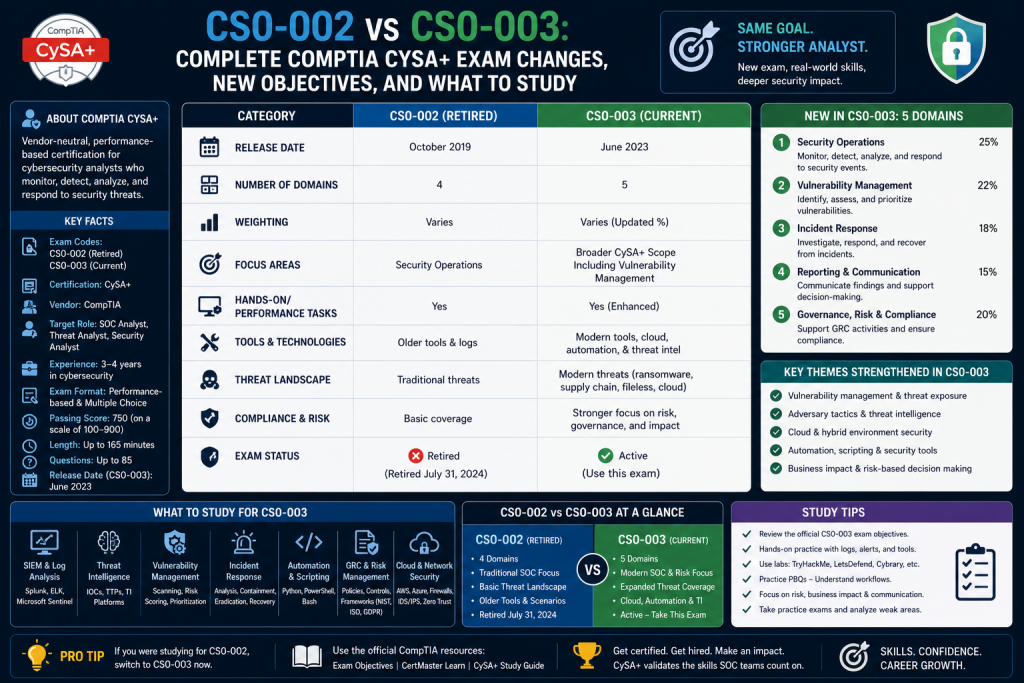
Cybersecurity continues to expand as one of the most critical professional fields in the modern digital economy. Organizations across every sector now depend on secure infrastructure, cloud services, mobile ecosystems, and real-time threat detection to protect business continuity. As cyber threats become more advanced, cybersecurity certifications must evolve to ensure professionals are prepared for current operational realities rather than outdated security models.
Among mid-level cybersecurity certifications, CompTIA Cybersecurity Analyst (CySA+) has become one of the most recognized credentials for professionals seeking validation in threat detection, incident response, vulnerability management, and security operations. CySA+ occupies a strategic space between foundational certifications such as Security+ and more advanced specializations in penetration testing, cloud security, or enterprise defense architecture.
The transition from CS0-002 to CS0-003 represents more than a routine certification refresh. It reflects broader shifts in cybersecurity priorities, including automation, threat intelligence integration, cloud-first architecture, zero-trust implementation, and improved communication between technical and executive teams. For aspiring security analysts, SOC professionals, or IT specialists pivoting into cybersecurity, understanding the difference between these exam versions is essential for proper preparation and long-term career planning.
This updated exam is not simply a revised list of objectives—it is a reflection of how cybersecurity analyst roles themselves are changing in modern enterprises.
Why CySA+ Matters in Today’s Cybersecurity Job Market
The demand for cybersecurity professionals has increased dramatically over the past decade, and that growth shows little sign of slowing. Cyberattacks targeting corporations, healthcare systems, governments, educational institutions, and critical infrastructure continue to rise in sophistication. Ransomware, phishing campaigns, insider threats, supply chain compromises, and cloud misconfigurations now create a broad threat landscape that organizations must constantly monitor.
As a result, businesses need cybersecurity analysts who can do more than identify obvious risks. Modern professionals must correlate threat data, interpret alerts, automate response processes, understand attacker behavior, and communicate findings clearly to stakeholders.
CySA+ is particularly valuable because it focuses on defensive security operations rather than purely theoretical knowledge. Unlike some certifications that emphasize memorization, CySA+ validates practical analysis skills that align closely with Security Operations Center (SOC) workflows.
This makes CySA+ relevant for roles such as:
Security analyst
Threat intelligence analyst
SOC analyst
Vulnerability analyst
Incident responder
Security operations specialist
Compliance analyst
Junior security engineer
For professionals who already possess Network+ or Security+, CySA+ often serves as the next strategic step because it bridges technical fundamentals with operational cybersecurity responsibilities.
The Retirement of CS0-002 and the Arrival of CS0-003
CompTIA regularly updates certification exams to ensure they reflect modern technologies, threats, and best practices. Cybersecurity is not static; therefore, certifications cannot remain static either.
The CS0-002 version officially retired in December 2023, while CS0-003 launched in June 2023. This overlap gave learners time to transition, but professionals using older materials must now align their study efforts entirely with CS0-003 objectives.
This retirement cycle is important because many candidates mistakenly assume a new exam version means an entirely different certification. In reality, the CySA+ core mission remains the same: validating an individual’s ability to proactively defend and secure systems through analysis.
What changed is the operational context.
The newer exam acknowledges that cybersecurity analysts now operate in environments shaped by:
Cloud infrastructure
Hybrid workforces
Mobile device proliferation
Automated security orchestration
Threat intelligence feeds
Behavioral analytics
Extended detection ecosystems
Zero-trust architecture
This means CS0-003 is less about isolated security tools and more about interconnected security ecosystems.
Exam Format: What Stayed the Same
One of the reassuring aspects for candidates transitioning from CS0-002 materials is that the exam structure itself has remained largely unchanged.
Candidates still face:
Maximum of 85 questions
165-minute time limit
Multiple-choice questions
Performance-based questions
Passing score of 750 on a 100–900 scale
This continuity means that while content has evolved, test-taking strategies remain similar. Time management, scenario analysis, and practical tool familiarity continue to be crucial.
Performance-based questions remain particularly important because they test practical reasoning. Rather than simply asking for definitions, these questions may require analyzing log data, identifying indicators of compromise, prioritizing incidents, or recommending remediation strategies.
This reinforces a key truth about CySA+: it is designed for practitioners, not passive learners.
The Shift from Five Domains to Four
One of the most visible structural changes between CS0-002 and CS0-003 is the consolidation of exam objectives into four streamlined categories.
This shift reflects CompTIA’s effort to align exam objectives more directly with real-world analyst workflows.
The updated categories are:
Security operations
Vulnerability management
Incident and response management
Reporting and communication
This reorganization emphasizes operational cohesion. Instead of separating concepts too rigidly, the exam now mirrors how analysts actually work—moving between threat monitoring, vulnerability identification, response, and stakeholder communication in an integrated process.
For example, a security analyst may:
Monitor SIEM alerts
Investigate anomalies
Assess vulnerabilities
Contain threats
Document findings
Communicate risk
In practice, these are interconnected responsibilities, not isolated tasks.
By streamlining domains, CompTIA reflects the reality that cybersecurity analysts function across a continuous security lifecycle.
Security Operations Becomes More Central
Security operations now receives greater emphasis because organizations increasingly rely on active defense rather than passive security.
This includes:
Continuous monitoring
Alert triage
Behavior analysis
Endpoint visibility
Log aggregation
Threat correlation
Detection engineering
Modern analysts are expected to understand tools like:
SIEM platforms
SOAR systems
EDR solutions
XDR ecosystems
Network detection tools
CS0-003 reflects this by placing stronger focus on integrated detection and response rather than standalone technologies.
For example, under CS0-002, understanding SIEM may have centered more heavily on configuration and data review. Under CS0-003, analysts are expected to understand how SIEM interacts with automation tools, endpoint telemetry, and cloud monitoring platforms.
This is a significant shift because it emphasizes ecosystem fluency.
The Growing Importance of Automation
One of the most significant additions in CS0-003 is the stronger emphasis on automation.
Security teams face overwhelming volumes of alerts daily. Manual triage alone is no longer sustainable. Organizations now increasingly deploy SOAR technologies to automate repetitive tasks such as:
Alert enrichment
Threat feed correlation
Ticket generation
Containment workflows
User notifications
Response escalation
This does not mean analysts are being replaced—it means analysts must become automation-aware.
Professionals preparing for CS0-003 should understand:
Why automation matters
How SOAR differs from SIEM
When automation improves response speed
Risks of over-automation
False positive considerations
Playbook orchestration
Automation literacy is becoming a career differentiator because organizations want analysts who can improve operational efficiency, not just react manually.
Cloud Security’s Expanded Role
CS0-002 acknowledged cloud security, but CS0-003 significantly expands it.
This reflects a major industry transformation: organizations are rapidly migrating workloads to cloud platforms such as AWS, Azure, and Google Cloud. At the same time, remote workforces increasingly depend on SaaS tools and mobile endpoints.
As infrastructure decentralizes, security analysts must understand cloud-specific concerns, including:
Misconfigured storage
Identity and access management
Shadow IT
Container vulnerabilities
Shared responsibility models
Cloud logging
API security
Virtual machine hardening
Cloud security in CySA+ is not purely administrative. Analysts must interpret cloud risks operationally.
This means understanding how incidents may appear differently in cloud environments compared to traditional on-prem systems.
For example:
Unauthorized IAM changes
Exposed storage buckets
API abuse
Cross-region anomalies
Cloud workload compromise
The shift toward cloud reflects broader industry hiring trends, where cybersecurity professionals with cloud awareness often possess stronger marketability.
Mobile Security and Endpoint Expansion
Mobile ecosystems are another major priority in CS0-003.
The growth of BYOD policies, hybrid work, and remote access has dramatically expanded the endpoint attack surface. Security analysts can no longer focus exclusively on desktop systems or internal networks.
Modern environments require awareness of:
Mobile malware
App permission abuse
Device encryption
MDM systems
Remote wipe policies
Wireless threats
Mobile phishing
Authentication risks
This aligns with zero-trust philosophy, where every endpoint must be continuously evaluated regardless of location.
By including stronger mobile security emphasis, CySA+ now better reflects enterprise realities where smartphones and tablets may hold sensitive corporate access credentials.
Threat Intelligence: A Strategic Upgrade
Perhaps one of the most important conceptual shifts in CS0-003 is its deeper treatment of threat intelligence.
Modern cybersecurity is increasingly proactive. Rather than waiting for incidents, organizations now rely on threat intelligence to anticipate and prioritize risk.
Candidates must now understand distinctions between:
Threat intelligence
Threat hunting
Threat feeds
Indicators of compromise
Tactics, techniques, and procedures
Threat actor profiling
This means analysts are expected not only to investigate alerts but to contextualize them.
For example:
Is an IP address part of a broader campaign?
Does malware behavior align with known TTPs?
Should intelligence alter vulnerability prioritization?
Can threat feeds reduce detection gaps?
Threat intelligence maturity helps organizations move from reactive defense toward strategic resilience.
Communication Skills Become More Valuable
A major but sometimes overlooked update is the stronger emphasis on reporting and communication.
Cybersecurity analysts increasingly communicate with:
Executives
Compliance officers
Legal teams
Auditors
IT leadership
End users
This means technical expertise alone is insufficient.
Analysts must explain:
Risk levels
Incident severity
Business impact
Remediation priorities
Compliance implications
This reflects a broader trend in cybersecurity hiring where communication is often a promotion catalyst. Technical professionals who can translate security events into business language frequently advance faster into leadership roles.
CySA+ CS0-003 acknowledges that cybersecurity is not just technical defense—it is organizational risk management.
Who Should Pursue CySA+ Now
CySA+ remains ideal for professionals with intermediate experience, particularly those who already understand:
Networking fundamentals
Basic security principles
System administration
Security controls
Threat categories
Recommended candidates include:
Help desk professionals transitioning to security
Network administrators entering SOC roles
Security+ holders seeking progression
IT auditors expanding technical depth
System administrators focusing on defense
CySA+ is less suitable for complete beginners because it assumes operational familiarity.
For those with around 3–4 years of practical IT or security experience, however, it can significantly strengthen credibility and improve role mobility.
The Career Value of Transitioning to CS0-003
Because CS0-003 better reflects modern cybersecurity environments, earning this version may provide stronger alignment with current employer expectations.
This includes:
Cloud security operations
Threat intelligence awareness
Automation readiness
Incident response maturity
Cross-platform visibility
In competitive hiring environments, relevance matters.
A candidate who understands XDR, SOAR, zero trust, and cloud monitoring may appear more operationally prepared than one whose knowledge is anchored in older frameworks.
This does not invalidate CS0-002 knowledge—it expands upon it.
Preparing for the New Reality
Professionals transitioning from CS0-002 study materials should not panic. Much foundational knowledge remains useful:
Log analysis
Network traffic review
IDS/IPS
SIEM basics
Vulnerability scanning
Incident handling
The key is updating study plans to focus more heavily on:
Automation
Cloud
Mobile
Threat intelligence
Communication
This approach prevents unnecessary restart while ensuring modern readiness.
CySA+ as a Strategic Career Move
Ultimately, CySA+ remains one of the most practical mid-level cybersecurity certifications because it aligns closely with operational roles rather than purely theoretical knowledge.
CS0-003 strengthens that value by recognizing where cybersecurity is headed:
Integrated ecosystems
Automation-assisted defense
Cloud-native infrastructure
Zero-trust models
Threat-informed strategy
For professionals serious about cybersecurity advancement, adapting to these shifts is not optional—it is essential.
The move from CS0-002 to CS0-003 represents a modernization of analyst expectations. It challenges candidates not just to understand security, but to operate effectively within modern, evolving security architectures.
Deep Dive Into CS0-003: New Skills, Modern Threats, and How the Updated CySA+ Reflects Real-World Cybersecurity Operations
As cybersecurity continues evolving from perimeter defense into a dynamic, intelligence-driven discipline, certifications must do more than validate isolated technical knowledge. They must prepare professionals for the operational complexity of defending modern enterprises. This is where the CompTIA CySA+ CS0-003 exam distinguishes itself from its predecessor.
While the earlier CS0-002 version focused heavily on foundational security analytics, log interpretation, vulnerability analysis, and incident response, CS0-003 expands these concepts into a broader strategic framework. It reflects a world where cloud-first architecture, hybrid workforces, automation, endpoint sprawl, threat intelligence, and zero-trust strategies have transformed how organizations think about defense.
This evolution means that professionals preparing for CySA+ today are not simply studying for a test—they are training for a cybersecurity environment fundamentally different from the one that shaped earlier certification versions.
Understanding these deeper changes is essential for candidates who want not only to pass the exam, but also to maximize the long-term career value of certification.
From Reactive Security to Continuous Security Operations
One of the most important conceptual changes in CS0-003 is the move away from purely reactive security thinking.
Historically, many security teams operated primarily in response mode. Analysts reviewed logs after suspicious activity occurred, investigated malware after infection, or responded to incidents after compromise. While this remains part of cybersecurity operations, modern enterprises increasingly rely on continuous security operations that emphasize proactive defense, persistent monitoring, and integrated detection.
CS0-003 reflects this operational reality by placing stronger emphasis on active security functions.
Candidates are now expected to think more deeply about:
Continuous security monitoring
Security baselining
Behavior analytics
Anomaly detection
Integrated detection ecosystems
Threat prioritization
Real-time operational workflows
This reflects how security operations centers (SOCs) now function in practice. Rather than simply reviewing data, analysts are expected to understand what “normal” looks like, identify deviations rapidly, and correlate findings across multiple platforms.
For example, a suspicious login from a foreign IP address may not immediately indicate compromise. However, when combined with endpoint privilege escalation, cloud IAM changes, and unusual data transfer, it becomes a more credible incident.
This is why modern cybersecurity analysts must increasingly think in systems, not silos.
Security Information and Event Management Is No Longer Enough Alone
In CS0-002, SIEM platforms played a major role, but often as standalone tools for centralized logging and alert review. In CS0-003, SIEM remains foundational—but its role is now part of a broader ecosystem.
Modern security analysts must understand how SIEM integrates with:
SOAR
EDR
XDR
Threat intelligence platforms
Cloud-native logging systems
User behavior analytics
Vulnerability scanners
This ecosystem-based approach reflects the complexity of current cybersecurity infrastructure.
SIEM platforms collect and correlate data, but organizations increasingly require orchestration and response capabilities to handle overwhelming alert volumes. Analysts must therefore understand not just what a SIEM does, but how it functions within a larger defense architecture.
This includes:
Automated enrichment
Response playbooks
Threat feed integration
Cross-platform telemetry
Risk scoring
Incident prioritization
The ability to contextualize SIEM data within broader detection pipelines is a major career differentiator.
SOAR: The Automation Imperative
Security Orchestration, Automation, and Response (SOAR) is one of the clearest examples of CS0-003’s modernization.
The inclusion of SOAR reflects a critical reality: cybersecurity teams are often overloaded.
Analysts may face thousands of alerts daily. Without automation, critical threats can be buried under noise. SOAR addresses this challenge by automating repetitive or low-level response functions.
Examples include:
Blocking malicious IPs
Quarantining endpoints
Enriching alerts with threat intelligence
Generating tickets
Escalating severe incidents
Launching predefined workflows
CySA+ candidates are not necessarily expected to become SOAR engineers, but they must understand:
When SOAR is useful
Where automation can fail
Human oversight requirements
Risk of false positives
Benefits of standardized workflows
Operational efficiency improvements
This reflects a broader trend in cybersecurity careers: professionals who understand both technical tools and process optimization are increasingly valuable.
Endpoint Detection and Response Becomes Core Knowledge
The rise of remote work, mobile users, and decentralized systems has dramatically expanded the endpoint attack surface.
In traditional security models, network perimeters were the primary defense focus. Today, endpoints themselves often serve as frontline targets.
CS0-003 reflects this by placing greater emphasis on endpoint detection and response (EDR).
EDR focuses on:
Endpoint telemetry
Behavior analysis
Malware indicators
Lateral movement
Persistence detection
Privilege misuse
Isolation and containment
Candidates should understand how EDR differs from traditional antivirus. While antivirus often relies heavily on signature-based detection, EDR emphasizes behavior monitoring and investigative depth.
For example:
Unusual PowerShell execution
Credential dumping behavior
Registry persistence
Suspicious parent-child process relationships
This operational focus better reflects current attacker methodologies, where living-off-the-land techniques often bypass legacy defenses.
Extended Detection and Response Expands Visibility
XDR is another important modernization area.
Where EDR focuses on endpoints, XDR integrates multiple telemetry sources into unified detection strategies.
This can include:
Endpoints
Email
Cloud workloads
Networks
Identity systems
Servers
The goal is to reduce fragmented security operations.
For example, phishing email → credential theft → cloud login anomaly → endpoint compromise can be correlated into a single threat chain.
This broader perspective helps analysts prioritize incidents more effectively.
By incorporating XDR awareness, CS0-003 acknowledges that cybersecurity analysts increasingly work across interconnected digital environments rather than isolated infrastructure segments.
Zero Trust: A Strategic Security Philosophy
Zero trust has become one of the most influential modern cybersecurity principles, and CS0-003 reflects this shift.
Traditional security models often assumed trust within internal networks. Once users or devices were inside, they frequently had broad access.
Zero trust rejects this model.
Its philosophy is:
Never trust, always verify.
This means continuous validation of:
Users
Devices
Applications
Access requests
Location context
Behavior patterns
Candidates should understand zero-trust implications for:
Identity management
Least privilege
Microsegmentation
Continuous authentication
Conditional access
Device posture validation
This is especially relevant in cloud and hybrid work environments where network boundaries are blurred.
Zero trust is not merely a tool—it is an architectural mindset. Its presence in CS0-003 demonstrates how certification now reflects strategic security design, not just technical response.
Cloud Security Is No Longer Optional
Cloud transformation has reshaped enterprise IT, and cybersecurity analysts must adapt.
CS0-003 significantly strengthens cloud security coverage because organizations increasingly depend on:
IaaS
PaaS
SaaS
Multi-cloud deployments
Hybrid environments
Cloud introduces unique security concerns, including:
Misconfigured permissions
Publicly exposed storage
API vulnerabilities
Shared responsibility confusion
Identity sprawl
Shadow IT
Data residency issues
Analysts must understand cloud monitoring and incident response from both technical and operational perspectives.
For example, suspicious activity in cloud environments may involve:
Unexpected IAM policy changes
Excessive API calls
Unusual geographic login patterns
Cloud workload abuse
Token misuse
This differs from traditional network defense and requires cloud-aware thinking.
The broader message is clear: cybersecurity analysts must defend wherever workloads exist.
Mobile Security and BYOD Complexity
The inclusion of stronger mobile security focus reflects workforce transformation.
Smartphones, tablets, remote laptops, and personal devices now frequently connect to enterprise systems. This creates challenges around:
Mobile malware
Application permissions
Wireless attacks
Device theft
Unsecured networks
Data leakage
Mobile phishing
Bring Your Own Device (BYOD) policies increase convenience but also introduce control limitations.
CS0-003 acknowledges that analysts must understand:
Mobile Device Management (MDM)
Containerization
Encryption enforcement
Remote wipe
Authentication hardening
Endpoint policy
This reflects how security now extends far beyond office walls.
Threat Intelligence Becomes a Strategic Function
Perhaps one of the most substantial intellectual upgrades in CS0-003 is the enhanced focus on threat intelligence.
In earlier frameworks, threat detection often centered on event identification. Modern security operations increasingly emphasize context.
Threat intelligence answers deeper questions:
Who is behind this?
What patterns are emerging?
How does this align with known TTPs?
What threats matter most to our organization?
Candidates must distinguish between:
Threat feeds
Threat hunting
Threat intelligence platforms
Indicators of compromise
Indicators of attack
Strategic intelligence
This helps analysts prioritize rather than simply react.
For example, a vulnerability may exist—but if active exploitation by a known ransomware group is increasing, urgency changes.
This shift aligns cybersecurity with risk-informed strategy.
Threat Hunting vs Threat Intelligence
CS0-003 also places more emphasis on differentiating threat hunting from threat intelligence.
Threat intelligence provides information.
Threat hunting applies investigative action.
Threat hunting involves proactively searching environments for hidden adversaries even when alerts are absent.
This requires:
Hypothesis generation
Behavioral pattern recognition
Data correlation
Forensic reasoning
By including this distinction, CySA+ better reflects the maturity expected of intermediate professionals.
Incident Response Maturity Expands
Incident response in CS0-003 is more operationally nuanced.
Candidates should understand the full lifecycle:
Preparation
Detection
Analysis
Containment
Eradication
Recovery
Lessons learned
Beyond technical remediation, analysts must consider:
Business continuity
Legal considerations
Evidence preservation
Communication chains
Post-incident improvements
This reflects how cybersecurity incidents now affect entire organizations, not just technical teams.
Reporting and Communication as Leadership Skills
A cybersecurity analyst’s value increasingly depends on communication.
CS0-003 recognizes that technical findings must often be translated for:
Executives
Auditors
Compliance teams
Legal departments
Board leadership
This includes producing:
Incident reports
Risk summaries
Vulnerability prioritization
Compliance documentation
Executive briefings
Clear communication influences funding, policy, and strategic response.
This shift acknowledges that cybersecurity is now a business function as much as a technical one.
Performance-Based Questions Reflect Practical Demands
CySA+ continues emphasizing performance-based questions because cybersecurity proficiency requires action.
Candidates may analyze:
Logs
Network traffic
Security dashboards
Configuration issues
Threat scenarios
This reinforces real-world readiness.
Success depends not only on memorization, but on operational interpretation.
Who Benefits Most From CS0-003
The updated CySA+ is particularly valuable for:
SOC analysts
Security+ graduates
Network professionals
System administrators
Threat intelligence beginners
Blue team professionals
It is especially useful for those transitioning from general IT into security operations.
Study Strategy for the Modern Exam
To prepare effectively, candidates should combine:
Official objectives
Hands-on labs
SIEM practice
Threat intel concepts
Cloud basics
Automation awareness
Incident scenarios
Tool familiarity matters.
Candidates should ideally gain exposure to:
Wireshark
Snort
Zeek
AlienVault
Splunk
Microsoft Defender
Cloud dashboards
Practical understanding improves both exam performance and job readiness.
The Bigger Meaning of CS0-003
Ultimately, CS0-003 is not simply an updated exam—it represents cybersecurity’s broader transformation.
It reflects:
Operational integration
Automation dependence
Cloud normalization
Threat-informed defense
Cross-platform visibility
Business communication
For professionals, this means earning CySA+ today may offer stronger alignment with actual organizational needs than ever before.
The certification increasingly serves as proof that a candidate can function within modern cybersecurity ecosystems rather than simply understand security theory.
As enterprises continue evolving, analysts who embrace this operational mindset will likely be better positioned for advancement, specialization, and leadership.
Certification Strategy, Career Impact, Study Mastery, and Long-Term Professional Growth
Earning the CompTIA CySA+ CS0-003 certification is not simply about passing an exam—it is about strategically positioning yourself within one of the fastest-growing, most operationally critical sectors in technology. As cybersecurity evolves from isolated technical specialization into a business-essential discipline, certifications like CySA+ increasingly serve as both validation tools and career accelerators.
For many professionals, CySA+ represents the transition point between foundational IT knowledge and practical cybersecurity operations. It is often where generalists begin becoming specialists, where support professionals pivot into defense, and where aspiring analysts establish credibility in threat detection, incident response, and security operations.
But while understanding exam objectives is essential, a broader strategic question matters just as much:
How does CySA+ fit into a sustainable cybersecurity career?
The answer depends on understanding certification not as a standalone achievement, but as one component in a larger professional development strategy.
CySA+ as a Mid-Level Career Bridge
CySA+ occupies a unique position in the certification ecosystem because it is neither entry-level nor highly specialized. Instead, it serves as a bridge.
This bridge connects:
Foundational networking knowledge
Basic security awareness
System administration experience
Operational defense skills
Intermediate threat management
For many candidates, Security+ teaches what cybersecurity is. CySA+ teaches how cybersecurity functions in real environments.
This distinction matters because employers increasingly seek professionals who can actively contribute to security operations rather than simply understand terminology.
CySA+ validates skills related to:
Threat analysis
SIEM operations
Vulnerability management
Incident response
Security monitoring
Threat intelligence
Communication and reporting
This means professionals with CySA+ are often better positioned for operational security roles than those who only hold baseline certifications.
Career Roles That Benefit From CySA+
CS0-003’s modernization has made CySA+ especially relevant for a broad range of practical cybersecurity positions.
These include:
SOC Analyst (Tier 1 or Tier 2)
Security Operations Specialist
Cybersecurity Analyst
Incident Response Coordinator
Threat Intelligence Junior Analyst
Compliance Security Associate
Security Engineer (entry-intermediate)
Blue Team Specialist
Vulnerability Management Analyst
These roles increasingly demand hybrid capabilities—technical analysis combined with cloud awareness, automation literacy, and communication skills.
Because CS0-003 emphasizes these priorities, the certification aligns more closely with contemporary hiring demands than earlier versions.
Why Employers Respect Vendor-Neutral Certifications
CompTIA certifications remain highly respected because they are vendor-neutral.
This matters strategically.
While vendor-specific certifications may prove expertise in one ecosystem (such as Microsoft, AWS, or Cisco), vendor-neutral certifications demonstrate adaptability.
CySA+ signals that a professional understands broader cybersecurity principles applicable across:
Cloud providers
Security tools
Operating systems
Enterprise environments
Industry sectors
For employers, this flexibility can reduce onboarding risk.
For candidates, it can improve versatility.
In rapidly changing security landscapes, adaptability is often as valuable as platform specialization.
CySA+ vs Other Cybersecurity Certifications
A strategic certification path requires understanding where CySA+ fits relative to alternatives.
Compared with Security+:
CySA+ is more analytical, operational, and defense-focused.
Compared with PenTest+:
CySA+ emphasizes blue team operations rather than offensive testing.
Compared with CASP+:
CySA+ is more practical and less architecturally advanced.
Compared with vendor-specific SOC certifications:
CySA+ provides broader conceptual grounding.
This means CySA+ often functions best as a stepping stone, especially for professionals deciding whether to pursue:
Threat intelligence
Incident response
Cloud security
Security engineering
Governance
Advanced blue teaming
The Importance of Hands-On Skill Development
Passing CS0-003 without practical understanding may help earn certification, but practical experience determines long-term value.
Modern cybersecurity hiring increasingly rewards demonstrable capability.
Candidates should ideally gain familiarity with:
Log analysis
Packet capture
Threat detection
Cloud dashboards
Endpoint alerts
Vulnerability scanning
Access controls
Automation concepts
Hands-on environments may include:
Wireshark
Snort
Zeek
Splunk
Microsoft Sentinel
AlienVault
AWS CloudTrail
Azure security tools
Even home labs can significantly improve understanding.
Practical skill transforms certification from résumé value into workplace performance.
Building a Sustainable Certification Strategy
One of the biggest mistakes professionals make is chasing certifications without coherent strategy.
A sustainable path often looks like this:
Network+ or equivalent networking knowledge
Security+ for foundational security
CySA+ for operational analysis
Specialization based on goals
Advanced certifications later
This progression builds layered competency.
For example:
Security analyst → CySA+ → SIEM specialization
Cloud defender → CySA+ → AWS/Azure security
Incident responder → CySA+ → forensic specialization
This prevents “certification overload,” where professionals collect credentials without developing usable expertise.
Strategic progression matters more than volume.
Avoiding Common CySA+ Preparation Mistakes
Many candidates underestimate CySA+ because CompTIA is often associated with beginner certifications.
This can be costly.
CS0-003 requires operational maturity.
Common mistakes include:
Memorizing definitions only
Ignoring cloud security
Neglecting automation concepts
Skipping performance-based practice
Overlooking reporting objectives
Avoiding hands-on labs
Because CySA+ increasingly reflects real-world workflows, conceptual understanding alone may be insufficient.
Professionals should focus on interpretation, prioritization, and applied reasoning.
Mastering Performance-Based Questions
Performance-based questions often create the greatest anxiety.
These questions may require:
Log interpretation
Threat prioritization
Tool output analysis
Incident classification
Configuration troubleshooting
Success depends on:
Pattern recognition
Security logic
Tool familiarity
Time management
To prepare:
Practice reading SIEM-style dashboards
Analyze firewall logs
Study attack indicators
Review incident stages
Understand containment options
The goal is to think like an analyst, not merely like a test taker.
Time Management During Exam Preparation
CySA+ preparation time varies depending on experience.
Approximate timelines:
Beginner-intermediate IT professionals: 3–4 months
Security+ holders: 2–3 months
Experienced analysts: 4–8 weeks
Effective preparation often includes:
Objective review
Structured coursework
Lab repetition
Practice exams
Weakness remediation
Consistency matters more than cramming.
Short, focused daily study often outperforms inconsistent long sessions.
Cybersecurity Soft Skills and Their Rising Importance
One of CS0-003’s most forward-looking elements is its communication emphasis.
This reflects a major industry trend: technical excellence alone does not guarantee advancement.
Professionals increasingly need:
Executive communication
Incident documentation
Policy understanding
Risk translation
Cross-team collaboration
A SOC analyst who can clearly explain threat severity may advance faster than one who is technically skilled but poor at communication.
CySA+ acknowledges this reality by integrating reporting into certification objectives.
This makes it particularly valuable for professionals aiming for leadership pathways.
How CySA+ Supports Salary and Advancement
Certification alone does not guarantee salary increases, but it can improve competitiveness.
CySA+ may support:
Promotion eligibility
Role transitions
Security credibility
Interview differentiation
Operational trust
Combined with experience, it may strengthen candidacy for higher-paying roles in:
Managed security services
Enterprise SOCs
Cloud security teams
Government cybersecurity
Consulting
The stronger alignment of CS0-003 with current technologies may further enhance relevance.
Cloud and Automation as Long-Term Career Multipliers
Because CS0-003 emphasizes cloud and automation, professionals can use it as a foundation for future-proofing.
Future-focused paths may include:
Cloud Security Analyst
Detection Engineer
SOAR Specialist
Threat Hunter
Security Automation Engineer
Zero Trust Architect
This is important because cybersecurity careers increasingly reward specialization built on strong fundamentals.
CySA+ can provide those fundamentals.
The Global Relevance of CySA+
CompTIA’s international recognition adds another strategic advantage.
CySA+ may support opportunities across:
North America
Europe
Asia-Pacific
Remote global roles
Government contracting
Enterprise consulting
Because cyber defense principles are globally relevant, CySA+ often retains value across markets.
Continuous Learning Beyond Certification
Cybersecurity changes constantly.
Threats evolve. Tools change. Architectures shift.
This means CySA+ should be viewed as a milestone, not a finish line.
Professionals should continue learning in:
Threat reports
Cloud updates
Frameworks
Labs
Security communities
Vendor documentation
Sustained growth separates certification holders from true experts.
Building Professional Credibility Beyond the Exam
Long-term credibility often combines:
Certification
Experience
Labs
Projects
Communication
Adaptability
Examples include:
Home SIEM projects
Threat hunting exercises
Cloud sandbox environments
Incident simulations
Professional networking
This broader ecosystem of growth strengthens career resilience.
Mental Resilience in Cybersecurity Careers
Cybersecurity can be demanding.
Analysts often manage:
Alert fatigue
Incident pressure
Rapid change
Continuous learning
Building resilience matters.
CySA+ preparation can also help candidates develop discipline, structured reasoning, and operational confidence.
These traits benefit both exam success and long-term sustainability.
CySA+ as a Strategic Investment
From a cost-benefit perspective, CySA+ often offers strong value because it is:
Recognized
Vendor-neutral
Mid-level
Operationally relevant
Broadly applicable
For professionals transitioning into security, it can offer one of the clearest returns on investment when paired with practical development.
Conclusion
The transition from CS0-002 to CS0-003 represents more than an updated certification blueprint—it reflects the broader transformation of cybersecurity itself.
Modern cybersecurity analysts must now operate in environments shaped by:
Cloud ecosystems
Automation
Zero trust
Threat intelligence
Mobile expansion
Integrated detection
Business communication
CS0-003 captures this transformation by aligning certification objectives with the real-world expectations placed on today’s security professionals.
For aspiring analysts, CySA+ remains one of the most strategically valuable certifications available because it does more than validate technical awareness—it demonstrates operational readiness.
Professionals who approach CySA+ strategically can use it as:
A bridge from IT to cybersecurity
A pathway to security operations
A launchpad for specialization
A credibility enhancer
A career acceleration tool
However, the true power of CySA+ lies not in certification alone, but in how it is used.
Those who combine CySA+ with hands-on practice, communication skills, cloud awareness, and continuous education will likely gain the greatest long-term advantage.
In an era where organizations urgently need skilled defenders, CS0-003 offers more than a credential—it offers a framework for becoming a capable, adaptable, and future-ready cybersecurity professional.
Continue exploring the technologies and certification concepts that matter most to you.