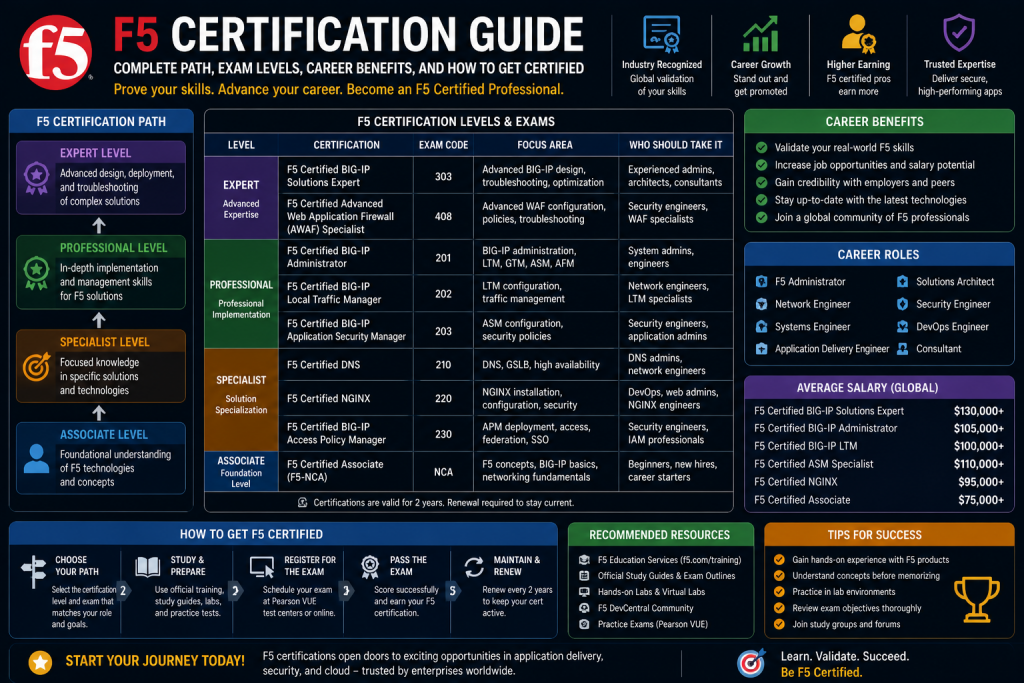
In the broader world of networking and cybersecurity, certain names dominate conversations because of their size and visibility. Yet some of the most strategically important technologies in enterprise environments belong to companies that specialize in highly specific infrastructure functions. F5 is one of those companies. While it may not always receive the same widespread recognition as larger networking brands, F5 has built a powerful reputation in application delivery, traffic optimization, load balancing, security, and identity management.
Modern organizations increasingly rely on digital services, cloud applications, distributed workforces, and always-available platforms. This evolution has elevated the role of application delivery controllers, secure access systems, DNS optimization, and web application protection. F5 technologies are frequently deployed at the center of these environments, ensuring that applications remain secure, fast, resilient, and available. Because of this, professionals who understand F5 architecture can become highly valuable in enterprise networking, cloud integration, and security-focused operations.
F5 certification serves as formal validation that an IT professional understands how to deploy, manage, secure, troubleshoot, and optimize F5 technologies. These credentials are especially relevant for professionals working in organizations that rely on BIG-IP platforms, advanced traffic management, secure remote access, or hybrid cloud application delivery.
As of 2025, F5’s certification program has undergone significant modernization. Legacy foundational exams have been retired, and the pathway now better reflects practical administrative and specialist job roles. This shift makes the certification path more aligned with real-world enterprise responsibilities rather than purely theoretical progression.
For IT professionals seeking specialization beyond general networking, F5 certifications can create opportunities in administration, security engineering, cloud architecture, and solution design. Whether someone is a network engineer looking to expand beyond routing and switching, a security engineer seeking advanced web application defense expertise, or a cloud architect integrating application delivery into hybrid systems, F5 certification can become a career accelerator.
This guide explores the structure of the F5 certification ecosystem, how it has changed, and why it matters in today’s enterprise technology landscape.
What F5 Does in Enterprise IT
To understand the value of F5 certification, it is important to first understand F5’s role in the technology stack.
F5 primarily focuses on application delivery and security. Rather than simply moving packets from one location to another, F5 solutions manage how applications are delivered to users efficiently and securely. This includes:
Load balancing across servers
Application traffic optimization
DNS and global traffic management
Identity and access control
Web application firewall functionality
Secure remote access
Cloud application integration
API protection
Distributed denial-of-service mitigation
In practical terms, F5 products often sit between users and mission-critical applications, directing traffic intelligently, protecting systems from attack, and ensuring availability during heavy usage.
For example, a multinational business may use F5 to ensure customers in Europe are directed to one data center while users in Asia are redirected to another, all while inspecting traffic for malicious activity and enforcing authentication policies.
This specialization makes F5 particularly important in:
Large enterprises
Financial institutions
Healthcare systems
Government environments
Cloud migration projects
Zero-trust security frameworks
Application modernization initiatives
As applications become more central to business strategy, F5-certified professionals become increasingly relevant.
The Evolution of the F5 Certification Program
The F5 certification path historically began with foundational exams that tested basic application delivery concepts. Earlier candidates often started with introductory certifications before progressing into TMOS administration and specialized tracks.
However, F5’s 2025 changes significantly restructured this model.
Retirement of older foundational exams means the pathway now begins more directly with role-focused administrative certification. This modernization reduces redundancy and prioritizes practical deployment knowledge over preliminary conceptual testing.
The major updates include:
Retirement of Application Delivery Fundamentals (101)
Retirement of TMOS Administration (201)
Replacement with more granular BIG-IP Administrator modules
Expanded role alignment
Greater emphasis on specialized architecture and solution outcomes
This redesign reflects a broader certification trend across IT: employers increasingly value operational competency over broad conceptual entry exams.
Instead of proving only that candidates understand application delivery theory, modern F5 certifications now focus more on whether candidates can install, configure, secure, troubleshoot, and optimize production environments.
For candidates, this means preparation is often more hands-on and lab-intensive.
Overview of the Main F5 Certification Tracks
F5’s certification ecosystem is designed around distinct professional roles rather than a single universal ladder.
The four primary tracks include:
Administration
Technical Specialization
Solution Expertise
Sales Engineering
Each serves a different audience and career objective.
The Administrative track is ideal for day-to-day operators managing BIG-IP systems.
The Technical Specialist path is designed for engineers focused on specific technologies such as LTM, DNS, ASM, or APM.
The Solution Expert track is intended for architects who design integrated enterprise or cloud solutions.
The Sales credential supports pre-sales engineers and channel professionals.
This role-specific approach helps organizations identify professionals not just by knowledge level, but by functional specialization.
The Foundational Shift: F5 Certified BIG-IP Administrator
The F5 Certified BIG-IP Administrator credential is now the primary starting point for most technical candidates.
This certification is highly significant because it establishes the operational baseline for higher-level F5 certifications.
Rather than focusing on broad networking alone, it targets the practical realities of managing BIG-IP devices in enterprise environments.
Professionals pursuing this certification are expected to understand:
Initial deployment
System upgrades
Configuration management
Traffic flow
Data plane concepts
Control plane administration
Performance monitoring
Device troubleshooting
Support workflows
This is a major distinction from many networking certifications, which often emphasize conceptual design before hands-on administration.
F5’s administrator path is deeply practical.
Candidates must demonstrate their ability to:
Install BIG-IP systems
Perform upgrades without service disruption
Manage licensing
Configure interfaces
Secure device management
Diagnose common issues
Interpret status indicators
Maintain application services
Support enterprise uptime
The certification now requires five focused exams, which collectively test different dimensions of BIG-IP administration.
This modular approach offers several advantages:
Better knowledge segmentation
More precise skill validation
Reduced over-reliance on one high-stakes exam
More realistic alignment with daily job functions
For professionals already experienced in system administration, this can feel more intuitive than broader exam models.
Who Should Pursue F5 Certification
F5 certification is not equally necessary for every IT professional. Its greatest value emerges when F5 technologies are present in a target environment.
Ideal candidates include:
Network administrators managing enterprise traffic
Application delivery engineers
Security engineers
Cloud infrastructure architects
Identity and access specialists
Systems integrators
Pre-sales engineers
Managed services professionals
Data center engineers
Professionals in organizations heavily invested in Microsoft Azure, AWS, VMware, or hybrid cloud may also find F5 certification increasingly relevant because F5 products often integrate into these ecosystems.
For example:
A Cisco-certified network engineer may use F5 to extend into application-layer traffic optimization.
A cloud architect may use F5 to secure hybrid migrations.
A cybersecurity analyst may leverage F5 ASM or APM expertise to strengthen application security.
This makes F5 particularly useful as a specialization layer rather than a replacement for broader networking knowledge.
F5 Certification vs Traditional Networking Certifications
A common question among IT professionals is whether F5 should replace broader certifications like Cisco.
In most cases, the answer is no.
F5 certifications are best viewed as complementary rather than foundational.
Traditional networking certifications often emphasize:
Routing
Switching
Network protocols
Infrastructure fundamentals
WAN/LAN architecture
By contrast, F5 focuses more heavily on:
Application delivery
Traffic management
Load balancing
Identity access
Application security
Enterprise service continuity
This means Cisco or equivalent networking knowledge often provides foundational breadth, while F5 offers strategic specialization.
An IT professional with both broad networking and F5 expertise may become significantly more marketable than one focused on only one domain.
For example:
Cisco establishes core network competency.
F5 validates advanced application-layer infrastructure capability.
Together, they can position a professional for enterprise-grade architecture roles.
Understanding BIG-IP and Why It Matters
BIG-IP is central to the F5 certification ecosystem.
BIG-IP is not a single-purpose product; it is a platform supporting multiple modules that address various enterprise requirements.
These modules include:
Local Traffic Manager (LTM)
DNS
Application Security Manager (ASM)
Access Policy Manager (APM)
BIG-IQ
Cloud integration tools
Because BIG-IP environments are modular, professionals often specialize after mastering administration.
This architecture-driven certification design mirrors how real organizations deploy F5.
For example:
A company focused on secure remote access may prioritize APM.
A multinational digital platform may prioritize DNS and LTM.
A security-first enterprise may prioritize ASM.
This specialization makes F5 credentials highly customizable to career direction.
The Cost Structure of F5 Certification
One of the practical considerations for any certification path is cost.
F5 exams are individually priced, which means total certification investment depends on the number of required exams for a credential.
Administrative certifications typically require multiple exams, while advanced specialist certifications may require one or two beyond prerequisites.
This creates a cumulative investment model.
Professionals should budget for:
Exam fees
Retake fees if necessary
Training materials
Lab practice
Practice exams
Potential employer reimbursement opportunities
While the full path can become expensive, the modular design allows candidates to progress incrementally.
This can be financially advantageous compared to all-or-nothing certification structures.
Preparing for F5 Certification Successfully
Because F5 is operationally focused, preparation should prioritize applied skill development.
Successful candidates often combine:
Blueprint review
Official study guides
Lab simulations
Virtual BIG-IP deployments
Traffic management exercises
Troubleshooting scenarios
Policy configuration
Cloud integration testing
Unlike purely theoretical exams, F5 often rewards real deployment familiarity.
Hands-on labs are especially valuable because they help candidates understand not only what a configuration is, but why it affects traffic, security, or availability.
This practical orientation can make F5 certification particularly respected among hiring managers who prioritize implementation over memorization.
The Strategic Career Value of F5
F5 certification can significantly influence career growth in specialized enterprise environments.
Potential career outcomes include:
BIG-IP Administrator
Application Delivery Engineer
Load Balancing Specialist
Security Engineer
Cloud Security Architect
Identity Access Engineer
Solutions Architect
Technical Consultant
Because F5 expertise is less common than general networking knowledge, niche specialization can sometimes increase compensation potential in F5-heavy organizations.
This scarcity can create premium opportunities, particularly in large enterprises, consulting firms, or managed service providers.
The F5 Certified BIG-IP Administrator as the Core of Technical Progression
For most technical professionals entering the F5 ecosystem, the F5 Certified BIG-IP Administrator credential serves as the true operational foundation. This certification is not simply an introductory badge—it establishes the baseline competencies required to manage enterprise-grade F5 deployments effectively.
F5’s redesign of its certification roadmap elevated this credential from a stepping stone into a comprehensive practical qualification. Instead of focusing narrowly on conceptual networking or broad application delivery theory, the BIG-IP Administrator path validates whether a professional can actively support, maintain, and troubleshoot BIG-IP systems in live enterprise environments.
This distinction matters because organizations deploying F5 technologies often use them to support business-critical applications where downtime, security failures, or traffic inefficiencies can create major operational disruption.
The administrator track therefore emphasizes real-world responsibilities such as:
Installing BIG-IP devices
Performing system initialization
Managing software upgrades
Handling licensing and activation
Monitoring hardware health
Configuring network interfaces
Understanding traffic paths
Managing data plane behavior
Administering control plane settings
Supporting application delivery continuity
Managing troubleshooting workflows
Escalating support effectively
Candidates are expected to move beyond abstract knowledge and demonstrate readiness for actual enterprise operations.
The Five-Exam BIG-IP Administrator Structure
Unlike certifications that rely on one broad exam, the BIG-IP Administrator certification now requires five separate exams, each focused on a distinct domain.
This modular structure allows for deeper topic mastery and more precise evaluation.
The five exams cover:
Installation, Initial Configuration, and Upgrade
Data Plane Concepts
Data Plane Configuration
Control Plane Administration
Support and Troubleshooting
Each area reflects a practical layer of F5 operational competency.
Installation and Initial Configuration focuses on deployment readiness. Professionals must understand system requirements, software installation procedures, upgrade methodologies, and baseline setup.
Data Plane Concepts explores how traffic flows through BIG-IP, emphasizing virtual servers, pools, nodes, persistence, and traffic processing logic.
Data Plane Configuration shifts from conceptual understanding into active implementation, requiring professionals to configure delivery behavior.
Control Plane Administration focuses on governance, system settings, authentication, user roles, and operational management.
Support and Troubleshooting validates diagnostic reasoning, incident response, and issue remediation.
Together, these exams build a profile of a professional capable of managing BIG-IP in production.
Why the Administrator Track Matters in Real Enterprise Environments
In enterprise infrastructure, many failures occur not because architecture was poorly designed, but because day-to-day administration was weak.
Examples include:
Misconfigured pools causing application downtime
Improper upgrades creating outages
Certificate expiration disrupting services
Management plane exposure increasing attack surfaces
Persistence issues affecting user sessions
Routing misconfigurations impacting delivery
F5’s administrator path addresses these operational realities directly.
This practical focus can make the certification particularly valuable for:
Network operations teams
Infrastructure administrators
Managed services engineers
Data center operators
Application support specialists
Security operations teams
Rather than emphasizing only strategic design, it ensures candidates can sustain platform reliability.
Transitioning from Administration to Technical Specialization
After mastering administration, candidates often pursue the F5 Certified Technical Specialist (F5-CTS) path.
This transition is where F5 certification becomes highly customizable.
The Technical Specialist path reflects a major reality of enterprise IT: not all F5 professionals perform the same role.
Some specialize in traffic management.
Others focus on DNS resilience.
Others work in application security.
Others concentrate on identity and secure access.
By dividing technical specialization into role-focused tracks, F5 allows professionals to align certification with career direction.
The four main F5-CTS paths are:
BIG-IP Local Traffic Manager (LTM)
BIG-IP Domain Name System (DNS)
BIG-IP Application Security Manager (ASM)
BIG-IP Access Policy Manager (APM)
Each specialization supports different organizational priorities.
The Core Engineering Path
Among all technical specialist certifications, LTM is often considered the most foundational and broadly relevant.
Local Traffic Manager sits at the center of F5’s identity because it controls how application traffic is distributed, optimized, and maintained.
LTM-certified professionals focus on:
Application architecture
Virtual server configuration
Pool design
Health monitoring
Load balancing methods
SSL offloading
Traffic persistence
Application acceleration
Performance optimization
Basic security hardening
Troubleshooting traffic behavior
Because application uptime is central to business continuity, LTM expertise often becomes essential in enterprises with customer-facing systems.
Examples include:
Banking portals
E-commerce platforms
Healthcare systems
SaaS environments
Government services
A failure in traffic management can mean lost revenue, degraded user experience, or service interruption.
The Two-Exam LTM Path
The LTM certification requires two exams:
Architect, Setup, and Deploy
Maintain and Troubleshoot
This dual-exam structure reflects two different professional competencies.
The first focuses on implementation:
Designing traffic architecture
Deploying services
Securing configurations
Creating application delivery environments
The second focuses on operational excellence:
Performance diagnosis
Issue isolation
Connectivity troubleshooting
Configuration correction
This combination ensures that certified professionals are not only capable builders but also capable sustainers.
Career Value of LTM Certification
LTM specialists are often valuable because load balancing and application delivery are essential yet often misunderstood.
Many general network engineers understand routing, but fewer possess advanced traffic distribution expertise.
This creates opportunities in roles such as:
Application Delivery Engineer
BIG-IP Specialist
Infrastructure Architect
Enterprise Traffic Engineer
Performance Optimization Engineer
Cloud Load Balancing Specialist
Because LTM knowledge applies to both on-premises and hybrid systems, it often remains relevant even as organizations modernize.
Global Resilience and Intelligent Traffic Direction
DNS is often underestimated until it fails.
The F5 DNS specialization focuses on scalable DNS and Global Server Load Balancing (GSLB), which are essential for distributed environments.
This path validates expertise in:
DNS protocol fundamentals
Wide IP configuration
Data center failover
Intelligent traffic redirection
Global availability
Latency optimization
Disaster recovery support
Configuration validation
Troubleshooting DNS-related disruptions
Organizations with multiple data centers, cloud regions, or international user bases often depend on DNS specialists to ensure resilience.
For example:
A retail company may route users to the nearest healthy region.
A cloud application may redirect around outages.
A healthcare provider may prioritize compliance-based traffic paths.
DNS specialists therefore contribute directly to uptime, resilience, and global service quality.
Why DNS Specialization Is Increasingly Strategic
As organizations embrace:
Multi-cloud deployments
Disaster recovery planning
Regional compliance
Latency-sensitive applications
Always-on services
DNS becomes more than name resolution—it becomes strategic traffic governance.
This elevates DNS specialists beyond traditional administrators.
Web Security Specialization
Application-layer attacks continue to grow in sophistication, making ASM one of F5’s most security-focused certifications.
ASM professionals specialize in protecting web applications against threats such as:
SQL injection
Cross-site scripting
Session hijacking
Bot attacks
Protocol abuse
Malicious payloads
Application vulnerability exploitation
ASM validates a candidate’s ability to:
Design secure policies
Deploy protections
Optimize security controls
Integrate security architecture
Analyze logs
Respond to threats
Tune protection without excessive false positives
This balance is critical.
Overly aggressive security controls can break applications.
Weak controls leave systems vulnerable.
ASM specialists must therefore combine security understanding with operational sensitivity.
The Security Engineering Advantage
ASM can be especially valuable for professionals transitioning from:
SOC analysis
Firewall administration
WAF engineering
Application security
Compliance operations
As application-layer security becomes increasingly important, ASM expertise can align with modern cybersecurity priorities such as zero trust, secure application modernization, and DevSecOps.
F5-CTS BIG-IP Access Policy Manager (APM): Identity, Access, and Secure Connectivity
As organizations expand remote work and zero-trust strategies, APM becomes increasingly relevant.
APM professionals focus on:
Authentication
Authorization
Accounting
Single sign-on
Federated identity
Mobile device management
Secure application access
VPN services
Identity integration
Policy enforcement
This specialization is especially important because identity has become a primary security perimeter.
Instead of securing only networks, modern organizations secure user identity, session trust, and application authorization.
APM-certified professionals may work on:
Remote workforce enablement
Zero-trust implementation
SSO architecture
Partner access
Mobile access governance
Secure authentication workflows
The Business Importance of APM
Poor access policy design can create:
Unauthorized access
User friction
Compliance failures
Security gaps
Operational disruption
APM certification validates the ability to design secure yet usable access systems.
How to Choose the Right Technical Specialist Path
Choosing an F5-CTS specialization should depend on career direction rather than exam convenience.
LTM is often best for:
General F5 engineers
Infrastructure professionals
Application delivery specialists
DNS is often best for:
Distributed infrastructure
Multi-region systems
Global enterprises
ASM is often best for:
Cybersecurity professionals
Application security engineers
WAF specialists
APM is often best for:
Identity architects
Zero-trust teams
Secure remote access professionals
Some professionals pursue multiple specializations, especially if targeting expert-level credentials.
Operational Experience vs Certification Knowledge
F5 consistently emphasizes practical experience.
This is especially important because certification alone may not prepare professionals for production complexity.
For example:
A candidate may memorize persistence types but struggle with broken user sessions.
They may understand DNS records but fail to design failover properly.
They may know WAF concepts but misconfigure policy tuning.
This is why serious candidates often benefit from:
Lab environments
Virtual editions
Scenario simulations
Cloud integrations
Multi-module experimentation
Hands-on experience transforms certification from credential to capability.
The Strategic Benefit of Layered Expertise
One of F5’s strengths is stackable specialization.
A professional can begin with administration, expand into LTM, then move into ASM or APM.
This layered progression mirrors enterprise maturity.
For example:
Administrator → Operational control
LTM → Delivery optimization
ASM → Security hardening
APM → Identity governance
This creates professionals who are not siloed but architecturally aware.
Advancing Beyond Technical Specialization into Solution Expertise
After progressing through administration and technical specialist certifications, many F5 professionals eventually reach a point where operational execution alone is no longer enough. At higher levels of enterprise IT, organizations require experts who can design integrated business solutions, align infrastructure with strategic objectives, and architect environments that combine performance, scalability, security, and cloud transformation.
This is where the F5 Certified Solution Expert (F5-CSE) track becomes particularly important.
The F5-CSE certifications represent the highest technical tier within the F5 certification framework. These credentials are not focused primarily on individual module operation, day-to-day administration, or isolated troubleshooting. Instead, they validate that a professional can assess business requirements, translate those requirements into technical architectures, and implement advanced solutions that often combine multiple F5 technologies with broader enterprise ecosystems.
This distinction is significant.
A technical specialist may know how to configure BIG-IP ASM effectively.
A solution expert understands how ASM, APM, LTM, DNS, cloud architecture, compliance requirements, and business continuity all interact to solve organizational challenges.
At this level, professionals are often expected to bridge the gap between technical implementation and strategic business outcomes.
The Strategic Purpose of the F5 Certified Solution Expert Path
Modern organizations increasingly operate in environments shaped by:
Hybrid cloud adoption
Multi-cloud complexity
Distributed workforces
Zero-trust security
Application modernization
Regulatory compliance
Scalable digital transformation
These priorities require more than product familiarity.
They demand professionals who can design solutions that align technical systems with broader business priorities such as customer experience, resilience, governance, and innovation.
The F5-CSE path is designed for these professionals.
Rather than validating only how to configure products, it validates whether candidates can answer questions like:
How should a company secure hybrid applications during cloud migration?
How should traffic be distributed across multiple regions?
How can identity and access be enforced consistently?
How should security modules interact across applications?
How can infrastructure remain resilient under scaling pressure?
How can application delivery support regulatory or operational demands?
This broader perspective transforms F5 expertise from technical specialization into enterprise leadership.
Understanding the Two F5-CSE Tracks
F5 offers two primary Solution Expert pathways:
F5 Certified Solution Expert, Cloud
F5 Certified Solution Expert, Security
These tracks reflect two major enterprise priorities.
Cloud focuses on transformation, scalability, orchestration, and infrastructure modernization.
Security focuses on protection, governance, integrated defense, and cyber resilience.
Both are architect-level pathways, but each serves different strategic business functions.
F5-CSE Cloud: Architecting Modern Enterprise Application Delivery
The F5-CSE Cloud certification is designed for professionals responsible for designing cloud-oriented solutions that incorporate F5 technologies into larger business architectures.
Cloud adoption has shifted dramatically from simple infrastructure hosting into highly strategic transformation initiatives.
Organizations now face decisions involving:
Public cloud integration
Private cloud optimization
Hybrid architectures
Migration planning
Automation frameworks
Traffic orchestration
Business continuity
Cost governance
Security alignment
F5-CSE Cloud validates expertise in designing these systems with F5 as a strategic component.
Candidates are expected to understand:
Cloud fundamentals
Business requirements assessment
Technical translation
Migration strategy
Infrastructure architecture
Deployment methodologies
Automation
Operational continuity
This makes the certification especially relevant for:
Cloud architects
Infrastructure strategists
Digital transformation consultants
Enterprise network architects
Hybrid cloud engineers
Platform modernization specialists
Why Cloud Expertise Is Increasingly Critical
Cloud is no longer optional for many enterprises.
However, migration alone is not enough.
Poorly architected cloud solutions can create:
Security blind spots
Application latency
Traffic inefficiency
Identity fragmentation
Compliance risk
Operational complexity
F5-certified cloud experts help organizations avoid these pitfalls by integrating application delivery, DNS, traffic governance, and security into migration and scaling strategies.
This role can be especially valuable when organizations need to modernize without disrupting service delivery.
F5-CSE Security: Enterprise Defense Through Integrated Architecture
If cloud represents transformation, security represents survival.
The F5-CSE Security track is built for professionals designing enterprise-wide security architectures using F5 technologies.
This path goes beyond isolated web application security or secure access policy.
It emphasizes unified security design involving:
BIG-IP LTM
Application Security Manager
Access Policy Manager
Identity controls
Threat mitigation
Integrated policy design
Operational governance
Troubleshooting across multiple modules
Security architects at this level are often tasked with designing systems that support:
Zero trust
Web application defense
Secure remote access
Identity federation
Application-layer protection
Risk reduction
Compliance strategy
Cross-platform security integration
The Business Perspective of Security Architecture
A security specialist may block attacks.
A security solution expert designs an ecosystem that prevents, detects, governs, and adapts.
This broader perspective is increasingly important because businesses face layered threats involving:
Credential abuse
API attacks
Session compromise
Cloud misconfiguration
Remote access risk
Policy inconsistency
Application exploitation
As enterprises become more interconnected, security architecture must become more cohesive.
This makes F5-CSE Security highly relevant for senior security roles.
Prerequisites and Progressive Complexity
One of the defining characteristics of the F5 certification ecosystem is progressive complexity.
To reach CSE-level certifications, candidates must first complete lower-level specialist credentials.
For example:
Cloud requires LTM and DNS.
Security requires LTM, ASM, and APM.
This structure ensures that solution experts are not purely theoretical architects.
They must first demonstrate operational and technical depth.
This layered requirement is important because architecture without implementation understanding can produce impractical solutions.
By contrast, F5’s pathway helps produce experts who understand both strategic design and deployment realities.
The F5 Certified Technical Professional, Sales
While most F5 certifications focus on technical implementation, F5 also recognizes the importance of technical sales enablement.
The F5 Certified Technical Professional, Sales certification is designed for professionals who support solution positioning, pre-sales consulting, and channel partnerships.
This role may involve:
Customer discovery
Technical education
Solution proposal
Business alignment
Sales engineering
Partner enablement
Competitive differentiation
This certification is particularly useful for:
Pre-sales engineers
Channel consultants
Technical account strategists
Solution advisors
Systems consultants
Although less implementation-heavy than technical certifications, it can be strategically powerful for professionals bridging business and technology.
Recertification and Long-Term Credential Maintenance
Certifications are only as valuable as their continued relevance.
F5 certifications are generally valid for two years, and renewal depends on maintaining the highest certification level earned.
This structure encourages continuous professional development.
Instead of retaking every prior certification, professionals typically renew by retaking the latest qualifying exam.
This offers several advantages:
Reduced redundancy
Encouragement of specialization
Ongoing knowledge relevance
Adaptation to product evolution
Because application delivery and security technologies evolve rapidly, recertification helps ensure professionals remain aligned with:
Cloud shifts
Security updates
Platform enhancements
Operational best practices
Ignoring recertification can diminish credential value, especially in enterprise environments where certification status may influence hiring or consulting eligibility.
The Financial Investment of F5 Certification
Pursuing F5 certification requires financial planning.
Costs may include:
Exam fees
Retakes
Official study materials
Third-party courses
Practice exams
Lab infrastructure
Virtual environments
Time investment
The total cost depends heavily on specialization depth.
An administrator path may require multiple exams.
A solution expert path involves prerequisites plus advanced certification.
However, this investment should be measured against career outcomes rather than isolated exam expense.
For professionals in F5-heavy organizations, certification may improve:
Promotion potential
Role specialization
Salary competitiveness
Project leadership opportunities
Consulting authority
Employer reimbursement programs may also reduce direct cost burden.
F5 Salary Potential and Career Outcomes
Specialized expertise often commands stronger compensation than generalized skill sets in niche enterprise environments.
F5-related career paths may include:
BIG-IP Administrator
Application Delivery Engineer
Load Balancing Architect
Security Solutions Engineer
Identity Architect
Cloud Solutions Architect
Pre-Sales Consultant
Enterprise Security Architect
Compensation varies significantly by geography, experience, and organizational dependency on F5 infrastructure.
In organizations where F5 is mission-critical, specialists may command higher salaries because replacing advanced expertise can be difficult.
Combining F5 with broader credentials such as:
Cisco
AWS
Azure
VMware
Security certifications
can increase strategic value even further.
F5 as a Complementary Career Strategy
One of the smartest professional approaches is not choosing F5 instead of broader IT expertise—but integrating F5 into a larger skill ecosystem.
For example:
Cisco + F5 = Advanced network and application delivery
AWS + F5 = Cloud application governance
Security + F5 ASM/APM = Application-layer defense
VMware + F5 = Data center and hybrid optimization
This blended strategy can produce more resilient career flexibility.
Rather than becoming overly niche, professionals can combine specialization with versatility.
Preparing for Long-Term Success in F5
Certification alone is not enough.
To maximize value, professionals should build practical capability through:
Home labs
Virtual editions
Cloud deployments
Traffic simulations
Policy testing
Security integrations
Architecture case studies
Troubleshooting exercises
F5 expertise is often most respected when paired with real implementation confidence.
Employers frequently distinguish between exam passers and professionals who can solve production problems.
The Future of F5 Certification
As enterprise IT evolves, F5’s relevance may continue expanding in areas such as:
API security
Zero trust
Distributed cloud
Application modernization
Identity governance
Automation
DevSecOps integration
The announced SME-level developments suggest F5 may further evolve its certification ecosystem toward thought leadership and community contribution.
This could create new opportunities for professionals seeking elite specialization.
Common Mistakes Professionals Make with F5 Certification
Several strategic mistakes can reduce certification ROI:
Pursuing F5 without organizational relevance
Ignoring foundational networking knowledge
Skipping hands-on labs
Choosing tracks based only on exam simplicity
Failing recertification
Neglecting cloud or security integration
Over-specializing without broader career strategy
The strongest certification outcomes occur when F5 aligns with broader business demand.
Building a Sustainable F5 Career Roadmap
A practical long-term strategy may look like:
Start with BIG-IP Administration to build strong operational fundamentals in deployment, system management, troubleshooting, and daily platform maintenance. This stage establishes the technical confidence needed to work effectively with enterprise-grade F5 environments.
Pursue LTM for broad technical depth, since Local Traffic Manager often serves as the backbone of application delivery, load balancing, traffic optimization, and performance management. LTM provides one of the most versatile and marketable F5 specializations.
Add DNS, ASM, or APM based on specialization goals. DNS supports global traffic governance and business continuity, ASM strengthens application-layer security and web protection, while APM aligns with identity management, zero trust, and secure remote access strategies.
Advance into CSE Cloud or Security once technical proficiency matures. At this level, the focus shifts from product administration to enterprise architecture, business alignment, and designing integrated solutions that address organizational priorities.
Maintain certification currency through recertification planning, platform updates, and evolving best practices. Keeping credentials active demonstrates long-term commitment and ensures your knowledge remains aligned with changing technologies.
Integrate broader cloud, security, and networking credentials such as AWS, Azure, cybersecurity frameworks, virtualization, or advanced networking certifications. This broadens career flexibility while making F5 expertise more strategically valuable.
Develop architecture and business communication skills so you can translate technical capabilities into business outcomes. Senior professionals are often distinguished not just by what they can configure, but by how effectively they can design, justify, and communicate strategic solutions.
Build hands-on lab environments and real-world deployment experience throughout every stage. Certification is strongest when reinforced by practical implementation, troubleshooting, and design confidence.
Follow industry trends such as zero trust, API security, hybrid cloud, and automation so your F5 expertise evolves alongside enterprise priorities rather than becoming overly product-specific.
Position yourself as both a specialist and strategist. The most successful professionals often combine technical depth with business awareness, enabling progression into consulting, architecture, leadership, or advisory roles.
This approach transforms certification from a series of exams into career architecture—creating a structured pathway from administrator to specialist to architect, while building sustainable long-term value in enterprise IT.
Conclusion: Is F5 Certification Worth It in 2025 and Beyond?
F5 certification can be exceptionally valuable—but its true worth depends on alignment.
For professionals in organizations where application delivery, security, DNS, remote access, or hybrid cloud are strategic priorities, F5 can provide a major competitive advantage.
Its value lies not in mass-market visibility, but in enterprise specialization.
F5 is not typically the first certification path for general IT beginners.
Instead, it excels as a strategic specialization for professionals seeking deeper authority in application delivery, enterprise security, cloud architecture, or integrated infrastructure.
The 2025 certification structure reflects this clearly by emphasizing practical administration, technical specialization, and business-aligned solution expertise.
For those willing to invest in hands-on skill, layered specialization, and strategic alignment, F5 certification can become more than a credential—it can become a career differentiator.
In a world increasingly dependent on secure, resilient, high-performance applications, professionals who can architect and protect those systems will remain valuable.
F5 certification helps prove that capability.
Continue exploring the technologies and certification concepts that matter most to you.