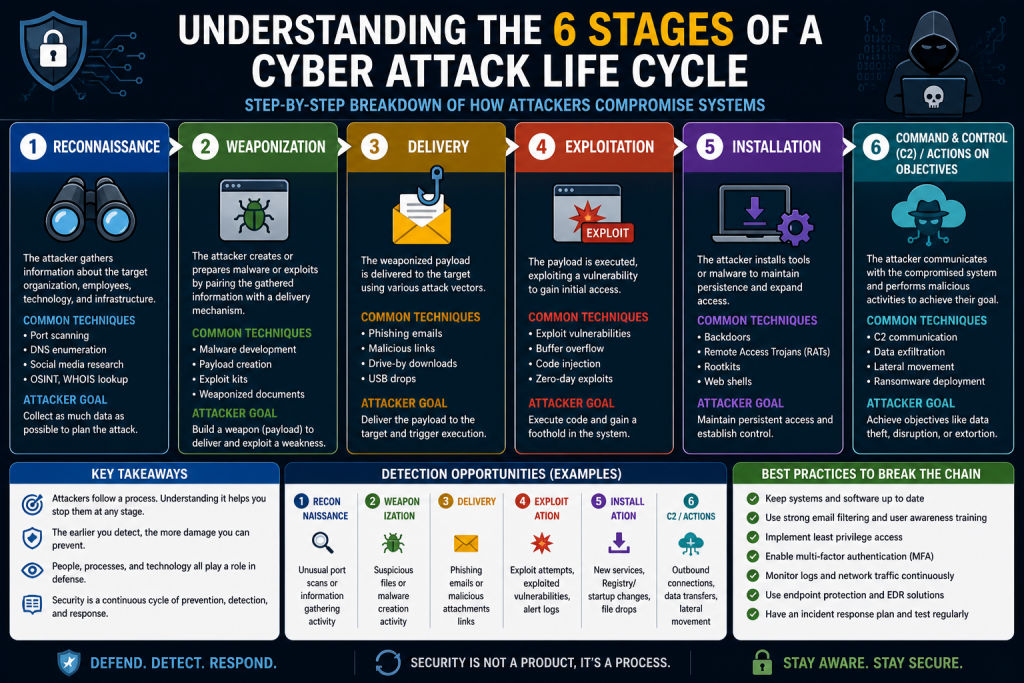
Cybersecurity has become one of the most critical concerns in today’s digital environment. As businesses, governments, and individuals increasingly rely on technology, the risk of cyber attacks continues to grow. Data breaches, ransomware incidents, and system compromises are no longer rare events—they are part of a constantly evolving threat landscape. What makes these attacks particularly dangerous is not just their impact, but the structured way in which they are carried out.
A cyber attack does not happen randomly or instantly. Instead, it follows a systematic process known as the cyber attack lifecycle. This lifecycle is a sequence of steps that attackers follow to achieve their objectives, whether that involves stealing sensitive data, disrupting operations, or gaining unauthorized access to systems. Understanding this process is essential for anyone responsible for protecting digital assets.
One of the most important aspects of the cyber attack lifecycle is that it provides defenders with multiple opportunities to stop an attack. While attackers must successfully complete every stage to achieve their goal, defenders only need to disrupt one stage to prevent the attack from succeeding. This makes knowledge of the lifecycle a powerful tool in building effective cybersecurity strategies.
In this first part, we will explore the broader concept of cyber threats and take a detailed look at the first two stages of the lifecycle: reconnaissance and weaponization and delivery. These early stages are where attacks begin, and they often determine whether an attacker will succeed or fail.
The Growing Importance of Cybersecurity
The modern world is deeply interconnected. Organizations store vast amounts of sensitive information, including personal data, financial records, intellectual property, and confidential communications. This data is highly valuable, making it a prime target for cybercriminals.
At the same time, the tools and techniques used by attackers are becoming more sophisticated. Cybercriminals are no longer limited to basic hacking attempts. They now use advanced methods such as social engineering, automated attack tools, and targeted campaigns designed to exploit specific vulnerabilities.
Another factor contributing to the rise in cyber attacks is the increasing attack surface. With the growth of cloud computing, remote work, mobile devices, and Internet of Things technologies, there are more entry points than ever before. Each connected device or system represents a potential vulnerability.
Because of this, organizations cannot rely solely on reactive measures. Waiting until an attack occurs is no longer a viable strategy. Instead, a proactive approach is required—one that focuses on prevention, detection, and continuous improvement.
Understanding the Cyber Attack Lifecycle
The cyber attack lifecycle is a model that describes how attackers plan, execute, and complete an attack. It breaks down the process into six distinct stages, each representing a step toward the attacker’s ultimate objective.
These stages are:
- Reconnaissance
- Weaponization and Delivery
- Exploitation
- Installation
- Command and Control
- Actions on Objectives
Each stage builds upon the previous one. If an attacker fails at any stage, the entire attack can collapse. This is why understanding each phase is so important. It allows organizations to identify weak points and implement controls to block attackers before they can progress further.
In this section, we will focus on the first two stages, which are critical for setting up the attack.
Stage 1: Reconnaissance
Reconnaissance is the first and one of the most important stages of the cyber attack lifecycle. In this phase, attackers gather information about their target. This information is used to identify vulnerabilities and plan the attack strategy.
The goal of reconnaissance is to understand the target as thoroughly as possible. The more information attackers have, the higher their chances of success in later stages.
During this stage, attackers may collect a wide range of data, including organizational structure, employee roles, email addresses, and details about the technologies in use. They may also look for weaknesses in public-facing systems such as websites or servers.
One of the key characteristics of reconnaissance is that it often relies on publicly available information. Attackers do not need to break into systems to gather useful data. Instead, they can find valuable insights through open sources.
For example, social media platforms can reveal employee names, job titles, and professional connections. Company websites may provide information about internal processes or technologies. Job postings can indicate which software and systems are being used within the organization.
Even small details can be useful. An attacker might use an employee’s name and position to craft a convincing phishing email. They might use information about software versions to identify known vulnerabilities.
Reconnaissance can be divided into two main types: passive and active.
Passive reconnaissance involves gathering information without directly interacting with the target system. This approach is difficult to detect because it relies on publicly available data. Examples include browsing websites, analyzing social media profiles, and reviewing public records.
Active reconnaissance, on the other hand, involves direct interaction with the target. This may include scanning networks, probing systems, or attempting to identify open ports and services. While this method can provide more detailed information, it also increases the risk of detection.
The reconnaissance stage is critical because it lays the foundation for the entire attack. If attackers fail to gather accurate or useful information, their chances of success decrease significantly. Conversely, a well-executed reconnaissance phase can make the rest of the attack much easier.
Defending against reconnaissance requires a combination of awareness and technical controls. Organizations should limit the amount of sensitive information that is publicly available. Employees should be trained to avoid sharing unnecessary details online. Systems should be monitored for unusual activity, such as repeated scanning attempts.
By reducing the amount of information available to attackers, organizations can make it more difficult for them to plan effective attacks.
Stage 2: Weaponization and Delivery
After completing reconnaissance, attackers move on to the next stage: weaponization and delivery. This is where they prepare the tools needed for the attack and attempt to deliver them to the target.
Weaponization involves creating or selecting malicious tools that can exploit identified vulnerabilities. These tools may include malware, exploit kits, or specially crafted files designed to trigger a system weakness.
Attackers often customize their tools based on the information gathered during reconnaissance. For example, if they know that a target is using outdated software, they may choose an exploit that specifically targets that version.
The delivery phase is how the attacker gets the malicious payload into the target environment. This step is crucial because it represents the first direct interaction with the target.
There are several common methods used for delivery. One of the most widespread is phishing. In a phishing attack, the attacker sends an email that appears to be legitimate. The email may contain a link or an attachment that, when clicked or opened, executes malicious code.
Another common method is the use of malicious links. These links may lead to compromised websites that automatically download malware onto the user’s device. In some cases, simply visiting the website is enough to trigger the attack.
Infected attachments are also widely used. These may be disguised as harmless files such as documents or images. When opened, they execute hidden malicious code.
Drive-by downloads are another technique, where malware is downloaded without the user’s knowledge when they visit a compromised site. This method takes advantage of vulnerabilities in browsers or plugins.
Physical delivery methods can also be used. For example, attackers may leave infected USB devices in locations where employees are likely to find them. Curious users may plug these devices into their computers, unknowingly introducing malware into the system.
One of the most significant factors in this stage is human behavior. Many attacks rely on tricking users into taking actions that compromise security. This is known as social engineering.
Social engineering techniques are designed to manipulate users into trusting the attacker. This may involve creating a sense of urgency, impersonating a trusted individual, or offering incentives. For example, an email might claim that immediate action is required to prevent account suspension, prompting the user to click a malicious link.
The effectiveness of these techniques highlights the importance of user awareness. Even the most advanced security systems can be bypassed if a user unknowingly grants access to an attacker.
Defending against weaponization and delivery requires a multi-layered approach. Security awareness training is essential to help users recognize and avoid potential threats. Email filtering systems can block suspicious messages before they reach users. Endpoint protection tools can detect and prevent malware execution.
Web filtering can restrict access to known malicious sites, reducing the risk of drive-by downloads. Multi-factor authentication adds an additional layer of security, making it more difficult for attackers to gain access even if credentials are compromised.
These defenses work together to create a strong barrier against attacks. By addressing both technical vulnerabilities and human factors, organizations can significantly reduce their risk.
The Connection Between Reconnaissance and Delivery
The first two stages of the cyber attack lifecycle are closely connected. The success of weaponization and delivery often depends on the quality of the information gathered during reconnaissance.
For example, if an attacker learns that a company frequently communicates with a particular vendor, they may impersonate that vendor in a phishing email. If they know the software used within the organization, they can tailor their malware to exploit specific vulnerabilities.
This targeted approach makes attacks more convincing and more difficult to detect. It also increases the likelihood that users will fall for social engineering tactics.
Because of this, organizations must address both stages together. Reducing information exposure can limit the effectiveness of reconnaissance, while strong defenses can prevent successful delivery.
The Value of Early Detection and Prevention
Stopping an attack in its early stages is far easier than dealing with the consequences later. Once attackers gain access to systems, they can move deeper into the network, making detection and removal more challenging.
Early detection provides several benefits. It reduces the risk of data loss, minimizes operational disruption, and lowers the overall cost of incident response. It also prevents attackers from establishing a foothold within the system.
Organizations should focus on building a proactive security posture. This includes continuous monitoring, regular security assessments, and ongoing training for employees. By staying vigilant, they can identify potential threats before they escalate.
Exploitation and Installation – Gaining Access and Establishing Persistence
In the first part, we explored how cyber attacks begin, focusing on reconnaissance and weaponization and delivery. Those early stages are critical because they allow attackers to gather intelligence and prepare their entry point. However, the real turning point in any cyber attack occurs when an attacker successfully transitions from attempting access to actually gaining it. This is where the next two stages—exploitation and installation—come into play.
These stages represent the moment when a potential threat becomes an active breach. Up until this point, attackers are still on the outside, attempting to get in. Once exploitation succeeds, they cross that boundary and begin interacting directly with systems, applications, or networks. Installation then ensures they can maintain that access over time, often without being detected.
Understanding these stages is essential because they mark the shift from prevention to containment. If an organization fails to stop an attacker here, the situation becomes significantly more complex, and the potential damage increases rapidly.
The Transition from Attempt to Breach
Before exploitation occurs, attackers are essentially probing and testing defenses. They may send phishing emails, distribute malicious files, or attempt to trick users into taking certain actions. However, none of these efforts matter unless they successfully exploit a vulnerability.
Exploitation is the moment when the attacker’s efforts pay off. It is the point at which a weakness is successfully used to gain unauthorized access. This could involve exploiting a software flaw, abusing weak credentials, or taking advantage of misconfigured systems.
Once exploitation is successful, the attacker is no longer just an external threat. They now have a foothold within the environment. This foothold may be small at first, but it provides a base from which they can expand their access.
Installation follows closely behind. Its purpose is to ensure that the attacker can maintain access even if the initial vulnerability is patched or the system is rebooted. Without installation, the attacker’s access may be temporary. With it, they can remain inside the system for extended periods.
Together, these two stages form the core of many successful cyber attacks.
Stage 3: Exploitation
Exploitation is the stage where attackers take advantage of a vulnerability to gain access to a system or network. This vulnerability can exist in software, hardware, or even human behavior.
At its core, exploitation is about using a weakness to bypass security controls. This weakness could be something as simple as a user clicking a malicious link or as complex as a flaw in an operating system.
There are many types of vulnerabilities that attackers can exploit. Software vulnerabilities are among the most common. These include bugs or flaws in applications, operating systems, or plugins that can be used to execute unauthorized code.
For example, if a system is running outdated software with known vulnerabilities, an attacker can use publicly available exploits to gain access. This is why regular updates and patch management are so important.
Another common form of exploitation involves weak or stolen credentials. If an attacker obtains a username and password—through phishing, data breaches, or guessing—they can log in as a legitimate user. In this case, the vulnerability is not in the system itself but in the way access is managed.
Misconfigurations are also a major source of vulnerabilities. Systems that are improperly configured may expose sensitive data or allow unauthorized access. For instance, a database left open to the internet without proper authentication can be easily exploited.
Human error plays a significant role in exploitation as well. Users may unknowingly install malicious software, reuse weak passwords, or fall victim to social engineering attacks. These actions create opportunities for attackers to gain access.
Once exploitation is successful, the attacker typically gains limited access. This initial access may not provide full control over the system, but it is enough to begin further actions.
Attackers often use this foothold to escalate their privileges. Privilege escalation involves gaining higher levels of access within the system. For example, an attacker who initially gains access as a regular user may attempt to obtain administrative privileges.
With elevated privileges, the attacker can perform more powerful actions, such as modifying system settings, accessing sensitive data, or disabling security controls.
Another important concept during exploitation is lateral movement. This refers to the process of moving from one system to another within a network. Once inside, attackers may explore the network to find additional targets, such as servers, databases, or other devices.
Lateral movement allows attackers to expand their reach and increase the impact of the attack. It also makes detection more difficult, as the activity may appear similar to normal user behavior.
Detecting exploitation can be challenging, especially if the attacker uses sophisticated techniques. However, there are several signs that may indicate exploitation is occurring.
Unusual system behavior, unexpected processes, and unauthorized access attempts can all be indicators. Monitoring tools and intrusion detection systems can help identify these anomalies.
Preventing exploitation requires a proactive approach. Regularly updating software, enforcing strong authentication policies, and conducting security assessments can reduce the number of vulnerabilities available to attackers.
Organizations should also implement the principle of least privilege. This means giving users only the access they need to perform their tasks. By limiting privileges, organizations can reduce the potential impact of exploitation.
Common Exploitation Techniques
Attackers use a wide range of techniques to exploit vulnerabilities. Some of the most common include exploiting unpatched software, using credential-based attacks, and leveraging misconfigurations.
Unpatched software is a frequent target because known vulnerabilities are often publicly documented. Attackers can use automated tools to scan for systems that have not been updated.
Credential-based attacks include methods such as brute force, where attackers try multiple password combinations, and credential stuffing, where stolen credentials from one system are used to access another.
Another technique involves exploiting trust relationships. For example, if one system trusts another within a network, an attacker who compromises the first system may gain access to the second.
Fileless attacks are also becoming more common. These attacks do not rely on traditional malware files but instead use existing system tools to execute malicious actions. This makes them harder to detect using standard antivirus solutions.
Each of these techniques highlights the importance of layered security. Relying on a single defense is not enough. Multiple controls must work together to protect against different types of exploitation.
Stage 4: Installation
After successfully exploiting a vulnerability, attackers move to the installation stage. The goal of this stage is to establish a persistent presence within the system.
Persistence means that the attacker can maintain access even if the system is restarted or the initial vulnerability is fixed. Without persistence, the attacker risks losing access and having to start over.
Installation typically involves deploying malware or creating mechanisms that allow the attacker to reconnect to the system at any time.
There are many ways attackers can achieve persistence. One common method is installing backdoors. A backdoor is a hidden entry point that allows attackers to bypass normal authentication processes.
Another method involves modifying system settings. For example, attackers may create new user accounts with administrative privileges or alter startup processes so that malicious code runs automatically when the system boots.
Attackers may also install remote access tools that allow them to control the system from a distance. These tools can provide full access, enabling attackers to execute commands, transfer files, and monitor activity.
In some cases, attackers use rootkits. These are advanced types of malware designed to hide their presence and evade detection. Rootkits can modify the operating system itself, making them extremely difficult to detect and remove.
Installation is not always immediate. Attackers may take time to carefully plan how they will establish persistence without being noticed. This often involves studying the system and identifying the best methods for remaining hidden.
One of the key challenges during this stage is stealth. Attackers want to avoid detection for as long as possible. The longer they remain undetected, the more damage they can potentially cause.
This is why many installation techniques focus on blending in with normal system activity. For example, malicious processes may be disguised as legitimate ones, or scheduled tasks may appear routine.
Why Installation Is Critical
Installation transforms a temporary breach into a long-term compromise. Once persistence is established, attackers can operate within the system over extended periods.
This allows them to gather information, move laterally, and prepare for the final stages of the attack. It also makes removal more difficult, as simply fixing the initial vulnerability may not be enough.
For organizations, this stage represents a significant escalation in risk. The attacker is no longer just testing defenses—they are actively embedded within the environment.
Detecting and Preventing Installation
Detecting installation can be difficult because attackers often use techniques designed to avoid detection. However, there are several strategies that can help.
Monitoring system changes is one of the most effective methods. Unexpected modifications to files, settings, or user accounts can indicate malicious activity.
Endpoint detection and response tools can provide visibility into system behavior, helping to identify suspicious actions. Regular system scans can also help detect malware.
Preventing installation requires strong security controls. Application whitelisting can ensure that only approved software is allowed to run. This can prevent unauthorized programs from being installed.
Access controls should be carefully managed to prevent unauthorized changes. Only trusted users should have administrative privileges, and their activities should be monitored.
Regular backups are also important. In the event of a compromise, backups can help restore systems to a clean state.
Another key defense is network segmentation. By dividing the network into smaller sections, organizations can limit the spread of an attack. Even if one system is compromised, the attacker may not be able to access others.
The Relationship Between Exploitation and Installation
Exploitation and installation are closely linked stages. Exploitation provides the initial access, while installation ensures that access is maintained.
Without exploitation, installation cannot occur. Without installation, exploitation may only result in temporary access.
Together, these stages enable attackers to move deeper into the system and prepare for further actions. They also represent a critical point where detection and response efforts must be highly effective.
The Importance of Rapid Response
Time is a crucial factor during these stages. The faster an organization can detect and respond to exploitation and installation, the better its chances of minimizing damage.
Delays in detection can allow attackers to establish persistence, escalate privileges, and expand their reach. This can turn a minor incident into a major breach.
Incident response plans should be in place to ensure that teams can act quickly. These plans should include procedures for identifying, containing, and removing threats.
Regular testing of these plans is also important. Simulated attacks can help identify weaknesses and improve response capabilities.
Building Resilience Against Mid-Stage Attacks
To defend against exploitation and installation, organizations must adopt a comprehensive approach to security. This includes technical controls, user education, and continuous monitoring.
Security should not be treated as a one-time effort. It requires ongoing attention and adaptation to new threats.
Organizations should regularly review their systems for vulnerabilities, update their defenses, and train their employees. By staying proactive, they can reduce the likelihood of successful attacks.
Command and Control, Actions on Objectives, and Final Insights
In the previous parts, we examined how cyber attacks begin and how attackers gain access to systems through reconnaissance, weaponization, delivery, exploitation, and installation. By the end of those stages, attackers are no longer outsiders—they have successfully infiltrated the target environment and established a presence within it.
However, gaining access is not the ultimate goal. It is only the beginning of the final and most impactful phases of a cyber attack. Once attackers have established persistence, they shift their focus toward controlling compromised systems and achieving their intended objectives. These final stages—command and control and actions on objectives—are where the true consequences of a cyber attack unfold.
Understanding these stages is critical because they represent the point at which attackers can cause the most damage. Whether the goal is data theft, financial gain, espionage, or disruption, these stages determine the outcome of the attack.
The Shift from Access to Control
After successfully installing malicious tools or backdoors, attackers begin to solidify their control over the compromised environment. At this point, they are no longer simply exploiting vulnerabilities—they are actively managing systems, issuing commands, and coordinating activities.
This shift is important because it marks the transition from infiltration to operation. The attacker now has the ability to execute strategies, gather intelligence, and manipulate systems in real time.
Unlike earlier stages, which may rely heavily on automation or opportunistic tactics, the later stages often involve more deliberate and strategic actions. Attackers may spend time studying the environment, identifying valuable assets, and planning their next steps carefully.
This phase can last for days, weeks, or even months, depending on the sophistication of the attack and the level of detection within the organization.
Stage 5: Command and Control
Command and control, often abbreviated as C2, is the stage where attackers establish communication between the compromised system and their own infrastructure. This communication allows them to send instructions, receive data, and manage the attack remotely.
At its core, command and control is about maintaining a reliable connection. Without it, attackers would not be able to control infected systems or coordinate their activities effectively.
This connection is typically established through specialized servers or services controlled by the attacker. These servers act as a central hub, enabling the attacker to communicate with one or more compromised systems.
The communication between the attacker and the compromised system is often designed to be stealthy. Attackers may use encryption, disguise traffic as normal network activity, or route communication through multiple intermediaries to avoid detection.
For example, command and control traffic may mimic legitimate web traffic, making it difficult for security systems to distinguish between normal and malicious activity. This allows attackers to operate without raising immediate suspicion.
One of the key features of command and control is flexibility. Attackers can issue a wide range of commands depending on their objectives. These commands may include collecting data, executing programs, modifying system settings, or moving to other parts of the network.
In many cases, attackers use automated tools to manage command and control operations. These tools can coordinate activities across multiple compromised systems, creating what is known as a botnet.
A botnet is a network of infected devices that can be controlled remotely. These devices can be used to perform large-scale attacks, such as distributed denial-of-service attacks, or to carry out coordinated data theft.
Another important aspect of command and control is persistence. Attackers often implement multiple communication channels to ensure they do not lose access if one channel is disrupted. This redundancy makes it more difficult for defenders to fully remove the threat.
Detecting command and control activity can be challenging because it is designed to blend in with normal network traffic. However, there are certain indicators that may suggest its presence.
Unusual outbound connections, especially to unknown or suspicious destinations, can be a sign of command and control activity. Similarly, consistent communication patterns that do not match typical user behavior may indicate an ongoing connection.
Monitoring network traffic and analyzing patterns can help identify these anomalies. Advanced security tools can detect unusual behavior and flag potential threats for further investigation.
Preventing command and control requires a combination of network security measures and continuous monitoring. Firewalls can block unauthorized connections, while intrusion detection systems can identify suspicious activity.
Network segmentation can also play a critical role. By dividing the network into smaller sections, organizations can limit the ability of attackers to communicate freely and move between systems.
Another effective strategy is restricting outbound traffic. By controlling which systems can communicate with external networks, organizations can reduce the risk of command and control connections being established.
Stage 6: Actions on Objectives
The final stage of the cyber attack lifecycle is where attackers achieve their goals. This stage is often referred to as actions on objectives, and it represents the culmination of all previous efforts.
The specific actions taken during this stage depend on the attacker’s intent. Different attackers have different motivations, and these motivations shape the outcome of the attack.
One of the most common objectives is data theft. Attackers may target sensitive information such as personal data, financial records, intellectual property, or confidential communications. This data can be used for financial gain, sold on illicit markets, or used for espionage.
Another common objective is financial extortion. In ransomware attacks, attackers encrypt the victim’s data and demand payment in exchange for restoring access. This type of attack can cause significant disruption and financial loss.
Some attackers aim to disrupt operations. This may involve shutting down systems, deleting data, or launching denial-of-service attacks. Such actions can damage an organization’s reputation and impact its ability to operate.
In certain cases, attackers may seek to manipulate or alter data. This can be particularly dangerous in industries where data integrity is critical, such as finance or healthcare.
Defacement is another form of action, where attackers modify websites or public-facing systems to display messages or propaganda. While this may not always result in data loss, it can harm an organization’s image.
Espionage is a more subtle objective. In these cases, attackers aim to remain undetected while collecting information over an extended period. This type of attack is often associated with advanced persistent threats.
Regardless of the objective, this stage often involves extracting data from the compromised system. Attackers may compress and encrypt the data before transferring it to their own servers.
To avoid detection, data exfiltration may occur slowly over time. Small amounts of data may be transferred periodically, making it less noticeable.
Another tactic involves disguising exfiltration as normal network activity. For example, data may be hidden within legitimate-looking traffic, such as web requests.
Detecting actions on objectives requires careful monitoring of system activity and data flows. Unusual data transfers, especially those involving sensitive information, should be investigated.
Access controls can help limit the amount of data that attackers can reach. By restricting access to sensitive information, organizations can reduce the potential impact of a breach.
Encryption is another important defense. Even if data is stolen, encryption can make it difficult for attackers to use it.
Regular backups are essential for mitigating the impact of attacks such as ransomware. By maintaining secure backups, organizations can restore their systems without paying a ransom.
The Importance of Visibility and Monitoring
In the final stages of the cyber attack lifecycle, visibility becomes one of the most important factors in defense. Organizations must have a clear understanding of what is happening within their networks.
Without visibility, attackers can operate undetected, carrying out their objectives without interference. With proper monitoring, suspicious activity can be identified and addressed before significant damage occurs.
Security information and event management systems can collect and analyze data from multiple sources, providing a comprehensive view of system activity. This helps identify patterns and detect anomalies.
Behavioral analysis is another powerful tool. By understanding normal behavior, organizations can identify deviations that may indicate malicious activity.
Continuous monitoring ensures that threats are detected in real time, allowing for faster response and mitigation.
Breaking the Final Stages of the Lifecycle
Even in the later stages of an attack, it is still possible to disrupt the attacker’s progress. Blocking command and control connections can prevent attackers from issuing commands or receiving data.
Isolating compromised systems can limit the spread of the attack and prevent further damage. Incident response teams can then work to remove the threat and restore normal operations.
Data loss prevention tools can help detect and block unauthorized data transfers. These tools can identify sensitive information and prevent it from leaving the network.
By focusing on these controls, organizations can reduce the impact of attacks even if earlier stages were not successfully stopped.
Building Long-Term Cyber Resilience
Cybersecurity is not just about stopping individual attacks. It is about building resilience—the ability to withstand and recover from incidents.
Resilience requires a comprehensive approach that includes prevention, detection, response, and recovery. Each stage of the cyber attack lifecycle provides an opportunity to strengthen defenses.
Organizations should invest in training, technology, and processes that support this goal. Employees should be aware of potential threats and know how to respond. Systems should be regularly updated and monitored. Incident response plans should be tested and refined.
By taking a proactive approach, organizations can reduce their risk and improve their ability to handle attacks.
Conclusion
The cyber attack lifecycle provides a structured framework for understanding how cyber attacks unfold. From initial reconnaissance to final actions on objectives, each stage plays a critical role in the success of an attack.
In the earlier stages, attackers gather information and prepare their tools. In the middle stages, they exploit vulnerabilities and establish persistence. In the final stages, they take control and achieve their objectives.
For defenders, this lifecycle offers valuable insight. It highlights the points where attacks can be detected and stopped. It also emphasizes the importance of a layered security approach, where multiple defenses work together to protect systems.
No organization can eliminate all risks, but by understanding the lifecycle, they can significantly reduce their exposure. Prevention, monitoring, and rapid response are key to minimizing the impact of cyber attacks.
Ultimately, cybersecurity is an ongoing effort. As attackers continue to evolve, so must defenses. By staying informed and proactive, organizations can build stronger, more resilient systems capable of withstanding the challenges of an increasingly digital world.
Continue exploring the technologies and certification concepts that matter most to you.