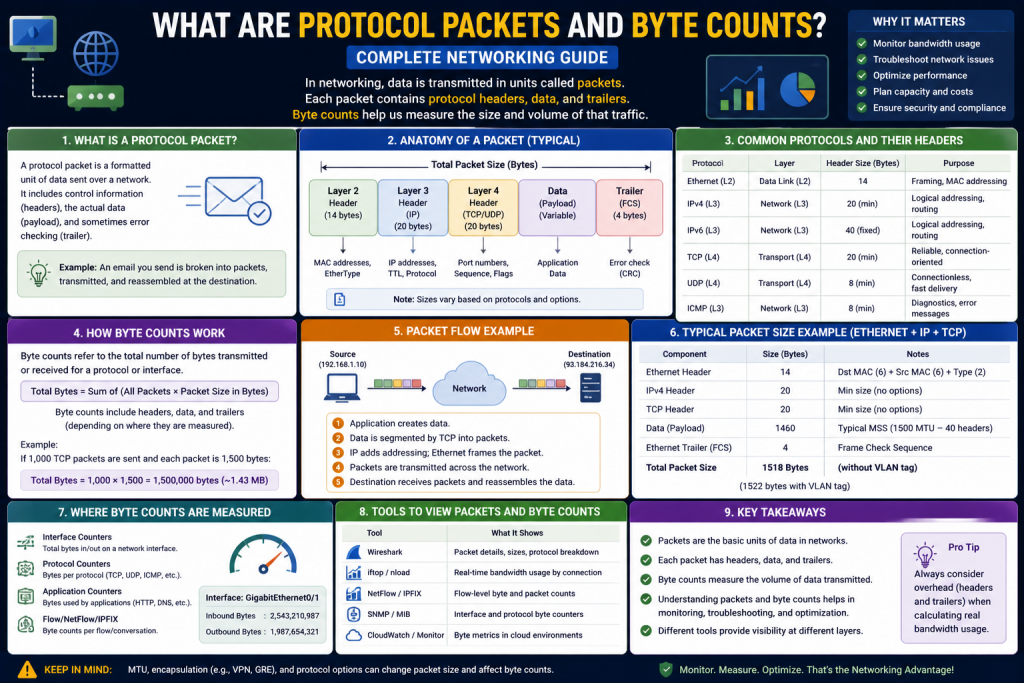
In modern computer networks, data does not travel as one large continuous stream. Instead, it is broken down into smaller, structured units that move independently across the network and are reassembled at the destination. These units are called protocol packets. They form the foundation of digital communication between computers, servers, mobile devices, and network infrastructure.
Along with packets, another important measurement used in networking is byte count. While packet counts show how many units of data are transmitted, byte counts show how much actual data is being transferred. Together, these two metrics help network engineers understand performance, diagnose problems, and optimize traffic flow.
To understand these concepts in a simple way, imagine sending a large book to a friend. Instead of sending the entire book as one heavy package, you divide it into many small envelopes. Each envelope travels separately and may take different routes. When all envelopes arrive, your friend puts them back in the correct order to rebuild the full book. This is exactly how data moves across a network using packets.
This method is necessary because modern networks handle huge amounts of information every second. Without breaking data into smaller parts, communication would be slow, unreliable, and inefficient.
What Are Protocol Packets
A protocol packet is a structured unit of data that is transmitted across a network using a defined set of rules called a protocol. These rules determine how data is formatted, addressed, transmitted, routed, and received. Without protocols, devices would not be able to understand each other.
When you send a message, open a website, stream a video, or download a file, your device does not send the entire content in one piece. Instead, it divides the information into multiple packets. Each packet travels independently through the network and may take different paths depending on traffic conditions and routing decisions.
This method improves efficiency by allowing networks to balance load across multiple routes rather than relying on a single path. It also increases reliability because if one route is slow or temporarily unavailable, packets can still reach their destination through alternative paths. As a result, communication remains smooth and continuous even under heavy network usage.
Once these packets reach their destination, they are reassembled into the original message or file. This process happens extremely quickly, often in milliseconds, which is why users do not notice it happening in the background.
Packets are essential because they allow networks to handle congestion efficiently. If one path in the network is busy, packets can be sent through alternate routes. This flexibility makes modern networks resilient and scalable.
Structure of a Network Packet
Every packet is made up of three main parts. These parts work together to ensure data is transmitted correctly and can be reconstructed at the destination.
Header Section
The header is the first part of a packet. It contains important control information that guides the packet through the network. This includes source address, destination address, sequencing information, and protocol type.
The source address tells the packet where it originated from, while the destination address tells it where to go. Sequencing information is extremely important because packets may arrive out of order. The receiving system uses this information to reconstruct the original message correctly. This process ensures that even when packets travel through different routes across a network, the final data remains accurate and consistent. Without sequencing, the original message would appear fragmented or jumbled, making communication unreliable.
In addition to basic routing, the source and destination addresses also play an important role in network management and security. Routers use these addresses to forward packets efficiently toward their destination by selecting the best available path. This decision-making process happens at every hop in the network, ensuring that data moves closer to its endpoint step by step.
Sequencing also supports error handling and retransmission mechanisms. If a packet is lost or delayed, the system can identify exactly which part of the data is missing and request only that specific packet again instead of resending the entire message. This improves efficiency and reduces unnecessary network load.
Furthermore, sequencing allows streaming and real-time applications to function smoothly. Even if packets arrive slightly delayed or out of order, buffering systems use sequence numbers to restore the correct order before presenting the data to the user. This is especially important in video calls, online gaming, and media streaming where smooth and continuous data flow is required for a good user experience.
The header also includes details that help routers decide the best path for the packet. Each router reads the header and forwards the packet closer to its destination.
Without the header, packets would have no direction and would not be able to reach the correct device.
Payload Section
The payload is the core content of the packet. It contains the actual data being transmitted, such as part of a message, a segment of a file, or a portion of a video stream.
This is the most important part of the packet from a user perspective because it contains the information that is being communicated.
However, the payload is limited in size. Large files are divided into many small payloads across multiple packets. This ensures smooth transmission and avoids overwhelming the network.
In some cases, the payload may include additional padding. Padding is extra empty data added to maintain consistent packet size. It does not carry meaningful information but helps maintain structure and alignment.
Trailer Section
The trailer, also known as the footer, appears at the end of the packet. Its primary purpose is error detection.
The trailer often contains checksum values or validation data. These values are used to check whether the packet has been altered or damaged during transmission.
When the packet arrives at its destination, the system recalculates the checksum and compares it with the value in the trailer. If both values match, the packet is considered valid. If they do not match, the packet is discarded or retransmitted depending on the protocol being used.
This mechanism ensures data integrity and reliability in communication.
How Packet Transmission Works
Packet transmission is the process of sending data from one device to another through a network. This process involves several steps and happens very quickly.
First, the original data is broken into packets. Each packet is given a header, payload, and trailer. Once the packets are created, they are sent into the network.
As packets travel through the network, they pass through multiple devices such as routers and switches. Each device reads the header and decides where to send the packet next.
Packets may not follow the same path. Some may travel through faster routes, while others may take longer paths depending on network conditions.
At the destination, the receiving device collects all packets and uses sequencing information to rearrange them in the correct order. Once all packets are received, the original data is reconstructed.
If any packet is missing or damaged, the system may request it again, depending on the protocol used.
This process allows networks to operate efficiently even when conditions are not ideal.
Why Packet-Based Communication Is Important
Packet-based communication is essential for modern digital systems because it improves efficiency, reliability, and scalability.
If data were sent as a single large block, any interruption would require the entire block to be resent. This would waste bandwidth and increase delays.
By breaking data into packets, networks can handle interruptions more efficiently. Only the missing or damaged packets need to be resent, not the entire dataset.
Packet-based communication also allows multiple users to share the same network simultaneously. Since packets are small and flexible, they can be interleaved with other traffic without causing major delays.
This is why the internet can support billions of devices at the same time.
Introduction to Interface Statistics
Network devices constantly monitor data flowing through their interfaces. These measurements are called interface statistics.
Interface statistics include information such as the number of packets sent, number of packets received, total bytes transferred, error rates, and packet drops.
These statistics provide a real-time view of network activity. They help engineers understand how a network is performing and identify potential issues.
For example, if a network interface shows a sudden increase in errors, it may indicate hardware issues, cable problems, or misconfiguration.
If packet drops increase, it may indicate congestion or overload.
By analyzing interface statistics, network administrators can maintain stability and ensure smooth communication.
Role of Packet Counts in Network Monitoring
Packet counts refer to the total number of packets transmitted or received over a network interface or protocol.
Monitoring packet counts helps identify how active a network is. High packet counts usually indicate heavy communication between devices, while low counts may indicate inactivity.
However, packet counts alone do not provide complete insight. They must be analyzed along with other metrics such as byte counts and error rates.
For example, a network may have a high packet count but low byte count, which could indicate many small packets being transmitted. On the other hand, low packet count with high byte count may indicate large data transfers.
Understanding these patterns helps in diagnosing network performance and identifying unusual behavior.
Importance of Byte Counts in Networking
Byte count refers to the total amount of data transmitted or received in bytes. Unlike packet count, which only measures the number of packets, byte count measures the actual size of data being transferred.
This is important because packets can vary in size. Some packets carry large amounts of data, while others carry very small amounts.
By monitoring byte counts, network engineers can understand how much bandwidth is being used and whether the network is handling traffic efficiently.
Byte counts help in identifying issues such as bandwidth saturation, traffic spikes, and performance bottlenecks.
For example, if byte counts suddenly increase significantly, it may indicate a large file transfer or unexpected traffic surge.
Tracking byte counts over time helps establish a baseline for normal network behavior. Any deviation from this baseline can indicate potential problems.
Relationship Between Packets and Bytes
Packets and bytes are closely related but measure different aspects of network traffic.
Packets measure quantity, while bytes measure volume.
A network can have many small packets or fewer large packets, depending on the type of data being transmitted.
For example, text messages typically use small packets, while video streaming uses large amounts of data in larger packets.
By analyzing both metrics together, engineers get a complete picture of network activity.
Introduction to Packet Behavior in Real Networks
In the first part, we explored how data is broken into packets and how byte counts measure the amount of information transferred across a network. To understand these concepts more deeply, it is important to examine how packets behave in real network environments.
When data travels through a network, it does not follow a straight or predictable path. Instead, it moves through a complex system of routers, switches, and links that decide the best possible route at any given moment. This dynamic behavior ensures that communication continues even when parts of the network are busy, slow, or temporarily unavailable.
Packets are designed to be independent. Each packet carries enough information to find its destination without relying on a fixed path. This flexibility is one of the main reasons modern networks are highly scalable and reliable.
In this section, we will explore how packet transmission works in detail, how networks handle delays and loss, and how different factors influence packet flow and byte counts in real environments.
How Packets Travel Across a Network
When a device sends data, the information is first broken into smaller packets. Each packet is given a header that contains routing information and a payload that carries the actual data.
Once created, these packets enter the network and begin their journey toward the destination. However, unlike physical mail sent through a single delivery route, network packets can take multiple paths.
Routers in the network act as decision points. Each router examines the packet header and decides the next best hop based on current network conditions. This decision is influenced by factors such as congestion, link availability, and routing protocols.
Because of this dynamic routing, packets belonging to the same message may arrive out of order. Some may arrive quickly through shorter or less congested routes, while others may take longer paths.
At the destination, the receiving system uses sequence information in the packet headers to rearrange them correctly before reconstructing the original data.
This process ensures efficient use of network resources and allows the system to handle large-scale communication without overloading any single path.
Packet Switching and Its Importance
The method used to send packets across a network is known as packet switching. In packet switching, data is divided into packets that are transmitted independently and reassembled at the destination. This approach allows multiple users and applications to share the same network resources efficiently without requiring a dedicated communication path.
Each packet may take a different route depending on network conditions such as congestion, link availability, and routing decisions made by intermediate devices. This flexibility improves overall network utilization and reduces the chances of a single failure disrupting communication. Packet switching also enhances scalability, making it suitable for large and complex networks like the internet where millions of devices communicate simultaneously while maintaining efficient and reliable data delivery.
Additionally, packet switching improves fault tolerance because if one route becomes unavailable, packets can automatically be redirected through alternative paths without stopping the entire transmission. It also supports load balancing by distributing traffic across multiple routes, which prevents network overload and improves performance. Since packets are independently handled, the network can prioritize different types of traffic based on importance, such as giving preference to real-time communication over background data transfers. This makes packet switching a highly efficient and resilient method for modern digital communication systems.
This is different from older communication methods that required a dedicated connection between sender and receiver for the entire duration of communication.
Packet switching has several advantages. It allows multiple users to share the same network infrastructure, improves efficiency, and reduces the chance of network failure affecting entire communication sessions.
If one path becomes unavailable, packets can be rerouted through alternate paths without interrupting the communication process.
This flexibility is one of the key reasons the internet is able to support billions of devices simultaneously.
Packet Loss and Its Effects on Communication
Although packet-based communication is efficient, it is not perfect. One of the common issues in networking is packet loss.
Packet loss occurs when one or more packets fail to reach their destination. This can happen for several reasons, including network congestion, hardware failure, signal interference, or routing issues.
When packet loss occurs, the impact depends on the type of protocol being used.
In reliable communication systems, missing packets are detected and retransmitted. In less reliable systems, lost packets may simply be ignored, which can result in degraded performance.
For example, in video streaming, small amounts of packet loss may cause minor visual glitches, but the stream continues. In file transfers, however, packet loss can lead to incomplete or corrupted files if not handled properly.
Understanding packet loss is important because it directly affects network quality and user experience.
Packet Delay and Network Latency
Another important factor in packet behavior is delay, also known as latency.
Latency refers to the time it takes for a packet to travel from source to destination. Even though packets travel at high speeds, they may still experience delays due to routing distance, congestion, or processing time at intermediate devices. This delay can vary depending on how many network hops a packet must pass through and how busy each device is during transmission.
Latency is an important performance metric because it directly affects the responsiveness of applications, especially in real-time communication systems. Higher latency can lead to noticeable lag, slower page loading, and reduced quality in voice or video interactions, making it a key factor in overall network efficiency and user experience.
each router or switch a packet passes through introduces a small amount of delay. When combined across multiple hops, these delays can become noticeable.
High latency can affect real-time applications such as video calls, online gaming, and live streaming. Even if packets are delivered correctly, delays can disrupt smooth communication.
Network engineers often monitor latency alongside packet counts and byte counts to evaluate overall network performance.
Jitter and Packet Timing Variations
In addition to delay, networks can experience jitter. Jitter refers to variations in packet arrival times.
Even if packets are sent at regular intervals, they may arrive at irregular intervals due to differences in routing paths and congestion levels.
Jitter is particularly important in real-time communication systems. For example, in voice or video calls, consistent packet timing is necessary to maintain smooth audio and video playback.
High jitter can cause distortion, delays, or interruptions in communication.
To manage jitter, networks often use buffering techniques that temporarily store packets and release them at a steady rate.
Role of Protocols in Packet Management
Different protocols manage packets in different ways. Each protocol is designed for specific types of communication and has its own rules for reliability, speed, and error handling.
Some protocols focus on ensuring that every packet arrives correctly, while others prioritize speed over accuracy.
The behavior of packets and byte counts can vary significantly depending on the protocol being used.
For example, some protocols track every packet carefully and request retransmission if errors occur. Others simply send packets without checking whether they arrive successfully.
This difference affects how network performance is measured and analyzed.
Relationship Between Packet Flow and Byte Counts
Packet flow refers to the movement of packets through a network over time. Byte counts measure the total volume of data being transferred.
Although these two metrics are related, they provide different types of information.
A high number of packets does not always mean a large amount of data is being transferred. For example, many small packets may carry little total data.
Similarly, a small number of packets may carry large amounts of data if each packet is large.
By analyzing both packet flow and byte counts together, network engineers can better understand traffic patterns and identify anomalies.
For instance, a sudden increase in packet count with low byte count may indicate fragmented communication or inefficient data transmission.
On the other hand, a high byte count with stable packet count may indicate large file transfers or streaming activity.
Network Congestion and Its Impact on Packets
Network congestion occurs when too much data is transmitted through a network path, exceeding its capacity.
When congestion occurs, packets may experience delays, loss, or rerouting.
Routers may begin dropping packets if buffers become full. This leads to packet loss and can degrade network performance.
Congestion also increases latency and jitter, making communication less stable.
Monitoring packet counts and byte counts helps identify congestion early. Sudden spikes in either metric can indicate that a network is under stress.
Network administrators often use this information to balance traffic loads and optimize performance.
How Byte Counts Reflect Network Usage
Byte counts provide a detailed view of how much data is flowing through a network.
Unlike packet counts, which only show the number of units, byte counts show the actual size of data being transmitted.
This is important for understanding bandwidth usage.
For example, a network with high byte counts may be handling large file transfers, video streaming, or data backups.
By tracking byte counts over time, engineers can identify usage patterns and plan for future capacity needs.
Byte counts are also useful for detecting unusual activity. A sudden spike in data transfer may indicate unexpected behavior or system issues.
Traffic Analysis Using Packet and Byte Data
Network traffic analysis involves examining packet counts, byte counts, and other metrics to understand how a network is performing.
By studying traffic patterns, engineers can identify trends, detect anomalies, and troubleshoot problems.
For example, if packet counts increase but byte counts remain low, it may indicate excessive small packet transmissions.
If both packet and byte counts increase significantly, it may indicate heavy data usage or a potential attack.
Traffic analysis helps ensure that networks remain stable and efficient under different conditions.
Introduction to Advanced Network Monitoring
In earlier discussions, we explored how protocol packets are structured and how byte counts measure the total volume of data moving across a network. We also examined how packets behave during transmission and how they interact with routers, switches, and different network paths. To complete the understanding, it is important to focus on how these concepts are applied in real-world monitoring and troubleshooting environments.
Modern networks are not static systems. They are constantly changing due to user activity, application demands, and infrastructure conditions. Because of this, network engineers must continuously observe how data flows through systems. Packets and byte counts become the foundation of this observation because they reveal what is happening inside the network at a very detailed level.
Without these measurements, networks would behave like black boxes where problems appear without explanation. By analyzing packets and bytes, engineers gain visibility into performance, stability, and efficiency.
Importance of Continuous Network Monitoring
Network monitoring is the ongoing process of tracking data flow across devices and connections. It involves observing packet behavior, measuring byte usage, and identifying performance changes over time. This process helps network administrators maintain visibility into how systems are operating under normal and peak conditions. By continuously collecting and analyzing data, they can detect early signs of congestion, latency, or unusual traffic patterns.
It also supports troubleshooting by allowing engineers to trace issues back to specific devices or communication paths. Over time, network monitoring builds a performance history that helps in capacity planning, security analysis, and improving overall system reliability and efficiency. The purpose of monitoring is not only to detect problems but also to prevent them. Many network issues begin as small changes in traffic patterns. These changes might not immediately affect users, but they can grow into serious issues if ignored.
By continuously monitoring packet counts, engineers can detect unusual spikes in traffic, sudden drops in communication, or unexpected behavior from applications. Byte counts help identify whether the volume of data is increasing or decreasing abnormally.
Together, these metrics provide a real-time understanding of how the network is performing under different conditions.
Role of Interface Statistics in Network Visibility
Every network device has interfaces that connect it to other devices or networks. These interfaces constantly collect data about incoming and outgoing traffic.
Interface statistics include packet counts, byte counts, error counts, and dropped packet information. These values help engineers understand how each connection is performing.
If an interface shows high packet drops, it may indicate congestion or hardware issues. If error counts increase, it may suggest faulty cables, misconfiguration, or interference.
Byte counts help determine how much data is flowing through each interface. When combined with packet counts, they provide a complete picture of network usage.
Interface statistics act as the first layer of network visibility and are often used for quick diagnosis of performance issues.
Behavior of Network Protocols in Data Transmission
Different protocols control how packets are transmitted across networks. Each protocol defines rules for reliability, speed, and error handling.
Some protocols focus on ensuring that every packet reaches its destination correctly. Others prioritize speed and allow occasional packet loss.
This difference affects how packet counts and byte counts behave during communication.
Reliable protocols generate additional packets for acknowledgments and retransmissions. This increases packet counts but ensures data accuracy.
Fast protocols generate fewer control packets but may result in missing or out-of-order data.
Understanding protocol behavior is essential for interpreting network metrics correctly because the same traffic pattern may look different depending on the protocol used.
TCP and Reliable Communication Flow
Transmission Control Protocol is designed for reliability and accuracy. It establishes a connection before data transfer begins and ensures that all packets are delivered in order.
Each packet sent through TCP is tracked. The receiver sends acknowledgments for received packets, and missing packets are retransmitted automatically.
This process creates a stable and reliable communication channel.
However, TCP also increases overhead because of its continuous tracking and acknowledgment system. This means packet counts may be higher compared to simpler protocols.
TCP is commonly used in applications where accuracy is more important than speed, such as file transfers, web browsing, and email communication.
UDP and Fast Communication Flow
User Datagram Protocol operates in a completely different way. It does not establish a connection before sending data and does not guarantee delivery.
Packets are sent directly to the destination without waiting for confirmation.
This makes UDP extremely fast but less reliable.
Even though some packets may be lost, many applications can tolerate this loss without major issues. For example, video streaming and online gaming rely on UDP because speed is more important than perfect accuracy.
In UDP communication, packet counts may be lower in terms of control overhead, and byte counts reflect direct data transfer without additional reliability mechanisms.
ICMP and Network Diagnostics
Internet Control Message Protocol is used for diagnostic and error reporting purposes. It does not carry application data but instead sends control messages between devices.
One of the most common uses of ICMP is the ping operation, which checks whether a device is reachable across a network.
When a ping request is sent, the destination responds with a reply if it is reachable. If it is not reachable, ICMP reports the error.
ICMP is also used to indicate issues such as unreachable destinations or exceeded time limits.
Although ICMP traffic is relatively small, it plays a critical role in understanding network health and connectivity.
Tools Used for Packet and Byte Analysis
Network professionals rely on various tools to observe and analyze packets and byte counts. These tools allow them to capture live traffic, inspect packet details, and study communication patterns. They also help in breaking down complex network behavior into readable information that can be used for troubleshooting and optimization. By using these tools, engineers can identify where delays are occurring, which devices are generating unusual traffic, and how data is flowing across different network segments. This level of visibility is essential for maintaining performance, ensuring security, and diagnosing issues before they affect users or critical applications. In addition, these tools support long-term network planning by helping teams understand usage trends, peak traffic hours, and resource demands over time, which improves capacity management and system reliability.
Some tools show real-time traffic flow, while others provide historical analysis. Packet capture tools allow engineers to examine individual packets in detail, including headers and payloads.
Other monitoring tools summarize traffic into graphs and reports, showing packet counts, byte counts, and error rates over time.
By using these tools, engineers can identify performance issues, detect unusual activity, and optimize network behavior.
Deep Packet Inspection and Traffic Understanding
Deep packet inspection is a method used to examine the content of packets beyond basic header information.
It allows systems to analyze the actual data being transmitted, identify applications, and detect security threats.
This level of inspection is useful for identifying malicious activity, unauthorized data transfers, or abnormal application behavior.
Deep inspection provides much more insight than simple packet counting because it reveals what is actually inside the traffic.
It is widely used in cybersecurity systems and advanced network monitoring environments.
Byte Counts and Bandwidth Utilization
Byte counts measure the total volume of data being transmitted across a network.
This metric is directly related to bandwidth usage, which defines how much data a network can handle within a given time.
When byte counts increase significantly, it indicates higher bandwidth usage.
If byte counts consistently approach maximum capacity, the network may become congested, leading to slower performance and increased delays.
By analyzing byte usage patterns, engineers can plan capacity upgrades and optimize network performance.
Byte counts also help identify abnormal data transfers that may indicate system issues or unauthorized activity.
Relationship Between Packet Flow and Byte Volume
Packet flow and byte volume are closely related but provide different types of information. Packet flow shows how many individual data units are moving through the network. Byte volume shows how much total data is being transferred. A network with many small packets may have high packet counts but low byte counts. A network transferring large files may have lower packet counts but higher byte counts. Understanding both metrics together is necessary for accurate network analysis.
When these two measurements are analyzed side by side, they help reveal the true nature of network traffic. For example, a sudden rise in packet flow without a matching increase in byte volume may indicate inefficient communication, such as excessive small requests or fragmented transmissions. On the other hand, a sharp increase in byte volume with stable packet flow often points to large data transfers like backups, media streaming, or database replication.
Network engineers also use this relationship to detect performance issues. If packet flow is high but byte volume remains unusually low over time, it may suggest unnecessary overhead or even malicious traffic such as scanning or denial attempts. Similarly, if byte volume spikes without a proportional increase in packet flow, it can indicate heavy payload usage that may strain bandwidth.
By studying both metrics together, professionals can better understand traffic efficiency, optimize routing strategies, and ensure balanced network performance under varying loads.
Detecting Abnormal Network Behavior
One of the most important uses of packet and byte analysis is detecting abnormal behavior.
Networks typically follow predictable patterns based on usage. When these patterns change unexpectedly, it may indicate a problem.
For example, sudden increases in packet counts may indicate network attacks or misconfigured applications.
Sudden increases in byte counts may indicate large data transfers or system malfunctions.
By comparing current behavior with normal baseline patterns, engineers can quickly detect and respond to issues.
Real World Importance of Packet and Byte Monitoring
Packet and byte monitoring is essential in real-world networking environments because modern systems depend heavily on continuous communication.
Organizations rely on networks for business operations, communication, data storage, and application delivery.
Any disruption in network performance can affect productivity and services.
By monitoring packets and bytes, engineers ensure that networks remain stable, efficient, and secure.
This monitoring also supports long-term planning, performance optimization, and security management.
Conclusion
Protocol packets and byte counts form the foundation of modern network communication. Packets define how data is structured, transmitted, and delivered, while byte counts measure the total amount of data being transferred.
Together, they provide a complete understanding of network activity and performance.
Through packet analysis, engineers can study transmission behavior, detect delays, identify loss, and understand protocol operations. Through byte analysis, they can measure data usage, monitor bandwidth, and detect unusual traffic patterns.
When combined with monitoring tools and interface statistics, these metrics allow for deep visibility into network systems.
In real-world environments, packet and byte analysis is essential for maintaining performance, ensuring reliability, and supporting the growing demands of digital communication systems.
Continue exploring the technologies and certification concepts that matter most to you.