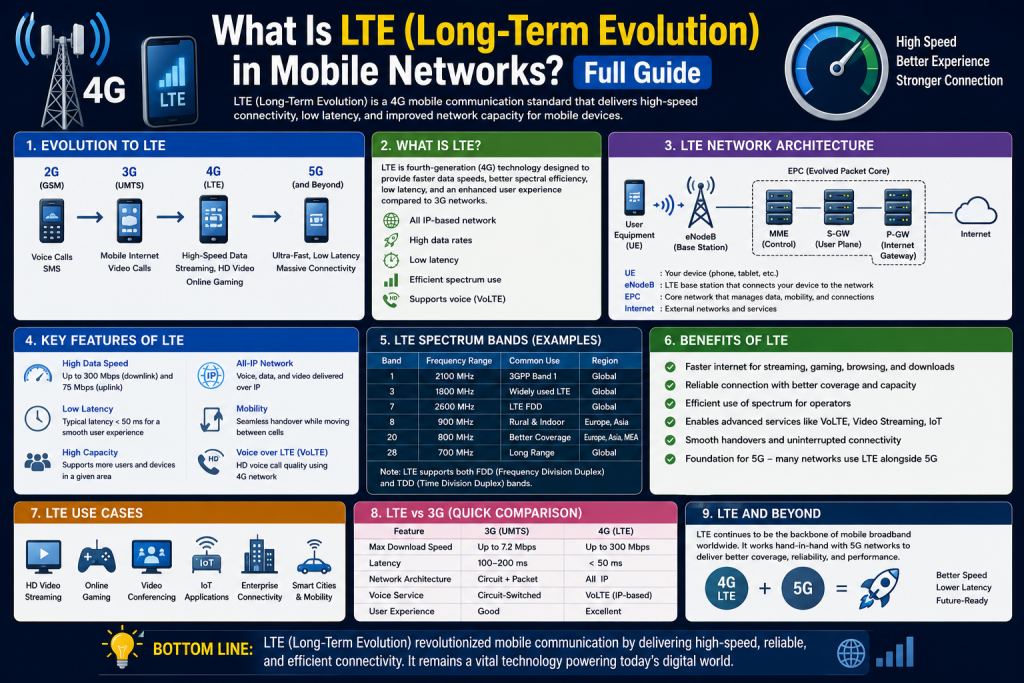
Long-Term Evolution (LTE) is one of the most important milestones in modern wireless communication. It is the technology that powers most 4G mobile networks around the world and delivers fast, reliable, and low-latency internet access on smartphones, tablets, and other connected devices. LTE has transformed how people communicate, work, and access information by enabling high-speed data transmission even in mobile environments. In today’s digital world, where cloud computing, video streaming, online gaming, and IoT devices are rapidly growing, LTE plays a critical role in supporting modern IT infrastructure. It is not just a mobile technology; it is a backbone for enterprise connectivity, remote operations, and backup internet solutions.
LTE also plays an important role in bridging the gap between traditional wired networks and modern wireless systems. It allows organizations to maintain connectivity in situations where fiber or DSL connections are unavailable or disrupted. This makes it especially valuable for disaster recovery, temporary deployments, and mobile workforces. Many businesses use LTE routers and hotspots to ensure continuous internet access for critical operations, reducing downtime and improving productivity.
Another key advantage of LTE is its global standardization, which ensures compatibility across different countries and network providers. This enables seamless international roaming and consistent user experience regardless of location. LTE networks are also designed to be scalable, allowing telecom operators to upgrade infrastructure gradually without completely replacing existing systems. This reduces costs while improving performance over time. As a result, LTE continues to serve as a reliable foundation for both current mobile communication and the transition toward next-generation technologies.
What is Long-Term Evolution (LTE)?
LTE stands for Long-Term Evolution and is a standard for wireless broadband communication. It is designed to provide significantly higher data speeds, lower latency, and improved network capacity compared to older technologies like 3G. LTE is considered part of the 4G mobile network family, although early versions were sometimes referred to as “3.9G” because they were an evolutionary step between 3G and true 4G standards. At its core, LTE is built to deliver high-speed internet access for mobile users, low delay in data transmission, improved support for large numbers of connected devices, and efficient use of radio spectrum. This makes LTE suitable for modern applications such as video calls, cloud services, online gaming, and IoT deployments.
LTE also introduces advanced radio technologies such as OFDMA for downlink communication and SC-FDMA for uplink communication. These techniques improve spectral efficiency and reduce interference, allowing more users to share the same network resources effectively. As a result, LTE networks can handle heavy data traffic while maintaining stable performance. Another important feature is its ability to support seamless mobility, meaning users can move between different cell towers without losing connectivity or experiencing call drops.
In addition, LTE supports a fully packet-switched IP-based architecture, which simplifies network design and enables faster data routing. This design also makes it easier for telecom operators to integrate LTE with modern cloud-based systems and enterprise applications. Because of these advantages, LTE has become a global standard for mobile communication and continues to serve as the foundation for advanced technologies like 5G evolution paths.
Historical Background and Evolution of LTE
LTE was developed by the 3rd Generation Partnership Project (3GPP), a global collaboration of telecommunications standards organizations. The goal of 3GPP was to create a next-generation mobile communication system that could overcome the limitations of 3G networks. The development timeline includes early concept work in 2004, first public demonstrations in 2007, and first commercial deployments in 2009. LTE was created to meet growing global demand for mobile data. As smartphones became more powerful and internet usage increased, 3G networks struggled to keep up with bandwidth requirements. LTE solved this problem by introducing a more efficient, IP-based architecture.
Key Features and Benefits of LTE
LTE brought major improvements over previous generations of mobile technology. It provides high data speeds with download speeds up to 300 Mbps and upload speeds up to 75 Mbps. It offers low latency of around 10 milliseconds, making real-time communication like video calls and online gaming much smoother. LTE uses radio spectrum more efficiently, allowing more data to be transmitted over the same frequency range and reducing congestion. It is fully IP-based, meaning voice calls are transmitted as data, networks are simpler and more scalable, and integration with internet services is seamless. LTE also supports a much larger number of users simultaneously without major performance issues, making it ideal for crowded environments.
Technical Architecture of LTE
LTE is built on a modern network architecture designed for speed, scalability, and efficiency. It consists of User Equipment (UE), which includes smartphones, tablets, modems, and IoT devices. These devices connect to the eNodeB, which is the LTE base station responsible for wireless communication, radio resource management, and signal transmission. The Evolved Packet Core (EPC) acts as the central brain of the network, handling authentication, routing data, managing mobility, and connecting to external networks.
In addition to these core components, LTE architecture is designed with a flat and simplified structure compared to older mobile networks. This flat design reduces the number of intermediate nodes between the user and the core network, which helps minimize latency and improve overall data transmission speed. The EPC itself is composed of several functional elements such as the Mobility Management Entity (MME), Serving Gateway (S-GW), and Packet Data Network Gateway (P-GW), each playing a specific role in managing connectivity, session control, and data routing.
Another important aspect of LTE architecture is its strong support for mobility management. As users move between different cell sites, the network ensures seamless handovers without interrupting active sessions such as calls or video streaming. LTE also supports Quality of Service (QoS) mechanisms that prioritize different types of traffic based on their importance, ensuring stable performance for critical applications. This architecture makes LTE highly reliable, scalable, and capable of supporting both consumer and enterprise-level communication needs efficiently.
LTE Protocol Stack
LTE uses a layered protocol structure similar to the OSI model. The physical layer handles transmission of raw radio signals. The MAC layer manages scheduling and error correction. The RLC layer ensures reliable delivery by handling segmentation and reassembly of packets. The PDCP layer provides compression and encryption for data. The RRC layer manages connection setup and maintenance between devices and the network. This layered design ensures efficient, secure, and stable communication.
Radio Access Network (RAN) in LTE
The Radio Access Network connects user devices to the core network through eNodeBs. It is responsible for managing radio connections, allocating network resources, handling handovers between towers, and maintaining service quality. The RAN ensures that users experience seamless connectivity even while moving between different coverage areas.
In addition to these core responsibilities, the RAN plays a critical role in optimizing overall network performance. It continuously monitors signal strength, user demand, and traffic conditions to dynamically allocate bandwidth where it is needed most. This intelligent resource management helps prevent network congestion and ensures fair usage among multiple users connected to the same cell tower. The RAN also uses advanced scheduling algorithms to prioritize different types of traffic, such as voice calls, video streaming, or data downloads, based on Quality of Service (QoS) requirements.
Another important function of the RAN is interference management. Since multiple eNodeBs operate within close proximity, the RAN coordinates frequency usage and power levels to minimize signal interference and maintain stable communication quality. It also supports mobility features such as fast handover procedures, allowing users in fast-moving vehicles like cars or trains to maintain uninterrupted connections.
Furthermore, modern LTE RAN architectures are evolving toward virtualization and cloud-based deployment, known as vRAN (virtualized RAN). This approach increases flexibility, reduces hardware dependency, and allows telecom operators to scale networks more efficiently. Overall, the RAN is a crucial component that directly impacts user experience, network reliability, and system performance in LTE environments.
Installing LTE Infrastructure
LTE infrastructure requires both hardware and software components. Hardware includes eNodeB base stations, antennas for signal transmission, and backhaul connections using fiber optic or microwave links. Software includes network management systems and EPC software that controls routing, authentication, and traffic management. Installation involves placing eNodeBs in optimal locations such as rooftops or towers, connecting them to the core network, configuring IP addresses and routing, installing EPC software, and testing connectivity to ensure proper performance.
Configuring an LTE Network
LTE network configuration involves setting frequency bands, adjusting power levels, and defining handover thresholds to ensure smooth connectivity. Security measures such as encryption, authentication, and access control are implemented to protect the network. Quality of Service (QoS) settings are configured to prioritize important traffic like voice and video. Proper testing is essential to verify coverage, stability, and performance under different load conditions.
Integrating LTE with Existing IT Infrastructure
LTE can be integrated with existing IT systems to improve connectivity and reliability. It is commonly used as backup internet for businesses, remote connectivity for branch offices, and communication support for IoT devices. LTE works well with IP-based systems such as VoIP, cloud computing platforms, and video conferencing tools. This integration helps organizations maintain uninterrupted operations and improve overall efficiency.
Real-World Applications of LTE
LTE is widely used across industries including business networking, healthcare for remote monitoring, transportation for fleet tracking, smart cities for connected infrastructure, and education for online learning systems. Its flexibility makes it suitable for both consumer and enterprise environments, supporting a wide range of digital services.
Advantages and Limitations of LTE
LTE offers high-speed data, low latency, wide availability, and strong support for mobile applications. However, its performance depends on network coverage and can be affected by congestion in densely populated areas. Infrastructure deployment can also be expensive compared to older technologies. Despite these limitations, LTE remains one of the most reliable and widely used wireless communication standards.
Conclusion
Long-Term Evolution (LTE) is a major advancement in wireless communication that enables high-speed, low-latency, and efficient mobile connectivity. It forms the foundation of modern 4G networks and supports a wide range of applications from mobile internet to enterprise systems and IoT devices. With its all-IP architecture, scalable design, and strong performance, LTE continues to play a vital role in global communication infrastructure. Even as newer technologies like 5G emerge, LTE remains essential for providing stable and widespread connectivity across the world.
Continue exploring the technologies and certification concepts that matter most to you.