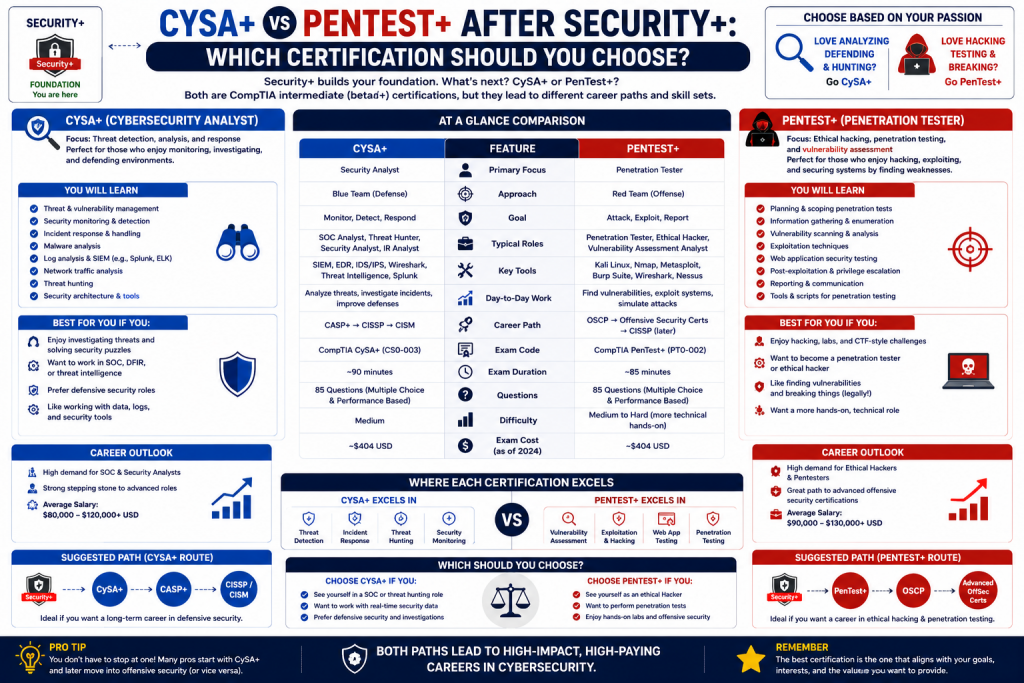
After completing Security+, many cybersecurity learners reach an important decision point: whether to move toward defensive security or offensive security. Both CySA+ and PenTest+ are strong intermediate-level certifications that build on foundational knowledge, but they lead in very different career directions. One focuses on detecting and responding to threats, while the other focuses on actively simulating attacks to find weaknesses before real attackers do. Choosing between them depends on your interests, career goals, and the type of work environment you want to grow into.
Security+ gives you a broad understanding of cybersecurity concepts, including network security, risk management, identity and access control, and basic incident response. However, it does not specialize you. That is where CySA+ and PenTest+ come in. They help you transition from general knowledge into job-ready specialization.
Understanding CySA+ and Its Focus
CySA+ is designed for professionals who want to work in defensive cybersecurity roles. It emphasizes monitoring systems, analyzing security data, and responding to threats in real time. Instead of trying to break systems, CySA+ focuses on protecting them by identifying unusual behavior and investigating security incidents.
This certification is especially useful in Security Operations Center environments, where analysts continuously monitor logs, alerts, and network traffic. The goal is to detect suspicious activity early and reduce damage before attackers can fully compromise systems.
CySA+ covers areas such as threat detection, vulnerability analysis, incident response, and security tool usage. It also introduces behavioral analytics, where analysts study patterns in data to detect anomalies. For example, repeated failed login attempts, unusual data transfers, or unexpected system changes can indicate an ongoing attack.
Another important aspect of CySA+ is understanding security architecture from a defensive point of view. This includes learning how systems are designed to resist attacks and how security controls work together to protect data. While technical knowledge is important, CySA+ also emphasizes analytical thinking and decision-making under pressure.
Professionals with CySA+ often move into roles such as security analyst, SOC analyst, threat intelligence analyst, or incident handler. These positions involve continuous monitoring and response rather than offensive testing.
CySA+ is generally considered an intermediate certification. It is more advanced than Security+ but does not require deep hacking expertise. It is a strong choice for those who enjoy investigation, problem-solving, and defensive strategy.
Understanding PenTest+ and Its Focus
PenTest+ is designed for professionals who want to specialize in offensive cybersecurity. Instead of defending systems, it focuses on testing them by simulating real-world attacks. The goal is to identify vulnerabilities before malicious hackers can exploit them.
This certification is ideal for those interested in ethical hacking, penetration testing, and security consulting. It requires a mindset that thinks like an attacker. You learn how systems can be broken, how weaknesses are discovered, and how exploitation techniques work.
PenTest+ covers a wide range of offensive techniques including vulnerability scanning, exploitation methods, password attacks, social engineering, wireless attacks, and web application testing. It also includes planning and scoping penetration tests, which is a critical part of real-world ethical hacking engagements.
A major part of PenTest+ is reporting. After identifying vulnerabilities, penetration testers must clearly document their findings and explain risks to organizations. This communication aspect is essential because technical findings must be translated into business impact.
Unlike CySA+, which focuses on ongoing monitoring, PenTest+ focuses on structured testing engagements. These are usually time-limited and follow a defined scope agreed upon with the organization.
Career paths for PenTest+ holders include penetration tester, ethical hacker, vulnerability analyst, security consultant, and offensive security specialist. These roles are more hands-on and often involve actively attempting to breach systems in controlled environments.
PenTest+ is also an intermediate-level certification, but it requires a more technical and hands-on mindset compared to CySA+. It is well suited for individuals who enjoy problem-solving through breaking systems and understanding how attacks work from the inside.
Key Differences Between CySA+ and PenTest+
Although both certifications belong to the same general level, they serve completely different purposes.
CySA+ is defensive. It focuses on monitoring systems, analyzing alerts, and responding to incidents. It is about protecting infrastructure and identifying threats as they happen.
PenTest+ is offensive. It focuses on actively finding vulnerabilities by simulating attacks. It is about thinking like a hacker to understand how systems can be compromised.
CySA+ is more aligned with Security Operations Center work, where analysts continuously monitor systems and respond to incidents. PenTest+ is more aligned with consulting and testing environments, where professionals perform structured security assessments.
CySA+ requires strong analytical skills and the ability to interpret data. PenTest+ requires stronger technical and practical skills in exploiting systems and understanding attack methods.
CySA+ is often considered more suitable for long-term defensive roles, while PenTest+ is more suitable for those interested in ethical hacking careers.
Career Direction and Job Roles
Choosing between CySA+ and PenTest+ depends heavily on the type of cybersecurity career you want to build.
If you choose CySA+, you are likely moving toward roles such as security analyst, SOC analyst, incident responder, or threat intelligence specialist. These jobs focus on defending organizations, monitoring systems, and reacting to security events.
If you choose PenTest+, you are likely moving toward roles such as penetration tester, ethical hacker, vulnerability tester, or security consultant. These jobs focus on testing security systems, finding weaknesses, and helping organizations fix vulnerabilities before attackers exploit them.
CySA+ roles are often continuous and operational, meaning you work daily on monitoring and response tasks. PenTest+ roles are often project-based, where you perform assessments over a defined period.
Both paths are valuable, but they require different personality traits and interests. Defensive roles require patience, attention to detail, and strong analytical thinking. Offensive roles require curiosity, creativity, and technical experimentation.
Difficulty and Preparation Expectations
Both certifications are challenging but manageable with proper preparation. CySA+ requires understanding security tools, log analysis, threat behavior, and incident response processes. Practical experience in security monitoring environments is very helpful but not always required. Developing familiarity with Security Information and Event Management systems, intrusion detection systems, and endpoint protection tools can significantly improve performance in this exam. Candidates are also expected to interpret security alerts and determine whether they represent real threats or false positives, which requires strong analytical thinking.
In addition, CySA+ places importance on understanding how attackers operate so that defenders can recognize suspicious patterns early. This includes studying common attack techniques, lateral movement within networks, and indicators of compromise. Hands-on practice with log analysis and simulated incident response scenarios helps build confidence and speed during the exam. Time management is also important because many questions are scenario-based and require careful reading before selecting the best response.
Consistent study habits, combined with real-world lab practice, greatly improve success rates. Even beginners in cybersecurity can pass CySA+ if they dedicate enough time to learning both theory and practical skills. Overall, it is a certification that rewards disciplined preparation and a strong focus on understanding how real security operations environments function.
PenTest+ requires knowledge of hacking techniques, vulnerability analysis, and testing methodologies. Hands-on practice is essential because theoretical knowledge alone is not enough.
CySA+ preparation often involves studying detection techniques, security frameworks, and incident response workflows. PenTest+ preparation involves practicing attacks in controlled environments and understanding how different systems can be exploited.
Neither certification is entry-level. Security+ is usually recommended before attempting either of them.
Which Certification Should You Choose First
If you enjoy analysis, monitoring systems, and defending against attacks, CySA+ is the better choice. It builds strong defensive skills and prepares you for SOC and analyst roles.
If you enjoy ethical hacking, breaking systems, and simulating real attacks, PenTest+ is the better choice. It builds offensive skills and prepares you for penetration testing roles.
If you are unsure, CySA+ is often considered slightly easier for those coming from Security+ because it stays closer to defensive fundamentals. PenTest+ tends to require more technical confidence and hands-on experience.
There is no wrong choice. Both certifications build valuable cybersecurity skills and can lead to strong career opportunities.
Long-Term Career Growth
Both CySA+ and PenTest+ can eventually lead to advanced cybersecurity certifications and senior roles.
CySA+ can serve as a stepping stone toward advanced security operations roles, threat hunting, and even security engineering positions.
PenTest+ can serve as a stepping stone toward advanced ethical hacking certifications and red team roles, where professionals simulate advanced cyberattacks.
In the long term, many professionals gain experience in both defensive and offensive security, which creates a more complete understanding of cybersecurity systems.
Conclusion
CySA+ and PenTest+ are both valuable certifications that build on Security+ but lead in very different directions. CySA+ focuses on defense, monitoring, and incident response, making it ideal for SOC analysts and security operations roles. PenTest+ focuses on offensive security, ethical hacking, and vulnerability testing, making it ideal for penetration testers and security consultants.
Your choice should depend on your interests and career goals. If you prefer analyzing threats and protecting systems, CySA+ is the right path. If you prefer breaking systems and thinking like an attacker, PenTest+ is the better option. Both certifications provide strong career opportunities and can even complement each other over time, giving you a well-rounded cybersecurity skill set.
Continue exploring the technologies and certification concepts that matter most to you.