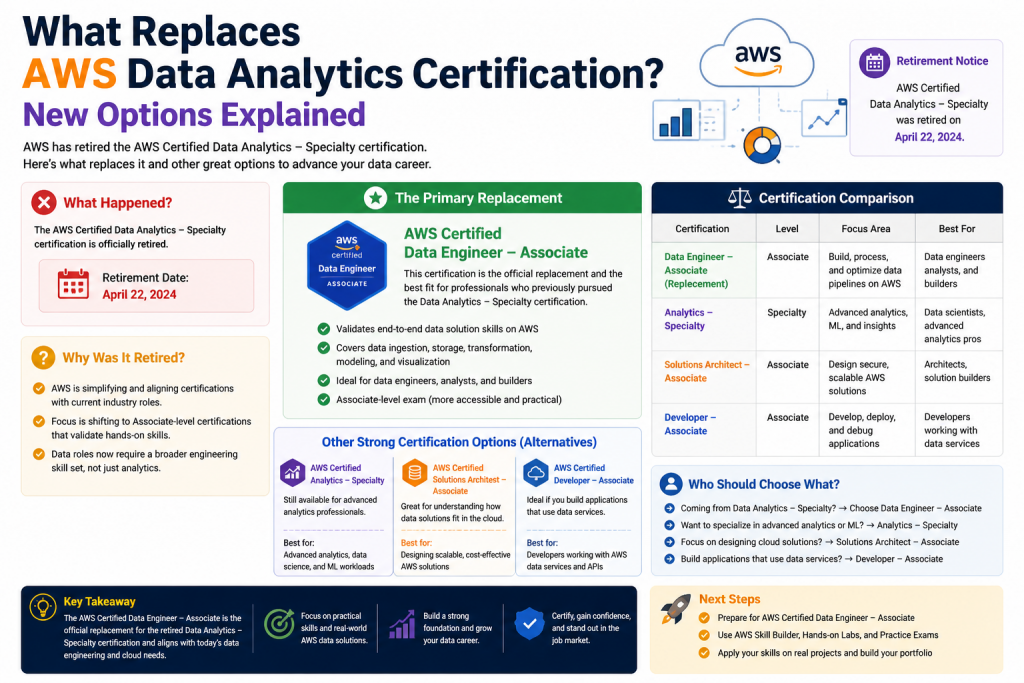
The landscape of cloud certifications is constantly evolving, and few changes have drawn as much attention in the data community as the retirement of the AWS Certified Data Analytics – Specialty certification. For years, this credential served as a benchmark for professionals who specialized in working with large-scale data systems within the Amazon Web Services ecosystem. Its removal in 2024 marked a turning point, signaling not just the end of a certification, but a broader shift in how data roles are defined and validated in the cloud era.
Understanding this transition requires more than simply noting that one certification has been replaced by another. It involves examining how the role of data professionals has changed, how cloud technologies have matured, and how organizations now approach data-driven decision-making. The retirement of the AWS Data Analytics certification reflects a deeper alignment with industry trends, particularly the merging of data analytics and data engineering responsibilities.
Data has become one of the most valuable assets for organizations across every industry. From healthcare and finance to retail and entertainment, companies rely on data to gain insights, optimize operations, and predict future outcomes. As the volume and complexity of data have grown, so too has the need for professionals who can manage and analyze it effectively. This demand has driven the development of specialized roles and certifications designed to validate expertise in specific areas of data management.
Amazon Web Services has long been at the forefront of this transformation. By offering a wide range of tools for data storage, processing, and analysis, AWS has enabled organizations to build sophisticated data systems without the need for extensive on-premises infrastructure. The AWS Data Analytics certification was designed to validate expertise in using these tools, focusing on the ability to design and implement scalable analytics solutions.
However, as the field has evolved, the distinction between data analytics and data engineering has become less clear. Modern data workflows often require a combination of skills, including data ingestion, transformation, storage, and analysis. This has led to a shift in how organizations define data roles, with a growing emphasis on versatility and cross-functional expertise.
The introduction of the AWS Certified Data Engineer – Associate certification reflects this shift. Instead of focusing solely on analytics, the new certification emphasizes the broader skill set required to build and maintain data systems. This includes designing data pipelines, ensuring data quality, and implementing security measures, all of which are essential for effective data analytics.
For professionals, this change represents both a challenge and an opportunity. On one hand, it requires adapting to a new certification path and potentially expanding one’s skill set. On the other hand, it provides a chance to develop a more comprehensive understanding of data systems, which can lead to greater career opportunities.
The Role of Advanced Data Analytics in the Cloud Era
To fully appreciate the significance of the AWS Data Analytics certification, it is important to understand the role of advanced data analytics in today’s technology landscape. Data analytics is no longer limited to generating reports or visualizing trends. It has become a critical component of decision-making processes, enabling organizations to respond quickly to changing conditions and make informed choices.
Advanced data analytics involves working with large and complex datasets, often referred to as big data. This requires specialized tools and techniques to collect, store, process, and analyze data efficiently. Cloud platforms like AWS have made it possible to handle these tasks at scale, providing the infrastructure and services needed to support modern data workflows.
One of the key advantages of using cloud-based analytics solutions is scalability. Organizations can easily adjust their resources based on demand, ensuring that they can handle large volumes of data without compromising performance. This flexibility is particularly important in industries where data volumes can fluctuate significantly.
Another important aspect of advanced data analytics is the ability to process data in real time. In many cases, organizations need to analyze data as it is generated, allowing them to respond to events as they happen. This requires systems that can handle streaming data and perform complex computations and efficiently.
Data integration is also a critical component of modern analytics. Organizations often collect data from multiple sources, including databases, applications, and external systems. Combining this data into a unified view requires careful planning and the use of tools that can handle different data formats and structures.
Security and compliance are equally important considerations. As data becomes more valuable, it also becomes a target for cyber threats. Organizations must implement robust security measures to protect sensitive information and ensure compliance with regulations. This includes encrypting data, managing access controls, and monitoring for potential vulnerabilities.
The AWS Data Analytics certification was designed to validate expertise in all of these areas. It demonstrated that a professional had the skills needed to work with complex data systems and leverage AWS tools to build effective solutions. This made it a valuable credential for anyone looking to specialize in data analytics within the cloud.
What the AWS Data Analytics Certification Represented
The AWS Certified Data Analytics – Specialty certification was more than just a test of knowledge. It was a comprehensive validation of a professional’s ability to design and implement data analytics solutions using AWS services. This made it one of the most respected certifications in the field of cloud-based data analytics.
One of the defining features of the certification was its focus on real-world applications. Rather than simply testing theoretical knowledge, it required candidates to demonstrate their ability to solve practical problems. This included selecting the appropriate tools for a given task, designing efficient data pipelines, and optimizing performance.
The certification covered the entire data lifecycle, from data collection to analysis and visualization. This holistic approach ensured that certified professionals had a deep understanding of how data systems work and how different components interact. It also emphasized the importance of considering factors such as scalability, reliability, and cost when designing solutions.
Another important aspect of the certification was its emphasis on AWS-specific tools and services. Candidates were expected to be familiar with a wide range of services and understand how to use them effectively. This required hands-on experience and a deep understanding of the AWS ecosystem.
The certification also highlighted the importance of security in data analytics. With the increasing focus on data privacy and compliance, professionals needed to ensure that data was protected at every stage of the lifecycle. This included implementing encryption, managing access controls, and monitoring for potential threats.
Preparing for the certification often required significant time and effort. Candidates typically needed several years of experience in data analytics and hands-on experience with AWS. This made the certification a strong indicator of expertise and commitment.
Despite its challenges, the certification was highly valued by employers. It demonstrated that a professional had the skills needed to handle complex data challenges and contribute to large-scale projects. This made it a valuable asset for career advancement.
Key Skills Validated by the Certification
The AWS Data Analytics certification validated a wide range of skills that were essential for working with data in a cloud environment. These skills went beyond basic data analysis and included advanced techniques for managing and processing large datasets.
One of the key skills validated by the certification was data ingestion. This involved collecting data from various sources and ensuring that it was available for processing. Candidates needed to understand different methods of data ingestion, including batch processing and real-time streaming.
Data storage was another important area of focus. Professionals needed to be familiar with different storage options and understand how to choose the right one based on the requirements of a project. This included considering factors such as performance, cost, and scalability.
Data processing was a critical component of the certification. This involved transforming raw data into a format that could be analyzed. Candidates needed to understand how to use distributed computing frameworks and optimize performance.
Analysis and visualization were also key skills. Once data was processed, the next step was to extract insights and present them in a meaningful way. This required knowledge of analytical techniques as well as tools for creating visual representations of data.
Security was an underlying theme throughout the certification. Professionals needed to ensure that data was protected at every stage of the lifecycle. This included implementing access controls, encryption, and monitoring systems.
The certification also emphasized the importance of problem-solving and critical thinking. Candidates were required to analyze complex scenarios and determine the best approach to solving a problem. This required a deep understanding of both data analytics and AWS services.
Why the Certification Was Considered Valuable
The AWS Data Analytics certification was widely regarded as a valuable credential for several reasons. One of the primary reasons was its focus on practical skills. By testing real-world scenarios, the certification ensured that professionals were prepared to handle the challenges they would encounter in their work.
Another reason for its value was the level of expertise required to earn it. The certification was not designed for beginners, which meant that those who achieved it had a strong foundation in data analytics and AWS. This made it a reliable indicator of competence.
The certification also provided a competitive advantage in the job market. As organizations increasingly relied on data to drive decision-making, the demand for skilled data professionals grew. Having a recognized certification helped candidates stand out and demonstrate their expertise.
In addition to career advancement, the certification also contributed to professional development. Preparing for the exam required learning new skills and gaining a deeper understanding of data analytics. This helped professionals stay current with industry trends and improve their capabilities.
The certification also aligned with the growing importance of cloud computing. As more organizations moved their data systems to the cloud, the need for professionals who could work with cloud-based tools increased. The AWS Data Analytics certification validated this expertise and made it easier for professionals to transition to cloud-based roles.
The Transition Toward a New Certification Model
The retirement of the AWS Data Analytics certification and the introduction of the AWS Certified Data Engineer – Associate certification represent a shift in how AWS approaches data-related certifications. This change reflects the evolving nature of data roles and the increasing importance of data engineering skills.
Data engineering has become a critical component of modern data workflows. It involves building and maintaining the infrastructure needed to collect, store, and process data. Without effective data engineering, analytics cannot be performed efficiently.
The new certification focuses on these foundational skills, emphasizing the importance of designing and managing data systems. This includes creating data pipelines, ensuring data quality, and implementing security measures.
By focusing on data engineering, the new certification provides a broader skill set that can be applied to a wide range of roles. This makes it more versatile and aligned with current industry needs.
For professionals, this transition highlights the importance of adaptability. As the field continues to evolve, it is essential to stay informed and update skills accordingly. Those who embrace these changes will be better positioned to succeed in the rapidly changing world of data analytics.
The Emergence of the AWS Certified Data Engineer – Associate Certification
The introduction of the AWS Certified Data Engineer – Associate certification marked a significant shift in how cloud-based data expertise is defined and validated. Rather than focusing narrowly on analytics, this new certification embraces a broader perspective that reflects the realities of modern data workflows. It recognizes that the ability to analyze data is deeply connected to how that data is collected, transformed, stored, and maintained.
This evolution is not accidental. Over the past decade, organizations have moved away from siloed data teams where analysts, engineers, and architects operated independently. Instead, there is now a strong emphasis on collaboration and integration across roles. Data professionals are increasingly expected to understand multiple aspects of the data lifecycle, even if they specialize in one area. The new certification aligns with this expectation by validating a more comprehensive skill set.
At its core, the AWS Certified Data Engineer – Associate certification focuses on the design and implementation of data systems. It emphasizes practical knowledge and hands-on experience, ensuring that certified professionals can build solutions that are not only functional but also efficient and secure. This makes it particularly relevant in an environment where data systems must scale rapidly and adapt to changing requirements.
The shift toward data engineering also reflects the growing complexity of data environments. Modern organizations deal with diverse data sources, including structured, semi-structured, and unstructured data. Managing this diversity requires robust systems that can handle different formats and processing needs. Data engineers play a crucial role in creating these systems, ensuring that data flows smoothly from source to destination.
By introducing this certification, AWS has effectively acknowledged that strong analytics capabilities depend on solid engineering foundations. Without reliable data pipelines and well-designed storage systems, even the most advanced analytical tools cannot deliver meaningful insights. This perspective is now central to how data expertise is evaluated.
Key Differences Between the Old and New Certification Paths
While the AWS Data Analytics certification and the AWS Certified Data Engineer – Associate certification share some similarities, they differ in important ways that reflect their distinct focus areas. Understanding these differences is essential for professionals deciding how to approach their certification journey.
The most obvious difference lies in the scope of each certification. The former was heavily centered on analytics, including data visualization and interpretation. It required candidates to demonstrate their ability to derive insights from data and present those insights effectively. In contrast, the new certification places greater emphasis on the underlying systems that make analytics possible.
This does not mean that analytics is no longer important. Instead, it is integrated into a broader framework that includes data ingestion, transformation, and storage. The new certification recognizes that effective analytics cannot exist in isolation and must be supported by well-designed infrastructure.
Another key difference is the level of abstraction. The previous certification often required deep knowledge of specific AWS services used for analytics. While the new certification still requires familiarity with AWS tools, it places more emphasis on understanding how these tools fit into larger systems. This encourages a more holistic approach to problem-solving.
The types of questions and scenarios presented in the exam have also evolved. The older exam frequently focused on selecting the best tool for a given analytical task. The new exam, however, is more likely to present scenarios that involve building and maintaining data pipelines, optimizing performance, and ensuring reliability.
There is also a shift in how experience is valued. While both certifications require hands-on experience, the new certification emphasizes practical implementation skills. Candidates are expected to have a strong understanding of how to design and manage data systems in real-world environments.
These differences highlight the changing expectations for data professionals. Rather than specializing narrowly in analytics, individuals are now encouraged to develop a broader skill set that includes both engineering and analytical capabilities. This shift can be challenging, but it also opens up new opportunities for growth and advancement.
Core Skills Required for the Data Engineer Certification
The AWS Certified Data Engineer – Associate certification validates a set of core skills that are essential for building and managing data systems in the cloud. These skills are designed to reflect the practical requirements of modern data roles and ensure that certified professionals can contribute effectively to their organizations.
One of the most important skills is data ingestion. This involves collecting data from various sources and ensuring that it is available for processing. Data engineers must understand different ingestion methods, including batch processing and real-time streaming, and know when to use each approach.
Data transformation is another critical skill. Raw data is rarely suitable for analysis in its original form. It often needs to be cleaned, structured, and enriched before it can be used effectively. This requires a deep understanding of data processing techniques and the ability to implement them efficiently.
Storage management is also a key area of focus. Data engineers must be able to choose the appropriate storage solutions based on factors such as performance, cost, and scalability. This includes understanding different storage architectures and how they can be optimized for specific use cases.
Data pipeline design is a central component of the certification. Pipelines are the systems that move data from one stage to another, and their design has a significant impact on performance and reliability. Engineers must ensure that pipelines are robust, scalable, and capable of handling large volumes of data.
Security is an integral part of all these processes. Data engineers must implement measures to protect data at every stage of the lifecycle. This includes managing access controls, encrypting data, and monitoring for potential threats.
Another important skill is performance optimization. Data systems must be able to handle increasing workloads without compromising efficiency. This requires an understanding of how to identify bottlenecks and implement solutions to improve performance.
Finally, the certification emphasizes the importance of monitoring and troubleshooting. Data engineers must be able to identify issues quickly and resolve them to minimize disruptions. This requires a combination of technical knowledge and problem-solving skills.
Preparing for the New Certification Path
Preparing for the AWS Certified Data Engineer – Associate certification requires a strategic approach that combines theoretical knowledge with practical experience. Unlike entry-level certifications, this credential is designed for individuals who already have a solid foundation in data and cloud technologies.
One of the first steps in preparation is gaining hands-on experience with AWS services. This is essential because the certification focuses on real-world applications. Working on projects, whether in a professional setting or through personal practice, helps build the skills needed to succeed.
Learning the fundamentals of data engineering is equally important. This includes understanding how data pipelines work, how to process data efficiently, and how to design systems that can scale. These concepts form the backbone of the certification and are critical for both the exam and real-world applications.
Another key aspect of preparation is studying best practices. AWS provides guidelines for designing and implementing data systems, and these are often reflected in the exam. Familiarity with these best practices can help candidates make better decisions when answering scenario-based questions.
Practice exams can also be a valuable resource. They help candidates become familiar with the format of the test and identify areas where they need improvement. Reviewing explanations for both correct and incorrect answers can deepen understanding and reinforce key concepts.
Time management is another important factor. The exam requires candidates to analyze complex scenarios and make decisions quickly. Practicing under timed conditions can help improve efficiency and confidence.
It is also beneficial to stay updated with the latest developments in AWS and data engineering. The field is constantly evolving, and new tools and techniques are introduced regularly. Keeping up with these changes ensures that candidates are well-prepared for the exam and for their careers.
Career Opportunities After the Certification Transition
The shift from the AWS Data Analytics certification to the AWS Certified Data Engineer – Associate certification has implications for career opportunities in the data field. While the change may initially seem disruptive, it ultimately aligns with the growing demand for versatile data professionals.
Data engineers are in high demand across industries. Organizations need individuals who can build and maintain the systems that support data-driven decision-making. This demand is expected to continue growing as more companies adopt cloud-based solutions and generate larger volumes of data.
The new certification positions professionals to take advantage of these opportunities. By validating a broad set of skills, it prepares individuals for roles that require both technical expertise and strategic thinking. This includes positions such as data engineer, data architect, and analytics engineer.
For those who previously focused on analytics, the transition to data engineering can open new career paths. It allows professionals to expand their skill set and take on more complex responsibilities. This can lead to increased job security and higher earning potential.
The certification also enhances credibility in the job market. Employers recognize AWS certifications as a reliable indicator of expertise, and the new certification is no exception. It demonstrates that a candidate has the skills needed to work with modern data systems.
In addition to traditional employment opportunities, the certification can also support freelance and consulting work. Many organizations seek experts who can help them design and implement data solutions, and certified professionals are well-positioned to provide these services.
Adapting to the Changing Data Landscape
The transition from the AWS Data Analytics certification to the AWS Certified Data Engineer – Associate certification highlights the importance of adaptability in the data field. As technologies and practices continue to evolve, professionals must be willing to learn and grow.
One of the key ways to adapt is by embracing continuous learning. This includes staying updated with new tools, techniques, and best practices. It also involves seeking out opportunities to gain practical experience and apply new knowledge.
Collaboration is another important factor. Modern data workflows often involve cross-functional teams, and the ability to work effectively with others is essential. This includes communicating clearly, sharing knowledge, and contributing to shared goals.
Developing a strong foundation in both analytics and engineering can also help professionals adapt. While specialization is still valuable, having a broad skill set provides greater flexibility and opens up more opportunities.
Finally, it is important to focus on problem-solving skills. The ability to analyze complex situations and develop effective solutions is a key requirement in the data field. This skill is emphasized in both the old and new certifications and remains critical for success.
The changing landscape of data certifications is a reflection of the broader evolution of the industry. By understanding these changes and adapting accordingly, professionals can position themselves for long-term success and take full advantage of the opportunities that the field has to offer.
Choosing the Right Path After the Certification Change
The retirement of the AWS Certified Data Analytics – Specialty certification has created a moment of reflection for many professionals in the data field. While the introduction of the AWS Certified Data Engineer – Associate certification provides a clear alternative, deciding whether to pursue it depends on your current skills, career goals, and level of experience. This decision is not simply about replacing one certification with another but about understanding how your role fits into the evolving data landscape.
For individuals who were already preparing for the older certification, the transition may feel disruptive at first. However, much of the foundational knowledge remains relevant. Concepts such as data ingestion, transformation, storage, and security continue to play a central role in modern data systems. The difference lies in how these concepts are applied and the increased emphasis on building and maintaining infrastructure.
If your career has been focused primarily on data analysis, you may need to expand your skill set to include more engineering-oriented tasks. This does not mean abandoning analytics altogether but rather enhancing your capabilities to work more effectively with data systems. Learning how to design pipelines, optimize performance, and manage data workflows can significantly increase your value in the job market.
On the other hand, if you already have experience in data engineering, the new certification may be a natural fit. It provides an opportunity to formalize your skills and demonstrate your expertise to employers. Even for experienced professionals, preparing for the certification can help reinforce best practices and introduce new techniques.
Another factor to consider is the role you aspire to. Different positions require different skill sets, and the new certification aligns more closely with roles that involve building and managing data systems. If your goal is to move into a position such as data engineer or data architect, pursuing this certification can be a strategic step.
Ultimately, the key is to approach the transition with a growth mindset. Instead of viewing it as a setback, consider it an opportunity to broaden your knowledge and adapt to changing industry demands. By doing so, you can position yourself for long-term success in a field that continues to evolve rapidly.
Expanding Your Skill Set Beyond Certification
While certifications are valuable, they represent only one aspect of professional development. To truly succeed in the data field, it is essential to build a well-rounded skill set that goes beyond what any single certification can offer. This is especially important in a rapidly changing environment where new tools and techniques are constantly emerging.
One of the most important areas to focus on is hands-on experience. Working on real-world projects allows you to apply theoretical knowledge and develop practical skills. This can include building data pipelines, analyzing datasets, or creating dashboards to visualize insights. The more experience you gain, the more confident and capable you will become.
Programming skills are another critical component. Languages such as Python and SQL are widely used in data engineering and analytics. Learning how to write efficient code, manipulate data, and automate processes can greatly enhance your productivity and effectiveness.
Understanding data modeling is also essential. This involves designing structures that organize data in a way that supports analysis and reporting. A well-designed data model can improve performance and make it easier to extract meaningful insights.
In addition to technical skills, soft skills play a significant role in career success. Communication, problem-solving, and teamwork are all important for working effectively in a collaborative environment. Being able to explain complex concepts in a clear and concise manner is particularly valuable, especially when working with stakeholders who may not have a technical background.
Another important aspect of professional development is staying informed about industry trends. The field of data is constantly evolving, and keeping up with new developments can help you stay competitive. This can include reading articles, attending webinars, or participating in online communities.
By focusing on continuous learning and skill development, you can build a strong foundation that supports your career growth. Certifications can complement this process, but they should not be the sole focus. Instead, they should be part of a broader strategy that includes both technical and professional development.
Alternative Learning Paths for Data Professionals
The retirement of a certification does not limit your ability to learn or grow. In fact, it can encourage you to explore alternative learning paths that may be more aligned with your goals. There are many ways to develop data skills, and choosing the right approach depends on your preferences and circumstances.
Online courses are one of the most popular options. They offer flexibility and allow you to learn at your own pace. Many courses cover a wide range of topics, from basic data analysis to advanced data engineering techniques. These courses often include hands-on exercises and projects, which can help reinforce your understanding.
Another option is to pursue vendor-neutral certifications. These certifications focus on general data concepts rather than specific tools, making them applicable across different platforms. They can provide a solid foundation and complement more specialized certifications.
Bootcamps and intensive training programs are also worth considering. These programs are designed to provide a comprehensive learning experience in a short period of time. They often include practical projects and mentorship, which can be beneficial for those looking to transition into a new role.
Self-directed learning is another powerful approach. This involves using resources such as books, tutorials, and open-source projects to develop your skills. While it requires discipline and motivation, it allows you to tailor your learning experience to your specific needs.
Networking and community involvement can also play a significant role in your development. Engaging with other professionals can provide valuable insights, support, and opportunities for collaboration. This can include participating in online forums, attending meetups, or contributing to open-source projects.
By exploring different learning paths, you can find the approach that works best for you. The key is to remain proactive and committed to your growth, regardless of changes in certification offerings.
Building a Long-Term Career Strategy in Data
Developing a successful career in data requires more than technical expertise. It involves setting clear goals, identifying opportunities, and continuously adapting to changes in the industry. The transition from the AWS Data Analytics certification to the AWS Certified Data Engineer – Associate certification is just one example of how the field evolves over time.
The first step in building a long-term career strategy is to define your goals. Consider what type of role you want to pursue and what skills are required to achieve it. This can help guide your learning and development efforts.
Once you have a clear direction, it is important to create a plan for acquiring the necessary skills. This can include pursuing certifications, taking courses, and gaining practical experience. Setting milestones and tracking your progress can help keep you motivated and focused.
Gaining experience is a critical part of career development. This can be achieved through internships, freelance work, or personal projects. The goal is to apply your knowledge in real-world situations and build a portfolio that demonstrates your abilities.
Mentorship can also be a valuable resource. Learning from experienced professionals can provide guidance and help you avoid common pitfalls. A mentor can offer insights into the industry and help you navigate your career path.
Another important aspect of career strategy is adaptability. The data field is constantly changing, and being able to adjust to new technologies and trends is essential. This may involve learning new tools, exploring different roles, or even changing your focus as needed.
Finally, it is important to maintain a balance between specialization and versatility. While it is beneficial to develop expertise in a specific area, having a broad skill set can provide more opportunities and increase your resilience in a changing job market.
By taking a strategic approach to your career, you can navigate changes in certifications and industry trends with confidence and continue to grow professionally.
The Future of Data Certifications and Cloud Skills
The evolution of AWS certifications is part of a larger trend in the technology industry. As cloud computing continues to advance, the skills required to work with data are becoming more complex and interconnected. This has led to changes in how certifications are designed and what they aim to validate.
One of the key trends is the integration of multiple skill sets into a single certification. Rather than focusing on a narrow area, certifications are increasingly covering a broader range of topics. This reflects the reality that modern data roles often require a combination of skills, including engineering, analytics, and security.
Another trend is the emphasis on practical experience. Certifications are moving away from purely theoretical knowledge and focusing more on real-world applications. This ensures that certified professionals are prepared to handle the challenges they will encounter in their work.
The growing importance of automation and artificial intelligence is also influencing the development of certifications. As these technologies become more prevalent, data professionals need to understand how to integrate them into their workflows. This may lead to new certifications that focus on these areas.
Cloud platforms will continue to play a central role in data management. As organizations increasingly rely on cloud-based solutions, the demand for professionals with cloud expertise will remain strong. Certifications from providers like AWS will continue to be valuable, but they will evolve to reflect changing needs.
For professionals, this means that continuous learning is more important than ever. Staying updated with new certifications and technologies can help you remain competitive and take advantage of new opportunities.
Navigating Challenges and Staying Competitive
Adapting to changes in certifications and industry trends can be challenging, but it is also an opportunity to grow. The key is to approach these changes with a proactive mindset and a willingness to learn.
One of the main challenges is keeping up with the pace of change. New tools and techniques are introduced regularly, and it can be difficult to stay current. To address this, it is important to prioritize learning and focus on the skills that are most relevant to your goals.
Another challenge is gaining practical experience. While theoretical knowledge is important, hands-on experience is essential for building confidence and competence. Seeking out opportunities to work on real-world projects can help bridge this gap.
Competition in the job market is another factor to consider. As more people enter the data field, it becomes increasingly important to differentiate yourself. This can be achieved by developing a unique combination of skills, building a strong portfolio, and demonstrating your ability to solve problems.
Networking can also help you stay competitive. Building relationships with other professionals can provide access to opportunities and insights that may not be available otherwise.
Finally, maintaining a positive attitude and a commitment to growth can make a significant difference. Challenges are a natural part of any career, and how you respond to them can determine your success.
Conclusion
The retirement of the AWS Certified Data Analytics – Specialty certification marks the end of an important chapter, but it also signals the beginning of a new era in cloud-based data careers. The introduction of the AWS Certified Data Engineer – Associate certification reflects the evolving nature of data roles and the increasing importance of integrated skill sets.
Rather than viewing this change as a loss, it is more productive to see it as an opportunity to grow and adapt. The new certification aligns with current industry trends and provides a pathway for developing skills that are highly востребованы in today’s job market.
Success in the data field depends on more than certifications alone. It requires a commitment to continuous learning, practical experience, and strategic career planning. By focusing on these areas, you can build a strong foundation and remain competitive in a rapidly changing environment.
As the field continues to evolve, those who embrace change and invest in their development will be best positioned to succeed. Whether you are just starting your journey or looking to advance your career, the key is to stay curious, adaptable, and focused on your goals.
Continue exploring the technologies and certification concepts that matter most to you.