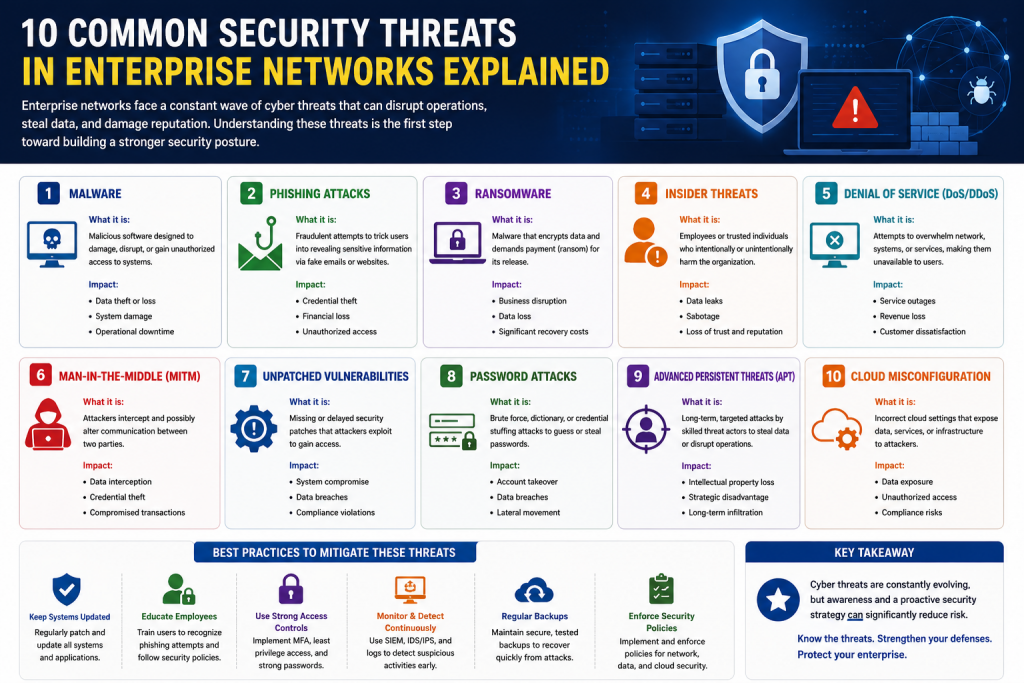
businesses increasingly depend on digital infrastructure, attackers continue to develop more advanced techniques to exploit vulnerabilities. Enterprise environments are especially attractive targets because they store large volumes of sensitive data, financial information, and intellectual property.
This article explores the 10 most common security threats in enterprise environments, how they work, real-world examples, and practical mitigation strategies. Understanding these threats is essential for building a strong cybersecurity posture.
Malware Threats in Enterprise Systems
Malware is one of the oldest yet still most dangerous cybersecurity threats. It refers to malicious software designed to disrupt, damage, or gain unauthorized access to systems. Malware is not a single type of attack but a broad category that includes multiple variants.
Common types include spyware that secretly monitors user activity, ransomware that locks systems until payment is made, worms that self-replicate across networks, and trojans that disguise themselves as legitimate software. Each type has a different method of infiltration, but the goal remains the same: compromise system integrity.
In enterprises, malware often spreads through phishing emails, infected downloads, or compromised websites. Once inside, it can steal data, disrupt operations, or even provide attackers with remote control.
To mitigate malware risks, organizations should use updated antivirus solutions, apply regular software patches, and enforce strict email filtering policies. Employee awareness training is also critical since human error is one of the most common infection vectors.
Phishing and Social Engineering Attacks
Phishing is a deceptive technique used to trick users into revealing sensitive information such as passwords, credit card numbers, or login credentials. Attackers often disguise themselves as trusted organizations like banks or internal company departments.
Phishing typically occurs through email, but it can also appear in SMS messages, social media, or fake websites. These messages often create a sense of urgency, encouraging users to act quickly without verifying authenticity.
For example, an employee may receive an email appearing to be from IT support requesting password verification. If the user complies, attackers gain access to corporate systems.
To defend against phishing, enterprises should implement email authentication protocols, conduct regular security awareness training, and encourage employees to verify sender details before responding. Multi-factor authentication (MFA) also significantly reduces risk.
Password Attacks and Credential Theft
Passwords remain one of the weakest links in enterprise security. Attackers use various techniques to steal or guess passwords, including brute-force attacks, dictionary attacks, credential stuffing, and keylogging.
Credential stuffing is particularly dangerous because it exploits reused passwords across multiple platforms. If one service is breached, attackers attempt to use the same credentials elsewhere.
In enterprise environments, weak password policies can lead to widespread compromise. Once attackers gain access, they may escalate privileges and move laterally within the network.
Mitigation includes enforcing strong password policies, using password managers, implementing MFA, and monitoring for suspicious login attempts. Account lockout mechanisms can also help prevent repeated guessing attempts.
Distributed Denial of Service (DDoS) Attacks
A DDoS attack aims to overwhelm a system with massive traffic, making it unavailable to legitimate users. Attackers use networks of compromised devices, often called botnets, to flood servers with requests.
These attacks can disrupt websites, online services, and internal systems. For enterprises, downtime can result in financial losses, reputational damage, and operational disruption.
Large-scale attacks have grown significantly in recent years due to the availability of powerful botnets. Some attacks reach terabits of traffic per second.
Mitigation strategies include traffic monitoring, rate limiting, load balancing, and using DDoS protection services. Establishing a normal traffic baseline helps detect anomalies early.
Man-in-the-Middle (MITM) Attacks
A man-in-the-middle attack occurs when an attacker intercepts communication between two parties without their knowledge. The attacker can eavesdrop, alter data, or impersonate either party.
These attacks are common on unsecured Wi-Fi networks where attackers can intercept unencrypted traffic. Even encrypted sessions can be targeted through techniques like SSL stripping or session hijacking.
In enterprise environments, MITM attacks can lead to data theft, credential capture, and financial fraud.
To reduce risk, organizations should enforce HTTPS, use VPNs for remote access, implement strong encryption protocols, and avoid unsecured public networks.
Drive-By Download Attacks
Drive-by downloads occur when malware is automatically installed on a system without the user’s knowledge. Simply visiting a compromised website can trigger the download if the browser or plugins are vulnerable.
These attacks often exploit outdated software or hidden malicious scripts embedded in websites. Users may not even realize their system is infected.
Once installed, malware can steal data, monitor activity, or provide remote access to attackers.
Prevention requires keeping browsers and operating systems updated, disabling unnecessary plugins, and using web filtering tools. Endpoint protection software can also detect suspicious behavior.
Rogue Software and Fake Security Tools
Rogue software tricks users into believing their system is infected, prompting them to install fake antivirus programs. Once installed, these programs may actually introduce malware instead of removing it.
They often display alarming messages such as “Your system is infected” to create panic and urgency. Users then unknowingly pay for or install malicious software.
In enterprises, rogue software can bypass traditional defenses by exploiting user trust rather than technical vulnerabilities.
To prevent such attacks, organizations should restrict software installation permissions, use trusted security tools, and educate employees about fake security alerts.
Web Application Security Threats
Web applications are frequent targets due to their accessibility and complexity. Common vulnerabilities include SQL injection, cross-site scripting (XSS), broken authentication, and insecure configurations.
For example, SQL injection allows attackers to manipulate database queries, potentially exposing entire datasets. XSS attacks inject malicious scripts into web pages viewed by users.
These vulnerabilities can lead to data breaches, unauthorized access, and system compromise.
Enterprises should follow secure coding practices, conduct regular penetration testing, and implement frameworks like OWASP guidelines. Input validation and proper authentication mechanisms are essential defenses.
IP Spoofing Attacks
IP spoofing involves forging the source IP address in network packets to disguise the attacker’s identity. This technique is commonly used in DDoS attacks or to bypass access restrictions. By impersonating trusted devices, attackers can gain unauthorized access or redirect traffic. For enterprises, IP spoofing poses risks to authentication systems and network trust models. Mitigation includes packet filtering, access control lists, encryption, and network monitoring tools that detect abnormal traffic patterns.
In addition to these defensive measures, enterprises can implement ingress and egress filtering at the router level to ensure that only legitimate IP addresses are allowed to enter or leave the network. This helps prevent spoofed packets from being accepted or transmitted beyond internal systems. Protocols such as BCP 38 (Best Current Practice 38) are widely recommended for reducing IP spoofing at the internet service provider level.
Another important strategy is the use of secure authentication mechanisms that do not rely solely on IP addresses for identity verification. Multi-factor authentication and cryptographic verification methods ensure that even if an IP address is spoofed, unauthorized access is still blocked.
Network segmentation also plays a vital role by limiting how far spoofed traffic can travel within an organization. If an attacker manages to bypass perimeter defenses, segmentation reduces lateral movement across critical systems.
Additionally, advanced intrusion detection and prevention systems (IDS/IPS) can analyze traffic behavior patterns and flag anomalies associated with spoofing attempts. When combined, these layered defenses significantly strengthen enterprise resilience against IP spoofing attacks and help maintain network integrity and trust.
Wireless Attacks and Rogue Access Points
Wireless networks are especially vulnerable to attacks such as rogue access points, evil twin attacks, and Wi-Fi eavesdropping. A rogue access point is an unauthorized device connected to a network, while an evil twin mimics legitimate Wi-Fi networks to trick users into connecting. Once connected, attackers can intercept traffic, steal credentials, or deploy malware. In enterprise environments, unsecured wireless access can expose entire networks. Security measures include using strong WPA3 encryption, disabling unauthorized access points, implementing network segmentation, and using VPNs for secure communication.
In addition to these core protections, continuous wireless monitoring is essential in enterprise environments. Network administrators should regularly scan for unknown devices and unusual SSIDs that may indicate the presence of rogue access points. Wireless intrusion detection systems (WIDS) can help identify suspicious activity in real time and alert security teams before significant damage occurs. This proactive approach reduces the chances of attackers maintaining long-term access to the network.
Employee awareness also plays a crucial role in wireless security. Users should be trained to avoid connecting to unknown or suspicious Wi-Fi networks, especially in public places such as cafes, airports, or hotels. Even seemingly harmless connections can be used as traps for data interception.
Furthermore, enterprises should enforce strict authentication mechanisms such as 802.1X for network access control. This ensures that only verified devices and users can connect to internal systems. Combined with regular security audits and firmware updates for wireless access points, these practices significantly strengthen overall network resilience against wireless-based threats.
Conclusion
Enterprise security threats continue to evolve as attackers develop more sophisticated methods. From malware and phishing to advanced network attacks like DDoS and MITM, organizations must stay proactive rather than reactive.
No single solution can eliminate all risks. Instead, a layered security approach—combining technology, policies, and employee awareness—is essential for strong defense.
Regular monitoring, continuous training, and up-to-date security tools are key to minimizing vulnerabilities. As cyber threats grow in scale and complexity, enterprises that prioritize cybersecurity will be far better equipped to protect their data, systems, and reputation.
Continue exploring the technologies and certification concepts that matter most to you.