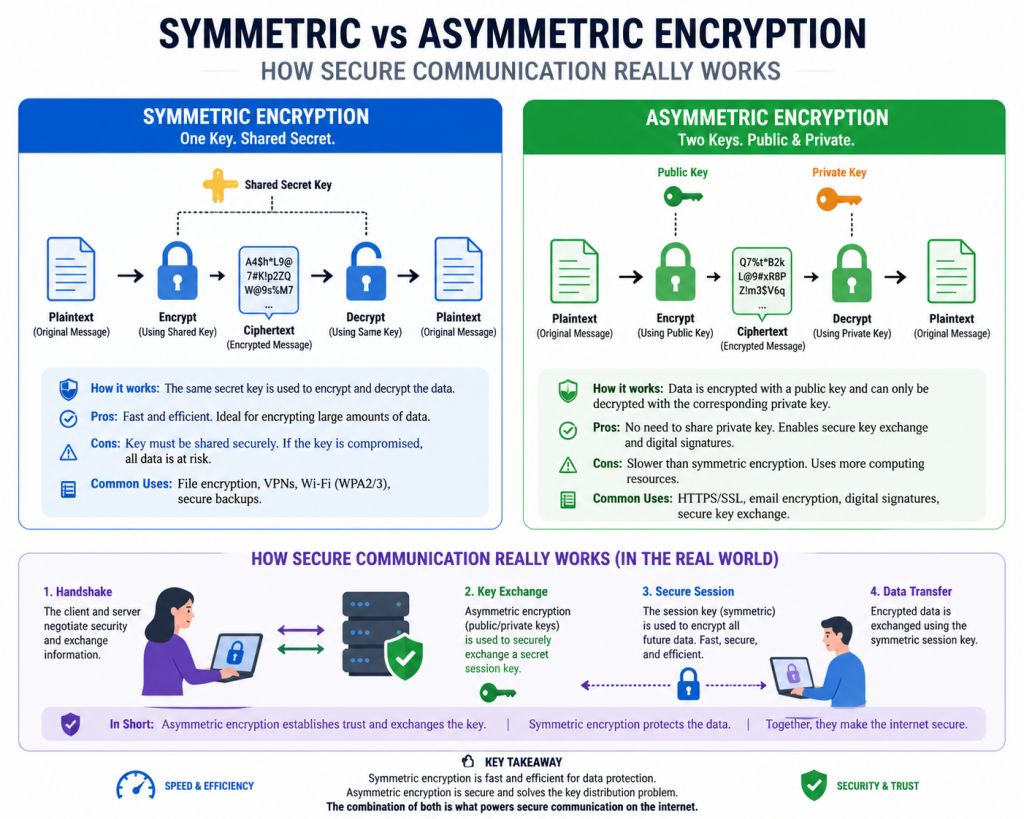
Encryption is one of the most important building blocks of modern cybersecurity. Every time data moves across the internet or is stored on a device, there is a risk that it could be intercepted, altered, or accessed by unauthorized individuals. Encryption addresses this problem by transforming readable information into a form that cannot be understood without the proper key. This process ensures confidentiality, integrity, and in many cases authenticity of data.
At a high level, encryption techniques fall into two main categories: symmetric encryption and asymmetric encryption. While both aim to protect information, they do so in fundamentally different ways. Understanding how each method works is essential for choosing the right approach in different scenarios.
This part focuses on building a strong foundation by exploring how symmetric and asymmetric encryption operate, their core differences, and why both are essential in modern systems.
What is Symmetric Encryption
Symmetric encryption is the simplest form of encryption. It uses a single key for both encrypting and decrypting data. This means that the same key must be shared between the sender and the receiver before communication can take place securely.
To understand this concept, imagine placing a document inside a locked box. You lock the box using a key and send it to someone else. In order for them to open the box and read the document, they must have the exact same key. If anyone else gets access to that key, they can also unlock the box and read the contents.
This shared-key model is the defining feature of symmetric encryption. It is straightforward and highly efficient, which is why it has been widely used for decades in securing data.
How Symmetric Encryption Works
The process of symmetric encryption involves two main steps. First, the original data, often referred to as plaintext, is transformed into an unreadable format known as ciphertext using the encryption key. Then, when the intended recipient receives the ciphertext, they use the same key to convert it back into readable plaintext.
The strength of this method depends heavily on the secrecy of the key. If the key remains private, the encrypted data stays secure. However, if the key is exposed, the entire system becomes vulnerable.
Symmetric encryption algorithms rely on mathematical operations that are designed to be fast and efficient. These operations allow large volumes of data to be processed quickly, which is one of the main reasons symmetric encryption is so widely used.
Common Symmetric Encryption Algorithms
Over time, several algorithms have been developed to implement symmetric encryption. Each has its own characteristics, but they all follow the same basic principle of using a single shared key.
One of the most widely used algorithms is Advanced Encryption Standard. It has become the global standard for securing data and is trusted by governments, financial institutions, and technology companies. Its strength lies in its ability to provide high levels of security while maintaining excellent performance.
Another variation, often referred to as AES with a 256-bit key, offers even stronger protection. This level of encryption is commonly used in environments where security is critical, such as banking systems and sensitive data storage.
Older algorithms like Triple DES were once widely used but are gradually being phased out due to advancements in computing power and the availability of more secure alternatives.
More modern approaches such as ChaCha20 are designed to perform efficiently on devices with limited processing power. This makes them particularly useful in mobile and embedded systems where resources are constrained.
Speed and Efficiency of Symmetric Encryption
One of the biggest advantages of symmetric encryption is its speed. Because it uses a single key and relatively simple mathematical operations, it can process data extremely quickly.
In many cases, encryption and decryption operations take only microseconds. While this may seem like a small difference, it becomes significant when dealing with large-scale systems that process millions or even billions of operations.
This high level of efficiency makes symmetric encryption ideal for scenarios where large amounts of data need to be protected without introducing delays. For example, when streaming video content or processing financial transactions, even a slight delay can negatively impact user experience.
The ability to handle large data volumes quickly is one of the main reasons symmetric encryption remains a core component of modern security systems.
The Key Distribution Challenge
Despite its advantages, symmetric encryption has a major limitation. Both parties must have access to the same secret key, which raises the question of how to share that key securely.
If the key is transmitted over an insecure channel, there is a risk that it could be intercepted. Once an attacker gains access to the key, they can decrypt all communications protected by it.
This issue is known as the key distribution problem. It is one of the biggest challenges associated with symmetric encryption and often requires additional mechanisms to solve.
Because of this limitation, symmetric encryption is rarely used in isolation for secure communication over open networks. Instead, it is often combined with other methods that can securely exchange keys.
What is Asymmetric Encryption
Asymmetric encryption takes a different approach to solving the problem of secure communication. Instead of using a single shared key, it uses a pair of keys that work together.
These keys are known as the public key and the private key. The public key can be shared openly with anyone, while the private key must be kept secret by its owner.
This system eliminates the need to share a secret key in advance, making it much easier to establish secure communication between parties who have never interacted before.
How Asymmetric Encryption Works
The relationship between the public and private keys is what makes asymmetric encryption unique. Data encrypted with one key can only be decrypted with the other key in the pair.
For example, if someone wants to send you a secure message, they can use your public key to encrypt it. Once encrypted, the message can only be decrypted using your private key, which only you possess.
This ensures that even if the encrypted message is intercepted during transmission, it cannot be read without the private key.
Asymmetric encryption can also be used in reverse for authentication purposes. If you encrypt data using your private key, others can use your public key to verify that the data came from you. This forms the basis of digital signatures.
Common Asymmetric Encryption Algorithms
Several algorithms are used to implement asymmetric encryption, each designed to provide strong security through complex mathematical relationships.
One of the most well-known algorithms is RSA. It has been widely used for many years and remains a standard choice for secure data transmission and digital signatures.
Elliptic Curve Cryptography is a more recent development that provides similar levels of security with smaller key sizes. This makes it more efficient, especially for devices with limited resources.
Another important method is Diffie-Hellman, which is used to securely exchange keys over a public network. While it is not used for encryption itself, it plays a crucial role in establishing secure communication channels.
Performance Differences Between the Two Methods
One of the most noticeable differences between symmetric and asymmetric encryption is their performance.
Symmetric encryption is designed for speed and efficiency. It can handle large amounts of data quickly and with minimal resource usage.
Asymmetric encryption, on the other hand, involves more complex mathematical operations. As a result, it is significantly slower. Operations that take microseconds in symmetric encryption may take milliseconds in asymmetric systems.
While this difference may seem small, it becomes a major factor in systems that require high throughput. Using asymmetric encryption for large data transfers would lead to performance issues and increased processing costs.
Because of this, asymmetric encryption is typically reserved for tasks that involve small amounts of data, such as key exchange and authentication.
Strengths of Asymmetric Encryption
Despite its slower performance, asymmetric encryption offers several advantages that make it indispensable in modern security systems.
One of its key strengths is the ability to establish secure communication without prior key exchange. This makes it ideal for use over open networks such as the internet.
It also enables digital signatures, which provide a way to verify the identity of a sender and ensure that data has not been altered. This is critical for applications such as software distribution, legal documents, and secure email communication.
Another advantage is simplified key management. Since public keys can be shared openly, there is no need to protect them in the same way as secret keys.
Comparing Symmetric and Asymmetric Encryption
When comparing these two approaches, it becomes clear that each has its own strengths and weaknesses.
Symmetric encryption excels in speed and efficiency. It is well suited for encrypting large amounts of data and is relatively simple to implement.
Asymmetric encryption, while slower, provides additional security features such as secure key exchange and identity verification.
In terms of key management, symmetric encryption can become complex as the number of users increases. Each pair of users requires a unique shared key, which can quickly become difficult to manage.
Asymmetric encryption simplifies this by allowing each user to maintain a single key pair. Public keys can be distributed freely, while private keys remain secure.
Why Both Methods Are Necessary
Rather than choosing one method over the other, modern systems rely on both symmetric and asymmetric encryption to achieve the best results.
Symmetric encryption handles the bulk of data processing due to its speed and efficiency. Asymmetric encryption is used to establish secure connections and exchange keys safely.
This combination allows systems to benefit from the strengths of both approaches while minimizing their weaknesses.
Building a Strong Understanding
Understanding the differences between symmetric and asymmetric encryption is essential for anyone working with data security. Each method plays a specific role, and knowing when to use each one can significantly impact both security and performance.
As technology continues to evolve, encryption methods will also advance. However, the fundamental principles behind symmetric and asymmetric encryption will remain relevant.
By mastering these concepts, you can better understand how secure systems are designed and how data is protected in the digital world.
Practical Applications of Symmetric and Asymmetric Encryption
Encryption becomes truly meaningful when applied to real-world systems. While understanding how symmetric and asymmetric encryption works is important, knowing where and when to use each method is what allows organizations and developers to build secure and efficient systems. In practice, these encryption types are not used randomly. Each is chosen based on specific requirements such as performance, scalability, trust, and the nature of the data being protected.
This section explores how symmetric and asymmetric encryption are used in practical environments, highlighting their strengths in different scenarios and explaining why they are often combined in modern systems.
When to Use Symmetric Encryption
Symmetric encryption is the preferred choice when speed and efficiency are critical. Because it can process large amounts of data quickly, it is widely used in everyday applications that require continuous and high-volume data protection.
One of the key reasons symmetric encryption is so popular is that it introduces minimal delay. This makes it ideal for systems where performance directly impacts user experience.
Bulk Data Encryption in Storage Systems
One of the most common uses of symmetric encryption is protecting stored data. This includes files, databases, and backups that contain sensitive information. Organizations rely on symmetric encryption to ensure that even if storage systems are compromised, the data remains unreadable without the proper key.
For example, when a company stores customer records in a database, symmetric encryption is often used to protect that data at rest. The encryption process happens quickly, allowing systems to retrieve and decrypt information without noticeable delays.
Backup systems also benefit from symmetric encryption. Large volumes of data can be encrypted efficiently before being stored or transferred to remote locations. This ensures that archived data remains secure even if it is accessed by unauthorized parties.
In cloud environments, symmetric encryption plays a crucial role in protecting stored data. Cloud providers often use it to encrypt data automatically, ensuring that users do not have to manage the encryption process manually.
Real-Time Communication and Messaging
Applications that rely on real-time communication depend heavily on symmetric encryption. Messaging platforms, voice calls, and video streaming services all require encryption that operates quickly and seamlessly.
When you send a message through a secure chat application, symmetric encryption is used to protect the content of that message. The encryption and decryption process happens almost instantly, ensuring that communication feels smooth and uninterrupted.
In video streaming, encryption must handle continuous data flow without causing buffering or delays. Symmetric encryption is well suited for this because it can process data streams efficiently.
Voice communication systems also rely on symmetric encryption to protect conversations. Since these systems require low latency, slower encryption methods would negatively impact call quality.
Financial Systems and Transaction Security
Financial institutions rely on encryption to protect sensitive data such as account details, transaction records, and payment information. Symmetric encryption is widely used in these systems because of its speed and reliability.
When processing transactions, systems must handle large volumes of data in real time. Symmetric encryption ensures that this data is protected without slowing down the process.
For example, when a user makes an online payment, the transaction data is encrypted to prevent interception. The system must encrypt and decrypt this data quickly to complete the transaction efficiently.
Banking applications also use symmetric encryption to secure session data. Once a user logs in, their session is protected using fast encryption to ensure that all interactions remain secure.
Internal Network Communication
Within organizations, symmetric encryption is commonly used to secure communication between systems that already trust each other. Once a secure key has been established, it can be used to protect data transfers within the network.
This includes communication between servers, data centers, and internal applications. Since these environments are controlled, the challenge of key distribution is easier to manage.
For example, data centers that exchange large amounts of information rely on symmetric encryption to ensure both security and performance. The ability to encrypt data quickly allows systems to operate efficiently without compromising protection.
In enterprise environments, internal messaging systems also use symmetric encryption to secure communication between employees. This ensures that sensitive business information remains confidential.
Resource-Constrained Devices and Mobile Systems
Devices with limited processing power, such as smartphones, sensors, and embedded systems, benefit significantly from symmetric encryption. These devices often need to conserve battery life and operate efficiently with limited resources.
Symmetric encryption requires less computational power compared to asymmetric methods. This makes it ideal for mobile applications that handle sensitive data, such as banking apps and secure messaging platforms.
In the world of connected devices, such as smart home systems and industrial sensors, symmetric encryption is used to protect data transmitted between devices. Its efficiency allows these systems to operate securely without draining resources.
Wearable technology, including fitness trackers and smartwatches, also relies on symmetric encryption to protect user data. Since these devices operate on limited battery capacity, efficient encryption is essential.
When to Use Asymmetric Encryption
Asymmetric encryption is designed to solve problems that symmetric encryption cannot address effectively. It is particularly useful in situations where secure communication must be established without prior trust.
Although it is slower, its ability to enable secure key exchange and identity verification makes it a critical component of modern security systems.
Secure Key Exchange Over Open Networks
One of the most important uses of asymmetric encryption is securely exchanging keys over public networks. When two parties want to communicate securely but have never interacted before, they need a way to establish a shared secret.
Asymmetric encryption allows this to happen without exposing sensitive information. By using public and private key pairs, both parties can agree on a shared key that will later be used for symmetric encryption.
This process is essential for establishing secure connections on the internet, where data is transmitted over potentially insecure channels.
Web Security and HTTPS Connections
When users visit secure websites, asymmetric encryption is used during the initial connection phase. This ensures that the website is authentic and that the connection is secure.
During this process, the server provides its public key, which is used to establish a secure communication channel. Once the connection is verified, a symmetric key is exchanged and used for ongoing communication.
This combination ensures both security and performance. The initial use of asymmetric encryption establishes trust, while symmetric encryption handles the actual data transfer.
This process is what enables secure browsing and protects sensitive information such as login credentials and payment details.
Digital Signatures and Identity Verification
Asymmetric encryption enables digital signatures, which are used to verify the authenticity of data and the identity of the sender.
When a document is digitally signed, the sender uses their private key to create a signature. The recipient can then use the sender’s public key to verify that the document has not been altered and that it came from a trusted source.
This is widely used in legal, financial, and software-related processes. For example, software developers use digital signatures to ensure that applications and updates are genuine and have not been tampered with.
In secure communication systems, digital signatures provide an additional layer of trust by confirming the identity of the sender.
Secure Email Communication
Email encryption systems often rely on asymmetric encryption to ensure that messages can only be read by the intended recipient.
When a message is encrypted using the recipient’s public key, only their private key can decrypt it. This ensures that even if the message is intercepted, it remains secure.
This approach is particularly important for sensitive communications, such as business correspondence and confidential information sharing.
Software Distribution and Updates
Asymmetric encryption plays a critical role in ensuring the integrity of software distribution. When users download software or updates, they need to be confident that the files are legitimate and have not been altered.
Developers use their private keys to sign software packages. Users can then verify these signatures using the corresponding public keys.
This process helps prevent the distribution of malicious software and ensures that updates come from trusted sources.
Performance Considerations in Real Systems
In practical environments, the performance differences between symmetric and asymmetric encryption become more apparent.
Symmetric encryption is capable of handling large data volumes efficiently. It can process gigabytes of data quickly, making it suitable for high-throughput systems.
Asymmetric encryption, due to its complexity, is much slower. It is not designed for processing large datasets but rather for handling small, critical operations.
Because of this, systems are designed to use each method where it performs best. Symmetric encryption handles the bulk of data, while asymmetric encryption is used for specific tasks such as key exchange and authentication.
Key Management in Practice
Managing encryption keys is one of the most challenging aspects of implementing secure systems. The approach to key management differs significantly between symmetric and asymmetric encryption.
In symmetric systems, each pair of users requires a shared key. As the number of users increases, the number of keys grows rapidly. This creates complexity in storing, distributing, and updating keys.
In contrast, asymmetric systems simplify key management. Each user only needs a single key pair. Public keys can be shared openly, while private keys remain secure.
This makes asymmetric encryption more scalable in environments where many users need to communicate securely.
Real-World Integration of Both Methods
In real-world systems, symmetric and asymmetric encryption are rarely used in isolation. Instead, they are integrated to take advantage of their respective strengths.
For example, a secure communication system might use asymmetric encryption to establish a connection and exchange keys. Once the connection is established, symmetric encryption is used to handle the actual data transfer.
This approach ensures both security and efficiency. It allows systems to operate at high speeds while maintaining strong protection against threats.
Understanding Practical Trade-Offs
Choosing the right encryption method involves understanding the trade-offs between speed, security, and complexity.
Symmetric encryption offers high performance but requires secure key distribution. Asymmetric encryption provides advanced security features but comes with higher computational costs.
By understanding these trade-offs, organizations can design systems that meet their specific requirements without compromising on security or performance.
Moving Toward Hybrid Approaches
The limitations of using a single encryption method have led to the widespread adoption of hybrid approaches. These systems combine symmetric and asymmetric encryption to create balanced solutions.
In such systems, asymmetric encryption is used to solve the problem of secure key exchange, while symmetric encryption is used to handle data efficiently.
This combination has become the standard approach in modern cybersecurity, forming the foundation of secure communication across the internet and beyond.
As encryption continues to evolve, the practical use of these methods will remain essential in protecting data and ensuring trust in digital systems.
Hybrid Encryption and Advanced Implementation Strategies
Modern encryption systems rarely rely on a single method. Instead, they combine the strengths of both symmetric and asymmetric encryption to create secure, efficient, and scalable solutions. This combined approach is known as hybrid encryption, and it forms the backbone of most secure communication systems used today.
To fully understand how encryption works in real-world environments, it is important to explore how hybrid encryption operates, why it is necessary, and what challenges come with implementing it effectively.
What is Hybrid Encryption
Hybrid encryption is a method that integrates both symmetric and asymmetric encryption into a single system. The goal is to take advantage of the speed of symmetric encryption and the secure key exchange capabilities of asymmetric encryption.
In this approach, asymmetric encryption is used at the beginning of a communication session to establish trust and exchange keys securely. Once a shared key is created, symmetric encryption takes over to handle the actual data transmission.
This combination allows systems to achieve both high performance and strong security without sacrificing one for the other.
Why Hybrid Encryption is Necessary
If only symmetric encryption were used, the system would face the key distribution problem. Securely sharing a secret key over an insecure network is extremely difficult and risky.
If only asymmetric encryption were used, the system would become slow and inefficient, especially when handling large volumes of data.
Hybrid encryption solves both of these problems by assigning specific roles to each method. Asymmetric encryption handles trust and key exchange, while symmetric encryption handles speed and data processing.
This division of responsibilities makes hybrid encryption the most practical solution for modern applications.
Step-by-Step Process of Hybrid Encryption
To understand hybrid encryption in detail, it is helpful to look at how a secure connection is established between two parties.
The process begins when a client, such as a web browser, attempts to connect to a server. The server responds by providing its public key. This key is available to anyone and does not need to be kept secret.
The client then generates a random symmetric key. This key will be used for encrypting the actual data exchanged during the session.
Before sending the symmetric key to the server, the client encrypts it using the server’s public key. This ensures that only the server can decrypt it, since only the server has the corresponding private key.
Once the server receives the encrypted key, it uses its private key to decrypt it. At this point, both the client and the server share the same symmetric key.
From this point onward, all communication between the client and the server is encrypted using symmetric encryption. This allows data to be transmitted quickly and securely.
This entire process happens in a matter of milliseconds and is completely transparent to the user.
Real-World Systems That Use Hybrid Encryption
Hybrid encryption is used in many systems that people interact with every day. It is a fundamental part of secure communication on the internet and in private networks.
Secure web browsing is one of the most common examples. When a user visits a secure website, the connection is established using a hybrid encryption process. This ensures that sensitive information such as passwords and payment details are protected.
Virtual private networks also rely on hybrid encryption. These systems create secure tunnels between devices and networks, allowing data to be transmitted safely over public infrastructure.
Messaging applications use hybrid encryption to protect conversations. When users send messages, the system ensures that only the intended recipient can read them.
Email encryption systems also use a similar approach. Messages are protected using a combination of encryption methods to ensure confidentiality and authenticity.
Software update mechanisms rely on hybrid encryption to verify the integrity of updates and securely deliver them to users. This helps prevent malicious software from being distributed.
Benefits of Hybrid Encryption
Hybrid encryption offers several advantages that make it the preferred approach for modern systems.
One of the most important benefits is performance. By using symmetric encryption for data transfer, systems can handle large volumes of information quickly without introducing delays.
Another key benefit is security. Asymmetric encryption ensures that keys are exchanged securely, reducing the risk of interception.
Hybrid encryption also supports authentication. It allows systems to verify the identity of users and servers, which is essential for preventing impersonation attacks.
Resource efficiency is another advantage. By limiting the use of computationally expensive asymmetric operations, systems can operate more efficiently.
Scalability is also improved. Hybrid systems can support large numbers of users without the complexity that comes with managing shared keys in purely symmetric systems.
Challenges in Implementing Encryption Systems
While encryption provides strong protection, implementing it correctly is not always straightforward. There are several challenges that organizations must address to ensure that their systems remain secure and efficient.
Performance and Resource Management
Encryption requires processing power and memory. Systems that use encryption extensively must be designed to handle these requirements without affecting performance.
Symmetric encryption is generally efficient, but when used at scale, it still consumes resources. Asymmetric encryption, being more complex, requires even more computational power.
In environments with limited resources, such as mobile devices, careful optimization is necessary. Developers must choose algorithms and configurations that provide security without overloading the system.
In large-scale systems, such as cloud services, encryption can increase operational costs due to higher CPU usage. Proper planning is required to balance security and cost.
Key Management Complexity
Managing encryption keys is one of the most critical aspects of any secure system. Keys must be generated, stored, distributed, rotated, and eventually retired.
If a key is lost, the data it protects may become inaccessible. If a key is compromised, the security of the entire system may be at risk.
Secure storage is essential. Sensitive keys should be protected using specialized hardware or encrypted storage systems.
Key rotation is another important practice. Regularly changing keys reduces the impact of potential breaches. However, this process must be handled carefully to avoid data loss or service disruptions.
Backup and recovery procedures must also be in place. Organizations need to ensure that keys can be restored in case of failure or disaster.
Compliance and Regulatory Requirements
Many industries are subject to strict regulations regarding data security. These regulations often specify how encryption should be implemented.
Organizations may be required to use specific algorithms or key lengths. They may also need to undergo regular security audits and maintain detailed documentation.
Failure to comply with these requirements can result in legal and financial consequences. Therefore, it is important to understand and follow the relevant standards.
Compliance also involves ensuring that encryption systems are properly maintained and updated. As new threats emerge, older algorithms may become vulnerable and need to be replaced.
Secure Storage of Keys and Data
Protecting encryption keys is just as important as protecting the data itself. If an attacker gains access to the keys, they can bypass the encryption entirely.
Hardware-based solutions are often used to store sensitive keys. These systems provide additional layers of protection against unauthorized access.
Encrypted databases can also be used to store less critical keys. However, access to these systems must be tightly controlled.
Backup copies of keys must be protected with the same level of security as the original keys. Otherwise, they could become a weak point in the system.
Access control mechanisms should be implemented to ensure that only authorized individuals can access sensitive keys.
Planning for Key Rotation and Lifecycle Management
Keys should not be used indefinitely. Over time, the risk of compromise increases, making it necessary to replace keys periodically.
Key rotation involves generating new keys and replacing old ones without disrupting operations. This process must be carefully planned and tested.
Organizations must also consider how to handle data that was encrypted with old keys. In some cases, old keys must be retained to allow access to historical data.
Lifecycle management includes tracking the creation, usage, and retirement of keys. Proper documentation and monitoring are essential for maintaining security.
Building Secure Systems from the Ground Up
Implementing encryption should not be an afterthought. It should be integrated into system design from the beginning.
Developers should start with small test environments to understand how encryption works in practice. This allows them to identify potential issues before deploying systems at scale.
Clear documentation is essential. Every aspect of the encryption system, including key management procedures, should be well documented.
Training is also important. Staff members who handle encrypted data must understand how to use and manage encryption tools correctly.
Regular audits should be conducted to ensure that systems remain secure and compliant with standards.
Common Mistakes to Avoid
There are several common mistakes that can weaken encryption systems.
Using outdated algorithms is one of the most serious issues. As computing power increases, older encryption methods may become vulnerable.
Poor key management is another major risk. Storing keys in insecure locations or failing to rotate them regularly can lead to breaches.
Improper implementation can also create vulnerabilities. Even strong algorithms can be compromised if they are not used correctly.
Lack of monitoring is another problem. Without proper oversight, it may be difficult to detect and respond to security incidents.
Avoiding these mistakes requires careful planning and ongoing maintenance.
The Future of Encryption
As technology continues to evolve, encryption methods will also change. Advances in computing, including the development of quantum computing, may impact current encryption techniques.
Researchers are already working on new algorithms that can withstand future threats. These developments aim to ensure that encryption remains effective in the face of evolving challenges.
At the same time, the demand for secure communication continues to grow. As more devices become connected and more data is generated, the importance of encryption will only increase.
Hybrid encryption is likely to remain a key part of this landscape, as it provides a flexible and efficient solution for a wide range of applications.
Conclusion
Encryption is a fundamental component of modern digital security. Symmetric encryption provides the speed and efficiency needed to handle large volumes of data, while asymmetric encryption offers secure key exchange and identity verification.
On their own, each method has limitations. Symmetric encryption struggles with key distribution, while asymmetric encryption is too slow for large-scale data processing. Hybrid encryption brings these two approaches together, creating a balanced solution that meets both performance and security requirements.
In real-world systems, encryption is not just about choosing an algorithm. It involves careful planning, proper implementation, and ongoing management. Key handling, performance optimization, and compliance with regulations all play critical roles in maintaining secure systems.
By understanding how these encryption methods work and how they are applied, organizations and individuals can make informed decisions about protecting their data. A well-designed encryption strategy ensures that sensitive information remains secure while systems continue to operate efficiently.
As the digital world continues to expand, the role of encryption will only become more important. Building strong encryption practices today is essential for staying secure in the future.
Continue exploring the technologies and certification concepts that matter most to you.