Microsoft technologies have shaped modern workplaces for decades. From operating systems to enterprise servers and cloud platforms, Microsoft products are deeply embedded in business environments across the world. Windows operating systems dominate desktops, Microsoft Server solutions are widely used in enterprise infrastructure, and cloud services have become essential for digital transformation. Because of this widespread adoption, IT professionals often find themselves working with Microsoft technologies at some point in their careers.
To ensure that professionals have the right knowledge and skills, Microsoft developed a structured certification program. These certifications were designed to validate technical expertise, helping employers identify qualified candidates while also giving IT professionals a clear learning path. Certification programs also made it easier for individuals to specialize in certain technologies and advance their careers.
For many years, Microsoft certifications followed a tiered structure. This structure allowed learners to progress from basic knowledge to advanced expertise in a logical and organized way. Among these certifications, one of the most important and widely recognized was the Microsoft Certified Solutions Associate, commonly known as MCSA.
Understanding the Role of MCSA
The Microsoft Certified Solutions Associate certification served as a foundational credential for IT professionals who wanted to build a career around Microsoft technologies. It was designed specifically for individuals at the beginning of their professional journey. The certification validated the kind of knowledge and practical skills that someone would typically gain during their first year of working with Microsoft systems.
MCSA played a critical role in bridging the gap between theoretical knowledge and real-world application. It ensured that individuals could not only understand Microsoft technologies but also configure, manage, and troubleshoot them in practical scenarios. This made it highly valuable for both job seekers and employers.
For employers, hiring someone with an MCSA certification meant hiring a candidate who had proven their ability to work with essential Microsoft tools and systems. For professionals, earning the certification was a way to demonstrate competence and commitment to their field. It helped them stand out in a competitive job market and opened doors to various entry-level IT roles.
The Certification Structure Before 2021
Before Microsoft updated its certification model, its certification system was structured like a pyramid. At the base of this pyramid was the Microsoft Technology Associate certification, often referred to as MTA. This entry-level certification focused on fundamental concepts and was ideal for beginners who were just starting to explore IT.
Above the MTA was the MCSA certification. This was considered the associate-level credential and required a deeper understanding of Microsoft technologies. While MTA introduced the basics, MCSA focused on practical skills and real-world tasks, making it a critical step for those entering the workforce.
At the top of the pyramid was the Microsoft Certified Solutions Expert certification, known as MCSE. This advanced certification was designed for experienced professionals who wanted to specialize further and take on leadership or expert-level roles. It required a strong foundation, often built through the MCSA certification.
This structured approach allowed learners to progress gradually. They could start with basic knowledge, move on to hands-on skills, and eventually develop advanced expertise. It created a clear career pathway for IT professionals working with Microsoft technologies.
What Made MCSA Important
The importance of the MCSA certification cannot be overstated. It was widely recognized across the IT industry and served as a standard benchmark for entry-level professionals. One of the key reasons for its popularity was its practical focus. Instead of only testing theoretical knowledge, the certification required candidates to demonstrate their ability to perform real tasks.
Typically, earning an MCSA certification required passing two or three exams. Each exam focused on a specific area of Microsoft technology, such as Windows Server, SQL databases, or desktop systems. This multi-exam structure ensured that candidates gained a well-rounded understanding of the subject.
Another important aspect of MCSA was its alignment with job roles. While it was considered an entry-level certification, it prepared individuals for a wide range of positions. These included roles such as system administrator, network administrator, desktop support specialist, and IT support technician.
By earning the MCSA, professionals could prove that they were ready to handle the responsibilities associated with these roles. This made it easier for them to secure employment and begin building their careers.
Skills Validated by MCSA
The MCSA certification validated a variety of technical skills depending on the specific track chosen. Microsoft offered multiple MCSA certifications, each focusing on a different product or technology area. Some of the most common tracks included Windows Server, SQL Server, and Office technologies.
For example, an MCSA in Windows Server would cover topics such as installing and configuring servers, managing storage, implementing networking features, and maintaining system security. On the other hand, an MCSA in SQL Server would focus on database management, query optimization, and data security.
Despite these differences, all MCSA certifications shared a common goal: to ensure that candidates could effectively manage and support Microsoft technologies in a professional environment. This made the certification highly practical and relevant to real-world scenarios.
Recommended Experience for MCSA
While there were no strict prerequisites for taking MCSA exams, Microsoft recommended that candidates have at least one year of hands-on experience working with the relevant technologies. This recommendation was based on the level of knowledge required to pass the exams.
The certification was not designed for complete beginners. Instead, it targeted individuals who had already gained some exposure to IT environments, either through work experience, internships, or self-study. This ensured that candidates could understand the concepts and apply them effectively during the exams.
Even though Microsoft did not verify work experience as part of the certification process, having practical experience significantly increased the chances of success. Many candidates prepared for the exams by combining study materials with hands-on practice in lab environments.
Career Opportunities with MCSA
Earning an MCSA certification opened up a wide range of career opportunities. Because the certification focused on practical skills, it prepared individuals for roles that required hands-on technical expertise.
Common job roles associated with MCSA included system administrator, network administrator, help desk technician, and desktop support specialist. These roles often serve as entry points into the IT industry, allowing professionals to gain valuable experience and build their careers.
In addition to entry-level positions, the MCSA also served as a stepping stone to more advanced certifications and roles. Many professionals used it as a foundation for pursuing higher-level certifications, such as the MCSE, which could lead to senior or specialized positions.
Industry Recognition and Value
One of the reasons the MCSA certification was so widely respected was its strong industry recognition. Microsoft is one of the largest technology companies in the world, and its certifications are known for their quality and relevance.
Employers often looked for candidates with Microsoft certifications because they provided a reliable measure of technical competence. Having an MCSA certification on a resume could significantly improve a candidate’s chances of getting hired.
In many cases, organizations also encouraged their existing employees to earn certifications. This helped improve overall productivity and ensured that teams had the necessary skills to manage Microsoft technologies effectively.
Transition to Modern Certification Models
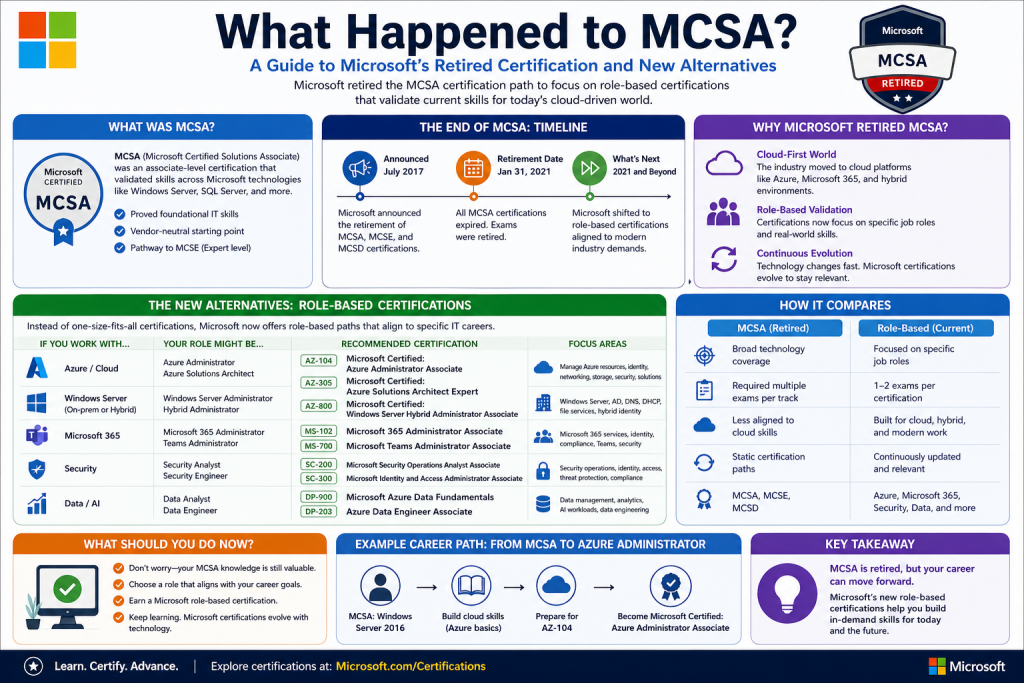
In 2021, Microsoft made a major change to its certification program by retiring the MCSA, along with other certifications in the same family. This decision marked the end of an era and reflected a shift in how Microsoft approached professional training and validation.
The traditional certification model, which was based on specific products, was replaced with a more flexible and role-based approach. This new model focuses on the skills required for specific job roles rather than just knowledge of individual products.
This transition was driven by changes in the technology landscape. As cloud computing and digital transformation became more important, IT roles began to evolve. Professionals were no longer limited to managing a single product; instead, they needed a broader set of skills that spanned multiple technologies.
Why Microsoft Retired MCSA
The decision to retire MCSA was not random. It was part of a larger strategy to modernize Microsoft’s certification program and make it more relevant to current industry needs. The traditional certification model had certain limitations, especially in a rapidly changing technological environment.
One of the main challenges was that product-based certifications could become outdated as technologies evolved. For example, a certification focused on a specific version of a product might lose its relevance when a new version was released.
By moving to a role-based model, Microsoft aimed to create certifications that were more adaptable and aligned with real-world job requirements. This approach allows professionals to focus on the skills they need for their specific roles, rather than just learning about individual products.
The Legacy of MCSA
Even though the MCSA certification has been retired, its impact on the IT industry remains significant. For many years, it served as a gateway for individuals entering the field and helped shape countless careers.
Professionals who earned the MCSA still benefit from their certification. While it may now be considered a legacy credential, it continues to demonstrate foundational knowledge and experience. Employers often recognize the value of these certifications, even after their retirement.
The MCSA also laid the groundwork for the modern certification model. By focusing on practical skills and real-world applications, it set a standard that continues to influence Microsoft’s approach to training and certification.
Difference Between MCSA and MCSE
To fully understand the significance of the Microsoft Certified Solutions Associate certification, it is important to examine how it compared to other certifications within the same ecosystem. One of the most closely related certifications was the Microsoft Certified Solutions Expert, commonly known as MCSE. While both belonged to the same certification framework, they served very different purposes and targeted professionals at different stages of their careers.
The MCSA certification was designed as an entry-level or associate-level credential. It focused on building a solid foundation of technical skills required to manage and support Microsoft technologies. On the other hand, the MCSE certification was intended for experienced professionals who wanted to demonstrate advanced expertise and take on more complex responsibilities.
One of the key differences between the two certifications was the level of difficulty. MCSA exams tested fundamental and intermediate skills, ensuring that candidates could perform everyday administrative tasks. MCSE exams, however, required a deeper understanding of systems architecture, design, and advanced troubleshooting. Candidates pursuing MCSE were expected to have significant hands-on experience and a strong grasp of the underlying technologies.
Another major distinction was the number of exams required. Typically, earning an MCSA certification required passing two or three exams, each covering different aspects of a specific technology. In contrast, MCSE usually required passing a single exam, but that exam was much more comprehensive and challenging. It built upon the knowledge gained through MCSA and pushed candidates to demonstrate a higher level of competence.
The career paths associated with these certifications also differed. MCSA prepared individuals for entry-level roles such as system administrator, help desk technician, or network support specialist. MCSE, on the other hand, was aimed at professionals seeking senior roles such as IT manager, systems engineer, or technical architect. In many cases, earning an MCSA was a prerequisite for pursuing an MCSE, making it a stepping stone in the certification journey.
Certification Validity and Renewal Changes
Another important aspect of Microsoft certifications was their validity and renewal process. Over time, Microsoft made several changes to how certifications were maintained, which affected both MCSA and MCSE holders.
Before 2017, MCSE certifications required recertification every three years. This meant that professionals had to periodically take additional exams to keep their certification active. The goal was to ensure that certified individuals stayed up to date with the latest technologies and industry trends.
However, Microsoft later updated this policy. After the changes, certifications such as MCSA and MCSE no longer required traditional recertification. Instead, they remained valid until the associated exams were retired. Once an exam was retired, the certification would remain active for a certain period before being classified as a legacy credential.
This shift simplified the certification process and reduced the burden on professionals. It also reflected the changing nature of technology, where continuous learning is often more important than periodic testing. Professionals were encouraged to keep their skills current through ongoing education rather than relying solely on recertification exams.
Comparing MCSA with Other Vendor Certifications
While MCSA was a major certification within the Microsoft ecosystem, it was not the only entry-level certification available in the IT industry. Many professionals also pursued certifications from other vendors to broaden their skill sets and increase their career opportunities.
One of the most well-known alternatives was the Cisco Certified Network Associate certification. Although both MCSA and Cisco certifications were considered entry-level, they focused on different areas of expertise and prepared candidates for different types of roles.
MCSA certifications were primarily product-based. They focused on specific Microsoft technologies such as operating systems, servers, and databases. This meant that candidates gained in-depth knowledge of Microsoft products and how to use them effectively in real-world scenarios.
In contrast, Cisco certifications were more role-based and network-focused. They emphasized concepts such as routing, switching, security, and wireless networking. While Cisco exams also included product knowledge, they were generally centered around networking principles and infrastructure rather than a single vendor’s ecosystem.
Despite these differences, many IT professionals chose to pursue both certifications. This combination allowed them to develop a well-rounded skill set that included both Microsoft systems and networking technologies. For example, a system administrator might use Microsoft tools to manage servers while also relying on Cisco equipment for network connectivity.
Having expertise in both areas made professionals more versatile and valuable to employers. It also opened up additional career opportunities, as organizations often require individuals who can manage multiple aspects of their IT infrastructure.
The Role of MCSA in Career Development
The MCSA certification played a crucial role in shaping the careers of many IT professionals. It served as a foundation for learning and provided a clear starting point for individuals entering the industry.
One of the main benefits of MCSA was its practical focus. By requiring candidates to pass multiple exams, it ensured that they gained a comprehensive understanding of the subject matter. This knowledge could be directly applied in real-world situations, making certified professionals more effective in their roles.
In addition to technical skills, MCSA also helped individuals develop problem-solving abilities. Many exam questions were designed to simulate real-life scenarios, requiring candidates to analyze situations and choose the best course of action. This approach prepared them for the challenges they would face in their careers.
Another important aspect of MCSA was its role in career progression. Once individuals earned the certification and gained some experience, they could move on to more advanced certifications and roles. This created a clear pathway for growth and development.
For example, a professional might start as a help desk technician, earn an MCSA certification, and then move into a system administrator role. From there, they could pursue advanced certifications and eventually become a systems engineer or IT manager. This progression highlights the long-term value of the MCSA certification.
Salary Potential and Job Market Impact
The impact of the MCSA certification on salary and job opportunities was another key factor in its popularity. While salaries varied depending on factors such as location, experience, and job role, having an MCSA certification generally increased earning potential.
Professionals with MCSA certifications often worked in technical roles that required hands-on expertise. These roles typically offered competitive salaries, especially for individuals with additional experience and skills. For example, system administrators and database administrators often earned higher salaries compared to entry-level support roles.
In addition to salary benefits, the certification also improved job prospects. Many employers specifically looked for candidates with Microsoft certifications when hiring for IT positions. This made it easier for certified professionals to find job opportunities and advance their careers.
The demand for skilled IT professionals has continued to grow, driven by the increasing reliance on technology in business operations. As a result, certifications like MCSA played an important role in meeting this demand by preparing individuals for the workforce.
Cost and Investment Considerations
Earning an MCSA certification required an investment of both time and money. Each exam typically had a fee, and since most certifications required multiple exams, the total cost could add up. However, compared to other certifications in the industry, MCSA was relatively affordable.
In addition to exam fees, candidates often invested in training materials such as books, online courses, and practice exams. These resources helped them prepare effectively and increased their chances of passing the exams.
While the initial cost might seem significant, many professionals viewed it as a worthwhile investment. The potential return in terms of career opportunities and salary growth often outweighed the expenses. Employers also sometimes covered the cost of certification as part of their employee development programs, further reducing the financial burden.
Another factor to consider was the difficulty of the exams. Microsoft certifications were known for being challenging, and it was not uncommon for candidates to retake exams. To address this, Microsoft occasionally offered discounted retake options, making it easier for candidates to achieve their goals.
The Learning Experience Behind MCSA
Preparing for the MCSA certification was a valuable learning experience in itself. The process required candidates to study a wide range of topics and gain hands-on experience with Microsoft technologies.
Many candidates used a combination of study methods, including online courses, practice labs, and self-study materials. Hands-on practice was especially important, as it allowed individuals to apply their knowledge and gain confidence in their skills.
The learning process also encouraged continuous improvement. Even after earning the certification, professionals often continued to build on their knowledge by exploring new technologies and staying updated with industry trends.
This emphasis on learning and development was one of the reasons why MCSA remained relevant for so long. It not only validated skills but also encouraged individuals to grow and adapt in a rapidly changing field.
Challenges and Limitations of MCSA
Despite its many advantages, the MCSA certification was not without its challenges and limitations. One of the main criticisms was its focus on specific products. While this provided in-depth knowledge, it could also limit flexibility in a rapidly evolving technology landscape.
As new technologies emerged, some aspects of the certification became less relevant. For example, the rise of cloud computing shifted the focus away from traditional on-premises systems. This created a need for certifications that addressed modern technologies and practices.
Another challenge was the time required to complete the certification. Since it involved multiple exams, candidates needed to invest significant effort and dedication. Balancing study time with work and other responsibilities could be difficult for some individuals.
Additionally, while MCSA provided a strong foundation, it was not always sufficient on its own. Employers often looked for candidates with a combination of certifications, experience, and additional skills. This meant that professionals needed to continue learning and developing beyond the certification.
Transition Toward Modern IT Roles
As the IT industry evolved, so did the roles and responsibilities of professionals. Traditional roles such as system administrator began to change, with a greater emphasis on cloud computing, automation, and security.
This shift had a direct impact on certification programs. The skills required for modern IT roles were no longer limited to a single product or technology. Instead, professionals needed a broader understanding of multiple systems and how they interact.
The MCSA certification, with its product-based approach, was not fully aligned with these changing requirements. This highlighted the need for a new certification model that could better reflect the realities of the modern IT landscape.
The Lasting Influence of MCSA
Even though the MCSA certification has been retired, its influence can still be seen in the IT industry. It set a standard for entry-level certifications and demonstrated the importance of practical, hands-on skills.
Many professionals who earned the certification continue to benefit from it in their careers. It remains a valuable credential that showcases foundational knowledge and experience with Microsoft technologies.
The lessons learned from the MCSA program have also influenced the development of new certifications. Microsoft’s current role-based certifications build on the principles established by MCSA while adapting to modern requirements.
Shift to Role-Based Certification Model
When Microsoft retired the Microsoft Certified Solutions Associate certification in 2021, it introduced a completely new approach to professional certifications. Instead of continuing with a product-focused model, Microsoft shifted toward a role-based certification system. This new structure reflects how modern IT jobs actually function in real-world environments.
In the past, certifications like MCSA focused on specific technologies such as Windows Server or SQL Server. While this approach worked well for many years, it became less effective as technology evolved. Organizations no longer rely on a single product or platform. Instead, they use a combination of cloud services, hybrid systems, and integrated solutions. As a result, IT professionals are expected to perform tasks that span multiple technologies rather than specialize in just one.
The role-based certification model addresses this change by focusing on what professionals actually do in their jobs. Instead of asking what product someone knows, it asks what role they perform. This allows certifications to be more aligned with industry needs and ensures that professionals are prepared for real-world responsibilities.
Key Features of the New Certification Approach
The new certification system introduced by Microsoft is designed to be more flexible and relevant. One of its main features is the emphasis on job roles. Each certification is built around a specific role, such as administrator, developer, or security engineer. This helps candidates choose a certification path that matches their career goals.
Another important feature is the integration of cloud technologies. Modern certifications place a strong emphasis on cloud platforms, particularly Microsoft Azure. This reflects the growing importance of cloud computing in today’s business environment.
The new model also encourages continuous learning. Instead of earning a certification and keeping it indefinitely, professionals are expected to regularly update their skills. Many certifications now require renewal through online assessments, ensuring that individuals stay current with the latest technologies.
This approach makes certifications more dynamic and ensures that they remain relevant in a rapidly changing industry.
Closest Equivalent to MCSA Today
Although there is no direct replacement for the MCSA certification, some modern certifications cover similar ground. One of the closest equivalents is the Microsoft Certified: Windows Server Hybrid Administrator Associate certification.
This certification focuses on managing both on-premises and cloud-based Windows Server environments. It combines traditional server administration skills with modern cloud concepts, making it a natural successor to the knowledge areas covered by MCSA.
The hybrid nature of this certification reflects the reality of modern IT environments. Many organizations still use on-premises servers while also adopting cloud solutions. Professionals need to understand how to manage both environments and integrate them effectively.
By combining these skills into a single certification, Microsoft has created a more comprehensive and practical credential that aligns with current industry needs.
Popular Role-Based Certification Paths
The role-based certification model offers a wide range of options, allowing professionals to specialize in different areas of IT. Each role has its own set of certifications and exams, providing a clear path for career development.
One of the most common roles is administrator. Certifications in this category focus on managing systems, configuring services, and maintaining infrastructure. These certifications are ideal for individuals who want to work in system administration or IT support roles.
Another important role is developer. Developer certifications focus on building applications, writing code, and working with development tools. These certifications are suitable for individuals interested in software development and application design.
Data-related roles are also becoming increasingly important. Certifications for data engineers and data scientists focus on managing data, building data pipelines, and analyzing information. These roles are in high demand as organizations rely more on data-driven decision-making.
Security is another critical area. Security certifications focus on protecting systems, detecting threats, and responding to incidents. With the rise of cyber threats, these skills are more important than ever.
There are also certifications for roles such as DevOps engineer, solution architect, and business analyst. Each of these roles addresses a specific aspect of modern IT operations, providing professionals with a wide range of career options.
Examples of Modern Microsoft Certification Exams
The new certification model includes a variety of exams that align with different roles. Each exam focuses on specific skills and knowledge areas, allowing candidates to demonstrate their expertise.
For example, the AZ-204 exam focuses on developing solutions for Microsoft Azure. It is designed for developers who want to build and maintain cloud-based applications. This exam covers topics such as coding, debugging, and integrating cloud services.
The AZ-800 exam focuses on administering Windows Server in a hybrid environment. It is aimed at administrators who need to manage both on-premises and cloud systems. This exam includes topics such as server configuration, networking, and security.
Another example is the SC-200 exam, which focuses on security operations. It is designed for professionals who work in cybersecurity and need to monitor systems, detect threats, and respond to incidents.
The DP-300 exam focuses on managing Azure SQL solutions. It is ideal for database administrators who work with cloud-based databases and need to ensure performance, security, and reliability.
These exams demonstrate how the new certification model covers a wide range of roles and skills, making it more versatile than the old system.
Benefits of the Role-Based Model
The shift to role-based certifications offers several advantages for both professionals and employers. One of the main benefits is improved relevance. Certifications are now directly aligned with job roles, making them more meaningful in the workplace.
Another advantage is flexibility. Professionals can choose certifications based on their career goals rather than following a fixed progression path. This allows for more personalized learning and development.
The new model also supports continuous growth. By requiring regular updates, it encourages professionals to keep learning and stay current with industry trends. This is especially important in a field where technology changes rapidly.
For employers, role-based certifications provide a clearer understanding of a candidate’s skills. Instead of interpreting product-based credentials, they can directly see how a certification relates to a specific job role.
Challenges of the New System
While the role-based model offers many benefits, it also comes with some challenges. One of the main challenges is the lack of a clear entry point. In the old system, MCSA served as a well-defined starting point for beginners. In the new system, there are multiple entry-level certifications, which can make it harder for individuals to choose the right path.
Another challenge is the need for continuous renewal. While this ensures that skills remain up to date, it also requires ongoing effort from professionals. Some individuals may find it difficult to keep up with the constant need for learning and assessment.
Additionally, the focus on cloud technologies may be challenging for those who are more familiar with traditional systems. Transitioning to a cloud-based mindset requires time and effort, especially for professionals who have built their careers around on-premises infrastructure.
Despite these challenges, the new system provides a more accurate reflection of modern IT roles and prepares professionals for the future.
Certification Costs and Investment Today
The cost of Microsoft certifications has remained relatively consistent, but the structure of expenses has changed slightly. Instead of paying for multiple exams to earn a single certification, candidates often pay for one or two exams per role-based certification.
In addition to exam fees, professionals may invest in training resources such as online courses, practice tests, and lab environments. These resources are essential for gaining the hands-on experience needed to succeed in the exams.
While the cost of certification can add up, it is generally considered a worthwhile investment. Certifications can lead to better job opportunities, higher salaries, and career advancement. Many employers also support certification efforts by covering costs or providing training resources.
The return on investment depends on factors such as experience, location, and job role, but certifications remain a valuable tool for professional growth.
Career Opportunities with Modern Certifications
The introduction of role-based certifications has expanded the range of career opportunities available to IT professionals. Instead of being limited to traditional roles, individuals can now pursue specialized positions that align with their interests and skills.
For example, someone interested in cloud computing can pursue certifications related to Azure and become a cloud administrator or cloud engineer. Similarly, individuals interested in security can specialize in cybersecurity roles and work as security analysts or security engineers.
The demand for these roles continues to grow as organizations adopt new technologies and face increasing security challenges. This makes modern certifications highly valuable in today’s job market.
Another advantage is the ability to combine certifications. Professionals can earn multiple certifications across different roles, creating a diverse skill set that makes them more versatile and competitive.
The Continuing Importance of Practical Skills
One of the key principles carried over from the MCSA certification is the importance of practical skills. While the certification model has changed, the focus on hands-on experience remains the same.
Modern certifications still require candidates to demonstrate their ability to perform real tasks. This ensures that certified professionals can apply their knowledge in practical situations.
Hands-on learning is often achieved through labs, simulations, and real-world projects. These methods help individuals gain confidence and prepare for the challenges they will face in their careers.
Employers continue to value practical skills, making this aspect of certification just as important as it was in the past.
The Evolution of IT Learning
The transition from MCSA to role-based certifications reflects a broader shift in how IT professionals learn and develop their skills. Traditional learning methods are being replaced by more flexible and interactive approaches.
Online training platforms, virtual labs, and self-paced courses have become increasingly popular. These resources allow individuals to learn at their own pace and focus on the areas that are most relevant to their careers.
This shift has made learning more accessible and convenient, enabling more people to enter the IT field and advance their careers.
At the same time, it has increased the importance of self-discipline and motivation. Professionals must take responsibility for their own learning and stay committed to continuous improvement.
Conclusion
The Microsoft Certified Solutions Associate certification was once a cornerstone of the IT certification landscape. It provided a structured pathway for learning, validated essential skills, and helped countless professionals launch their careers. Its practical focus and strong industry recognition made it one of the most valuable entry-level certifications available.
However, as technology evolved, the need for a more flexible and relevant certification model became clear. Microsoft’s transition to role-based certifications marked a significant shift in how skills are defined and validated. By focusing on job roles rather than individual products, the new model better reflects the realities of modern IT environments.
While the MCSA certification is no longer available, its legacy continues to influence the way certifications are designed today. The emphasis on practical skills, hands-on experience, and career progression remains at the core of Microsoft’s certification program.
For IT professionals, the new role-based certifications offer exciting opportunities to specialize, grow, and adapt to the changing demands of the industry. Whether pursuing a career in cloud computing, security, data, or development, there are now more pathways than ever to achieve success.
In the end, the evolution from MCSA to modern certifications is not just a change in structure but a reflection of how the IT industry itself has transformed. Those who embrace continuous learning and adapt to new technologies will continue to thrive, just as they did in the era of MCSA.
Continue exploring the technologies and certification concepts that matter most to you.