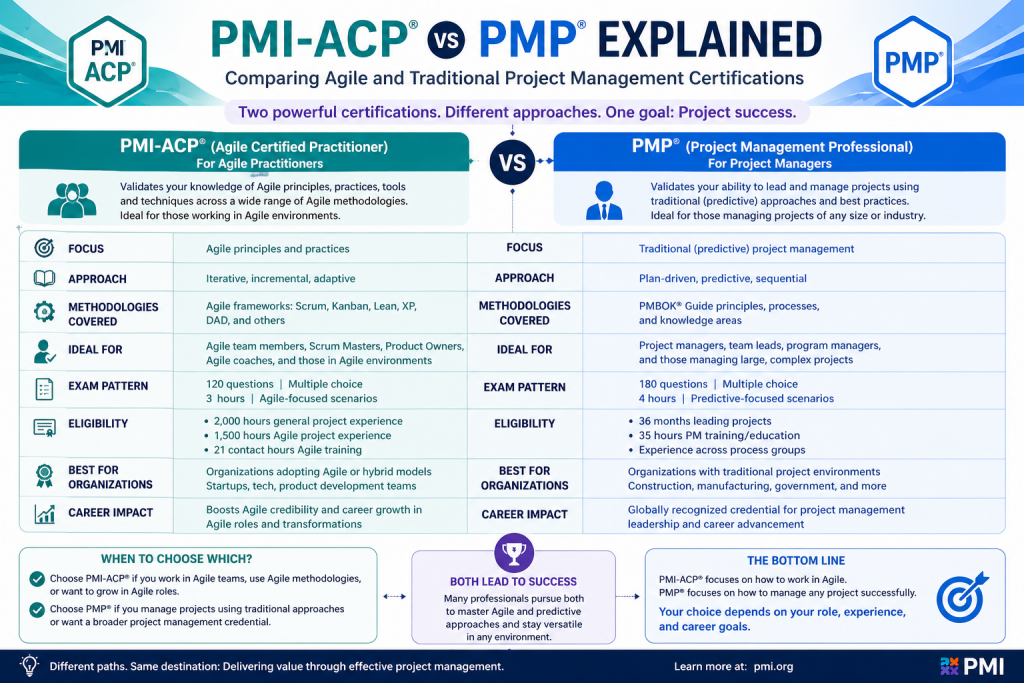
Project management has become one of the most critical disciplines in modern organizations. As industries grow more complex and competitive, businesses are under constant pressure to deliver projects on time, within budget, and with high quality. This demand has elevated the role of project managers, making professional certifications an important way to validate skills and stand out in the job market. Among the most recognized certifications are PMP (Project Management Professional) and PMI-ACP (Agile Certified Practitioner). Although both are offered by the same institution, they represent distinct approaches to managing projects.
Choosing between these certifications requires a clear understanding of their philosophies, methodologies, and career implications. Some professionals operate best in structured environments where everything is planned in advance, while others excel in flexible settings that allow continuous change and improvement. This part explores the core differences between PMP and PMI-ACP, helping you understand their purpose and how they align with different career paths.
The Evolution of Project Management Certifications
Project management as a discipline has evolved over decades. In its early stages, it was heavily focused on planning, documentation, and strict execution. This traditional approach worked well in industries where changes were minimal and predictability was essential. Over time, however, the business environment became more dynamic, especially with the rise of technology and global competition.
As organizations began to face rapidly changing requirements, traditional methods started to show limitations. This led to the development of more flexible frameworks that could adapt to change quickly. Certifications evolved alongside these methodologies, giving rise to different credentials that cater to varying project environments.
The PMP certification represents the traditional foundation of project management. It emphasizes planning, risk management, and control. PMI-ACP, on the other hand, reflects the modern shift toward agility, collaboration, and iterative development. Understanding this evolution is key to appreciating why both certifications exist and how they serve different purposes.
What the PMP Certification Represents
The PMP certification is widely regarded as a benchmark for project management excellence. It is designed for professionals who manage projects with clearly defined scopes, timelines, and deliverables. The certification focuses on structured processes that guide a project from initiation to completion.
At the heart of PMP is a predictive approach to project management. This means that the majority of planning is done upfront. Project managers create detailed plans that outline every aspect of the project, including resources, schedules, risks, and costs. Once the project begins, progress is measured against this plan, and any changes are carefully controlled.
This approach is particularly effective in industries where uncertainty must be minimized. For example, in construction projects, changes can be costly and time-consuming. Similarly, in regulated industries such as healthcare or finance, strict compliance requirements make detailed planning essential.
PMP-certified professionals are expected to have significant experience in managing projects. The certification validates their ability to lead teams, communicate with stakeholders, and deliver results within constraints. It also demonstrates a strong understanding of project management principles that can be applied across different industries.
The Core Principles Behind PMP
The PMP framework is built on a set of structured processes and knowledge areas. These include initiating, planning, executing, monitoring and controlling, and closing. Each of these stages plays a crucial role in ensuring that a project is completed successfully.
Initiating involves defining the project and obtaining approval to proceed. Planning focuses on creating a roadmap that outlines how the project will be executed. Executing is where the actual work takes place, while monitoring and controlling ensure that the project stays on track. Finally, closing involves completing all activities and formally ending the project.
These processes are supported by knowledge areas such as scope management, time management, cost management, quality management, and risk management. Together, they provide a comprehensive framework for managing projects in a structured and controlled manner.
The emphasis on documentation and control makes PMP particularly suitable for large and complex projects. It ensures that every aspect of the project is carefully planned and executed, reducing the likelihood of unexpected issues.
What the PMI-ACP Certification Represents
PMI-ACP is designed for professionals who work in Agile environments. Unlike PMP, which focuses on predictability and control, PMI-ACP emphasizes flexibility and adaptability. It is based on the idea that change is inevitable and should be embraced rather than resisted.
Agile project management breaks projects into smaller, manageable increments. Instead of delivering a complete product at the end, teams deliver smaller pieces of value throughout the project. This allows for continuous feedback and improvement.
PMI-ACP covers a variety of Agile frameworks, including Scrum, Kanban, Lean, and others. Each of these frameworks has its own practices and principles, but they all share a common focus on collaboration, customer satisfaction, and iterative progress.
Professionals who earn PMI-ACP certification demonstrate their ability to work in dynamic environments. They are skilled at managing changing requirements, facilitating team collaboration, and delivering value . This makes them highly valuable in industries where innovation and speed are critical.
The Philosophy of Agile Project Management
Agile is not just a methodology; it is a mindset. It prioritizes individuals and interactions over processes and tools, working solutions over comprehensive documentation, and customer collaboration over contract negotiation. This philosophy encourages teams to be flexible, responsive, and focused on delivering value.
One of the key principles of Agile is continuous improvement. Teams regularly reflect on their performance and identify ways to improve. This creates a culture of learning and innovation, which is essential in fast-paced environments.
Another important aspect of Agile is transparency. Teams share progress openly, allowing stakeholders to provide feedback and make informed decisions. This reduces the risk of misunderstandings and ensures that the final product meets customer expectations.
PMI-ACP certification validates a professional’s ability to apply these principles in real-world scenarios. It shows that they can navigate uncertainty and deliver results in environments where requirements are constantly evolving.
Predictive vs Adaptive Approaches
The most fundamental difference between PMP and PMI-ACP lies in their approach to project management. PMP follows a predictive approach, while PMI-ACP follows an adaptive approach.
In a predictive approach, the project is planned in detail before execution begins. The goal is to anticipate potential challenges and create a roadmap that guides the project from start to finish. This approach works best when requirements are well understood and unlikely to change.
In an adaptive approach, planning is done incrementally. Teams start with a general idea of the project and refine it as they go. This allows them to respond to new information and adjust their approach accordingly.
Both approaches have their advantages and limitations. Predictive methods provide structure and control, making them ideal for stable environments. Adaptive methods offer flexibility and responsiveness, making them suitable for dynamic environments.
Choosing the right approach depends on the nature of the project and the industry in which you work.
Experience Requirements and Accessibility
One of the key differences between PMP and PMI-ACP is the level of experience required to pursue each certification.
PMP is intended for experienced project managers who have already demonstrated their ability to lead projects. Candidates are typically required to have several years of experience, along with formal project management education. This ensures that they have a strong foundation in both theory and practice.
PMI-ACP, on the other hand, is more accessible to professionals who may not have extensive experience in traditional project management. It focuses specifically on Agile experience, making it a suitable option for those who have worked in Agile teams or are transitioning into Agile roles.
This difference in requirements makes PMI-ACP a faster path to certification for many professionals. However, it also means that PMP carries a higher level of recognition and credibility in many industries.
Exam Structure and Focus
The exams for PMP and PMI-ACP reflect their respective methodologies and areas of focus.
The PMP exam is comprehensive and covers a wide range of topics. It tests a candidate’s knowledge of project management processes, tools, and techniques. The exam includes scenario-based questions that require critical thinking and problem-solving skills.
PMI-ACP exam, while still rigorous, is more focused on Agile concepts. It tests a candidate’s understanding of Agile principles, frameworks, and practices. The questions are designed to assess the ability to work in Agile environments and adapt to changing requirements.
Because of its broader scope, the PMP exam is often considered more challenging. However, PMI-ACP requires a deep understanding of Agile concepts, which can also be demanding.
Industry Demand and Career Relevance
Both PMP and PMI-ACP are highly valued in the job market, but their relevance depends on the industry and role.
PMP is widely recognized across various industries, including construction, manufacturing, healthcare, and finance. It is often required for senior project management positions and is considered a mark of expertise in traditional project management.
PMI-ACP is particularly valuable in industries that rely on Agile methodologies, such as software development, product management, and technology. As more organizations adopt Agile practices, the demand for professionals with Agile expertise continues to grow.
Having PMI-ACP certification demonstrates that you can work effectively in fast-paced environments and deliver value quickly. It also shows that you are adaptable and capable of handling change.
The Rise of Hybrid Project Management
In recent years, many organizations have started to adopt hybrid approaches that combine elements of both traditional and Agile methodologies. This reflects the need for flexibility while maintaining a certain level of structure.
Hybrid project management allows teams to use predictive methods for planning and governance, while applying Agile practices for execution and delivery. This approach provides the best of both worlds, enabling organizations to adapt to change while maintaining control.
For professionals, this means that having knowledge of both PMP and Agile principles can be a significant advantage. It allows you to work in a wider range of environments and take on more diverse roles.
Choosing the Right Certification for Your Career
Selecting between PMP and PMI-ACP is not a one-size-fits-all decision. It depends on your experience, career goals, and the type of projects you want to work on.
If you prefer structured environments where projects are carefully planned and executed, PMP is likely the better choice. It provides a strong foundation in traditional project management and is recognized across many industries.
If you enjoy working in dynamic environments where change is constant, PMI-ACP may be more suitable. It allows you to specialize in Agile practices and positions you for roles in modern, innovation-driven industries.
It is also possible to pursue both certifications. Many professionals start with one and later obtain the other to broaden their skill set. This combination can be particularly valuable in organizations that use hybrid approaches.
Final Thoughts on the Core Differences
Understanding the core differences between PMP and PMI-ACP is essential for making an informed decision. Each certification has its own strengths and is suited to different types of professionals and work environments.
PMP offers a structured and comprehensive approach to project management, making it ideal for experienced professionals in traditional industries. PMI-ACP provides flexibility and adaptability, making it a strong choice for those working in Agile environments.
As the field of project management continues to evolve, the ability to understand and apply both approaches will become increasingly important. Whether you choose PMP, PMI-ACP, or both, the key is to align your certification with your career goals and the demands of your industry.
PMI-ACP vs. PMP: Cost, Salary, Exam Difficulty, and Prerequisites Explained
After understanding the fundamental differences between PMP and PMI-ACP, the next step is to look deeper into the practical aspects that influence decision-making. For most professionals, factors such as cost, salary potential, exam difficulty, and eligibility requirements play a major role in choosing the right certification.
While both certifications offer strong career benefits, they differ significantly in terms of investment, preparation effort, and financial return. This section provides a detailed breakdown of these elements so you can evaluate which option aligns better with your current situation and long-term goals.
Understanding the Cost of PMP Certification
Pursuing PMP certification requires a considerable financial investment. The total cost is not limited to the exam fee alone; it also includes training, study materials, and potential retake expenses.
The exam fee varies depending on whether you are a member of the certifying organization. Members receive a discounted rate, while non-members pay a higher fee. In addition to this, there is an annual membership cost, which some candidates choose to pay in order to reduce the exam fee and gain access to additional resources.
Training is another major expense. Most candidates enroll in formal training programs to meet the required education hours and prepare for the exam. These programs can vary widely in cost depending on the provider, format, and depth of content. Some are self-paced online courses, while others are instructor-led sessions.
Study materials such as books, practice exams, and mock tests also add to the overall cost. While some resources are included in training programs, others may need to be purchased separately.
If a candidate does not pass the exam on the first attempt, retake fees apply. These fees are lower than the initial exam fee but still contribute to the total investment.
Overall, PMP certification is often seen as a premium investment. However, many professionals consider it worthwhile due to its strong reputation and career benefits.
Understanding the Cost of PMI-ACP Certification
Compared to PMP, PMI-ACP is generally more affordable. The exam fee is lower, and the training requirements are less extensive, which reduces the overall cost.
Like PMP, the exam fee depends on membership status. Becoming a member can still provide savings, but the difference is not as significant as it is for PMP.
Training costs for PMI-ACP are typically lower because the required number of training hours is less. Many candidates find affordable online courses that cover Agile principles and practices effectively.
Study materials for PMI-ACP are also more focused, which can reduce expenses. Since the exam covers a narrower scope, candidates may not need as many resources to prepare.
Retake fees exist for PMI-ACP as well, but the overall financial risk is lower due to the lower initial cost.
For professionals who are looking for a cost-effective certification, PMI-ACP can be an attractive option. It provides strong value without requiring the same level of financial commitment as PMP.
Comparing Overall Investment
When comparing the two certifications, it is important to consider the total investment rather than just the exam fee.
PMP requires a higher upfront cost, including training, study materials, and potential membership fees. However, it also offers broader recognition and can lead to higher-paying roles in many industries.
PMI-ACP, on the other hand, requires a smaller investment. It is quicker to obtain and more accessible for professionals who may not have the resources or time to pursue PMP immediately.
The decision ultimately depends on your financial situation and career goals. If you are looking for a long-term investment with widespread recognition, PMP may be worth the higher cost. If you want a faster and more affordable certification that focuses on Agile practices, PMI-ACP may be the better choice.
Salary Potential for PMP-Certified Professionals
One of the main reasons professionals pursue certifications is to increase their earning potential. PMP certification is widely associated with higher salaries, particularly in traditional industries.
Professionals with PMP certification are often considered for senior roles such as project manager, program manager, or portfolio manager. These positions typically come with higher responsibilities and, consequently, higher pay.
The salary of a PMP-certified professional can vary depending on factors such as experience, industry, location, and organization size. However, in general, PMP holders tend to earn significantly more than non-certified project managers.
In industries like construction, engineering, and finance, PMP certification is often a requirement for leadership roles. This increases its value and makes it a strong asset for career advancement.
Another advantage of PMP is its global recognition. It is accepted in many countries and industries, making it easier for professionals to explore international opportunities.
Salary Potential for PMI-ACP-Certified Professionals
PMI-ACP certification is particularly valuable in Agile-driven industries, where demand for skilled professionals continues to grow. Agile project managers, Scrum masters, and product managers often benefit from this certification.
Salaries for Agile professionals can be very competitive, especially in technology-related fields. In some cases, Agile roles may even offer higher salaries than traditional project management roles due to the high demand for these skills.
The earning potential for PMI-ACP holders depends on their experience and the industry they work in. For example, professionals in software development or product management may see significant salary increases after obtaining the certification.
Another factor to consider is the rapid growth of Agile practices across industries. As more organizations adopt Agile methodologies, the demand for PMI-ACP-certified professionals is likely to increase, which can positively impact salaries.
Factors Influencing Salary Differences
While certifications play an important role in determining salary, they are not the only factor. Experience, skills, and industry demand also have a significant impact.
Professionals with several years of experience and a strong track record of successful projects are more likely to command higher salaries, regardless of certification. Certifications serve as validation of skills, but practical experience is equally important.
Industry demand also plays a crucial role. In industries where Agile practices are widely adopted, PMI-ACP may provide a stronger salary advantage. In more traditional industries, PMP may be more valuable.
Location is another factor. Salaries can vary significantly depending on the region, with higher pay typically offered in developed markets or major cities.
Exam Difficulty: PMP vs PMI-ACP
Exam difficulty is another important consideration for candidates. Both PMP and PMI-ACP exams are challenging, but they differ in scope and complexity.
The PMP exam is known for its broad coverage of project management concepts. It includes a large number of questions that test knowledge across multiple domains. Candidates must understand processes, tools, and techniques in detail and be able to apply them in different scenarios.
The exam requires strong analytical skills and the ability to interpret complex situations. Time management is also crucial, as candidates must answer a large number of questions within a limited timeframe.
PMI-ACP exam, while still challenging, is more focused. It concentrates on Agile principles and practices, which reduces the scope of study. However, it requires a deep understanding of Agile concepts and the ability to apply them in real-world situations.
Many candidates find PMP more difficult due to its breadth, while PMI-ACP is considered more manageable because of its narrower focus. However, this does not mean that PMI-ACP is easy; it still requires thorough preparation.
Preparing for the PMP Exam
Preparation for the PMP exam typically requires a significant time commitment. Candidates often spend several months studying and practicing before taking the exam.
The preparation process includes understanding project management frameworks, studying knowledge areas, and practicing scenario-based questions. Many candidates also take mock exams to assess their readiness.
Training programs play a crucial role in PMP preparation. They provide structured learning and help candidates cover all necessary topics. Some programs also offer practice exams and study guides.
Consistency and discipline are key to success. Candidates must dedicate regular time to studying and ensure that they understand the concepts rather than memorizing them.
Preparing for the PMI-ACP Exam
Preparation for PMI-ACP is generally shorter but still requires focused effort. Candidates need to understand Agile principles, frameworks, and practices in depth.
Study materials often include guides on Scrum, Kanban, Lean, and other Agile methodologies. Practice exams are also important for familiarizing candidates with the exam format.
One advantage of PMI-ACP preparation is that many candidates already have practical experience working in Agile environments. This can make it easier to understand concepts and apply them during the exam.
However, candidates should not underestimate the exam. A strong grasp of Agile mindset and principles is essential for success.
Prerequisites for PMP Certification
PMP certification has strict eligibility requirements, which reflect its advanced nature. Candidates must have a combination of education, project management experience, and formal training.
Typically, candidates are required to have several years of experience leading and managing projects. The exact requirement depends on their educational background.
In addition to experience, candidates must complete a certain number of training hours in project management. This ensures that they have a solid understanding of the concepts covered in the exam.
These requirements make PMP more suitable for experienced professionals who have already established their careers in project management.
Prerequisites for PMI-ACP Certification
PMI-ACP has more accessible requirements compared to PMP. Candidates need a general educational background, some experience working on Agile projects, and a smaller number of training hours.
The focus is on Agile experience rather than traditional project management experience. This makes it a suitable option for professionals who have worked in Agile teams or are transitioning into Agile roles.
The lower requirements make PMI-ACP a faster path to certification. It allows professionals to gain recognition without needing extensive experience in traditional project management.
Time Investment and Certification Timeline
Another important factor to consider is the time required to earn each certification.
PMP typically requires a longer preparation period due to its extensive syllabus and strict eligibility requirements. Candidates may need several months to meet the requirements and prepare for the exam.
PMI-ACP, on the other hand, can often be completed in a shorter timeframe. The preparation period is usually shorter, and the eligibility requirements are easier to meet.
This makes PMI-ACP a good option for professionals who want to gain certification quickly and start advancing their careers.
Return on Investment
When evaluating PMP and PMI-ACP, it is important to consider the return on investment. This includes both financial and career benefits.
PMP offers a strong return on investment due to its global recognition and higher salary potential. It can open doors to senior roles and provide long-term career growth.
PMI-ACP offers a quicker return on investment due to its lower cost and shorter preparation time. It can help professionals enter Agile roles and benefit from the growing demand for Agile skills.
The choice depends on your priorities. If you are looking for long-term career growth and are willing to invest more time and money, PMP may be the better option. If you want a faster and more affordable way to enhance your skills, PMI-ACP may be more suitable.
Final Thoughts on Cost, Salary, and Requirements
Both PMP and PMI-ACP offer valuable benefits, but they differ in terms of cost, salary potential, exam difficulty, and prerequisites.
PMP requires a higher investment and more preparation, but it provides broad recognition and strong career opportunities. PMI-ACP is more accessible and cost-effective, making it a great option for professionals in Agile environments.
Understanding these differences will help you make an informed decision and choose the certification that best aligns with your career goals.
PMI-ACP vs. PMP: Choosing the Right Certification and Building a Long-Term Career Strategy
After exploring the foundational differences, costs, salary expectations, and exam requirements, the final step is understanding how to make the right choice based on your career path. Certifications are not just short-term achievements; they are long-term investments that shape your professional identity and open doors to future opportunities.
Both PMP and PMI-ACP offer strong advantages, but the value you gain depends on how well the certification aligns with your current experience, industry demands, and long-term goals. This section focuses on decision-making strategies, career planning, and how to maximize the benefits of each certification.
Understanding Your Career Direction
Before choosing between PMP and PMI-ACP, it is essential to evaluate your current career position and where you want to go. Certifications should support your professional journey rather than define it.
If you are already working as a project manager in a structured environment, you are likely dealing with clearly defined scopes, deadlines, and budgets. In such cases, a certification that strengthens your ability to manage complex, predictable projects will be more valuable.
On the other hand, if your work involves constant changes, evolving requirements, and close collaboration with cross-functional teams, you are likely operating in an Agile environment. In this situation, a certification that enhances your adaptability and understanding of Agile practices will be more relevant.
Your industry also plays a major role. Traditional sectors such as construction, manufacturing, and government projects often rely on structured methodologies. Technology-driven industries, including software development and product innovation, tend to favor Agile approaches.
Understanding these factors will help you align your certification choice with your daily responsibilities and future ambitions.
When PMP Should Be Your First Choice
PMP is often considered the default choice for experienced project managers, and for good reason. It has a long-standing reputation and is widely recognized across industries.
If you meet the eligibility requirements and have several years of project management experience, pursuing PMP first can provide immediate benefits. It validates your expertise, enhances your credibility, and positions you for leadership roles.
PMP is particularly valuable if you aim to work in industries that prioritize structure and compliance. It demonstrates that you can manage large-scale projects, handle risks, and ensure that objectives are achieved within constraints.
Another advantage of PMP is its versatility. Because it covers a wide range of project management principles, it can be applied in different industries and roles. This makes it a strong foundation for long-term career growth.
For professionals who want to move into senior management or executive roles, PMP is often a key requirement. It shows that you have the knowledge and experience needed to lead complex initiatives and manage teams effectively.
When PMI-ACP Should Be Your First Choice
PMI-ACP is an excellent choice for professionals who are either new to project management or already working in Agile environments. It provides a focused understanding of Agile principles and practices, making it highly relevant in modern industries.
If you do not yet meet the experience requirements for PMP, PMI-ACP can serve as a stepping stone. It allows you to gain certification and build credibility while continuing to develop your project management experience.
PMI-ACP is particularly valuable in industries where speed and adaptability are critical. It demonstrates that you can work effectively in dynamic environments, respond to changes, and deliver value incrementally.
Another reason to choose PMI-ACP first is if your organization already follows Agile methodologies. In such cases, the certification will have immediate practical value and can help you perform better in your current role.
For professionals who want to specialize in Agile roles such as Scrum master or Agile coach, PMI-ACP provides a strong foundation. It equips you with the skills needed to facilitate collaboration, manage iterations, and drive continuous improvement.
Building a Dual Certification Strategy
Many professionals choose not to limit themselves to a single certification. Instead, they pursue both PMP and PMI-ACP to gain a comprehensive understanding of project management.
This dual certification strategy is becoming increasingly popular as organizations adopt hybrid approaches. Having both certifications allows you to work effectively in a wide range of environments and adapt your approach based on project requirements.
For example, you might start with PMP to build a strong foundation in traditional project management. Once you have established yourself, you can pursue PMI-ACP to develop Agile expertise. This combination makes you a versatile professional capable of handling both structured and dynamic projects.
Alternatively, you might start with PMI-ACP if you are working in an Agile environment and later pursue PMP as you gain more experience. This approach allows you to build your skills gradually while staying relevant in your current role.
Having both certifications can also enhance your career prospects. Employers value professionals who can navigate different methodologies and bring flexibility to their teams.
The Importance of Continuous Learning
Earning a certification is not the end of your learning journey. Project management is a constantly evolving field, and staying updated with new trends and practices is essential.
Both PMP and PMI-ACP require ongoing professional development to maintain certification. This encourages professionals to continue learning and improving their skills.
Continuous learning can take many forms, including attending workshops, participating in training programs, and gaining hands-on experience. It also involves staying informed about industry trends and emerging methodologies.
For example, concepts such as hybrid project management, digital transformation, and data-driven decision-making are becoming increasingly important. Understanding these trends can help you stay competitive and relevant in the job market.
Leveraging Certifications for Career Growth
Certifications are powerful tools, but their value depends on how you use them. Simply earning a certification is not enough; you need to apply your knowledge and demonstrate your skills in real-world situations.
One way to leverage your certification is by taking on more challenging projects. This allows you to apply your knowledge, gain experience, and showcase your capabilities.
Networking is another important aspect. Connecting with other professionals in your field can open doors to new opportunities and provide valuable insights.
You can also use your certification to negotiate better roles or salaries. Employers often recognize the value of certified professionals and are willing to offer higher compensation for their expertise.
Additionally, certifications can help you transition into new roles or industries. For example, a PMP-certified professional may move into program management, while a PMI-ACP-certified professional may transition into Agile coaching.
Adapting to Industry Trends
The field of project management is constantly changing, driven by technological advancements and evolving business needs. Understanding these trends is essential for making informed career decisions.
One of the most significant trends is the increasing adoption of Agile methodologies across industries. What was once limited to software development is now being used in areas such as marketing, healthcare, and education.
At the same time, traditional project management remains relevant, particularly in industries that require strict planning and compliance. This means that both PMP and PMI-ACP continue to hold value.
Another trend is the rise of hybrid approaches, which combine elements of both methodologies. This highlights the importance of having a diverse skill set and being able to adapt to different project environments.
Digital tools and automation are also transforming project management. Professionals who can leverage these tools effectively are likely to have a competitive advantage.
Overcoming Common Challenges
Pursuing certification can be challenging, especially when balancing work, study, and personal commitments. Understanding these challenges and preparing for them can increase your chances of success.
One common challenge is time management. Both PMP and PMI-ACP require dedicated study time, and finding a consistent schedule can be difficult. Creating a study plan and setting realistic goals can help you stay on track.
Another challenge is understanding complex concepts. Project management involves a wide range of topics, and some may be difficult to grasp. Using multiple learning resources and practicing regularly can make the process easier.
Financial constraints can also be a concern, particularly for PMP certification. Planning your budget and exploring affordable training options can help reduce the financial burden.
Finally, exam anxiety is a common issue. Taking practice exams and familiarizing yourself with the format can help build confidence and reduce stress.
Making the Final Decision
Choosing between PMP and PMI-ACP ultimately comes down to your individual circumstances. There is no one-size-fits-all answer, and the best choice depends on your experience, goals, and industry.
If you are an experienced project manager looking to advance your career in traditional environments, PMP is likely the better option. It offers strong recognition and opens doors to leadership roles.
If you are working in Agile environments or looking for a faster path to certification, PMI-ACP may be more suitable. It provides focused knowledge and aligns with modern industry trends.
For many professionals, the best approach is to pursue both certifications over time. This allows you to build a well-rounded skill set and adapt to different project requirements.
Conclusion
PMP and PMI-ACP are both valuable certifications, but they serve different purposes in the world of project management. PMP represents a structured, comprehensive approach that is widely recognized across industries. It is ideal for experienced professionals who manage complex projects with defined requirements.
PMI-ACP, on the other hand, focuses on flexibility and adaptability. It is designed for professionals who work in Agile environments and need to respond quickly to changing requirements. It reflects the growing importance of Agile methodologies in modern organizations.
When deciding between the two, it is important to consider factors such as cost, experience, career goals, and industry demand. PMP requires a greater investment of time and money but offers long-term benefits and broad recognition. PMI-ACP is more accessible and cost-effective, making it a strong option for those entering or working in Agile roles.
In today’s evolving project management landscape, having knowledge of both traditional and Agile methodologies is becoming increasingly important. Organizations are adopting hybrid approaches, and professionals who can navigate both worlds are highly valued.
Ultimately, the best certification is the one that aligns with your career path and helps you achieve your goals. Whether you choose PMP, PMI-ACP, or both, the key is to continue learning, gaining experience, and adapting to the changing demands of the industry.
Continue exploring the technologies and certification concepts that matter most to you.