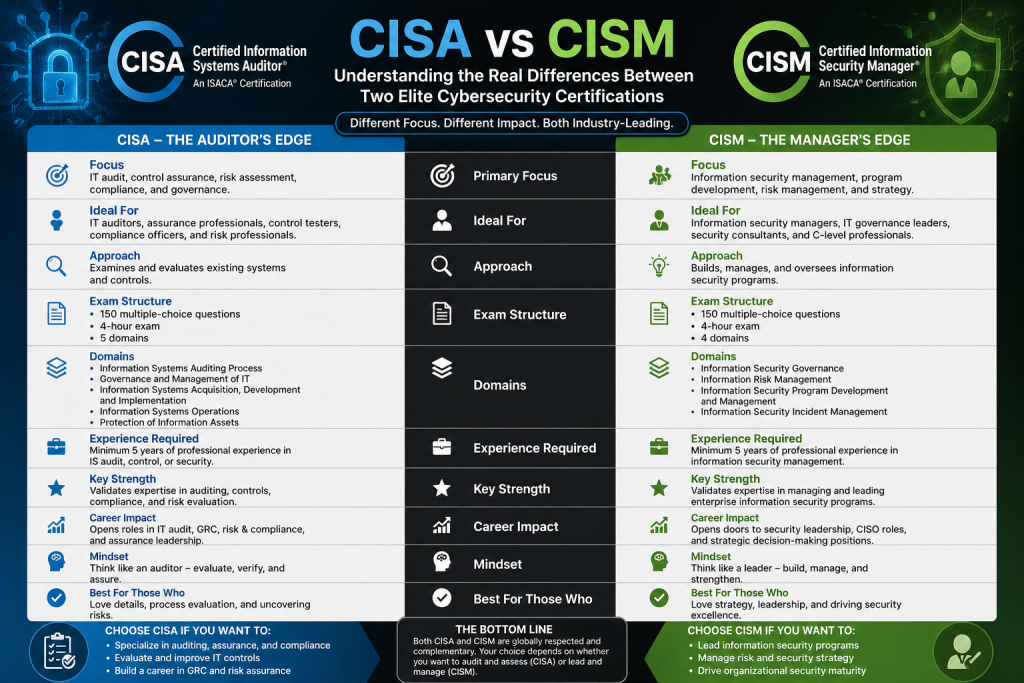
Cybersecurity has evolved from a specialized technical discipline into one of the most strategically important functions within modern organizations. As cyber threats become more sophisticated, businesses are under increasing pressure to protect data, maintain operational continuity, meet regulatory obligations, and align security with larger business objectives. In this environment, professional certifications have become powerful tools for validating expertise, demonstrating credibility, and accelerating career progression.
Among the many certifications available in cybersecurity and information governance, two stand out for their prestige, recognition, and career impact: CISA and CISM. Both certifications are administered by ISACA, a globally respected authority in information systems governance, risk, audit, and security. Both are highly valued by employers, widely recognized across industries, and often associated with senior-level career advancement.
Despite these similarities, CISA and CISM are not interchangeable certifications. They are designed for different types of professionals, different responsibilities, and different long-term career goals. While both contribute to organizational security and resilience, they approach these objectives from very different perspectives.
For professionals considering one of these certifications, understanding the distinction is critical. Choosing between CISA and CISM is not simply a matter of deciding which certification is “better.” Instead, it involves understanding which one aligns more effectively with your skills, interests, current experience, and future aspirations.
This first section explores the foundational differences between CISA and CISM by examining their purpose, strategic focus, professional identity, organizational value, and the types of careers they are designed to support.
Why CISA and CISM Are Frequently Compared
CISA and CISM are often mentioned together because they are both advanced certifications focused on information security, governance, and enterprise protection. They are also both designed for experienced professionals rather than newcomers. Unlike foundational certifications that introduce broad cybersecurity concepts, these credentials are aimed at individuals who already possess practical experience and want to validate or elevate their expertise.
Both certifications also carry strong reputational value. Employers often recognize them as indicators of professional maturity, practical capability, and strategic understanding. In competitive job markets, this recognition can significantly improve opportunities for advancement.
However, the reason these certifications are compared so often is also the reason professionals can misunderstand them. Because both operate under the cybersecurity umbrella, people sometimes assume they cover the same knowledge or prepare candidates for similar roles. In reality, they represent two different branches of the information security profession.
One focuses primarily on auditing, control validation, compliance, and assurance.
The other focuses on leadership, governance, policy development, and enterprise-wide security management.
This distinction defines everything from exam content to target audience.
Understanding the Core Purpose of CISA
CISA, or Certified Information Systems Auditor, is fundamentally centered on assurance. It validates a professional’s ability to assess, audit, monitor, and control information systems in a way that protects organizational assets while ensuring operational effectiveness.
The essence of CISA lies in asking critical questions about trust and accountability:
Are systems secure?
Are controls functioning correctly?
Are regulatory standards being met?
Are organizational risks being effectively identified and managed?
Can leadership trust the integrity of their systems?
CISA-certified professionals often serve as evaluators of systems and processes. Their role is not necessarily to build systems from scratch or lead broad security programs, but rather to assess whether those systems are secure, compliant, resilient, and properly governed.
This makes CISA especially relevant in industries where accountability is essential. Financial institutions, healthcare systems, government agencies, and multinational enterprises often rely on rigorous audits to satisfy stakeholders, regulators, and customers.
The CISA mindset is deeply analytical. It emphasizes control structures, governance processes, documentation, operational consistency, and verification.
In many ways, CISA professionals function as protectors of trust.
They help ensure that technology systems do what organizations believe they do—and that they do so securely, consistently, and in compliance with applicable requirements.
CISA as a Strategic Assurance Credential
Although auditing may sound narrow to some, modern information systems auditing is deeply strategic.
Organizations today depend on cloud platforms, third-party vendors, remote access infrastructure, software development pipelines, and digital transformation initiatives. Each introduces risks that must be evaluated carefully.
A CISA-certified professional may be tasked with assessing:
Cloud security controls
Vendor governance frameworks
Data privacy processes
Internal compliance standards
Business continuity capabilities
Disaster recovery planning
Operational risk controls
Cybersecurity maturity
This role goes far beyond simple checklist auditing. It often requires understanding how technical controls interact with organizational risk, business objectives, and legal obligations.
For example, when a company adopts a new SaaS platform, leadership may focus on efficiency gains. A CISA professional may instead ask:
How is data protected?
Are access controls adequate?
What compliance issues exist?
How are vendor risks managed?
Is incident response clearly defined?
This evaluative lens makes CISA highly valuable in governance-heavy environments.
The Professional Identity of a CISA Holder
Professionals who pursue CISA often gravitate toward careers that involve structure, investigation, process integrity, and independent evaluation.
These individuals may enjoy:
Reviewing systems for weaknesses
Testing controls
Assessing governance structures
Investigating inefficiencies
Ensuring compliance
Validating security posture
Supporting regulatory audits
Their work frequently intersects with executive stakeholders, regulators, and governance committees because assurance is often a board-level concern.
A CISA professional may not always be the one implementing firewalls or configuring systems, but they may be the person responsible for determining whether those controls are sufficient, effective, and aligned with policy.
This distinction gives CISA unique importance.
It is often less about direct technical intervention and more about ensuring systems and processes are trustworthy.
Understanding the Core Purpose of CISM
CISM, or Certified Information Security Manager, approaches cybersecurity from an entirely different angle.
Rather than focusing primarily on evaluating systems, CISM focuses on designing, leading, and managing enterprise security programs.
CISM is fundamentally about strategic security leadership.
A CISM-certified professional is often responsible for ensuring that an organization’s security strategy supports business goals while effectively managing risk.
This includes:
Developing security programs
Creating policies
Aligning security with organizational priorities
Leading incident response from a governance perspective
Managing risk strategically
Overseeing teams
Communicating with executives
Budgeting for security initiatives
CISM is less concerned with verifying whether individual controls are functioning properly and more focused on broader questions such as:
What security strategy best supports business growth?
How should security resources be prioritized?
How do we align risk management with operational goals?
How should leadership respond to evolving threats?
How do we build long-term security maturity?
This leadership orientation makes CISM especially attractive for those interested in management, governance, and executive influence.
CISM and Business Alignment
One of the defining characteristics of CISM is its emphasis on business alignment.
In modern organizations, security can no longer operate in isolation. Security decisions influence productivity, customer trust, regulatory compliance, brand reputation, and strategic growth.
For example, implementing highly restrictive controls may improve security but reduce business agility.
A CISM professional must balance these competing priorities.
This often means translating technical security concerns into business language executives can understand.
Rather than simply saying a vulnerability exists, a CISM professional may explain:
Potential business disruption
Financial exposure
Regulatory consequences
Operational impact
Strategic mitigation options
This ability to bridge technical security with executive priorities is a major reason CISM is associated with senior leadership.
The Professional Identity of a CISM Holder
Professionals drawn to CISM often prefer broader organizational influence over specialized auditing.
They may enjoy:
Building security strategy
Leading teams
Developing policy
Managing enterprise risk
Supporting executive decisions
Shaping organizational culture
Driving governance maturity
Coordinating business resilience
CISM often appeals to individuals transitioning from technical or operational roles into leadership.
For example, a security analyst may eventually want to oversee security programs rather than perform only technical assessments. CISM can validate that transition.
Auditor vs Manager: A Foundational Distinction
A practical way to understand the difference between CISA and CISM is to compare their organizational roles.
CISA often asks:
Are controls effective and compliant?
CISM often asks:
How should security be led and governed?
This distinction shapes career direction.
CISA is often investigative, evaluative, and assurance-driven.
CISM is often strategic, managerial, and policy-driven.
Neither role is inherently superior. They simply support different organizational needs.
An enterprise needs both strong auditors and strong managers.
Without auditors, organizations may lack accountability.
Without managers, organizations may lack strategic direction.
Different Mindsets, Different Career Paths
Your personality and professional preferences can significantly influence which certification is the better fit.
CISA may align better if you:
Enjoy detailed analysis
Like evaluating systems
Prefer governance verification
Value structure and process
Excel in compliance-heavy environments
Are interested in audit or assurance
CISM may align better if you:
Enjoy leadership
Prefer strategic planning
Want organizational influence
Like managing teams
Are interested in executive pathways
Want to shape enterprise security
These differences often matter more than salary comparisons because they influence long-term satisfaction.
Industry Demand and Organizational Need
Both certifications remain highly respected because organizations increasingly recognize cybersecurity as both a technical and business priority.
Digital transformation, cloud adoption, ransomware, regulatory pressure, and supply chain complexity have increased demand for both assurance professionals and strategic security leaders.
CISA remains highly relevant because organizations must continuously validate controls and governance.
CISM remains highly relevant because organizations need security leaders capable of guiding enterprise resilience.
As cyber risk becomes more visible at the board level, both certifications continue to hold strong value.
Why Some Professionals Pursue Both
Because CISA and CISM represent complementary strengths, some experienced professionals eventually pursue both credentials.
This combination can create a particularly powerful professional profile:
CISA demonstrates assurance expertise.
CISM demonstrates leadership capability.
Together, they can position a professional for senior governance roles, consulting leadership, or executive pathways.
However, for most individuals, choosing one first based on immediate career direction is more practical.
Avoiding Common Misconceptions
One of the biggest mistakes professionals make is assuming one certification is more “advanced” than the other.
They are advanced in different ways.
CISA is not a lesser version of CISM.
CISM is not simply “CISA plus management.”
They are distinct certifications built around different competencies.
Another misconception is that technical professionals should always choose CISA and managers should always choose CISM.
While often true, career transitions matter.
A technical security engineer aiming for leadership may find CISM strategically valuable.
An experienced compliance professional may find CISA more aligned.
Career trajectory matters more than current title alone.
Making the Right Strategic Choice
Before choosing either certification, professionals should ask:
Do I want to evaluate systems or lead programs?
Do I prefer compliance or strategy?
Do I enjoy detailed assurance or executive planning?
Do I want to specialize or manage?
Do I thrive in governance validation or organizational leadership?
These questions often reveal the best fit more clearly than salary statistics or exam difficulty.
Career Growth, Salary Potential, Industry Demand, and Long-Term Professional Value
Once professionals understand the foundational differences between CISA and CISM, the next major consideration becomes career impact. Certifications are not simply educational achievements—they are strategic investments. They require significant time, effort, and financial commitment, so one of the most important questions candidates ask is how each certification can influence career growth, salary potential, marketability, and long-term professional direction.
CISA and CISM are both globally respected, but they often open doors to different kinds of opportunities. One tends to strengthen careers rooted in assurance, audit, governance, and compliance, while the other is more closely associated with security leadership, enterprise strategy, and management. These differences influence not only the jobs professionals pursue but also the level of authority they may hold, the types of organizations they may work for, and the earning potential they may eventually reach.
Choosing between CISA and CISM from a career perspective means understanding how each credential aligns with industry needs, employer expectations, promotion pathways, and executive credibility.
This section explores how both certifications perform in the real world by examining job opportunities, salary ranges, industry demand, career mobility, leadership pathways, and the broader market forces shaping their value.
Why Career Path Matters More Than Certification Prestige Alone
Many professionals begin by asking which certification is “better,” but this question often oversimplifies reality. Neither CISA nor CISM is universally superior. Their value depends heavily on where you want your career to go.
For example, a professional interested in governance reviews, regulatory assurance, or enterprise audit may gain more practical value from CISA than CISM.
Conversely, someone aiming to lead security teams, shape enterprise security programs, or pursue executive leadership may find CISM more strategically useful.
This distinction matters because cybersecurity careers are increasingly specialized. Modern organizations require professionals who can perform technical analysis, governance oversight, business continuity planning, policy development, compliance monitoring, and executive communication.
As a result, certifications create the most value when they align with the direction of your desired specialization.
Career Pathways for CISA Professionals
CISA is strongly associated with careers that emphasize auditing, control assurance, compliance validation, and information systems governance. Because organizations face increasing regulatory obligations and rising cyber risks, professionals capable of evaluating security controls are in high demand.
CISA often supports career progression into roles such as:
IT Auditor
Information Systems Auditor
Internal Auditor
Compliance Analyst
Risk Consultant
Security Assessor
Governance Specialist
Audit Manager
Chief Audit Executive
Cyber Risk Advisor
These roles are particularly important in sectors where security and compliance failures can create severe financial or legal consequences.
For example:
Banks must prove governance integrity
Healthcare providers must protect patient data
Government agencies must maintain operational accountability
Insurance providers must validate controls
Global corporations must meet international compliance requirements
CISA-certified professionals often become trusted advisors because they validate whether controls and governance frameworks truly function as intended.
This creates opportunities not only within internal corporate roles but also in consulting, external audit firms, governance advisory services, and regulatory organizations.
The Strategic Value of CISA in Regulated Industries
One of the strongest advantages of CISA is its relevance in highly regulated sectors.
As privacy laws, cybersecurity frameworks, and governance mandates continue to expand, organizations need professionals who understand how to align systems with standards.
Examples include:
Financial regulations
Data privacy laws
Healthcare security standards
Government security frameworks
Third-party risk controls
Corporate governance requirements
Because compliance failures can result in penalties, lawsuits, or reputational damage, organizations increasingly prioritize assurance professionals.
This means CISA can remain highly resilient even during shifts in cybersecurity trends.
While technologies evolve, governance and accountability remain constant.
Career Pathways for CISM Professionals
CISM is generally more aligned with leadership and enterprise security oversight.
Professionals who earn CISM often pursue roles such as:
Information Security Manager
Security Program Manager
Risk Director
Governance Lead
IT Security Consultant
Security Operations Leader
Incident Governance Manager
Chief Information Security Officer (CISO)
Chief Risk Officer
Enterprise Security Strategist
These roles emphasize strategic oversight more than direct operational auditing.
A CISM professional may be responsible for:
Building security frameworks
Leading teams
Managing budgets
Defining security priorities
Aligning security strategy with business growth
Communicating with executive leadership
Guiding incident governance
Overseeing enterprise resilience
This strategic orientation often places CISM-certified professionals closer to boardrooms and executive leadership.
CISM and the Executive Leadership Pipeline
One of CISM’s most important career advantages is its connection to management advancement.
Organizations increasingly recognize cybersecurity as a business-critical issue rather than a purely technical department.
As cyber threats impact legal risk, financial exposure, customer trust, and strategic resilience, businesses need security leaders capable of participating in executive conversations.
This is where CISM becomes particularly valuable.
CISM-certified professionals often develop credibility in areas such as:
Risk governance
Policy design
Strategic communication
Business continuity leadership
Cross-functional coordination
Program oversight
These competencies can create pathways into executive positions that extend beyond traditional cybersecurity roles.
For example, a CISM holder may eventually transition into broader governance, operational risk, or strategic advisory leadership.
Salary Potential: Understanding the Real Drivers
Salary comparisons between CISA and CISM often attract significant attention, but compensation depends on many variables beyond certification alone.
Key salary drivers include:
Geographic location
Years of experience
Industry sector
Company size
Leadership responsibility
Technical depth
Regulatory environment
Executive influence
That said, both certifications are generally associated with above-average earning potential because they target experienced professionals.
CISA often supports strong earning potential in:
Audit management
Compliance consulting
Governance advisory
Internal controls leadership
Risk analysis
CISM often supports higher salary ceilings in:
Security management
Program leadership
Executive governance
Strategic consulting
CISO pathways
Because CISM often aligns more directly with management and executive roles, it may offer stronger long-term salary acceleration for professionals who successfully move into leadership.
However, experienced CISA professionals in senior governance or consulting roles can also command highly competitive compensation.
Industry Demand Across Global Markets
The cybersecurity workforce shortage continues to drive demand for qualified professionals, but different market segments prioritize different skills.
CISA demand is especially strong where organizations need:
Audit readiness
Regulatory assurance
Control validation
Risk oversight
Governance maturity
Vendor assurance
CISM demand is especially strong where organizations need:
Security leadership
Program maturity
Strategic governance
Incident management leadership
Executive communication
Risk transformation
As organizations mature, many require both.
For example:
A multinational bank may need CISA professionals to validate governance and CISM professionals to lead enterprise security.
A healthcare network may need CISA for HIPAA-related controls and CISM for enterprise security direction.
A government contractor may need both compliance assurance and strategic security governance.
This dual demand reinforces the lasting relevance of both certifications.
Consulting Opportunities
Both CISA and CISM can significantly improve consulting opportunities, though the nature of consulting differs.
CISA consulting often includes:
Control assessments
Compliance reviews
Risk audits
Governance evaluations
Regulatory preparation
Security assessments
CISM consulting often includes:
Security strategy design
Governance frameworks
Risk leadership
Policy development
Executive advisory
Program transformation
Independent consultants may eventually pursue both certifications to strengthen versatility, but specialization can also be powerful.
Career Stability and Economic Resilience
Economic uncertainty can influence hiring trends, but governance and security often remain business priorities.
CISA offers resilience because organizations consistently require audit and compliance functions, especially under regulatory scrutiny.
CISM offers resilience because organizations cannot afford strategic security neglect, particularly in high-risk sectors.
In many cases, cybersecurity governance roles may remain more stable than purely operational roles because governance obligations persist even when budgets tighten.
Promotion Potential
Promotion opportunities often differ between the two certifications.
CISA may naturally lead toward:
Senior auditor
Audit director
Governance lead
Risk assurance executive
Compliance director
CISM may naturally lead toward:
Security manager
Director of information security
Head of governance
CISO
Strategic risk executive
This distinction is important.
CISA may strengthen specialization depth.
CISM may strengthen organizational authority breadth.
Global Recognition
Both certifications hold strong international recognition because ISACA is globally respected.
This can benefit professionals seeking:
International consulting
Cross-border governance roles
Remote enterprise opportunities
Multinational corporate advancement
Government or compliance work
Because governance, audit, and management principles often transcend regional technical differences, both certifications can support international mobility.
The Psychological Value of Certification
Beyond salary and job titles, certifications often influence confidence and professional identity.
CISA may reinforce a professional’s credibility as a trusted evaluator.
CISM may reinforce identity as a strategic leader.
This can affect how professionals position themselves internally and externally.
For example:
A CISA may be viewed as a governance authority.
A CISM may be viewed as a strategic security leader.
Perception can influence opportunity.
Which Certification Offers Faster Career Growth?
This depends heavily on your starting point.
If you already work in audit, governance, or compliance, CISA may produce faster relevant advancement.
If you already lead teams or aspire to management, CISM may accelerate strategic growth more effectively.
The “faster” path is usually the one aligned with existing strengths and future direction.
The Role of Experience
Neither certification guarantees career success on its own.
Experience remains essential.
A certification can enhance credibility, but real-world expertise determines long-term effectiveness.
Professionals who combine certification with strong communication, business awareness, and practical execution often outperform those who rely solely on credentials.
Building a Long-Term Professional Strategy
When evaluating career growth, it is useful to think in stages:
Early specialization
Mid-career advancement
Leadership development
Executive authority
CISA may be especially powerful in early-to-mid governance specialization.
CISM may be especially powerful in mid-to-late strategic leadership.
This is why some professionals earn CISA first, then later pursue CISM.
Avoiding Salary-Only Decision Making
Choosing solely based on average salary can be misleading.
A certification should support a sustainable and fulfilling professional identity.
Higher salary without alignment can lead to dissatisfaction.
The better question is:
Which path supports both my strengths and long-term goals?
Exam Requirements, Preparation Strategy, Certification Challenges, and Choosing the Right Path for Your Future
Choosing between CISA and CISM is not only about understanding their focus areas or potential career outcomes. For most professionals, the final decision often comes down to practical realities: eligibility requirements, exam structure, study commitment, professional experience, certification maintenance, and long-term alignment with personal goals.
Both certifications are widely respected because they are demanding. They are not designed to be quick résumé boosters or beginner-level credentials. Instead, they validate meaningful professional experience, broad knowledge, and the ability to apply principles in real organizational environments. This rigor is precisely why employers value them.
For aspiring candidates, however, this also means preparation must be intentional. Time investment, strategic planning, realistic self-assessment, and understanding the certification journey are all critical.
This final section explores the major practical differences between CISA and CISM by examining exam expectations, experience requirements, study strategies, common challenges, certification value over time, and how to determine which path best aligns with your future.
Why Certification Planning Matters More Than Exam Registration Alone
Many professionals make the mistake of viewing certification as a single event—the exam itself. In reality, successful certification is a long-term process involving:
Career alignment
Experience validation
Knowledge development
Study discipline
Practical application
Post-certification maintenance
This is particularly true for CISA and CISM because both certifications are tied closely to real-world expertise.
Passing the exam is only one part of the journey.
Candidates must also understand how each certification supports their broader professional identity.
For example, earning CISA without a genuine interest in governance or assurance may produce limited long-term value.
Similarly, pursuing CISM without management aspirations may not maximize its strategic advantages.
This is why planning matters.
Eligibility and Experience Requirements
One of the defining characteristics of both CISA and CISM is that they are designed for experienced professionals.
Unlike entry-level certifications that primarily test knowledge, these certifications emphasize applied competence.
Both generally require five years of relevant professional experience, though waivers may reduce part of that requirement under qualifying circumstances.
This structure reinforces credibility.
It ensures that certified professionals are not only academically prepared but also professionally seasoned.
For CISA, relevant experience typically centers on:
Information systems auditing
Control assurance
Security governance
Risk management
Compliance oversight
For CISM, relevant experience typically centers on:
Security management
Governance leadership
Risk strategy
Program development
Incident governance
This difference matters because experience alignment often reveals which certification is more realistic or beneficial.
A compliance analyst with years of audit work may naturally fit CISA.
A security team lead managing governance initiatives may align more naturally with CISM.
Understanding Exam Philosophy
Although both certifications use multiple-choice exams and share a reputation for difficulty, their testing philosophies differ.
CISA tends to evaluate a candidate’s ability to assess, validate, and ensure that systems and controls function properly.
This often means candidates must think like evaluators.
They may be asked to determine:
Which control is most effective
What audit finding is most critical
How governance weaknesses should be prioritized
What compliance issue creates the greatest exposure
How assurance should be approached
CISM, by contrast, often evaluates strategic leadership thinking.
Candidates may need to determine:
Which governance decision best aligns with business objectives
How leadership should prioritize security resources
What management response is most appropriate
How incident governance should be structured
How enterprise strategy should influence security
This distinction is important.
CISA often rewards an analytical assurance mindset.
CISM often rewards a business-aligned management mindset.
The Real Challenge: Perspective Shift
For many candidates, the hardest part is not memorization—it is adapting to the mindset required.
A highly technical engineer may struggle with management-oriented CISM questions if they default to technical problem-solving rather than strategic governance.
Similarly, a security manager may find CISA challenging if they are less familiar with detailed auditing logic.
Success often depends on understanding how the exam expects you to think.
This is why exam-specific preparation is so critical.
Study Commitment and Time Investment
Both certifications require significant preparation, though exact timelines vary based on:
Professional background
Existing experience
Study habits
Familiarity with governance
Understanding of ISACA methodology
Many candidates underestimate the challenge because they already work in cybersecurity.
Experience helps, but these exams test structured frameworks, decision-making logic, and certification-specific priorities.
Effective preparation often includes:
Official study guides
Practice exams
Scenario analysis
Concept review
Policy understanding
Governance frameworks
Risk methodology
Time management planning
Consistency often matters more than intensity.
Studying strategically over several months is usually more effective than cramming.
The Importance of Practice Questions
One of the most effective preparation strategies for both certifications is repeated exposure to scenario-based questions.
This is because ISACA exams often test judgment, not just factual recall.
For example, two answers may both appear technically valid, but one may better reflect governance best practice.
Practice helps candidates learn:
Question phrasing
Prioritization logic
Business alignment
Risk hierarchy
Management expectations
Without this, even experienced professionals may struggle.
Balancing Work and Study
Because many CISA and CISM candidates are already working professionals, one of the biggest challenges is balancing preparation with career responsibilities.
This often requires:
Study scheduling
Burnout prevention
Weekend planning
Progress tracking
Employer support
Realistic pacing
Professionals who treat preparation like a structured project often perform better than those relying on motivation alone.
Certification Cost Considerations
Beyond study time, both certifications involve financial investment.
Costs may include:
Exam registration
Study materials
Practice tests
Training platforms
Membership fees
Continuing education obligations
While cost can feel significant, many professionals view these certifications as long-term investments because they may improve:
Earning potential
Promotion opportunities
Credibility
Market competitiveness
Still, candidates should evaluate return on investment based on their actual career path.
Maintaining Certification
Certification does not end after passing.
Both CISA and CISM require ongoing professional education and maintenance to preserve active status.
This reflects an important reality:
Cybersecurity governance evolves constantly.
Threats change.
Regulations evolve.
Frameworks mature.
Leadership expectations expand.
Maintaining certification demonstrates commitment to continuous professional development.
For employers, this can strengthen trust.
Choosing Based on Professional Identity
One of the most important decisions candidates must make is whether they identify more strongly with assurance or leadership.
Choose CISA if you are drawn to:
Audit
Governance validation
Control assessment
Risk evaluation
Compliance
Operational trust
Choose CISM if you are drawn to:
Leadership
Program development
Security governance
Strategic alignment
Business integration
Executive communication
This decision often matters more than salary assumptions or prestige comparisons.
When CISA May Be the Better Choice
CISA may be particularly suitable if:
You enjoy structured analysis
You work in audit or compliance
You prefer objective evaluation
You want governance specialization
You support regulatory frameworks
You like investigating process maturity
It can also serve as a powerful differentiator for consultants and governance professionals.
When CISM May Be the Better Choice
CISM may be particularly suitable if:
You want management growth
You oversee teams
You influence policy
You want executive relevance
You enjoy strategic planning
You seek broader organizational authority
For aspiring CISOs or governance leaders, CISM may offer stronger alignment.
Can You Pursue Both?
Yes, and many professionals eventually do.
Earning both certifications can create a powerful profile that combines:
Assurance credibility
Governance expertise
Management leadership
Strategic oversight
This combination may be especially useful for senior consultants, governance executives, or enterprise leaders.
However, for most professionals, pursuing one first based on immediate relevance is often more practical.
Common Mistakes Candidates Make
Some of the most common mistakes include:
Choosing based solely on salary
Underestimating exam difficulty
Ignoring experience alignment
Studying without practice questions
Pursuing prestige over strategy
Failing to assess long-term goals
Avoiding these mistakes can significantly improve outcomes.
The Psychological Component
Certification journeys often involve self-doubt, especially for professionals returning to structured study after years in the workforce.
Success often requires:
Confidence
Consistency
Patience
Adaptability
Strategic discipline
Candidates should remember that preparation is often as much about mindset as knowledge.
Long-Term Value Beyond Certification
The real value of CISA or CISM often extends beyond exam success.
These certifications can reshape:
Professional identity
Employer perception
Promotion readiness
Strategic credibility
Career confidence
They may also strengthen networking opportunities through professional communities and industry recognition.
The Future of Cybersecurity Certifications
As cybersecurity evolves, organizations increasingly prioritize professionals who understand not only technical threats but also governance, resilience, and business continuity.
This trend supports ongoing relevance for both CISA and CISM.
CISA remains vital because assurance and compliance are foundational.
CISM remains vital because leadership and strategic governance are essential.
In a world of AI risk, cloud transformation, supply chain complexity, and regulatory growth, these certifications may become even more valuable.
Final Decision Framework
Before committing, ask yourself:
Do I want to evaluate or lead?
Do I prefer controls or strategy?
Do I want specialization or executive direction?
Am I more analytical or managerial?
Where do I want my career in five to ten years?
These questions often provide the clearest answer.
Conclusion
CISA and CISM are both exceptional certifications, but their true value lies not in prestige alone—it lies in alignment.
CISA is ideal for professionals who want to strengthen trust through auditing, governance, compliance, and assurance. It supports careers rooted in evaluation, accountability, and control integrity.
CISM is ideal for professionals who want to shape organizational security through leadership, governance strategy, policy development, and executive influence. It supports careers focused on management, direction, and enterprise resilience.
Both certifications require meaningful experience, serious preparation, and long-term commitment. Neither is easy, and neither should be pursued casually.
The right choice depends on who you are as a professional and who you want to become.
If your future lies in validating systems, strengthening governance, and ensuring organizational trust, CISA may be your strongest path.
If your future lies in leading teams, shaping enterprise security strategy, and guiding organizations through complex risk, CISM may be your ideal destination.
Ultimately, the best certification is not the one with the highest prestige or salary average—it is the one that aligns most powerfully with your ambitions, your strengths, and your vision for the future.
In cybersecurity, credentials matter—but purposeful direction matters even more.
Continue exploring the technologies and certification concepts that matter most to you.