Modern digital infrastructure depends heavily on fast, stable, and scalable communication systems. As global demand for internet connectivity, cloud computing, streaming, enterprise networking, and data center performance continues to accelerate, traditional copper-based communication mediums often struggle to meet modern bandwidth and distance requirements. This is where fiber optic technology has become a transformative force in networking.
Fiber optic cables transmit information using pulses of light rather than electrical signals. This fundamental difference gives fiber optics extraordinary advantages in speed, distance, bandwidth, and resistance to electromagnetic interference. Instead of relying on electricity moving through metal conductors, fiber optics use light traveling through ultra-pure strands of glass or plastic, allowing data to move at remarkably high speeds with minimal signal loss.
Fiber optics are now used in countless applications, from international submarine cables connecting continents to enterprise campuses, telecommunications backbones, military infrastructure, and local area networks. Whether supporting cloud computing platforms, streaming services, smart cities, or industrial automation, fiber has become essential.
Understanding fiber optics requires more than simply recognizing that it is “faster.” The architecture of fiber networks varies significantly depending on use case, distance, budget, and performance needs. The two primary categories are single mode fiber and multimode fiber. While both use light to transmit information, their design, behavior, and deployment strategies differ considerably.
Before comparing these technologies in detail, it is essential to understand the core principles of fiber optic communication itself. Knowing how fiber functions at a physical level helps clarify why certain fiber types excel in some environments while others are better suited elsewhere.
How Fiber Optic Technology Works
At its core, fiber optic communication relies on light propagation through a specially engineered cable. A fiber optic cable contains several layers, each serving a specific role in protecting and guiding the signal.
The central portion is called the core. This is where light travels. Surrounding the core is the cladding, which has a lower refractive index than the core. This difference allows light to remain trapped inside the core through a process called total internal reflection. Light signals bounce along the cable while staying contained, even across long distances.
Outside the cladding is protective coating and jacketing, which shield the fiber from moisture, physical damage, and environmental stress.
Data transmission begins when a transmitter converts electrical information into optical signals. These signals are then sent through the fiber using either LEDs or lasers, depending on the fiber type. At the receiving end, optical receivers convert light back into electrical signals for processing.
Fiber optics offer several key advantages over copper cabling:
- Higher bandwidth capacity
- Longer transmission distances
- Lower attenuation
- Immunity to electromagnetic interference
- Greater security
- Reduced latency
- Smaller cable size
These characteristics make fiber ideal for high-performance networking, but not all fiber is identical. Core diameter, light source, and signal propagation create major distinctions.
The Two Main Fiber Types
Fiber optic cabling generally falls into two categories:
- Single mode fiber
- Multimode fiber
The primary distinction lies in how light travels through the core.
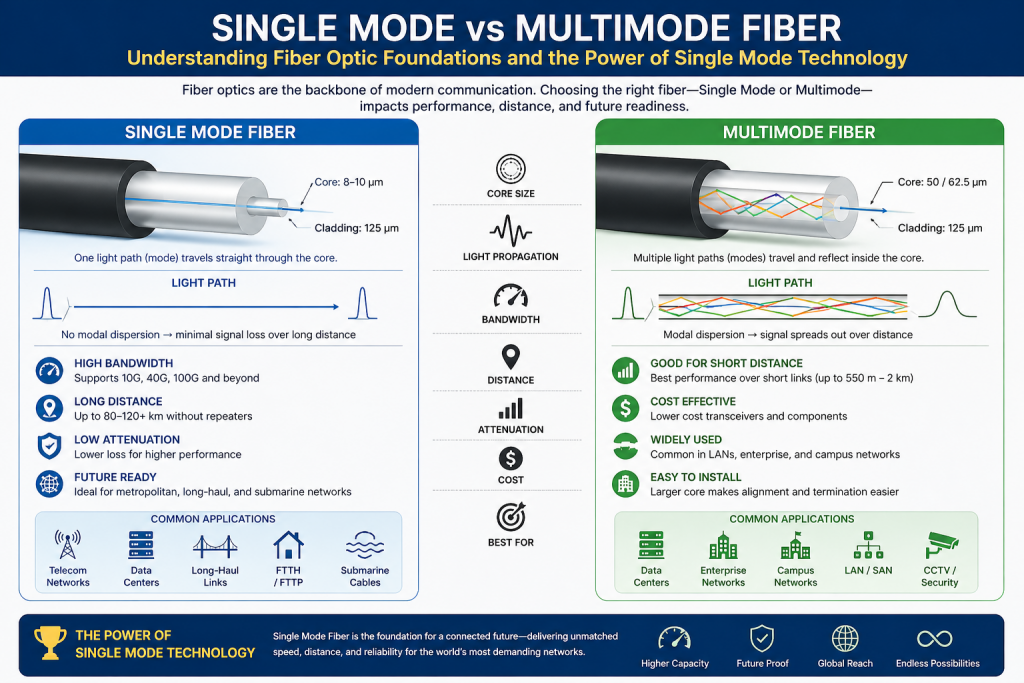
Single mode fiber allows one mode, or path, of light to travel directly through the cable.
Multimode fiber allows multiple light modes to travel simultaneously through a larger core.
This difference may sound minor, but it dramatically impacts performance, distance, cost, and deployment strategy.
To fully appreciate these differences, it is important to first explore single mode fiber in depth.
What Is Single Mode Fiber?
Single mode fiber, often abbreviated as SMF, is designed for long-distance, high-bandwidth communication. Its defining characteristic is its extremely small core diameter, typically between 8 and 10 micrometers.
Because the core is so narrow, only one light path can propagate through the fiber. This single pathway minimizes internal reflection variations and nearly eliminates modal dispersion, which is a major source of signal degradation in other fiber types.
Single mode fiber usually operates with laser-based transmitters rather than LEDs. Laser diodes produce highly focused, coherent, monochromatic light, making them ideal for precise transmission over vast distances.
The consistency of laser light enables:
- Greater signal integrity
- Longer transmission ranges
- Higher data rates
- Reduced attenuation
- Better future scalability
This architecture makes SMF the dominant choice for telecommunications carriers, long-haul internet backbones, metropolitan area networks, and submarine communication systems.
The Science Behind Single Mode Efficiency
The reason single mode fiber performs so well comes down to physics.
When multiple light rays travel through a larger core, they arrive at slightly different times due to path variation. This phenomenon, known as modal dispersion, reduces clarity over distance.
Single mode fiber solves this by restricting transmission to one path. With one direct beam, there is virtually no modal distortion. The result is exceptional signal consistency even over dozens or hundreds of kilometers.
This streamlined light propagation means that single mode systems can often transmit data over distances approaching 100 kilometers without requiring regeneration, depending on hardware and environmental conditions.
By minimizing distortion, SMF supports technologies such as:
- Dense wavelength division multiplexing
- Long-haul telecommunications
- Fiber-to-the-home deployments
- Carrier Ethernet
- 5G backbone networks
Single Mode Fiber Construction and Standards
Single mode fiber typically follows standardized constructions that ensure interoperability and predictable performance.
Its common design includes:
- Core diameter: 8–10 µm
- Cladding diameter: 125 µm
- Light source: Laser
- Common wavelengths: 1310 nm and 1550 nm
The 1310 nm wavelength is often used for moderate-distance transmission because of lower dispersion.
The 1550 nm wavelength is preferred for very long distances because attenuation is even lower.
These wavelength standards are important because fiber performance depends not only on cable quality but also on optical transceiver design.
Major Advantages of Single Mode Fiber
Single mode fiber’s greatest strength is transmission range. It dramatically exceeds the capabilities of copper and multimode alternatives.
SMF is ideal for:
- Intercity communication
- Campus backbone infrastructure
- ISP core networks
- International communications
- Undersea cable systems
Without frequent signal repeaters, infrastructure costs can often be optimized over larger geographic deployments.
Higher Bandwidth Potential
Single mode fiber offers enormous bandwidth capabilities. Because signal degradation is low, SMF can support advanced protocols and scaling requirements far beyond many short-range alternatives.
This makes it suitable for:
- High-frequency trading
- Cloud infrastructure
- Data center interconnects
- AI data transport
- Scientific research networks
As enterprise demands grow, SMF often provides superior future-proofing.
Lower Signal Loss
Attenuation in single mode systems is significantly reduced compared to many other mediums. Lower attenuation means signals travel farther without degradation, increasing reliability and lowering the need for intermediate equipment.
Enhanced Security
Fiber optics are inherently more secure than copper because intercepting optical signals without disruption is difficult. Single mode’s focused transmission can provide additional resistance to leakage and interference, making it attractive for sensitive applications.
Support for Advanced Multiplexing
Single mode fiber can support multiple wavelengths simultaneously through wavelength division multiplexing. This allows enormous amounts of data to travel over a single strand, dramatically increasing infrastructure efficiency.
Challenges and Limitations of Single Mode Fiber
Despite its advantages, SMF is not always the ideal solution for every environment.
Higher Initial Cost
The most significant drawback is implementation cost.
Expenses may include:
- Laser transceivers
- Precision connectors
- Specialized installation tools
- Higher-skilled technicians
- More expensive testing equipment
While cable itself may not always be drastically more expensive, associated optical components often are.
Complex Installation Requirements
The small core size demands exceptional precision. Improper alignment can significantly impact performance.
Technicians must carefully manage:
- Connector cleanliness
- Bend radius
- Fusion splicing precision
- Optical power budgets
Installation mistakes can quickly reduce system reliability.
Bend Sensitivity
Although durable, SMF often has stricter bend radius tolerances. Excessive bending can create microbends or macrobends that degrade transmission.
Potential Overengineering for Small Networks
For a modest office LAN or short in-building connections, SMF may exceed operational needs and budget realities.
Where Single Mode Fiber Is Commonly Used
Single mode fiber dominates environments where distance and scalability are top priorities.
Common deployments include:
- Telecommunications providers
- Internet backbone infrastructure
- Government communication systems
- Utility grids
- Large-scale educational campuses
- Military communication systems
- Cloud service providers
- Smart city infrastructure
Its role in global connectivity cannot be overstated. The majority of worldwide internet traffic ultimately relies on extensive single mode networks.
Single Mode Fiber in Residential and Enterprise Growth
Fiber-to-the-home initiatives increasingly rely on SMF because of long-term scalability. Although deployment costs can be high initially, SMF supports future upgrades without replacing the physical cable.
For enterprises, installing SMF in backbone pathways can reduce future recabling costs as bandwidth requirements evolve.
This strategic advantage often offsets early investment.
The Future of Single Mode Fiber
As technology evolves, single mode fiber remains central to innovation.
Emerging technologies increasing SMF importance include:
- 5G and 6G infrastructure
- Autonomous systems
- Industrial IoT
- Edge computing
- Quantum networking
- AI supercomputing
- Smart transportation
Because these systems require high-speed, low-latency, long-distance communication, SMF continues to be a foundational technology.
Understanding Fiber Choice Begins with Understanding Need
Single mode fiber is not simply “better” than other forms of networking. It is better for specific scenarios where performance requirements justify investment.
When evaluating infrastructure, organizations must consider:
- Distance
- Budget
- Existing equipment
- Growth expectations
- Security
- Maintenance complexity
For some environments, SMF is indispensable. For others, it may be excessive.
Advanced Multimode Fiber Design Considerations
As network environments become increasingly dependent on real-time data exchange, virtualization, unified communications, and distributed computing, multimode fiber design must move beyond simple bandwidth discussions. Infrastructure planners now evaluate multimode deployments based on long-term architecture, environmental resilience, equipment lifecycle, and migration strategy.
A major advantage of multimode fiber is that it can often be integrated into modular growth strategies. Organizations can deploy multimode in phases, expanding from server room interconnectivity to campus-wide backbone segments while controlling costs. This phased deployment strategy is particularly useful for educational institutions, hospitals, and mid-sized enterprises where capital expenditures must be carefully managed.
Structured cabling design also plays a major role in multimode success. Proper cable pathways, patch panel placement, rack density planning, and airflow management all influence operational efficiency. In high-density environments such as data centers, multimode fiber’s smaller cable footprint compared to copper can improve cooling efficiency by reducing airflow obstruction. Better airflow can directly contribute to lower operational costs through improved thermal management.
Additionally, multimode systems can be designed to support redundancy models that improve fault tolerance. Enterprises often deploy diverse multimode pathways between critical infrastructure points to ensure business continuity in case of cable damage or hardware failure. While multimode is generally associated with short-range deployment, strategic engineering can make it a highly resilient medium.
Multimode Fiber and High-Speed Ethernet Evolution
Ethernet standards have evolved dramatically, and multimode fiber has adapted alongside them.
Modern multimode environments can support a wide range of Ethernet protocols, including:
- 1 Gigabit Ethernet
- 10 Gigabit Ethernet
- 25 Gigabit Ethernet
- 40 Gigabit Ethernet
- 100 Gigabit Ethernet (distance dependent)
This evolution demonstrates that multimode is not limited to “basic” networking. In many cases, properly selected OM3, OM4, or OM5 fiber can handle sophisticated enterprise and cloud workloads.
For example, 10GbE over OM4 is a common enterprise standard because it balances performance with manageable infrastructure cost. In virtualization-heavy environments where east-west traffic between servers is substantial, this bandwidth can dramatically improve application responsiveness.
However, higher Ethernet speeds often require careful consideration of connector quality, transceiver compatibility, and insertion loss budgets. Even when the cable itself supports high throughput, poor implementation at physical connection points can undermine performance.
Connector Types and Their Role in Multimode Performance
Fiber performance is not determined solely by cable category. Connector selection significantly impacts deployment quality.
Common multimode connectors include:
- LC
- SC
- ST
- MPO/MTP
LC connectors are especially common in modern enterprise and data center environments because of their compact size and high-density compatibility.
MPO/MTP connectors are increasingly used for parallel optics and higher-speed applications such as 40G and 100G deployments. These connectors allow multiple fiber strands within a single connector body, improving density but also increasing the need for precise polarity and cleanliness management.
Connector contamination remains one of the most common causes of fiber performance degradation. Dust, oils, or improper cleaning can significantly reduce signal quality. Even multimode’s relatively forgiving architecture still requires rigorous optical hygiene.
Environmental Factors Affecting Multimode Fiber
Although fiber optics are highly reliable, environmental conditions still matter.
Factors that can impact MMF include:
- Excessive bending
- Temperature fluctuations
- Moisture intrusion
- Physical compression
- Connector contamination
Indoor enterprise environments typically present fewer risks, but industrial settings such as manufacturing plants or warehouses may require armored cabling or additional protective sheathing.
Fire safety standards also matter. Plenum-rated multimode cables may be required in ventilation spaces, while riser-rated cables are used for vertical shafts. Compliance with building regulations is essential for both safety and legal deployment.
Multimode Fiber in Smart Buildings and IoT Expansion
As smart building technology expands, multimode fiber increasingly supports integrated ecosystems.
Examples include:
- Building automation systems
- Surveillance infrastructure
- Access control systems
- Smart lighting controls
- Wireless access point aggregation
- IoT sensor backbones
Because many of these systems operate within contained facilities, multimode fiber provides an ideal foundation. It can support substantial data aggregation without requiring the long-distance specialization of single mode.
This makes MMF especially attractive in airports, hospitals, universities, and manufacturing campuses.
Economic Lifecycle of Multimode Infrastructure
When evaluating multimode fiber, organizations should assess total cost of ownership rather than only installation cost.
Initial savings often include:
- Lower transceiver pricing
- Faster deployment
- Reduced training complexity
Operational considerations may include:
- Maintenance
- Upgrade cycles
- Hardware compatibility
- Energy consumption
- Expansion pathways
For many organizations, multimode offers excellent medium-term ROI. However, if a network is expected to scale geographically or require extreme future bandwidth, planners may consider hybrid models that combine multimode for local infrastructure and single mode for broader backbone connectivity.
Hybrid Fiber Strategies
Many modern enterprises no longer choose exclusively between single mode and multimode. Instead, they implement both.
A common model includes:
- Multimode for in-building and rack-level deployments
- Single mode for campus backbone or metropolitan links
This hybrid architecture allows organizations to optimize costs while preserving scalability.
For example, a corporation may use OM4 multimode within office towers but deploy SMF between citywide campuses. This design balances economics with strategic performance.
Multimode Fiber and Network Certification Relevance
For networking professionals, multimode fiber knowledge is essential for certifications and practical engineering.
Key concepts often include:
- Core diameter
- Modal dispersion
- OM standards
- Wavelengths
- Connector types
- Distance limitations
- Bandwidth calculations
Understanding multimode is especially relevant for infrastructure specialists, systems administrators, network engineers, and data center architects.
Long-Term Outlook
Despite frequent discussion around single mode dominance, multimode remains deeply relevant because networking is not one-size-fits-all. Practicality, economics, and environmental requirements continue to drive multimode adoption.
Its future will likely remain strongest in:
- Edge computing
- Enterprise networking
- Building automation
- Campus systems
- AI clusters with localized infrastructure
- High-density server environments
As organizations continue balancing budget and performance, multimode fiber will remain a critical component of network architecture rather than an obsolete transitional technology. Properly deployed multimode systems can deliver exceptional value, particularly when aligned with realistic operational goals.
Deployment Strategy, Performance Planning, Security, Scalability, and Final Decision Framework
Selecting between single mode fiber and multimode fiber is one of the most important infrastructure decisions in network design. While both technologies rely on light to transmit information through glass strands at exceptional speeds, their practical use cases, deployment strategies, cost structures, and long-term benefits differ significantly. Organizations that fail to understand these distinctions may overspend, underperform, or create future scalability problems that require expensive redesigns.
A network is not simply a collection of cables connecting devices. It is a strategic platform that supports communication, cloud integration, business continuity, cybersecurity, productivity, and future innovation. The decision between SMF and MMF should therefore be approached not only from a technical perspective but also from financial, operational, and strategic viewpoints.
The right choice depends on numerous variables including distance, speed requirements, infrastructure lifespan, budget, installation environment, security priorities, and future expansion plans. In modern enterprise environments, selecting the wrong medium can create bottlenecks that hinder organizational growth, while selecting the right one can provide decades of reliable, scalable service.
Fundamental Performance Comparison Between SMF and MMF
Single mode fiber and multimode fiber differ most fundamentally in the way light travels through their cores. This physical distinction directly impacts network performance.
Single mode fiber contains a very small core, typically around 8–10 microns, allowing only one light path to travel through the cable. This singular transmission path minimizes modal dispersion, which is the spreading of light pulses over distance. Reduced dispersion means data remains clearer and more consistent over long distances, making SMF ideal for high-performance wide-area communication.
Multimode fiber, by contrast, has a larger core, often 50 or 62.5 microns, enabling multiple light rays to travel simultaneously. While this design supports high bandwidth over short distances, it also introduces modal dispersion because different light paths arrive at slightly different times. This limits MMF’s effective distance and long-term scalability compared to SMF.
From a practical perspective:
SMF excels in long-distance, high-capacity environments.
MMF excels in short-distance, cost-efficient environments.
Both can deliver impressive speeds, but the context of deployment determines their true value.
Distance as the Primary Deployment Variable
Distance is often the first and most decisive factor when selecting fiber type.
Single mode fiber dominates scenarios involving:
Telecommunications backbones
Inter-building enterprise links
Metropolitan area networks
Campus-wide infrastructure
Regional ISP deployment
Undersea communication
Long-haul data center interconnects
Its ability to transmit signals for tens or even hundreds of kilometers with minimal attenuation makes it indispensable when distance matters.
Multimode fiber is typically deployed in:
Office buildings
Local area networks
Server rooms
Data halls
Campus buildings with moderate cable runs
Industrial facilities
For many LAN environments, multimode’s range is more than sufficient. Deploying SMF for every internal office connection may provide excellent performance, but often at unnecessary cost.
A critical planning mistake is overengineering small networks while underengineering growth-focused environments. Strategic deployment means matching cable capability to operational scope.
Cost Comparison: Beyond Purchase Price
Many organizations initially gravitate toward multimode because its transceivers, patch cables, and connectors are generally less expensive. This makes sense for projects with immediate budget limitations.
Short-term MMF cost benefits often include:
Lower transceiver prices
Cheaper LED-based optics
Reduced connector precision requirements
Simpler technician workflows
Lower initial deployment costs
However, financial analysis should not stop at installation.
Long-term cost considerations include:
Upgrade cycles
Equipment replacement
Bandwidth limitations
Downtime during transitions
Expansion redesign
Lifecycle maintenance
Single mode often requires:
Laser-based optics
Higher-grade components
Precision installation
Specialized testing
These factors raise initial capital expenditures. Yet in rapidly expanding organizations, single mode may reduce long-term costs because it avoids repeated infrastructure upgrades.
For example:
A business expecting cloud migration, remote workforce scaling, AI adoption, or multiple office expansion may save money by deploying SMF early.
The true financial question is not “Which is cheaper today?”
It is “Which is more cost-effective over the infrastructure’s full lifespan?”
Deployment Strategy for Small Businesses
Small businesses often prioritize practicality, affordability, and manageable implementation.
For smaller organizations, multimode is frequently ideal because:
Distances are limited
Budgets are constrained
Bandwidth needs are moderate
Installation simplicity matters
Equipment costs are lower
Examples include:
Single office suites
Retail locations
Medical clinics
Schools
Warehouses
In these scenarios, OM3 or OM4 multimode often provides more than enough performance while maintaining manageable costs.
However, small businesses planning rapid growth should evaluate whether installing SMF backbone links now could reduce future transition costs.
Enterprise Deployment Strategy
Larger enterprises face more complex challenges.
Enterprises may require:
Cross-campus networking
Disaster recovery sites
Private cloud systems
Advanced cybersecurity segmentation
Massive storage synchronization
High-density virtualization
These environments often benefit from a hybrid strategy:
SMF for backbone and inter-building connectivity
MMF for internal floor or rack-level distribution
This approach combines:
Cost efficiency
High performance
Future-proof scalability
Operational flexibility
Hybrid deployment has become increasingly common because it balances practical economics with strategic resilience.
Data Center Considerations
Data centers represent one of the most nuanced fiber deployment environments.
Traditional data centers often use multimode for:
Top-of-rack switching
Server aggregation
Short-range storage links
Advantages include:
Reduced transceiver cost
Simpler cable management
Lower operational complexity
However, next-generation data centers increasingly deploy single mode because:
Higher speeds continue to evolve
Spine-leaf designs increase distance demands
Cloud integration requires scalability
AI and machine learning workloads require enormous throughput
Hyperscale operators increasingly prioritize SMF because infrastructure longevity matters more than initial hardware savings.
Security Comparison
Security is often overlooked in fiber planning discussions, yet it can significantly influence deployment decisions.
Fiber optics in general offer stronger protection than copper because they are resistant to electromagnetic interference and more difficult to tap.
Single mode often provides additional advantages because:
Dedicated pathways reduce interception opportunities
Long-haul enterprise deployments often include stricter physical controls
Laser precision may reduce leakage risk
Sensitive industries such as:
Defense
Government
Finance
Critical infrastructure
Healthcare research
may prioritize SMF for both performance and confidentiality.
That said, security depends more on implementation than cable type alone. Secure pathways, access restrictions, endpoint controls, and monitoring systems remain essential regardless of medium.
Scalability and Future-Proofing
Modern networks must support not only today’s operational requirements but also the accelerating pace of future digital transformation. Infrastructure decisions made now can determine whether an organization can adapt smoothly to tomorrow’s technological shifts or face costly overhauls later. As businesses become increasingly dependent on data-intensive applications, automation, and distributed services, fiber infrastructure must be evaluated as a long-term strategic asset rather than a short-term connectivity solution.
Emerging technologies continue to reshape network architecture at an unprecedented pace, including:
5G and private cellular deployments
Wi-Fi 7 and next-generation wireless density
Edge computing for localized processing
IoT ecosystems with billions of connected devices
Autonomous transportation and industrial systems
AI-driven analytics and machine learning
Real-time cloud applications
Augmented and virtual reality platforms
Smart manufacturing
Remote healthcare systems
Digital twins
Blockchain infrastructure
Advanced surveillance and sensor fusion
Each of these technologies increases pressure on network backbones by demanding lower latency, greater throughput, higher reliability, and more scalable architecture. For example, AI-driven analytics platforms often require rapid movement of massive datasets between storage, compute clusters, and cloud environments. Similarly, IoT ecosystems may involve thousands of sensors transmitting continuous streams of telemetry data, creating persistent bandwidth demand across distributed infrastructure.
Single mode fiber generally offers stronger future-proofing because:
Higher wavelength flexibility supports greater upgrades
Distance limitations are far less restrictive
Infrastructure replacement cycles may be reduced
Advanced multiplexing technologies can dramatically increase capacity
Long-term compatibility with next-generation standards is often stronger
Wide-area scalability supports geographic expansion
Backbone modernization is simpler without replacing physical cable
High-capacity enterprise growth can be supported more effectively
This makes single mode particularly valuable for organizations planning:
Regional expansion
Smart campus development
Cloud-native transformation
Large-scale automation
AI integration
Multi-site redundancy
Long-term infrastructure standardization
Single mode’s ability to support advanced technologies like Dense Wavelength Division Multiplexing significantly increases its strategic value. Rather than replacing physical infrastructure, organizations may increase throughput by upgrading optical equipment, which can substantially reduce long-term disruption and capital expense.
Multimode remains highly relevant, particularly for organizations with shorter transmission requirements, moderate budgets, and localized infrastructure. In many enterprise buildings, campuses, and data halls, multimode can continue delivering excellent value for years when matched correctly to workload requirements. Modern OM3, OM4, and OM5 solutions can support substantial speeds for internal environments and may remain practical where distance and scalability ceilings are acceptable.
However, organizations expecting major digital transformation should carefully evaluate long-term bandwidth ceilings, because technological demand often grows faster than anticipated. A network originally designed for traditional office traffic may later need to support:
High-resolution video collaboration
AI-assisted security platforms
Cloud-hosted ERP ecosystems
Massive storage replication
Industrial robotics
Real-time operational analytics
When this occurs, infrastructure that once seemed sufficient may become a bottleneck.
Future-proofing does not mean always choosing the most powerful or expensive option.
It means selecting infrastructure that aligns with realistic growth trajectories, operational strategy, financial planning, and expected innovation cycles.
A balanced future-proofing strategy should consider:
Projected employee growth
Geographic expansion plans
Cloud adoption maturity
Security evolution
Compliance requirements
Application modernization
Equipment lifecycle
Energy efficiency
Maintenance capabilities
Disaster recovery objectives
For some organizations, deploying multimode today with strategically placed single mode backbone pathways may provide the best balance of cost and scalability. For others, particularly those in healthcare, telecommunications, defense, hyperscale computing, or research, full single mode deployment may represent the wiser long-term investment.
Another important factor is the convergence of wired and wireless infrastructure. As Wi-Fi 7, private 5G, and edge computing expand, wireless technologies will increasingly rely on robust fiber backhaul. Wireless innovation does not reduce fiber importance—it often increases it. High-density wireless environments still require powerful wired backbones to transport aggregated traffic efficiently.
Additionally, sustainability is becoming an important aspect of future-proofing. Repeated infrastructure replacement creates material waste, operational downtime, and additional energy expenditure. Investing in scalable infrastructure early may reduce environmental impact while supporting broader corporate sustainability initiatives.
Organizations should also prepare for evolving cybersecurity architecture. Zero trust frameworks, distributed identity platforms, AI-powered monitoring, and encrypted east-west traffic all increase network complexity and throughput demand. Future-ready fiber planning therefore supports not only speed but also security architecture maturity.
Ultimately, the best future-proofing strategy is proactive rather than reactive. Businesses that plan only for immediate requirements often face expensive redesigns, while those that align infrastructure with strategic transformation can gain:
Longer infrastructure lifespan
Reduced operational disruption
Lower long-term upgrade costs
Improved scalability
Enhanced resilience
Competitive technological advantage
In a rapidly evolving digital world, fiber decisions should be made with a horizon measured in years or decades—not months. Whether deploying single mode, multimode, or hybrid architectures, the goal is to build a network capable of adapting to innovation without constant reinvention. The strongest infrastructure is not necessarily the most expensive—it is the one intentionally designed to evolve alongside organizational growth, technological disruption, and the future of connectivity itself.
Environmental and Installation Planning
Deployment conditions significantly affect project success because fiber optic performance is determined not only by cable type, but also by how effectively that infrastructure is installed, protected, tested, and maintained within its operating environment. A theoretically perfect network design can still underperform or fail entirely if deployment challenges are underestimated. Physical infrastructure planning must therefore consider architecture, environment, labor expertise, regulatory requirements, and long-term maintainability from the beginning.
Single mode installation often demands:
Precise splicing
Advanced optical testing
Specialized technicians
Strict bend radius compliance
High-precision connectors
Laser-optimized transceiver calibration
Detailed signal loss analysis
Cleanroom-like connector hygiene practices
Because single mode fiber has an extremely small core, even slight misalignment during splicing or connector termination can significantly affect signal integrity. Dust particles, microscopic scratches, poor polishing, or connector contamination may create attenuation, reflection, or complete transmission failure. This level of precision increases both labor demands and deployment complexity.
Single mode deployments often require:
Fusion splicing rather than simpler mechanical alternatives
Optical Time Domain Reflectometer testing
Insertion loss measurement
Reflectance validation
Patch panel precision management
Long-haul signal planning
This can complicate retrofits, especially in:
Dense commercial buildings
Older infrastructure with limited conduit space
Historical structures
Industrial facilities with difficult cable pathways
High-rise office towers
Retrofitting legacy environments may involve navigating pre-existing electrical systems, structural barriers, fire code constraints, and limited conduit accessibility. In these cases, even highly capable single mode solutions may require more planning and cost than originally anticipated.
Multimode’s larger core often makes it easier to install in:
Older office buildings
Educational institutions
Healthcare expansions
Manufacturing facilities
Warehouses
Municipal offices
Retail complexes
Campus modernization projects
Its wider core diameter generally allows for easier connector alignment, less stringent light source precision, and more forgiving installation tolerances. This can reduce installation errors, labor intensity, and deployment time in practical business environments.
For example:
A school district upgrading campus connectivity may benefit from multimode’s easier deployment across multiple classroom buildings.
A hospital expansion may prioritize rapid installation with minimal disruption.
A manufacturing plant may require practical deployment around machinery and operational hazards.
Environmental considerations include:
Temperature fluctuations
Moisture exposure
Mechanical stress
Cable routing limitations
Physical security
Chemical exposure
Electromagnetic proximity
Vibration
Dust contamination
Rodent damage
UV exposure in outdoor deployments
Flood risk
Fire resistance requirements
Each environmental factor can significantly impact fiber longevity and reliability.
Temperature fluctuations are especially important in:
Outdoor installations
Industrial settings
Data centers with cooling variations
Telecommunications enclosures
Extreme heat or cold may affect cable jackets, connectors, and protective materials. Fiber deployed in deserts, cold climates, or manufacturing plants may require specialized temperature-rated sheathing.
Moisture exposure presents risks in:
Underground pathways
Coastal installations
Healthcare facilities
Outdoor campus environments
Water-blocking materials, sealed enclosures, and proper conduit design are essential to avoid degradation.
Mechanical stress is another critical factor. Excessive pulling tension during installation can damage internal fiber strands, sometimes without immediately visible symptoms. Over time, hidden stress points may create intermittent faults that are difficult to diagnose.
Cable routing limitations can become major project obstacles in:
Older buildings with narrow conduits
Crowded risers
Shared utility pathways
Renovation projects
In such environments, route design, bend radius planning, and cable protection become as important as cable type itself.
Physical security is equally vital. Fiber cables should be protected against:
Unauthorized access
Tampering
Accidental cuts
Construction damage
Sabotage
This is particularly important in:
Government facilities
Financial institutions
Critical infrastructure
Healthcare networks
Fiber pathway security may involve locked closets, armored cable, secure conduits, or surveillance.
Installation quality also depends heavily on technician expertise. Poor workmanship remains one of the leading causes of deployment issues, including:
Improper polishing
Incorrect termination
Connector contamination
Labeling failures
Patch panel mismanagement
Testing shortcuts
Documentation gaps
Without proper documentation, future troubleshooting becomes significantly more difficult. Every deployment should include:
Cable maps
Connector identification
Testing results
Optical budgets
Pathway records
Maintenance procedures
Regulatory and compliance factors can further influence deployment strategy. Different industries may require:
Fire-rated plenum cables
Low-smoke zero-halogen materials
Healthcare compliance
Industrial safety standards
Telecommunications codes
Ignoring compliance can lead to safety risks, legal liabilities, or expensive rework.
Scalability should also influence physical deployment. Organizations often focus on immediate connectivity but fail to leave room for:
Future cable additions
Higher-capacity upgrades
Redundant pathways
Disaster recovery links
Best practices often include installing additional conduit capacity or spare strands during initial deployment to reduce future disruption.
For outdoor and campus deployments, additional considerations may include:
Aerial vs underground pathways
Lightning protection
Seismic resilience
Weatherproof enclosures
Geographic obstacles
Even the best fiber choice can fail if installation quality is poor. Exceptional technology cannot compensate for:
Improper splicing
Contaminated connectors
Poor route design
Environmental neglect
Weak documentation
Insufficient testing
Successful fiber deployment requires a holistic strategy that combines:
Correct cable selection
Environmental awareness
Skilled labor
Compliance
Testing discipline
Maintenance planning
Security controls
Scalable design
Ultimately, fiber deployment is not just about purchasing high-performance cable—it is about ensuring that the entire physical ecosystem supports reliable operation over years or decades. A well-installed multimode network may outperform a poorly deployed single mode network, despite theoretical technical differences. Long-term success depends on precision, planning, and environmental alignment.
In modern infrastructure design, deployment conditions are often the dividing line between network excellence and network failure. Organizations that understand this reality can maximize performance, minimize downtime, and protect their investment far more effectively.
Common Mistakes in Fiber Selection
Organizations frequently make avoidable errors such as:
Focusing only on upfront cost
Ignoring expansion plans
Overestimating current needs
Neglecting maintenance requirements
Underestimating installation complexity
Failing to document infrastructure
Choosing based on trend rather than strategy
A poor decision may lock an organization into expensive limitations for years.
Practical Decision Matrix
Choose SMF when:
Distance is extensive
Scalability is critical
Budget allows strategic investment
High security is required
Enterprise growth is expected
Long-term infrastructure matters
Choose MMF when:
Distances are short
Budget is limited
LAN deployment is primary
Installation simplicity matters
Growth projections are modest
Immediate ROI is essential
Choose hybrid deployment when:
Current costs matter but future expansion is likely
Multiple environments exist
Campus or enterprise infrastructure spans varied distances
Balanced architecture is preferred
Industry-Specific Deployment Examples
Healthcare:
Hospitals may use MMF internally while using SMF between campuses.
Education:
Universities often deploy SMF backbone with MMF building distribution.
Manufacturing:
Industrial campuses may use hybrid strategies for automation and office operations.
Finance:
SMF often dominates due to performance and security priorities.
Cloud Providers:
SMF increasingly serves as foundational architecture.
The Human Factor: Training and Expertise
Technology alone does not determine success. Skilled personnel matter.
Professionals must understand:
Connector types
Optical budgets
Testing standards
Maintenance
Fiber troubleshooting
Upgrade pathways
Training investments are essential for maximizing infrastructure value.
Conclusion
The comparison between single mode fiber and multimode fiber goes far beyond technical specifications. It is a strategic infrastructure decision that influences organizational performance, growth, resilience, and cost for years or even decades.
Single mode fiber offers unmatched advantages in:
Long-distance communication
Scalability
Future readiness
Bandwidth potential
Enterprise-grade resilience
It is the backbone of telecommunications, internet infrastructure, intercontinental networking, and growth-focused enterprise design.
Multimode fiber provides exceptional value in:
Cost efficiency
Short-range speed
Ease of deployment
Local networking
Practical LAN applications
For many businesses, multimode remains the most sensible and economical solution.
The most effective strategy is often not choosing one exclusively, but deploying each where it performs best. Hybrid environments increasingly represent the smartest architectural model, blending multimode’s affordability with single mode’s strategic power.
Ultimately, the right choice depends on understanding:
Distance requirements
Operational goals
Budget realities
Security priorities
Growth projections
Maintenance capabilities
Fiber optics are foundational to modern connectivity. Making the right SMF vs MMF decision ensures not only better performance today, but stronger scalability and adaptability tomorrow. Organizations that carefully align fiber strategy with long-term objectives position themselves for success in a world increasingly defined by speed, data, and digital transformation.
Continue exploring the technologies and certification concepts that matter most to you.