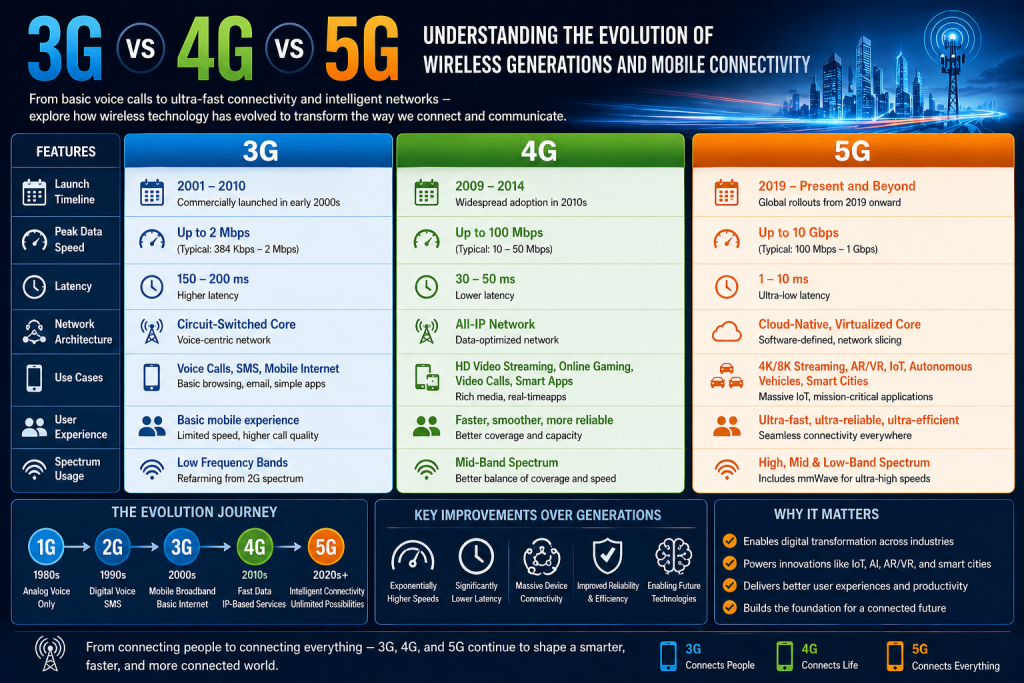
Wireless communication feels like a natural part of modern life, but its development has been relatively recent when viewed across the broader timeline of technological progress. A few decades ago, communication without wires was limited in both capability and accessibility. Today, people expect constant connectivity, instant access to information, and seamless communication regardless of location. This transformation did not happen overnight. It is the result of continuous improvements in cellular technology, each generation building upon the last.
The term “wireless generation” refers to a stage in the evolution of mobile communication standards. Each generation introduces advancements in speed, reliability, capacity, and functionality. These improvements are driven by growing user demand, technological innovation, and the need for more efficient communication systems. As mobile devices became more powerful and data-driven, networks had to evolve to keep pace.
The journey from early cellular systems to modern mobile internet has been shaped by both technological breakthroughs and changing user behavior. Initially, mobile phones were designed primarily for voice communication. Over time, they transformed into multifunctional devices capable of handling complex computing tasks. This shift required networks to support not just calls, but also data-heavy applications such as video streaming, online gaming, and real-time communication.
Understanding how wireless technology evolved provides valuable insight into the capabilities we enjoy today. It also helps explain why each new generation is necessary and how it addresses the limitations of its predecessor. The transition to third-generation technology marked a major turning point, as it introduced mobile internet in a practical and widely accessible way.
What Does “G” Mean in Wireless Technology
Before exploring the specifics of 3G, it is important to understand what the “G” in terms like 3G, 4G, and 5G actually represents. The letter “G” stands for “generation,” indicating a particular stage in the development of wireless communication technology. Each generation is defined by a set of standards that determine how networks operate and what they can deliver.
Generations are not just simple upgrades. They represent significant changes in network architecture, transmission methods, and overall performance. Moving from one generation to the next typically involves new infrastructure, updated hardware, and improved protocols. These changes allow networks to handle more users, deliver faster speeds, and support new types of services.
The first generation, known as 1G, introduced analog voice communication. It allowed people to make calls without being physically connected by wires, but the quality was often poor and security was limited. The second generation, or 2G, brought digital communication, which improved call quality and enabled features such as text messaging. However, 2G networks were not designed for internet access in the modern sense.
As the demand for data began to grow, it became clear that a new approach was needed. Users wanted to do more than just talk and send messages. They wanted to access information, communicate visually, and use their devices for a wider range of tasks. This demand led to the development of 3G technology.
The Emergence of 3G Technology
Third-generation wireless technology, commonly known as 3G, emerged in the early 2000s. It represented a major shift in how mobile networks were used and perceived. For the first time, mobile internet became a realistic and usable feature rather than a limited add-on.
3G was designed to provide both voice and data services efficiently. This meant that users could browse the internet, send emails, and access multimedia content directly from their phones. While earlier technologies offered basic data capabilities, they were often slow and unreliable. 3G changed that by significantly improving data transmission speeds and overall performance.
The introduction of 3G coincided with the rise of more advanced mobile devices. Phones were becoming smarter, with better screens, improved processing power, and enhanced software capabilities. These devices required faster and more reliable networks to function effectively, and 3G provided the foundation for this new era of mobile computing.
One of the most important aspects of 3G was its ability to support simultaneous voice and data communication. This allowed users to stay connected in multiple ways at the same time, making mobile devices more versatile and useful. The shift from simple communication tools to multifunctional devices began with 3G and continues to evolve today.
Speed and Performance Improvements in 3G
One of the defining features of 3G technology was its improved data speed compared to previous generations. Early implementations offered speeds of up to around 2 megabits per second under ideal conditions. Although actual speeds were often lower in real-world scenarios, this was still a significant improvement over earlier technologies.
As 3G networks evolved, enhancements such as High-Speed Packet Access further increased data speeds. These improvements allowed users to download files more quickly, load web pages with less delay, and access richer multimedia content. While the experience was not as smooth as modern networks, it was a major step forward at the time.
Faster speeds also made new applications possible. Services that required more data, such as video streaming and online communication, became accessible on mobile devices. Even though buffering and interruptions were still common, the ability to access such content on the go was revolutionary.
Performance improvements were not limited to speed alone. 3G networks also offered better reliability and consistency compared to earlier systems. Users experienced fewer dropped connections and more stable data transmission, which contributed to a more dependable mobile experience.
Key Features Introduced by 3G
Beyond speed, 3G introduced a range of features that significantly expanded the capabilities of mobile devices. One of the most important was mobile internet browsing. For the first time, users could access websites in a way that resembled the experience on desktop computers. This led to the development of mobile-optimized websites and eventually mobile applications.
Another major feature was video calling. Although early versions were not always high quality, they demonstrated the potential for real-time visual communication over mobile networks. This innovation laid the groundwork for modern video conferencing and communication platforms.
3G also enabled multimedia messaging, allowing users to send images, audio, and video clips. This expanded communication beyond simple text and made interactions more dynamic and expressive. Services such as mobile television and streaming began to emerge, offering new forms of entertainment on handheld devices.
Security was another area that saw improvement. As mobile devices started handling more sensitive information, stronger encryption and authentication methods became necessary. 3G introduced enhanced security measures to protect user data and ensure safer communication.
These features collectively transformed mobile phones into powerful tools for communication, entertainment, and productivity. The impact of these changes can still be seen in how mobile technology is used today.
Technologies Behind 3G Networks
The capabilities of 3G were made possible by advanced technologies that improved how data was transmitted and managed. Two of the most widely used technologies were Wideband Code Division Multiple Access and CDMA2000. These systems allowed multiple users to share the same frequency spectrum efficiently, increasing network capacity and performance.
3G networks typically operated within frequency ranges between 850 megahertz and 2100 megahertz. These frequencies provided a balance between coverage and data capacity, making it possible to deploy networks across a wide range of environments. Lower frequencies offered better coverage over long distances, while higher frequencies allowed for greater data transmission rates.
The use of packet-switched data was another important aspect of 3G technology. Unlike earlier systems that relied heavily on circuit-switched communication, packet switching allowed data to be broken into smaller pieces and transmitted more efficiently. This approach improved overall network performance and made better use of available resources.
These technological advancements laid the groundwork for future generations of wireless communication. They demonstrated that mobile networks could support complex data services and handle increasing demand from users.
The Impact of 3G on Society
The introduction of 3G had a profound impact on society and the way people interacted with technology. It marked the beginning of the mobile internet era, making information accessible anytime and anywhere. This shift changed how people communicated, worked, and entertained themselves.
One of the most significant effects was the rise of smartphones. As networks became more capable, device manufacturers began developing more advanced phones with enhanced features. These devices offered better displays, improved processing power, and access to a growing range of applications.
Social media platforms also benefited from 3G connectivity. Users could share updates, images, and videos in real time, leading to a more connected and interactive online experience. This contributed to the rapid growth of digital communities and changed the way people communicate globally.
Businesses and industries were also affected. Mobile connectivity enabled new forms of commerce, communication, and collaboration. Employees could access information and perform tasks remotely, increasing productivity and flexibility. Educational resources became more accessible, allowing people to learn and explore new topics from their mobile devices.
The influence of 3G extended beyond technology, shaping cultural and social trends. It played a key role in the digital transformation that continues to evolve today.
Limitations of 3G Technology
Despite its many advantages, 3G had several limitations that became more apparent as usage increased. One of the main challenges was speed. While it was a significant improvement over earlier technologies, it was not sufficient to meet the growing demand for high-quality content and real-time applications.
Network congestion was another issue. As more users began relying on mobile data, networks often struggled to maintain consistent performance. This was especially noticeable in densely populated areas where many devices were connected simultaneously.
Latency was also relatively high, meaning there was a noticeable delay in data transmission. This made certain applications, such as online gaming and real-time communication, less responsive. Users often experienced lag and interruptions, which affected the overall experience.
Battery consumption was another concern. Devices using 3G networks often required more power to maintain connections, leading to shorter battery life. This was particularly challenging for early smartphones, which already had limited battery capacity.
These limitations highlighted the need for further advancements in wireless technology. While 3G laid the foundation for mobile internet, it was clear that a more advanced system was needed to support the next generation of applications and services.
Preparing for the Next Generation
As technology continued to evolve, the demand for faster, more reliable, and more efficient mobile networks grew rapidly. Users expected better performance, smoother streaming, and quicker access to information. At the same time, developers were creating more complex and data-intensive applications that required higher bandwidth and lower latency.
The success of 3G demonstrated the potential of mobile internet, but it also revealed its limitations. Meeting the needs of a growing digital world required a new approach to network design and performance. This led to the development of fourth-generation technology, which would build upon the foundation established by 3G and take mobile connectivity to a new level.
The transition to 4G would bring significant improvements in speed, efficiency, and user experience, setting the stage for the modern mobile landscape.
Introduction to the 4G Era
The transition from third-generation wireless systems to fourth-generation technology marked a defining moment in the evolution of mobile communication. While 3G introduced the concept of accessing the internet on mobile devices, 4G transformed that concept into a fast, reliable, and widely adopted reality. By the time 4G networks began rolling out around 2010, the digital landscape had already begun to change rapidly. Smartphones were becoming more advanced, applications were more demanding, and users expected seamless connectivity wherever they went.
The limitations of 3G had become increasingly noticeable. Slow loading times, buffering during video playback, and lag in real-time applications created a need for a more capable system. 4G was developed to meet these growing demands, offering significantly higher speeds, lower latency, and improved network efficiency. It was not just an upgrade but a complete shift in how mobile networks were designed and used.
With 4G, mobile internet became powerful enough to rival traditional broadband connections in many cases. This change allowed users to rely more heavily on mobile data for everyday tasks, from streaming high-definition videos to participating in video conferences and running cloud-based applications. The introduction of 4G reshaped user expectations and set new standards for connectivity.
The Core Principles of 4G Technology
Fourth-generation wireless technology was built with a strong focus on data. Unlike earlier systems that prioritized voice communication, 4G networks were designed primarily for high-speed data transmission. This shift reflected the changing role of mobile devices, which had evolved from simple communication tools into powerful computing platforms.
One of the key principles behind 4G was the use of an all-IP network architecture. This means that all types of communication, including voice calls, video streaming, and data transfer, are handled using internet protocols. This approach made networks more flexible, efficient, and scalable.
Voice communication in 4G networks is typically handled through technologies such as Voice over Internet Protocol. Instead of relying on traditional circuit-switched systems, voice data is transmitted in the same way as other types of data. This allows for better integration of services and more efficient use of network resources.
Another important aspect of 4G is its ability to support a wide range of applications simultaneously. Whether users are streaming video, browsing the web, or playing online games, the network can handle multiple types of data traffic without significant performance issues. This versatility is one of the reasons why 4G became so widely adopted.
Speed and Performance Advancements
One of the most noticeable improvements in 4G technology is the dramatic increase in data speeds. Theoretical download speeds can reach up to 1 gigabit per second under ideal conditions. In real-world scenarios, users typically experience speeds ranging from 10 to 100 megabits per second, depending on network conditions, location, and device capabilities.
These speeds represent a significant leap from what was possible with 3G. Tasks that once took minutes, such as downloading large files or loading media-rich websites, can now be completed in seconds. This improvement has had a major impact on how people use mobile devices.
Streaming high-definition video is one of the most prominent examples of this change. With 4G, users can watch videos smoothly without constant buffering or interruptions. This has contributed to the rise of video-based platforms and increased consumption of digital media.
Faster speeds also enable better performance for cloud-based applications. Users can access files, run software, and collaborate with others in real time, regardless of their location. This has made mobile devices more useful for both personal and professional tasks.
Reduction in Latency
Latency refers to the time it takes for data to travel from one point to another within a network. In 4G systems, latency is significantly lower than in previous generations, typically ranging between 20 and 30 milliseconds. This reduction has a noticeable impact on user experience, especially for applications that require real-time interaction.
Lower latency means that actions performed on a device are reflected more quickly. For example, when playing an online game, there is less delay between user input and the corresponding response. This makes the experience more responsive and enjoyable.
Video calls and conferencing also benefit from reduced latency. Conversations feel more natural, with fewer delays and interruptions. This improvement has made mobile communication more effective and reliable.
Although 4G latency is not as low as what newer technologies can achieve, it represented a major step forward at the time of its introduction. It allowed for a range of applications that were previously impractical on mobile networks.
Increased Network Capacity and Efficiency
As the number of mobile users continued to grow, networks needed to handle more simultaneous connections without sacrificing performance. 4G addressed this challenge by improving network capacity and efficiency.
Advanced technologies allow 4G networks to allocate resources more effectively, ensuring that users receive consistent performance even during peak usage times. This is particularly important in densely populated areas, where many devices are connected to the network at the same time.
Improved efficiency also means that networks can deliver higher speeds without requiring a proportional increase in infrastructure. This makes it easier for service providers to expand coverage and improve service quality.
Another important factor is the ability to manage different types of data traffic. 4G networks can prioritize certain types of data, such as voice calls or video streams, to ensure a smooth user experience. This level of control helps maintain performance across a wide range of applications.
LTE as the Foundation of 4G
Long-Term Evolution, commonly known as LTE, is the primary technology behind 4G networks. It represents a significant advancement in how data is transmitted and managed within a cellular network.
LTE uses a packet-switched architecture, which allows data to be broken into smaller pieces and transmitted more efficiently. This approach improves overall network performance and reduces delays. It also makes better use of available bandwidth, allowing more data to be transmitted within the same frequency range.
One of the key advantages of LTE is its scalability. Networks can be upgraded and expanded over time to support higher speeds and more users. This flexibility has allowed LTE to evolve alongside changing user demands.
4G networks typically operate within frequency bands ranging from around 600 megahertz to 2.5 gigahertz. These frequencies provide a balance between coverage and capacity. Lower frequencies can travel longer distances and penetrate obstacles more effectively, while higher frequencies can carry more data.
The widespread adoption of LTE has made 4G one of the most successful wireless technologies in history. It has become the standard for mobile broadband in many parts of the world.
The Evolution to 4G+
As technology continued to advance, improvements were made to the original 4G standard, leading to the development of 4G+, also known as LTE-Advanced. This enhanced version introduced several features designed to further improve performance and efficiency.
One of the most important innovations in 4G+ is carrier aggregation. This technology allows devices to combine multiple frequency bands into a single connection. By doing so, it increases the amount of available bandwidth and enables higher data speeds.
With carrier aggregation, theoretical speeds can reach up to 3 gigabits per second. In real-world conditions, users typically experience speeds in the range of hundreds of megabits per second. While these speeds depend on various factors, they represent a significant improvement over standard 4G.
Another key feature of 4G+ is enhanced Multiple Input Multiple Output technology. By using multiple antennas for both transmission and reception, networks can send and receive more data simultaneously. This improves both speed and reliability.
Latency is also reduced further in 4G+ networks, making real-time applications even more responsive. These improvements make 4G+ a powerful and efficient solution for modern mobile communication.
Real-World Impact of 4G and 4G+
The introduction of 4G and its advanced versions has had a profound impact on how people use mobile devices. Smartphones have become central to everyday life, serving as tools for communication, entertainment, and productivity.
Streaming services have grown rapidly due to the capabilities of 4G networks. Users can watch high-definition videos, listen to music, and access a wide range of digital content without interruptions. This has changed how media is consumed and distributed.
Social media platforms have also evolved, incorporating features such as live streaming, video sharing, and real-time interaction. These features rely heavily on the speed and reliability of 4G networks.
In the business world, 4G has enabled greater flexibility and mobility. Employees can work remotely, access cloud-based systems, and collaborate with colleagues from anywhere. This has contributed to the growth of remote work and digital collaboration.
Education has also benefited from improved connectivity. Students can access online resources, participate in virtual classes, and engage with interactive content. This has expanded learning opportunities and made education more accessible.
Challenges and Limitations of 4G
Despite its many advantages, 4G is not without its limitations. As technology continues to evolve, new challenges have emerged that require further innovation.
One of the main issues is the increasing demand for data. As more devices connect to the network and applications become more data-intensive, maintaining consistent performance becomes more difficult. Network congestion can still occur, especially in heavily populated areas.
Another limitation is latency. While 4G offers significant improvements over earlier technologies, it is not always sufficient for applications that require near-instant response times. Emerging technologies such as virtual reality and autonomous systems demand even lower latency.
Coverage can also be a challenge in certain areas. While 4G networks are widely available, there are still regions where connectivity is limited or inconsistent. Expanding coverage requires significant investment in infrastructure.
Energy efficiency is another concern. As networks become more complex and handle more data, they require more power to operate. This has implications for both network providers and device manufacturers.
These challenges highlight the need for continued innovation in wireless technology. While 4G has been highly successful, it is not the final stage in the evolution of mobile communication.
Preparing for the Next Generation
As user expectations continue to grow, the demand for faster, more reliable, and more efficient networks becomes increasingly important. New technologies and applications require capabilities that go beyond what 4G can provide.
The limitations of 4G have led to the development of the next generation of wireless technology. This new generation aims to address issues such as latency, capacity, and connectivity on a much larger scale.
The transition to the next stage of wireless communication is driven by the need to support a more connected world. From smart cities to advanced industrial systems, the future of technology depends on networks that can handle massive amounts of data with minimal delay.
4G laid the foundation for this future by demonstrating the potential of high-speed mobile broadband. However, the next generation will take these capabilities even further, enabling new possibilities and transforming how people interact with technology.
The Core Principles of 4G Technology
Fourth-generation wireless technology was built with a strong focus on data. Unlike earlier systems that prioritized voice communication, 4G networks were designed primarily for high-speed data transmission. This shift reflected the changing role of mobile devices, which had evolved from simple communication tools into powerful computing platforms.
One of the key principles behind 4G was the use of an all-IP network architecture. This means that all types of communication, including voice calls, video streaming, and data transfer, are handled using internet protocols. This approach made networks more flexible, efficient, and scalable.
Voice communication in 4G networks is typically handled through technologies such as Voice over Internet Protocol. Instead of relying on traditional circuit-switched systems, voice data is transmitted in the same way as other types of data. This allows for better integration of services and more efficient use of network resources.
Another important aspect of 4G is its ability to support a wide range of applications simultaneously. Whether users are streaming video, browsing the web, or playing online games, the network can handle multiple types of data traffic without significant performance issues. This versatility is one of the reasons why 4G became so widely adopted.
Speed and Performance Advancements
One of the most noticeable improvements in 4G technology is the dramatic increase in data speeds. Theoretical download speeds can reach up to 1 gigabit per second under ideal conditions. In real-world scenarios, users typically experience speeds ranging from 10 to 100 megabits per second, depending on network conditions, location, and device capabilities.
These speeds represent a significant leap from what was possible with 3G. Tasks that once took minutes, such as downloading large files or loading media-rich websites, can now be completed in seconds. This improvement has had a major impact on how people use mobile devices.
Streaming high-definition video is one of the most prominent examples of this change. With 4G, users can watch videos smoothly without constant buffering or interruptions. This has contributed to the rise of video-based platforms and increased consumption of digital media.
Faster speeds also enable better performance for cloud-based applications. Users can access files, run software, and collaborate with others in real time, regardless of their location. This has made mobile devices more useful for both personal and professional tasks.
Reduction in Latency
Latency refers to the time it takes for data to travel from one point to another within a network. In 4G systems, latency is significantly lower than in previous generations, typically ranging between 20 and 30 milliseconds. This reduction has a noticeable impact on user experience, especially for applications that require real-time interaction.
Lower latency means that actions performed on a device are reflected more quickly. For example, when playing an online game, there is less delay between user input and the corresponding response. This makes the experience more responsive and enjoyable.
Video calls and conferencing also benefit from reduced latency. Conversations feel more natural, with fewer delays and interruptions. This improvement has made mobile communication more effective and reliable.
Although 4G latency is not as low as what newer technologies can achieve, it represented a major step forward at the time of its introduction. It allowed for a range of applications that were previously impractical on mobile networks.
Increased Network Capacity and Efficiency
As the number of mobile users continued to grow, networks needed to handle more simultaneous connections without sacrificing performance. 4G addressed this challenge by improving network capacity and efficiency.
Advanced technologies allow 4G networks to allocate resources more effectively, ensuring that users receive consistent performance even during peak usage times. This is particularly important in densely populated areas, where many devices are connected to the network at the same time.
Improved efficiency also means that networks can deliver higher speeds without requiring a proportional increase in infrastructure. This makes it easier for service providers to expand coverage and improve service quality.
Another important factor is the ability to manage different types of data traffic. 4G networks can prioritize certain types of data, such as voice calls or video streams, to ensure a smooth user experience. This level of control helps maintain performance across a wide range of applications.
LTE as the Foundation of 4G
Long-Term Evolution, commonly known as LTE, is the primary technology behind 4G networks. It represents a significant advancement in how data is transmitted and managed within a cellular network.
LTE uses a packet-switched architecture, which allows data to be broken into smaller pieces and transmitted more efficiently. This approach improves overall network performance and reduces delays. It also makes better use of available bandwidth, allowing more data to be transmitted within the same frequency range.
One of the key advantages of LTE is its scalability. Networks can be upgraded and expanded over time to support higher speeds and more users. This flexibility has allowed LTE to evolve alongside changing user demands.
4G networks typically operate within frequency bands ranging from around 600 megahertz to 2.5 gigahertz. These frequencies provide a balance between coverage and capacity. Lower frequencies can travel longer distances and penetrate obstacles more effectively, while higher frequencies can carry more data.
The widespread adoption of LTE has made 4G one of the most successful wireless technologies in history. It has become the standard for mobile broadband in many parts of the world.
The Evolution to 4G+
As technology continued to advance, improvements were made to the original 4G standard, leading to the development of 4G+, also known as LTE-Advanced. This enhanced version introduced several features designed to further improve performance and efficiency.
One of the most important innovations in 4G+ is carrier aggregation. This technology allows devices to combine multiple frequency bands into a single connection. By doing so, it increases the amount of available bandwidth and enables higher data speeds.
With carrier aggregation, theoretical speeds can reach up to 3 gigabits per second. In real-world conditions, users typically experience speeds in the range of hundreds of megabits per second. While these speeds depend on various factors, they represent a significant improvement over standard 4G.
Another key feature of 4G+ is enhanced Multiple Input Multiple Output technology. By using multiple antennas for both transmission and reception, networks can send and receive more data simultaneously. This improves both speed and reliability.
Latency is also reduced further in 4G+ networks, making real-time applications even more responsive. These improvements make 4G+ a powerful and efficient solution for modern mobile communication.
Real-World Impact of 4G and 4G+
The introduction of 4G and its advanced versions has had a profound impact on how people use mobile devices. Smartphones have become central to everyday life, serving as tools for communication, entertainment, and productivity.
Streaming services have grown rapidly due to the capabilities of 4G networks. Users can watch high-definition videos, listen to music, and access a wide range of digital content without interruptions. This has changed how media is consumed and distributed.
Social media platforms have also evolved, incorporating features such as live streaming, video sharing, and real-time interaction. These features rely heavily on the speed and reliability of 4G networks.
In the business world, 4G has enabled greater flexibility and mobility. Employees can work remotely, access cloud-based systems, and collaborate with colleagues from anywhere. This has contributed to the growth of remote work and digital collaboration.
Education has also benefited from improved connectivity. Students can access online resources, participate in virtual classes, and engage with interactive content. This has expanded learning opportunities and made education more accessible.
Challenges and Limitations of 4G
Despite its many advantages, 4G is not without its limitations. As technology continues to evolve, new challenges have emerged that require further innovation.
One of the main issues is the increasing demand for data. As more devices connect to the network and applications become more data-intensive, maintaining consistent performance becomes more difficult. Network congestion can still occur, especially in heavily populated areas.
Another limitation is latency. While 4G offers significant improvements over earlier technologies, it is not always sufficient for applications that require near-instant response times. Emerging technologies such as virtual reality and autonomous systems demand even lower latency.
Coverage can also be a challenge in certain areas. While 4G networks are widely available, there are still regions where connectivity is limited or inconsistent. Expanding coverage requires significant investment in infrastructure.
Energy efficiency is another concern. As networks become more complex and handle more data, they require more power to operate. This has implications for both network providers and device manufacturers.
These challenges highlight the need for continued innovation in wireless technology. While 4G has been highly successful, it is not the final stage in the evolution of mobile communication.
Preparing for the Next Generation
As user expectations continue to grow, the demand for faster, more reliable, and more efficient networks becomes increasingly important. New technologies and applications require capabilities that go beyond what 4G can provide.
The limitations of 4G have led to the development of the next generation of wireless technology. This new generation aims to address issues such as latency, capacity, and connectivity on a much larger scale.
The transition to the next stage of wireless communication is driven by the need to support a more connected world. From smart cities to advanced industrial systems, the future of technology depends on networks that can handle massive amounts of data with minimal delay.
4G laid the foundation for this future by demonstrating the potential of high-speed mobile broadband. However, the next generation will take these capabilities even further, enabling new possibilities and transforming how people interact with technology.
.i want part 3 with h2 headings in 2500 words dont bold inner text add conclusion
The Power of 5G and the Future of Wireless Communication
The arrival of fifth-generation wireless technology represents one of the most significant advancements in the history of communication systems. While earlier generations focused mainly on improving speed and enabling mobile internet access, 5G takes a broader approach. It is designed not only to enhance performance but also to support entirely new categories of technology and applications.
By the time 5G began rolling out, the digital world had already undergone a major transformation. Smartphones had become essential tools, cloud computing was widely used, and billions of devices were connected to the internet. The demand for faster speeds, lower latency, and greater capacity continued to grow, pushing the limits of what 4G networks could handle.
5G was developed to meet these demands and to prepare for future innovations. It is not just an incremental upgrade but a comprehensive rethinking of how wireless networks operate. With its advanced capabilities, 5G is expected to play a central role in shaping the next phase of digital evolution.
Speed and Data Throughput
One of the most talked-about features of 5G is its incredible speed. Under ideal conditions, 5G networks can achieve theoretical data rates of up to 20 gigabits per second. In real-world scenarios, speeds are typically lower but still significantly faster than those offered by 4G, often reaching around 1 gigabit per second.
These speeds allow users to download large files almost instantly and stream ultra-high-definition content without interruptions. Activities that once required a stable wired connection can now be performed smoothly on mobile networks.
The increase in speed is not just about convenience. It also enables new types of applications that require large amounts of data to be transmitted quickly. For example, high-resolution video streaming, immersive virtual environments, and complex cloud-based services all benefit from faster data transfer rates.
Another important aspect of 5G speed is consistency. Users are more likely to experience stable performance even in areas with high network usage. This reliability makes 5G suitable for both personal and professional applications.
Ultra-Low Latency and Real-Time Communication
Latency is a critical factor in modern communication systems, especially for applications that require real-time interaction. 5G significantly reduces latency, with response times as low as one millisecond in optimal conditions.
This near-instant communication opens the door to a wide range of possibilities. For example, remote medical procedures can be performed with precision, as there is minimal delay between a surgeon’s actions and the response of robotic instruments. Similarly, autonomous vehicles can communicate with each other and with infrastructure in real time, improving safety and efficiency.
Gaming is another area where low latency makes a noticeable difference. Players can enjoy smoother and more responsive gameplay, even in fast-paced, competitive environments. Virtual reality and augmented reality applications also benefit from reduced latency, as it helps create a more immersive and realistic experience.
The improvements in latency provided by 5G are not just incremental. They represent a fundamental change in how quickly information can be transmitted and processed, enabling applications that were previously impractical.
Massive Device Connectivity
One of the defining features of 5G is its ability to support a massive number of connected devices. While earlier generations were primarily designed for human communication, 5G is built to accommodate both human users and machines.
In densely populated areas, 5G networks can support up to one million devices per square kilometer. This capability is essential for the growth of the Internet of Things, where devices such as sensors, appliances, and vehicles communicate with each other and share data.
Smart cities are a key example of how this connectivity can be used. Traffic systems, energy grids, and public services can all be interconnected, allowing for more efficient management and improved quality of life. Sensors can monitor environmental conditions, detect issues, and provide real-time data to authorities.
In industrial settings, 5G enables advanced automation and monitoring. Machines can communicate with each other to optimize production processes, reduce downtime, and improve safety. This level of connectivity is transforming industries and creating new opportunities for innovation.
Advanced Network Architecture
5G introduces a more flexible and sophisticated network architecture compared to previous generations. One of the most important innovations is network slicing. This allows a single physical network to be divided into multiple virtual networks, each tailored to specific needs.
For example, one slice can be optimized for high-speed data, while another is designed for low-latency communication. This flexibility allows service providers to offer customized solutions for different applications and industries.
Another key aspect of 5G architecture is virtualization. Instead of relying solely on physical hardware, many network functions are implemented in software. This makes networks more adaptable and easier to manage.
Edge computing is also an important component of 5G. By processing data closer to where it is generated, edge computing reduces latency and improves performance. This is particularly useful for applications that require real-time processing, such as autonomous systems and industrial automation.
These architectural advancements make 5G more efficient, scalable, and capable of supporting a wide range of use cases.
Frequency Spectrum and Technology
5G operates across a wide range of frequency bands, each with its own characteristics. These include low-band, mid-band, and high-band frequencies.
Low-band frequencies provide broad coverage and are useful for reaching rural and remote areas. Mid-band frequencies offer a balance between coverage and speed, making them suitable for urban environments. High-band frequencies, also known as millimeter waves, can deliver extremely high speeds but have a shorter range and require more infrastructure.
Millimeter wave technology is one of the key innovations of 5G. It allows for the transmission of large amounts of data at very high speeds. However, these signals are more easily blocked by obstacles, which means that networks need to use smaller cells and more base stations to maintain coverage.
The use of multiple frequency bands allows 5G to deliver both high performance and wide coverage. By combining these frequencies, networks can adapt to different environments and user needs.
Real-World Applications of 5G
The capabilities of 5G extend far beyond traditional mobile communication. It is expected to play a central role in the development of new technologies and industries.
In healthcare, 5G enables remote consultations, real-time monitoring, and advanced medical procedures. Patients can receive care from specialists without needing to travel, and medical devices can transmit data continuously for better diagnosis and treatment.
In transportation, 5G supports the development of connected and autonomous vehicles. Vehicles can communicate with each other and with infrastructure to improve safety, reduce congestion, and enhance efficiency.
Entertainment is another area that benefits from 5G. Users can experience high-quality streaming, immersive virtual environments, and interactive content without interruptions. Augmented reality applications can provide real-time information and enhance everyday experiences.
Education is also transformed by 5G. Students can access interactive learning tools, participate in virtual classrooms, and explore complex subjects through immersive technologies. This makes education more engaging and accessible.
In the business world, 5G enables new forms of collaboration and productivity. Companies can use advanced communication tools, access cloud-based resources, and implement innovative solutions to improve efficiency.
Challenges and Limitations of 5G
Despite its many advantages, 5G also presents several challenges. One of the main issues is the cost of infrastructure. Deploying 5G networks requires a large number of base stations, especially for high-frequency bands. This can be expensive and time-consuming.
Coverage is another challenge. While 5G offers high speeds, achieving consistent coverage across large areas can be difficult. Rural and remote regions may take longer to benefit from 5G technology.
There are also concerns about energy consumption. As networks become more complex and handle more data, they require more power to operate. This has implications for both environmental sustainability and operational costs.
Device compatibility is another factor to consider. Users need compatible devices to take full advantage of 5G capabilities. As adoption increases, more devices are being designed to support the technology, but the transition takes time.
Security is also an important consideration. As more devices connect to the network, the potential for cyber threats increases. Ensuring the security of data and communication is a critical aspect of 5G deployment.
The Road Toward 6G
Even as 5G continues to expand, researchers and engineers are already exploring the possibilities of the next generation of wireless technology. 6G is still in the early stages of development, but it is expected to bring even more advanced capabilities.
Future networks may achieve speeds of up to a terabit per second, far exceeding what is possible with current technology. They may also use higher frequency bands, including terahertz frequencies, to support greater data transmission.
Artificial intelligence is likely to play a significant role in 6G networks. AI can be used to optimize performance, manage resources, and improve efficiency. This could lead to smarter and more adaptive communication systems.
Another goal of 6G is to provide connectivity everywhere, including remote and hard-to-reach areas. This includes not only land but also air and space, creating a truly global communication network.
While 6G is still a concept, it represents the next step in the ongoing evolution of wireless technology.
Conclusion
The journey from early mobile communication systems to the advanced capabilities of 5G reflects a remarkable progression in technology. Each generation has brought significant improvements, transforming how people connect, communicate, and interact with the digital world.
5G stands out as a transformative technology that goes beyond faster speeds. Its low latency, massive connectivity, and flexible architecture enable a wide range of applications that were once considered futuristic. From healthcare and transportation to entertainment and education, 5G is reshaping industries and creating new opportunities.
At the same time, challenges such as infrastructure costs, coverage limitations, and security concerns must be addressed to fully realize its potential. As networks continue to evolve and expand, these challenges will be met with innovation and collaboration.
Looking ahead, the development of future technologies like 6G shows that the evolution of wireless communication is far from complete. Each new generation builds on the achievements of the past, pushing the boundaries of what is possible.
Understanding the progression from 3G to 5G provides valuable insight into how far wireless technology has come and where it is headed. As the world becomes increasingly connected, the importance of reliable, high-performance communication networks will continue to grow, shaping the future of technology and society.
Continue exploring the technologies and certification concepts that matter most to you.