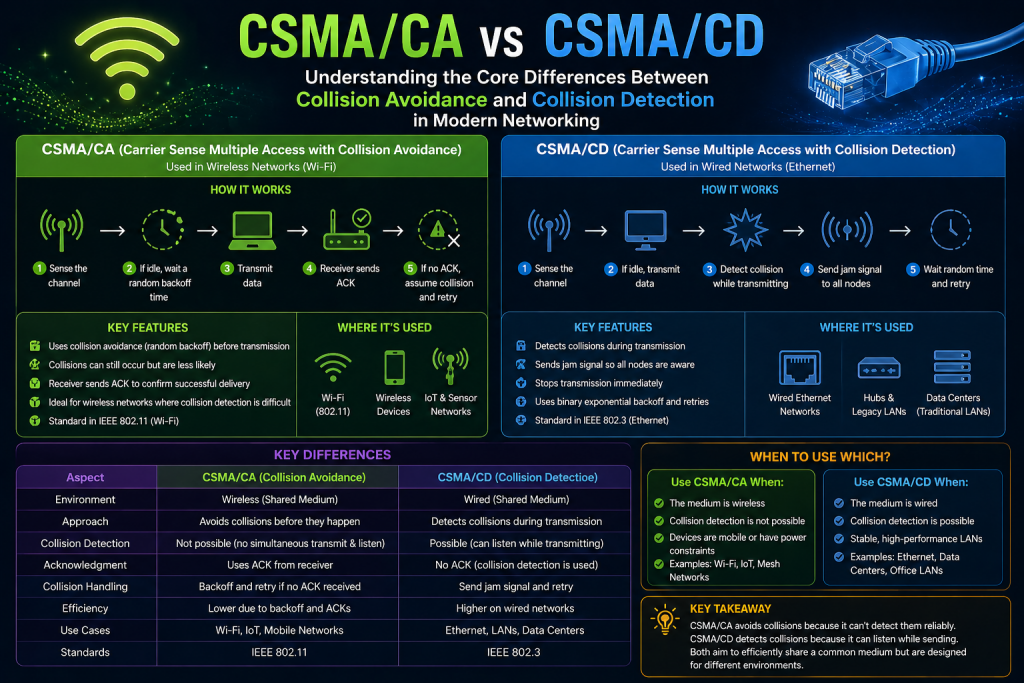
Modern computer networking is built on an extraordinary balance of speed, organization, and precision. Every second, billions of devices around the world exchange information through local networks, enterprise systems, and wireless environments. Emails are sent, websites load, cloud applications sync, and video conferences stream smoothly, often without users thinking about the technical coordination required behind the scenes.
This seamless communication can make networking appear simple, but the reality is far more complex. One of the earliest and most fundamental challenges in networking was determining how multiple devices could share the same communication medium without interfering with one another. If numerous systems attempt to transmit data simultaneously over the same pathway, packet collisions can occur, causing corrupted transmissions, wasted bandwidth, and degraded performance.
In the early development of networking, engineers recognized that communication lines needed structured rules to maintain order. These rules became especially important in shared-medium environments where many computers relied on the same cable or wireless spectrum. Without such control, networks would suffer frequent interruptions and instability.
To address this challenge, Carrier Sense Multiple Access (CSMA) was developed. CSMA became a foundational media access control methodology that allowed devices to check whether a communication line was in use before transmitting. Over time, this system evolved into two specialized forms:
CSMA/CD (Carrier Sense Multiple Access with Collision Detection)
CSMA/CA (Carrier Sense Multiple Access with Collision Avoidance)
Although both protocols share the same basic purpose—managing network access and reducing data transmission conflicts—they were designed for different technological environments and use fundamentally different strategies.
CSMA/CD became associated primarily with traditional wired Ethernet networks, especially older half-duplex systems.
CSMA/CA became essential for wireless communication, where collision detection was impractical.
Understanding the differences between these two methods is not merely an academic exercise. These technologies explain major networking concepts such as collision domains, half-duplex communication, wireless contention, Ethernet history, and Wi-Fi reliability. They also provide valuable context for network troubleshooting, certification studies, and infrastructure design.
The Problem of Shared Communication Channels
To understand why CSMA exists, it is important to first understand the concept of shared communication media.
A shared medium is any transmission channel used by multiple devices to communicate. Examples include:
Coaxial Ethernet cables in early LANs
Hub-based Ethernet segments
Radio frequencies in wireless LANs
Legacy bus topologies
In such environments, all devices compete for access to the same pathway.
Imagine a classroom where many students want to speak to a teacher at once. If everyone talks simultaneously, communication becomes unintelligible. The same thing happens on networks when devices transmit data at the same time over a shared channel.
This simultaneous transmission causes collisions.
A collision occurs when multiple transmissions overlap on the same medium, resulting in corrupted data. Because the data becomes unreadable, devices must resend it, increasing congestion and reducing efficiency.
Frequent collisions create several operational problems:
Reduced throughput
Higher latency
Packet loss
Bandwidth waste
Lower application performance
Potential service interruptions
As networks expanded in size and complexity, collision management became one of the most critical technical priorities.
What Carrier Sense Multiple Access Means
The phrase Carrier Sense Multiple Access can be broken into three essential concepts:
Carrier:
The communication medium carrying signals, such as electrical cables or wireless radio waves.
Sense:
The ability of a device to listen to the medium before sending data.
Multiple Access:
The fact that many devices share the same communication channel.
Together, CSMA means that before transmitting, a device first checks whether the medium is currently in use.
If the line is busy:
The device waits.
If the line is idle:
The device transmits.
This “listen before transmit” principle significantly reduces the likelihood of immediate collisions.
However, CSMA alone cannot eliminate collisions entirely.
Two devices may both sense an idle medium at nearly the same time and decide simultaneously that it is safe to send. This timing issue introduces the need for more advanced collision management strategies.
The Evolution of Network Access Control
As computer networks matured, engineers realized that one generalized access strategy was insufficient for all environments.
Wired and wireless systems have fundamentally different physical properties:
Wired systems can often monitor the medium while transmitting.
Wireless systems cannot reliably transmit and detect collisions simultaneously.
This difference led to the development of two distinct methods:
Collision Detection for wired systems
Collision Avoidance for wireless systems
These methods reflect the practical realities of each environment.
Historical Importance of CSMA/CD in Ethernet
In early Ethernet networks, shared coaxial cables and hub-based infrastructures were common.
These networks typically operated in half-duplex mode, meaning devices could either send or receive at one time, but not both simultaneously.
This environment created one large collision domain where every connected node competed for bandwidth.
Because all devices shared the same cable, collisions were expected.
CSMA/CD emerged as the solution.
Its operational philosophy was straightforward:
Listen for traffic
Transmit if clear
Monitor while transmitting
If collision occurs, stop immediately
Send a jam signal
Wait a random time
Retry
This method worked effectively because wired devices could detect voltage irregularities on the cable caused by simultaneous transmissions.
The Shift Toward Wireless and CSMA/CA
Wireless networking introduced a completely different challenge.
In wireless environments:
Devices often cannot hear every other device
Signal strength varies
Interference is common
Hidden node issues exist
Simultaneous detection is difficult
For example, two wireless devices may both communicate with the same access point but be too far apart to hear each other. Each may believe the channel is idle and transmit at once.
Unlike wired Ethernet, wireless devices cannot reliably detect collisions while sending because their own transmission power overwhelms their receiver.
Thus, wireless networking required prevention rather than detection.
CSMA/CA was developed to minimize collisions before they happen.
Collision Domains and Why They Matter
A collision domain is a network segment where data packet collisions can occur.
In older hub-based Ethernet:
All devices shared one collision domain.
In switched Ethernet:
Each switch port generally forms its own collision domain.
In Wi-Fi:
Devices share the same radio spectrum, effectively creating contention zones.
Understanding collision domains helps explain why older networks relied heavily on CSMA/CD while modern switched Ethernet largely eliminated its practical necessity.
How Timing Creates Transmission Risks
Even with carrier sensing, timing delays remain a challenge.
Consider this sequence:
Device A checks the medium.
Device B checks the medium milliseconds later.
Both detect silence.
Both transmit.
Collision occurs.
This issue is called propagation delay.
Because no system can react instantaneously, protocols need structured responses.
CSMA/CD responds after the collision.
CSMA/CA attempts to prevent the collision beforehand.
The Role of Random Backoff
Both CSMA models use random timing as a critical mechanism.
Without randomization:
Two devices collide
Both wait identical periods
Both retry together
Another collision occurs
Random backoff introduces unpredictability, ensuring retransmissions happen at different times.
This significantly improves network fairness and efficiency.
Randomization remains one of the most important principles in networking protocol design.
Half-Duplex Communication and Its Limitations
Half-duplex systems can either transmit or receive, but not both simultaneously.
This limitation resembles walkie-talkie communication.
In such systems:
Only one device should speak at a time
Contention is unavoidable
Coordination is critical
CSMA/CD was ideal for this model.
Modern full-duplex Ethernet, however, allows simultaneous sending and receiving, making collisions largely irrelevant in switched environments.
Why Modern Switches Reduced CSMA/CD Dependence
Switches changed networking dramatically.
Unlike hubs, switches create dedicated communication pathways.
Benefits include:
Separate collision domains
Improved bandwidth allocation
Reduced packet contention
Enhanced performance
Because of switches:
Traditional Ethernet collisions became rare
CSMA/CD became less operationally relevant
Full-duplex became standard
Despite this, CSMA/CD remains historically and educationally important.
Wireless Networking Complexity
Wireless communication remains inherently shared.
All devices in a Wi-Fi network compete for airtime.
Additional wireless challenges include:
Hidden nodes
Signal attenuation
Interference from other devices
Microwave noise
Bluetooth overlap
Physical barriers
Because of these variables, CSMA/CA remains highly relevant today.
The Hidden Node Problem
One of wireless networking’s most significant issues is the hidden node problem.
Example:
Laptop A can reach the router
Laptop B can reach the router
Laptop A cannot hear Laptop B
Both believe the channel is free
Both transmit
Collision occurs at the router
This problem explains why wireless systems need extra safeguards such as RTS/CTS.
RTS/CTS as an Advanced Coordination Method
Request to Send (RTS) and Clear to Send (CTS) add another layer of collision prevention.
Process:
Sender requests permission
Access point grants clearance
Other devices remain silent
Transmission occurs
This mechanism helps reduce hidden-node collisions.
Though it adds overhead, it can significantly improve reliability in crowded wireless networks.
Why CSMA Concepts Still Matter
Even in advanced networking environments, CSMA concepts remain foundational.
They help professionals understand:
Network history
Protocol engineering
Wi-Fi contention
Ethernet evolution
Infrastructure troubleshooting
Bandwidth optimization
Without understanding CSMA, modern networking architecture can seem disconnected from its technological roots.
Educational Relevance for IT Professionals
CSMA knowledge is essential for:
CompTIA Network+
Cisco CCNA
Security+
Wireless certifications
Systems administration
Infrastructure architecture
These concepts often appear in both theoretical and practical contexts.
Common Misconceptions
A common misunderstanding is that collisions no longer exist.
Reality:
Wired switched collisions are rare
Wireless contention remains constant
Interference still impacts performance
Protocol coordination is always necessary
Networking has not eliminated access problems—it has simply evolved more sophisticated solutions.
Broader Technological Significance
CSMA’s development reflects broader engineering philosophy:
Observe conditions
Coordinate behavior
Reduce failure
Recover intelligently
Optimize fairness
This philosophy appears across computing disciplines, including:
CPU scheduling
Cloud orchestration
Cybersecurity controls
Distributed systems
Traffic shaping
Thus, CSMA is more than a networking concept—it represents a model for cooperative resource sharing.
Introduction to Collision Avoidance in Modern Wireless Communication
Wireless networking transformed digital communication by removing physical cabling and enabling mobility, scalability, and convenience. Laptops, smartphones, smart TVs, IoT devices, industrial sensors, and enterprise systems now depend heavily on wireless connectivity. While this freedom has revolutionized networking, it has also introduced one of the most difficult communication challenges in data networking: coordinating multiple devices across a shared radio spectrum without constant packet collisions.
Unlike wired Ethernet, where devices use physical cables and can often detect signal conflicts directly, wireless devices operate in a more unpredictable environment. Radio waves are invisible, shared, interference-prone, and influenced by distance, walls, obstacles, and competing technologies. Multiple devices may communicate through the same access point while being unable to hear each other at all.
This reality created a major problem:
How can wireless devices communicate efficiently if they cannot reliably detect collisions while transmitting?
The answer is Carrier Sense Multiple Access with Collision Avoidance, better known as CSMA/CA.
CSMA/CA was developed primarily for wireless local area networks, especially those following IEEE 802.11 Wi-Fi standards. Instead of detecting collisions after they occur, CSMA/CA focuses on preventing collisions before transmission begins.
This shift from reaction to prevention represents one of the most important differences between wired and wireless networking philosophies.
Understanding CSMA/CA is essential because it explains why wireless performance changes under congestion, why latency increases in crowded environments, why hidden node problems occur, and how Wi-Fi remains functional despite dozens or hundreds of devices sharing the same frequency space.
Why Wireless Networks Cannot Reliably Use Collision Detection
To appreciate CSMA/CA, one must first understand why wireless systems do not simply use CSMA/CD.
In wired Ethernet:
A device can transmit and simultaneously monitor voltage changes on the cable.
In wireless:
A transmitting device’s own radio signal is often far stronger than incoming signals from other devices.
This means:
A wireless device cannot effectively “listen” for a collision while transmitting.
This creates a major operational limitation.
Imagine trying to hear someone whispering while you are shouting through a megaphone. Your own voice overwhelms your hearing.
Wireless transmitters face a similar challenge.
Because real-time collision detection is unreliable, wireless systems instead prioritize:
Listening first
Waiting strategically
Randomizing transmission attempts
Using acknowledgments
Employing optional reservation mechanisms
This creates a proactive communication model.
The Core Principle of CSMA/CA
At its simplest, CSMA/CA follows this logic:
Listen before transmitting
If busy, wait
If idle, wait a little more
Transmit carefully
Confirm successful delivery
Retry if needed
This process dramatically reduces the probability of simultaneous transmissions.
Unlike collision detection, which accepts collisions as inevitable and manages them afterward, collision avoidance attempts to minimize the chance of conflict from the beginning.
Carrier Sensing
Carrier sensing is the first stage.
Before a wireless device sends data, it checks whether the communication channel is currently active.
If another transmission is detected:
The device defers.
If the channel appears clear:
The device proceeds to the next step.
This is called physical carrier sensing.
Wireless systems may also use virtual carrier sensing through duration announcements, allowing devices to reserve future transmission windows.
Strategic Waiting for Order
Even if the channel is clear, a wireless device does not immediately transmit.
Instead, it waits for a predefined interval known as an Interframe Space (IFS).
These waiting periods create prioritization and order.
Different IFS types serve different purposes:
Short Interframe Space (SIFS)
Distributed Interframe Space (DIFS)
Point Coordination Function Interframe Space (PIFS)
The most common in standard contention environments is DIFS.
This delay ensures that urgent acknowledgment traffic can proceed first and helps reduce immediate transmission conflicts.
Preventing Simultaneous Starts
After the waiting interval, the device selects a random backoff timer.
This timer counts down only while the medium remains idle.
If another device begins transmitting:
The timer pauses.
When the channel clears:
The countdown resumes.
When the timer reaches zero:
Transmission begins.
This randomization is essential because multiple devices may all detect an idle channel simultaneously.
Without backoff:
They would all send together.
With randomization:
Their attempts spread over time.
This is one of CSMA/CA’s most critical features.
Confirming Successful Delivery
Wireless communication is inherently vulnerable to:
Interference
Signal fading
Obstructions
Noise
Hidden nodes
Because senders cannot always know whether data arrived successfully, receivers send acknowledgments (ACKs).
If the sender receives an ACK:
Transmission succeeded.
If no ACK arrives:
The sender assumes failure and retries.
This acknowledgment system provides reliability despite environmental unpredictability.
The Hidden Node Problem Explained
The hidden node problem is one of wireless networking’s defining challenges.
Example:
Device A communicates with the access point
Device B communicates with the access point
A and B are too far apart to detect one another
A senses silence
B senses silence
Both transmit
Collision occurs at the access point
Neither device knew the other was transmitting.
This issue is especially common in:
Large offices
Warehouses
Apartment buildings
Outdoor deployments
Industrial facilities
The hidden node problem is a major reason collision avoidance requires more than simple carrier sensing.
Request to Send and Clear to Send
To reduce hidden node risks, wireless systems may use RTS/CTS.
Process:
Device sends Request to Send (RTS)
Access point replies Clear to Send (CTS)
All nearby devices hearing CTS remain silent
Authorized device transmits
This creates temporary transmission reservations.
Benefits:
Reduced hidden node collisions
Improved coordination
Better performance in congested environments
Trade-off:
Extra overhead
Because RTS/CTS adds additional packets, it is not always used for small transmissions.
Wireless Access Points as Traffic Coordinators
Access points serve as centralized communication managers.
They:
Relay data
Manage associations
Coordinate medium access
Enforce timing
Respond to RTS
Issue CTS
This role is crucial because wireless environments often lack direct peer visibility.
The access point helps organize communication where decentralized awareness is limited.
Contention Windows and Adaptive Backoff
CSMA/CA uses contention windows to manage retry timing.
After each failed attempt:
The random waiting range expands.
This reduces repeated collisions during congestion.
For example:
First retry:
Small random range
Second retry:
Larger range
Third retry:
Even larger range
This exponential backoff improves stability under heavy traffic.
Why Wireless Performance Slows in Crowded Areas
In dense environments such as airports, campuses, or stadiums, performance often drops.
Reasons include:
More contention
Longer backoff periods
Interference
Shared bandwidth
Higher retransmission rates
Even when signal strength appears strong, airtime competition can reduce actual performance.
CSMA/CA plays a major role in this slowdown because every device must negotiate for transmission opportunities.
Signal Interference Beyond Wi-Fi Devices
Wireless networks also compete with:
Bluetooth
Microwave ovens
Cordless phones
Neighboring Wi-Fi channels
Industrial equipment
Smart home devices
These factors increase noise and reduce channel clarity.
CSMA/CA cannot eliminate all interference, but it helps devices respond intelligently.
Advantages of CSMA/CA
CSMA/CA offers several critical strengths:
Enables wireless networking functionality
Reduces collision probability
Supports mobility
Handles hidden node scenarios better than basic sensing
Provides reliability through acknowledgments
Scales across consumer and enterprise Wi-Fi
Without CSMA/CA, practical wireless networking would be far less stable.
Limitations of CSMA/CA
Despite its strengths, CSMA/CA has drawbacks:
Overhead from waiting and acknowledgments
Reduced efficiency under congestion
Hidden node vulnerabilities
Performance decline with many users
Increased latency
Variable throughput
Thus, collision avoidance is highly effective but not perfect.
CSMA/CA and Security Considerations
From a cybersecurity perspective, CSMA/CA behavior can influence:
Wireless denial-of-service patterns
Jamming attacks
Rogue access point disruptions
Channel saturation attacks
Network reconnaissance
Attackers may exploit wireless contention or manipulate RTS/CTS mechanisms.
Understanding CSMA/CA helps security professionals recognize abnormal wireless behavior.
Enterprise Wi-Fi Optimization
Modern enterprise networks improve CSMA/CA efficiency through:
Band steering
Channel planning
Power tuning
Multiple AP placement
Mesh coordination
QoS prioritization
These enhancements do not replace CSMA/CA but improve its operating conditions.
CSMA/CA in IoT Environments
IoT expansion has increased wireless contention dramatically.
Smart homes may include:
Cameras
Sensors
Lights
Locks
Assistants
Appliances
Industrial IoT may involve thousands of endpoints.
As IoT scales, CSMA/CA remains essential, though efficiency challenges grow.
Why Collision Avoidance Reflects Preventive Engineering
CSMA/CA embodies a preventive systems philosophy:
Anticipate conflict
Delay strategically
Coordinate proactively
Confirm outcomes
Retry intelligently
This model mirrors broader trends in technology, where prevention often outperforms reactive recovery.
Comparison to Human Communication
CSMA/CA resembles polite group conversation:
Listen first
Wait for pause
Signal intention
Speak
Confirm understanding
Retry if misunderstood
This human-like coordination helps explain why wireless communication can remain surprisingly orderly despite shared spectrum complexity.
The Continued Relevance of CSMA/CA
Even as Wi-Fi standards evolve through Wi-Fi 6, Wi-Fi 6E, and Wi-Fi 7, CSMA/CA principles remain deeply influential.
Advanced standards improve scheduling, OFDMA, and efficiency, but shared-medium coordination still matters.
Understanding CSMA/CA remains critical for:
Wireless administrators
Network engineers
Cybersecurity analysts
IT students
Infrastructure architects
Introduction to Collision Detection in Traditional Wired Networking
Before wireless communication became dominant and before modern switches transformed Ethernet into highly efficient full-duplex infrastructure, early computer networks faced a major operational challenge: how to allow multiple devices to share one communication medium without constant transmission failures.
In the early days of local area networking, especially in bus topology and hub-based Ethernet environments, all connected systems often used the same physical cable or shared communication segment. This design was practical and cost-effective, but it introduced a critical technical problem. If two devices transmitted simultaneously, their signals could overlap, causing data corruption.
This event was known as a collision.
Unlike modern switched networks where traffic is segmented intelligently, traditional Ethernet was a competitive communication environment. Every connected device had to share bandwidth and coordinate its use of the medium.
To manage this challenge, networking engineers developed Carrier Sense Multiple Access with Collision Detection (CSMA/CD).
CSMA/CD became one of the foundational technologies of Ethernet networking. It was central to the operation of many early networks and played a major role in shaping the growth of computer communication.
Although modern full-duplex switched Ethernet has largely reduced the practical necessity of CSMA/CD, understanding it remains essential for anyone studying networking because it explains:
Ethernet history
Collision domains
Half-duplex communication
Hub limitations
Media access logic
Protocol engineering evolution
CSMA/CD is more than an old protocol—it represents a critical stage in the technological development of networking infrastructure.
Why Early Ethernet Needed Collision Detection
In early Ethernet systems, devices were often connected using shared coaxial cable or hubs.
This meant:
All devices used one communication pathway
Only one transmission should occur at a time
Every system could “hear” every transmission
Simultaneous transmissions could collide
Because multiple devices competed for one medium, a management system was required.
Unlike wireless systems, wired Ethernet offered one important advantage:
Devices could detect electrical disturbances on the cable while transmitting.
This capability made collision detection possible.
Instead of preventing every collision beforehand, wired systems could:
Transmit when clear
Monitor the line during transmission
Recognize a collision
Abort transmission immediately
Retry later
This approach balanced efficiency with practicality.
The Core Logic of CSMA/CD
CSMA/CD follows a structured sequence:
Carrier Sense:
Listen before sending
Multiple Access:
Many devices share one medium
Collision Detection:
Monitor for interference while transmitting
This process can be summarized as:
Check the cable
If idle, transmit
While transmitting, monitor signal integrity
If collision occurs, stop immediately
Send jam signal
Wait random time
Retry
This strategy allowed shared Ethernet systems to function relatively efficiently despite unavoidable contention.
Listening Before Transmission
Before sending data, a device first checks whether another system is already transmitting.
If the medium is busy:
Wait
If idle:
Begin transmission
This minimizes obvious collisions but cannot eliminate them entirely.
Why?
Because two devices may both detect silence at nearly the same time.
This creates the possibility of simultaneous starts.
Transmission and Monitoring
Once a device begins transmitting, it does not simply assume success.
It continuously monitors the electrical characteristics of the network medium.
If the outgoing signal differs from what it expects, the device assumes another transmission is interfering.
This is collision detection.
This real-time monitoring capability was practical in wired environments because electrical signal changes could be measured directly.
Collision Occurs
When two devices transmit simultaneously:
Signals overlap
Data becomes corrupted
Both devices detect abnormal electrical patterns
Both stop transmitting
This immediate recognition prevents further bandwidth waste.
Jam Signal
After detecting a collision, devices send a jam signal.
Purpose:
Notify all devices on the segment
Confirm collision occurrence
Ensure all nodes discard corrupted frames
This coordinated warning system was crucial because all devices shared the same cable.
Binary Exponential Backoff
After a collision, immediate retransmission would likely repeat the collision.
To avoid this, devices use Binary Exponential Backoff.
Mechanism:
Choose random wait time
Retry after timer expires
After repeated collisions, increase possible wait range exponentially
This method dramatically reduces repeated simultaneous retransmissions.
Example:
First collision:
Wait 0 or 1 slot
Second collision:
Wait 0–3 slots
Third collision:
Wait 0–7 slots
This system improved fairness and network recovery.
Why Randomization Was Essential
Without randomization:
Two devices collide
Both stop
Both retry instantly
Both collide again
Random delays break synchronization.
This innovation was one of the most elegant aspects of Ethernet protocol design.
Half-Duplex and the Necessity of CSMA/CD
CSMA/CD was tightly tied to half-duplex communication.
Half-duplex means:
Send or receive
Not both simultaneously
This was common in:
Coaxial Ethernet
Hub networks
Legacy LANs
Because only one active transmission could exist safely, collision management was critical.
Hub-Based Networks and Collision Domains
Hubs simply repeated incoming signals to all connected devices.
This meant:
One large collision domain
Shared bandwidth
Frequent contention
Poor scalability
As network size grew, collisions increased.
This limitation eventually drove the adoption of switches.
The Switch Revolution
Switches fundamentally changed Ethernet.
Switches create:
Dedicated communication paths
Separate collision domains
Full-duplex support
Improved efficiency
In switched full-duplex networks:
Collisions are largely eliminated
CSMA/CD becomes mostly unnecessary
Bandwidth improves dramatically
This transition marked one of the most important milestones in networking history.
Limitations of CSMA/CD
Though revolutionary for its time, CSMA/CD had weaknesses:
Performance declines with network growth
Collision frequency increases under congestion
Bandwidth waste during collisions
Hub inefficiency
Distance limitations
Scalability constraints
These limitations became more significant as enterprise networking demands increased.
Why CSMA/CD Declined
CSMA/CD became less relevant due to:
Ethernet switches
Full-duplex communication
Improved segmentation
VLANs
Modern infrastructure design
Today, CSMA/CD is primarily educational rather than operational in most environments.
The Core Philosophical Difference
The major difference between these systems lies in strategy.
CSMA/CD:
Transmit, detect, recover
CSMA/CA:
Delay, coordinate, prevent
This reflects environmental realities.
Wired:
Collision detection feasible
Wireless:
Collision detection impractical
Environmental Comparison
Wired Ethernet:
Predictable medium
Direct electrical monitoring
Lower hidden-node risk
Dedicated pathways possible
Wireless Wi-Fi:
Shared spectrum
Signal variability
Hidden nodes
Interference-heavy
Thus, each protocol evolved logically from physical constraints.
Efficiency Comparison
CSMA/CD:
Efficient in small wired environments
Less efficient as collisions rise
CSMA/CA:
More overhead
Better for wireless unpredictability
Neither is universally superior—they are context-specific solutions.
Collision Domains vs Contention Domains
CSMA/CD focused heavily on collision domains.
CSMA/CA addresses contention domains.
Collision domain:
Where packets physically collide
Contention domain:
Where devices compete for access
Modern networking increasingly emphasizes contention management over classic collision recovery.
Security Implications
CSMA/CD understanding helps security professionals identify:
Duplex mismatches
Legacy infrastructure weaknesses
Broadcast storms
Hub vulnerabilities
Traffic anomalies
CSMA/CA understanding supports wireless defense against:
Jamming
Rogue AP congestion
RTS abuse
Deauthentication patterns
Both remain relevant in infrastructure security education.
Why Legacy Knowledge Still Matters
Even though CSMA/CD is less common today, it remains foundational because it explains:
Why hubs became obsolete
Why switches matter
How Ethernet evolved
Why duplex settings are critical
How protocol design adapts
Without CSMA/CD, Ethernet history is incomplete.
CSMA as a Broader Engineering Lesson
CSMA principles extend beyond networking.
They demonstrate:
Resource sharing
Conflict resolution
Probabilistic fairness
Adaptive recovery
Scalable coordination
These ideas appear in:
Cloud systems
CPU scheduling
Distributed databases
Traffic engineering
Cybersecurity controls
Real-World Troubleshooting Relevance
Understanding CSMA/CD can still help diagnose:
Legacy network slowness
Improper duplex settings
Collision counter spikes
Broadcast saturation
Infrastructure bottlenecks
Similarly, CSMA/CA helps explain:
Wi-Fi congestion
Latency spikes
Dense deployment failures
Channel overlap
The Human Communication Analogy
CSMA/CD resembles this conversation model:
Listen
Speak
If interrupted, stop
Acknowledge confusion
Retry later
CSMA/CA resembles:
Listen
Wait
Reserve turn
Speak
Confirm understanding
These analogies simplify protocol philosophy.
Modern Networking and the Legacy of Both Systems
Today’s networking world includes:
Switched Ethernet
Wi-Fi 6/7
Mesh systems
IoT ecosystems
Cloud-managed infrastructure
Software-defined networking (SDN)
Edge computing
5G and private wireless deployments
Satellite internet constellations
Industrial automation networks
Hybrid cloud architectures
AI-driven network optimization
These innovations have dramatically expanded network speed, intelligence, scalability, and accessibility. Networks are no longer confined to office buildings or home routers. They now power smart cities, autonomous systems, healthcare infrastructure, manufacturing plants, logistics chains, financial systems, and billions of interconnected consumer devices.
Yet despite this extraordinary evolution, one core challenge remains fundamentally unchanged:
How do large numbers of devices share limited communication resources efficiently, fairly, and reliably?
Whether the medium is copper, fiber, radio spectrum, satellite bandwidth, or virtualized cloud pathways, communication channels always involve finite resources. Bandwidth, airtime, switching capacity, spectrum allocation, and routing intelligence must all be managed carefully to prevent congestion, interference, latency, and service degradation.
This is the enduring significance of CSMA/CD and CSMA/CA.
These protocols were not merely technical solutions for older Ethernet or Wi-Fi systems—they were foundational models for resource coordination in shared environments.
CSMA/CD introduced the principle that systems can monitor shared resources, detect conflicts, recover intelligently, and adapt dynamically.
CSMA/CA advanced that principle by showing that in more complex or less observable environments, systems must anticipate contention, coordinate proactively, and minimize disruption before it occurs.
Together, they helped establish broader engineering principles that still influence modern infrastructure:
Carrier awareness became network state awareness
Collision detection evolved into anomaly detection and adaptive recovery
Collision avoidance inspired predictive scheduling and contention prevention
Random backoff informed fairness algorithms and distributed coordination
Shared-medium logic influenced cloud orchestration, virtualization, and wireless multiplexing
In modern switched Ethernet, dedicated pathways and segmentation have reduced classic collisions, but resource contention still exists in switch buffers, uplinks, and oversubscribed architectures.
In Wi-Fi 6 and Wi-Fi 7, technologies such as OFDMA, MU-MIMO, beamforming, and scheduled access have improved efficiency dramatically, yet these advancements still build on the same fundamental need to coordinate multiple devices sharing finite spectrum.
Mesh networks extend this challenge further by requiring devices not only to communicate, but also to relay, prioritize, and self-organize dynamically.
IoT ecosystems magnify resource-sharing complexity because thousands or millions of low-power devices may compete for limited wireless channels while balancing battery efficiency and real-time responsiveness.
Cloud-managed infrastructure adds another dimension, where centralized intelligence optimizes distributed traffic patterns across physical and virtual systems, but still depends on efficient allocation of shared resources.
Even emerging technologies like autonomous vehicles, smart factories, and edge AI must solve the same universal question:
Who communicates, when, how, and with what priority?
This continuity demonstrates a profound truth about networking:
Technology changes, speeds increase, and architectures evolve—but coordination remains eternal.
The challenge is no longer simply avoiding packet collisions on a cable or wireless channel. Today it includes:
Preventing congestion collapse
Balancing latency-sensitive applications
Prioritizing voice and video traffic
Securing shared infrastructures
Managing billions of endpoints
Reducing energy consumption
Supporting autonomous machine communication
Ensuring fairness across massive ecosystems
The principles pioneered by CSMA/CD and CSMA/CA continue to echo throughout these systems because both protocols addressed something deeper than collisions:
They addressed orderly coexistence.
They proved that when multiple independent systems share finite resources, efficiency depends on structured cooperation.
This lesson applies far beyond networking. It parallels challenges in:
Cloud resource scheduling
CPU task management
Distributed computing
Cybersecurity rate limiting
Transportation systems
Supply chains
Telecommunications policy
AI infrastructure
As networking continues toward quantum communication, 6G, autonomous edge systems, and hyperconnected environments, the specific technologies will change, but the essential problem will persist:
How can many entities share limited resources without chaos?
CSMA/CD and CSMA/CA were two of the earliest and most influential answers.
Their legacy is not limited to Ethernet cables or Wi-Fi radios.
Their true legacy is the engineering philosophy they introduced:
Sense conditions
Coordinate intelligently
Minimize conflict
Adapt dynamically
Recover efficiently
Scale sustainably
This is why these technologies remain historically important even in a world of ultra-fast switching, intelligent wireless scheduling, and cloud-native networking.
They represent the beginning of a larger journey—one in which networking evolved from simple collision management into sophisticated global resource orchestration.
From early shared cables to interconnected smart infrastructure, the question has remained the same, but the answers have grown more advanced.
And at the foundation of that progress lies one enduring truth:
Reliable communication is not just about speed—it is about coordination.
Conclusion
CSMA/CD played a transformative role in the rise of Ethernet by providing a practical method for managing collisions in shared wired environments. Through carrier sensing, collision detection, jam signals, and binary exponential backoff, it allowed early networks to function reliably despite technological limitations.
As networking evolved, switches and full-duplex communication reduced Ethernet’s dependence on collision detection, but CSMA/CD remains one of the most important concepts in networking education because it explains how shared wired communication matured.
CSMA/CA, by contrast, emerged as the wireless solution to an entirely different problem: the inability to reliably detect collisions in radio-based communication. Through proactive coordination, random backoff, acknowledgments, and RTS/CTS, it became the backbone of wireless stability.
Together, these protocols represent two distinct but equally important philosophies:
CSMA/CD manages collisions after they happen
CSMA/CA seeks to prevent collisions before they happen
Their differences reveal how networking adapts to physical realities, technological constraints, and performance needs.
Understanding both is essential because they are not merely historical protocols—they are foundational lessons in communication engineering, protocol design, and the evolution of reliable digital infrastructure.
From the earliest Ethernet cables to modern Wi-Fi ecosystems, CSMA technologies helped shape the connected world by ensuring devices could share communication channels intelligently, efficiently, and predictably.
Continue exploring the technologies and certification concepts that matter most to you.