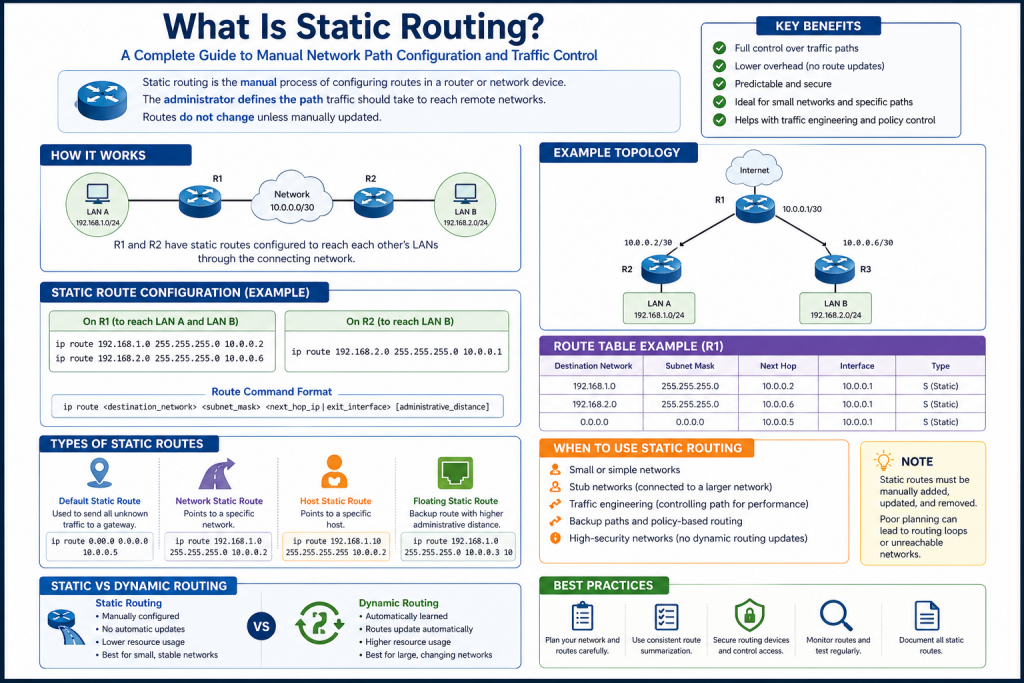
Static routing is one of the core concepts in networking that helps define how data travels from one network to another. It refers to a routing method where network paths are manually configured by an administrator instead of being automatically learned through routing protocols. In simple terms, static routing allows a network engineer to decide exactly how traffic should move across a network by setting fixed routes in a router’s routing table.
At the heart of static routing is the idea of control and predictability. Unlike dynamic routing, which continuously updates routes based on changing network conditions, static routing relies on predefined instructions. These instructions remain unchanged unless they are manually modified. Because of this, static routing provides a stable and consistent way to manage traffic flow.
Even though modern networks often rely heavily on dynamic routing protocols, static routing continues to be widely used. It is especially important for understanding how routing works at a fundamental level. It also plays a significant role in real-world scenarios such as small networks, backup routing paths, and specific security implementations.
Understanding static routing is not just useful for beginners. It is also an essential skill for experienced network engineers. Many certification programs include static routing as a key topic because it forms the foundation for more advanced routing concepts.
Understanding the Concept of Routing
To fully understand static routing, it is important to first grasp the broader concept of routing. Routing is the process of directing data packets from a source device to a destination device across one or more networks. Since most networks are interconnected, data rarely travels directly from sender to receiver. Instead, it passes through intermediate devices known as routers.
Routers are responsible for making decisions about where to send incoming packets. They use routing tables to determine the best path for each packet. A routing table is essentially a list of known networks along with instructions on how to reach them.
When a router receives a packet, it examines the destination IP address and compares it with entries in its routing table. Based on this comparison, the router forwards the packet to the next appropriate device. This process continues until the packet reaches its final destination.
Static routing comes into play by providing specific entries in the routing table. These entries are manually configured and define exactly how packets should be forwarded for certain destinations. Instead of relying on automatic updates, the router follows these predefined paths.
What Is Static Routing
Static routing is a method of routing where network routes are manually defined and do not change unless modified by an administrator. It is called “static” because the routes remain fixed over time. This means that once a route is configured, it stays in place regardless of changes in the network unless someone updates it.
In static routing, each route includes two main components. The first is the destination network, which identifies where the traffic is going. The second is the next hop, which specifies the device that should receive the traffic on its way to the destination.
For example, if a router needs to send traffic to a particular network, a static route can be configured to direct that traffic to a specific gateway. The router will then forward all matching traffic to that gateway.
One important thing to note is that static routing does not involve communication between routers to exchange routing information. There are no routing updates, no advertisements, and no automatic adjustments. Everything is defined manually.
Although static routing is often associated with manual configuration, it can also be deployed using automated tools. Scripts, configuration management systems, and network services can be used to apply static routes across multiple devices. However, the routes themselves still behave as fixed entries.
Key Characteristics of Static Routing
Static routing has several defining characteristics that distinguish it from other routing methods. One of the most notable features is its simplicity. Because there are no routing protocols involved, the configuration process is straightforward. An administrator simply defines the route, and the router follows it.
Another important characteristic is predictability. Since static routes do not change automatically, the path that traffic takes is always the same. This makes it easier to understand and troubleshoot network behavior.
Static routing also provides a high level of control. Administrators can precisely determine how traffic flows through the network. This can be useful in situations where specific paths are required for performance, policy, or security reasons.
In addition, static routing consumes fewer resources compared to dynamic routing. There is no need for continuous route calculations or updates, which reduces CPU usage and bandwidth consumption.
However, these benefits come with certain limitations. Static routes must be manually updated whenever there is a change in the network. This can become time-consuming and error-prone, especially in larger environments.
Static Routing Compared to Dynamic Routing
Static routing and dynamic routing represent two different approaches to managing network traffic. While static routing relies on manual configuration, dynamic routing uses protocols to automatically learn and update routes.
In dynamic routing, routers communicate with each other to share information about network topology. They use this information to build and maintain routing tables. If a network change occurs, such as a link failure, the routing protocol can quickly adjust and find an alternative path.
Static routing, on the other hand, does not adapt to changes automatically. If a route becomes invalid, traffic may be lost until the configuration is updated. This lack of adaptability is one of the main drawbacks of static routing.
Despite this limitation, static routing has its advantages. It is easier to configure in simple networks and provides greater control over routing decisions. It also avoids the overhead associated with routing protocols.
Another key difference is administrative distance, which is used to determine the preferred route when multiple options are available. Static routes typically have a lower administrative distance, meaning they are often chosen over dynamically learned routes.
An easy way to understand the difference is to think of static routing as a fixed plan and dynamic routing as a flexible system that adjusts as needed. Each approach has its place depending on the network requirements.
How Static Routing Works
Static routing works by defining fixed paths for network traffic. The process begins with an administrator configuring routes on a router. These routes specify the destination network and the next hop.
Once the routes are in place, the router uses them to make forwarding decisions. When a packet arrives, the router checks its routing table for a matching entry. If a static route matches the destination, the router forwards the packet according to that route.
If no specific route is found, the router may use a default route if one is configured. A default route acts as a catch-all for traffic that does not match any other entries.
Static routes can also coexist with dynamic routes in the same routing table. In such cases, the router uses rules to determine which route to use. Typically, the most specific route is preferred. If multiple routes have the same level of specificity, administrative distance is used as a tiebreaker.
Because static routes do not change automatically, they require careful planning and maintenance. Any changes in network topology must be reflected in the routing configuration.
Components of a Static Route
A static route consists of several key components that define how traffic should be handled. The most important component is the destination network. This specifies the network that the route applies to.
Another essential component is the subnet mask, which defines the size of the destination network. Together with the destination network, it determines which packets match the route.
The next hop is also a critical part of a static route. This is the IP address of the device that will receive the packet next. It acts as a gateway toward the destination network.
In some cases, an exit interface can be specified instead of a next hop. This tells the router which interface to use when forwarding the packet.
An optional component is the administrative distance. This value indicates the priority of the route compared to others. Lower values are preferred, and this can be used to create backup routes.
Understanding these components is essential for configuring and managing static routes effectively.
Advantages of Static Routing
Static routing offers several advantages that make it useful in certain scenarios. One of the main benefits is simplicity. Since there are no routing protocols involved, the configuration process is straightforward and easy to understand.
Another advantage is predictability. Static routes do not change unless they are manually updated, which means network behavior remains consistent. This can be especially helpful for troubleshooting and ensuring reliable performance.
Static routing also provides enhanced security. Because routes are not advertised to other devices, there is less exposure to potential threats. This reduces the risk of certain types of attacks.
Resource efficiency is another benefit. Static routing does not require continuous updates or calculations, which reduces the load on network devices. This makes it suitable for environments with limited resources.
In addition, static routing allows precise control over traffic flow. Administrators can define exactly how packets should move through the network, which can be useful for meeting specific requirements.
Limitations of Static Routing
While static routing has its advantages, it also comes with several limitations. One of the biggest challenges is scalability. As the network grows, managing static routes becomes increasingly difficult.
Another limitation is the lack of flexibility. Static routes do not adapt to changes in the network. If a link fails or a new path becomes available, the routing configuration must be updated manually.
Static routing is also prone to human error. Since routes are configured manually, mistakes can lead to connectivity issues. This requires careful planning and regular maintenance.
In addition, static routing does not provide automatic failover. If a route becomes unavailable, traffic will not be redirected unless a backup route has been configured.
These limitations mean that static routing is not always suitable for large or complex networks. However, it remains a valuable tool when used appropriately.
Importance of Static Routing in Modern Networks
Despite the widespread use of dynamic routing protocols, static routing continues to play an important role in modern networks. It is often used in combination with dynamic routing to achieve specific goals.
For example, static routes can be used to define default paths or provide backup routes. They can also be used in networks with simple topologies where dynamic routing is unnecessary.
Static routing is particularly useful in small to medium-sized networks. In these environments, the simplicity and predictability of static routing can outweigh its limitations.
It is also valuable in situations where security is a priority. Since static routes are not shared with other devices, they reduce the risk of certain types of attacks.
Overall, static routing remains a fundamental concept that every network professional should understand. It provides a solid foundation for learning more advanced routing technique
Configuration and Practical Implementation
Static routing becomes truly meaningful when it is applied in real network environments. While understanding the theory is important, knowing how to configure and implement static routes is what allows network administrators to control traffic flow effectively. In this section, we will explore how static routing is set up, the steps involved in configuration, and how it behaves in real-world scenarios.
At its core, configuring a static route requires defining a destination network and specifying where the traffic should be sent. This “where” is typically referred to as the next hop, which is the address of the next router or gateway along the path. Once this information is entered into a router, it becomes part of the routing table and is used to forward packets.
Static routes can be configured using different methods depending on the type of networking equipment. Most commonly, administrators use a command-line interface, but many modern devices also provide graphical interfaces for easier configuration. Regardless of the method used, the underlying concept remains the same.
When implementing static routing, it is important to have a clear understanding of the network topology. This includes knowing how different networks are connected, what devices are involved, and what paths are available. Without this knowledge, it becomes difficult to configure accurate and effective routes.
Configuring Static Routes Using Command Line Interface
The command-line interface is one of the most common ways to configure static routes, especially in enterprise networking environments. It provides precise control and allows administrators to enter commands directly into the device.
To begin, the administrator accesses the router’s terminal. Once inside, they move through different modes of operation, typically starting in a basic mode and progressing to a configuration mode where changes can be made.
The actual command used to configure a static route generally includes the destination network, the subnet mask, and the next hop address. This command tells the router that any traffic destined for a specific network should be forwarded to a particular gateway.
For example, if a network administrator wants to define a route to a remote network, they would enter a command specifying that network along with the address of the next router in the path. Once entered, the route becomes active and is stored in the routing table.
In addition to the basic configuration, administrators can also define an administrative distance. This value determines the priority of the route compared to others. By adjusting this value, it is possible to create backup routes that only become active when the primary route is unavailable.
After configuring static routes, it is important to verify that they are working correctly. This can be done using diagnostic commands that display the routing table. These commands allow administrators to confirm that the routes are present and being used as expected.
Configuring Static Routes Using Graphical Interfaces
While command-line configuration is widely used, many modern networking devices offer graphical interfaces that simplify the process. These interfaces provide a more visual way to configure static routes, making them accessible to users who may not be comfortable with command-line commands.
In a graphical interface, static routing configuration is usually found within network settings or routing sections. The administrator is typically required to fill out fields such as destination network, subnet mask, and next hop address.
Once the required information is entered, the route can be saved and applied. The device then uses this configuration to update its routing table. The overall process mirrors what happens in the command-line interface, but with a more user-friendly approach.
Graphical interfaces often include additional features such as validation checks and guided steps. These features help reduce errors and ensure that the configuration is correct. However, they may not offer the same level of flexibility as command-line interfaces.
Despite these differences, both methods achieve the same goal. They allow administrators to define fixed routes that control how traffic flows through the network.
Understanding Routing Table Behavior
The routing table is a central component of any routing device. It contains all the routes that the router uses to make forwarding decisions. Static routes become part of this table once they are configured.
When a packet arrives at a router, the router checks the destination address and compares it with entries in the routing table. If a match is found, the router forwards the packet according to that route.
One important concept in routing table behavior is route specificity. When multiple routes match a destination, the router selects the most specific one. This means that routes with longer subnet masks are preferred because they define a smaller, more precise network.
If there are multiple routes with the same level of specificity, administrative distance is used as a tiebreaker. Routes with lower administrative distance are preferred because they are considered more reliable.
Static routes usually have a low administrative distance, which means they are often chosen over dynamic routes. This allows administrators to override dynamically learned routes when necessary.
Understanding how routing tables work is essential for managing static routes effectively. It helps ensure that traffic is directed correctly and that routing decisions are predictable.
Types of Static Routes
Static routing is not limited to a single type of configuration. There are several variations that serve different purposes in a network. Each type is designed to address specific needs and scenarios.
A standard static route is the most basic type. It defines a path to a specific network by specifying the destination and next hop. This is the most commonly used form of static routing.
A default static route is used when no other routes match a destination. It acts as a fallback path and is often referred to as a gateway of last resort. This type of route is particularly useful for connecting a network to external networks.
A summary static route combines multiple networks into a single route entry. This reduces the size of the routing table and simplifies management. Instead of defining separate routes for each network, a single summarized route can be used.
A floating static route is designed as a backup. It has a higher administrative distance than the primary route, which means it is only used when the primary route becomes unavailable. This provides a basic form of failover in static routing environments.
Each of these types plays an important role in network design. By using them appropriately, administrators can create efficient and reliable routing configurations.
Practical Considerations for Static Routing
When implementing static routing, there are several practical considerations that must be taken into account. One of the most important is accuracy. Since routes are configured manually, even a small mistake can lead to connectivity issues.
Another consideration is network changes. Static routes do not update automatically, so any changes in the network must be reflected in the configuration. This requires regular monitoring and maintenance.
Documentation is also critical. Keeping track of configured routes helps ensure that the network remains manageable. It also makes it easier for other administrators to understand the setup.
Scalability is another factor to consider. While static routing works well in smaller networks, it becomes more challenging as the network grows. In larger environments, the number of routes can increase significantly, making manual management difficult.
Despite these challenges, careful planning can help mitigate potential issues. By designing the network thoughtfully and maintaining clear documentation, static routing can be used effectively.
Best Practices for Static Route Configuration
To make the most of static routing, it is important to follow certain best practices. These practices help ensure that the network remains stable, efficient, and easy to manage.
One key practice is maintaining proper documentation. Every static route should be recorded along with its purpose. This helps prevent confusion and makes troubleshooting easier.
Another important practice is planning for redundancy. Since static routing does not automatically handle failures, backup routes should be configured where necessary. Floating static routes are a common solution for this.
Regular review of routing configurations is also essential. Over time, networks change, and outdated routes can cause problems. Periodic checks help ensure that all routes are still relevant and accurate.
Keeping the configuration simple is another important guideline. Overcomplicating static routing can make it difficult to manage. It is better to use dynamic routing when the network becomes too complex.
Finally, testing is crucial. After configuring static routes, administrators should verify that traffic flows as expected. This helps identify and resolve issues before they impact users.
Interaction Between Static and Dynamic Routes
In many real-world networks, static routing is used alongside dynamic routing. This combination allows administrators to take advantage of both approaches.
Static routes can be used to define specific paths that should always be followed. At the same time, dynamic routing protocols can handle general traffic and adapt to changes in the network.
When both types of routes are present, the router uses rules to determine which one to use. As mentioned earlier, static routes often have a lower administrative distance, which gives them priority.
This interaction can be useful for implementing policies or ensuring that certain traffic follows a specific path. It also allows for the creation of backup routes that complement dynamic routing.
However, it is important to manage this interaction carefully. Misconfiguration can lead to conflicts or unexpected behavior. Understanding how routes are selected helps prevent such issues.
Real-World Behavior of Static Routing
In real-world networks, static routing is often used in targeted scenarios rather than as a complete solution. Its simplicity and predictability make it ideal for certain use cases.
For example, static routing is commonly used in small networks where the topology is simple and does not change frequently. In such environments, the overhead of dynamic routing is unnecessary.
It is also used for defining default routes, which provide a path for traffic that does not match any specific route. This is particularly useful for connecting internal networks to external ones.
Another common use is in creating backup paths. By configuring floating static routes, administrators can ensure that traffic is redirected if the primary route fails.
Use Cases and Real World Applications
Static routing continues to play a meaningful role in modern networking environments despite the widespread use of dynamic routing protocols. Its simplicity and predictability make it suitable for a variety of specific use cases where full automation is not necessary or even desirable. Understanding these use cases helps clarify why static routing remains relevant.
One of the most common scenarios where static routing is applied is in small to medium-sized networks. In these environments, the network topology is usually simple and does not change frequently. Because of this stability, administrators can define routes once and rely on them without worrying about constant updates. Static routing eliminates the need for routing protocols, reducing complexity and conserving system resources.
Another important use case is in stub networks. A stub network is a network that has only one path to reach other networks. Since there is only a single exit point, there is no need for dynamic route calculation. Static routing works perfectly in this situation because all outbound traffic can be directed to a single default gateway. This simplifies configuration and reduces overhead.
Static routing is also widely used for defining default routes. A default route acts as a fallback option when no specific route is available for a destination. Instead of configuring routes for every possible network, administrators can define a single default path that handles all unknown traffic. This is particularly useful in networks that connect to the internet or a larger upstream network.
Another practical application of static routing is in creating backup or redundant paths. Although static routes do not automatically adapt to network changes, administrators can configure backup routes using higher administrative distance values. These are often referred to as floating static routes. They remain inactive under normal conditions but become active when the primary route fails. This provides a simple form of failover without requiring dynamic routing protocols.
Security-focused environments also benefit from static routing. Since static routes are not advertised across the network, they limit the amount of routing information exposed to other devices. This reduces the risk of certain types of attacks and helps maintain tighter control over traffic flow. Additionally, static routes can be used to direct unwanted traffic to null interfaces, effectively discarding it and protecting network resources.
Static Routing in Network Design
Incorporating static routing into network design requires careful planning and consideration. While it offers simplicity, it must be used in the right context to avoid unnecessary complications.
One key aspect of network design is determining where static routing is appropriate. In general, it works best in stable environments where network paths are unlikely to change. For example, branch offices with a single connection to a central location can benefit from static routing. In such cases, all traffic can be directed through a predefined path without the need for dynamic updates.
Another consideration is network segmentation. Static routing can be used to control how traffic moves between different segments of a network. By defining specific routes, administrators can enforce policies and ensure that data follows approved paths.
In hybrid environments, static routing is often used alongside dynamic routing protocols. This combination allows administrators to leverage the strengths of both approaches. For instance, dynamic routing can handle general traffic and adapt to changes, while static routing can be used for critical paths or specific requirements.
Scalability is an important factor in network design. While static routing is easy to manage in small networks, it becomes more challenging as the network grows. Each new network requires additional routes, increasing the complexity of configuration and maintenance. For this reason, static routing is typically limited to specific parts of larger networks.
Proper documentation is essential when using static routing in network design. Since routes are manually configured, it is important to keep track of them. Clear documentation helps ensure that configurations remain consistent and understandable over time.
Advanced Static Routing Concepts
Beyond basic configuration, there are several advanced concepts that enhance the functionality of static routing. These concepts allow administrators to create more flexible and efficient routing strategies.
One such concept is route summarization. This involves combining multiple network routes into a single entry. By summarizing routes, administrators can reduce the size of the routing table and simplify management. This is particularly useful in networks with multiple subnets that share a common address range.
Another advanced concept is the use of floating static routes for redundancy. By assigning a higher administrative distance to a backup route, it remains inactive until the primary route fails. This provides a basic level of resilience without the complexity of dynamic routing protocols.
Policy-based routing is another technique that can work alongside static routing. It allows administrators to define routing decisions based on factors other than the destination address, such as source address or type of traffic. While this goes beyond traditional static routing, it demonstrates how static routes can be part of a broader strategy.
Load distribution can also be achieved using static routes in certain scenarios. By configuring multiple routes to the same destination with equal administrative distance, traffic can be distributed across multiple paths. However, this approach requires careful planning to avoid imbalances or inefficiencies.
These advanced concepts show that static routing is not limited to basic configurations. With proper understanding, it can be adapted to meet more complex requirements.
Challenges and Limitations in Real Networks
Despite its advantages, static routing presents several challenges when used in real-world networks. One of the most significant issues is scalability. As the network grows, the number of static routes increases, making management more difficult. Each route must be configured and maintained manually, which can become time-consuming.
Another challenge is the lack of automatic adaptation. Static routes do not respond to network changes such as link failures or congestion. If a path becomes unavailable, traffic may be disrupted until the configuration is updated. This can lead to downtime and reduced reliability.
Human error is also a common concern. Since static routing relies on manual configuration, mistakes can occur. Incorrect routes can cause traffic to be misdirected or lost entirely. This highlights the importance of careful planning and verification.
Maintenance is another factor to consider. Static routes require regular review to ensure they remain accurate. As networks evolve, outdated routes can cause conflicts or inefficiencies. Keeping configurations up to date is essential for maintaining network performance.
Limited flexibility is another drawback. Static routing does not provide the dynamic capabilities needed for complex or rapidly changing networks. In such environments, dynamic routing protocols are often a better choice.
These challenges do not mean that static routing should be avoided. Instead, they emphasize the importance of using it appropriately and understanding its limitations.
Best Practices for Using Static Routing Effectively
To maximize the benefits of static routing while minimizing its drawbacks, it is important to follow best practices. These guidelines help ensure that static routes are implemented in a way that supports network stability and efficiency.
One of the most important practices is maintaining accurate documentation. Every static route should be recorded along with its purpose and configuration details. This makes it easier to manage the network and troubleshoot issues.
Planning for redundancy is another key practice. Since static routing does not provide automatic failover, backup routes should be configured where necessary. Floating static routes are a common solution for this.
Regular review of routing configurations is also essential. Networks change over time, and static routes must be updated to reflect these changes. Periodic audits help identify outdated or unnecessary routes.
Simplicity should be a guiding principle. Overcomplicating static routing can lead to confusion and errors. It is important to use static routing only where it makes sense and rely on dynamic routing for more complex scenarios.
Testing is another critical practice. After configuring static routes, administrators should verify that traffic flows as expected. This helps identify issues early and ensures that the network operates smoothly.
Security considerations should also be taken into account. Static routing can be used to control traffic flow and limit exposure to potential threats. Proper configuration helps enhance network security.
Static Routing in Modern Networking Environments
In today’s networking landscape, static routing is often used as part of a larger strategy rather than as a standalone solution. It complements dynamic routing protocols and provides additional control where needed.
For example, static routes are commonly used to define default paths in enterprise networks. They can also be used to connect isolated segments or provide backup routes for critical connections.
In cloud and virtualized environments, static routing can be used to manage traffic between virtual networks. It provides a simple way to define connectivity without relying on complex routing protocols.
Internet service providers and large organizations may also use static routing for specific purposes, such as directing traffic to certain services or enforcing policies. While dynamic routing handles the majority of traffic, static routes provide targeted control.
Another modern use case is in security applications. Static routes can be used to direct unwanted traffic to null interfaces, effectively blocking it. This helps protect network resources and maintain performance.
These examples demonstrate that static routing remains relevant even in advanced networking environments. Its role may have evolved, but its importance has not diminished.
Conclusion
Static routing is a fundamental concept that continues to play an important role in networking. It provides a simple and predictable way to control how data moves across a network. By manually defining routes, administrators gain precise control over traffic flow and can meet specific requirements.
Throughout this discussion, we explored how static routing is used in real-world scenarios, from small networks and stub networks to security-focused environments and backup routing strategies. We also examined how it fits into network design and how advanced concepts can enhance its functionality.
While static routing has limitations, such as lack of scalability and flexibility, it remains a valuable tool when used appropriately. By following best practices and understanding its role within a broader network strategy, administrators can take full advantage of its benefits.
In modern networks, static routing is rarely used in isolation. Instead, it works alongside dynamic routing to create balanced and efficient systems. This combination allows networks to adapt to changes while maintaining control over critical paths.
Ultimately, static routing is more than just a basic networking technique. It is a foundational skill that helps build a deeper understanding of how networks operate. Whether used in simple configurations or as part of complex designs, it remains an essential tool for network professionals.
Continue exploring the technologies and certification concepts that matter most to you.