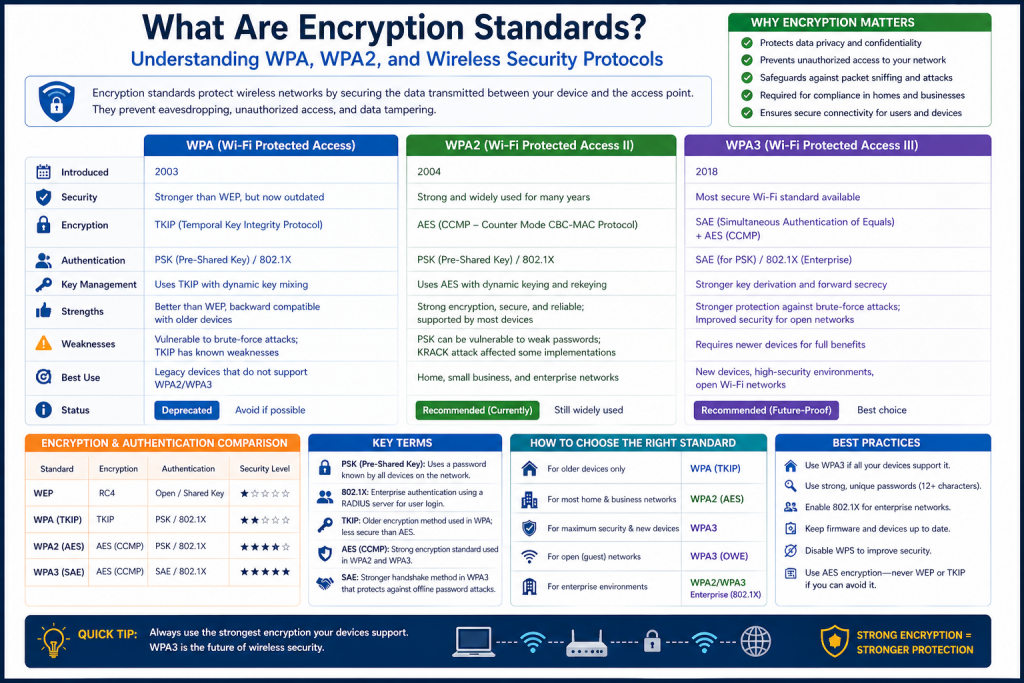
In the modern digital landscape, wireless connectivity has become a fundamental part of everyday life. From homes and offices to public spaces and industrial environments, Wi-Fi networks are used to transmit vast amounts of information every second. While this convenience has transformed communication and productivity, it has also introduced significant security challenges. Unlike wired networks, which rely on physical connections, wireless networks broadcast signals through the air. This makes them inherently more vulnerable to interception, unauthorized access, and malicious attacks.
Because of this exposure, protecting wireless communication is essential. Without proper safeguards, sensitive data such as passwords, financial information, and personal messages can be captured by attackers using relatively simple tools. This is where encryption standards come into play. These standards are designed to ensure that even if data is intercepted, it cannot be understood or misused by unauthorized individuals.
Encryption standards form the backbone of wireless security. They define how data is encoded, transmitted, and decoded, ensuring confidentiality, integrity, and authenticity. Over time, these standards have evolved to address new threats and vulnerabilities, leading to the development of more secure protocols like Wi-Fi Protected Access.
What Are Encryption Standards
Encryption standards are structured frameworks that define how information is transformed into a secure format during transmission. The primary goal of encryption is to convert readable data, known as plaintext, into an unreadable form called ciphertext. This transformation ensures that only authorized parties with the correct decryption key can access the original information.
At a basic level, encryption works through algorithms and keys. An algorithm is a mathematical process that scrambles the data, while a key is a piece of information that determines how the algorithm operates. Without the correct key, it becomes extremely difficult, if not impossible, to reverse the encryption process.
In the context of wireless networks, encryption standards are essential because of the open nature of radio communication. Any device within range of a Wi-Fi signal can potentially capture transmitted data. Encryption ensures that even if this data is intercepted, it remains protected.
These standards also establish guidelines for authentication and data integrity. Authentication verifies the identity of users and devices attempting to access the network, while data integrity ensures that the information has not been altered during transmission. Together, these elements create a secure environment for communication.
Over the years, encryption standards have been continuously improved to counter evolving threats. Early methods were relatively simple and eventually became vulnerable to attacks. Modern standards, however, use complex algorithms and dynamic key management techniques to provide stronger protection.
The Need for Wireless Encryption
Wireless networks are particularly susceptible to security risks due to their broadcast nature. Unlike a wired connection, which requires physical access to a cable, a wireless signal can be accessed by anyone within range. This makes it easier for attackers to attempt unauthorized access or intercept data.
Without encryption, data transmitted over a wireless network can be easily read using packet-sniffing tools. These tools capture network traffic and display it in a human-readable format, exposing sensitive information such as login credentials and personal communications. This risk is especially high in public Wi-Fi environments, where multiple users share the same network.
Encryption addresses these vulnerabilities by securing data at the point of transmission. It ensures that even if an attacker captures the data, they cannot interpret it without the proper key. This adds a critical layer of defense against eavesdropping and data theft.
Another important aspect of wireless encryption is preventing unauthorized access. Without proper security measures, attackers can connect to a network and use it for malicious purposes, such as launching attacks, stealing data, or consuming bandwidth. Encryption protocols require users to authenticate themselves before gaining access, reducing the likelihood of unauthorized connections.
Additionally, encryption helps maintain data integrity. During transmission, data can potentially be altered by attackers. Encryption standards include mechanisms to detect such tampering, ensuring that the data received is exactly the same as the data sent.
Given these risks, it is clear that encryption is not just an optional feature but a necessity for any wireless network. It provides the foundation for secure communication and protects both individuals and organizations from a wide range of threats.
Introduction to Wi-Fi Protected Access
Wi-Fi Protected Access, commonly known as WPA, is a security protocol developed to address the weaknesses of earlier wireless encryption methods. It was introduced as an improvement over older standards, providing stronger protection for wireless communication.
WPA was designed with the goal of enhancing security without requiring significant changes to existing hardware. This made it easier for organizations and individuals to upgrade their networks without replacing all their equipment. By introducing improved encryption techniques and authentication mechanisms, WPA significantly increased the level of protection available to wireless users.
The protocol focuses on securing data as it travels between devices and access points. It ensures that information remains confidential and protected from unauthorized access. WPA also includes features to detect and prevent tampering, making it a comprehensive solution for wireless security.
One of the key strengths of WPA is its adaptability. It was developed as a transitional solution that could be implemented on older devices while paving the way for more advanced standards. This flexibility allowed it to gain widespread adoption and become a foundational element of wireless security.
Core Objectives of WPA
WPA is built around several key objectives that define its role in securing wireless networks. These objectives ensure that the protocol addresses the most critical aspects of security.
The first objective is preventing unauthorized access. WPA requires users to authenticate themselves before connecting to the network. This ensures that only authorized individuals and devices can gain access, reducing the risk of intrusions.
The second objective is protecting data confidentiality. WPA uses encryption to secure data during transmission, making it unreadable to anyone who does not have the correct key. This prevents attackers from accessing sensitive information even if they intercept the data.
The third objective is maintaining data integrity. WPA includes mechanisms to verify that data has not been altered during transmission. If any changes are detected, the data is rejected, ensuring that only accurate information is received.
The fourth objective is supporting compliance with security standards and regulations. Many industries require strict data protection measures, and WPA helps organizations meet these requirements by providing a reliable and standardized approach to wireless security.
Together, these objectives create a robust framework for protecting wireless communication and ensuring the safety of transmitted data.
How WPA Works
WPA operates by combining encryption and authentication techniques to secure wireless communication. When a device attempts to connect to a WPA-protected network, it must first go through an authentication process. This process verifies the identity of the device and ensures that it is authorized to access the network.
Once authentication is complete, WPA establishes an encrypted connection between the device and the access point. This involves generating encryption keys that are used to secure the data being transmitted. These keys are dynamically updated, which adds an extra layer of security by preventing attackers from using previously captured data to gain access.
WPA also uses integrity checks to ensure that data has not been tampered with during transmission. Each data packet includes a code that allows the receiving device to verify its authenticity. If the data has been altered, it is rejected, preventing potential attacks.
This combination of authentication, encryption, and integrity verification makes WPA an effective solution for securing wireless networks. It addresses multiple aspects of security, ensuring that data remains protected at all times.
Limitations of Early WPA
While WPA represented a significant improvement over earlier standards, it was not without its limitations. The original version of WPA relied on a protocol known as Temporal Key Integrity Protocol, or TKIP. TKIP was designed as a temporary solution to enhance security without requiring new hardware.
Although TKIP provided important improvements, it was eventually found to have vulnerabilities. These weaknesses were primarily due to its reliance on older encryption algorithms, which were not strong enough to withstand advanced attacks. Over time, researchers discovered methods to exploit these weaknesses, reducing the effectiveness of WPA.
Another limitation of early WPA was its dependence on shared passwords in many implementations. If the password was weak or widely shared, it increased the risk of unauthorized access. Attackers could use brute-force techniques to guess the password and gain entry to the network.
These limitations highlighted the need for a more robust and secure solution. As threats continued to evolve, it became clear that stronger encryption and improved authentication methods were necessary.
Transition Toward Stronger Standards
The challenges faced by early WPA led to the development of more advanced encryption standards. This evolution was driven by the need to address vulnerabilities and provide stronger protection against emerging threats.
One of the key improvements was the adoption of more secure encryption algorithms. These algorithms use complex mathematical processes to protect data, making it significantly more difficult for attackers to break the encryption. This shift marked a major step forward in wireless security.
Another important advancement was the introduction of enhanced authentication methods. These methods provide more reliable ways to verify the identity of users and devices, reducing the risk of unauthorized access. They also allow for greater flexibility in managing network access, particularly in larger environments.
The transition to stronger standards also included improvements in key management. Modern protocols use dynamic keys that are regularly updated, making it harder for attackers to exploit captured data. This approach adds an additional layer of security and helps protect against a wide range of attacks.
These advancements laid the groundwork for the next generation of wireless security protocols, which continue to build on the foundation established by WPA.
The Role of WPA in Modern Networking
Despite its limitations, WPA played a crucial role in the evolution of wireless security. It served as a bridge between older, less secure standards and the more advanced protocols used today. By introducing stronger encryption and improved authentication, WPA helped raise the overall level of security in wireless networks.
WPA also contributed to increased awareness of the importance of network security. As more users began to understand the risks associated with wireless communication, the demand for better protection grew. This, in turn, drove further innovation and the development of more secure technologies.
In modern networking, the principles established by WPA continue to be relevant. Concepts such as encryption, authentication, and data integrity remain central to wireless security. While newer standards have built upon these ideas, the foundation laid by WPA is still evident in today’s protocols.
Understanding WPA and its role in the development of wireless security provides valuable insight into how modern networks are protected. It highlights the importance of continuous improvement and adaptation in the face of evolving threats.
Introduction to WPA2 Personal
As wireless networking became more widespread, the demand for stronger and more reliable security solutions increased significantly. While earlier protocols provided a basic level of protection, they were not sufficient to counter evolving cyber threats. This led to the development of WPA2, a more advanced and secure wireless encryption standard that improved upon its predecessor in several critical ways.
WPA2 Personal is one of the most commonly used configurations of this standard, particularly in home networks and small business environments. It is designed to balance strong security with ease of use, making it accessible to users who may not have extensive technical knowledge. Unlike enterprise-level solutions, WPA2 Personal does not require complex infrastructure or dedicated authentication servers. Instead, it relies on a shared password to control access to the network.
Despite its simplicity, WPA2 Personal offers a high level of protection when configured correctly. It uses advanced encryption techniques to secure data and prevent unauthorized access. Understanding how it works is essential for anyone looking to maintain a safe and reliable wireless network.
The Evolution from WPA to WPA2
The transition from WPA to WPA2 marked a significant step forward in wireless security. While WPA introduced important improvements over earlier standards, it still relied on older encryption methods that were eventually found to be vulnerable. These limitations highlighted the need for a stronger and more future-proof solution.
WPA2 was developed to address these concerns by introducing a new encryption method known as the Advanced Encryption Standard. This change represented a major upgrade in security, as AES is far more robust than the algorithms used in earlier protocols. It provides stronger protection against attacks and is capable of securing large volumes of data without compromising performance.
Another important improvement in WPA2 was the adoption of more reliable authentication mechanisms. These enhancements made it more difficult for unauthorized users to gain access to the network. As a result, WPA2 quickly became the preferred standard for wireless security and remains widely used today.
The shift to WPA2 also aligned with industry standards, ensuring compatibility across a wide range of devices. This widespread support has contributed to its continued popularity and effectiveness in securing wireless networks.
Understanding the Role of AES Encryption
At the core of WPA2 Personal is the Advanced Encryption Standard, which plays a crucial role in protecting data during transmission. AES is a symmetric encryption algorithm, meaning the same key is used for both encryption and decryption. This approach simplifies the process while maintaining a high level of security.
AES works by transforming plaintext data into ciphertext using a series of complex mathematical operations. These operations involve multiple rounds of substitution, permutation, and mixing, which make it extremely difficult for attackers to reverse the process without the correct key. The strength of AES lies in its ability to resist a wide range of attacks, including brute-force attempts and cryptographic analysis.
One of the key advantages of AES is its efficiency. It can encrypt and decrypt data quickly, making it suitable for real-time communication in wireless networks. This ensures that security does not come at the cost of performance, allowing users to enjoy fast and reliable connectivity.
In WPA2 Personal, AES is used to encrypt all data transmitted between devices and the access point. This ensures that even if the data is intercepted, it remains unreadable without the proper key. As a result, AES provides a strong foundation for wireless security and is widely regarded as one of the most secure encryption methods available.
How WPA2 Personal Authentication Works
Authentication is a critical component of WPA2 Personal, as it determines who is allowed to access the network. In this configuration, authentication is based on a pre-shared key, which is essentially a password known to all authorized users.
When a device attempts to connect to a WPA2-protected network, it must first provide the correct password. This password is used to generate an encryption key that will be used to secure the connection. If the password is incorrect, the device is denied access, preventing unauthorized users from connecting.
The authentication process involves a series of steps known as the four-way handshake. This process allows the device and the access point to verify each other and establish a secure connection. During this handshake, encryption keys are generated and exchanged in a way that prevents them from being exposed to potential attackers.
The four-way handshake also ensures that each session uses unique encryption keys. This means that even if an attacker manages to capture data from one session, they cannot use it to decrypt data from another session. This dynamic approach to key management significantly enhances security.
While the use of a shared password simplifies the setup process, it also introduces certain risks. If the password is weak or widely shared, it increases the likelihood of unauthorized access. Therefore, choosing a strong and secure password is essential for maintaining the integrity of the network.
Setting Up WPA2 Personal on a Wireless Network
Configuring WPA2 Personal on a wireless network is a relatively straightforward process, but it requires careful attention to detail to ensure optimal security. The first step is to access the administrative interface of the wireless access point. This is typically done through a web browser by entering the device’s IP address.
Once logged in, the user navigates to the wireless settings section, where the network’s security options can be configured. From the available choices, WPA2 Personal should be selected as the security mode. This ensures that the network will use the advanced encryption and authentication features associated with WPA2.
Next, the encryption type must be chosen. It is recommended to select AES, as it provides the highest level of security. Some devices may offer compatibility modes that include older encryption methods, but these should generally be avoided unless necessary, as they can weaken the overall security of the network.
The most critical step in the setup process is creating a strong password. This password should be between 8 and 63 characters and include a combination of uppercase and lowercase letters, numbers, and special characters. A strong password makes it significantly more difficult for attackers to gain access through guessing or brute-force attacks.
After entering the password, the configuration is saved, and the network becomes active. Devices can then connect to the network by entering the password, and all communication will be encrypted using AES. Proper setup ensures that the network is both secure and easy to use.
Security Strengths of WPA2 Personal
WPA2 Personal offers several advantages that make it a reliable choice for securing wireless networks. One of its primary strengths is the use of AES encryption, which provides a high level of protection against unauthorized access and data interception. This ensures that sensitive information remains secure even in potentially hostile environments.
Another strength is its simplicity. Unlike enterprise-level solutions, WPA2 Personal does not require complex infrastructure or specialized knowledge to implement. This makes it accessible to a wide range of users, from homeowners to small business operators.
The dynamic key generation used in WPA2 Personal also enhances security. By generating unique keys for each session, the protocol reduces the risk of key reuse and makes it more difficult for attackers to exploit captured data. This approach adds an extra layer of protection that is not present in older encryption methods.
Additionally, WPA2 Personal is widely supported by modern devices, ensuring compatibility across different platforms and systems. This makes it a practical and versatile solution for a variety of networking environments.
Limitations and Potential Risks
Despite its strengths, WPA2 Personal is not without its limitations. One of the main challenges is the reliance on a shared password. Since all users must use the same password to access the network, it can be difficult to manage access in larger environments. If the password is shared with unauthorized individuals, it compromises the security of the entire network.
Another potential risk is the use of weak passwords. Many users choose simple or easily guessable passwords, which can be exploited by attackers using brute-force techniques. Even with strong encryption, a weak password can undermine the effectiveness of the entire system.
WPA2 Personal is also vulnerable to certain types of attacks, such as dictionary attacks and handshake capture attempts. In these scenarios, attackers attempt to capture the authentication handshake and use it to guess the password. While strong passwords can mitigate this risk, it remains a concern that users must be aware of.
Furthermore, as technology continues to evolve, new vulnerabilities may be discovered. This highlights the importance of staying informed about security developments and updating systems as needed to address emerging threats.
Best Practices for Using WPA2 Personal
To maximize the security of a WPA2 Personal network, it is important to follow best practices. One of the most important steps is using a strong and unique password. Avoid using common words or predictable patterns, and consider using a passphrase that combines multiple words and characters.
Regularly updating the password is another important practice. Changing the password periodically reduces the risk of unauthorized access and ensures that only current users can connect to the network. It is also important to update the password immediately if there is any suspicion that it has been compromised.
Keeping the wireless access point’s firmware up to date is essential for maintaining security. Manufacturers often release updates to address vulnerabilities and improve performance. Installing these updates ensures that the network remains protected against known threats.
Disabling unnecessary features, such as remote management or unused network services, can also enhance security. These features can create additional entry points for attackers and should only be enabled when needed.
Monitoring network activity is another effective way to detect potential issues. By reviewing connected devices and traffic patterns, users can identify unusual behavior and take action before it leads to a security breach.
The Role of WPA2 Personal in Everyday Networking
WPA2 Personal plays a vital role in everyday networking by providing a secure and user-friendly solution for protecting wireless communication. Its widespread adoption has made it a standard feature in most routers and devices, ensuring that users can easily implement strong security measures.
In homes, WPA2 Personal protects personal data and prevents unauthorized access to the network. This is especially important as more devices become connected through the Internet of Things. From smart appliances to security cameras, these devices rely on secure connections to function properly.
In small businesses, WPA2 Personal provides a cost-effective way to secure network resources without the need for complex infrastructure. It allows employees to connect securely while protecting sensitive business information from potential threats.
The continued relevance of WPA2 Personal demonstrates its effectiveness as a security solution. While newer standards have been introduced, it remains a reliable option for many users, particularly when implemented with best practices.
Introduction to WPA2 Enterprise
As wireless networks expanded beyond homes and small offices into large organizations, universities, hospitals, and government institutions, the need for more advanced security mechanisms became clear. While WPA2 Personal provides strong encryption, its reliance on a shared password makes it less suitable for environments where many users require controlled and individualized access. This is where WPA2 Enterprise becomes essential.
WPA2 Enterprise is designed to provide a higher level of security, scalability, and control. Instead of relying on a single shared password, it uses centralized authentication systems that assign unique credentials to each user or device. This approach significantly reduces the risk of unauthorized access and makes it easier to manage large networks.
The primary strength of WPA2 Enterprise lies in its ability to combine strong encryption with sophisticated authentication. It not only protects data during transmission but also ensures that only verified users can connect to the network. This makes it a preferred choice for organizations that handle sensitive information and require strict access control.
Key Differences Between Personal and Enterprise Modes
Understanding the differences between WPA2 Personal and WPA2 Enterprise is crucial for selecting the right security approach. While both use the same underlying encryption standard, their methods of authentication and management differ significantly.
WPA2 Personal uses a pre-shared key, meaning all users connect to the network using the same password. This simplicity makes it easy to deploy but can become a security risk in larger environments. If the password is shared or compromised, the entire network becomes vulnerable.
In contrast, WPA2 Enterprise assigns unique credentials to each user. This eliminates the need for a shared password and allows administrators to control access on an individual basis. Users can be added or removed without affecting others, making the system more flexible and secure.
Another important difference is scalability. WPA2 Personal works well for small networks, but it becomes difficult to manage as the number of users increases. WPA2 Enterprise, on the other hand, is designed to handle large numbers of users efficiently.
These differences highlight why WPA2 Enterprise is often the preferred choice for organizations that require robust security and detailed access control.
Understanding RADIUS and Centralized Authentication
A key component of WPA2 Enterprise is the use of a RADIUS server, which stands for Remote Authentication Dial-In User Service. This server acts as a central authority for verifying user credentials and controlling access to the network.
When a device attempts to connect to a WPA2 Enterprise network, the access point does not authenticate the user directly. Instead, it forwards the request to the RADIUS server. The server then checks the provided credentials against its database and determines whether access should be granted.
This centralized approach offers several advantages. It allows administrators to manage all user accounts from a single location, making it easier to enforce security policies and monitor activity. It also provides detailed logging, which can be used for auditing and troubleshooting.
RADIUS servers support various authentication methods, including usernames and passwords, digital certificates, and token-based systems. This flexibility allows organizations to choose the method that best fits their security requirements.
By separating authentication from the access point, WPA2 Enterprise creates a more secure and scalable system that can adapt to the needs of modern networks.
The Role of EAP in Secure Communication
The Extensible Authentication Protocol, commonly known as EAP, plays a central role in WPA2 Enterprise authentication. EAP is not a single method but a framework that supports multiple authentication techniques. This flexibility allows organizations to implement different levels of security based on their requirements.
When a device connects to a WPA2 Enterprise network, EAP is used to facilitate communication between the device, the access point, and the RADIUS server. This process ensures that authentication is performed securely and efficiently.
There are several EAP methods available, each with its own strengths. Some methods use simple username and password combinations, while others rely on digital certificates for stronger authentication. Certificate-based methods are generally more secure, as they are harder to forge or steal.
EAP also supports mutual authentication, meaning both the client and the server verify each other’s identity. This prevents attackers from setting up fake access points to trick users into revealing their credentials.
The use of EAP enhances the overall security of WPA2 Enterprise by providing a flexible and robust authentication framework.
How WPA2 Enterprise Secures Data Transmission
In addition to strong authentication, WPA2 Enterprise uses advanced encryption to protect data during transmission. Like WPA2 Personal, it relies on the Advanced Encryption Standard to ensure that all communication is secure.
Once a user is authenticated, the system generates unique encryption keys for the session. These keys are used to encrypt data as it travels between the device and the access point. Because each session uses different keys, the risk of data being compromised is significantly reduced.
WPA2 Enterprise also includes mechanisms to ensure data integrity. Each packet of data is checked to confirm that it has not been altered during transmission. If any discrepancies are detected, the data is discarded, preventing potential attacks.
This combination of strong authentication and encryption makes WPA2 Enterprise one of the most secure wireless networking solutions available. It provides comprehensive protection against unauthorized access, data interception, and tampering.
Setting Up WPA2 Enterprise in a Network
Implementing WPA2 Enterprise requires more planning and resources compared to WPA2 Personal. The first step is to set up a RADIUS server, which will handle authentication for the network. This server must be properly configured with user accounts and security policies.
Next, the wireless access point must be configured to use WPA2 Enterprise as its security mode. This involves entering the IP address of the RADIUS server and a shared secret key that allows secure communication between the two.
Administrators must also choose an appropriate EAP method based on their security requirements. For example, certificate-based authentication may be preferred in highly secure environments, while password-based methods may be sufficient for less critical applications.
Once the system is configured, users can connect to the network using their individual credentials. This process may involve entering a username and password or installing a digital certificate on their device.
Although the setup process is more complex, the benefits of WPA2 Enterprise in terms of security and control make it well worth the effort for larger organizations.
Advantages of WPA2 Enterprise
WPA2 Enterprise offers several advantages that make it ideal for large and complex networks. One of its most significant benefits is enhanced security. By using unique credentials for each user, it eliminates the risks associated with shared passwords.
Another advantage is improved access control. Administrators can easily manage user permissions, granting or revoking access as needed. This is particularly useful in organizations where employees frequently join or leave.
WPA2 Enterprise also provides detailed logging and monitoring capabilities. These features allow administrators to track user activity and identify potential security issues. This level of visibility is essential for maintaining a secure network environment.
Scalability is another key benefit. WPA2 Enterprise can support a large number of users without compromising performance or security. This makes it suitable for organizations of all sizes.
These advantages demonstrate why WPA2 Enterprise is widely used in professional and institutional settings.
Challenges and Considerations
Despite its strengths, WPA2 Enterprise is not without challenges. One of the main difficulties is the complexity of setup and management. Configuring a RADIUS server and integrating it with the network requires technical expertise and careful planning.
Another consideration is cost. Implementing WPA2 Enterprise may require additional hardware, software, and administrative resources. This can be a barrier for smaller organizations with limited budgets.
User training is also important. Employees must understand how to connect to the network and follow security guidelines. Without proper training, even the most secure system can be compromised by human error.
Additionally, maintaining the system requires ongoing effort. Administrators must regularly update software, monitor activity, and adjust security policies to address new threats.
These challenges highlight the importance of careful planning and resource allocation when implementing WPA2 Enterprise.
Best Practices for Secure Wireless Deployment
Regardless of the chosen security mode, following best practices is essential for maintaining a secure wireless network. One of the most important practices is keeping all systems up to date. Regular updates ensure that vulnerabilities are patched and performance is optimized.
Strong authentication policies should also be enforced. This includes using complex passwords, enabling multi-factor authentication, and implementing certificate-based methods where possible.
Network monitoring is another critical practice. By analyzing traffic and reviewing logs, administrators can detect unusual activity and respond quickly to potential threats. Intrusion detection and prevention systems can further enhance security by identifying and blocking malicious behavior.
Segmentation of the network can also improve security. By dividing the network into smaller segments, organizations can limit the spread of potential attacks and protect sensitive resources.
User education is equally important. Training employees to recognize threats such as phishing and social engineering can significantly reduce the risk of security breaches.
By combining these practices with strong encryption standards, organizations can create a robust and resilient wireless network.
The Future of Wireless Security
As technology continues to evolve, so do the threats facing wireless networks. New attack methods and vulnerabilities are constantly emerging, requiring ongoing innovation in security standards.
While WPA2 remains widely used, newer protocols have been developed to address its limitations and provide even stronger protection. These advancements include improved encryption techniques and enhanced authentication mechanisms.
The future of wireless security will likely involve greater integration with artificial intelligence and automation. These technologies can help detect and respond to threats in real time, improving overall security.
At the same time, user awareness and best practices will continue to play a critical role. No matter how advanced the technology becomes, human factors will always be a key component of security.
Understanding current standards like WPA2 Enterprise provides a strong foundation for adapting to future developments in wireless security.
Conclusion
WPA2 Enterprise represents a powerful and flexible solution for securing wireless networks in large and complex environments. By combining centralized authentication, advanced encryption, and detailed access control, it provides a high level of protection against a wide range of threats.
Unlike simpler security methods, WPA2 Enterprise allows organizations to manage users individually, ensuring that access is both secure and controlled. Its use of RADIUS servers and EAP authentication adds layers of security that are essential for modern networking environments.
However, implementing WPA2 Enterprise requires careful planning, technical expertise, and ongoing maintenance. Organizations must be prepared to invest in the necessary resources and training to fully benefit from its capabilities.
When combined with best practices such as regular updates, strong authentication policies, and continuous monitoring, WPA2 Enterprise can significantly enhance the security of wireless networks. It not only protects sensitive data but also ensures the reliability and integrity of communication.
In an increasingly connected world, the importance of wireless security cannot be overstated. By understanding and implementing advanced standards like WPA2 Enterprise, organizations can build resilient networks that are prepared to evolving threats and challenges.
Continue exploring the technologies and certification concepts that matter most to you.