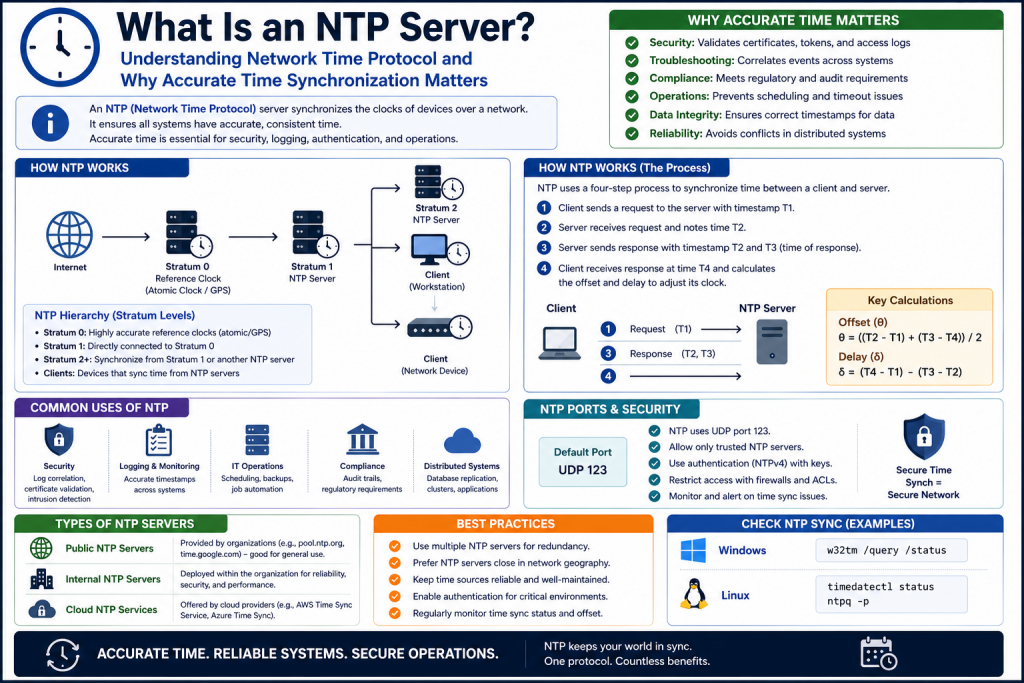
A Network Time Protocol server, commonly known as an NTP server, is a system that provides accurate time to devices connected within a network. Its main role is to ensure that all systems share a consistent and synchronized clock. This may seem like a small detail at first, but in reality, accurate timekeeping is a fundamental requirement for the proper functioning of modern digital environments.
An NTP server does not generate time randomly. Instead, it receives highly precise time from authoritative sources such as atomic clocks or Global Positioning System receivers. These sources are considered extremely reliable because they maintain time with incredible precision. Once the NTP server receives this accurate time, it distributes it to other devices, known as clients, which rely on it to keep their internal clocks aligned.
Every device on a network has its own internal clock, but these clocks are not perfect. Over time, they tend to drift, meaning they slowly become inaccurate. This drift can lead to inconsistencies across systems. NTP servers correct this problem by regularly updating the time on each device, ensuring consistency throughout the network.
Why Time Synchronization Matters
Time synchronization plays a critical role in nearly every aspect of computing and networking. Without a consistent time reference, systems can behave unpredictably, and important processes may fail.
One of the most important uses of synchronized time is in logging. Systems record events with timestamps, which are essential for troubleshooting, auditing, and security analysis. If different systems have different times, logs become unreliable and difficult to interpret. For example, an event that appears to happen before another event might actually occur afterward, simply because the clocks are out of sync.
Another key area where time synchronization is essential is in distributed systems. Modern applications often run across multiple servers located in different regions. These systems rely on accurate timing to coordinate tasks and ensure data consistency. Even a small difference in time between servers can lead to errors, conflicts, or data corruption.
Security is also heavily dependent on accurate time. Authentication systems, encryption protocols, and digital certificates all rely on timestamps. If a system’s clock is incorrect, it may reject valid credentials or accept expired ones, creating vulnerabilities.
In financial systems, precise timing is critical for transactions. Stock trades, banking operations, and payment processing systems depend on exact timestamps to ensure accuracy and fairness. Even a small discrepancy can lead to serious consequences.
A Real-World Analogy for Time Synchronization
To better understand the importance of synchronized time, consider a busy transportation hub such as an airport. Flights are scheduled based on precise timing, and every operation depends on a shared understanding of the current time.
If different parts of the airport operate on different clocks, chaos quickly follows. Departures may be delayed, arrivals may overlap, and coordination between teams becomes impossible. Passengers would experience confusion, and operations would break down.
The same principle applies to computer networks. Devices must operate based on a shared timeline to ensure smooth communication and coordination. NTP acts as the system that keeps everything aligned, much like a central clock in an airport.
The Early Days of Network Time Protocol
The Network Time Protocol was first developed in the mid-1980s, a time when computer networks were much smaller and less complex than they are today. At that stage, the need for precise time synchronization was not as critical because systems were limited in scale and functionality.
The first version of NTP, introduced in 1985, was designed to provide basic time synchronization across these early networks. It was effective for its time but lacked the advanced features needed to handle large-scale environments.
As the internet began to grow rapidly in the late 1980s and 1990s, the limitations of early NTP became more apparent. Networks expanded across regions and continents, and the number of connected devices increased dramatically. With this growth came new challenges, including the need for greater accuracy, reliability, and scalability.
The Evolution of NTP
To meet the demands of expanding networks, NTP underwent significant improvements over time. These enhancements transformed it from a simple protocol into a sophisticated system capable of maintaining accurate time across the global internet.
One of the most important developments was the introduction of a hierarchical structure for time sources. This structure allowed devices to determine which sources were more reliable and prioritize them accordingly.
Another major improvement was the addition of algorithms designed to compensate for network delays. When a device communicates with an NTP server, the time it takes for data to travel between them can affect accuracy. Modern NTP versions account for these delays and adjust the time accordingly.
Scalability was also a key focus. As networks grew larger, NTP needed to handle increasing numbers of clients without compromising performance. Enhancements were made to ensure that the protocol could operate efficiently even in large and complex environments.
Today, NTP version 4 is widely used and supports a wide range of features that make it suitable for modern networks. It is capable of maintaining accurate time across vast distances while adapting to changing network conditions.
Understanding the Concept of Stratum Levels
One of the core concepts in NTP is the idea of stratum levels. This system organizes time sources based on their distance from the original reference clock.
Stratum levels form a hierarchy that helps devices determine which time sources are most reliable. The lower the stratum number, the closer the server is to the original time source.
Stratum 0 represents the most accurate sources of time. These are not typical servers but rather specialized devices such as atomic clocks or GPS receivers. They provide the foundational time used by the entire system.
Stratum 1 servers are directly connected to stratum 0 devices. They receive highly accurate time and act as primary servers for other systems.
Stratum 2 servers obtain their time from stratum 1 servers. They are slightly less accurate but still reliable and widely used.
Stratum 3 and higher levels continue this chain, with each level receiving time from the one above it. As the stratum number increases, the potential for small inaccuracies also increases.
How Stratum Levels Affect Accuracy
While the differences in accuracy between stratum levels are usually very small, they can accumulate over time. This is why it is generally recommended to use servers that are as close as possible to the original time source.
Clients typically synchronize with stratum 1 or stratum 2 servers to achieve a good balance between accuracy and availability. Stratum 1 servers offer the highest precision, but they may not always be accessible to all clients. Stratum 2 servers are more commonly used and still provide excellent accuracy.
The hierarchical structure also improves reliability. If one server becomes unavailable, clients can switch to another server at the same or a similar stratum level. This redundancy helps maintain continuous synchronization.
How NTP Servers Distribute Time
NTP servers distribute time using a client-server model. Clients send requests to the server, asking for the current time. The server responds with its timestamp, and the client uses this information to adjust its own clock.
However, the process is more complex than simply copying the server’s time. The client must account for network delays, which can affect the accuracy of the received time.
To address this, NTP uses a series of calculations to estimate the true time. It measures the time it takes for a request to travel to the server and back, then uses this information to determine the most accurate adjustment.
This process is repeated at regular intervals, allowing the client to maintain synchronization even as conditions change.
The Role of NTP in Modern Networks
In today’s digital world, NTP is an essential component of network infrastructure. It supports a wide range of applications and services that depend on accurate time.
Cloud computing environments rely on synchronized time to coordinate operations across multiple data centers. Without it, tasks could become misaligned, leading to inefficiencies and errors.
Communication systems also depend on accurate timing. Protocols that manage data transmission require synchronized clocks to ensure that messages are processed in the correct order.
Database systems use timestamps to manage transactions and maintain consistency. If time is not synchronized, data integrity can be compromised.
Even everyday activities such as browsing the internet or sending emails rely on accurate time behind the scenes. NTP ensures that these processes function smoothly and reliably.
Challenges in Time Synchronization
Maintaining accurate time across a network is not without challenges. One of the primary issues is network latency, which can introduce delays in communication between clients and servers.
Another challenge is clock drift. Even with regular updates, devices may experience slight variations in their internal clocks. NTP must continuously correct these differences to maintain accuracy.
Security is also a concern. If a client connects to an unreliable or malicious server, it may receive incorrect time data. This can disrupt operations and create vulnerabilities.
To address these challenges, NTP includes features designed to improve accuracy, reliability, and security. These features help ensure that the protocol remains effective in a wide range of environments.
The Importance of Reliable Time Sources
The accuracy of an NTP system ultimately depends on the quality of its time sources. Reliable sources such as atomic clocks provide a stable foundation for the entire hierarchy.
Organizations often use a combination of internal and external servers to ensure reliability. Internal servers provide control and security, while external servers offer redundancy and additional accuracy.
Selecting the right time sources is a critical step in building an effective NTP infrastructure. It ensures that all devices in the network receive consistent and accurate time.
Summary of Key Concepts
An NTP server serves as a central authority for time synchronization within a network. It obtains precise time from reliable sources and distributes it to connected devices.
Time synchronization is essential for logging, security, communication, and data integrity. Without it, systems can become inconsistent and unreliable.
NTP has evolved significantly since its introduction, adapting to the needs of modern networks. Its hierarchical structure, based on stratum levels, ensures efficient and accurate distribution of time.
By continuously adjusting for network delays and clock drift, NTP maintains synchronization across devices, enabling smooth and coordinated operations.
As networks continue to grow in size and complexity, the importance of accurate timekeeping will only increase. NTP remains a fundamental tool for ensuring that systems operate in harmony, providing a shared sense of time that supports the digital world.
.i want part 1 with h2 headings in 2500 words dont bold inner text .please add title
Understanding NTP Servers and the Role of Time Synchronization in Modern Networks
Network Time Protocol, commonly referred to as NTP, is one of the foundational technologies that keeps modern digital systems functioning in a coordinated and reliable manner. At its core, NTP is designed to synchronize the clocks of computers and other devices across a network so that they all share a consistent and accurate sense of time.
Although time synchronization may seem like a minor technical detail, it plays a critical role in ensuring that systems communicate effectively, process data correctly, and maintain operational integrity. In an interconnected world where systems often span multiple locations and time zones, having a unified time reference is essential.
NTP operates quietly in the background, continuously adjusting system clocks and correcting small deviations. Without it, networks would experience inconsistencies that could lead to errors, security issues, and operational disruptions.
What Is an NTP Server
An NTP server is a specialized system responsible for providing accurate time to other devices on a network. It acts as a trusted source of time, ensuring that all connected devices remain synchronized.
These servers obtain their time from highly accurate sources such as atomic clocks or satellite-based systems. Atomic clocks are known for their precision, measuring time based on the vibrations of atoms. This level of accuracy ensures that the time distributed by NTP servers is extremely reliable.
Once the NTP server has obtained the correct time, it shares this information with client devices. These clients can include computers, routers, switches, and various network-enabled systems. Each client periodically contacts the server to update its internal clock.
The role of an NTP server is not just to provide time but to maintain consistency across the entire network. By acting as a central reference point, it ensures that all devices operate using the same timeline.
The Importance of Accurate Time in Computing
Accurate timekeeping is essential for a wide range of computing functions. One of the most significant uses of synchronized time is in event logging. Systems record events with timestamps, which are used for monitoring, troubleshooting, and auditing purposes.
If devices have inconsistent clocks, these logs can become confusing and unreliable. Events may appear out of order, making it difficult to determine what actually happened during a system issue or security incident.
Time synchronization is also critical in distributed systems. Many modern applications run across multiple servers, often located in different geographic regions. These systems rely on synchronized time to coordinate processes and ensure data consistency.
In the field of cybersecurity, accurate time is equally important. Authentication systems often depend on timestamps to validate credentials. If a system’s clock is incorrect, it may reject valid authentication attempts or accept invalid ones, leading to potential security risks.
Financial systems provide another example of the importance of precise timing. Transactions must be recorded with exact timestamps to ensure accuracy and accountability. Even a small discrepancy can lead to significant issues in financial reporting and compliance.
A Practical Example of Time Synchronization
To better understand the role of time synchronization, consider a scenario involving a large transportation system such as a railway network. Trains must operate according to precise schedules, and coordination between stations is essential.
If each station operates on a different clock, scheduling conflicts can occur. Trains may arrive too early or too late, leading to confusion and delays. Passengers would experience inconvenience, and the entire system could become unreliable.
In a similar way, computer networks depend on synchronized time to ensure that operations run smoothly. NTP serves as the mechanism that keeps all devices aligned, preventing the kind of chaos that would result from inconsistent timing.
The Origins of NTP
The development of NTP dates back to the mid-1980s, a time when computer networks were much smaller and less complex than they are today. Early networks consisted of a limited number of connected systems, and the need for precise time synchronization was not as critical.
The first version of NTP was introduced in 1985. It was designed to provide basic time synchronization capabilities for these early networks. While it was effective for its intended purpose, it lacked the advanced features needed to support larger and more complex environments.
As the internet began to expand, the limitations of early NTP became apparent. Networks grew in size, and the number of connected devices increased dramatically. This growth created a demand for more accurate and reliable time synchronization.
The Evolution of NTP Over Time
To address the challenges of growing networks, NTP underwent significant improvements over the years. These enhancements transformed it into a robust and scalable protocol capable of supporting modern computing environments.
One of the key developments in NTP was the introduction of a hierarchical system for organizing time sources. This system allowed devices to determine which sources were more accurate and prioritize them accordingly.
Another important advancement was the implementation of algorithms designed to compensate for network delays. When a device communicates with an NTP server, there is always some delay in the transmission of data. These algorithms help ensure that such delays do not compromise the accuracy of time synchronization.
Scalability also became a major focus. As networks expanded to include thousands or even millions of devices, NTP needed to handle increased demand without sacrificing performance. Modern versions of NTP are capable of operating efficiently in large-scale environments.
Today, NTP version 4 is widely used and continues to serve as a reliable solution for time synchronization across the internet.
Understanding Stratum Levels in NTP
A fundamental concept in NTP is the use of stratum levels. These levels represent the hierarchy of time sources within the network.
Stratum levels indicate how close a particular server is to the original reference clock. The lower the stratum number, the more accurate the time source.
Stratum 0 consists of the most precise timekeeping devices, such as atomic clocks and GPS receivers. These devices are not directly connected to the network but serve as the ultimate reference points for time.
Stratum 1 servers are directly connected to stratum 0 devices. They receive highly accurate time and act as primary sources for other servers and clients.
Stratum 2 servers obtain their time from stratum 1 servers. While slightly less accurate, they are still reliable and widely used.
Stratum 3 and higher levels continue this chain, with each level receiving time from the one above it. As the stratum number increases, the potential for small inaccuracies also increases.
The Impact of Stratum Levels on Accuracy
Although the differences in accuracy between stratum levels are generally very small, they can accumulate over time. This is why it is important to choose appropriate servers for synchronization.
Clients are typically configured to use stratum 1 or stratum 2 servers. These levels provide a good balance between accuracy and availability. Stratum 1 servers offer the highest precision, but they may not always be accessible due to network restrictions or capacity limitations.
Stratum 2 servers are more commonly used because they are widely available and still provide excellent accuracy. By using multiple servers at different strata, clients can improve reliability and ensure continuous synchronization.
The hierarchical structure of stratum levels also enhances redundancy. If one server becomes unavailable, clients can switch to another server without losing synchronization.
How NTP Servers Distribute Time to Clients
NTP servers distribute time using a client-server communication model. Clients periodically send requests to the server, asking for the current time. The server responds with a timestamp, which the client uses to adjust its own clock.
However, the process is more sophisticated than simply copying the server’s time. Network delays can affect the accuracy of the received timestamp. To address this, NTP uses mathematical calculations to estimate the actual time.
The client measures the time it takes for a request to travel to the server and back. It then uses this information to calculate the time offset and adjust its clock accordingly. This process helps ensure that synchronization remains accurate even in the presence of network latency.
Continuous Synchronization and Clock Adjustment
One of the key strengths of NTP is its ability to maintain continuous synchronization. Instead of making large adjustments all at once, NTP gradually corrects the system clock over time.
This approach prevents sudden jumps in time, which could disrupt applications and processes. By making small, incremental adjustments, NTP ensures smooth and stable synchronization.
Clients typically update their clocks at regular intervals, which can be configured based on the needs of the network. More frequent updates provide higher accuracy but may increase network traffic.
The Role of NTP in Modern Technology
In today’s technology landscape, NTP plays a vital role in ensuring the proper functioning of various systems and services. It supports everything from cloud computing and data centers to communication networks and online services.
Cloud platforms rely on synchronized time to coordinate operations across multiple servers and regions. Without accurate timing, tasks could become misaligned, leading to inefficiencies and errors.
Communication protocols also depend on precise timing to ensure that data is transmitted and received correctly. Synchronized clocks help maintain the order of messages and prevent data loss.
Database systems use timestamps to manage transactions and maintain consistency. Accurate time ensures that data is processed in the correct sequence.
Even everyday activities such as browsing the internet, sending emails, and using mobile applications rely on synchronized time behind the scenes.
Challenges in Maintaining Accurate Time
Despite its effectiveness, maintaining accurate time synchronization presents several challenges. One of the main issues is network latency, which can introduce delays in communication between clients and servers.
Another challenge is clock drift. Internal clocks in devices are not perfectly accurate and can gradually deviate over time. NTP must continuously correct these deviations to maintain synchronization.
Security is also a concern. If a client connects to an unreliable or malicious server, it may receive incorrect time information. This can disrupt operations and create vulnerabilities.
To address these challenges, NTP includes features designed to improve accuracy, reliability, and security. These features help ensure that the protocol remains effective in a wide range of environments.
Building a Reliable Time Synchronization System
Creating a reliable NTP infrastructure requires careful planning and configuration. Organizations often use multiple servers to provide redundancy and improve accuracy.
Internal NTP servers can be used to maintain control and enhance security, while external servers provide additional sources of accurate time. By combining these approaches, organizations can create a robust and resilient time synchronization system.
Selecting reliable time sources is a critical step. High-quality sources such as atomic clocks and GPS systems provide a strong foundation for accurate timekeeping.
Regular monitoring and maintenance are also important. Ensuring that servers and clients are functioning correctly helps prevent issues and maintain consistent synchronization.
Understanding the Role of NTP Clients
In any time synchronization system, NTP clients play an equally important role as NTP servers. While servers provide accurate time, clients are the devices that receive and apply that time to maintain synchronization across a network.
An NTP client can be any device with a system clock that needs to stay accurate. This includes servers, desktop computers, laptops, routers, switches, and even embedded systems. Each of these devices relies on its internal clock to manage operations, but these clocks are not perfectly precise and tend to drift over time.
The purpose of an NTP client is to regularly communicate with one or more NTP servers, retrieve the correct time, and adjust its internal clock accordingly. This ongoing process ensures that all devices within a network remain aligned with a consistent time reference.
Rather than making sudden adjustments, NTP clients typically apply gradual corrections. This prevents disruptions to applications that rely on stable and predictable time progression.
How NTP Clients Obtain Time
NTP clients obtain time by sending requests to configured NTP servers at regular intervals. When a client sends a request, the server responds with a timestamp that reflects its current time.
However, the process involves more than simply accepting the server’s time. Because data transmission over a network takes time, the client must account for delays when calculating the correct time.
To achieve this, the client measures the round-trip delay between itself and the server. It then uses this information to estimate the time offset and adjust its clock accordingly. This method allows NTP to maintain high accuracy even when network conditions are not ideal.
Clients usually connect to multiple servers rather than relying on a single source. By comparing responses from different servers, the client can determine the most accurate time and avoid relying on potentially faulty sources.
The Importance of Multiple Time Sources
Configuring multiple NTP servers for a client is considered a best practice. Relying on a single server introduces a single point of failure. If that server becomes unavailable or provides incorrect time, the client may lose synchronization.
By using multiple servers, the client gains redundancy and improved accuracy. It can compare the time received from different sources and select the most reliable one. This approach also helps protect against issues such as network outages or misconfigured servers.
In many environments, clients are configured with a combination of internal and external NTP servers. Internal servers provide control and security, while external servers offer additional reliability and access to highly accurate time sources.
NTP Client Communication Modes
NTP clients can operate in different communication modes depending on the needs of the network. These modes determine how clients interact with servers and how time updates are delivered.
The three primary modes are unicast, broadcast, and multicast. Each mode has its own advantages and is suited for specific scenarios.
Unicast Mode
Unicast mode is the most commonly used communication method in NTP. In this mode, a client communicates directly with a specific server in a one-to-one relationship.
The client sends a request to the server, and the server responds with the current time. This direct communication allows for precise calculations of network delay and time offset.
Unicast mode is preferred in many environments because it offers high accuracy and reliability. It also provides better control over which servers the client communicates with, making it a more secure option.
Since each client communicates individually with the server, unicast mode can generate more network traffic compared to other modes. However, the benefits of accuracy and control often outweigh this drawback.
Broadcast Mode
Broadcast mode is designed for environments where a large number of clients need to receive time updates from a single server. Instead of responding to individual requests, the server periodically sends time updates to all devices within a network segment.
Clients that are configured to listen for these broadcasts can receive the time updates without sending requests. This reduces the overall network traffic and simplifies configuration.
Broadcast mode is particularly useful in local networks with many devices, such as corporate environments or industrial systems. It allows a single server to efficiently distribute time to multiple clients.
However, broadcast mode has some limitations. Since clients do not initiate communication, they may have less accurate measurements of network delay. Additionally, security can be a concern because any device on the network can receive the broadcast messages.
Multicast Mode
Multicast mode provides a more controlled approach to distributing time updates. In this mode, the server sends time information to a specific group of clients rather than broadcasting it to the entire network.
Clients that are part of the multicast group receive the updates, while others do not. This approach reduces unnecessary network traffic and improves efficiency in larger networks.
Multicast mode is especially useful in environments where only certain devices require synchronization. It allows administrators to target specific groups of clients without affecting the entire network.
Like broadcast mode, multicast reduces the need for individual client requests. However, it offers better control and scalability, making it suitable for more complex network environments.
Choosing the Right Communication Mode
Selecting the appropriate communication mode depends on several factors, including network size, security requirements, and performance considerations.
Unicast mode is ideal for environments where accuracy and security are priorities. It is commonly used in enterprise networks and systems that require precise timekeeping.
Broadcast mode works well in smaller networks with many devices that need simple and efficient synchronization.
Multicast mode is best suited for larger networks where selective distribution of time updates is necessary.
In many cases, a combination of these modes may be used to achieve the desired balance between accuracy, efficiency, and scalability.
Setting Up NTP Clients
Configuring an NTP client involves several steps that ensure proper synchronization with time servers. Although the exact process may vary depending on the operating system, the general principles remain the same.
The first step is to identify reliable NTP servers. These servers can be public or private, depending on the network’s requirements. Public servers are widely available and easy to use, while private servers offer greater control and security.
Once the servers are selected, the client must be configured to communicate with them. This typically involves specifying the server addresses in a configuration file or system settings.
After configuring the servers, the next step is to define the polling interval. This determines how frequently the client requests time updates. Shorter intervals provide higher accuracy but increase network traffic, while longer intervals reduce traffic but may allow more drift.
Understanding Polling Intervals
Polling intervals play a crucial role in maintaining accurate time synchronization. They determine how often a client communicates with its configured servers.
Frequent polling ensures that the client’s clock remains closely aligned with the server’s time. However, it also increases network usage and server load.
On the other hand, longer polling intervals reduce network traffic but may allow the client’s clock to drift further between updates.
Finding the right balance is important. Many systems use adaptive polling, where the interval changes based on the stability of the client’s clock. If the clock is stable, the interval increases. If instability is detected, the interval decreases.
Key Configuration Considerations
Several factors should be considered when configuring NTP clients to ensure optimal performance.
Server selection is one of the most important aspects. Choosing reliable and geographically appropriate servers can improve accuracy and reduce latency.
Network conditions also play a significant role. High latency or unstable connections can affect synchronization. Configuring multiple servers helps mitigate these issues.
Compatibility between client and server versions should be ensured to avoid communication problems. Using outdated software may lead to reduced accuracy or security vulnerabilities.
Maintaining Consistency Across Devices
Consistency is essential for effective time synchronization. All devices within a network should follow similar configuration standards to ensure uniform behavior.
Standardizing server lists, polling intervals, and other settings helps maintain a cohesive timekeeping system. This is especially important in large organizations where multiple teams manage different systems.
Regular monitoring is also necessary. Administrators should verify that clients are successfully synchronizing with servers and address any issues promptly.
Best Practices for NTP Client Management
Managing NTP clients effectively requires a combination of proper configuration and ongoing maintenance. Following best practices can help ensure reliable and accurate time synchronization.
Using multiple servers provides redundancy and improves accuracy. Clients should be configured with at least two or three servers whenever possible.
Selecting servers with lower stratum levels helps achieve better precision. However, availability and network conditions should also be considered.
Keeping software up to date is essential for maintaining compatibility and security. Regular updates ensure that known issues are addressed.
Implementing consistent configurations across all devices simplifies management and reduces the risk of errors.
Monitoring and Verification
Monitoring is a critical aspect of maintaining an NTP system. Administrators should regularly check the status of clients and servers to ensure proper synchronization.
Logs can provide valuable insights into synchronization activity and help identify potential issues. Monitoring tools can also be used to track performance and detect anomalies.
Verifying synchronization periodically helps ensure that the system is functioning as expected. This can include checking time offsets, polling intervals, and server responses.
Common Challenges in Client Configuration
Despite careful planning, challenges can arise when configuring NTP clients. Network latency, misconfigured servers, and connectivity issues can all affect synchronization.
Clients may also experience issues if they are configured with unreliable or unreachable servers. Ensuring that servers are accessible and properly configured is essential.
Another common issue is incorrect polling intervals. Setting intervals too high or too low can impact performance and accuracy.
Addressing these challenges requires a combination of proper configuration, monitoring, and troubleshooting.
Building a Reliable Client Infrastructure
A reliable NTP client infrastructure is built on careful planning and consistent management. By selecting appropriate servers, configuring clients correctly, and following best practices, organizations can maintain accurate time synchronization across their networks.
This reliability supports a wide range of applications and services, ensuring that systems operate smoothly and efficiently.
As networks continue to grow in complexity, the importance of effective NTP client management will only increase. Understanding how clients interact with servers and how to optimize their configuration is essential for maintaining a stable and reliable network environment.
Understanding Security Risks in NTP Environments
While Network Time Protocol is essential for maintaining accurate time across systems, it also introduces certain security considerations that cannot be ignored. Because NTP operates as a service that distributes time across networks, it can become a target for misuse if not properly secured.
One of the primary risks involves malicious or spoofed NTP servers. If a client unknowingly connects to a compromised server, it may receive incorrect time information. This can lead to serious consequences, especially in systems that rely heavily on precise timing. For example, incorrect timestamps can disrupt authentication processes, invalidate logs, or interfere with scheduled operations.
Another concern is the possibility of man-in-the-middle attacks, where an attacker intercepts communication between a client and server. In such cases, the attacker could alter the time data being transmitted, causing the client to synchronize with an incorrect time source without detection.
NTP servers can also be used in amplification attacks, where attackers exploit the protocol to overwhelm a target system with traffic. Although modern implementations have addressed many of these vulnerabilities, they remain a consideration for network administrators.
To mitigate these risks, it is important to use trusted servers, implement proper network controls, and regularly monitor NTP activity. Ensuring that only authorized systems can communicate with NTP servers helps reduce exposure to potential threats.
The Importance of Trusted Time Sources
The reliability of an NTP system depends heavily on the trustworthiness of its time sources. Using reputable and verified servers ensures that the time being distributed across the network is accurate and consistent.
Organizations often rely on a combination of internal and external time sources. Internal servers provide greater control and can be secured within the organization’s network. External servers, on the other hand, offer access to highly accurate reference clocks and serve as additional sources of validation.
Selecting trusted sources is especially important in environments where timing accuracy directly affects operations. Systems involved in finance, telecommunications, and security require precise and reliable time to function correctly.
Regular validation of time sources is also necessary. Administrators should verify that servers are providing consistent and accurate time and that no anomalies are present. This helps maintain confidence in the overall synchronization process.
Keeping NTP Systems Updated
Like any network service, NTP software must be kept up to date to ensure security and reliability. Over time, vulnerabilities may be discovered in specific versions of NTP implementations. If these vulnerabilities are not addressed, they can be exploited by attackers.
Applying updates and patches ensures that known issues are resolved and that the system remains protected against emerging threats. It also helps maintain compatibility between clients and servers, reducing the likelihood of communication problems.
Regular updates should be part of a broader maintenance strategy that includes monitoring, testing, and validation. By staying current with software updates, organizations can ensure that their NTP infrastructure remains secure and effective.
How NTP Synchronization Algorithms Work
At the heart of NTP lies a set of sophisticated algorithms designed to maintain accurate time synchronization. These algorithms allow clients to calculate the most precise estimate of the current time, even in the presence of network delays and other uncertainties.
When a client communicates with an NTP server, it records several timestamps during the exchange. These timestamps are used to calculate two key values: the round-trip delay and the time offset between the client and the server.
The round-trip delay represents the total time it takes for a request to travel from the client to the server and back again. The time offset indicates the difference between the client’s clock and the server’s clock.
Using these values, the client can determine how much its clock needs to be adjusted. The algorithms are designed to minimize the impact of network latency and ensure that the adjustment is as accurate as possible.
This process is repeated continuously, allowing the client to adapt to changing network conditions and maintain synchronization over time.
Dealing with Network Latency and Variability
Network latency is one of the biggest challenges in time synchronization. Since data takes time to travel across a network, delays can affect the accuracy of time calculations.
NTP addresses this issue by measuring the time taken for communication and incorporating it into its calculations. By estimating the delay and adjusting for it, the protocol can achieve a high level of accuracy even in less-than-ideal conditions.
However, network conditions can vary due to factors such as congestion, routing changes, and physical distance. These variations can introduce inconsistencies in delay measurements.
To handle this, NTP clients often communicate with multiple servers and compare the results. By analyzing multiple responses, the client can identify outliers and select the most reliable time estimate.
This approach improves accuracy and helps ensure that synchronization remains stable despite fluctuations in network performance.
Clock Drift and Continuous Adjustment
All computer systems experience clock drift, which is the gradual deviation of a system’s internal clock from the correct time. This occurs because hardware clocks are not perfectly precise and can be affected by environmental factors such as temperature and voltage.
NTP compensates for clock drift by continuously monitoring and adjusting the system clock. Instead of making sudden changes, the protocol applies gradual corrections. This ensures that the system time remains stable and avoids disruptions to applications.
The rate at which adjustments are made depends on the level of drift detected. If the clock is stable, fewer adjustments are needed. If significant drift is observed, the client may increase the frequency of updates to maintain accuracy.
This ongoing process allows NTP to keep system clocks aligned with minimal impact on performance.
Fine Tuning NTP Performance
In certain environments, achieving optimal time synchronization requires fine tuning of NTP settings. This involves adjusting parameters such as polling intervals, server selection, and algorithm behavior.
Fine tuning is particularly important in systems that require high precision, such as scientific research facilities, financial institutions, and telecommunications networks. In these environments, even small inaccuracies can have significant consequences.
Administrators can optimize performance by selecting servers that are geographically closer to clients, reducing latency and improving accuracy. Adjusting polling intervals based on network conditions can also enhance synchronization.
Careful configuration and testing are essential when fine tuning NTP settings. Changes should be evaluated to ensure that they improve performance without introducing new issues.
Common Issues in NTP Synchronization
Despite its reliability, NTP systems can encounter various issues that affect synchronization. Identifying and resolving these issues is essential for maintaining accurate time.
One common problem is incorrect configuration. If a client is set to use invalid or unreachable servers, it will not be able to synchronize properly. Ensuring that server addresses are correct and accessible is a basic but important step.
Network connectivity issues can also disrupt synchronization. Firewalls, routing problems, or network outages may prevent communication between clients and servers.
Another issue is inconsistent time sources. If a client receives conflicting information from different servers, it may struggle to determine the correct time. Using reliable and consistent sources helps minimize this problem.
Outdated software can also cause issues, as older versions may lack support for modern features or contain unresolved bugs.
Troubleshooting NTP Problems
Troubleshooting NTP issues involves a systematic approach to identifying and resolving problems. The first step is to verify the client’s configuration. This includes checking server addresses, polling intervals, and other settings.
Next, connectivity should be tested to ensure that the client can communicate with the configured servers. This may involve checking network paths, firewall rules, and server availability.
Logs provide valuable information for diagnosing issues. Reviewing log entries can reveal errors, failed synchronization attempts, and other anomalies.
Diagnostic tools can also be used to assess the status of NTP synchronization. These tools can display information such as time offset, delay, and server responses, helping administrators identify potential problems.
If issues persist, it may be necessary to consult network documentation or seek assistance from experienced administrators.
Maintaining Long Term Reliability
Ensuring the long term reliability of an NTP system requires ongoing monitoring and maintenance. Regular checks help identify issues before they become significant problems.
Consistency is key to maintaining a stable environment. Standardizing configurations across all devices ensures that they operate in a predictable manner.
Redundancy is also important. Using multiple servers provides backup options in case one source becomes unavailable. This helps maintain continuous synchronization.
Periodic testing and validation ensure that the system continues to perform as expected. By proactively managing the NTP infrastructure, organizations can maintain accurate time across their networks.
The Future of Time Synchronization
As technology continues to evolve, the importance of accurate time synchronization will only increase. Emerging technologies such as distributed computing, cloud services, and real time analytics depend on precise timing.
NTP remains a critical component of this ecosystem, providing a reliable and widely supported solution for time synchronization. Ongoing improvements and adaptations ensure that it can meet the demands of modern networks.
New approaches and enhancements may complement NTP in the future, but its core principles will continue to play a vital role in maintaining coordinated and efficient systems.
Conclusion
Network Time Protocol is a fundamental technology that ensures consistent and accurate time across networked systems. While its operation may seem simple on the surface, it involves complex algorithms, careful configuration, and ongoing management.
Understanding the security considerations associated with NTP is essential for protecting systems from potential threats. By using trusted time sources, keeping software updated, and implementing proper safeguards, organizations can reduce risks and maintain reliable synchronization.
The algorithms used by NTP enable it to account for network delays and clock drift, ensuring that systems remain aligned even in challenging conditions. Continuous adjustment and fine tuning further enhance its accuracy and stability.
Troubleshooting and maintenance are critical components of a successful NTP implementation. By monitoring performance, addressing issues promptly, and following best practices, organizations can ensure long term reliability.
As networks grow in complexity and scale, the need for precise time synchronization will continue to expand. NTP provides the foundation for this synchronization, supporting a wide range of applications and services that depend on accurate timing.
Continue exploring the technologies and certification concepts that matter most to you.