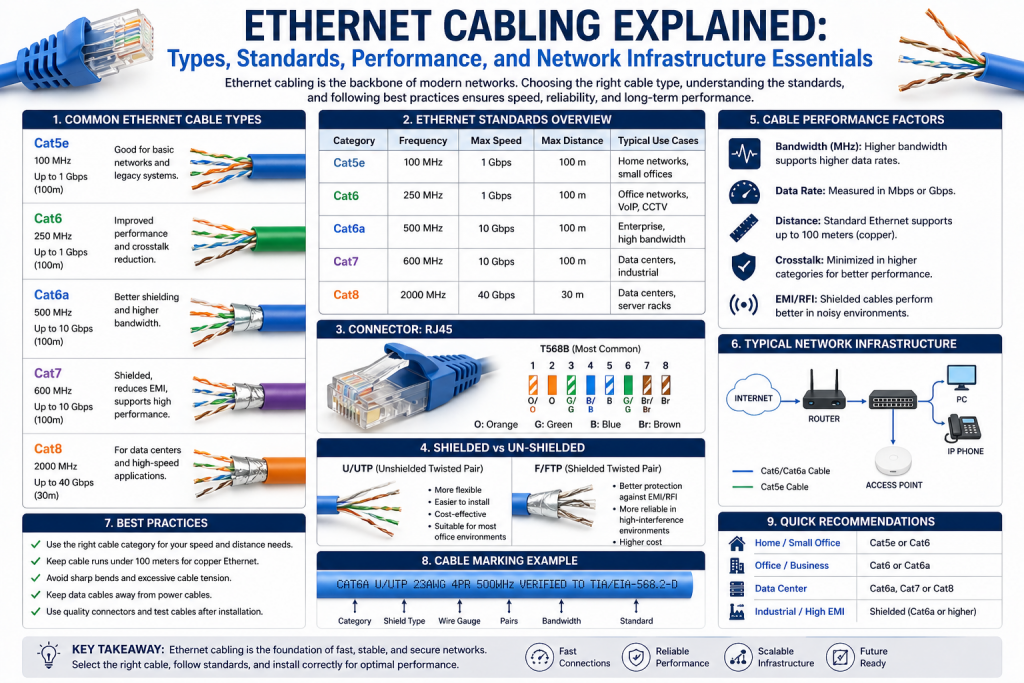
Ethernet cabling remains one of the most important elements of modern networking. Even in an age where wireless connectivity is widely used, wired ethernet continues to provide unmatched reliability, consistency, and speed. It forms the physical backbone of networks, ensuring that devices can communicate with each other efficiently and securely. From small home setups to large enterprise infrastructures, ethernet cabling plays a central role in maintaining stable and high-performance connections.
At a fundamental level, ethernet cabling is responsible for carrying data signals between devices such as computers, switches, routers, and servers. These signals travel through carefully designed cables that are built to minimize interference and maximize performance. The quality of these cables, along with how they are installed and maintained, directly impacts the overall performance of a network. Poor cabling choices can lead to slow speeds, frequent disconnections, and increased maintenance challenges, while well-planned cabling ensures long-term stability and efficiency.
One of the key reasons ethernet cabling is so widely used is its ability to deliver consistent performance. Unlike wireless connections, which can be affected by obstacles, interference, and signal fluctuations, wired connections provide a stable and predictable data path. This makes ethernet especially important in environments where reliability is critical, such as offices, data centers, and industrial systems.
Another major advantage of ethernet is its low latency. Latency refers to the time it takes for data to travel from one point to another. In applications such as online gaming, video conferencing, and real-time data processing, even small delays can have a noticeable impact. Ethernet cabling minimizes these delays, ensuring that data is transmitted quickly and efficiently.
Security is also an important consideration in networking, and ethernet cabling offers a significant advantage in this area. Because wired connections require physical access, they are inherently more secure than wireless networks, which broadcast signals that can potentially be intercepted. This makes ethernet a preferred choice for organizations that need to protect sensitive data and maintain strict security standards.
To fully understand ethernet cabling, it is important to explore the different types of cables available and how they are used. Ethernet cables are generally divided into two main categories: copper cables and fiber optic cables. Each type has its own characteristics, advantages, and limitations, making them suitable for different applications.
Copper cables have been the traditional choice for ethernet networking for many years. They are made of twisted pairs of copper wires that carry electrical signals. These cables are relatively inexpensive, easy to install, and compatible with a wide range of devices. Because of these advantages, copper cables are commonly used in homes, offices, and small to medium-sized networks.
Within the category of copper cables, there are several different standards, often referred to as categories. These include Cat5, Cat5e, Cat6, and newer variations such as Cat6a. Each category is designed to support specific performance levels, including data transfer speeds and resistance to interference. Understanding these categories is essential for selecting the right cable for a particular network.
Cat5 cables were once widely used but are now considered outdated. They support lower speeds and are more susceptible to interference compared to newer standards. Cat5e, which stands for enhanced Category 5, improved upon the original design by reducing crosstalk and supporting gigabit speeds. As a result, Cat5e became a popular choice for many networks.
Cat6 cables offer even better performance, with higher bandwidth and improved shielding. This makes them suitable for environments with higher data demands, such as offices with multiple users and devices. Cat6 cables are also better at reducing interference, which helps maintain stable connections in complex networking environments.
As technology continues to advance, newer cable standards such as Cat6a and Cat7 are becoming more common. These cables are designed to handle higher frequencies and faster data rates, making them ideal for future-proofing networks. Choosing a higher category cable can provide additional headroom for future upgrades, ensuring that the network remains capable of supporting new technologies.
While copper cables are widely used, they do have limitations. One of the main challenges is signal degradation over distance. As electrical signals travel through copper wires, they gradually weaken, which can affect performance. This is why copper cables are typically limited to shorter distances, usually up to 100 meters for standard ethernet connections.
Fiber optic cables address this limitation by using light instead of electrical signals to transmit data. This allows them to achieve much higher speeds and longer transmission distances without significant signal loss. Fiber optic cables are commonly used in large networks, such as those found in data centers, telecommunications systems, and enterprise environments.
There are several advantages to using fiber optic cables. In addition to their high speed and long-distance capabilities, they are also resistant to electromagnetic interference. This makes them ideal for environments where electrical noise could disrupt traditional copper cables. Fiber optics also offer enhanced security, as it is more difficult to tap into a fiber cable without detection.
Despite these advantages, fiber optic cables are more expensive and complex to install than copper cables. They require specialized equipment and expertise, which can increase the overall cost of a network installation. For this reason, many networks use a combination of both copper and fiber cables, leveraging the strengths of each type.
In a typical hybrid network, fiber optic cables are used for long-distance connections and high-speed backbone links, while copper cables are used for shorter connections to individual devices. This approach provides a balance between performance and cost, allowing networks to achieve high efficiency without unnecessary expense.
Another important aspect of ethernet cabling is the role of connectors. Connectors are the components that attach cables to devices, enabling data to be transmitted between them. Without proper connectors, even the highest quality cables would not be able to function effectively.
For copper cables, connectors are usually attached through a process known as crimping. This involves securing the connector to the cable in a way that ensures proper contact between the internal wires and the connector pins. The most common type of connector for copper ethernet cables is the RJ45 connector, which is widely used in networking equipment.
The process of attaching connectors requires precision and attention to detail. The individual wires inside the cable must be arranged in the correct order before being inserted into the connector. If the wiring is incorrect, the connection may not work properly, leading to performance issues or complete failure.
Fiber optic connectors, on the other hand, are typically pre-terminated in controlled environments. This is because the alignment of the fiber strands must be extremely precise to ensure proper transmission of light signals. Any imperfections in the connector can result in significant signal loss, making it essential to use high-quality components and proper installation techniques.
The choice of connectors depends on the type of cable being used and the specific requirements of the network. Different connectors are designed for different applications, and selecting the right one is crucial for achieving optimal performance.
In addition to cables and connectors, cable management is a critical aspect of network design. Proper cable management ensures that cables are organized, accessible, and protected from damage. This not only improves the appearance of the network infrastructure but also makes it easier to maintain and troubleshoot.
Effective cable management involves a combination of planning, organization, and the use of appropriate tools. This includes using cable trays, racks, and ties to keep cables neatly arranged. Labeling cables is also important, as it allows network administrators to quickly identify and trace connections.
Another key consideration in cable management is scalability. Networks often grow over time, with new devices and connections being added. Designing a cabling system with future expansion in mind can save time and effort in the long run. This might involve leaving extra space in cable pathways or using higher-capacity cables than currently needed.
Proper cable management also helps improve airflow in network environments, particularly in server rooms and data centers. Tangled or poorly organized cables can obstruct airflow, leading to overheating and reduced performance of equipment. By keeping cables neatly arranged, it is easier to maintain optimal operating conditions.
Ultimately, ethernet cabling is about more than just connecting devices. It is about creating a reliable and efficient infrastructure that supports communication and data exchange. Every aspect of the cabling system, from the type of cables used to the way they are managed, plays a role in the overall performance of the network.
A well-designed ethernet cabling system provides a strong foundation for all network operations. It ensures that data can be transmitted quickly and accurately, allowing users to access the resources they need without interruption. As networks continue to evolve, the importance of solid cabling practices remains as relevant as ever.
Understanding the basics of ethernet cabling is essential for anyone involved in networking. It provides the knowledge needed to make informed decisions about cable selection, installation, and maintenance. By focusing on quality and adherence to standards, it is possible to build networks that are both reliable and
Ethernet Connectors in Depth: Types, Standards, and Real-World Applications
Ethernet connectors are a critical component of any wired network, acting as the physical interface that links cables to networking devices. While cables carry the data signals, connectors ensure that these signals are properly transmitted between endpoints. Without reliable connectors, even the most advanced cabling systems would struggle to deliver consistent performance. Understanding how connectors work, the different types available, and how they are used in real-world environments is essential for anyone involved in networking.
At their core, connectors are designed to provide a secure and precise connection between a cable and a device. This connection must maintain signal integrity, ensuring that data is transmitted accurately without loss or interference. A poorly installed or damaged connector can introduce errors, reduce speeds, or even cause a complete loss of connectivity. For this reason, connectors are not just simple attachments but carefully engineered components that play a vital role in network reliability.
The type of connector used depends largely on the type of cable. Ethernet networks primarily use two types of cables: copper and fiber optic. Each requires its own set of connectors, designed to handle the unique characteristics of the transmission medium. Copper cables transmit electrical signals, while fiber optic cables use light, and this fundamental difference influences how connectors are designed and installed.
Copper connectors are the most commonly encountered in everyday networking. These connectors are used with twisted-pair cables, which are widely deployed in homes, offices, and enterprise environments. The most recognizable copper connector is the RJ45, which is used to connect devices such as computers, switches, and routers. Its widespread use is due to its simplicity, reliability, and compatibility with various cable categories.
The process of attaching a connector to a copper cable is known as crimping. This involves stripping the outer insulation of the cable, arranging the internal wires in a specific order, and inserting them into the connector before securing them with a crimping tool. The of the wires is critical, as it determines how signals are transmitted. Standard wiring schemes, such as T568A and T568B, are used to ensure consistency and compatibility across networks.
Crimping requires attention to detail and proper tools. If the wires are not aligned correctly or the connector is not securely attached, the cable may not function as intended. In professional environments, technicians often use cable testers to verify that connections are properly established and free from faults. This ensures that the network operates efficiently and reduces the likelihood of troubleshooting issues later.
In addition to RJ45, another connector in the Registered Jack family is RJ11. This connector was originally designed for telephone systems and is smaller than RJ45. While it played an important role in early communication technologies, it is not suitable for modern high-speed ethernet networking. However, it may still be found in legacy systems or specific applications where lower data transmission requirements are acceptable.
While copper connectors dominate many networks, fiber optic connectors are essential in high-performance and long-distance applications. Fiber connectors are designed to align the cores of optical fibers with extreme precision, allowing light signals to pass through with minimal loss. This level of precision makes fiber connectors more complex and sensitive compared to their copper counterparts.
One of the most commonly used fiber connectors is the LC connector. Known for its compact size, the LC connector is ideal for high-density environments such as data centers. Its small form factor allows more connections to be accommodated within limited space, making it a preferred choice for modern networking . LC connectors are widely used to connect switches, routers, and other devices in fiber-based networks.
Another type of fiber connector is the SC connector. This connector features a square shape and uses a push-pull mechanism for easy insertion and removal. SC connectors are valued for their simplicity and reliability, making them suitable for both enterprise and residential fiber installations. Their design ensures a stable connection, reducing the risk of accidental disconnections.
The ST connector represents an older style of fiber connector that uses a bayonet-style locking mechanism. This requires a twist to secure the connection, which can make installation slightly more cumbersome. While ST connectors have largely been replaced by newer designs such as LC and SC, they are still found in some legacy systems and specialized applications.
Mechanical Transfer connectors offer a unique approach to fiber termination. Unlike factory-terminated connectors, these can be installed in the field, allowing for quick and flexible deployment. They eliminate the need for complex processes such as epoxy bonding or splicing. However, they require specialized tools and careful handling to ensure proper alignment and performance.
In fiber optic networking, the quality of the connector surface plays a significant role in performance. Polishing techniques are used to prepare the end of the fiber, ensuring efficient transmission of light signals. Two common polishing methods are Angled Physical Contact and Ultra Physical Contact.
Angled Physical Contact connectors are polished at a slight angle, which helps reduce back reflection. This is particularly important in high-speed or long-distance applications, where reflected signals can interfere with transmission. The angled design ensures that reflected light is directed away from the core, improving overall performance.
Ultra Physical Contact connectors, on the other hand, are polished to create a flat and smooth surface. This reduces insertion loss and ensures efficient signal transmission. While they may not reduce reflection as effectively as angled connectors, they provide excellent performance in many standard networking scenarios.
Choosing between these polishing methods depends on the specific requirements of the network. Factors such as distance, data rate, and sensitivity to signal interference must be considered. In many cases, network designers select connectors based on a balance between performance, cost, and compatibility with existing infrastructure.
Beyond the connectors themselves, additional components such as transceivers and media converters play an important role in network connectivity. These devices are used to bridge different types of connections, enabling greater flexibility in network design.
Media converters are particularly useful in hybrid networks that combine copper and fiber cabling. For example, a network may use fiber optic cables for long-distance connections and copper cables for shorter runs داخل a building. A media converter can connect these two segments, allowing devices to communicate seamlessly despite differences in transmission technology.
Transceivers are commonly used in fiber networks to convert electrical signals into optical signals and vice versa. They are often integrated into networking devices or used as separate modules. By enabling communication between different types of connections, transceivers add versatility to network infrastructure.
Understanding the wide range of connectors and related components can initially seem complex. However, practical experience and familiarity with networking standards make it easier to identify the appropriate solutions for specific scenarios. Each connector type has its own strengths and ideal use cases, and selecting the right one is key to building a reliable network.
In real-world applications, connector selection is influenced by several factors, including the environment, performance requirements, and budget. For example, a large data center may prioritize high-density fiber connectors such as LC to maximize space and performance. In contrast, a small office network may rely primarily on RJ45 connectors for simplicity and cost-effectiveness.
Proper installation and maintenance of connectors are essential for ensuring long-term performance. Connectors should be handled with care to avoid damage, and they should be kept clean to prevent contamination. Dust or debris on a connector can interfere with signal transmission, particularly in fiber optic systems where precision is critical.
Regular testing and inspection are also important practices. By identifying potential issues early, network administrators can prevent small problems from escalating into major disruptions. Tools such as cable testers and optical power meters are commonly used to verify the integrity of connections and ensure optimal performance.
Labeling is another key aspect of connector management. Clearly labeled cables and connectors make it easier to identify connections, perform maintenance, and implement changes. In large networks, proper labeling can save significant time and reduce the risk of errors.
Durability is an additional consideration, especially in environments where connectors are frequently plugged and unplugged. High-quality connectors are designed to withstand repeated use without degradation. Investing in durable components can reduce maintenance costs and improve overall reliability.
As networking technology continues to evolve, connectors are also advancing to meet new demands. Innovations in design and materials are enabling higher data rates, greater density, and improved performance. Staying informed about these developments is important for professionals who want to build and maintain modern networks.
Ultimately, ethernet connectors are a fundamental part of network infrastructure. They ensure that data can flow smoothly between devices, supporting everything from basic communication to complex applications. By understanding the different types of connectors, their functions, and how they are used, it is possible to create networks that are both efficient and reliable.
Advanced Cable Management Planning and Design
Effective ethernet cable management begins long before cables are physically installed. Planning and design are critical stages that determine how organized, scalable, and efficient the network will be over time. A well-thought-out design reduces future complications, minimizes maintenance efforts, and ensures that the network can handle growth without major restructuring.
During the planning phase, it is important to assess the environment where the cabling will be deployed. This includes understanding the building layout, identifying equipment locations, and estimating the number of connections required. Network designers must also consider future expansion, ensuring that the infrastructure can accommodate additional devices and higher data demands.
Creating a structured layout diagram is a best practice. This diagram outlines how cables will be routed, where patch panels will be installed, and how devices will connect. By visualizing the system in advance, potential issues can be identified and resolved before installation begins. This proactive approach saves time and resources while improving overall efficiency.
Cable Routing Techniques and Best Practices
Cable routing is one of the most visible aspects of cable management. Proper routing ensures that cables are protected, organized, and easy to access. There are several routing methods, each suited to different environments.
Overhead routing uses cable trays or ladder racks mounted above equipment. This method provides excellent visibility and accessibility, making it easy to add or modify cables. It is commonly used in data centers and industrial environments.
Underfloor routing involves running cables beneath raised floors. This approach keeps cables hidden and reduces clutter in visible areas. It is often used in large data centers where aesthetics and airflow are important considerations.
Wall-mounted conduits and raceways are commonly used in office environments. These systems protect cables from damage while keeping them neatly contained. They also make it easier to add or remove cables without disrupting existing connections.
Regardless of the method used, it is essential to follow best practices such as maintaining proper bend radius, avoiding sharp edges, and securing cables at regular intervals. These practices help prevent damage and ensure consistent performance.
Managing Cable Density in High-Performance Environments
As networks grow, cable density becomes a significant challenge. High-density environments, such as data centers, can contain thousands of cables in a relatively small space. Without proper management, this can lead to congestion, overheating, and difficulty in identifying connections.
To manage cable density effectively, it is important to use high-capacity cable management systems. These include large cable trays, vertical and horizontal managers, and high-density patch panels. These tools help distribute cables evenly and prevent overcrowding.
Another strategy is to use shorter patch cables where possible. This reduces excess cable length and minimizes clutter. Proper spacing between cables also improves airflow, which is critical for maintaining optimal operating temperatures.
Labeling Standards and Documentation Practices
Labeling is a cornerstone of effective cable management. A consistent labeling system allows network administrators to quickly identify cables, reducing the time required for troubleshooting and maintenance.
Labels should include information such as the cable’s origin, destination, and purpose. For example, a label might indicate the specific port on a switch and the device it connects to. This level of detail ensures that anyone working on the network can understand the connections without confusion.
In addition to labeling, maintaining accurate documentation is essential. Documentation should include network diagrams, cable layouts, and records of any changes made. This information serves as a reference for future maintenance and upgrades.
Digital documentation tools can further enhance this process. By storing information electronically, it becomes easier to update, share, and access. This is especially useful in large organizations where multiple technicians may be involved in managing the network.
Tools and Accessories for Efficient Cable Management
A wide range of tools and accessories are available to support cable management. These tools help organize cables, protect them from damage, and simplify maintenance tasks.
Cable ties are among the most commonly used accessories. They are used to bundle cables together and keep them in place. Reusable cable ties are particularly useful, as they allow for adjustments without cutting and replacing them.
Cable clips and mounts provide additional support, securing cables to walls, racks, or surfaces. These accessories help maintain a clean and organized appearance while preventing cables from sagging or becoming tangled.
Cable management panels, both horizontal and vertical, are used in racks to guide cables and keep them व्यवस्थित. These panels include slots and मार्ग that help route cables neatly, reducing clutter and improving accessibility.
Using high-quality tools and accessories not only improves organization but also extends the lifespan of cables. Proper support reduces stress on cables, preventing damage and ensuring reliable performance.
Preventing Interference and Signal Loss
Interference is a common issue in networking, particularly with copper cables. Electromagnetic interference can disrupt signals, leading to reduced performance and data errors. Proper cable management plays a key role in minimizing this problem.
One of the most effective strategies is to separate data cables from power cables. Keeping these cables apart reduces the risk of interference. In environments with high levels of electrical activity, shielded cables may also be used to provide additional protection.
Maintaining proper separation is especially important in environments such as offices, factories, and data centers where multiple electrical systems operate simultaneously. Power cables can generate electromagnetic fields that interfere with the signals traveling through data cables, particularly in copper-based ethernet systems. This interference, often referred to as electromagnetic interference, can lead to packet loss, slower data transmission, and unstable network performance.
To minimize these risks, it is recommended to follow established spacing guidelines. For example, running data cables and power cables in separate conduits or trays can significantly reduce the chance of interference. If they must cross paths, they should do so at a 90-degree angle rather than running parallel for long distances. This reduces the exposure of data cables to electromagnetic fields.
Shielded twisted pair cables add another layer of protection by incorporating a metallic shield that blocks external interference. Proper grounding of these cables is essential to ensure their effectiveness. By combining physical separation with the use of shielded cabling, networks can maintain higher reliability and consistent performance even in electrically noisy environments.
Maintaining proper cable spacing and avoiding tight bundles can further reduce interference. Overcrowded cables can generate heat and increase the likelihood of signal degradation. By organizing cables בצורה orderly manner, these risks can be minimized.
Maintenance and Troubleshooting Strategies
Regular maintenance is essential for keeping a cabling system in optimal condition. This includes inspecting cables for signs of wear, checking connections, and ensuring that labels remain accurate and legible.
Troubleshooting is much easier in a well-managed system. When cables are organized and labeled, identifying the source of a problem becomes straightforward. This reduces downtime and allows issues to be resolved quickly.
Preventive maintenance practices, such as cleaning connectors and checking for loose connections, can help avoid problems before they occur. Scheduling regular inspections ensures that the network remains reliable and efficient.
Scalability and Future-Proofing the Network
A key goal of cable management is to support future growth. Networks are constantly evolving, and the cabling infrastructure must be able to adapt. Designing with scalability in mind ensures that new devices and connections can be added without major disruptions.
This can be achieved by installing additional cable pathways, leaving spare capacity in patch panels, and using higher-performance cables than currently required. These provide flexibility and reduce the need for costly upgrades in the future.
Planning for extra capacity allows organizations to respond quickly to changing requirements without disrupting existing operations. For example, when new devices or departments are added, having pre-installed pathways and available ports makes expansion much easier and faster. Instead of running new cables from scratch, technicians can simply utilize the existing infrastructure, saving both time and labor costs.
Using higher-performance cables also ensures that the network can handle increased data demands as technology evolves. Even if current usage does not require high bandwidth, future applications such as cloud services, high-definition streaming, and advanced communication tools may demand greater speeds. By preparing in advance, organizations avoid the need for frequent replacements and upgrades.
Additionally, scalable design improves overall network reliability. With spare capacity available, maintenance and repairs can be performed without interrupting critical services. Backup connections can be established quickly, ensuring continuity of operations. This forward-thinking approach not only enhances performance but also provides long-term cost efficiency and operational stability.
Future-proofing also involves staying informed about emerging technologies. As new standards and become available, integrating them into the network can improve performance and efficiency.
Environmental and Safety Considerations
Cable management also has implications for safety and environmental responsibility. Poorly managed cables can create hazards, such as tripping risks or fire . Ensuring that cables are properly secured and routed helps maintain a safe working environment.
Environmental factors such as temperature, humidity, and exposure to dust can affect cable performance. Using materials and protective helps mitigate these risks and extend the lifespan of the infrastructure.
Sustainable practices, such as recycling old cables and reducing waste, are becoming increasingly important. Efficient cable management contributes to sustainability by minimizing the need for frequent replacements and ensuring that resources are used effectively.
Human Factors and Team Coordination
Effective cable management is not just about tools and techniques; it also involves people. Clear communication and coordination among team members are essential for maintaining an organized network.
In many network environments, multiple technicians and engineers may work on the same infrastructure at different times. Without proper communication, changes made by one person can create confusion or issues for others. For example, if a cable is rerouted or replaced without updating documentation or informing the team, it can lead to troubleshooting difficulties and wasted time. Establishing clear communication channels helps ensure that everyone is aware of changes and follows the same procedures.
Team coordination also improves consistency in how cables are installed, labeled, and maintained. When all team members follow standardized practices, the network remains uniform and easier to manage. This consistency becomes especially important in large organizations where the network spans multiple locations or departments.
Regular team meetings, proper documentation updates, and shared guidelines can greatly enhance collaboration. Training sessions also help ensure that everyone understands best practices and stays aligned with current standards. By focusing on teamwork and communication, organizations can maintain a well-structured and efficient cabling system that supports long-term reliability and performance.
Establishing standard procedures ensures that everyone follows the same practices. This includes guidelines for labeling, routing, and documenting cables. Consistency reduces confusion and makes the network easier to manage.
Training is another important factor. Technicians should be familiar with best practices and understand the أهمية of proper cable management. Ongoing education helps keep skills up to date and ensures that the network continues to operate efficiently.
Conclusion
Cable management is a vital component of any ethernet network, influencing performance, reliability, and scalability. By focusing on planning, organization, and maintenance, it is possible to create a system that supports both current needs and future growth.
From routing techniques and labeling standards to tools and environmental considerations, every aspect of cable management contributes to the overall success of the network. A well-managed system reduces downtime, simplifies troubleshooting, and enhances efficiency.
In the long run, investing time and effort into proper cable management pays significant dividends. It ensures that the network remains organized, adaptable, and capable of meeting the demands of an ever-changing technological landscape.
As businesses grow and technologies evolve, networks must be able to scale without requiring complete overhauls. A well-managed cabling system supports this growth by providing flexibility and reducing the complexity of adding new devices or expanding infrastructure.
Beyond scalability, proper cable management also improves overall workflow efficiency for IT teams. When everything is structured and easy to understand, routine tasks such as inspections, upgrades, and replacements can be completed faster and with greater accuracy. This reduces human error and helps maintain consistent network performance. Organized systems also make it easier to onboard new technicians, as they can quickly understand the layout without confusion.
Another important benefit is improved equipment longevity. Poorly managed cables can create physical strain on connectors and ports, leading to premature wear and failure. By securing cables properly and avoiding unnecessary tension, organizations can extend the lifespan of both cables and networking devices. This not only saves money but also reduces the frequency of disruptions caused by hardware issues.
Additionally, a clean and well-structured cabling system enhances safety. Loose or tangled cables can pose hazards such as tripping risks or accidental disconnections. Proper management eliminates these risks, creating a safer working environment while maintaining uninterrupted network operations.
Ultimately, cable management is not just about organization; it is a strategic investment in reliability, performance, and long-term success.
Continue exploring the technologies and certification concepts that matter most to you.