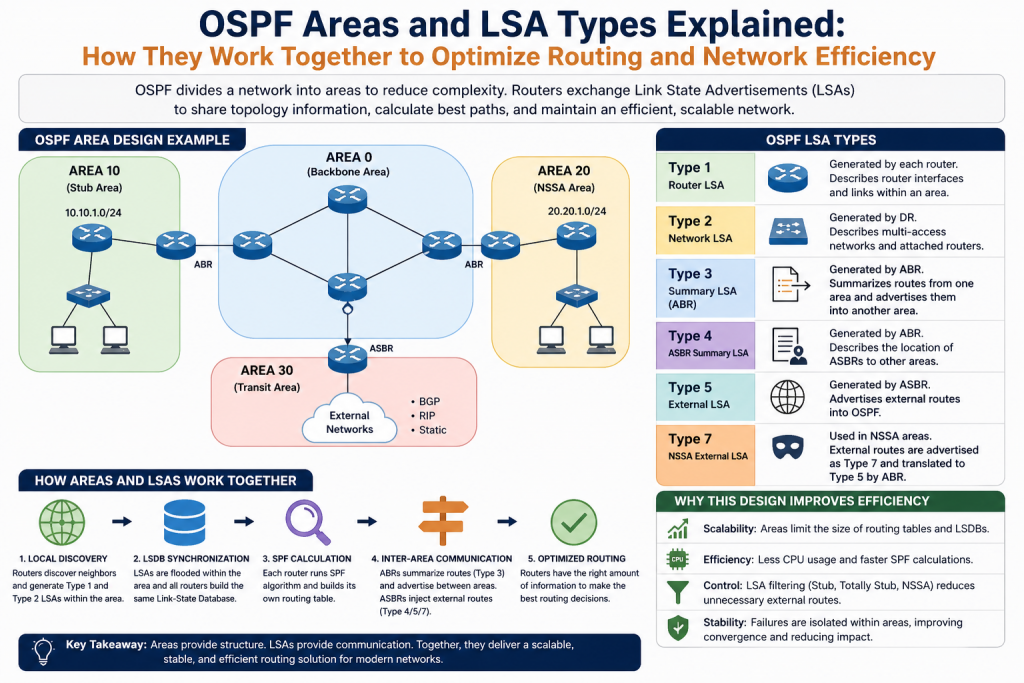
Open Shortest Path First (OSPF) is one of the most important dynamic routing protocols in modern networking because it was specifically designed to solve the scalability and inefficiency problems that older routing methods struggled to handle. As enterprise networks grew larger, spanning offices, data centers, branch locations, and cloud integrations, routing systems needed to become faster, more intelligent, and more efficient. OSPF emerged as one of the strongest solutions because it introduced hierarchical routing, faster convergence, and more controlled route propagation.
To understand why OSPF remains so widely respected, it helps to first recognize the challenge it was built to solve. In early routed networks, protocols often relied on periodic updates where routers repeatedly sent entire routing tables to neighboring devices regardless of whether changes had occurred. While this approach functioned in smaller environments, it became increasingly wasteful in larger networks. Constant updates consumed bandwidth, overloaded routers, increased CPU utilization, and slowed adaptation to network changes.
OSPF changed this model by using a link-state approach rather than a distance-vector model. Instead of broadcasting complete routing tables every cycle, OSPF routers share only relevant topology information and only when changes occur. This dramatically reduces unnecessary traffic while maintaining an accurate and synchronized view of network topology.
At the center of OSPF’s intelligence is the Shortest Path First (SPF) algorithm, often called Dijkstra’s algorithm. Each OSPF router independently builds a topological map of the network and calculates the best path to every destination based on cost metrics. This means routing decisions are more precise, more adaptive, and generally more efficient than legacy systems.
However, OSPF’s true strength is not just in path calculation—it is in how it organizes large networks. This organizational capability comes primarily through OSPF areas.
Why Flat Network Routing Becomes a Serious Problem
In a small business network with only a few routers, maintaining complete awareness of every route may not create significant strain. But as a network grows, the amount of topology information expands exponentially.
Consider a large enterprise with:
- Multiple branch offices
- Regional hubs
- Data centers
- VPN links
- Cloud edge routers
- Security zones
- Third-party partner connections
If every router in this environment had to store and process every route from every segment in full detail, several operational problems would emerge.
First, routing tables would become enormous. More routes mean more memory consumption. Second, every topology change anywhere in the network would force SPF recalculations on all routers, even those unaffected by the change. Third, LSA flooding would consume bandwidth and processor cycles. Fourth, troubleshooting would become increasingly difficult because instability in one region could ripple across the entire infrastructure.
This flat design creates operational inefficiency.
OSPF addresses this challenge by dividing large autonomous systems into smaller, logical subdivisions called areas.
What OSPF Areas Actually Are
An OSPF area is a logical grouping of routers and networks that share detailed routing information with one another while limiting the scope of topology changes beyond their boundaries.
Areas allow routers to focus on local topology while reducing the need to process excessive external detail.
Think of an area like a district inside a large city:
- Streets within the district are known in detail
- Traffic between districts is summarized
- Major highways connect districts
- Local incidents stay mostly local
This design dramatically improves scalability.
Inside an area, routers maintain detailed awareness of:
- Interfaces
- Link states
- Neighbor relationships
- Costs
- Network changes
Between areas, summarized routes can often replace detailed route-by-route knowledge.
This means routers can operate more efficiently while still maintaining end-to-end connectivity.
The Primary Purpose of OSPF Areas
The main purpose of OSPF areas is reducing overhead.
This overhead reduction occurs in several ways.
Smaller Link-State Databases
Routers store detailed topology primarily for their own area instead of the entire autonomous system.
Reduced SPF Recalculations
Topology changes in one area do not necessarily force recalculations everywhere.
Controlled LSA Flooding
Many LSAs remain contained within their area.
Improved Stability
Problems remain more localized.
Route Summarization
ABRs can condense route information before advertising it elsewhere.
The result is a routing system that scales more effectively and performs better under pressure.
The Backbone of OSPF
The most critical concept in OSPF area design is Area 0, also called the backbone area.
Area 0 is the central transit structure that all other OSPF areas must connect to, either physically or logically.
This is not optional in standard multi-area OSPF design. Without a backbone, OSPF loses structural consistency.
Area 0 serves several major purposes:
- Connects all other OSPF areas
- Carries inter-area routing traffic
- Maintains topology continuity
- Prevents routing fragmentation
- Supports hierarchical communication
In practical terms, if Area 1 needs to exchange routing information with Area 2, that communication typically passes through Area 0.
This backbone architecture ensures:
- Predictable route flow
- Structured topology
- Easier troubleshooting
- Better scalability
Because of this, Area 0 is often placed in:
- Core networks
- Headquarters
- Primary data centers
- High-speed backbone links
Single-Area OSPF vs Multi-Area OSPF
Many smaller organizations begin with single-area OSPF.
In this design:
- All routers exist in Area 0
- Configuration is simpler
- Troubleshooting is easier
- Administrative complexity is lower
For modest environments, this works well.
However, growth changes everything.
As more routers and subnets are added:
- LSDB size increases
- SPF calculations grow
- Convergence complexity rises
- Instability spreads faster
At that point, multi-area OSPF becomes more practical.
Multi-area OSPF introduces:
- Segmentation
- Route filtering
- Summarization
- Hierarchical control
This makes it ideal for:
- Enterprises
- Universities
- Government networks
- Service providers
- Multi-site organizations
The tradeoff is design complexity, but the efficiency gains are substantial.
The Major Router Roles Within OSPF Area Architecture
OSPF routers are not all functionally identical. Their role depends on where they sit in the topology.
Internal Router
All interfaces belong to one area.
These routers maintain detailed local awareness but do not bridge areas.
Backbone Router
At least one interface exists in Area 0.
These routers participate directly in backbone operations.
Area Border Router (ABR)
Connects one or more non-backbone areas to Area 0.
ABRs are essential because they:
- Summarize routes
- Translate routing detail
- Control LSA propagation
- Maintain multiple LSDBs
Autonomous System Boundary Router (ASBR)
Injects routes from external routing domains.
Examples include:
- RIP
- EIGRP
- BGP
- Static routes
ASBRs introduce external routing knowledge into OSPF.
Understanding these roles is essential because OSPF efficiency depends heavily on where routers sit and how they interact.
The Default OSPF Environment
A standard area is the normal operational mode for OSPF.
In this design:
- All standard LSAs are allowed
- Internal and external routes are accepted
- Full inter-area communication occurs
Advantages include:
- Maximum route awareness
- Flexibility
- Broad compatibility
Disadvantages include:
- Larger routing tables
- More CPU use
- More LSDB growth
Standard areas are often best where route visibility matters more than route minimization.
Why OSPF Introduced Specialized Area Types
Not every network segment needs full route awareness.
A branch office, for example, may only need:
- Internet access
- Headquarters connectivity
- Default route
It may not need thousands of external route entries.
This led to specialized OSPF area types that intentionally reduce routing detail.
These include:
- Stub Area
- Totally Stubby Area
- Not-So-Stubby Area (NSSA)
Each design improves efficiency for specific scenarios.
Blocking External Route Noise
A stub area blocks external Type 5 LSAs.
Instead of receiving every external route, routers inside the stub area receive a default route.
This means:
- Smaller routing tables
- Less LSDB complexity
- Lower CPU overhead
- Reduced memory consumption
Stub areas are ideal for:
- Branch offices
- Small campuses
- WAN edge locations
However, they cannot contain ASBRs because external redistribution would violate stub restrictions.
Maximum Simplicity
Totally stubby areas go further by blocking:
- Type 3
- Type 4
- Type 5 LSAs
This leaves routers with:
- Intra-area knowledge
- Default route only
This dramatically reduces complexity.
Advantages:
- Minimal resource use
- Very small routing tables
- Simplified management
Disadvantages:
- Less route specificity
- Reduced visibility
This model works best where simplicity outweighs route granularity.
Not-So-Stubby Areas: Flexibility Without Full Complexity
Sometimes a branch site needs stub efficiency but also has external connectivity.
For example:
- A remote office connects to a partner network
- Legacy routing exists locally
- Regional redistribution is necessary
Traditional stub areas cannot support this.
NSSA solves the problem.
NSSA allows limited external redistribution using Type 7 LSAs. These LSAs are later converted into Type 5 LSAs when they reach an ABR.
This approach preserves:
- Area efficiency
- Controlled redistribution
- Hierarchical integrity
NSSA is particularly useful in real-world edge cases where strict stub rules are too restrictive.
How OSPF Area Design Directly Improves Network Performance
OSPF areas are not just theoretical concepts—they produce measurable operational benefits.
Bandwidth Efficiency
Less unnecessary LSA flooding.
Processor Savings
Localized SPF calculations.
Memory Efficiency
Reduced LSDB scope.
Convergence Optimization
Changes stay localized.
Administrative Control
Granular route management.
These benefits become increasingly important as organizations scale.
Common OSPF Area Design Mistakes
Poor area design can reduce OSPF efficiency.
Too Many Small Areas
Excessive complexity without meaningful gain.
Ignoring Summarization
Missed optimization opportunities.
Misplacing ABRs
Can create bottlenecks.
Overusing Stub Designs
May limit necessary visibility.
Backbone Misconfiguration
Can disrupt inter-area routing.
Good OSPF design requires strategic planning, not just technical implementation.
Real-World Enterprise Example
Imagine a global company:
- Area 0 = Headquarters backbone
- Area 1 = North America
- Area 2 = Europe
- Area 3 = Asia-Pacific
- Area 4 = Remote retail branches
In this model:
- Regional changes remain regional
- Branches use stub designs
- Backbone coordinates global routing
- Summaries reduce route volume
This architecture improves performance while preserving scalability.
Why Understanding Areas Comes Before Understanding LSAs
Many networking learners struggle with OSPF because they study LSAs before area logic.
This often creates confusion.
Areas define:
Where routing information flows
LSAs define:
What routing information flows
Without understanding area structure, LSA restrictions seem arbitrary.
Once area design is clear, LSA behavior becomes logical:
- Standard areas allow more LSAs
- Stub areas block some LSAs
- NSSA introduces Type 7 LSAs
- ABRs summarize LSAs
The architecture drives the messaging system.
The Communication Engine Behind OSPF
Once OSPF area design is understood, the next critical step is understanding how routers actually communicate within that design. OSPF areas create the structural framework by dividing networks into logical segments that improve scalability and efficiency, but structure alone does not make routing functional. Link State Advertisements (LSAs) are the operational language that routers use to exchange topology information, route details, and path intelligence within and between those areas. In many ways, LSAs are the communication engine that transforms OSPF from a static design into a dynamic routing system.
Every OSPF router depends on LSAs to describe its interfaces, advertise connected networks, announce changes, identify designated routers, summarize routes across areas, and communicate external destinations. Without LSAs, routers would know only their directly connected links, leaving the broader OSPF architecture unable to synchronize or calculate optimal paths. LSAs allow routers to build and maintain a shared Link-State Database (LSDB), which acts as a synchronized map of network topology. Using this database, each router independently applies the SPF algorithm to calculate the shortest and most efficient routes.
This communication model is what gives OSPF its adaptability. When network conditions change—such as a failed link, new subnet, or updated route—LSAs distribute that information efficiently so routers can adjust quickly. Together, OSPF areas provide organization, while LSAs provide intelligence, coordination, and operational awareness.
Without LSAs, OSPF would have no way to build synchronized network awareness.
Every OSPF router depends on LSAs to:
- Discover neighboring routers
- Advertise interfaces
- Identify designated routers
- Summarize networks
- Announce external routes
- Maintain topology databases
- Trigger route recalculations
LSAs are not simply route announcements in the traditional sense. They are structured pieces of topology information that collectively allow every router to build an accurate map of the network. This map becomes the Link-State Database (LSDB), which OSPF then uses with the SPF algorithm to calculate optimal paths.
To understand this clearly, think of OSPF like a GPS navigation platform.
Each router is a driver.
The LSDB is the map.
LSAs are the live traffic and road updates.
SPF is the route calculator.
Without updates, the map becomes stale. Without a map, route selection becomes unreliable.
LSAs ensure routers always have current, synchronized awareness.
How OSPF Builds and Maintains Topology Awareness
When an OSPF router starts, it does not automatically know the network.
It first performs several key steps:
- Discovers neighbors
- Forms adjacencies
- Exchanges databases
- Floods LSAs
- Builds LSDB
- Runs SPF
- Installs best routes
This process allows routers to independently calculate routes while using shared topology information.
A major advantage here is consistency. Every router within an area should generally have the same LSDB for that area.
This consistency is critical because:
- Routing loops are minimized
- Route calculations remain stable
- Convergence is faster
- Troubleshooting is easier
LSAs are therefore fundamental to OSPF reliability.
The Purpose of Different LSA Types
Not all routing information serves the same purpose.
A router interface announcement is different from:
- A designated router election
- A route summary
- An external route injection
- ASBR location data
Because of this, OSPF uses multiple LSA types, each with a specialized role.
These types allow OSPF to scale while preserving order.
The major LSA types most network engineers focus on include:
- Type 1
- Type 2
- Type 3
- Type 4
- Type 5
- Type 7
Each type exists for a specific purpose within OSPF hierarchy.
Router LSA
Type 1 LSAs are the foundational building block of OSPF.
Every OSPF router generates Type 1 LSAs for each area it belongs to.
These LSAs describe:
- Router interfaces
- Link states
- Connected networks
- OSPF costs
- Neighbor relationships
Type 1 LSAs remain inside their local area and are not forwarded unchanged across area boundaries.
This is important because Type 1 LSAs provide detailed local topology awareness without overwhelming the broader OSPF domain.
Why Type 1 Matters
Type 1 LSAs allow routers within an area to know:
- Which routers exist
- How they connect
- Which paths are available
- Link costs
Without Type 1 LSAs, OSPF would lack internal area topology.
Practical Example
If Router A connects to:
- 10.1.1.0/24
- 10.1.2.0/24
- Router B
Its Type 1 LSA communicates this information to all routers in the area.
This allows each router to include Router A in SPF calculations.
Network LSA
Type 2 LSAs exist primarily in multi-access networks such as Ethernet.
In these environments, if every router formed full adjacency with every other router, the number of relationships would explode.
For example:
- 5 routers = 10 adjacencies
- 10 routers = 45 adjacencies
This creates unnecessary overhead.
To solve this, OSPF elects:
- Designated Router (DR)
- Backup Designated Router (BDR)
The DR becomes the central update coordinator.
Type 2 LSAs are generated by the DR and describe:
- The shared network segment
- Routers connected to it
Benefits of Type 2
- Reduces adjacency complexity
- Minimizes flooding overhead
- Improves broadcast network efficiency
Real-World Use
On a LAN switch with many routers, Type 2 LSAs help avoid chaotic update patterns.
Summary LSA
Type 3 LSAs are generated by Area Border Routers (ABRs).
Their purpose is to advertise networks from one area into another while summarizing route detail.
This is one of OSPF’s most important scalability tools.
Instead of exposing every internal topology detail across all areas, ABRs can summarize routes into cleaner advertisements.
Why Type 3 Is Critical
Type 3 LSAs:
- Enable inter-area communication
- Reduce routing table size
- Support hierarchical scalability
- Limit topology exposure
Example
Area 1 contains:
- 10.1.1.0/24
- 10.1.2.0/24
- 10.1.3.0/24
Rather than advertise every route separately, an ABR may summarize:
10.1.0.0/16
This reduces complexity.
Operational Advantage
Less route detail means:
- Smaller LSDBs
- Faster SPF
- Better performance
ASBR Summary LSA
Type 4 LSAs tell routers how to reach an Autonomous System Boundary Router (ASBR).
This is essential when external routes are redistributed into OSPF.
A Type 5 LSA may describe an external route, but routers also need to know where the ASBR is located.
Type 4 LSAs solve this.
Key Purpose
Type 4 LSAs:
- Identify ASBR location
- Enable path selection to external sources
- Support external route forwarding
Practical Example
If an ASBR injects routes from BGP into OSPF, internal routers use Type 4 to locate that ASBR.
Without Type 4, external route awareness would be incomplete.
External LSA
Type 5 LSAs advertise external routes that originate outside the OSPF autonomous system.
These may come from:
- BGP
- RIP
- EIGRP
- Static redistribution
Type 5 LSAs are generated by ASBRs.
Examples of External Routes
- Internet routes
- MPLS paths
- Third-party WAN
- Legacy network segments
Importance
Type 5 LSAs allow OSPF to integrate with broader network ecosystems.
Potential Drawbacks
Too many Type 5 LSAs can:
- Increase LSDB size
- Raise CPU demand
- Create complexity
This is one reason stub areas block them.
NSSA External LSA
Type 7 LSAs exist specifically for Not-So-Stubby Areas (NSSA).
NSSA areas cannot normally accept Type 5 LSAs directly due to stub-like restrictions, but they may still need controlled external redistribution.
Type 7 LSAs solve this problem.
How Type 7 Works
- External route enters NSSA
- Route is disguised as Type 7
- ABR translates Type 7 into Type 5
- Route propagates beyond NSSA
Why It Matters
Type 7 allows:
- Stub efficiency
- Controlled redistribution
- Greater flexibility
This “masking” concept makes NSSA highly practical.
Controlled Distribution of Routing Intelligence
Flooding is the process OSPF uses to distribute LSAs.
However, flooding is not reckless broadcasting.
OSPF carefully controls:
- Scope
- Area boundaries
- Sequence numbers
- Aging timers
LSA Sequence Numbers
Ensure newer updates replace older versions.
LSA Aging
Prevents stale entries from remaining indefinitely.
Reliable Flooding
Routers acknowledge LSAs to ensure database consistency.
This controlled flooding ensures routers remain synchronized without chaos.
The Link-State Database (LSDB)
All received LSAs populate the LSDB.
The LSDB is not a routing table.
Instead, it is a topology blueprint.
From this blueprint:
- SPF calculates best paths
- Routing table is generated
- Forwarding decisions are made
Important Distinction
LSDB = Full topology knowledge
Routing Table = Best-path decisions only
This distinction is critical for troubleshooting OSPF.
How Area Types Influence LSA Behavior
OSPF areas directly affect which LSAs are allowed.
Standard Area
Allows:
- Type 1
- Type 2
- Type 3
- Type 4
- Type 5
Stub Area
Blocks:
- Type 5
Totally Stubby Area
Blocks:
- Type 3
- Type 4
- Type 5
NSSA
Allows:
- Type 7 instead of direct Type 5
This is where area design and LSAs intersect most clearly.
LSA Efficiency and Route Summarization
LSA control is one of OSPF’s greatest strengths.
Good design can:
- Reduce Type 3 volume
- Limit Type 5 spread
- Contain instability
- Improve convergence
Poor design can:
- Flood excessive LSAs
- Increase SPF load
- Expand LSDB unnecessarily
This is why route summarization and area planning are strategic priorities.
Common LSA Misunderstandings
LSAs Are Just Routes
LSAs describe topology, not just destination paths.
More LSAs Are Better
Excessive LSAs can harm scalability.
Type 5 Is Always Necessary
Many branches function better without external route detail.
Type 7 Replaces Type 5 Everywhere
Type 7 is specific to NSSA.
Troubleshooting Through LSA Awareness
When OSPF issues occur, understanding LSAs helps identify root causes.
Examples:
- Missing Type 1 = Local router issue
- Missing Type 2 = DR issue
- Missing Type 3 = ABR issue
- Missing Type 4 = ASBR reachability issue
- Missing Type 5 = External redistribution issue
- Missing Type 7 = NSSA redistribution issue
LSA analysis is often the fastest path to diagnosing OSPF instability.
Real-World Enterprise Scenario
Imagine:
- Headquarters = Area 0
- Branch = Stub Area
- Partner Site = NSSA
- Internet Edge = ASBR
In this environment:
- Type 1 manages local topology
- Type 2 handles LAN DR
- Type 3 summarizes branches
- Type 4 identifies ASBR
- Type 5 injects internet
- Type 7 manages partner redistribution
Each LSA serves a precise operational role.
Bringing OSPF Areas and LSA Types Together Into One Unified Routing Strategy
Understanding OSPF areas alone provides only half the picture of how OSPF achieves scalability. Understanding LSAs alone explains how routing information is shared, but not why it is controlled differently in different parts of a network. To truly master OSPF, both concepts must be combined because OSPF’s power comes from how hierarchical area design and LSA control work together as one coordinated routing strategy.
OSPF is not simply a protocol that discovers routes. It is an architecture for controlling routing intelligence across large environments.
Areas define:
- Where routing information should travel
- How much topology detail should be visible
- Which routers need full awareness
- Which segments should be simplified
LSAs define:
- What routing information is shared
- How topology changes are advertised
- How external routes are introduced
- How route calculations remain synchronized
Together, areas and LSAs create a balance between route visibility and route efficiency.
This balance is what allows OSPF to support:
- Large enterprises
- Campus infrastructures
- Multi-region businesses
- WAN deployments
- Service providers
- Data center cores
Without area segmentation, LSAs could overwhelm routers. Without LSAs, areas would have no communication model.
OSPF succeeds because it carefully controls both.
Limit Complexity Without Losing Reachability
The central philosophy behind OSPF is simple: not every router needs to know everything in full detail. This principle is what fundamentally separates OSPF from flat routing systems that treat all routing devices as though they require identical topology awareness. In large-scale infrastructures, universal visibility often creates more harm than benefit. A branch office in one city does not need detailed knowledge of every router, switch, subnet, and link-state change occurring in another country. What it truly needs is a reliable and efficient path to reach business-critical destinations without wasting resources processing irrelevant information.
By controlling route detail through hierarchical areas, route summarization, and LSA filtering, OSPF strategically distributes intelligence based on operational relevance. This prevents oversized routing tables that consume memory, excessive CPU load caused by unnecessary SPF recalculations, broad instability where one regional issue impacts distant routers, and bandwidth waste from excessive LSA flooding. Instead of overwhelming all routers equally, OSPF ensures each device receives the level of routing awareness appropriate to its location and purpose.
This selective intelligence creates a network that is both scalable and resilient. Core routers can maintain broader visibility, while remote routers operate efficiently with simplified routing data. This role-based distribution of knowledge improves convergence, enhances performance, reduces administrative complexity, and supports long-term growth. It is one of OSPF’s greatest engineering strengths because it transforms routing from raw information sharing into intelligent information management.
How Area Boundaries Control LSA Propagation
Area boundaries are where OSPF’s hierarchy becomes operational.
Inside an area:
- Type 1 LSAs describe routers
- Type 2 LSAs describe multi-access networks
Between areas:
- Type 3 LSAs summarize networks
- Type 4 LSAs identify ASBRs
Outside OSPF or from redistributed domains:
- Type 5 LSAs describe external routes
Specialized environments:
- Type 7 LSAs operate inside NSSA
This means area boundaries do more than divide topology—they regulate the visibility and transformation of routing intelligence.
For example:
A local router may generate a Type 1 LSA with detailed interface data, but when that route crosses into another area, the ABR may convert it into a Type 3 summary.
This transforms:
Detailed local awareness → Efficient summarized awareness
This process is essential for scalability.
The Translators of OSPF Intelligence
Area Border Routers (ABRs) are among the most important devices in OSPF because they connect areas while controlling route complexity.
ABRs perform several critical tasks:
- Maintain multiple LSDBs
- Separate topology domains
- Generate Type 3 LSAs
- Generate Type 4 LSAs
- Enforce area policies
- Support summarization
ABRs are effectively policy enforcement points.
Without ABRs:
- Areas would not communicate properly
- Summarization would fail
- Hierarchical scaling would weaken
A well-designed ABR strategy improves:
- Convergence speed
- Resource efficiency
- Stability
- Administrative control
Poor ABR placement can create bottlenecks or excessive complexity.
Stub Areas and LSA Filtering: Simplifying Remote Networks
Stub areas demonstrate one of the clearest examples of OSPF optimization.
A remote office often does not need:
- Internet route specifics
- Partner route detail
- Full external topology
Instead, it often only needs:
- Local awareness
- Default path outward
By blocking Type 5 LSAs, stub areas eliminate unnecessary external route noise.
This improves:
- Router memory usage
- CPU efficiency
- LSDB size
- Convergence speed
Totally stubby areas take this even further by blocking:
- Type 3
- Type 4
- Type 5
This leaves a remote router with maximum simplicity.
In practical terms:
The smaller the routing requirement, the less complexity required.
This is especially useful in:
- Retail branches
- Small offices
- Satellite locations
- Limited hardware environments
Strategic Flexibility for Real-World Exceptions
Real networks rarely fit perfect design templates.
A branch may generally behave like a stub area but still require:
- Local redistribution
- Partner connectivity
- Legacy protocol integration
Traditional stub rules would block this.
NSSA solves the problem by allowing Type 7 LSAs.
This means:
- External routes can enter the area
- Stub efficiency remains mostly intact
- ABR later translates Type 7 into Type 5
This is an elegant compromise between:
Control and flexibility
NSSA demonstrates OSPF’s real-world adaptability.
Route Summarization: One of OSPF’s Most Powerful Efficiency Tools
Route summarization is one of the major reasons OSPF can scale so effectively.
Without summarization:
Every subnet would need broader advertisement.
With summarization:
Many subnets become one aggregate route.
For example:
Instead of:
- 10.1.1.0/24
- 10.1.2.0/24
- 10.1.3.0/24
- 10.1.4.0/24
An ABR may advertise:
10.1.0.0/16
Benefits include:
- Smaller routing tables
- Lower SPF complexity
- Reduced LSA volume
- Better scalability
- Increased stability
However, summarization requires thoughtful IP planning.
Poor summarization may:
- Hide failures
- Create suboptimal routing
- Complicate troubleshooting
Good OSPF design often begins with structured addressing.
Designated Routers and Broadcast Efficiency
In shared Ethernet networks, OSPF could become inefficient if every router formed full adjacency with every other router.
This is solved by:
- Designated Router (DR)
- Backup Designated Router (BDR)
The DR centralizes LSA coordination using Type 2 LSAs.
This reduces:
- Neighbor complexity
- Flooding volume
- Processing overhead
Without DR logic, large LAN segments could become operationally noisy.
This design reflects OSPF’s consistent pattern:
Reduce unnecessary complexity wherever possible.
OSPF Convergence: Why Areas and LSAs Matter During Failures
Network failures are inevitable.
Links fail. Routers reboot. WAN circuits degrade.
OSPF’s response to change is called convergence.
Fast convergence depends on:
- Accurate LSAs
- Controlled flooding
- Efficient SPF
- Stable area design
If a link fails:
- Router generates updated LSA
- Flooding occurs within scope
- SPF recalculates
- Routing table updates
Area boundaries help prevent:
Global recalculation storms
This means:
A branch failure should not destabilize a global enterprise.
This localized convergence is one of OSPF’s biggest advantages.
Security and Stability Considerations
OSPF design also affects security and operational resilience.
Overly broad route visibility can:
- Expose topology unnecessarily
- Increase attack surfaces
- Amplify misconfigurations
Using proper area segmentation can:
- Isolate instability
- Limit redistribution errors
- Improve policy control
Authentication, route filtering, and area planning together strengthen routing security.
Common OSPF Deployment Mistakes
Flat Design Overgrowth
Networks stay single-area too long.
Poor Summarization
Excess route detail spreads unnecessarily.
Excessive Stub Use
Useful routes may become inaccessible.
Improper NSSA Design
Redistribution confusion emerges.
Bad ABR Placement
Traffic inefficiency increases.
Unplanned Addressing
Summarization opportunities are lost.
OSPF is powerful, but poor planning can undermine that power.
Multi-Region Global Design
Imagine:
- Area 0 = Global backbone
- Area 10 = North America
- Area 20 = Europe
- Area 30 = Asia
- Area 40 = Retail branches
- Area 50 = Partner NSSA
This structure enables:
- Regional independence
- Global reachability
- Stub simplification
- NSSA flexibility
- Controlled external redistribution
Each area type serves a business purpose, not just a technical one.
How OSPF Supports Long-Term Growth
A well-designed OSPF deployment supports expansion by:
- Adding areas
- Expanding summaries
- Preserving backbone
- Limiting route growth
- Supporting mergers
- Integrating external systems
This is why OSPF remains common in environments where scalability matters.
OSPF Compared to Simpler Routing Models
Compared to simpler protocols:
OSPF requires more planning.
But that planning delivers:
- Faster convergence
- Better scalability
- Hierarchical control
- Efficient route propagation
- Enterprise-grade design
In small environments, this may seem excessive.
In large infrastructures, it becomes essential.
The Strategic Mindset
To master OSPF, engineers must think beyond commands.
They must evaluate:
- Business geography
- Failure domains
- Hardware limitations
- External connectivity
- Summarization strategy
- Future growth
OSPF is not merely configured—it is architected.
Why OSPF Areas and LSAs Are Studied Together
Areas without LSAs would create isolated segments because routers inside each area would lack the ability to share topology intelligence, exchange route changes, or maintain synchronized awareness of neighboring paths. Each area might function internally, but interconnectivity would collapse into disconnected routing islands with little strategic coordination. LSAs without areas, however, would create the opposite problem—an uncontrolled flood of routing information where every router processes excessive topology detail from every part of the network, regardless of relevance. This would dramatically increase CPU utilization, expand link-state databases, consume bandwidth, and reduce scalability as networks grow.
Together, OSPF solves both problems through balanced architectural design. Areas create hierarchy by dividing large infrastructures into manageable logical segments. LSAs create communication by ensuring routers can exchange precise topology information and adapt dynamically to network changes. Summaries create efficiency by reducing unnecessary route detail between areas, shrinking routing tables and improving convergence speed. Filters create simplicity by limiting route propagation where full awareness is unnecessary, especially in stub and specialized area types. The backbone creates cohesion by providing a central transit structure that unifies all areas into a single coordinated autonomous system.
This integrated design allows OSPF to combine scalability, speed, control, and resilience. It supports network growth without sacrificing performance, enabling organizations to build structured routing architectures that remain efficient even in highly complex enterprise environments. This strategic balance is what makes OSPF one of the most respected, scalable, and intelligently engineered routing protocols ever developed.
Conclusion
OSPF’s true strength lies not in any single feature, but in how its area architecture and LSA framework work together to create a routing environment that is scalable, intelligent, and operationally efficient.
Areas divide complexity into manageable segments. LSAs provide the structured communication needed to maintain accurate topology awareness. Stub designs simplify edge environments, NSSA supports exceptions, ABRs enforce hierarchy, and summarization reduces route overload.
When properly designed, OSPF allows organizations to scale from small office deployments to global enterprise infrastructures while preserving performance, minimizing instability, and optimizing route control.
Mastering OSPF means understanding not just routing, but architecture. It requires recognizing how topology, communication, hierarchy, and policy intersect to create a network that can grow, adapt, and perform under real-world conditions.
For networking professionals, OSPF remains more than a protocol—it is a strategic framework for building resilient, efficient, and scalable networks.
Continue exploring the technologies and certification concepts that matter most to you.