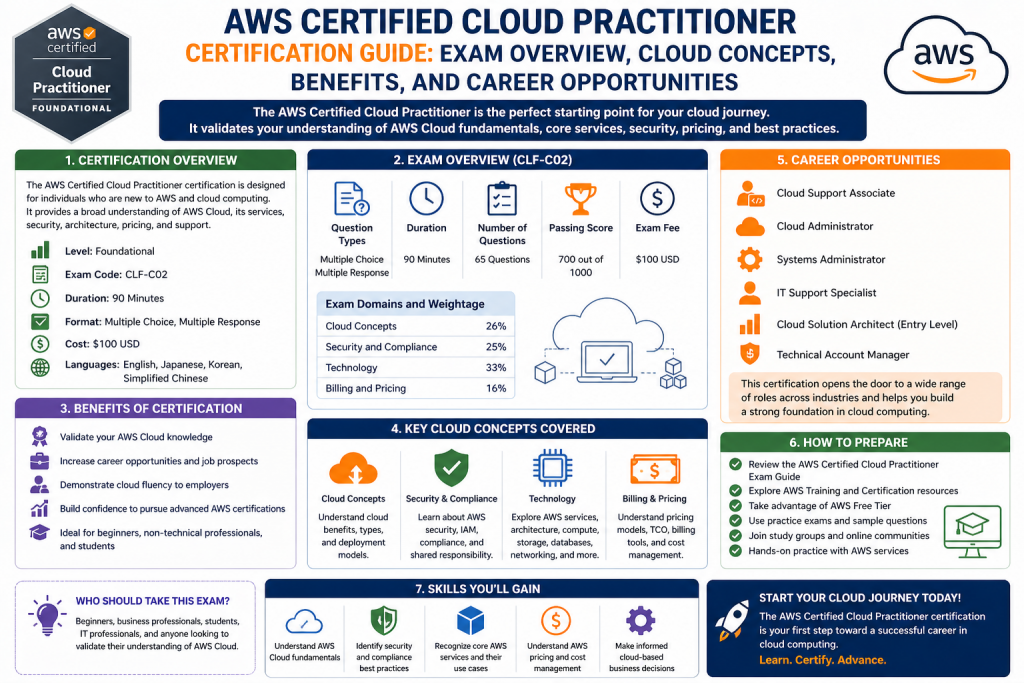
The AWS Certified Cloud Practitioner certification is widely regarded as one of the best entry points into the world of cloud computing. It is designed for individuals who want to develop a foundational understanding of cloud concepts without needing deep technical expertise. This certification serves as a bridge between technical and non-technical roles, making it accessible to a broad audience, including students, business professionals, managers, and aspiring IT specialists.
Cloud computing has transformed how organizations operate by enabling scalable, flexible, and cost-effective infrastructure. Instead of relying on traditional on-premises systems, businesses can now leverage cloud platforms to store data, run applications, and manage workloads efficiently. The AWS Cloud Practitioner certification helps individuals understand these transformations and equips them with the knowledge needed to participate in cloud-related discussions and decisions.
The certification validates a candidate’s understanding of core AWS services, basic architectural principles, pricing models, and security concepts. It does not require hands-on coding or advanced technical skills, but it does expect candidates to have a clear conceptual understanding of how cloud services work. This makes it an ideal starting point for those who want to explore cloud computing before pursuing more advanced certifications.
As AWS continues to evolve, so does the certification exam. The transition from CLF-C01 to CLF-C02 reflects the rapid pace of innovation in the cloud industry. While the overall structure of the exam remains consistent, the content has been updated to include new services, improved best practices, and a stronger emphasis on real-world applications.
Understanding these updates is essential for anyone preparing for the certification. Studying outdated material can lead to gaps in knowledge, especially since the newer exam includes additional topics that were not covered previously. By focusing on the latest version, candidates can ensure they are learning the most relevant and up-to-date information.
Overview of the Transition from CLF-C01 to CLF-C02
The shift from CLF-C01 to CLF-C02 is not a complete overhaul but rather an evolution of the existing exam. The newer version builds upon the foundation of the earlier one while introducing new topics and refining existing areas. This approach ensures continuity while keeping the certification aligned with current industry standards.
One of the key aspects of this transition is the adjustment in domain weightings. While the same four domains are still present, their relative importance has shifted slightly. This change reflects the growing significance of certain areas, particularly security, in modern cloud environments.
The exam format itself has not changed. Candidates are still given 90 minutes to complete a set of multiple-choice questions. The number of questions remains similar, and the passing score continues to be set at a level that ensures candidates have a solid understanding of the material. This consistency helps reduce uncertainty for those preparing for the exam.
Another important point is that very little content has been removed. Instead, the newer exam adds more depth and breadth to existing topics. This means that individuals who studied for the earlier version already have a strong foundation, but they will need to expand their knowledge to cover the additional material.
The inclusion of new services and concepts reflects the ongoing growth of AWS. As the platform introduces new tools and capabilities, the certification must adapt to ensure that candidates are familiar with these developments. This ensures that certified individuals are prepared to work with modern cloud environments.
Understanding Cloud Concepts in the Updated Exam
Cloud concepts form the backbone of the AWS Certified Cloud Practitioner exam. This domain focuses on the fundamental principles of cloud computing and helps candidates understand why organizations are moving to the cloud.
One of the most important concepts in this domain is scalability. Cloud platforms allow resources to be scaled up or down based on demand. This flexibility enables organizations to handle varying workloads without over-provisioning resources. Elasticity, a closely related concept, ensures that resources can be automatically adjusted in response to changes in demand.
Another key concept is the pay-as-you-go model. Unlike traditional infrastructure, where organizations must invest heavily in hardware upfront, cloud computing allows them to pay only for the resources they use. This reduces costs and improves financial efficiency.
High availability and fault tolerance are also central to cloud computing. AWS provides infrastructure that is designed to minimize downtime and ensure reliability. By distributing resources across multiple locations, AWS helps organizations maintain continuous operations even in the event of failures.
The updated exam places greater emphasis on understanding these concepts in practical scenarios. Candidates may be presented with situations where they must identify the benefits of using cloud services or choose the most appropriate solution based on specific requirements.
The Role of the AWS Cloud Adoption Framework
One of the most significant additions to the updated exam is the AWS Cloud Adoption Framework, often referred to as AWS CAF. This framework is designed to help organizations plan and implement their cloud strategies effectively.
The AWS CAF provides a structured approach to cloud adoption by dividing the process into six key perspectives. These perspectives include business, people, governance, platform, security, and operations. Each perspective addresses a different aspect of the organization’s transition to the cloud.
The business perspective focuses on aligning cloud adoption with organizational goals. It ensures that cloud initiatives deliver value and support the overall strategy. The people perspective addresses the skills and culture required for successful cloud adoption, emphasizing the importance of training and collaboration.
The governance perspective deals with policies, compliance, and risk management. It ensures that cloud usage aligns with regulatory requirements and organizational standards. The platform perspective focuses on the technical infrastructure needed to support cloud operations.
The security perspective emphasizes the importance of protecting data and systems in the cloud. It includes practices such as identity management, encryption, and monitoring. The operations perspective focuses on maintaining and optimizing cloud environments to ensure efficiency and reliability.
Understanding the AWS CAF is important because it reflects how organizations approach cloud adoption in real-world scenarios. The updated exam expects candidates to have a high-level understanding of this framework and how it can be applied.
Shared Responsibility Model in Greater Depth
The shared responsibility model is a fundamental concept in AWS, and it plays a more prominent role in the updated exam. This model defines the division of responsibilities between AWS and its customers.
AWS is responsible for the security of the cloud. This includes the physical infrastructure, hardware, software, and networking components that run AWS services. Customers, on the other hand, are responsible for security in the cloud. This includes managing access, protecting data, and configuring services securely.
The level of responsibility varies depending on the type of service being used. For example, in infrastructure services, customers have more control and responsibility. In managed services, AWS takes on more responsibility, but customers still need to manage their data and access controls.
Understanding this model is critical because it helps prevent misunderstandings about security responsibilities. The updated exam includes more scenario-based questions that require candidates to apply this knowledge.
Practical Application of Cloud Knowledge
The updated exam places a stronger emphasis on practical application rather than theoretical knowledge alone. Candidates are expected to understand how cloud concepts are used in real-world situations.
This includes analyzing scenarios and choosing the most appropriate solutions based on requirements such as cost, performance, and security. For example, candidates may need to identify the best way to deploy an application or select the most suitable storage option.
The focus on practical application reflects the needs of modern organizations. Employers are looking for individuals who can apply their knowledge effectively, not just recall definitions. By incorporating scenario-based questions, the exam ensures that candidates are prepared for real-world challenges.
Expanding Scope of AWS Services
Another important aspect of the updated exam is the expanded scope of AWS services. While the earlier version focused on a smaller set of core services, the newer exam includes a broader range of tools and capabilities.
This expansion reflects the growth of AWS as a platform. With hundreds of services available, AWS offers solutions for virtually every aspect of cloud computing. The updated exam ensures that candidates are aware of these services and understand their basic functions.
Candidates are not expected to have in-depth technical knowledge of each service, but they should be familiar with their purpose and use cases. This includes understanding how different services work together to create complete solutions.
The inclusion of newer services also highlights emerging trends in cloud computing, such as serverless architecture, artificial intelligence, and advanced networking. By covering these topics, the exam prepares candidates for the future of cloud technology.
Importance of Staying Updated with AWS Changes
One of the key reasons for updating the certification exam is the rapid pace of change in the cloud industry. AWS regularly introduces new services, updates existing ones, and improves best practices. Keeping up with these changes is essential for anyone working with cloud technology.
The transition to CLF-C02 ensures that the certification remains relevant and valuable. It reflects current industry standards and prepares candidates for real-world scenarios. By studying the latest material, candidates can ensure they are learning the most accurate and up-to-date information.
Staying updated also helps individuals remain competitive in the job market. Employers value candidates who are familiar with the latest technologies and practices. By earning the updated certification, individuals demonstrate their commitment to continuous learning and professional growth.
Building a Strong Foundation for Future Certifications
The AWS Certified Cloud Practitioner certification is often the first step in a broader learning journey. It provides a solid foundation that can be built upon with more advanced certifications.
For example, individuals who complete this certification may choose to pursue associate-level certifications in areas such as solutions architecture, development, or system operations. The knowledge gained from the Cloud Practitioner exam serves as a base for these more specialized paths.
By understanding core concepts, services, and best practices, candidates are better prepared to tackle more complex topics. This progression allows individuals to gradually build their expertise and advance their careers in cloud computing.
Security, Compliance, and Trust in the Updated AWS Certified Cloud Practitioner Exam
Security is one of the most critical aspects of cloud computing, and its importance has grown significantly over time. As more organizations migrate their infrastructure, applications, and sensitive data to the cloud, the need to protect these resources becomes increasingly vital. The updated AWS Certified Cloud Practitioner exam reflects this reality by placing greater emphasis on security and compliance compared to the earlier version.
In modern cloud environments, security is not just a technical concern but also a business priority. Data breaches, unauthorized access, and compliance failures can have serious consequences, including financial loss and reputational damage. As a result, AWS has expanded its security offerings and best practices, and the updated exam ensures that candidates understand these developments at a foundational level.
The exam expects candidates to grasp how AWS builds secure infrastructure and how customers can implement security measures within their own environments. This includes understanding identity management, monitoring tools, encryption techniques, and compliance frameworks. Rather than focusing purely on definitions, the updated exam emphasizes practical understanding and real-world application.
Identity and Access Management Fundamentals
Identity and access management is at the core of AWS security. It controls who can access resources and what actions they can perform. The updated exam places significant importance on understanding how access is granted, managed, and monitored.
In AWS, identities can represent users, applications, or services. Each identity is associated with permissions that define what actions it can perform. These permissions are typically assigned through policies, which are sets of rules that allow or deny specific actions on resources.
Candidates are expected to understand the difference between users, groups, and roles. Users represent individual entities, groups are collections of users with shared permissions, and roles are used to grant temporary access to resources. Roles are particularly important in modern cloud environments because they enhance security by reducing the need for long-term credentials.
The principle of least privilege is another key concept. This principle states that users should only be given the permissions they need to perform their tasks and nothing more. By limiting access, organizations can reduce the risk of accidental or malicious actions.
Multi-factor authentication is also an essential component of identity management. It adds an extra layer of security by requiring users to provide additional verification beyond a password. The updated exam expects candidates to understand when and why multi-factor authentication should be used.
Temporary Credentials and Secure Access
The use of temporary credentials is an important security practice in AWS. Unlike long-term credentials, which remain valid until they are manually changed or revoked, temporary credentials have a limited lifespan. This reduces the risk of unauthorized access if credentials are exposed.
Temporary credentials are commonly used in scenarios where applications or services need access to AWS resources. Instead of embedding permanent credentials in code, developers can use roles to generate temporary credentials dynamically. This approach improves security and simplifies credential management.
The updated exam includes more questions that test understanding of temporary access mechanisms. Candidates should be able to identify when temporary credentials are appropriate and how they contribute to a secure environment.
Monitoring, Logging, and Threat Detection
Monitoring and logging are essential for maintaining visibility into cloud environments. AWS provides a variety of tools that allow organizations to track activity, detect anomalies, and respond to potential threats.
Logging services record events and actions that occur within an AWS account. These logs can be used for auditing, troubleshooting, and security analysis. Candidates should understand the importance of logging and how it supports compliance and incident response.
Monitoring tools provide real-time insights into system performance and activity. They help organizations identify unusual behavior that may indicate a security issue. For example, a sudden spike in activity or access from an unexpected location could signal a potential threat.
The updated exam also introduces a stronger focus on threat detection services. These services use advanced techniques, including machine learning, to analyze data and identify suspicious patterns. While candidates are not expected to understand the underlying algorithms, they should know the purpose of these services and how they enhance security.
Data Protection and Encryption Strategies
Protecting data is a fundamental responsibility in cloud computing. AWS provides multiple mechanisms to ensure that data is secure both at rest and in transit. The updated exam places greater emphasis on understanding these mechanisms and their importance.
Encryption is one of the primary methods used to protect data. When data is encrypted, it is transformed into a format that cannot be read without the appropriate key. AWS supports encryption for data stored in its services as well as data being transmitted over networks.
Candidates should understand the difference between encryption at rest and encryption in transit. Encryption at rest protects data stored on disks, while encryption in transit protects data as it moves between systems. Both are essential for maintaining data security.
Key management is another important aspect of encryption. AWS provides services that allow organizations to create, store, and manage encryption keys securely. Candidates should be aware of how keys are used and why proper key management is critical.
In addition to encryption, data classification and access control are important for protecting sensitive information. Organizations must identify which data is sensitive and apply appropriate security measures to protect it. The updated exam reflects this by including questions that test understanding of data protection strategies.
Compliance and Governance in the Cloud
Compliance refers to the adherence to laws, regulations, and industry standards. In cloud environments, compliance is a shared responsibility between AWS and its customers. AWS provides tools and certifications to help organizations meet compliance requirements, but customers must ensure that their own configurations align with these standards.
The updated exam includes more content related to compliance and governance. Candidates should understand the role of policies, audits, and controls in maintaining compliance. This includes recognizing how AWS supports compliance through its infrastructure and services.
Governance involves establishing rules and processes for managing cloud resources. This includes setting policies for access, monitoring usage, and ensuring that resources are used appropriately. Effective governance helps organizations maintain control over their environments and reduce risks.
Candidates should also understand the importance of documentation and reporting in compliance. Organizations must be able to demonstrate that they are following required standards, and this often involves maintaining detailed records of their activities.
Expanded Coverage of Security Services
The updated exam includes a broader range of AWS security services. These services are designed to help organizations protect their environments, detect threats, and respond to incidents.
Candidates should be familiar with services that provide centralized visibility into security posture. These services aggregate data from multiple sources and present it in a unified view, making it easier to identify issues and take action.
Threat detection services are also emphasized. These services analyze logs and network traffic to identify potential threats. By using advanced analytics, they can detect patterns that may not be obvious through manual inspection.
Another category of services focuses on data protection. These services help organizations identify sensitive data, monitor access, and enforce security policies. Understanding the purpose of these services is important for building a comprehensive security strategy.
The updated exam does not require in-depth technical knowledge of each service, but candidates should understand their roles and how they contribute to overall security.
Evolution of Cloud Technology and Services
In addition to security, the updated exam expands its coverage of cloud technology and services. This reflects the growing complexity of AWS and the increasing adoption of modern architectures.
One of the most significant trends in cloud computing is the shift toward serverless architecture. This approach allows developers to build applications without managing servers. Instead, they can focus on writing code while AWS handles the underlying infrastructure.
Serverless computing offers several advantages, including scalability, cost efficiency, and reduced operational overhead. Candidates should understand these benefits and how serverless services are used in practice.
Containerization is another important trend. Containers allow applications to be packaged with their dependencies, ensuring consistency across different environments. While the exam does not require deep technical knowledge, candidates should understand the role of containers in modern application development.
Orchestration tools are used to manage containers at scale. These tools automate tasks such as deployment, scaling, and monitoring. Understanding the basic concept of orchestration is important for recognizing how complex applications are managed in the cloud.
Storage Solutions and Data Management
Storage is a fundamental component of cloud computing, and AWS offers a wide range of storage options to meet different needs. The updated exam includes expanded coverage of these options and their use cases.
Candidates should understand the different types of storage available, including object storage, block storage, and archival storage. Each type is designed for specific use cases, and choosing the right one is essential for optimizing performance and cost.
Object storage is commonly used for storing large amounts of unstructured data, such as images and videos. Block storage is typically used for applications that require low-latency access to data, such as databases. Archival storage is designed for long-term retention of data that is accessed infrequently.
The updated exam also includes newer storage classes that automatically optimize costs based on usage patterns. These options allow organizations to balance performance and cost without manual intervention.
Data management involves organizing, storing, and retrieving data efficiently. Candidates should understand how AWS services support data management and how they can be used to build scalable solutions.
Networking and Connectivity Enhancements
Networking is another area that has been expanded in the updated exam. AWS provides a variety of networking services that enable secure and reliable communication between resources.
Candidates should understand the basics of virtual networking, including how resources are isolated and connected within the cloud. This includes concepts such as subnets, routing, and security controls.
The updated exam also introduces more advanced networking topics, such as global connectivity and hybrid solutions. These topics reflect the needs of organizations that operate across multiple locations and integrate on-premises systems with cloud environments.
Hybrid networking allows organizations to connect their existing infrastructure with AWS. This enables them to gradually transition to the cloud while maintaining compatibility with existing systems.
Global networking services improve performance by routing traffic through optimized paths. Candidates should understand how these services enhance user experience and support large-scale applications.
Artificial Intelligence and Machine Learning Services
The inclusion of artificial intelligence and machine learning services is one of the most notable additions to the updated exam. These services enable applications to perform tasks that traditionally required human intelligence.
Candidates should understand the basic use cases of these services, such as image recognition, speech processing, and language translation. While they are not expected to build machine learning models, they should know how these services are used in real-world scenarios.
Machine learning services can analyze large amounts of data to identify patterns and make predictions. This capability is increasingly important in areas such as security, customer insights, and automation.
The updated exam reflects the growing importance of these technologies by including questions that test awareness of their capabilities and benefits.
Practical Understanding of Modern Cloud Architectures
The updated exam emphasizes understanding how different services work together to create complete solutions. Modern cloud architectures often involve multiple components, each serving a specific purpose.
Candidates should be able to identify how services interact and how they can be combined to meet specific requirements. This includes understanding concepts such as multi-tier applications, where different layers handle different aspects of an application.
For example, one layer may handle user interactions, another may process data, and a third may store information. By separating these functions, organizations can improve scalability and reliability.
The focus on architecture reflects the real-world application of cloud computing. Rather than working with isolated services, professionals must design and manage complex systems that meet diverse requirements.
Billing, Pricing, and Cost Optimization in the Updated AWS Certified Cloud Practitioner Exam
The billing and pricing domain remains an essential part of the AWS Certified Cloud Practitioner exam, even though its overall weight has been slightly reduced in the updated version. Understanding how AWS pricing works is critical because cost management is one of the primary reasons organizations move to the cloud. The ability to optimize expenses while maintaining performance and scalability is a key skill that candidates must develop.
Cloud computing introduces a different financial model compared to traditional infrastructure. Instead of making large upfront investments in hardware and maintenance, organizations can pay only for what they use. This shift allows businesses to align their costs more closely with their actual needs, reducing waste and improving efficiency.
The updated exam reflects modern pricing strategies and introduces candidates to more flexible options that have emerged over time. While the foundational concepts remain the same, there is now a greater emphasis on understanding how to manage and optimize costs in real-world scenarios.
Understanding AWS Pricing Models
AWS offers a variety of pricing models to accommodate different workloads and usage patterns. The most basic model is the pay-as-you-go approach, where customers are charged based on their actual usage. This model provides flexibility and eliminates the need for long-term commitments.
In addition to pay-as-you-go, AWS provides options that allow customers to save money by committing to certain levels of usage. These options are particularly useful for predictable workloads where demand remains relatively stable over time. By committing to a certain level of usage, organizations can benefit from discounted rates.
The updated exam includes these newer pricing strategies, requiring candidates to understand when and why they should be used. This involves recognizing scenarios where cost savings can be achieved through planning and forecasting.
Another important concept is tiered pricing. In this model, the cost per unit decreases as usage increases. This encourages organizations to scale their operations while benefiting from reduced costs at higher usage levels.
Candidates should also understand the concept of free tiers. AWS provides limited access to certain services at no cost, allowing users to explore the platform and gain hands-on experience. This is particularly useful for beginners who are preparing for the certification exam.
Cost Management Tools and Their Importance
Managing costs in the cloud requires more than just understanding pricing models. AWS provides a range of tools that help organizations monitor their usage, analyze spending patterns, and identify opportunities for savings.
These tools offer visibility into how resources are being used and how much they cost. By analyzing this data, organizations can make informed decisions about resource allocation and optimization. The updated exam includes questions that test understanding of these tools and their practical applications.
One important aspect of cost management is budgeting. Organizations can set budgets to control their spending and receive alerts when they approach or exceed their limits. This helps prevent unexpected expenses and ensures that costs remain within acceptable boundaries.
Another key feature is cost analysis. By examining usage patterns, organizations can identify inefficiencies and take corrective action. For example, they may discover that certain resources are underutilized and can be scaled down or removed.
Forecasting is also an important component of cost management. By predicting future usage, organizations can plan their budgets more effectively and avoid surprises. The updated exam reflects the importance of these practices by including scenario-based questions that require candidates to apply their knowledge.
Cost Optimization Strategies in Cloud Environments
Cost optimization is not just about reducing expenses; it is about achieving the best possible value for the resources being used. This involves balancing cost, performance, and scalability to meet organizational goals.
One common strategy is rightsizing, which involves adjusting resources to match actual usage. For example, if a server is consistently underutilized, it may be more cost-effective to switch to a smaller instance. This reduces costs without compromising performance.
Another strategy is automation. By automating tasks such as scaling and resource management, organizations can ensure that they are only using resources when needed. This reduces waste and improves efficiency.
Storage optimization is also an important consideration. Different types of storage have different cost structures, and choosing the right option can significantly impact overall expenses. For example, data that is accessed frequently should be stored in high-performance storage, while infrequently accessed data can be moved to lower-cost options.
The updated exam emphasizes the importance of these strategies and expects candidates to understand how they are applied in real-world scenarios. This includes recognizing situations where cost optimization techniques can be used to improve efficiency.
Understanding Billing Processes and Account Management
Billing in AWS involves tracking usage, calculating costs, and generating invoices. The updated exam includes content related to how billing works and how accounts are managed.
Candidates should understand how usage is measured and how charges are calculated. This includes recognizing the different factors that influence costs, such as data transfer, storage, and compute usage.
Account management is another important aspect. Organizations can use multiple accounts to separate workloads, manage access, and track costs more effectively. This approach is often used in large organizations to maintain control and visibility.
The concept of consolidated billing is also important. This allows multiple accounts to be linked together, enabling organizations to receive a single bill while still maintaining separate usage tracking for each account. This simplifies billing and can provide cost benefits.
The updated exam reflects these practices by including questions that test understanding of account structures and billing processes.
Who Should Take the AWS Certified Cloud Practitioner Exam
The AWS Certified Cloud Practitioner certification is designed for a wide audience. It is particularly beneficial for individuals who are new to cloud computing and want to build a foundational understanding.
Software developers who have little experience with cloud platforms can use this certification to gain insights into how AWS services work. This knowledge can help them design and deploy applications more effectively.
Business professionals can also benefit from the certification. Understanding cloud concepts allows them to make informed decisions and communicate effectively with technical teams. This is especially important in organizations where cloud adoption is a key part of the strategy.
Managers and team leaders can use the certification to gain a better understanding of the technologies their teams are using. This helps them provide guidance and make strategic decisions.
Individuals working in finance or accounting roles can benefit from understanding AWS pricing and cost management. This knowledge allows them to manage budgets and optimize expenses more effectively.
The certification does not require any prerequisites, making it accessible to anyone interested in cloud computing. This inclusivity is one of the reasons why it is so popular among beginners.
Exam Structure, Requirements, and Expectations
The structure of the AWS Certified Cloud Practitioner exam remains consistent in the updated version. Candidates are given a fixed amount of time to complete a set of multiple-choice questions. The questions are designed to test both knowledge and understanding.
The passing score is set at a level that ensures candidates have a solid grasp of the material. While not all questions are graded, candidates must perform well enough on the scored questions to achieve a passing result.
The exam includes a mix of straightforward and scenario-based questions. Some questions test basic knowledge, while others require candidates to analyze situations and choose the best solution. This approach ensures that candidates are prepared for real-world challenges.
Preparation for the exam involves studying the relevant topics and gaining practical experience. While theoretical knowledge is important, hands-on experience can significantly enhance understanding.
Effective Study Strategies for CLF-C02
Preparing for the updated exam requires a structured approach. Candidates should begin by reviewing the exam guide to understand the topics that will be covered. This helps them focus their efforts and avoid unnecessary material.
Using a variety of learning resources can also be beneficial. These may include online courses, practice exams, and study guides. Each resource provides a different perspective and helps reinforce understanding.
Hands-on experience is one of the most effective ways to learn. By creating an AWS account and exploring the platform, candidates can gain practical insights into how services work. This makes it easier to understand concepts and remember information.
Practice exams are another valuable tool. They allow candidates to test their knowledge and identify areas where they need improvement. By reviewing their performance, candidates can focus on weak areas and improve their chances of success.
Consistency is key when preparing for the exam. Regular study sessions and practice can help build confidence and ensure that candidates are well-prepared.
The Importance of Real-World Experience
While the exam focuses on foundational knowledge, real-world experience plays a crucial role in understanding cloud computing. Practical experience allows candidates to see how concepts are applied and how services interact.
Even simple tasks, such as launching a virtual server or storing data, can provide valuable insights. These experiences help candidates connect theoretical knowledge with practical application.
The updated exam reflects this by including more scenario-based questions. Candidates who have hands-on experience are better equipped to analyze situations and choose appropriate solutions.
Real-world experience also helps candidates develop problem-solving skills. In cloud environments, challenges often require creative solutions, and practical experience provides the foundation for this.
Adapting to the Evolving Cloud Landscape
The transition from CLF-C01 to CLF-C02 highlights the dynamic nature of cloud computing. As AWS continues to innovate and expand its services, the certification must evolve to remain relevant.
This evolution ensures that candidates are learning the most current and useful information. It also prepares them for the challenges of working in modern cloud environments.
Staying updated with changes in AWS is important for long-term success. Cloud technology is constantly evolving, and professionals must continuously learn and adapt to remain competitive.
The updated exam encourages this mindset by introducing new topics and emphasizing practical understanding. Candidates who embrace continuous learning will be better prepared for future opportunities.
Building a Path for Career Growth
The AWS Certified Cloud Practitioner certification is often the first step in a broader career journey. It provides a foundation that can be built upon with more advanced certifications and specialized skills.
After completing this certification, individuals may choose to pursue associate-level certifications in areas such as architecture, development, or operations. These certifications require deeper technical knowledge and provide opportunities for career advancement.
The knowledge gained from the Cloud Practitioner exam also has practical applications in many roles. Whether working in development, operations, or business analysis, understanding cloud concepts is increasingly important.
By earning this certification, candidates demonstrate their commitment to learning and their readiness to engage with cloud technologies. This can open doors to new opportunities and career growth.
Conclusion
The updated AWS Certified Cloud Practitioner exam reflects the evolving nature of cloud computing by expanding its coverage of security, technology, and pricing while maintaining its focus on foundational knowledge. The transition from CLF-C01 to CLF-C02 introduces new services, modern pricing strategies, and a stronger emphasis on real-world application.
In this final section, the focus on billing, pricing, and cost optimization highlights the importance of managing resources effectively in cloud environments. Understanding how to monitor usage, analyze costs, and implement optimization strategies is essential for achieving efficiency and value.
The certification remains accessible to a wide audience, making it an ideal starting point for anyone interested in cloud computing. With no prerequisites and a focus on fundamental concepts, it provides a solid foundation for further learning and career development.
By combining theoretical knowledge with practical experience, candidates can prepare effectively for the exam and gain the confidence needed to succeed. As cloud technology continues to evolve, this certification serves as a valuable stepping stone toward a deeper understanding of AWS and the broader cloud ecosystem.
Continue exploring the technologies and certification concepts that matter most to you.