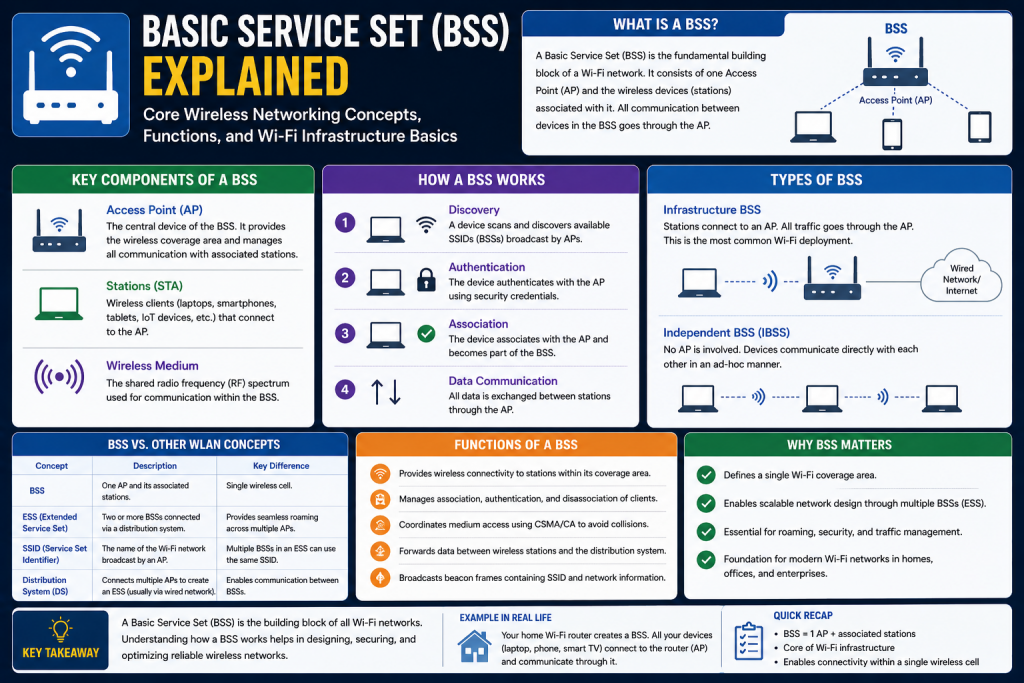
A Basic Service Set, often referred to as BSS, is one of the most essential concepts in wireless networking. It represents the simplest form of a wireless network, where a group of devices communicates within a defined area. These devices typically include laptops, smartphones, tablets, and other Wi-Fi-enabled equipment that rely on wireless signals to exchange data. Understanding how a BSS works is critical for anyone who wants to build, manage, or troubleshoot wireless networks.
Wireless networking can feel complex at first, especially because it involves many technical terms and acronyms. However, the idea behind a Basic Service Set is relatively straightforward. It is essentially a grouping of devices that can communicate with each other using a shared wireless medium. This grouping provides structure to wireless communication, ensuring that devices can connect and interact efficiently.
The importance of learning about BSS early in networking studies cannot be overstated. It serves as a foundation for understanding more advanced wireless concepts. Without a clear grasp of how a BSS operates, it becomes much more difficult to understand topics such as roaming, interference management, and network optimization.
The Role of BSS in Wireless Networking
A Basic Service Set acts as the building block of wireless local area networks. It defines how devices are organized and how communication is coordinated. In a wireless environment, multiple devices share the same airspace to transmit data. Without a structured system like a BSS, this shared medium could easily become chaotic.
The BSS ensures that communication happens in an orderly manner. Devices follow specific rules and protocols when sending and receiving data. These rules help prevent collisions and ensure that information reaches its intended destination. By organizing devices into a defined group, the BSS provides a controlled environment for wireless communication.
Another important role of a BSS is to establish the boundaries of a wireless network. Each BSS operates within a specific coverage area, which is determined by factors such as signal strength and environmental conditions. Devices within this area can communicate with each other, while those outside the range cannot.
This concept of defined coverage is particularly important in real-world deployments. For example, in a home network, a single BSS may cover the entire house. In larger environments, multiple BSSs may be used to ensure complete coverage. Understanding how these coverage areas work is key to designing effective wireless networks.
Infrastructure Mode and Ad-Hoc Mode
A Basic Service Set can operate in two main modes: infrastructure mode and ad-hoc mode. Each mode represents a different way of organizing communication between devices.
In infrastructure mode, a central device known as an access point manages all communication. The access point acts as a hub, coordinating how devices connect and exchange data. This is the most common type of BSS and is used in homes, offices, schools, and public Wi-Fi networks.
The access point plays a crucial role in maintaining network stability. It controls how devices access the wireless medium, ensuring that multiple devices can communicate without interfering with each other. It also acts as a bridge between the wireless network and a wired network, allowing devices to access the internet and other resources.
Ad-hoc mode, on the other hand, does not use an access point. Instead, devices communicate directly with each other in a peer-to-peer manner. This type of BSS is often referred to as an Independent Basic Service Set. It is typically used for temporary connections, such as when two devices need to share files without relying on a central network.
While ad-hoc networks offer flexibility, they are less common in everyday use. They lack the centralized management provided by an access point, which can make them less efficient and harder to secure. However, they demonstrate the versatility of wireless technology and its ability to adapt to different scenarios.
Understanding the IEEE 802.11 Standard
The concept of a Basic Service Set is closely tied to the IEEE 802.11 standard, which defines how wireless local area networks operate. This standard is the foundation of modern Wi-Fi technology and specifies how devices communicate over wireless frequencies.
The 802.11 standard operates primarily in the 2.4 GHz and 5 GHz frequency bands. These frequencies are well-suited for short-range communication, making them ideal for environments such as homes, offices, and public spaces. The standard provides guidelines for data transmission, security, and network management.
A BSS is one of the key components defined within the 802.11 framework. It outlines how devices are grouped and how communication is structured. By adhering to this standard, manufacturers ensure that devices from different vendors can work together seamlessly.
The widespread adoption of the 802.11 standard has made wireless networking an integral part of modern life. From connecting to the internet at home to accessing Wi-Fi in public places, the principles of BSS are constantly at work behind the scenes.
Identifying a BSS with BSSID
Each Basic Service Set is uniquely identified by a Basic Service Set Identifier, commonly known as a BSSID. This identifier is crucial for distinguishing one wireless network from another, especially in environments where multiple networks are present.
The BSSID is typically formatted like a MAC address, consisting of a series of hexadecimal numbers. It is assigned to the access point in an infrastructure-based BSS. Even if multiple networks share the same visible name, their BSSIDs will be different, allowing devices to differentiate between them.
This unique identification becomes particularly important in areas with many overlapping networks, such as apartment buildings or office complexes. Devices use the BSSID to determine which access point to connect to, often selecting the one with the strongest signal.
The BSSID also plays a role in network analysis and troubleshooting. By examining the BSSID, network administrators can identify specific access points and diagnose issues more effectively. This level of detail is essential for maintaining optimal network performance.
Comparing Short-Range and Long-Range Wireless Technologies
Wireless networking technologies are designed for different purposes, and understanding these differences helps clarify the role of a Basic Service Set. The 802.11 standard focuses on short-range communication, making it ideal for local networks.
In contrast, other standards are designed for long-range connectivity. These technologies can cover much larger distances, sometimes spanning entire regions. They are often used in rural or underserved areas where traditional infrastructure is not available.
The key difference lies in their intended use. Short-range technologies prioritize high-speed data transfer within a limited area, while long-range technologies focus on extending coverage over greater distances. The BSS is specifically designed for the former, providing efficient communication within a defined space.
This distinction highlights why the BSS is so important in everyday networking. It enables fast, reliable connections in environments where users need consistent access to network resources.
Communication Within a BSS
Communication within a Basic Service Set is carefully managed to ensure efficiency and reliability. Devices do not simply transmit data whenever they want. Instead, they follow specific protocols that regulate access to the wireless medium.
One of the key challenges in wireless communication is avoiding collisions. Since multiple devices share the same airspace, there is a risk that two devices may try to transmit data at the same time. This can lead to interference and data loss.
To address this issue, the 802.11 standard uses mechanisms that control how and when devices transmit data. These mechanisms help ensure that communication is orderly and that data is delivered successfully.
The access point plays a central role in this process. It coordinates communication between devices, ensuring that each device has an opportunity to transmit data. This coordination is essential for maintaining network performance, especially in environments with many connected devices.
Importance of Learning BSS Concepts
Understanding the concept of a Basic Service Set is essential for anyone interested in networking. It provides the foundation for exploring more advanced topics and helps build a deeper understanding of how wireless systems operate.
For students and professionals alike, mastering BSS concepts makes it easier to work with wireless technologies. Whether designing a new network or troubleshooting an existing one, this knowledge is invaluable.
The BSS also serves as a stepping stone to understanding larger network structures. Concepts such as Extended Service Sets and network roaming build upon the principles established by the BSS. Without a solid foundation, these advanced topics can be difficult to grasp.
In addition, knowledge of BSS is useful in real-world scenarios. From setting up a home Wi-Fi network to managing enterprise-level systems, the principles of BSS are applied in countless situations. This makes it a practical and relevant topic for anyone working with technology.
Real-World Applications of BSS
The concept of a Basic Service Set is not limited to theoretical discussions. It has practical applications in a wide range of environments. In homes, a single BSS is typically sufficient to provide wireless connectivity for all devices. This setup is simple and effective, making it ideal for everyday use.
In larger environments, such as offices or campuses, multiple BSSs are often used to ensure complete coverage. These BSSs can be connected to form a larger network, allowing users to move freely without losing connectivity. This seamless experience is made possible by the underlying structure provided by the BSS.
Public Wi-Fi networks also rely on BSS concepts. In places like airports, cafes, and hotels, multiple access points are deployed to handle large numbers of users. Each access point represents a BSS, working together to provide reliable connectivity.
These real-world examples demonstrate the versatility and importance of the BSS. It is a fundamental concept that underpins modern wireless communication, enabling devices to connect and interact in a wide variety of settings.
Introduction to BSS Components
To understand how a Basic Service Set functions in a real-world wireless network, it is important to break it down into its individual components. Each element within a BSS plays a distinct role, and together they create a structured environment that allows devices to communicate efficiently. While the concept of a BSS may seem simple at a high level, its effectiveness depends on how well these components are configured and how they interact with one another.
A wireless network is not just a collection of devices transmitting data randomly. Instead, it is a carefully coordinated system where every component contributes to stability, performance, and usability. By examining these components in detail, it becomes easier to understand how wireless communication is organized and how networks can be optimized for different environments.
The Central Role of the Access Point
At the heart of most Basic Service Sets is the access point, often referred to as the AP. This device serves as the central hub for communication in infrastructure mode. It is responsible for managing all wireless traffic within the BSS and acts as the bridge between wireless clients and the wired network.
The access point performs several critical tasks. It controls how devices connect to the network, ensuring that only authorized clients are allowed access. It also manages the flow of data, directing traffic between devices and external networks such as the internet. Without the access point, communication within an infrastructure-based BSS would be disorganized and inefficient.
One of the most important functions of the access point is coordinating access to the shared wireless medium. Since multiple devices use the same radio frequencies, there must be a system in place to prevent interference and collisions. The AP helps enforce this system by regulating when devices can transmit data.
In addition to managing communication, the access point also broadcasts signals that allow devices to discover the network. These signals include important information such as the network name and supported features. This process ensures that devices can easily find and connect to the appropriate network.
The placement and configuration of the access point have a significant impact on network performance. A poorly positioned AP can lead to weak signals, dead zones, and inconsistent connectivity. Conversely, a well-placed access point provides strong, reliable coverage and enhances the overall user experience.
Understanding the Service Set Identifier
The Service Set Identifier, or SSID, is one of the most recognizable elements of a wireless network. It is the name that users see when they search for available Wi-Fi networks on their devices. While it may seem like a simple label, the SSID plays an important role in network organization and usability.
An SSID is typically a human-readable string that can be up to 32 characters long. It allows users to identify and select the correct network from a list of available options. In environments where multiple networks are present, having clear and descriptive SSIDs helps prevent confusion and ensures that users connect to the intended network.
The SSID is broadcast by the access point through periodic signals known as beacon frames. These frames contain information about the network, including its capabilities and configuration. Devices use this information to determine whether they can connect to the network and what features are supported.
While it is possible to hide an SSID, this practice is generally not recommended. Hidden SSIDs do not provide meaningful security benefits and can make network management more complicated. Instead, it is better to focus on strong encryption and authentication methods to protect the network.
In larger environments, multiple SSIDs may be used to segment the network. For example, an organization might have separate SSIDs for employees, guests, and specialized devices. This segmentation helps improve security and performance by isolating different types of traffic.
The Importance of the Basic Service Set Identifier
While the SSID is visible to users, the Basic Service Set Identifier, or BSSID, operates behind the scenes. It is a unique identifier assigned to each access point within a BSS and is typically formatted like a MAC address. The BSSID ensures that each network instance can be uniquely identified, even if multiple networks share the same SSID.
The distinction between SSID and BSSID becomes especially important in environments with multiple access points. In such cases, several APs may broadcast the same SSID to create a seamless network experience. However, each AP will have its own BSSID, allowing devices to differentiate between them.
When a device connects to a network, it actually associates with a specific BSSID rather than just the SSID. This means that even though the network name appears the same, the device is connected to a particular access point. As the user moves around, the device may switch from one BSSID to another to maintain a strong connection.
The BSSID is also a valuable tool for network analysis and troubleshooting. By examining BSSID information, administrators can identify which access point a device is connected to and assess signal strength and performance. This level of detail is essential for diagnosing issues and optimizing network design.
Station Clients and Their Role in the Network
Station clients, often referred to as STAs or simply clients, are the devices that connect to the wireless network. These include laptops, smartphones, tablets, and other Wi-Fi-enabled equipment. While the access point manages communication, it is the clients that generate and consume the data that flows through the network.
Each client communicates with the access point to send and receive information. This communication involves a series of steps, including authentication, association, and data exchange. These processes ensure that the client is authorized to use the network and can communicate effectively with other devices.
The capabilities of client devices can vary widely. Some devices support advanced features such as higher data rates and multiple antennas, while others may be limited in their performance. This variation can impact the overall performance of the BSS, as slower devices may require more time to transmit data.
Network designers often consider the concept of the least capable, most important device when planning a BSS. This approach ensures that the network is designed to meet the needs of all users, even those with less advanced devices. By accommodating these devices, the network can provide a consistent experience for everyone.
Client behavior also plays a role in network performance. Devices may move around, connect and disconnect, or compete for bandwidth. Understanding these behaviors helps in designing networks that can handle dynamic conditions and maintain stability.
Interaction Between Components
The effectiveness of a Basic Service Set depends on how well its components work together. The access point, SSID, BSSID, and client devices all interact to create a functional network. Each component has a specific role, but their interactions determine the overall performance and reliability of the system.
For example, when a device searches for a network, it relies on SSID broadcasts from the access point. Once it selects a network, it uses the BSSID to establish a connection with a specific access point. The AP then manages communication between the device and other network resources.
This coordinated interaction ensures that data is transmitted efficiently and that devices can communicate without interference. It also allows the network to adapt to changing conditions, such as varying signal strength or the movement of devices.
Understanding these interactions is essential for troubleshooting network issues. Problems such as slow connections or dropped signals can often be traced back to how these components are configured or how they interact with each other.
Extended Service Sets and Network Expansion
While a single Basic Service Set is sufficient for small environments, larger areas often require multiple BSSs to provide adequate coverage. This is where the concept of an Extended Service Set, or ESS, comes into play. An ESS is formed by connecting multiple BSSs together to create a larger, unified network.
In an ESS, multiple access points work together to provide seamless connectivity. They typically share the same SSID, allowing users to move between coverage areas without needing to reconnect manually. This process, known as roaming, is a key feature of modern wireless networks.
Each access point in an ESS has its own BSSID, even though they share the same SSID. This allows devices to switch between access points as needed, maintaining a strong and stable connection. The ability to roam seamlessly is particularly important in environments such as offices, campuses, and public spaces.
Designing an effective ESS requires careful planning. Access points must be placed strategically to ensure overlapping coverage without causing interference. Proper channel selection and power settings are also important to maintain performance.
Independent Basic Service Sets
In addition to infrastructure-based BSSs, there is another type known as the Independent Basic Service Set, or IBSS. This type of network operates without an access point, allowing devices to communicate directly with each other. It is commonly referred to as an ad-hoc network.
IBSS networks are typically used for temporary or specialized purposes. For example, they may be used to share files between devices or to create a quick network in situations where no infrastructure is available. While they offer flexibility, they lack the centralized management provided by an access point.
Without an AP, devices in an IBSS must coordinate communication themselves. This can lead to inefficiencies and increased potential for interference. As a result, IBSS networks are less commonly used in modern environments, where infrastructure-based networks are preferred.
Despite their limitations, IBSS networks demonstrate the adaptability of wireless technology. They show that devices can form networks dynamically, even in the absence of traditional infrastructure.
Design Considerations for BSS Architecture
Designing a Basic Service Set involves more than just selecting hardware. It requires a thoughtful approach to how components are configured and how they will be used in practice. Factors such as coverage, capacity, and security must all be taken into account.
Coverage is one of the most important considerations. The goal is to ensure that all areas within the intended environment have a strong and reliable signal. This may involve adjusting the placement and power settings of access points.
Capacity planning is also critical. The network must be able to handle the expected number of devices and the volume of traffic they generate. This requires selecting access points that can support the necessary load and ensuring that bandwidth is distributed effectively.
Security is another key factor. Implementing strong encryption and authentication measures helps protect the network from unauthorized access. This is especially important in environments where sensitive data is transmitted.
By carefully considering these factors, network designers can create a BSS that meets the needs of users while maintaining performance and reliability.
Introduction to BSS Deployment
Deploying a Basic Service Set in a real-world environment requires more than simply installing an access point and allowing devices to connect. While the underlying concept of a BSS is straightforward, achieving reliable performance, strong coverage, and secure communication involves careful planning and continuous optimization. A well-designed deployment ensures that users experience stable connectivity, minimal interference, and consistent speeds across the network.
Wireless environments are dynamic by nature. Factors such as physical obstacles, user movement, and interference from other devices can all affect performance. Because of this, deploying a BSS is an ongoing process that involves both initial design and long-term maintenance. Understanding how to approach deployment strategically is essential for creating an effective wireless network.
Conducting a Site Survey
One of the most important steps in deploying a Basic Service Set is conducting a site survey. This process involves analyzing the physical environment where the network will operate. The goal is to identify factors that could impact signal strength, coverage, and overall performance.
A site survey examines elements such as building layout, wall materials, and sources of interference. For example, concrete walls, metal structures, and large appliances can weaken or block wireless signals. By identifying these obstacles in advance, network designers can plan access point placement more effectively.
There are two main types of site surveys: predictive and active. Predictive surveys use software tools to model signal propagation based on environmental data, while active surveys involve physically measuring signal strength in the environment. Both approaches provide valuable insights and are often used together to achieve the best results.
Conducting a thorough site survey helps prevent common issues such as dead zones, weak signals, and uneven coverage. It also ensures that the network is designed to meet the specific needs of the environment, whether it is a small home or a large enterprise facility.
Strategic Placement of Access Points
The placement of access points plays a critical role in the success of a BSS deployment. Even the most advanced hardware cannot compensate for poor positioning. Proper placement ensures that wireless signals are distributed evenly and that users can maintain strong connections throughout the coverage area.
Access points should generally be placed in central locations to maximize coverage. This helps reduce the distance between the AP and connected devices, improving signal strength and data rates. In larger environments, multiple access points may be required to cover all areas effectively.
Avoid placing access points near sources of interference, such as microwave ovens, cordless phones, or dense metal objects. These can disrupt wireless signals and degrade performance. Elevating access points, such as mounting them on ceilings or high walls, can also improve coverage by reducing obstructions.
Another important consideration is overlap between access points. While some overlap is necessary to support seamless roaming, excessive overlap can lead to interference and reduced performance. Achieving the right balance is key to an effective deployment.
Managing Wireless Channels
Wireless communication relies on specific frequency channels, and managing these channels properly is essential for minimizing interference. In environments with multiple access points, channel selection becomes particularly important.
In the 2.4 GHz band, there are limited non-overlapping channels, which increases the risk of interference. Careful planning is required to ensure that neighboring access points use different channels. In contrast, the 5 GHz band offers more channels, providing greater flexibility and reduced congestion.
Automatic channel selection features in modern access points can help optimize performance by dynamically adjusting channels based on current conditions. However, manual configuration may still be necessary in complex environments to achieve the best results.
Channel width is another factor to consider. Wider channels can provide higher data rates but may increase the risk of interference. Narrower channels offer more stability in crowded environments. Choosing the appropriate channel width depends on the specific needs of the network.
SSID Configuration and Network Segmentation
Configuring the Service Set Identifier correctly is an important aspect of BSS deployment. The SSID should be clear and descriptive, making it easy for users to identify the network. In larger environments, multiple SSIDs may be used to separate different types of traffic.
Network segmentation using multiple SSIDs allows administrators to isolate users and devices. For example, a business might have separate SSIDs for employees, guests, and IoT devices. This separation improves security and helps manage network resources more effectively.
However, using too many SSIDs can create additional overhead and reduce performance. Each SSID requires beacon transmissions, which consume bandwidth. Balancing the number of SSIDs with the needs of the network is essential.
It is also important to avoid relying on hidden SSIDs as a security measure. While hiding the network name may seem like an added layer of protection, it does not prevent unauthorized access. Strong encryption and authentication methods are far more effective.
Implementing Strong Security Measures
Security is a critical component of any wireless network. A poorly secured BSS can expose sensitive data and allow unauthorized users to access the network. Implementing robust security measures helps protect both the network and its users.
Modern encryption standards, such as WPA3, provide strong protection against unauthorized access. These protocols encrypt data transmitted over the network, ensuring that it cannot be easily intercepted or decoded by attackers.
Authentication methods also play a key role in security. Systems such as 802.1X provide centralized authentication, allowing administrators to control who can access the network. This is particularly important in enterprise environments where multiple users and devices are present.
Regularly updating firmware and security settings is essential for maintaining protection. As new vulnerabilities are discovered, updates help address these issues and keep the network secure. Ongoing monitoring also allows administrators to detect and respond to potential threats.
Capacity Planning and Performance Optimization
As the number of connected devices continues to grow, capacity planning becomes increasingly important. Each access point has a limit to how many devices it can support effectively. Exceeding this limit can lead to congestion, slower speeds, and reduced reliability.
Planning for capacity involves estimating the number of devices that will connect to the network and the amount of data they will generate. This information helps determine how many access points are needed and how they should be configured.
Load balancing techniques can distribute devices across multiple access points, preventing any single AP from becoming overloaded. This improves overall performance and ensures a better user experience.
Quality of service settings can also be used to prioritize certain types of traffic. For example, voice and video applications may be given higher priority to ensure smooth performance. This is especially important in environments where real-time communication is critical.
Monitoring and Maintenance of the BSS
Deploying a BSS is not a one-time task. Ongoing monitoring and maintenance are necessary to ensure that the network continues to perform well over time. Wireless environments can change due to new devices, physical modifications, or external interference.
Monitoring tools provide insights into network performance, including signal strength, device connectivity, and traffic patterns. This information helps administrators identify issues and make informed decisions about adjustments and improvements.
Regular maintenance tasks include updating firmware, reviewing configuration settings, and checking for security vulnerabilities. These actions help keep the network running smoothly and reduce the risk of unexpected problems.
Proactive maintenance is often more effective than reactive troubleshooting. By addressing potential issues before they become serious, administrators can maintain a stable and reliable network.
Supporting Mobility and Roaming
In many environments, users need to move freely while maintaining a continuous connection to the network. Supporting mobility requires careful coordination between multiple Basic Service Sets within an Extended Service Set.
Roaming allows devices to switch from one access point to another without interrupting the connection. This process must be seamless to avoid disruptions in applications such as video calls or online gaming.
Achieving seamless roaming involves ensuring that access points are properly configured and that coverage areas overlap appropriately. Fast roaming technologies can further improve the user experience by reducing the time it takes for devices to transition between access points.
Understanding how roaming works is essential for designing networks in environments such as offices, hospitals, and campuses, where mobility is a key requirement.
Scalability and Future Growth
As organizations grow and technology evolves, wireless networks must be able to adapt. Designing a BSS with scalability in mind ensures that it can accommodate future needs without requiring a complete redesign.
Scalability involves selecting equipment that can support additional devices and higher data demands. It also includes planning for the addition of new access points as coverage requirements expand.
Flexible network architectures make it easier to implement upgrades and changes. This adaptability is important in a rapidly changing technological landscape, where new standards and devices are constantly emerging.
By planning for growth from the beginning, network designers can create systems that remain effective over the long term.
Troubleshooting Common BSS Issues
Even with careful planning, issues can arise in a Basic Service Set. Common problems include weak signals, dropped connections, and slow performance. Troubleshooting these issues requires a systematic approach and a solid understanding of how the network operates.
Signal-related issues may be caused by poor access point placement or interference. Adjusting the position of the AP or changing channels can often resolve these problems. Connectivity issues may be related to authentication or configuration errors.
Performance problems can result from congestion or insufficient capacity. Adding additional access points or optimizing settings can help improve performance. Monitoring tools are invaluable for identifying the root cause of these issues.
Effective troubleshooting not only resolves immediate problems but also helps improve the overall design of the network.
Conclusion
A Basic Service Set is more than just a simple grouping of wireless devices. It is a carefully designed system that requires thoughtful planning, precise deployment, and ongoing management. From conducting site surveys to optimizing performance and ensuring security, every aspect of BSS deployment contributes to the overall success of the network.
By following best practices and understanding the factors that influence wireless performance, it is possible to create networks that are reliable, efficient, and scalable. The principles of BSS deployment remain essential in modern networking, providing the foundation for the wireless connectivity that people rely on every day.
As wireless technology continues to advance, the importance of these principles will only grow. A strong understanding of BSS deployment ensures that networks can meet current demands while remaining adaptable for the future.
Continue exploring the technologies and certification concepts that matter most to you.