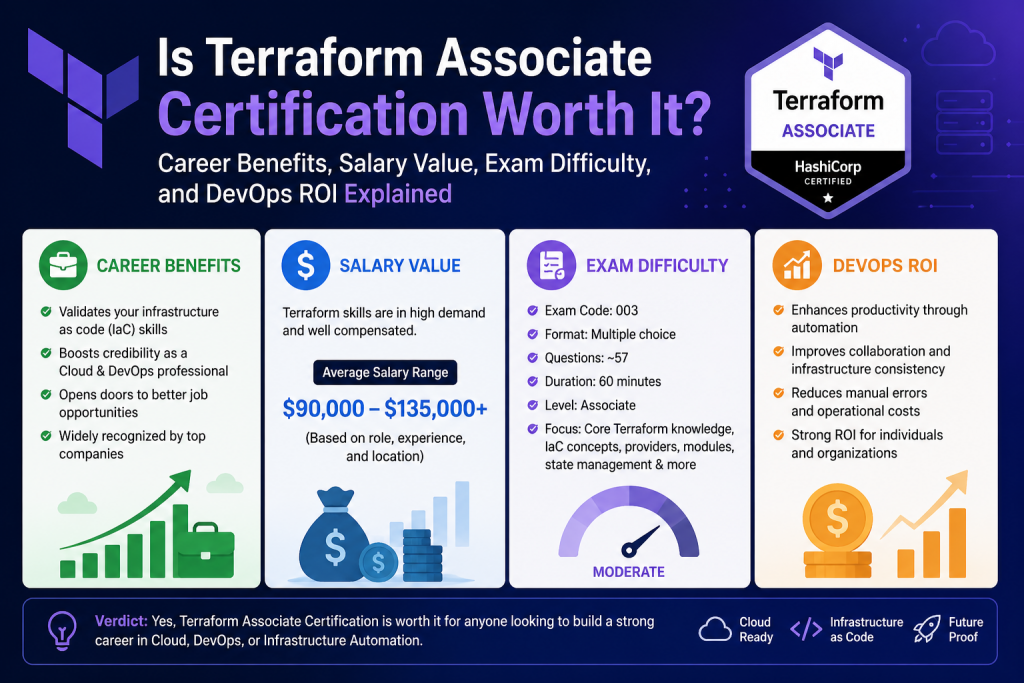
Terraform has become one of the most influential technologies in modern cloud infrastructure management. As organizations increasingly migrate workloads to cloud platforms, automate deployments, and manage large-scale environments across multiple providers, Infrastructure as Code (IaC) has evolved from a niche practice into a foundational skill. Among the many tools available in this space, Terraform consistently stands out as one of the most widely adopted, flexible, and practical solutions for provisioning and managing infrastructure.
Because Terraform plays such a critical role in DevOps, cloud engineering, and systems automation, many IT professionals eventually ask an important question: Is earning the Terraform Associate certification actually worth it?
The answer depends on career goals, technical experience, and the environments professionals want to work in. For some, the certification serves as a valuable entry point into automation and cloud operations. For others, it may act more as a resume booster than a transformational credential. To understand its real value, it is necessary to explore Terraform itself, what the certification measures, how employers perceive it, and whether it can meaningfully improve job opportunities or salary potential.
This guide examines Terraform from the ground up, beginning with its role in modern IT, why it matters, and why certification around Terraform has become increasingly relevant.
Understanding Terraform’s Role in Modern Infrastructure
Before evaluating whether certification is worthwhile, it is essential to understand why Terraform matters in the first place.
Terraform is an Infrastructure as Code platform that allows users to define, provision, and manage infrastructure resources through configuration files rather than manual processes. Instead of logging into cloud dashboards and clicking through interfaces to create virtual machines, networking rules, databases, or storage accounts, Terraform enables engineers to write declarative configurations that automate these tasks consistently.
This shift from manual provisioning to code-based deployment creates major operational advantages.
First, Terraform improves consistency. Manual infrastructure creation often introduces human error, configuration drift, or undocumented changes. Terraform standardizes infrastructure deployment, ensuring resources are created the same way every time.
Second, Terraform supports version control. Because infrastructure definitions are stored as code, teams can use systems like Git to track changes, review modifications, and roll back mistakes.
Third, Terraform enhances scalability. A single configuration can deploy identical infrastructure across multiple environments, whether development, staging, or production.
Fourth, Terraform promotes multi-cloud flexibility. One of Terraform’s defining strengths is that it is cloud-agnostic. It can manage resources across AWS, Microsoft Azure, Google Cloud, and many other providers using a consistent workflow.
These benefits make Terraform particularly attractive for organizations adopting DevOps, Site Reliability Engineering, hybrid cloud, and platform engineering practices.
As cloud complexity grows, Terraform becomes less of a “nice to have” skill and more of a practical operational requirement.
Why Infrastructure as Code Skills Matter More Than Ever
The rise of Terraform is deeply connected to the broader growth of Infrastructure as Code.
In traditional IT environments, infrastructure was often managed manually. Administrators configured servers individually, networking teams adjusted settings device by device, and deployment timelines were slow. This approach may have worked in smaller data centers, but it does not scale effectively in cloud-native environments.
Modern businesses require rapid deployment, automation, repeatability, and resilience. Infrastructure must be provisioned quickly, updated safely, and replicated across regions or providers.
This is where IaC becomes essential.
Terraform is one of the most prominent IaC tools because it focuses on declarative infrastructure provisioning. Engineers define the desired end state, and Terraform calculates how to achieve it.
As a result, professionals with Terraform skills are often better positioned for roles involving:
- Cloud engineering
- DevOps engineering
- Platform operations
- Site reliability engineering
- Security automation
- Systems architecture
Learning Terraform can also help traditional IT professionals modernize their skill sets. Systems administrators, network engineers, and database professionals increasingly encounter cloud-integrated systems, making automation knowledge more valuable than ever.
The Terraform Associate certification, therefore, is not simply about one software tool. It often represents a broader step into automation-centric IT.
What the Terraform Associate Certification Actually Represents
The Terraform Associate certification is designed as an entry-level credential focused on validating foundational Terraform knowledge.
Unlike highly specialized expert certifications, Terraform Associate is intended to prove that a candidate understands Terraform concepts, workflows, and practical use cases.
This distinction matters.
The certification is not meant to demonstrate mastery over advanced enterprise architecture. Instead, it confirms competency in using Terraform effectively within common operational scenarios.
For early-career professionals, this can be particularly valuable because it creates a formal benchmark for employers. Many hiring managers understand that certifications do not replace experience, but they often use certifications to validate baseline competence.
Terraform Associate typically signals that a candidate understands:
- Core Infrastructure as Code principles
- Terraform workflows
- State management
- Configuration syntax
- Provider usage
- Module concepts
- Basic troubleshooting
- Cloud and backend fundamentals
This can help reduce uncertainty for recruiters evaluating candidates transitioning into cloud or DevOps roles.
In practice, the certification often functions best as a career accelerator for beginners rather than a differentiator for highly experienced engineers.
The Growing Demand for Terraform in the Job Market
One of the strongest arguments in favor of Terraform certification is Terraform’s widespread employer demand.
Across cloud engineering and DevOps job listings, Terraform frequently appears as a preferred or required skill. This is especially true in organizations embracing automation at scale.
Several factors contribute to this demand:
Multi-Cloud Expansion
Businesses increasingly avoid single-provider lock-in. Terraform’s provider ecosystem makes it attractive for managing AWS, Azure, Google Cloud, Kubernetes, and SaaS resources from one framework.
Operational Standardization
Terraform allows organizations to create reusable modules and deployment templates, improving governance and consistency.
DevSecOps Integration
Terraform often integrates with CI/CD pipelines, security scanning tools, and policy-as-code systems.
Cloud Cost Governance
Automation reduces waste by standardizing resource provisioning and destruction.
Because of these advantages, Terraform often appears alongside tools like Kubernetes, Docker, Jenkins, and Ansible in technical hiring ecosystems.
For newcomers, certification can provide evidence that they understand one of the market’s most common automation tools.
Who Benefits Most from Terraform Associate Certification
Not every professional gains equal value from Terraform Associate.
For beginners, the certification can provide substantial benefits. This includes:
Aspiring DevOps Engineers
Those transitioning from support, help desk, or junior sysadmin roles often use Terraform certification to demonstrate cloud readiness.
Cloud Administrators
Professionals managing AWS, Azure, or GCP environments may use Terraform certification to validate automation capability.
Systems Administrators
Traditional infrastructure professionals can leverage Terraform to modernize skill sets.
Network Engineers
As networking increasingly intersects with software-defined infrastructure, Terraform knowledge can become more relevant.
Application Engineers
Developers responsible for deployment pipelines may benefit from infrastructure provisioning knowledge.
However, senior engineers with extensive Terraform production experience may find the certification less impactful unless their employer explicitly values certifications.
For experienced professionals, real-world project depth often outweighs entry-level credentials.
Certification vs Real-World Skill
A key consideration is that Terraform Associate alone does not make someone a Terraform expert.
Passing the exam confirms conceptual understanding, but employers often care more about whether candidates can:
- Write reusable modules
- Manage state securely
- Handle secrets properly
- Integrate Terraform into pipelines
- Troubleshoot deployment failures
- Manage drift
- Scale configurations across teams
This is an important distinction because certification can open doors, but practical implementation often determines long-term success.
The best strategy is often combining certification with hands-on labs, GitHub projects, sandbox environments, or cloud portfolio work.
For example, creating projects such as:
- Automated AWS VPC deployment
- Azure Kubernetes provisioning
- Multi-cloud DNS architecture
- Terraform module repositories
These projects can transform certification knowledge into demonstrable capability.
The Psychological and Professional Value of Certification
Beyond technical knowledge, certifications often offer psychological and strategic career benefits.
Studying for Terraform Associate can provide structure. Instead of learning Terraform randomly, candidates follow a defined path covering critical concepts systematically.
This can improve confidence, especially for professionals entering cloud automation for the first time.
Certification can also:
- Strengthen resumes
- Improve recruiter keyword matching
- Support internal promotions
- Demonstrate initiative
- Validate structured learning
While certifications are not magic career solutions, they can create momentum.
For someone with little DevOps experience, Terraform Associate may represent a meaningful first credential.
Why Terraform’s Vendor-Neutral Nature Adds Value
Unlike certifications tied exclusively to AWS, Azure, or Google Cloud, Terraform focuses on a broader automation framework.
This matters because Terraform skills often transfer across environments.
A professional who understands Terraform principles may adapt more easily to different providers because the core workflow remains relatively consistent:
- Define resources
- Initialize providers
- Validate configurations
- Plan changes
- Apply infrastructure
This portability can improve long-term career resilience.
As organizations increasingly adopt hybrid and multi-cloud strategies, Terraform’s flexibility becomes a strategic advantage.
Is Terraform Associate a Good Investment?
Cost is another major factor.
Compared with many enterprise certifications costing hundreds or thousands of dollars, Terraform Associate is relatively affordable. This lower financial barrier makes it appealing for self-funded learners.
Because of its accessibility, the certification often carries favorable return-on-investment potential for:
- Students
- Career changers
- Junior engineers
- Budget-conscious learners
When combined with hands-on experience, Terraform Associate can provide a relatively low-cost pathway into automation-focused roles.
The Bigger Career Picture
Ultimately, Terraform Associate should not be viewed in isolation.
Its value often increases when paired with adjacent skills such as:
- Linux
- Cloud platforms
- CI/CD
- Kubernetes
- Git
- Security fundamentals
Terraform certification alone may not guarantee major career transformation, but as part of a larger technical strategy, it can be highly effective.
For many professionals, Terraform Associate serves as a bridge—moving them from infrastructure familiarity into modern automation expertise
What the Terraform Associate Exam Covers and Why Its Knowledge Domains Matter
Understanding whether the Terraform Associate certification is worth pursuing requires more than recognizing Terraform’s industry popularity. It also requires examining what the certification actually tests, how relevant those skills are in professional environments, and whether the exam objectives align with real-world cloud and DevOps responsibilities.
Many certifications lose practical value because they emphasize theoretical knowledge disconnected from daily operational work. Terraform Associate tends to avoid that trap by focusing on core concepts that are directly tied to infrastructure automation. While it remains an entry-level certification, its knowledge categories are intentionally designed to validate foundational competence in Infrastructure as Code, Terraform architecture, workflows, and deployment practices.
This means the exam is not simply about memorizing commands. At its best, it evaluates whether candidates understand how Terraform fits into modern IT ecosystems.
For professionals considering the certification, one of the most important questions is whether studying for the exam teaches genuinely useful skills or merely helps pass a test. In Terraform’s case, many of the domains covered are directly applicable to real engineering work.
Infrastructure as Code Concepts: The Foundation of Modern Automation
One of the most important areas of the Terraform Associate exam focuses on Infrastructure as Code itself.
This emphasis is significant because Terraform is not useful unless users understand why IaC matters. Learning syntax without understanding purpose often creates shallow knowledge. Terraform’s certification framework begins by ensuring candidates understand the strategic transformation from manually managed infrastructure to code-defined systems.
This includes concepts like:
- Declarative vs imperative automation
- Version-controlled infrastructure
- Repeatable deployment pipelines
- Configuration consistency
- Reduced manual drift
- Scalability through templates
In practice, this knowledge has broad professional relevance.
For example, when an engineer provisions cloud networking manually, each deployment may differ slightly depending on human choices. Over time, these inconsistencies can lead to security gaps, troubleshooting complexity, and governance failures.
Terraform addresses this by making infrastructure reproducible.
Understanding these principles is essential because organizations increasingly expect IT professionals to think in systems rather than isolated tasks. The Terraform Associate exam introduces candidates to this mindset, which can benefit not only Terraform-specific roles but broader automation and DevOps trajectories.
Understanding Terraform’s Purpose in Multi-Cloud and Cloud-Agnostic Operations
Another core exam objective involves understanding what Terraform is used for and why organizations choose it over alternative tools.
This domain matters because Terraform’s greatest strength is not merely automation—it is orchestration across providers.
Terraform enables users to manage:
- AWS resources
- Azure services
- Google Cloud infrastructure
- Kubernetes clusters
- SaaS platforms
- DNS providers
- Monitoring tools
This broad provider ecosystem distinguishes Terraform from cloud-native tools that primarily operate within one vendor ecosystem.
For example:
- AWS CloudFormation is AWS-centric
- Azure Resource Manager is Azure-centric
- Terraform can work across both
For employers operating hybrid or multi-cloud strategies, this flexibility can reduce tooling fragmentation.
The certification tests whether candidates understand this practical advantage.
From a career perspective, this knowledge can be especially useful because cloud environments are rarely static. Engineers increasingly need to support migrations, acquisitions, mergers, or cross-platform architectures. Terraform’s vendor-neutrality often positions it as a strategic operational layer.
Candidates who truly understand this are often more adaptable in enterprise settings.
Terraform Basics: Providers, Plugins, and Architecture
The exam also tests Terraform’s foundational architecture, including providers, plugins, and installation principles.
This may seem basic, but these concepts are operationally important.
Terraform’s provider model is one of its defining characteristics. Providers act as connectors between Terraform and external APIs. Without understanding providers, users cannot effectively deploy or manage resources.
This includes knowledge of:
- Provider installation
- Version constraints
- Provider sources
- Plugin architecture
- Authentication requirements
- Provider aliases
These concepts directly affect deployment reliability.
For example, inconsistent provider versions can introduce unexpected changes, deprecated features, or compatibility issues. In enterprise environments, version locking can be critical for stability.
Similarly, understanding multiple providers within one configuration becomes essential when building integrated infrastructures.
A practical scenario might involve:
- AWS for compute
- Cloudflare for DNS
- GitHub for repository management
Terraform can orchestrate all of these together.
This architectural flexibility is why provider knowledge is not merely exam trivia—it is central to practical Terraform engineering.
Terraform Workflow: The Real Operational Core
Perhaps the most directly practical section of the certification focuses on Terraform’s core workflow.
This includes:
- terraform init
- terraform validate
- terraform plan
- terraform apply
- terraform destroy
- terraform fmt
This sequence forms the operational backbone of Terraform usage.
Understanding this workflow is essential because Terraform is not simply about writing code—it is about safely managing infrastructure changes.
For example:
Initialization
This prepares the environment, downloads providers, and configures backends.
Validation
This checks syntax and structural correctness before deployment.
Planning
This previews changes before they occur, reducing risk.
Applying
This executes infrastructure modifications.
Destroying
This removes resources cleanly when necessary.
These stages are highly relevant to production governance.
In many organizations, reviewing Terraform plans before apply is a security and cost-control requirement. Improperly skipping plan reviews could lead to accidental resource deletion or expensive deployments.
This makes workflow knowledge one of the most valuable aspects of Terraform Associate preparation.
Terraform State: One of the Most Critical Real-World Concepts
State management is often where Terraform beginners move from basic competence into meaningful operational understanding.
Terraform state tracks the relationship between configuration code and actual deployed infrastructure.
Without state, Terraform cannot effectively determine what exists, what changed, or what must be updated.
The exam covers:
- State files
- State locking
- Remote backends
- Resource drift
- State inspection
- Security considerations
This domain is arguably one of the certification’s most professionally relevant areas.
State mismanagement can create major operational problems.
For example:
- Lost state files may orphan infrastructure
- Shared state conflicts can overwrite resources
- Poor secret handling can expose credentials
- Drift can create security inconsistencies
Understanding remote backends such as cloud-based state storage is especially important for team environments.
In real organizations, state is often shared across multiple engineers. Locking mechanisms prevent simultaneous conflicting updates.
This is not theoretical knowledge—it is critical for safe infrastructure management.
Professionals who deeply understand state often outperform those who only know syntax.
Modules: Building Reusable and Scalable Infrastructure
Terraform modules are another central exam category.
Modules allow engineers to package reusable infrastructure definitions.
For example, instead of rewriting networking architecture repeatedly, teams can create modules for:
- VPCs
- Kubernetes clusters
- IAM policies
- Database deployments
This modularity improves:
- Reusability
- Governance
- Standardization
- Scalability
The Terraform Associate exam ensures candidates understand:
- Module sourcing
- Child modules
- Registry modules
- Versioning
- Scope
This is highly relevant in enterprise environments because large organizations rarely deploy infrastructure through single monolithic files.
Reusable modules often define operational maturity.
For instance, a company may standardize secure AWS account creation through approved Terraform modules, reducing risk while accelerating deployment.
Understanding modules therefore supports not just deployment skills, but scalable engineering practices.
Configuration Development: Writing and Managing Terraform Code
The certification also tests a candidate’s ability to read, modify, and create Terraform configurations.
This includes:
- Variables
- Outputs
- Resource blocks
- Data sources
- Dependencies
- Collections
- Expressions
These capabilities are fundamental because Terraform’s effectiveness depends on code quality.
Poorly written Terraform can become difficult to maintain, insecure, or error-prone.
For example:
Hardcoded values reduce flexibility.
Poor dependency handling can break deployments.
Improper variable management may expose secrets.
Candidates who study this section effectively often gain stronger practical coding discipline, even if they are not software developers by background.
This is one reason Terraform certification can be valuable for traditional administrators—it introduces code-driven operational thinking.
Terraform Beyond Core Workflows
The exam also introduces features outside standard deployment cycles, such as:
- Terraform import
- Verbose logging
- State commands
These areas matter because infrastructure rarely starts from zero.
Many organizations adopt Terraform after infrastructure already exists. Importing allows existing resources to become Terraform-managed.
Similarly, troubleshooting through logs can be crucial when provider APIs fail or deployments behave unexpectedly.
These skills reflect practical realities rather than idealized greenfield deployments.
Terraform Cloud and Ecosystem Awareness
The final domain typically involves understanding Terraform Cloud and related ecosystem distinctions.
This includes:
- Open-source Terraform
- Managed cloud offerings
- Collaboration tools
- Governance capabilities
This knowledge can help candidates understand when organizations may need more advanced operational tooling.
While entry-level professionals may not immediately manage enterprise governance systems, understanding ecosystem differences can improve strategic awareness.
How Exam Objectives Translate into Career Development
A major reason Terraform Associate can be worthwhile is that its domains map well to broader career advancement.
By mastering these concepts, candidates often strengthen capabilities relevant to:
- DevOps
- Platform engineering
- Cloud operations
- SRE
- Security automation
Rather than functioning purely as a credential, the exam can serve as structured professional development.
The Certification’s Practical Strength
Terraform Associate’s strongest advantage is that much of its curriculum reflects real infrastructure automation fundamentals.
This does not mean certification guarantees advanced expertise, but it often provides:
- Foundational confidence
- Resume credibility
- Structured learning
- Automation literacy
For many professionals, that combination can be highly useful.
Salary Impact, Employer Perception, Long-Term Growth, and Final Certification Verdict
After understanding Terraform’s role in Infrastructure as Code and examining the exam’s practical knowledge domains, the final and perhaps most important question remains: Does the Terraform Associate certification genuinely improve career outcomes?
This is where many certification decisions become more complex. Technical professionals rarely pursue certifications purely for educational purposes. Most want to know whether the investment of time, money, and study effort translates into better job opportunities, stronger earning potential, improved credibility, or accelerated career progression.
In competitive technology markets, certifications are often evaluated less as academic achievements and more as strategic career assets. Professionals frequently compare certifications against practical outcomes: Will this help secure interviews? Can it support a transition into a more advanced role? Does it increase employer trust? Will it justify salary negotiations or promotion discussions? These questions become especially important because certifications require not only exam fees, but also opportunity cost—hours spent studying could otherwise be invested in projects, portfolio building, or direct work experience.
As a result, many candidates approach certification decisions with a return-on-investment mindset. They want credentials that align with employer demand, strengthen professional differentiation, and complement real-world skill development. In some cases, certifications can serve as resume filters that help candidates pass recruiter screening systems.
In others, they may validate expertise for career changers who need formal proof of competence. However, not all certifications carry equal weight, and their true value often depends on industry recognition, technical relevance, and how effectively they integrate with broader career strategies. This makes certification decisions more nuanced than simple educational milestones—they often represent calculated investments in professional identity, marketability, and long-term career positioning.
The Terraform Associate certification sits in an interesting position because it is neither an elite architect-level credential nor a vendor-specific specialization limited to one cloud ecosystem. Instead, it occupies a strategic middle ground—accessible enough for newcomers while relevant enough to signal modern infrastructure awareness.
To determine whether it is truly worth earning, it is necessary to analyze employer expectations, salary influence, professional differentiation, limitations, and how Terraform fits into larger career strategies.
How Employers View Terraform Skills in the Modern IT Market
Terraform’s industry relevance is one of the strongest reasons the certification can hold real value.
Organizations increasingly rely on automation to manage cloud deployments, maintain compliance, reduce infrastructure drift, and improve operational efficiency. As cloud adoption expands, employers often prioritize candidates who understand not just cloud platforms, but automation frameworks that scale infrastructure safely. This shift reflects a broader transformation in enterprise IT, where speed alone is no longer enough—organizations also require consistency, governance, and security at scale. Manual provisioning methods often create configuration inconsistencies, security vulnerabilities, and operational bottlenecks, especially when infrastructure spans multiple regions, teams, or cloud providers. Automation frameworks like Terraform help solve these challenges by enabling infrastructure to be defined as code, reviewed systematically, version controlled, and deployed repeatedly with predictable outcomes.
For employers, this capability is especially valuable because it supports both technical performance and business continuity. Automated infrastructure can accelerate product launches, improve disaster recovery readiness, simplify audits, and reduce costly human errors. In highly regulated industries, automation also strengthens compliance by ensuring infrastructure policies are consistently applied rather than manually interpreted. As a result, professionals who understand automation frameworks are often seen as more strategically valuable than those who only manage isolated cloud resources. They are better equipped to contribute to scalable digital transformation, support DevOps initiatives, and align infrastructure practices with broader organizational goals. In many modern hiring environments, automation literacy is becoming a competitive advantage rather than an optional technical skill.
Terraform frequently appears in job descriptions for roles such as:
- DevOps Engineer
- Cloud Engineer
- Site Reliability Engineer
- Infrastructure Engineer
- Platform Engineer
- Security Automation Engineer
- Systems Administrator
- Cloud Consultant
This widespread presence means Terraform is often considered less of a niche skill and more of a practical operational capability.
For hiring managers, Terraform Associate may serve as an indicator that a candidate understands automation fundamentals even if they lack years of enterprise experience.
This is particularly useful in entry-level or transition-focused scenarios.
For example:
A systems administrator moving toward DevOps may use Terraform Associate to demonstrate readiness for cloud automation.
A help desk professional pursuing cloud engineering may use it to prove practical initiative.
A network engineer expanding into software-defined infrastructure may use it to modernize technical identity.
While employers generally prioritize hands-on experience over certifications, certifications often influence interview opportunities by improving resume filtering and keyword recognition.
In applicant tracking systems where recruiters search for Terraform familiarity, certification can strengthen visibility.
Can Terraform Associate Increase Salary?
Salary impact is often one of the biggest reasons professionals consider certifications, but this area requires nuance.
Terraform Associate alone rarely produces dramatic salary increases in isolation.
Unlike highly advanced credentials tied directly to architecture leadership or specialized enterprise design, Terraform Associate is foundational. It is more likely to influence salary indirectly through skill enablement than directly through credential prestige.
However, this does not mean it lacks financial value.
Terraform knowledge can contribute to salary growth by improving eligibility for higher-paying automation-related roles.
For example:
A traditional sysadmin without automation skills may have lower market competitiveness than one who can provision and manage cloud infrastructure through Terraform.
A cloud support engineer with Terraform capability may qualify for broader DevOps or infrastructure automation opportunities.
A junior engineer with Terraform certification may stand out more effectively than peers without structured IaC knowledge.
In this sense, Terraform certification often functions as a salary catalyst rather than a salary guarantee.
The larger salary gains typically come not from the badge itself, but from the professional trajectory it supports.
Terraform as a Gateway Skill Rather Than a Standalone Career Asset
One of the most realistic ways to evaluate Terraform Associate is by viewing it as a gateway credential.
Terraform alone is powerful, but its greatest career value often emerges when paired with adjacent competencies such as:
- AWS, Azure, or Google Cloud
- Linux administration
- Kubernetes
- Docker
- CI/CD pipelines
- Git
- Security governance
- Monitoring and observability
This broader combination transforms Terraform from a useful tool into part of an operational ecosystem.
For example:
Terraform + AWS can support cloud infrastructure roles.
Terraform + Kubernetes can support platform engineering.
Terraform + security policy can support DevSecOps.
This means Terraform Associate is often most valuable as part of layered professional development.
By itself, it may open doors. Combined strategically, it can help build entire career pathways.
The Advantage of Terraform’s Vendor-Neutral Position
A major strength of Terraform is that it is not locked to a single cloud provider.
This neutrality can create significant long-term value.
Cloud technologies evolve rapidly. Organizations may migrate providers, adopt hybrid strategies, or integrate multiple vendors simultaneously.
Professionals whose knowledge is tied exclusively to one ecosystem may face limitations when environments change.
Terraform’s broader provider architecture helps reduce this risk.
A professional who understands Terraform workflows often adapts more easily across:
- AWS
- Azure
- Google Cloud
- Oracle Cloud
- Kubernetes
- SaaS integrations
This portability can make Terraform skills more resilient over time than narrower platform-specific automation frameworks.
From a career standpoint, resilience matters.
Technology careers increasingly reward adaptability, and Terraform often enhances that adaptability.
Who Gains the Most from Terraform Associate?
Terraform Associate is not equally beneficial for everyone.
Best Fit Candidates
Beginners Entering Cloud or DevOps
Those with limited automation experience often gain substantial value because the certification creates structure and demonstrates foundational competence.
IT Professionals Transitioning Roles
System administrators, network engineers, and support professionals can use Terraform certification to reposition themselves.
Consultants and Freelancers
Terraform knowledge can improve credibility when working with clients seeking cloud automation expertise.
Students and Self-Taught Technologists
The certification can serve as formal validation when practical experience is limited.
Lower Relative Value Candidates
Senior DevOps Engineers
Professionals already managing Terraform in enterprise environments may see limited career transformation.
Cloud Architects with Extensive Portfolios
Hands-on architecture experience may overshadow entry-level certifications.
Highly Specialized Engineers
Those in roles unrelated to infrastructure automation may derive less direct value.
Common Limitations of Terraform Associate
No certification is perfect, and Terraform Associate has limitations.
Entry-Level Scope
It validates foundational knowledge but not advanced enterprise-scale expertise.
Experience Still Matters More
Many employers prioritize project history over exam completion.
Recertification Cycle
The certification has expiration timelines, meaning professionals must maintain currency.
Tool-Specific Nature
Terraform is valuable, but broader engineering success depends on surrounding technical ecosystems.
Understanding these limitations is important because certifications should be strategic tools, not unrealistic career shortcuts.
Certification ROI: Time vs Cost vs Opportunity
Terraform Associate is relatively affordable compared with many enterprise certifications.
This lower cost can significantly improve return on investment, especially for self-funded learners.
Benefits may include:
- Resume enhancement
- Structured learning
- Practical IaC knowledge
- Recruiter discoverability
- Career pivot support
Because the exam is comparatively accessible, the downside risk is lower than many expensive certification paths.
For many learners, the question is less “Will this certification transform my life?” and more “Is this a smart, practical investment?”
For beginners, the answer is often yes.
Building a Practical Terraform Portfolio
To maximize Terraform Associate’s value, certification should ideally be paired with demonstrable projects.
Examples include:
- Multi-tier AWS application deployment
- Azure networking automation
- Kubernetes cluster provisioning
- Secure IAM module creation
- Disaster recovery infrastructure templates
These projects help bridge the gap between certification and employability.
A candidate with Terraform Associate plus visible project work is often significantly stronger than one with certification alone.
How Terraform Certification Supports Long-Term Professional Identity
Technology careers increasingly reward specialization balanced with adaptability. Organizations no longer seek professionals who only understand one platform or one operational model; instead, they increasingly value individuals who can combine deep technical expertise with the flexibility to evolve alongside changing infrastructure ecosystems. Terraform contributes strongly to both of these priorities. It provides specialization in automation by teaching professionals how to define, provision, version, and maintain infrastructure through code, while also supporting broad provider flexibility through its cloud-agnostic architecture. This combination allows engineers to remain relevant even as organizations shift strategies, adopt hybrid environments, or expand across multiple platforms.
This makes Terraform particularly valuable for professionals who want to position themselves as automation-first engineers, cloud infrastructure specialists, DevOps practitioners, or platform operators. In each of these roles, Terraform supports operational consistency, scalable deployment practices, and cross-functional collaboration.
It also encourages a systems-thinking mindset, where infrastructure is treated as repeatable, governed, and strategically designed rather than manually configured. Over time, Terraform may become less of a simple resume line and more of a foundational operational language—similar to how scripting, Linux, or cloud architecture knowledge became essential over previous generations. For many professionals, Terraform can evolve from a single skill into a career-defining capability that supports long-term technical resilience, modernization, and leadership potential.
When Terraform Associate May Not Be Worth It
Despite its advantages, there are scenarios where Terraform Associate may offer limited value:
- If a role has no cloud or automation relevance
- If an employer prioritizes different platforms entirely
- If a professional already possesses deep Terraform production expertise
- If broader foundational gaps exist (such as lacking Linux or cloud basics)
In these cases, other educational priorities may produce stronger returns.
The Bigger Strategic Perspective
Perhaps the most important insight is that Terraform Associate is rarely about the certification alone.
Its real value often lies in what it encourages:
- Learning Infrastructure as Code
- Developing automation discipline
- Understanding scalable infrastructure
- Improving cloud readiness
- Building technical modernization
In this sense, Terraform certification can be both a practical credential and a professional mindset shift.
Conclusion
The Terraform Associate certification is worth it for many professionals—but especially for those early in their cloud, DevOps, or infrastructure automation journey.
Its strongest value lies not in prestige alone, but in its ability to validate modern Infrastructure as Code knowledge, provide structured learning, and support career transitions into increasingly automation-driven technical roles.
For beginners, aspiring DevOps engineers, cloud administrators, and IT professionals seeking modernization, Terraform Associate often offers an affordable and strategically valuable investment.
For experienced engineers, its direct impact may be smaller, but it can still serve as formal validation or organizational leverage.
Ultimately, Terraform itself is the larger prize. The certification is most powerful when used as a launchpad rather than an endpoint.
As cloud infrastructure continues evolving toward automation, repeatability, and multi-cloud orchestration, Terraform remains one of the most relevant tools in the industry.
That means learning Terraform is often worthwhile regardless of certification.
But for those seeking structure, credibility, and a practical career accelerator, Terraform Associate can absolutely be worth pursuing—especially when paired with hands-on experience, broader cloud skills, and long-term professional strategy.
Continue exploring the technologies and certification concepts that matter most to you.