The internet depends on countless background systems working together seamlessly so users can browse websites, send emails, verify online services, and interact with digital platforms without needing to understand the technical complexity behind each action. One of the most essential systems enabling this smooth experience is the Domain Name System, commonly referred to as DNS. Often described as the internet’s phonebook, DNS translates human-readable domain names into machine-readable IP addresses so browsers and applications can locate the correct servers.
When someone types a website address into a browser, DNS begins a lookup process that identifies where that website is hosted. Without DNS, users would need to remember complex numerical IP addresses for every online destination. DNS simplifies this process, making internet navigation practical and scalable.
While many people associate DNS strictly with website access, DNS performs far more than name resolution. It also stores critical information about domain ownership, service configuration, verification policies, and security instructions. This broader role is where TXT records become especially important.
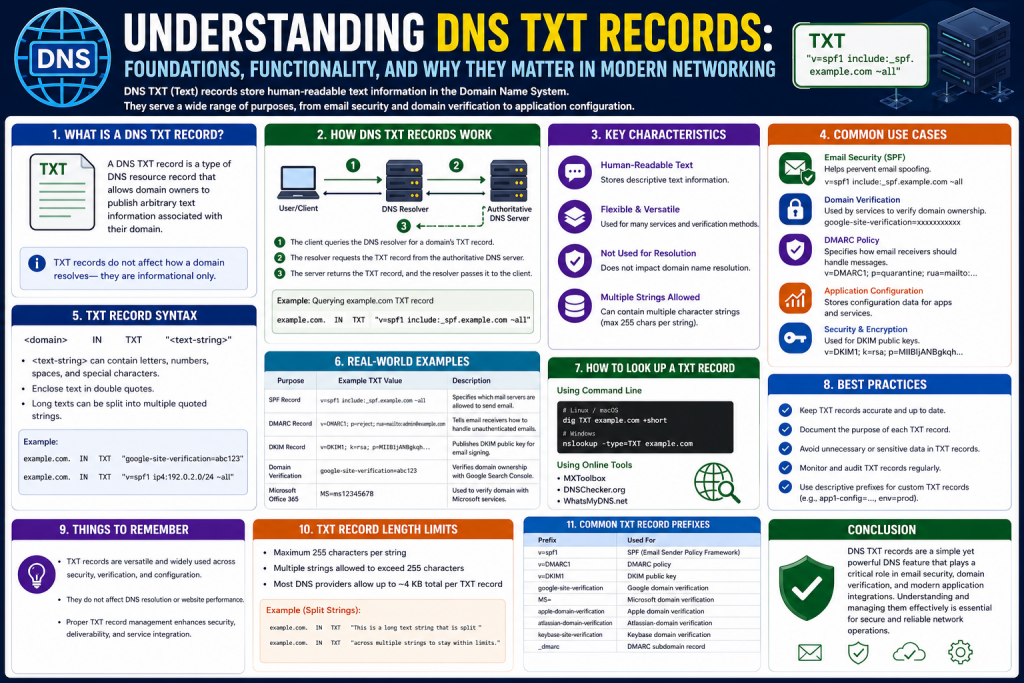
TXT records, short for text records, are one of the most flexible DNS record types. Unlike A records, which map domain names to IP addresses, or MX records, which direct email traffic, TXT records are designed to store text-based information that external systems can read and interpret. These records often serve as communication tools between domain owners and third-party services, providing instructions for verification, security, and policy enforcement.
In practical terms, TXT records help prove domain ownership, authorize email servers, support anti-spoofing protections, validate third-party integrations, and strengthen digital trust. Their flexibility has made them one of the most important components of modern domain management.
What Exactly Is a DNS TXT Record?
A DNS TXT record is a DNS entry that allows administrators to insert arbitrary text into the DNS database associated with a domain. This text can be read by systems querying the domain and interpreted according to specific service requirements.
Originally, TXT records were designed simply to hold descriptive notes or general text associated with a domain. Over time, however, internet standards evolved, and TXT records became a preferred method for publishing machine-readable verification and policy statements.
For example, an organization may use a TXT record to:
- Verify ownership of a domain for cloud services
- Publish SPF policies identifying authorized email senders
- Store DKIM public keys for email authentication
- Define DMARC policies for handling suspicious email
- Confirm SSL certificate requests
- Integrate with external business platforms
This adaptability has made TXT records a universal communication layer between domain administrators and online systems.
A TXT record typically includes:
- Host or name
- Value or text string
- TTL (Time to Live)
The host identifies where the record applies, the value contains the text data, and TTL determines how long other DNS servers should cache the information before refreshing it.
How DNS TXT Records Work Behind the Scenes
To understand TXT records properly, it helps to first understand how DNS itself works.
When a user requests a domain, a recursive DNS resolver checks whether it already knows the answer. If not, it queries root servers, top-level domain servers, and authoritative name servers until it finds the correct DNS records. This hierarchical lookup process allows DNS to function as a globally distributed information system, ensuring users can access online resources quickly and accurately without needing to memorize numerical IP addresses.
Each stage of the DNS process has a specialized role: root servers direct the query toward the appropriate top-level domain, top-level domain servers identify the correct authoritative source, and authoritative name servers provide the definitive records for the domain in question. This structure is designed for scalability, speed, and resilience across billions of internet requests each day. TXT records are stored on authoritative DNS servers alongside other record types. When a service requests TXT data, DNS returns the relevant text string. That returned text may contain ownership verification codes, email authentication policies, cryptographic public keys, or other machine-readable instructions used by external systems.
For example, an email provider may check TXT records to validate SPF or DKIM configurations before trusting a message, while a cloud platform may use TXT verification to confirm domain control. Because authoritative servers provide the official source of this information, the accuracy and integrity of TXT records are essential. Any misconfiguration, delay, or unauthorized modification can affect security, trust, and functionality across multiple digital services.
For instance, when an email server receives a message claiming to come from a specific domain, it may query that domain’s TXT records to evaluate SPF, DKIM, or DMARC configurations. Based on the information published there, the receiving system decides whether the message appears legitimate.
This process happens in milliseconds but plays a crucial role in cybersecurity.
Why TXT Records Have Become So Important
TXT records are now fundamental because modern digital ecosystems depend heavily on trust verification. As cyber threats such as phishing, spoofing, impersonation, and unauthorized integrations have grown, domain owners need ways to prove legitimacy.
TXT records address this need by serving as public declarations of trust policies.
Their importance includes:
- Confirming ownership of digital assets
- Preventing unauthorized email use
- Reducing phishing attacks
- Supporting service integrations
- Improving brand trust
- Strengthening deliverability
- Enhancing DNS security frameworks
Without TXT records, many common online security practices would be far more difficult to implement.
TXT Records and Domain Ownership Verification
One of the most widespread uses of TXT records is proving control over a domain.
Many online services require organizations to verify domain ownership before granting access to tools like:
- Email marketing systems
- Website analytics
- Search engine webmaster tools
- SSL certificate providers
- Cloud collaboration suites
The process usually works by having the service provider generate a unique verification token. The domain owner adds this token to DNS as a TXT record. Once DNS propagation occurs, the provider checks the record and confirms ownership.
This method is secure because only someone with DNS administrative control can publish the required token.
The Flexibility Advantage of TXT Records
Unlike highly specialized DNS record types, TXT records are intentionally broad. This flexibility allows evolving internet technologies to use them without requiring entirely new DNS standards.
For example:
- SPF uses TXT syntax
- DKIM stores cryptographic keys in TXT
- DMARC policies are TXT-based
- Site ownership verifications use TXT
- Security vendors deploy TXT-based integrations
This universal compatibility explains why TXT records remain highly relevant even as DNS continues evolving.
Understanding TTL in TXT Record Management
TTL, or Time to Live, controls how long DNS resolvers cache a TXT record before checking for updates.
For example:
- Low TTL = faster updates but more DNS queries
- High TTL = slower updates but reduced server load
When making changes to authentication settings, administrators often lower TTL temporarily to accelerate propagation. Once changes stabilize, TTL may be increased again.
Proper TTL planning is essential because outdated TXT records can cause:
- Failed verifications
- Email rejection
- Misrouted authentication checks
- Temporary service outages
Common TXT Record Syntax Basics
Although TXT records can contain varied content, syntax precision matters significantly.
A TXT entry generally follows a structure such as:
v=spf1 include:mailprovider.com -all
This string may look simple, but every symbol matters. Missing spaces, incorrect punctuation, or formatting errors can invalidate the record.
TXT records often rely on:
- Version identifiers
- Authorized services
- Selectors
- Security policies
- Reporting addresses
Because DNS treats TXT values literally, syntax mistakes can create authentication failures.
TXT Records as Security Infrastructure
Modern internet security increasingly depends on DNS-layer protections, and TXT records are central to that architecture.
Rather than simply routing users, DNS now helps verify:
- Who owns a domain
- Who can send on its behalf
- Which systems can authenticate messages
- How failed security checks should be handled
This evolution has transformed TXT records from optional informational tools into active cybersecurity components.
Email Authentication and the Rise of Trust-Based DNS
Email remains one of the most targeted communication channels for cybercrime. Attackers frequently impersonate trusted organizations to distribute malware, steal credentials, or conduct fraud.
TXT records play a major role in fighting these threats by enabling:
- SPF for sender authorization
- DKIM for message integrity
- DMARC for enforcement policies
Together, these systems create layered verification.
When properly configured, they help receiving servers answer critical questions:
- Was this sender authorized?
- Was the message altered?
- What should happen if authentication fails?
Without TXT records, these protections would be far less scalable.
TXT Records Beyond Security
Although security is a dominant use case, TXT records also support:
- Microsoft and Google service verification
- Certificate issuance
- Third-party SaaS integrations
- API validation
- Federated identity systems
This broad functionality means nearly every business with a professional online presence interacts with TXT records, even if indirectly.
Challenges of TXT Record Management
Despite their usefulness, TXT records can become difficult to manage as organizations scale.
Common challenges include:
- Character length limitations
- Record sprawl
- Syntax complexity
- Duplicate policies
- Conflicting entries
- Delayed propagation
For example, having multiple SPF records can break sender validation entirely. This is why regular auditing is essential.
Human Error and Misconfiguration Risks
DNS management often appears deceptively simple because many hosting dashboards offer user-friendly interfaces. However, even small mistakes can have serious consequences.
Examples include:
- Incorrect quotation marks
- Missing semicolons
- Wrong selectors
- Expired verification strings
- Obsolete third-party references
These issues may lead to:
- Email delivery failures
- Security vulnerabilities
- Failed integrations
- Reduced domain reputation
Best Practices for Early TXT Record Strategy
Organizations benefit from treating TXT management strategically from the beginning.
Recommended principles include:
- Document every TXT record’s purpose
- Remove outdated records
- Validate syntax before publishing
- Audit regularly
- Coordinate with security teams
- Monitor propagation
- Use DNSSEC where possible
Good TXT record hygiene improves both security and operational efficiency.
How DNS Propagation Affects TXT Record Updates
When TXT records are changed, updates do not become visible instantly worldwide. DNS propagation refers to the time required for updated information to spread across global DNS infrastructure.
Factors affecting propagation:
- TTL settings
- ISP caching
- Registrar speed
- Resolver refresh cycles
This delay means administrators must plan carefully when implementing urgent changes.
TXT Records and Business Continuity
For modern businesses, TXT records influence:
- Email functionality
- Security trust
- Brand reputation
- Service integrations
- User safety
A single misconfigured TXT entry can impact thousands of customers if email authentication breaks or verification fails.
Because of this, TXT record management should be considered a core operational responsibility rather than a minor DNS task.
The Growing Strategic Value of TXT Records
As internet ecosystems become increasingly security-focused, TXT records continue gaining strategic importance.
They are no longer just administrative text entries. They now function as:
- Security declarations
- Trust frameworks
- Verification tools
- Policy engines
- Integration enablers
This shift reflects the broader transformation of DNS from navigation infrastructure into security-critical architecture.
Introduction to Practical TXT Record Implementation
Understanding what DNS TXT records are and why they matter is only the beginning. The true operational value of TXT records emerges when organizations actively create, configure, modify, and maintain them to support domain security, service verification, and communication integrity. In modern networking, TXT records are not passive entries but active infrastructure components that influence whether emails are trusted, domains are verified, cloud services function correctly, and security protocols operate as intended.
Their significance becomes even greater as businesses expand across multiple platforms, integrate with third-party vendors, and depend on digital communication for daily operations. A properly managed TXT record strategy can determine whether marketing emails reach customer inboxes, whether cloud platforms recognize domain ownership instantly, and whether malicious actors are prevented from impersonating trusted brands. These records often function behind the scenes, yet they shape critical aspects of cybersecurity, operational continuity, and service reliability. Because TXT records support technologies like SPF, DKIM, and DMARC, they directly impact how receiving systems evaluate legitimacy and authenticity. Mismanagement can lead to spoofing risks, failed verifications, or service disruptions, while disciplined oversight can improve security posture and strengthen trust relationships. Organizations that treat TXT records strategically recognize them as part of a broader governance framework, integrating them into routine audits, infrastructure planning, and security policy updates. This transforms DNS from a basic technical necessity into a dynamic layer of digital trust management that supports business resilience, regulatory readiness, and long-term operational success.
For administrators, business owners, and IT teams, effective TXT record management requires both technical accuracy and strategic oversight. A single formatting error can disrupt email delivery, while a properly configured TXT environment can significantly strengthen digital trust.
This section focuses on the practical side of DNS TXT records: how they are created, how they are managed, the role of propagation, and how TXT records power some of the internet’s most important security systems, including SPF, DKIM, and DMARC.
Accessing DNS Management Systems
To create or modify a TXT record, administrators typically begin by accessing the DNS management platform associated with their domain registrar, hosting provider, or DNS service provider.
This may include:
- Web hosting dashboards
- Domain registrar control panels
- Cloud DNS platforms
- Enterprise DNS appliances
- Managed DNS security platforms
Although interfaces vary, the core DNS management process remains largely similar across providers. Administrators locate the DNS zone for their domain and then choose the option to add or edit DNS records.
DNS zones act as centralized databases containing all DNS configurations for a domain, including:
- A records
- AAAA records
- MX records
- CNAME records
- TXT records
Because TXT records often impact security systems, access to DNS management should be restricted to authorized personnel only.
The Basic Components of a TXT Record
When creating a TXT record, several core fields usually appear:
Host/Name:
This specifies where the TXT record applies. For root domains, this may appear as “@,” while subdomains may use labels like “selector._domainkey.”
Value:
This is the actual text content of the record. It may include verification codes, policy strings, or cryptographic keys.
TTL:
Time to Live determines how long DNS resolvers cache the record before requesting updated information.
Each field must be entered carefully because DNS systems interpret TXT records exactly as written.
Adding a TXT Record for Domain Verification
One of the most common reasons to create a TXT record is domain ownership verification.
For example, when setting up:
- Email service providers
- Search console platforms
- SSL validation
- Cloud productivity suites
- Marketing platforms
The service provider generates a unique verification string. The domain owner copies this string into DNS as a TXT record. Once DNS propagation occurs, the provider confirms the domain is under authorized control.
This process works because DNS control is treated as proof of ownership.
Verification records often resemble:
google-site-verification=examplecode
or
service-verification=randomstring
These records are usually temporary, though some organizations retain them for documentation purposes.
Editing Existing TXT Records Safely
Modifying TXT records requires caution because many existing records may already support active business functions.
Before editing:
- Audit current TXT entries
- Identify dependencies
- Confirm whether the record supports SPF, DKIM, DMARC, or third-party services
- Document the original value
- Create rollback plans
Accidental deletion or improper modification can break:
- Email authentication
- SaaS integrations
- Domain verification
- Security reporting
A common mistake is overwriting an SPF record when adding another service, rather than merging authorized senders into one properly structured policy.
DNS Propagation and Why Changes Take Time
Once a TXT record is added or changed, it does not update globally immediately. DNS propagation refers to the period during which DNS caches worldwide refresh to reflect new data.
Propagation can range from minutes to 48 hours depending on:
- TTL settings
- Resolver behavior
- ISP cache policies
- Registry speed
During this period:
- Some systems may see the old record
- Others may see the new one
- Authentication inconsistencies may temporarily occur
This delay is particularly important when configuring email authentication because partial propagation can cause temporary delivery issues.
How to Verify TXT Record Changes
After publishing a TXT record, validation is essential.
Common tools include:
- dig
- nslookup
- online DNS lookup platforms
- provider-specific verification systems
For example:
dig TXT yourdomain.com
This command displays active TXT records associated with the domain.
Verification helps administrators confirm:
- Correct syntax
- Successful publication
- Propagation status
- Record visibility
- Third-party accessibility
Testing should occur both immediately after changes and again after full propagation.
Understanding SPF Records in DNS TXT
Sender Policy Framework (SPF) is one of the most important TXT-based security systems.
SPF identifies which mail servers are authorized to send email on behalf of a domain. This helps prevent attackers from spoofing trusted domains.
When an email arrives, the recipient’s mail server checks the sender’s domain SPF record. If the sending IP matches authorized sources, SPF passes. If not, SPF may fail.
A typical SPF TXT record begins with:
v=spf1
This version tag tells receiving systems that the TXT entry is an SPF policy.
Core SPF Mechanisms
SPF syntax includes several mechanisms:
ip4:
Authorizes IPv4 addresses
ip6:
Authorizes IPv6 addresses
include:
References third-party domains allowed to send mail
a:
Authorizes the domain’s A record IP
mx:
Authorizes mail exchangers
all:
Defines final policy
Example:
v=spf1 ip4:192.0.2.1 include:serviceprovider.com -all
This means:
- One IP is authorized
- One external provider is authorized
- All others are unauthorized
SPF Policy Qualifiers
SPF uses qualifiers to define enforcement:
- Pass (default)
- Fail (hard fail)
~ Soft fail
? Neutral
“-all” is the strictest, rejecting unauthorized senders.
“~all” is more permissive, often used during testing.
Common SPF Mistakes
SPF is powerful but sensitive.
Frequent errors include:
- Multiple SPF records
- Missing include statements
- Syntax errors
- Excessive DNS lookups
- Forgotten third-party senders
SPF standards generally limit DNS lookups to ten per query. Exceeding this can invalidate SPF checks.
DKIM and TXT Records: Public Key Authentication
While SPF verifies sending server authorization, DKIM verifies message integrity.
DomainKeys Identified Mail uses cryptographic signatures attached to outgoing emails. The receiving server checks the signature against the public key published in DNS TXT records.
DKIM provides assurance that:
- The message was authorized
- Content was not altered
- Domain identity is valid
DKIM Structure
DKIM TXT records are usually stored under:
selector._domainkey.domain.com
Selectors allow multiple DKIM keys for different services.
A DKIM record includes:
- v= (version)
- k= (key type)
- p= (public key)
Example:
v=DKIM1; k=rsa; p=publickeystring
The private key signs outgoing mail, while DNS publishes the public key.
Why DKIM Matters
DKIM enhances security by protecting message integrity. Even if an attacker spoofs sender details, altering content invalidates DKIM verification.
Benefits include:
- Reduced spoofing
- Better inbox placement
- Improved trust
- Enhanced compliance
DKIM Deployment Challenges
DKIM keys can be lengthy, creating DNS character limitations. Some providers split long keys into multiple strings.
Other challenges include:
- Selector mismatches
- Key rotation
- Expired keys
- Incorrect formatting
- Missing semicolons
Routine monitoring is essential.
DMARC: Policy Enforcement Through TXT Records
DMARC builds on SPF and DKIM by defining what should happen when authentication fails.
A DMARC record is also stored as a TXT entry and typically begins:
v=DMARC1
It is usually placed at:
_dmarc.domain.com
Core DMARC Tags
p=
Policy action (none, quarantine, reject)
rua=
Aggregate reporting address
ruf=
Forensic reporting address
pct=
Policy percentage
Example:
v=DMARC1; p=quarantine; rua=mailto:reports@example.com
DMARC Policy Levels
none:
Monitor only
quarantine:
Suspicious messages may go to spam
reject:
Failing messages should be rejected
DMARC Benefits
DMARC gives organizations:
- Visibility into spoofing attempts
- Reporting intelligence
- Brand protection
- Stronger enforcement
It also helps align SPF and DKIM with domain identity.
Managing TXT Records for Multiple Services
As organizations expand, TXT records often multiply rapidly.
Examples:
- Marketing platforms
- CRM systems
- SSL tools
- Identity providers
- SaaS integrations
This creates complexity.
Best practices include:
- Labeling purposes
- Maintaining documentation
- Removing obsolete records
- Periodic reviews
- Centralized governance
Without oversight, TXT records can become disorganized and risky.
Security Best Practices for TXT Record Management
Strong TXT governance includes:
Principle of least privilege:
Limit DNS editing rights
Change control:
Document every adjustment
Backup records:
Maintain snapshots
Routine audits:
Review quarterly or after infrastructure changes
DNSSEC:
Protect DNS integrity
Third-party validation:
Confirm provider requirements
These practices reduce configuration drift and security gaps.
Troubleshooting Common TXT Record Problems
When TXT records fail, symptoms may include:
- Verification errors
- Email rejection
- Spam classification
- Security alerts
- Missing integrations
Troubleshooting checklist:
- Check syntax
- Confirm propagation
- Validate selectors
- Review TTL
- Test DNS globally
- Verify provider instructions
Many issues result from small formatting mistakes rather than major architectural failures.
TXT Records as Living Security Infrastructure
TXT records are not “set and forget” configurations. They require ongoing maintenance because:
- Vendors change requirements
- IPs change
- Keys rotate
- Policies evolve
- Threats increase
Treating TXT records as living infrastructure helps organizations remain secure and adaptable.
Strategic Importance of Proper TXT Configuration
Correct TXT record implementation directly impacts:
- Email deliverability
- Domain trust
- Security posture
- Compliance readiness
- Cloud service integration
In many cases, poor TXT management causes invisible but severe operational issues, such as silent phishing vulnerability or degraded email reputation.
Introduction to Advanced TXT Record Management
DNS TXT records may appear simple on the surface, but once organizations move beyond initial deployment, TXT record strategy becomes a complex and highly strategic component of cybersecurity, digital operations, and infrastructure governance. Modern businesses often rely on dozens of TXT records simultaneously for authentication, service verification, anti-spoofing, analytics integration, certificate validation, and cloud ecosystem coordination. As a result, TXT records evolve from basic DNS entries into a dynamic security and operational framework that requires long-term planning, oversight, and continuous optimization.
Organizations that treat TXT records as static configurations often encounter avoidable security risks, email failures, service interruptions, and compliance problems. In contrast, businesses that develop mature TXT governance strategies can significantly improve digital trust, operational resilience, and incident response capabilities. This difference often becomes more pronounced as companies expand their digital ecosystems, adopt multiple third-party platforms, and rely more heavily on cloud-based communication systems. Without regular reviews, TXT records can quickly become outdated, leaving behind obsolete vendor authorizations, expired verification entries, weak SPF policies, or inactive DKIM selectors that attackers may exploit or that can cause legitimate communications to fail.
Even a minor misconfiguration can lead to email spoofing vulnerabilities, reduced deliverability, or failed service integrations that disrupt business continuity. Mature governance involves continuous auditing, clear ownership, strict change management, and alignment with broader cybersecurity frameworks. Organizations that actively monitor TXT records can quickly identify anomalies, remove unnecessary permissions, and adapt to evolving security standards before small issues become large operational threats. This proactive approach not only protects external communications and brand reputation but also strengthens internal governance by ensuring DNS remains an actively managed component of enterprise security architecture rather than an overlooked administrative setting. Over time, strategic TXT record management becomes a competitive advantage by supporting reliability, trust, and long-term infrastructure stability.
This section explores advanced TXT record applications, troubleshooting methodologies, security hardening, DNSSEC integration, governance models, and the future evolution of TXT records in internet security architecture.
TXT Records as a Strategic Layer of Digital Identity
At the highest level, TXT records serve as public declarations of authority and trust. Every TXT record essentially communicates a policy, verification statement, or authentication mechanism to external systems.
This means TXT records now play a direct role in:
- Brand integrity
- Email reputation
- Fraud prevention
- Compliance
- Cloud service validation
- Domain ownership assurance
- Security monitoring
As cyber threats increasingly exploit trust relationships rather than technical vulnerabilities alone, TXT records help organizations establish machine-readable trust boundaries.
For example:
- SPF says who may send
- DKIM says content is authentic
- DMARC says what to do when checks fail
- Verification TXT confirms legitimate ownership
- Security TXT frameworks may provide policy disclosure
Collectively, these records shape how the outside world interprets a domain’s legitimacy.
The Problem of TXT Record Sprawl
As organizations adopt more digital platforms, TXT record volume often expands dramatically.
Examples include:
- Email providers
- Marketing platforms
- CRM integrations
- SSL certificate authorities
- Identity providers
- Cloud productivity tools
- Collaboration suites
- Security monitoring vendors
Without centralized management, this can create TXT record sprawl, where numerous records accumulate without documentation or lifecycle governance.
TXT sprawl introduces several risks:
- Duplicate records
- Conflicting SPF policies
- Expired verification tokens
- Obsolete DKIM selectors
- Unused third-party authorizations
- Increased attack surface
A mature DNS governance program should regularly audit for unnecessary TXT records and remove outdated entries.
Building a TXT Record Governance Framework
Effective TXT record governance mirrors broader cybersecurity governance principles.
Key components include:
Ownership:
Assign DNS governance responsibility to designated teams.
Documentation:
Maintain detailed records of every TXT entry, including purpose, owner, date added, and review schedule.
Change Management:
Require formal approval for TXT modifications.
Review Cycles:
Conduct recurring audits.
Access Controls:
Restrict DNS editing permissions.
Incident Response:
Develop TXT rollback procedures.
This governance framework transforms DNS from a reactive technical system into a proactively managed trust infrastructure.
Advanced SPF Optimization Strategies
SPF is often one of the first TXT systems organizations deploy, but many businesses never optimize it fully.
Advanced SPF strategy includes:
- Consolidating vendors
- Reducing DNS lookups
- Flattening SPF records
- Monitoring third-party sender changes
- Testing alignment with DMARC
- Evaluating policy strictness
One major issue is SPF lookup limits. Because SPF permits only ten DNS lookups, organizations using many third-party services may accidentally exceed limits, causing SPF failures.
SPF flattening reduces nested lookups by converting includes into direct IP references, though this requires active maintenance when providers change infrastructure.
DKIM Key Rotation and Lifecycle Security
DKIM is highly effective, but many organizations configure it once and ignore it indefinitely. This creates unnecessary long-term exposure.
Advanced DKIM management includes:
- Scheduled key rotation
- Multiple selectors
- Legacy key retirement
- Key length upgrades
- Monitoring failed validations
Using multiple selectors allows organizations to transition keys without interrupting email services.
For example:
- selector1 for active signing
- selector2 for staged deployment
This approach supports cryptographic hygiene and minimizes operational disruption.
DMARC Reporting as Threat Intelligence
DMARC is often misunderstood as merely an enforcement tool, but one of its greatest strengths lies in reporting.
Aggregate reports reveal:
- Unauthorized senders
- Spoofing attempts
- Misconfigured vendors
- Geographic anomalies
- Authentication pass/fail trends
These reports function as a form of domain intelligence, offering insight into how attackers may be targeting a brand.
Organizations with mature security teams analyze DMARC reports continuously to:
- Detect abuse
- Identify forgotten systems
- Improve policies
- Strengthen email ecosystems
This transforms TXT records from passive configuration into active security telemetry.
Common TXT Record Troubleshooting Scenarios
Even well-designed TXT ecosystems can encounter failures. Troubleshooting requires methodical investigation.
Common issues include:
SPF PermError:
Often caused by multiple SPF records or lookup excess.
DKIM Fail:
Usually linked to selector mismatch, formatting issues, or signing misconfiguration.
DMARC Fail:
Frequently due to alignment mismatch even when SPF or DKIM individually pass.
Verification Failure:
Commonly caused by propagation delay or misplaced host fields.
DNS Timeout:
May indicate provider or resolver problems.
Step-by-Step TXT Troubleshooting Process
A disciplined process often includes:
- Confirm DNS publication
- Check propagation globally
- Validate syntax
- Compare provider instructions
- Inspect TTL
- Analyze headers
- Test externally
- Review recent changes
Tools such as dig, nslookup, MXToolbox, and provider-specific analyzers can significantly streamline diagnostics.
DNSSEC and TXT Record Integrity
While TXT records publish security information, DNS itself can still be vulnerable if attackers manipulate DNS responses. This is where DNSSEC becomes essential.
DNSSEC (Domain Name System Security Extensions) adds cryptographic validation to DNS records, helping users confirm records truly came from authoritative sources.
Benefits include:
- DNS tampering prevention
- Cache poisoning resistance
- Enhanced trust
- Authentication chain validation
When TXT records are protected by DNSSEC, the reliability of SPF, DKIM, and verification systems increases significantly.
Without DNSSEC, attackers may theoretically attempt DNS spoofing even if TXT policies themselves are strong.
Third-Party TXT Record Risk Management
Many organizations authorize external vendors through TXT records, especially for:
- Marketing automation
- HR platforms
- CRM systems
- SaaS communication tools
Each authorization expands trust boundaries.
Risks include:
- Vendor compromise
- Over-authorized SPF includes
- Forgotten services
- Shadow IT integrations
Third-party TXT governance should include:
- Vendor inventory
- Authorization reviews
- Security assessments
- Contractual offboarding checklists
Removing obsolete vendor permissions is especially critical.
TXT Records and Regulatory Compliance
TXT record management increasingly intersects with compliance frameworks, especially where email integrity and data trust matter.
Relevant sectors include:
- Finance
- Healthcare
- Government
- Education
- E-commerce
Poor TXT configuration may contribute to:
- Brand impersonation
- Customer fraud
- Security audit failures
- Incident response gaps
While TXT records alone do not guarantee compliance, they often support broader security controls essential to governance frameworks.
Automation in TXT Record Management
Large enterprises increasingly automate TXT lifecycle management using:
- Infrastructure as Code
- DNS APIs
- Security orchestration tools
- Cloud governance platforms
Benefits include:
- Reduced manual errors
- Faster deployments
- Standardization
- Policy consistency
- Audit trails
Automation also supports rapid incident response if compromised services need immediate deauthorization.
However, automation must still include safeguards to prevent large-scale accidental misconfigurations.
Emerging TXT Record Use Cases
TXT records continue evolving beyond traditional email authentication.
Newer or expanding applications include:
- Zero-trust ecosystem signaling
- Security contact publication
- Certificate authority authorization
- Federated identity systems
- Decentralized verification frameworks
As digital identity complexity grows, TXT records remain attractive due to their flexibility and broad compatibility.
Security Risks of Poor TXT Hygiene
Neglected TXT records can create hidden vulnerabilities:
- Abandoned cloud verifications
- Legacy DKIM keys
- Overbroad SPF policies
- Inactive vendor permissions
- Weak DMARC settings
These issues may not immediately disrupt operations, making them especially dangerous because they can persist unnoticed.
Regular DNS audits are among the most effective countermeasures.
TXT Record Auditing Best Practices
A mature audit process should review:
- Record purpose
- Last validation date
- Third-party necessity
- Syntax accuracy
- SPF structure
- DKIM key strength
- DMARC enforcement
- DNSSEC status
Organizations often align TXT audits with quarterly security reviews.
Future Challenges for TXT Record Ecosystems
As cyber threats evolve, TXT records face several challenges:
- Greater complexity
- Increasing policy overlap
- Third-party dependence
- Scaling governance
- DNS abuse sophistication
At the same time, the role of TXT records is likely to expand as identity, authentication, and trust continue shifting toward decentralized validation models.
Organizations that invest early in governance and optimization will be better positioned to adapt.
The Human Element in TXT Security
Despite technological sophistication, many TXT record problems still originate from human factors:
- Misunderstood syntax
- Poor documentation
- Inadequate training
- Change errors
- Communication gaps
This means DNS security is not purely technical—it is operational and organizational.
Training administrators to understand not only how TXT records function but also why they matter is critical for sustainable security.
Building Long-Term TXT Record Resilience
To create resilient TXT architecture:
- Prioritize simplicity
- Document everything
- Audit continuously
- Rotate keys
- Enforce DMARC
- Deploy DNSSEC
- Limit third-party trust
- Use automation carefully
- Educate teams
This resilience mindset transforms TXT records into strategic security infrastructure.
Conclusion
DNS TXT records have evolved far beyond their original role as simple text containers. They now serve as foundational elements of digital identity, trust verification, cybersecurity policy, and operational governance. From SPF and DKIM to DMARC, DNSSEC, and third-party verification frameworks, TXT records help organizations define who they are, who may act on their behalf, and how external systems should evaluate their legitimacy.
As internet ecosystems become more interconnected and cyber threats become more trust-focused, TXT records are increasingly central to protecting brands, users, and infrastructure. However, their effectiveness depends entirely on strategic implementation, governance, auditing, and continuous maintenance.
Organizations that understand TXT records only at a surface level may meet minimum technical requirements, but those that master TXT strategy gain meaningful advantages in security, reliability, compliance, and resilience. In the modern digital landscape, TXT records are not merely administrative DNS settings—they are essential building blocks of secure communication and trusted online presence.
Continue exploring the technologies and certification concepts that matter most to you.