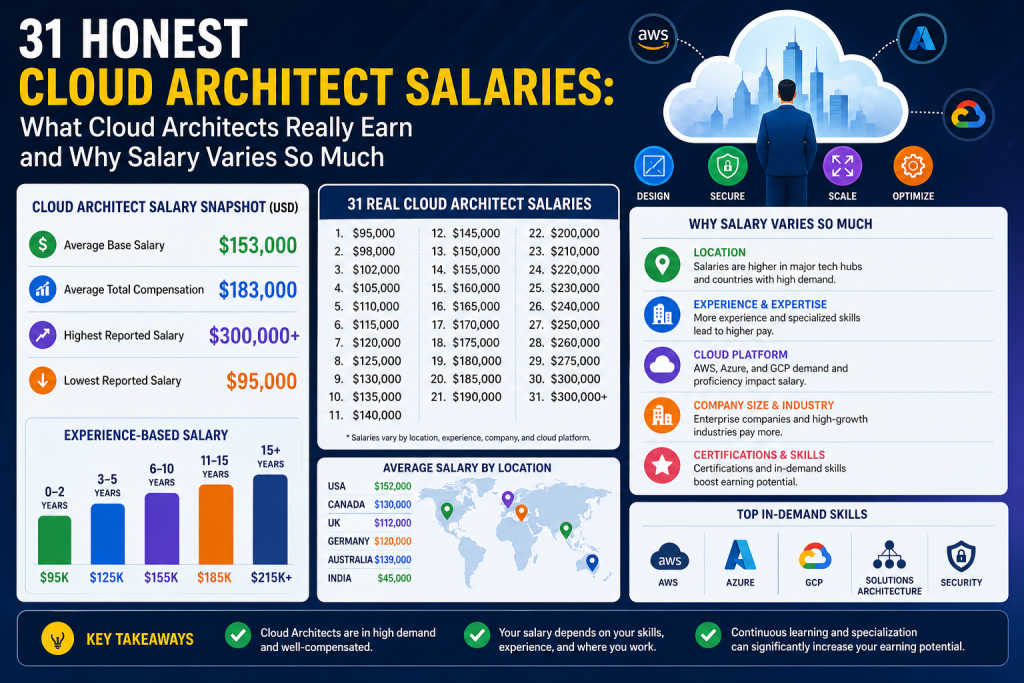
Cloud architecture has become one of the most financially rewarding and strategically important roles in modern information technology. As organizations continue shifting infrastructure, applications, storage, networking, and security operations into cloud ecosystems, cloud architects increasingly serve as the decision-makers responsible for shaping how businesses design, deploy, and scale their digital environments. Because of that responsibility, salary expectations for cloud architects are often significantly higher than for many other IT positions. However, despite the role’s prestige and strong earning potential, compensation varies dramatically depending on geography, technical specialization, certifications, industry, and years of experience.
For professionals already working in cloud architecture, understanding salary benchmarks is essential for evaluating whether current compensation reflects true market value. For aspiring cloud architects, salary data offers a realistic picture of what the profession can deliver financially and what factors influence upward mobility. The challenge is that cloud architect salary data can appear inconsistent. Depending on where you research, average compensation may look vastly different, ranging from salaries that resemble senior systems engineering positions to compensation packages rivaling executive-level technical leadership.
This variation exists because cloud architecture is not a narrow role. The title “cloud architect” can describe professionals who oversee basic cloud migrations for small businesses, enterprise-scale architects managing global hybrid infrastructure, or strategic technical leaders guiding digital transformation for multinational organizations. As cloud computing itself has evolved beyond simple hosting and storage into AI integration, zero-trust security, automation, containerization, and distributed services, the cloud architect role has become broader and more influential.
In practical terms, a cloud architect’s salary can differ by more than $100,000 annually depending on where they live and how advanced their expertise is. A cloud architect in a lower-demand market may earn compensation in the low six figures, while professionals in major enterprise centers or high-demand sectors can command salaries approaching or exceeding $200,000. This disparity can feel confusing, but once salary is analyzed through the lenses of regional demand, business complexity, and specialization, clear patterns begin to emerge.
What a Cloud Architect Actually Does
To understand why cloud architects earn what they do, it’s important to first define the role accurately. A cloud architect is responsible for planning, designing, implementing, and governing cloud solutions that align with an organization’s technical and business objectives. While many people assume cloud architecture is simply about selecting AWS, Azure, or Google Cloud services, the reality is far more complex.
A cloud architect evaluates an organization’s operational needs and determines how infrastructure, storage, networking, applications, and security should function together in cloud or hybrid environments. They assess whether a company should migrate fully to public cloud, maintain certain workloads on-premises, adopt multi-cloud strategies, or integrate specialized vendor ecosystems. These decisions can directly affect business agility, cost optimization, disaster recovery, scalability, compliance, and cybersecurity.
In many ways, cloud architects function similarly to traditional building architects. Just as a building architect considers structural integrity, materials, long-term use, occupancy, and expansion, a cloud architect designs technical ecosystems that support business growth, operational resilience, and future technological evolution. They do not simply deploy resources—they create strategic blueprints.
This means cloud architects frequently oversee:
- Cloud migration strategies
- Enterprise application modernization
- Hybrid and multi-cloud deployment
- Infrastructure cost optimization
- Security and governance frameworks
- Disaster recovery planning
- Networking architecture
- Automation and orchestration strategies
Because mistakes in architecture can cost organizations millions in inefficiency, downtime, or security failures, companies often compensate cloud architects at a premium. Their work affects nearly every aspect of modern enterprise technology.
National Salary Averages for Cloud Architects
Across the United States, cloud architects consistently rank among the highest-paid IT professionals. National salary averages generally place cloud architects comfortably in six-figure territory, with many professionals earning substantially more depending on specialization.
At the broad national level, cloud architect salaries often center around the mid-$140,000 range, with lower averages still comfortably above $120,000 and high-end averages reaching well above $150,000. However, these numbers only provide a baseline. Salary ceilings rise considerably when enterprise complexity, specialization, and location are factored in.
A key point for professionals evaluating salary data is that average salary figures can sometimes obscure the true opportunity spread. For example, two cloud architects in different regions may hold the same title but perform drastically different responsibilities. One may manage infrastructure for a regional healthcare provider, while another designs distributed cloud systems for a Fortune 500 telecommunications provider. The title remains similar, but compensation reflects business scale and technical depth.
Additionally, salary averages often fail to capture bonuses, stock options, consulting premiums, or specialized incentive packages that many cloud architects receive, especially in larger markets.
How Geography Influences Cloud Architect Salaries
Location remains one of the biggest determinants of cloud architect income. Regional cost of living, concentration of enterprise employers, technology sector density, and demand for specialized cloud talent all heavily impact compensation.
In smaller or mid-sized cities, cloud architects often still earn strong salaries, but compensation may align more closely with general enterprise infrastructure needs rather than highly competitive digital transformation ecosystems. These roles may focus on maintaining established cloud systems, overseeing migrations, or managing hybrid environments without the aggressive compensation structures seen in major tech centers.
In larger metropolitan areas—especially coastal technology hubs—salaries often rise significantly due to:
- Higher enterprise cloud adoption
- More competition for experienced architects
- Greater concentration of Fortune 500 employers
- Increased startup investment
- Higher cost of living
- Larger digital transformation budgets
For example, cloud architects in technology-intensive regions often command substantially higher salaries than counterparts in lower-demand markets because they are solving more complex infrastructure challenges, such as Kubernetes orchestration at scale, global redundancy, AI service integration, or compliance-heavy architectures.
This geographic reality creates a critical strategic consideration: relocation can be a major salary accelerator. For experienced cloud architects willing to move, geographic mobility may create compensation jumps larger than what some professionals achieve through years of incremental raises alone.
Mid-Sized Markets Still Offer Strong Opportunities
While major cloud salary discussions often focus on Silicon Valley, New York, or Seattle, mid-sized American cities present an important and often overlooked reality: cloud architecture remains lucrative nearly everywhere, even outside elite tech centers.
Mid-sized cities frequently offer a compelling balance between compensation and cost of living. A salary that appears lower than a Bay Area package may actually produce better purchasing power when housing, taxes, and living expenses are considered. This means some cloud architects may strategically choose markets with slightly lower salaries but substantially better lifestyle economics.
Additionally, as remote and hybrid work continue expanding, some organizations now hire cloud architects outside traditional tech hubs while still offering competitive salaries. This trend has begun softening historical geographic limitations, though high-demand urban centers still often command premium pay.
Why Salary Ranges Are So Wide
One of the most striking aspects of cloud architect salary research is how broad compensation ranges can be—even within the same city. This variation often reflects three major factors:
Experience
Junior or newly promoted cloud architects may possess foundational migration, networking, or provider knowledge but lack enterprise-wide design experience. Senior architects, by contrast, may lead digital transformation strategies, oversee compliance at scale, or design global cloud systems.
Technical Breadth
Architects with expertise across multiple providers, such as AWS, Azure, Google Cloud, VMware, Cisco, and Oracle ecosystems, often command stronger compensation because they can design flexible solutions rather than vendor-limited ones.
Strategic Leadership
Architects who influence executive decision-making, budgeting, governance, and business continuity typically earn more than implementation-focused professionals.
This is why salary spreads can exceed $50,000 to $80,000 even among professionals with the same job title. The title alone does not define earning power—business impact does.
The Entry-Level Versus Elite Compensation Gap
Lower-range cloud architect salaries tend to remain relatively stable across many regions because organizations hiring less-experienced architects often prioritize foundational implementation skills. At this stage, salary increases are typically tied to building expertise, proving reliability, and expanding technical range.
However, once architects reach advanced enterprise capability, compensation expands dramatically. Senior cloud architects who combine certifications, cross-platform fluency, governance knowledge, and leadership ability can enter a compensation tier far above average.
This creates a crucial reality for career planning: early-career salary growth may feel gradual, but advanced specialization often unlocks disproportionately larger rewards.
Why Cloud Architecture Is More Than a Technical Role
A common misconception is that cloud architects are simply technical specialists. In reality, the role increasingly blends technical execution with business strategy. Cloud architects often influence:
- Cost reduction initiatives
- Digital transformation roadmaps
- Vendor negotiation strategies
- Compliance modernization
- Cybersecurity resilience
- Organizational scalability
Because cloud decisions directly affect profitability, customer experience, and operational resilience, businesses often treat skilled cloud architects as strategic assets.
This strategic dimension is one reason cloud architects can earn far more than similarly experienced engineers or administrators. Their value lies not only in execution but in vision.
Cloud Architect Salary Trends Are Still Growing
Cloud adoption continues expanding globally, and enterprise dependence on cloud services is becoming deeper rather than broader alone. Organizations are no longer simply “moving to the cloud.” They are optimizing, securing, automating, and innovating within cloud ecosystems.
As a result, cloud architects are increasingly expected to understand:
- DevOps integration
- Infrastructure as Code
- AI cloud services
- Security architecture
- Zero-trust frameworks
- FinOps
- Regulatory compliance
This expansion of responsibility suggests salary potential for top cloud architects may continue rising, especially for professionals who stay ahead of platform evolution.
The First Major Salary Lesson for Cloud Architects
The most important takeaway from salary analysis is that cloud architecture offers exceptional earning potential, but income is not determined by title alone. Salary reflects a combination of:
- Location
- Experience
- Provider expertise
- Industry
- Certifications
- Strategic influence
For aspiring cloud architects, this means the path to higher compensation is rarely accidental. It requires deliberate skill-building, specialization, and often strategic career positioning.
For current cloud architects, salary awareness is essential because market value can change dramatically as skills mature. Many professionals may unknowingly underprice themselves simply because they underestimate how much expertise, certifications, or relocation could increase earning power.
Cloud architecture remains one of the clearest examples in modern IT where knowledge, specialization, and strategic capability can directly translate into life-changing financial advancement.
Why Experience Has a Bigger Impact on Salary Than Job Title Alone
One of the most revealing truths about cloud architect compensation is that salary progression is influenced far more by capability than by title. While many professionals assume that simply earning the “cloud architect” title guarantees premium compensation, salary data consistently shows that experience depth, technical complexity, and enterprise influence are what separate average earners from top-tier professionals.
A cloud architect with limited real-world migration experience may technically hold the same title as an enterprise architect designing multi-region disaster recovery, zero-trust networking, and hybrid governance for a Fortune 500 company, yet the salary gap between those two professionals can be enormous. This is because organizations pay not just for knowledge, but for proven ability to solve business-critical challenges.
Early-career cloud architects often focus on deployment support, vendor implementation, or infrastructure planning within smaller operational scopes. These responsibilities are important, but they may not yet involve large-scale budgeting, cross-functional strategy, compliance planning, or multi-cloud optimization. As cloud architects accumulate years of experience, their role often evolves from implementation specialist to strategic infrastructure leader.
This progression matters because companies consistently reward architects who can:
- Lead enterprise migrations
- Design scalable governance models
- Optimize long-term operational costs
- Reduce cloud waste
- Improve resilience
- Secure regulated environments
- Align cloud architecture with executive business priorities
The more expensive the consequences of failure, the more companies are willing to invest in proven architects. This is why highly experienced cloud architects can often negotiate salary jumps that dwarf the compensation increases available to junior professionals.
The Salary Ceiling Expands Dramatically With Seniority
For many technical careers, salary growth tends to plateau after reaching a senior engineering level. Cloud architecture is somewhat different because advanced architects frequently move beyond technical implementation into organizational strategy.
Senior cloud architects often become deeply involved in:
- Executive technology planning
- Enterprise transformation strategy
- Cloud governance policy
- Vendor ecosystem design
- Security modernization
- Performance optimization across departments
These expanded responsibilities can elevate compensation well beyond traditional infrastructure salaries. In some organizations, senior architects may influence millions of dollars in infrastructure decisions, making their compensation feel relatively small compared to the cost savings or operational efficiencies they generate.
This creates a major distinction between cloud architecture and many technical disciplines: advanced salary growth is often tied to business value creation, not just technical execution.
Cloud Tools That Directly Influence Salary Potential
Knowledge of cloud platforms is foundational to architecture, but platform familiarity alone is not enough to maximize salary. The cloud ecosystem is broad, and compensation often increases when architects demonstrate meaningful command of multiple categories of tools rather than isolated expertise.
Cloud Storage Platforms
Storage architecture remains one of the most critical elements of cloud design because storage decisions influence performance, cost, compliance, disaster recovery, and accessibility. A cloud architect who understands storage only at a surface level may be capable of deployment, but organizations increasingly need architects who can strategically compare and implement storage solutions based on business context.
This includes understanding:
- Structured vs unstructured storage
- High-availability storage design
- Disaster recovery replication
- Compliance-sensitive storage
- Cost-efficient archival strategies
- Vendor integration compatibility
Architects who can evaluate and deploy cloud storage intelligently become more valuable because storage mistakes can create long-term cost burdens or security liabilities.
Cloud Compute Services
Compute services are often where cloud architecture becomes most visible to business leadership because compute decisions directly affect application performance, scalability, and cost. Organizations rely on cloud architects to determine whether workloads should use virtual machines, containers, serverless frameworks, or hybrid deployments.
Architects with strong compute strategy often understand how to evaluate:
- Scalability requirements
- Workload elasticity
- Cost-performance ratios
- Vendor lock-in risks
- Automation potential
- Latency considerations
Because compute architecture often shapes operational agility, professionals who excel here frequently qualify for higher-paying positions.
Networking and Hybrid Infrastructure
Cloud networking may be one of the most underappreciated salary drivers in cloud architecture. Migration to cloud services without effective networking design can create bottlenecks, security gaps, or expensive inefficiencies.
Architects with strong networking and hybrid deployment expertise often stand out because they can bridge traditional enterprise infrastructure with cloud-native systems. This includes understanding:
- Multi-cloud connectivity
- Software-defined networking
- Hybrid WAN strategies
- Security segmentation
- Identity frameworks
- Public/private cloud interaction
As organizations increasingly adopt hybrid environments rather than full public-cloud dependence, architects who understand networking deeply often become especially valuable.
Why Multi-Platform Knowledge Creates Premium Compensation
Many cloud architects begin by specializing in a single ecosystem, such as AWS, Azure, or Google Cloud. While deep expertise in one provider is useful, compensation often increases substantially when architects demonstrate cross-platform fluency.
Organizations rarely operate in pure technical simplicity. Mergers, compliance requirements, legacy infrastructure, and departmental autonomy often create multi-platform realities. Architects who can compare providers and design around strengths and weaknesses become strategic assets.
For example, architects who understand how to align:
- AWS scalability
- Azure enterprise integration
- Google analytics and AI services
- VMware hybrid deployments
- Cisco networking
- Oracle enterprise infrastructure
can often command stronger salaries because they reduce vendor dependency and increase architectural flexibility.
Certifications as Salary Multipliers Rather Than Resume Decorations
In cloud architecture, certifications often carry more financial significance than in many other IT disciplines because they validate expertise in ecosystems where organizations are making major financial commitments.
Companies invest heavily in cloud vendors. Therefore, certifications from those same vendors create confidence that architects can maximize that investment responsibly.
Google Professional Cloud Architect
This certification is often associated with strategic Google Cloud mastery, including architecture design, governance, scalability, and enterprise implementation. Because Google Cloud often supports data-intensive, analytics-heavy, or AI-integrated environments, architects holding this credential may become especially attractive to organizations with advanced digital ambitions.
AWS Certified Solutions Architect – Professional
AWS remains deeply dominant in many enterprise sectors, and advanced AWS certification often signals expertise in scalable distributed systems, migration, automation, and operational excellence. Since AWS environments can become highly complex, this certification frequently carries significant salary influence.
Microsoft Azure Solutions Architect Expert
Azure’s prominence in enterprise environments, especially among organizations with deep Microsoft ecosystems, makes this certification particularly valuable. Architects with Azure expertise are often highly competitive in corporate digital transformation initiatives.
Why Certifications Matter Financially
The salary value of certifications often stems from three realities:
- They validate practical architecture standards
- They reduce perceived hiring risk
- They align with vendor trust
For many employers, certifications are not simply educational—they are operational assurances.
Industry Matters More Than Many Realize
Cloud architects are needed nearly everywhere, but not all industries compensate equally. The business stakes attached to cloud architecture often determine salary intensity.
Healthcare and Medical Networks
Healthcare organizations increasingly rely on cloud architecture for secure patient systems, compliance, interoperability, and digital modernization. Because regulatory complexity is high and security failures can be catastrophic, cloud architects in healthcare often command strong compensation.
Telecommunications
Telecommunications remains one of the most infrastructure-intensive sectors, requiring architects capable of managing enormous scale, performance reliability, and operational resilience. Telecom often offers some of the highest salary ceilings due to technical complexity.
Finance
Although not always the first industry associated with cloud migration, financial institutions increasingly rely on cloud architecture for modernization while balancing compliance, security, and latency. This often creates premium demand for experienced architects.
Government and Defense
Cloud architects in government or regulated sectors may also command high salaries, especially when compliance and security expertise intersect with specialized certifications or clearances.
The Relationship Between Skill Scarcity and Compensation
The reason cloud architects can earn dramatically different salaries often comes down to scarcity. Basic cloud familiarity is increasingly common, but advanced enterprise architecture remains relatively rare.
Professionals who combine:
- Multi-cloud knowledge
- Security strategy
- Compliance expertise
- Automation mastery
- Leadership ability
- Financial optimization
enter a much smaller talent pool. Scarcity creates leverage.
Soft Skills Also Affect Salary
Technical expertise alone does not always produce maximum compensation. Many top-paid cloud architects also excel in communication, executive alignment, and business translation.
Cloud architects often need to explain technical risk in business language, justify infrastructure investments, and mediate between stakeholders. Architects who can bridge technical and executive priorities frequently move into more influential—and better-paid—positions.
How Career Strategy Influences Salary Growth
Increasing salary as a cloud architect often requires more than simply gaining years of experience. Professionals frequently accelerate compensation through:
- Strategic certification timing
- Provider specialization
- Relocation
- Industry transition
- Leadership development
- Consulting or contract roles
For example, a cloud architect moving from general SMB infrastructure into healthcare compliance or telecom scale may significantly increase earning potential without changing title.
Why Cloud Architecture Remains a High-Upward-Mobility Career
Cloud computing continues evolving, and architecture roles are expanding accordingly. Emerging demands around AI services, automation, edge computing, and governance suggest that cloud architects may become even more central to enterprise success.
This ongoing evolution creates unusually strong upward mobility because architects who continuously adapt remain highly relevant. Unlike some technical roles that narrow over time, cloud architecture often broadens.
The Second Major Salary Lesson for Cloud Architects
Cloud architect salary growth is not random. It is typically shaped by deliberate expansion across four major categories:
- Experience
- Tool mastery
- Certifications
- Industry positioning
Professionals who remain static may still earn well, but those who strategically broaden technical and business capability often unlock the most dramatic financial rewards.
The most successful cloud architects are not merely cloud users—they become cloud strategists, infrastructure economists, and enterprise transformation leaders. That transformation is often where salary moves from strong to exceptional.
Why Some Cloud Architects Earn Dramatically More Than Others
By the time most IT professionals reach cloud architecture, they have already built years of technical experience in networking, systems administration, security, virtualization, DevOps, or infrastructure engineering. Yet despite similar technical foundations, cloud architects often experience vastly different income trajectories. Some remain in compensation bands close to senior engineering roles, while others move into premium salary brackets that rival executive technical leadership. This divergence often surprises professionals who assume that technical longevity alone guarantees financial growth. In reality, the difference usually comes down to how effectively an individual transforms broad technical knowledge into strategic business value. Two cloud architects may both understand AWS, Azure, automation, and infrastructure design, but the one who can align those capabilities with enterprise transformation, cost governance, regulatory compliance, or executive modernization goals often becomes substantially more valuable.
Higher-earning cloud architects frequently distinguish themselves by moving beyond implementation and becoming trusted advisors in organizational decision-making. They are often the professionals influencing multi-million-dollar migration strategies, designing business continuity frameworks, reducing operational waste through optimization, or creating scalable governance structures that directly impact profitability.
Leadership visibility also plays a major role. Architects who can communicate technical decisions to executives, justify infrastructure investments, and bridge operational goals with business outcomes often gain access to director-level pathways, consulting premiums, or enterprise architecture roles. In many cases, salary growth is less about technical competence alone and more about becoming the architect who not only builds systems, but shapes how the business evolves through technology.
This difference is rarely accidental. While geography, certifications, and industry all influence earnings, the largest salary gaps often come from how effectively a cloud architect positions themselves within the market. Salary growth at the highest levels is not simply about “working harder” or even “knowing more.” It is about aligning advanced technical expertise with organizational priorities that companies are willing to pay top dollar for.
A cloud architect who designs basic infrastructure deployments may still earn well, but one who can lead digital transformation, optimize millions in cloud spending, secure regulated workloads, and create future-proof enterprise strategy becomes significantly more valuable. At that level, salary reflects business leverage.
The reality is simple: cloud architects who understand how to shape business outcomes consistently earn more than those who only implement technical tasks.
The Most Important Career Shift: Moving From Technical Specialist to Strategic Architect
Many cloud professionals initially focus heavily on provider-specific skills—building AWS environments, deploying Azure resources, configuring storage, or managing migration projects. These capabilities are essential, but they often represent only the foundation of higher salary growth.
Top-earning cloud architects usually evolve beyond implementation into broader strategic ownership. This means they become professionals who can answer larger business questions such as:
- Should the company pursue hybrid, public, private, or multi-cloud?
- How can infrastructure costs be reduced without sacrificing performance?
- Which workloads should remain on-premises for compliance or latency?
- How should disaster recovery be architected for business continuity?
- What governance model prevents cloud waste?
- How can automation reduce operational overhead?
When cloud architects transition from “how to deploy” into “what should the business do and why,” their earning potential often expands dramatically.
This shift is important because executive leadership increasingly sees cloud architecture as a strategic business function, not merely an IT responsibility.
Choosing Employers That Pay Premium Salaries
Not every company values cloud architecture equally. Some organizations treat cloud architects primarily as infrastructure managers, while others position them as transformation leaders. Understanding this distinction can significantly affect salary outcomes.
Enterprise-Scale Organizations
Large enterprises often offer stronger compensation because cloud architecture impacts thousands of employees, global applications, customer-facing systems, and long-term digital competitiveness. In these environments, cloud architects may oversee:
- Global migrations
- Security governance
- Enterprise networking
- Mergers and acquisitions infrastructure alignment
- Vendor strategy
- AI and analytics platform integration
The complexity alone often justifies premium compensation.
Healthcare Systems
Healthcare continues expanding digitally through telemedicine, patient portals, integrated records, analytics, and regulatory modernization. Because healthcare cloud architecture often intersects with privacy laws, uptime sensitivity, and cybersecurity, skilled architects in this sector can become highly valuable. Modern healthcare organizations are no longer simply adopting cloud technologies for convenience—they are increasingly depending on them to improve patient outcomes, operational efficiency, and cross-system collaboration. Hospitals, insurance networks, pharmaceutical companies, diagnostic labs, and public health agencies all rely on secure cloud infrastructure to store, process, and share critical data in real time. This includes electronic health records, imaging systems, remote patient monitoring platforms, AI-assisted diagnostics, and claims processing systems.
Cloud architects in healthcare must design systems that not only scale effectively but also comply with strict regulatory frameworks such as HIPAA, HITECH, and other privacy standards that govern sensitive patient information. Even minor infrastructure failures can disrupt care delivery, delay emergency response, or compromise life-critical services, making reliability and redundancy essential. Security responsibilities are equally demanding, as healthcare remains a prime target for ransomware and data breaches. As a result, cloud architects who can build resilient, compliant, highly available healthcare ecosystems are often trusted with large-scale transformation initiatives. Their ability to balance innovation with patient safety and regulatory integrity makes them some of the most strategically important—and often best-compensated—cloud professionals in the industry.
Telecommunications and Infrastructure Providers
Telecom organizations often operate at enormous scale, supporting networking backbones, cloud ecosystems, and distributed systems. Cloud architects here may work on mission-critical infrastructure, often commanding strong salaries.
Financial Services
Banks, fintech organizations, and financial institutions increasingly require secure modernization. Architects who understand compliance-heavy cloud design often become especially desirable.
Consulting Firms and Cloud Integrators
Consulting can offer another path to premium earnings, particularly for cloud architects who specialize in migrations, governance, or transformation projects across multiple clients. These roles may include higher salaries, bonuses, or project premiums, though workload can also intensify.
Remote Work and the New Salary Equation
One of the most important modern developments in cloud architecture is the expansion of remote and distributed employment. Historically, geography heavily dictated salary because major metropolitan markets concentrated on premium opportunities. While location still matters, remote work has altered the equation.
Today, some cloud architects can access salaries associated with higher-demand markets while living in lower-cost regions. This can dramatically improve purchasing power.
However, remote work also increases competition. Cloud architects may now compete nationally—or globally—for premium positions. As a result, remote salary optimization often depends on standing out through specialization, certifications, and strategic expertise rather than location alone.
Specialization Paths That Increase Earning Power
Cloud architecture is broad, but specialization can often accelerate salary growth faster than generalization alone.
Cloud Security Architecture
As organizations face escalating cybersecurity threats, cloud architects with zero-trust, identity, encryption, governance, and compliance expertise are often among the most valuable.
DevOps and Automation
Architects who integrate Infrastructure as Code, CI/CD pipelines, orchestration, and operational automation frequently command higher compensation due to efficiency impact.
FinOps and Cost Governance
Cloud overspending is a major business issue. Architects who can significantly reduce cloud waste through cost optimization often create measurable financial value.
Multi-Cloud and Hybrid Strategy
Organizations increasingly seek flexibility. Architects capable of designing around multiple ecosystems often gain salary leverage.
AI and Data Platforms
As cloud providers increasingly power AI and analytics, architects who understand these environments may see rising salary opportunities.
Negotiating Salary as a Cloud Architect
Technical skill alone does not guarantee compensation growth. Negotiation strategy matters.
Cloud architects often improve salary outcomes when they can clearly quantify their business impact. Examples include:
- Reduced cloud spending by specific percentages
- Improved uptime
- Accelerated migration timelines
- Increased security compliance
- Reduced operational complexity
- Improved scalability
Organizations respond strongly when compensation discussions center on business outcomes rather than responsibilities alone.
A cloud architect who says, “I designed enterprise AWS deployments,” may sound capable. One who says, “I reduced annual infrastructure costs by 28% while improving redundancy,” often sounds indispensable.
Continuous Learning Is a Financial Strategy
Cloud evolves quickly. Professionals who stop learning may remain employable, but their salary growth often slows compared to architects who continuously adapt.
Areas increasingly affecting long-term salary include:
- Kubernetes and container strategy
- Serverless design
- AI cloud services
- Compliance automation
- Zero-trust architecture
- Edge computing
- Sustainable cloud operations
The highest-paid architects often treat learning not as optional education but as direct salary investment.
Avoiding Common Salary-Limiting Mistakes
Even highly capable cloud architects can unintentionally suppress earning potential.
Over-Specializing Too Early
Deep expertise is valuable, but excessive vendor dependence may reduce flexibility.
Ignoring Business Communication
Architects who cannot translate technical decisions into executive priorities may miss leadership opportunities.
Staying in Low-Growth Industries Too Long
Some sectors simply offer fewer premium opportunities.
Neglecting Certification Refresh
Cloud ecosystems evolve, and outdated credentials may reduce competitiveness.
Undervaluing Geographic or Remote Opportunity
Salary optimization sometimes requires changing employers, industries, or regions.
Building a Long-Term Financial Roadmap
Cloud architecture can become more than a high-paying job—it can become a launchpad into larger financial and career opportunities.
Many senior cloud architects eventually transition into:
- Enterprise architecture leadership
- Chief technology roles
- Consulting practices
- Fractional CTO services
- Cloud governance leadership
- Digital transformation executive positions
At this level, compensation may expand beyond salary into bonuses, consulting fees, equity, or leadership packages.
This makes cloud architecture especially powerful as a long-term career because its skills often scale upward rather than narrowing.
The Future Outlook for Cloud Architect Salaries
Cloud adoption is no longer emerging—it is foundational. Yet despite maturity, demand for advanced cloud architecture continues because complexity is increasing.
Organizations now need architects not just for migration, but for:
- Governance
- Security
- Automation
- AI integration
- Cost control
- Sustainability
- Innovation
This means salary potential is increasingly tied to complexity management rather than basic cloud familiarity.
Professionals who remain current and strategically positioned are likely to continue seeing strong salary opportunities.
Conclusion
Cloud architecture remains one of the most financially rewarding and strategically influential careers in modern IT because it sits at the intersection of technology, business strategy, security, scalability, and innovation. While salary ranges vary significantly based on geography, industry, certifications, and specialization, one pattern remains clear: the cloud architects who earn the most are typically those who move beyond implementation and become strategic decision-makers.
The highest salaries are rarely reserved solely for those with the most years in IT—they are earned by professionals who combine technical depth with business alignment, provider expertise with flexibility, and infrastructure knowledge with measurable organizational impact.
For early-career professionals, the path to higher compensation begins with mastering foundational cloud platforms, certifications, and architecture principles. For experienced architects, salary acceleration often comes from specialization, leadership, and positioning within high-value industries or enterprise-scale environments.
Ultimately, cloud architecture is one of the few technical fields where strategic growth can dramatically increase earnings over time. Whether through certifications, relocation, industry shifts, remote opportunities, or advanced specialization, the earning ceiling remains exceptionally high for those willing to continuously evolve.
The most successful cloud architects do not simply build cloud environments—they shape how businesses operate, compete, secure themselves, and grow in a digital-first world. That
level of influence is exactly why the profession continues to command such impressive compensation.
Continue exploring the technologies and certification concepts that matter most to you.