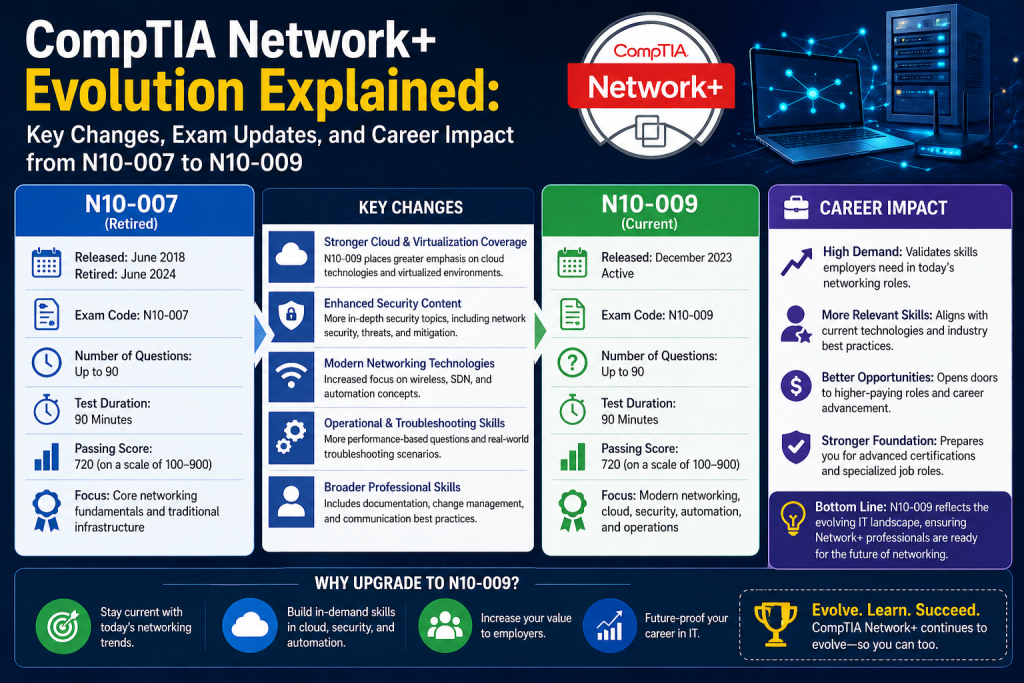
The field of information technology is constantly evolving, and certifications must evolve alongside it to remain relevant. The CompTIA Network+ certification is a clear example of how industry standards adapt to reflect technological progress. Over the years, this certification has undergone multiple revisions, each designed to ensure that IT professionals possess the most up-to-date networking knowledge and skills.
The transition from N10-007 to N10-008 and now to N10-009 represents more than just a routine update. It reflects major changes in how networks are designed, deployed, and managed. Modern networks are no longer limited to physical infrastructure; they now include cloud environments, virtualization, and software-defined technologies.
Understanding this evolution is important for anyone pursuing a career in networking. It provides context about what skills are in demand and how the certification aligns with real-world job requirements. Each exam version builds upon the last, gradually shifting focus toward more practical, integrated, and modern networking concepts.
What the Network+ Certification Is and Why It Matters
The CompTIA Network+ certification has been a foundational credential in the IT industry since its introduction in 1999. It is designed to validate essential networking skills that are applicable across a wide range of technologies and vendors. Unlike certifications tied to specific platforms, Network+ emphasizes universal principles that can be used in diverse environments.
The certification covers topics such as network configuration, troubleshooting, security, and operations. It ensures that candidates understand how networks function and how to maintain them effectively. This makes it an ideal starting point for individuals entering the IT field.
The exam itself typically consists of up to 90 questions, combining multiple-choice and performance-based formats. Candidates must achieve a passing score of 720 out of 900. This structure is intended to test both theoretical knowledge and practical problem-solving abilities.
Earning the Network+ certification can open doors to various career opportunities. It demonstrates to employers that the candidate has a solid understanding of networking fundamentals and is capable of handling real-world challenges. It also serves as a stepping stone to more advanced certifications in areas such as cybersecurity and cloud computing.
The Historical Progression from N10-007 to N10-008
The transition from N10-007 to N10-008 marked a significant shift in the focus of the Network+ certification. While the earlier version emphasized traditional networking concepts, the updated exam introduced a broader perspective that reflects modern IT environments.
One of the key changes was the restructuring of exam domains. In N10-007, topics were divided into distinct categories such as networking concepts, infrastructure, operations, security, and troubleshooting tools. This structure allowed candidates to study each area separately but did not हमेशा reflect how networking tasks are performed in real-world scenarios.
With N10-008, the domains were streamlined to create a more integrated approach. Troubleshooting, for example, was no longer treated as a separate category focused on specific tools. Instead, it became a holistic process that spans multiple areas of networking. This change encourages candidates to think critically and apply their knowledge in practical situations.
Another important update was the removal of the term infrastructure and the introduction of network architecture as a central concept. This shift reflects the growing complexity of modern networks, which often include a combination of physical and virtual components.
The Shift Toward Network Architecture
The emphasis on network architecture in N10-008 represents a major evolution in the certification. Traditional networking focused heavily on hardware components such as routers, switches, and cables. While these elements are still important, modern networks require a broader understanding of how systems are designed and interconnected.
Network architecture involves the planning and design of network systems to ensure they are efficient, scalable, and secure. This includes understanding different topologies, protocols, and technologies that enable communication between devices.
In today’s IT environments, networks often span multiple locations and include cloud-based services. This makes architecture a critical skill for networking professionals. They must be able to design systems that can handle increasing demands while maintaining performance and reliability.
By focusing on architecture, the N10-008 exam prepares candidates to work in these complex environments. It ensures they have the knowledge needed to design and manage modern networks effectively.
Integrated Troubleshooting and Real-World Application
Another significant change introduced in the newer exam versions is the approach to troubleshooting. In earlier versions, troubleshooting was often tied to specific tools and techniques. Candidates were expected to memorize various utilities and understand how to use them.
In contrast, N10-008 emphasizes a more integrated approach. Troubleshooting is now seen as a process that involves identifying, analyzing, and resolving issues across different areas of networking. This reflects how problems are handled in real-world environments.
For example, a network issue may involve multiple components, such as hardware, software, and configuration settings. A networking professional must be able to consider all these factors and determine the root cause of the problem.
This shift encourages critical thinking and problem-solving skills. It also ensures that candidates are better prepared for the challenges they will face in their careers.
The Role of Modern Networking Technologies
The evolution of the Network+ certification also reflects the growing importance of modern networking technologies. As organizations adopt new solutions, networking professionals must adapt to these changes.
Technologies such as cloud computing, virtualization, and software-defined networking have become essential components of modern IT environments. These technologies enable organizations to create flexible and scalable networks that can support a wide range of applications.
The N10-008 exam introduced greater emphasis on these areas, ensuring that candidates understand how they work and how to manage them. This includes knowledge of virtual machines, cloud services, and advanced networking concepts.
By incorporating these topics, the certification remains relevant and aligned with industry trends. It ensures that candidates are prepared to work with the technologies that are shaping the future of networking.
Why the Changes Between Exam Versions Matter
At first glance, the differences between N10-007, N10-008, and N10-009 may seem minor. However, these changes have a significant impact on how candidates prepare for the exam and what skills they develop.
The shift toward integrated learning and modern technologies means that candidates must adopt a more comprehensive approach to studying. Memorizing facts is no longer sufficient; they must understand how concepts apply in real-world scenarios.
These changes also reflect the expectations of employers. Organizations are looking for professionals who can adapt to new technologies and solve complex problems. The updated certification ensures that candidates meet these expectations.
By staying current with industry trends, the Network+ certification maintains its value and relevance. It continues to be a trusted credential for networking professionals around the world.
Building a Strong Foundation for IT Careers
Despite the changes introduced in newer exam versions, the core purpose of the Network+ certification remains the same. It is designed to provide a strong foundation in networking principles.
This foundation is essential for career growth in the IT industry. Many advanced roles require a deep understanding of networking concepts. Without this knowledge, it becomes difficult to specialize in areas such as cybersecurity or cloud computing.
The certification helps bridge the gap between theory and practice. It ensures that candidates not only understand networking concepts but can also apply them in real-world situations.
This combination of knowledge and practical skills makes Network+ a valuable credential for anyone pursuing a career in IT.
Preparing for Modern Network+ Exams
As the certification evolves, so must the approach to preparation. Candidates need to focus on developing skills that align with current industry practices. This includes gaining hands-on experience with modern networking tools and technologies.
Practical experience is especially important for performance-based questions, which require candidates to demonstrate their ability to solve real-world problems. Lab exercises, simulations, and practice tests can help build these skills.
In addition to technical knowledge, candidates should also develop strong analytical and problem-solving abilities. These skills are essential for troubleshooting and managing complex network environments.
By adopting a comprehensive approach to preparation, candidates can increase their chances of success and gain valuable skills that will benefit their careers.
Looking Ahead to the Latest Exam Developments
The progression from N10-007 to N10-008 set the stage for further advancements in the Network+ certification. The introduction of N10-009 continues this trend, incorporating new technologies and refining existing topics.
The latest version places even greater emphasis on modern networking environments, operational efficiency, and advanced troubleshooting techniques. It reflects the ongoing evolution of the IT industry and the need for professionals who can adapt to new challenges.
Understanding the changes introduced in earlier versions provides valuable context for these updates. It helps candidates appreciate how the certification has evolved and what skills are now considered essential.
Introduction to the N10-008 Transformation
The release of the N10-008 version of the CompTIA Network+ certification marked a major turning point in how networking knowledge is defined and assessed. While earlier versions such as N10-007 focused heavily on traditional networking concepts, N10-008 expanded its scope to include technologies that reflect the realities of modern IT environments.
This update was not just a simple refresh of topics. Instead, it represented a shift in philosophy. Networking was no longer viewed as an isolated discipline centered around hardware and connectivity. It became part of a broader ecosystem that includes cloud computing, virtualization, wireless innovation, and interconnected devices.
The goal of N10-008 was to prepare candidates for this new landscape. By incorporating emerging technologies and emphasizing practical skills, the exam ensures that certified professionals are ready to work in dynamic and complex network environments.
Virtualization and Its Expanded Role
One of the most significant changes introduced in N10-008 is the deeper focus on virtualization. While virtualization was present in earlier versions, it was treated as a secondary concept with limited coverage. In contrast, N10-008 places it at the forefront of modern networking.
Virtualization allows multiple virtual systems to run on a single physical machine. This technology has become essential in today’s IT environments because it improves efficiency, reduces hardware costs, and enables flexible resource management.
In the updated exam, candidates are expected to understand not only what virtualization is but also how it is implemented and managed. This includes knowledge of virtual machines, hypervisors, and virtual network configurations.
Another important aspect is troubleshooting virtual environments. Networking professionals must be able to identify and resolve issues that occur within virtual systems. This requires an understanding of how virtual networks interact with physical infrastructure.
Security is also a key consideration. Virtual environments introduce unique challenges, such as managing access controls and protecting virtual machines from unauthorized access. N10-008 ensures that candidates are prepared to address these challenges.
The Growing Importance of Cloud Computing
Cloud computing is another area that received significant attention in N10-008. As organizations increasingly rely on cloud services, networking professionals must understand how these environments operate and how to manage them effectively.
The exam covers various cloud service models, including software, infrastructure, platform, and desktop services delivered over the internet. Each model has its own characteristics and use cases, and candidates must understand how they differ.
In addition to service models, the exam emphasizes cloud deployment strategies. This includes understanding public, private, and hybrid cloud environments. Networking professionals need to know how to design and maintain these systems to ensure reliability and performance.
Redundancy and high availability are also critical topics. Candidates must understand concepts such as warm, cold, and hot sites, which are used to ensure continuity in the event of system failures. These concepts are essential for maintaining business operations in modern IT environments.
Load balancing is another important area. It involves distributing network traffic across multiple resources to optimize performance and prevent overload. Understanding how load balancing works and how to implement it is a key skill for networking professionals.
Overall, the expanded focus on cloud computing reflects its central role in today’s IT infrastructure. N10-008 ensures that candidates are equipped with the knowledge needed to work in cloud-based environments.
Internet of Things and Network Integration
The Internet of Things has become an integral part of modern networking, and N10-008 reflects this trend by including more detailed coverage of IoT devices and their management.
IoT refers to the network of physical devices that are connected to the internet and can communicate with each other. These devices range from household appliances to industrial sensors, and they play a significant role in various industries.
In the updated exam, candidates are expected to understand how IoT devices operate within a network. This includes knowledge of communication protocols, device management, and security considerations.
One important aspect is remote access. Networking professionals must be able to configure systems that allow IoT devices to be monitored and controlled from a central location. This is particularly important in environments where devices are distributed across multiple locations.
Logging and monitoring are also emphasized. IoT devices generate data that can be used to track performance and detect issues. Understanding how to access and interpret this data is essential for maintaining network reliability.
Security is a major concern in IoT environments. Because these devices are often connected to the internet, they can be vulnerable to cyberattacks. N10-008 ensures that candidates are aware of these risks and know how to mitigate them.
The Introduction of Cellular 5G Technology
Another major addition to N10-008 is the inclusion of cellular 5G technology. This reflects the growing importance of wireless connectivity in modern networks.
5G offers faster speeds, lower latency, and greater capacity compared to previous generations of cellular technology. These improvements make it possible to support a wide range of applications, from mobile devices to IoT systems.
In the context of the exam, candidates are expected to understand how 5G networks operate and how they are integrated into existing infrastructure. This includes knowledge of frequency ranges, coverage limitations, and performance characteristics.
Troubleshooting 5G connectivity is also an important skill. Because 5G operates over shorter distances, network professionals must be able to identify issues related to signal strength and coverage.
The integration of 5G with other technologies, such as software-defined networking, is another key topic. This combination enables more flexible and efficient network management, which is essential for modern IT environments.
By including 5G in the exam, N10-008 ensures that candidates are prepared for the future of wireless networking.
Changes in Network Architecture and Design
The shift toward network architecture that began with N10-008 is further reinforced through its emphasis on design principles and modern networking models.
Candidates are expected to understand various network topologies and how they are used in different scenarios. This includes traditional designs as well as newer approaches that incorporate virtualization and cloud technologies.
Software-defined networking is an important concept in this area. It allows network administrators to manage network resources through software rather than relying solely on hardware configurations. This approach improves flexibility and simplifies management.
Wide area networking also receives updated coverage. Candidates must understand how modern WAN technologies are used to connect geographically distributed locations. This includes knowledge of secure and reliable data transmission methods.
The focus on architecture ensures that candidates can design networks that meet organizational needs. It also prepares them to adapt to changes in technology and business requirements.
Enhanced Focus on Security Concepts
Security has always been an important part of networking, but N10-008 places even greater emphasis on this area. As cyber threats become more sophisticated, networking professionals must be equipped to protect systems and data.
The exam covers a wide range of security topics, including authentication, authorization, and encryption. Candidates must understand how these mechanisms are used to secure network communications.
Threat detection and prevention are also important. Networking professionals need to be able to identify potential vulnerabilities and implement measures to mitigate risks.
The integration of security into other areas of the exam reflects its importance in modern networking. Rather than treating security as a separate topic, it is incorporated into various domains, emphasizing its role in all aspects of network management.
Practical Skills and Real-World Application
One of the defining features of N10-008 is its focus on practical skills. The exam is designed to test not only theoretical knowledge but also the ability to apply that knowledge in real-world scenarios.
Performance-based questions require candidates to perform tasks such as configuring network settings, troubleshooting issues, and analyzing data. These questions simulate real-world situations and provide a more accurate assessment of a candidate’s abilities.
This emphasis on practical skills ensures that certified professionals are ready to work in actual IT environments. It also aligns with employer expectations, as organizations seek individuals who can contribute immediately.
Hands-on experience is therefore an essential part of exam preparation. Candidates are encouraged to use labs, simulations, and real-world practice to develop their skills.
The Impact of N10-008 on Career Opportunities
The updates introduced in N10-008 have a direct impact on career opportunities for certified professionals. By covering modern technologies and practical skills, the certification prepares candidates for a wide range of roles.
Positions such as network administrator, help desk technician, and junior cloud engineer benefit from the knowledge gained through this certification. Employers value candidates who understand both traditional networking and modern technologies.
The inclusion of cloud and virtualization topics also opens the door to emerging career paths. As organizations continue to adopt these technologies, the demand for skilled professionals is expected to grow.
By earning the N10-008 certification, candidates demonstrate their ability to work in modern IT environments and adapt to new challenges.
Preparing for the Transition to Newer Versions
While N10-008 introduced significant updates, it also set the stage for future developments in the Network+ certification. Understanding these changes is important for anyone preparing to transition to newer exam versions.
Candidates should focus on building a strong foundation in the topics covered in N10-008. This includes gaining hands-on experience with virtualization, cloud computing, and modern networking technologies.
Staying informed about industry trends is also important. As new technologies emerge, they are likely to be included in future exam updates.
By adopting a proactive approach to learning, candidates can ensure that they remain prepared for future changes and continue to develop their skills.
Introduction to the N10-009 Update
The release of the N10-009 version of the CompTIA Network+ certification represents the latest step in the ongoing evolution of networking standards. While earlier versions such as N10-007 and N10-008 introduced significant structural and conceptual changes, N10-009 refines and expands those ideas to better reflect the realities of modern IT environments.
This update is not about reinventing the certification but about aligning it more closely with current industry demands. Networking today is deeply integrated with cloud computing, automation, security frameworks, and distributed systems. As a result, professionals are expected to possess a broader and more adaptable skill set.
N10-009 responds to these expectations by placing greater emphasis on operational efficiency, advanced troubleshooting, and modern network design. It ensures that candidates are not only familiar with networking concepts but also capable of applying them in dynamic and complex environments.
Increased Focus on Network Operations and Troubleshooting
One of the defining characteristics of N10-009 is its stronger emphasis on network operations and troubleshooting. While these topics were present in earlier versions, they now take a more central role in the exam.
Modern networks are complex systems that require continuous monitoring and maintenance. Issues can arise from various sources, including hardware failures, software misconfigurations, and external threats. Networking professionals must be able to identify these issues quickly and resolve them effectively.
The updated exam focuses on real-world troubleshooting scenarios. Candidates are expected to demonstrate their ability to diagnose problems, analyze network behavior, and implement solutions. This requires a deep understanding of how different network components interact.
The shift toward operational skills reflects the demands of the workplace. Employers are looking for professionals who can maintain network performance and ensure reliability. By emphasizing these skills, N10-009 prepares candidates for the challenges they will face in their careers.
Modern Network Environments and Physical Installations
Another important update in N10-009 is the expanded coverage of modern network environments. This includes both virtual and physical aspects of networking.
While virtualization and cloud technologies continue to play a major role, the exam also highlights the importance of physical installations. Candidates must understand how network hardware is deployed and how it interacts with software-defined systems.
This includes knowledge of cabling, rack setups, and environmental considerations such as power and cooling. These factors are essential for maintaining reliable network operations, especially in large-scale deployments.
The inclusion of physical installation topics ensures that candidates have a well-rounded understanding of networking. It emphasizes that even in a digital world, physical infrastructure remains a critical component of network design.
Software-Defined Networking and SD-WAN Advancements
Software-defined networking continues to be a key focus in N10-009. This approach separates the control plane from the data plane, allowing network administrators to manage resources through software.
The exam expands on this concept by including both software-defined networking and software-defined wide area networking. These technologies enable more flexible and efficient network management, particularly in organizations with multiple locations.
Candidates are expected to understand how these systems work and how they are implemented. This includes knowledge of centralized control, automation, and policy-based management.
The integration of these technologies into the exam reflects their growing importance in the industry. Organizations are increasingly adopting software-defined solutions to improve scalability and reduce complexity.
Introduction of Infrastructure as Code
One of the notable additions in N10-009 is the inclusion of infrastructure as code. This concept involves using code to manage and provision network infrastructure, rather than relying on manual configuration.
Infrastructure as code improves efficiency by automating repetitive tasks and reducing the risk of human error. It also enables faster deployment of network resources and greater consistency across environments.
Candidates are expected to understand the basic principles of this approach and how it is used in modern IT environments. This includes knowledge of configuration management tools and scripting techniques.
The inclusion of infrastructure as code reflects the broader trend toward automation in IT. Networking professionals must be able to adapt to these changes and leverage new tools to improve their workflows.
Scalability and the Role of VxLAN
As organizations grow, their networks must be able to scale accordingly. N10-009 addresses this need by including topics related to scalability and advanced networking technologies such as virtual extensible local area networks.
VxLAN is used to extend network segments across large environments, allowing for greater flexibility and scalability. It is particularly useful in data centers and cloud environments where traditional networking methods may be insufficient.
Candidates are expected to understand how VxLAN works and how it is used to manage large-scale deployments. This includes knowledge of encapsulation, overlays, and network segmentation.
By covering these topics, the exam ensures that candidates are prepared to design and manage networks that can grow with organizational needs.
Structured Cabling and Distribution Frameworks
The N10-009 exam also introduces topics related to structured cabling and distribution frameworks. This includes concepts such as intermediate distribution frames and main distribution frames.
These components are essential for organizing network infrastructure and ensuring efficient data flow. They play a key role in large networks, where multiple connections must be managed effectively.
Candidates must understand how these frameworks are designed and how they contribute to overall network performance. This includes knowledge of cable types, layout strategies, and best practices for installation.
The inclusion of these topics highlights the importance of organization and planning in network design. It ensures that candidates can create systems that are both efficient and maintainable.
Zero Trust Architecture and Advanced Security Models
Security continues to be a major focus in N10-009, with the introduction of advanced models such as zero trust architecture. This approach assumes that no user or device should be trusted by default, even if it is within the network.
Instead of relying on a traditional perimeter-based defense, zero trust requires continuous verification of every access request, regardless of its origin.
To support this model, organizations implement strict identity and access management controls. Users must authenticate using multiple factors, and their access is limited based on roles and responsibilities. This principle of least privilege ensures that individuals only have access to the resources they absolutely need, reducing the potential impact of a security breach.
Another important aspect is continuous monitoring. Network activity is constantly analyzed to detect unusual behavior or potential threats. If suspicious activity is identified, automated systems can respond quickly to contain the issue and prevent further damage.
Encryption also plays a key role in protecting data as it moves across the network. Even if data is intercepted, encryption ensures that it cannot be easily read or misused. By combining these strategies, zero trust architecture creates a more resilient and secure networking environment that aligns with modern cybersecurity challenges.
Instead, access is continuously verified based on identity, behavior, and context. This reduces the risk of unauthorized access and improves overall security.
The exam also covers concepts such as secure access service edge and security service edge. These frameworks combine networking and security functions into a unified system, providing more comprehensive protection.
Candidates are expected to understand how these models work and how they are implemented. This includes knowledge of authentication methods, access controls, and monitoring techniques.
The emphasis on advanced security reflects the growing importance of protecting network resources in an increasingly connected world.
Comparing N10-009 with Previous Versions
While N10-009 builds upon the foundation established by N10-008, it introduces several refinements that make it more aligned with current industry practices.
The focus on operations and troubleshooting is more pronounced, reflecting the need for practical skills in the workplace. The inclusion of new technologies such as infrastructure as code and VxLAN demonstrates the certification’s commitment to staying current.
At the same time, the core principles of networking remain unchanged. Candidates are still expected to understand fundamental concepts such as protocols, topologies, and network devices.
This balance between foundational knowledge and modern advancements ensures that the certification remains both relevant and accessible.
Who Should Pursue the N10-009 Certification
The N10-009 certification is ideal for individuals who are starting their careers in networking or looking to validate their skills in modern IT environments.
It serves as a strong entry point for those who may not yet have extensive hands-on experience but want to demonstrate a solid understanding of networking fundamentals.
By covering a wide range of topics, the certification helps build confidence and prepares candidates to handle real-world networking tasks.
For beginners, it provides a clear pathway into the IT field by introducing essential concepts such as network configuration, troubleshooting, security, and operations. This structured knowledge makes it easier to transition into job roles where these skills are applied daily. For those already working in IT, the certification acts as a benchmark to confirm their expertise and keep their knowledge aligned with current industry standards.
Additionally, the certification can enhance career opportunities by making candidates more attractive to employers. It shows commitment to professional growth and a willingness to stay updated with evolving technologies. Whether aiming for a help desk role, network support position, or a junior administrative role, earning this certification can significantly strengthen a candidate’s resume and open doors to further advancement in the networking field.
Roles such as network administrator, help desk technician, and junior cloud engineer can benefit from this certification. It provides the knowledge needed to manage networks, troubleshoot issues, and support users.
For those already working in IT, the certification offers an opportunity to update their skills and stay current with industry trends. It demonstrates a commitment to professional development and continuous learning.
The broad scope of the exam makes it suitable for a wide range of career paths, providing a strong foundation for future specialization.
Preparing for the N10-009 Exam
Preparation for the N10-009 exam requires a comprehensive approach that combines theoretical study with practical experience.
To strengthen your preparation, it is important to build a structured study plan that breaks down topics into manageable sections and allocates time consistently
. Instead of trying to memorize everything at once, focus on understanding core networking concepts such as protocols, addressing, routing, and security principles.
Using multiple learning resources can significantly improve retention. Study guides, video courses, and practice exams each offer different perspectives that help reinforce your understanding. Practice exams are especially valuable because they familiarize you with the exam format and highlight weak areas that need further review.
Hands-on practice is equally critical. Setting up a home lab or using virtual lab environments allows you to simulate real-world networking scenarios. This helps you gain confidence in configuring devices, troubleshooting issues, and applying concepts in a practical setting.
Additionally, revisiting difficult topics regularly and taking notes in your own words can improve long-term retention. Staying consistent, practicing regularly, and focusing on both knowledge and application will greatly increase your chances of passing the exam successfully.
Candidates should begin by reviewing the exam objectives and identifying key topics. This provides a clear roadmap for study and ensures that all relevant areas are covered.
Hands-on practice is essential for developing practical skills. This can include working with network equipment, using simulation tools, and practicing troubleshooting scenarios.
In addition to technical knowledge, candidates should focus on developing analytical and problem-solving skills. These abilities are critical for success in both the exam and real-world environments.
By adopting a structured approach to preparation, candidates can build the confidence and competence needed to succeed.
Conclusion
The evolution of the CompTIA Network+ certification from N10-007 to N10-009 reflects the rapid changes taking place in the world of networking. Each version of the exam has introduced new concepts and refined existing ones, ensuring that the certification remains relevant and valuable.
N10-009 represents the culmination of these efforts, combining foundational knowledge with modern technologies and practical skills. Its emphasis on operations, troubleshooting, automation, and security prepares candidates for the challenges of today’s IT environments.
For aspiring networking professionals, this certification offers a strong starting point and a pathway to further career development. By understanding the differences between exam versions and focusing on current industry trends, candidates can make informed decisions and achieve their goals.
Ultimately, the Network+ certification continues to serve as a reliable benchmark for networking expertise. Its ongoing evolution ensures that it remains aligned with the needs of both professionals and organizations in an ever-changing technological landscape.
Continue exploring the technologies and certification concepts that matter most to you.