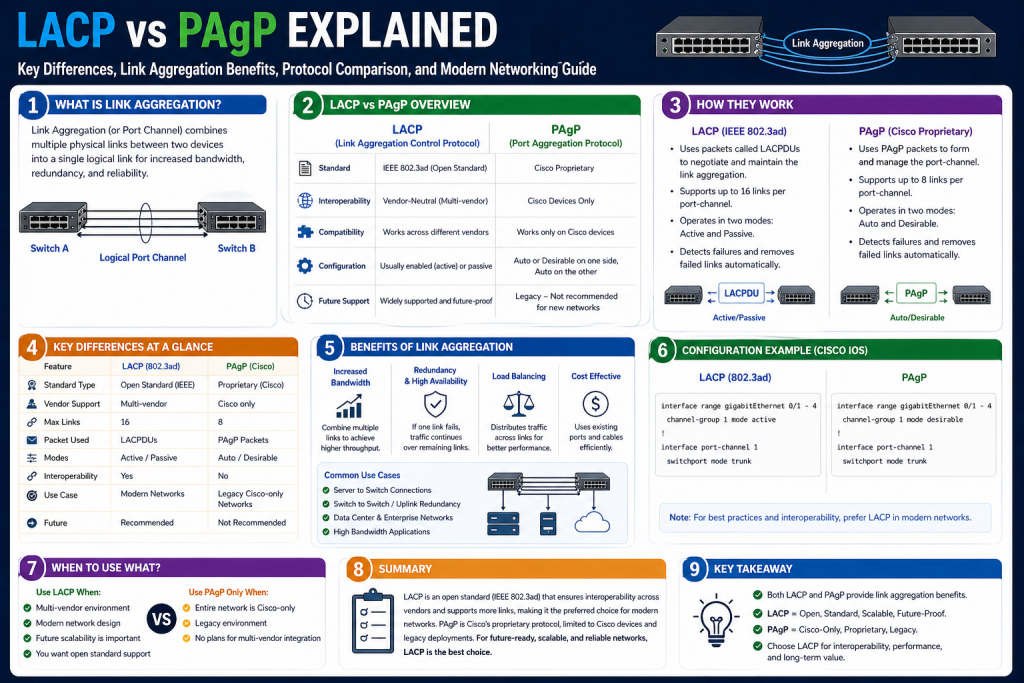
Modern networking environments demand high performance, reliability, and scalability. As organizations rely more heavily on digital systems, the need for stable and efficient network connections has become critical. One of the foundational techniques used to achieve these goals is link aggregation. This method combines multiple physical network connections into a single logical link, allowing data to travel more efficiently while also providing redundancy in case of failure.
Link aggregation is not a new concept. It has been around since the early days of enterprise networking, when engineers began searching for ways to increase bandwidth without replacing existing infrastructure. Instead of upgrading to a single high-capacity link, multiple smaller links could be grouped together to achieve the same or even better performance. This approach proved to be cost-effective and flexible, making it widely adopted across different industries.
In a typical setup, multiple Ethernet cables connect two devices, such as switches or servers. These links are then bundled together into what appears to be a single connection. Traffic is distributed across the links using specific algorithms, ensuring that no single link becomes a bottleneck. At the same time, if one link fails, the remaining links continue to carry traffic, preventing network downtime.
This dual benefit of increased bandwidth and improved reliability makes link aggregation a key component of modern network design. It is commonly used in data centers, enterprise networks, and service provider infrastructures. As networks continue to grow in complexity, the importance of efficient traffic management and redundancy becomes even more significant.
Evolution of Link Aggregation Technologies
The development of link aggregation technologies has gone through several stages. In the early years, vendors created their own proprietary solutions to address the need for higher bandwidth and redundancy. These solutions were often incompatible with one another, making it difficult to integrate equipment from different manufacturers.
One of the earliest examples of such proprietary solutions is Port Aggregation Protocol, developed by Cisco. This protocol allowed Cisco switches to automatically form aggregated links, simplifying configuration and improving performance within Cisco-based networks. However, its proprietary nature meant that it could not be used with devices from other vendors.
As networking environments became more diverse, the limitations of proprietary protocols became apparent. Organizations needed a standardized solution that would allow devices from different manufacturers to work together seamlessly. This led to the development of Link Aggregation Control Protocol, which was standardized by the Institute of Electrical and Electronics Engineers under the 802.3ad specification, later updated to 802.1AX.
The introduction of a standardized protocol marked a significant turning point in the evolution of link aggregation. It allowed for greater interoperability, enabling organizations to build networks using equipment from multiple vendors without sacrificing functionality. Over time, this standard became widely adopted, making it the preferred choice in most modern networks.
Despite the rise of standardized protocols, proprietary solutions like PAgP have not disappeared. They continue to be used in environments where a single vendor dominates, offering optimized performance and simplified configuration. Understanding the history of these technologies helps explain why both standardized and proprietary protocols still exist today.
Understanding the Fundamentals of Link Aggregation
To fully grasp the differences between LACP and PAgP, it is essential to understand how link aggregation works at a fundamental level. At its core, link aggregation involves combining multiple physical connections into a single logical interface. This logical interface behaves as if it were a single link, even though it is made up of multiple underlying connections.
One of the key requirements for link aggregation is that all participating links must have identical characteristics. This includes speed, duplex settings, and other configuration parameters. If these conditions are not met, the aggregation may fail or operate inefficiently.
Traffic distribution is another important aspect of link aggregation. When data is transmitted across an aggregated link, it must be divided among the available physical connections. This is typically done using a hashing algorithm that takes into account factors such as source and destination addresses. The goal is to ensure an even distribution of traffic while maintaining the integrity of data flows.
Another critical feature of link aggregation is redundancy. In a traditional single-link setup, the failure of that link would result in a loss of connectivity. With link aggregation, however, the failure of one link does not disrupt the entire connection. The remaining links continue to carry traffic, providing a seamless experience for users.
This redundancy is particularly important in environments where uptime is critical. For example, in data centers, even a brief interruption can have significant consequences. By using link aggregation, organizations can minimize the risk of downtime and ensure continuous operation.
The Role of Protocols in Link Aggregation
While the concept of link aggregation is straightforward, implementing it requires coordination between devices. This is where protocols like LACP and PAgP come into play. These protocols handle the negotiation and management of aggregated links, ensuring that both ends of the connection are properly configured.
Without these protocols, administrators would need to manually configure each link, which increases the risk of errors. Protocols automate the process, making it easier to establish and maintain aggregation groups. They also provide mechanisms for detecting and responding to changes in the network, such as link failures or configuration mismatches.
Both LACP and PAgP operate at Layer 2 of the OSI model, focusing on Ethernet connections. They use control messages to communicate between devices, exchanging information about link capabilities and configuration settings. Based on this information, they determine which links should be included in the aggregation group.
These protocols also monitor the status of each link, ensuring that only healthy connections are used for data transmission. If a link becomes unavailable, it is automatically removed from the group, and traffic is redistributed among the remaining links.
The use of protocols not only simplifies configuration but also enhances reliability. By automating key processes, they reduce the likelihood of human error and ensure consistent operation across the network.
Introduction to Link Aggregation Control Protocol
Link Aggregation Control Protocol, commonly referred to as LACP, is a standardized protocol designed to manage link aggregation. It is defined by the IEEE and is widely supported by networking equipment from various vendors. This makes it a versatile and flexible option for modern networks.
LACP works by exchanging control messages known as protocol data units between devices. These messages contain information about the links, such as their status and capabilities. Based on this information, the protocol determines which links should be active and included in the aggregation group.
One of the key advantages of LACP is its ability to support multi-vendor environments. Because it is a standard, devices from different manufacturers can communicate and work together seamlessly. This is particularly important in large organizations where equipment from multiple vendors is often used.
LACP also supports advanced features such as dynamic link management and cross-device aggregation. These capabilities allow for more resilient and scalable network designs, making LACP a preferred choice in many scenarios.
Another important aspect of LACP is its operating modes. Devices can be configured to actively initiate aggregation or passively wait for requests from other devices. This flexibility allows administrators to tailor the protocol’s behavior to suit their specific needs.
Introduction to Port Aggregation Protocol
Port Aggregation Protocol, or PAgP, is a proprietary protocol developed by Cisco. It was one of the earliest solutions for automating link aggregation and remains in use today, particularly in Cisco-centric environments.
PAgP allows Cisco switches to automatically form aggregation groups, known as EtherChannels. It simplifies the configuration process by enabling devices to detect whether the other end of a link supports aggregation. If both devices are compatible, they can establish an aggregated connection without manual intervention.
Because PAgP is proprietary, it is primarily used within networks that rely on Cisco equipment. While this can be a limitation in mixed environments, it also allows for tight integration and optimized performance within Cisco ecosystems.
PAgP uses its own set of control messages to manage aggregation. These messages are exchanged between devices to negotiate the formation of aggregation groups and ensure that both ends of the connection are properly configured.
Like LACP, PAgP also supports different operating modes. These modes determine how devices initiate and respond to aggregation requests, providing flexibility in configuration.
Key Concepts That Define Aggregation Protocols
Several core concepts underpin the operation of aggregation protocols. Understanding these concepts helps clarify how LACP and PAgP function and why they are essential for modern networking.
One such concept is negotiation. Before an aggregation group can be formed, both devices must agree on the configuration. This involves exchanging control messages and verifying compatibility. If the devices cannot reach an agreement, the aggregation will not be established.
Another important concept is synchronization. Once an aggregation group is formed, both devices must maintain a consistent view of the group’s status. This ensures that traffic is distributed correctly and that any changes are handled smoothly.
Load balancing is also a critical aspect of aggregation. Traffic must be evenly distributed across the available links to maximize efficiency. This requires careful consideration of hashing algorithms and traffic patterns.
Fault detection is another key feature. Aggregation protocols continuously monitor the status of each link, detecting failures and removing affected links from the group. This ensures that only healthy connections are used for data transmission.
Finally, scalability plays an important role. As networks grow, the ability to add or remove links without disrupting operations becomes increasingly important. Aggregation protocols provide the flexibility needed to accommodate these changes.
Setting the Stage for Deeper Comparison
With a solid understanding of link aggregation and the protocols that support it, it becomes easier to explore the differences between LACP and PAgP in greater detail. Both protocols aim to achieve the same goal, but they take different approaches based on their design and intended use cases.
LACP’s standardized nature makes it suitable for a wide range of environments, particularly those involving multiple vendors. Its advanced features and flexibility allow for sophisticated network designs that prioritize scalability and resilience.
PAgP, on the other hand, is tailored for Cisco environments. Its proprietary design allows for optimized performance and simplified configuration within that ecosystem. While it may not offer the same level of flexibility as LACP, it remains a valuable tool in the right context.
Understanding these distinctions is essential for network professionals who need to design and manage complex infrastructures. By choosing the appropriate protocol, they can ensure optimal performance, reliability, and scalability for their networks.
This foundational knowledge sets the stage for a deeper exploration of the specific differences between LACP and PAgP, including their operating modes, compatibility, and practical applications in real-world scenarios.
Core Differences Between LACP and PAgP
Although LACP and PAgP serve the same fundamental purpose of enabling link aggregation, their differences become more apparent when examined closely. These differences influence how networks are designed, how devices interact, and how scalable and flexible the overall infrastructure can be.
The most fundamental distinction lies in their origin and standardization. LACP is based on an open standard developed by the IEEE, which means it is not tied to a single vendor. This allows it to be implemented across a wide variety of networking devices from different manufacturers. PAgP, in contrast, is a proprietary protocol created by Cisco. It is designed specifically for Cisco devices and is typically limited to environments where Cisco hardware dominates.
This difference has a significant impact on interoperability. In a mixed-vendor environment, LACP becomes the natural choice because it allows devices from different vendors to communicate and form aggregation groups without compatibility issues. PAgP, on the other hand, cannot be used in such environments unless all devices support Cisco’s proprietary implementation.
Another key difference lies in flexibility. LACP supports a broader range of configurations, including more advanced scenarios such as distributing links across multiple switches. PAgP is generally more limited in scope, focusing on simpler aggregation setups within a single vendor ecosystem.
Despite these differences, both protocols share the same goal of improving bandwidth and providing redundancy. The way they achieve this goal, however, reflects their underlying design philosophies.
Vendor Support and Interoperability
One of the most important considerations when choosing between LACP and PAgP is vendor compatibility. Modern networks often consist of equipment from multiple manufacturers, making interoperability a critical factor.
LACP’s status as an industry standard ensures that it is widely supported. Most major networking vendors implement LACP in their switches, routers, and other devices. This widespread support allows organizations to build networks that are not restricted to a single vendor, providing greater flexibility in terms of procurement and design.
In contrast, PAgP is primarily limited to Cisco devices. While this is not an issue in environments that are entirely Cisco-based, it becomes a limitation in more diverse setups. Organizations that plan to integrate equipment from different vendors will find PAgP unsuitable for their needs.
Interoperability also affects long-term scalability. Networks evolve over time, and the ability to introduce new equipment without compatibility concerns is essential. LACP’s vendor-neutral design makes it easier to expand and upgrade networks without major disruptions.
Another aspect of interoperability is consistency. Because LACP follows a standardized specification, its behavior is generally predictable across different devices. This consistency simplifies troubleshooting and reduces the learning curve for network administrators.
Operating Modes and Their Impact
Both LACP and PAgP use operating modes to control how aggregation groups are formed. These modes determine whether a device actively initiates the aggregation process or passively waits for a request from another device.
LACP operates in two primary modes: active and passive. In active mode, a device initiates the aggregation process by sending control messages to the other end of the link. In passive mode, the device waits for incoming messages and responds accordingly.
For an LACP aggregation group to form, at least one side of the connection must be in active mode. If both sides are set to passive, neither will initiate the process, and the aggregation will not be established. This requirement ensures that aggregation only occurs when at least one device is actively seeking to form a group.
PAgP also has two main modes: desirable and auto. Desirable mode is similar to LACP’s active mode, where the device initiates the aggregation process. Auto mode is comparable to passive mode, where the device waits for a request from the other end.
As with LACP, at least one side must be in an initiating mode for PAgP to work. If both sides are set to auto, the aggregation will not form. This similarity in behavior reflects the shared goal of ensuring proper negotiation between devices.
The choice of operating mode can affect how quickly aggregation groups are formed and how they respond to changes in the network. Active or desirable modes tend to establish connections more quickly, while passive or auto modes rely on external initiation.
Control Messages and Negotiation Process
The negotiation process is a critical aspect of both LACP and PAgP. It ensures that both devices agree on the configuration of the aggregation group before it is established.
LACP uses standardized control messages known as protocol data units. These messages contain information about the device, its capabilities, and the status of its links. By exchanging these messages, devices can determine which links are suitable for aggregation and ensure that they are configured consistently.
PAgP uses its own proprietary message format for communication. These messages serve a similar purpose, allowing devices to exchange information and negotiate the formation of aggregation groups.
The negotiation process also involves verifying that the links meet certain criteria. For example, links must have the same speed and duplex settings to be included in the group. If a link does not meet these requirements, it will be excluded from the aggregation.
Another important aspect of negotiation is synchronization. Both devices must maintain a consistent view of the aggregation group. This ensures that traffic is distributed correctly and that changes in link status are handled smoothly.
The use of control messages not only facilitates initial setup but also enables ongoing management. Devices continuously exchange messages to monitor the health of the links and detect any changes that may affect the aggregation group.
Cross-Stack Aggregation Capabilities
One of the most significant advantages of LACP is its support for cross-stack aggregation. This feature allows links to be distributed across multiple switches, creating a more resilient and flexible network design.
In a cross-stack setup, links from one device connect to multiple switches that are part of a stack or cluster. These switches work together as a single logical entity, allowing the links to be aggregated even though they are physically connected to different devices.
This approach provides several benefits. First, it enhances redundancy. If one switch fails, the remaining switches continue to handle traffic, ensuring uninterrupted connectivity. Second, it improves load distribution by spreading traffic across multiple devices. Third, it simplifies management by allowing administrators to treat the entire stack as a single unit.
PAgP does not support cross-stack aggregation in the same way. Its aggregation groups are typically limited to links connected to a single switch. This limitation reduces its ability to provide the same level of redundancy and flexibility as LACP.
In environments where high availability is critical, cross-stack aggregation can be a decisive factor in choosing LACP over PAgP.
Configuration and Management Considerations
The process of configuring link aggregation can vary depending on the protocol used. Both LACP and PAgP aim to simplify this process, but their approaches differ.
LACP’s standardized nature means that its configuration is relatively consistent across different devices. Administrators can apply similar settings regardless of the vendor, making it easier to manage multi-vendor environments.
PAgP, being proprietary, is tailored specifically for Cisco devices. This can make configuration straightforward within Cisco environments, as the protocol is tightly integrated with the vendor’s operating systems and management tools.
However, this tight integration can also be a limitation. Administrators who are familiar with PAgP may need to learn new configurations when working with non-Cisco devices. LACP’s consistency reduces this learning curve.
Management tools also play a role in how aggregation groups are monitored and maintained. Both protocols provide mechanisms for tracking link status, detecting failures, and adjusting configurations as needed.
Proper documentation and monitoring are essential for ensuring that aggregation groups function correctly. Administrators must keep track of which links are part of each group and ensure that configurations remain consistent.
Performance and Load Balancing
Both LACP and PAgP are designed to improve network performance by distributing traffic across multiple links. The effectiveness of this distribution depends on the load-balancing algorithm used.
These algorithms typically consider factors such as source and destination addresses to determine how traffic is assigned to each link. The goal is to achieve an even distribution while maintaining the integrity of data flows.
In practice, both protocols offer similar performance benefits. The main difference lies in their implementation and compatibility rather than their ability to handle traffic.
It is important to note that link aggregation does not always result in a simple multiplication of bandwidth for a single connection. Instead, it provides increased total throughput for multiple simultaneous connections. Understanding this distinction helps set realistic expectations for performance improvements.
Proper configuration of load-balancing settings is essential for maximizing the benefits of aggregation. Administrators must choose algorithms that align with their network’s traffic patterns.
Reliability and Fault Tolerance
One of the primary reasons for using link aggregation is to improve reliability. Both LACP and PAgP provide mechanisms for detecting link failures and maintaining connectivity.
When a link in an aggregation group fails, the protocol automatically removes it from the group. Traffic is then redistributed among the remaining links, ensuring that the connection remains active.
LACP’s support for cross-stack aggregation enhances its fault tolerance. By distributing links across multiple switches, it reduces the impact of a single device failure.
PAgP also provides redundancy, but its limitations in cross-device aggregation can affect its overall resilience. In environments where high availability is critical, this difference becomes particularly important.
Regular monitoring and maintenance are essential for ensuring that redundancy mechanisms work as expected. Administrators should periodically test failover scenarios to verify that traffic is correctly rerouted in the event of a failure.
Scalability and Future Growth
As networks grow, scalability becomes a key consideration. The ability to add new links or devices without disrupting existing operations is essential for long-term success.
LACP’s flexibility and vendor-neutral design make it well-suited for scalable environments. Organizations can expand their networks by adding new devices and links without worrying about compatibility issues.
PAgP, while effective in smaller or Cisco-only environments, may present challenges as networks grow and diversify. Its proprietary nature can limit the ability to integrate new equipment from different vendors.
Planning for future growth involves considering not only current requirements but also potential changes in technology and infrastructure. Choosing a protocol that supports scalability can save time and resources in the long run.
Understanding these differences provides a strong foundation for selecting the appropriate protocol based on specific network needs.
Practical Deployment of LACP and PAgP in Real Networks
When moving from theory to real-world implementation, the choice between LACP and PAgP becomes more than just a technical preference. It directly affects how networks are built, maintained, and scaled over time. In production environments, link aggregation is commonly deployed between switches, between switches and servers, and even within storage networks. Each of these use cases has its own requirements, and the protocol selected must align with those needs.
In enterprise networks, aggregation is often used at the core and distribution layers to ensure high throughput between critical devices. For example, multiple uplinks between access switches and distribution switches are bundled to prevent bottlenecks. In such scenarios, LACP is frequently chosen because it allows interoperability and future flexibility, especially when organizations anticipate changes in hardware vendors.
In Cisco-centric environments, PAgP is sometimes preferred because it integrates seamlessly with Cisco operating systems. Configuration can feel more intuitive for administrators who are already familiar with Cisco tools and command structures. However, even in these environments, many engineers still choose LACP to maintain flexibility for future upgrades or integrations.
In data centers, link aggregation is heavily used to connect servers to switches. Servers equipped with multiple network interface cards can combine these interfaces into a single logical connection, improving both performance and redundancy. LACP is widely supported by server operating systems and hypervisors, making it the dominant choice in such deployments.
Another common use case is in storage networks, where consistent and reliable data transfer is essential. Aggregation helps ensure that storage traffic remains uninterrupted, even if one link fails. The ability of LACP to dynamically manage links makes it particularly valuable in these high-demand environments.
Configuration Approaches and Best Practices
Configuring link aggregation requires careful planning and attention to detail. Whether using LACP or PAgP, certain best practices apply to ensure optimal performance and stability.
One of the most important considerations is consistency. All links within an aggregation group must have identical settings, including speed, duplex mode, and VLAN configuration. Any mismatch can prevent the group from forming or cause unpredictable behavior.
Another key practice is selecting the appropriate operating mode. With LACP, administrators must decide whether to use active or passive mode. In most cases, setting at least one side to active ensures that the aggregation process begins reliably. Similarly, with PAgP, using desirable mode on at least one side helps initiate the connection.
It is also important to verify compatibility between devices. While LACP generally works across different vendors, there can still be variations in implementation. Testing configurations in a controlled environment before deploying them in production can help avoid issues.
Documentation plays a critical role in managing aggregation groups. Keeping track of which ports are part of each group, along with their configurations, helps administrators troubleshoot problems and maintain consistency.
Monitoring tools should also be used to track the performance and status of aggregated links. These tools can provide insights into traffic distribution, link utilization, and potential bottlenecks.
Load Balancing Techniques and Traffic Distribution
One of the key benefits of link aggregation is the ability to distribute traffic across multiple links. However, achieving effective load balancing requires an understanding of how traffic is assigned to each link.
Most aggregation implementations use hashing algorithms to determine how traffic is distributed. These algorithms consider factors such as source and destination IP addresses, MAC addresses, or port numbers. The goal is to ensure that traffic is spread evenly while maintaining the integrity of individual data flows.
It is important to understand that link aggregation does not necessarily increase the bandwidth available to a single connection. Instead, it increases the total bandwidth available for multiple simultaneous connections. For example, a single file transfer may still use only one link, but multiple transfers can be distributed across all available links.
Choosing the right load-balancing method depends on the nature of the network traffic. In environments with many small flows, simple algorithms may be sufficient. In networks with large or complex traffic patterns, more advanced methods may be required.
Administrators should also monitor traffic patterns to ensure that load balancing is working as intended. Uneven distribution can lead to congestion on some links while others remain underutilized.
Troubleshooting Common Issues
Despite its advantages, link aggregation can present challenges. Troubleshooting these issues requires a systematic approach and a solid understanding of how the protocols operate.
One of the most common problems is misconfiguration. Differences in speed, duplex settings, or VLAN assignments can prevent links from joining the aggregation group. Verifying that all settings match is often the first step in resolving such issues.
Another common issue is incorrect operating modes. If both ends of a link are set to passive or auto modes, the aggregation process will not begin. Ensuring that at least one side is in an initiating mode can resolve this problem.
Compatibility issues can also arise, particularly in mixed-vendor environments. While LACP is designed to be interoperable, differences in implementation can still cause problems. Checking device documentation and firmware versions can help identify potential conflicts.
Link failures are another area of concern. While aggregation provides redundancy, it is important to ensure that failed links are properly detected and removed from the group. Monitoring tools and logs can help identify and diagnose such issues.
In some cases, performance problems may occur due to uneven traffic distribution. Adjusting load-balancing settings or analyzing traffic patterns can help address these issues.
Security Considerations in Link Aggregation
Security is an often-overlooked aspect of link aggregation. While these protocols primarily focus on performance and reliability, they can also have implications for network security.
Aggregation increases the number of physical links in use, which can expand the attack surface of the network. Each link represents a potential point of entry for unauthorized access. Proper security measures must be in place to protect these connections.
Protocols like LACP include mechanisms for verifying the identity of participating devices, but these mechanisms are not designed as comprehensive security features. Additional measures, such as port security and access control lists, should be implemented to enhance protection.
Another consideration is the potential for misconfiguration to create vulnerabilities. For example, incorrect VLAN settings on aggregated links can expose sensitive network segments. Regular audits and configuration reviews can help prevent such issues.
Monitoring also plays a key role in security. Unusual traffic patterns or unexpected changes in link status can indicate potential threats. By keeping a close eye on aggregated links, administrators can detect and respond to security incidents more effectively.
Comparing Real-World Use Cases
In practice, the choice between LACP and PAgP often depends on the specific requirements of the network.
In large enterprises with diverse equipment, LACP is almost always the preferred choice. Its ability to work across different vendors and support advanced configurations makes it ideal for complex environments.
In smaller networks that rely entirely on Cisco equipment, PAgP can be a convenient option. Its integration with Cisco systems simplifies configuration and management, making it suitable for straightforward deployments.
Data centers and cloud environments overwhelmingly favor LACP due to its flexibility and compatibility with modern technologies. As these environments continue to evolve, the need for standardized solutions becomes even more important.
Educational and training environments may use both protocols to demonstrate their differences and provide hands-on experience. This helps network professionals understand the strengths and limitations of each approach.
Future Trends in Link Aggregation
As networking technology continues to evolve, link aggregation remains a relevant and important concept. Advances in hardware and software are enhancing its capabilities and making it easier to deploy and manage.
One trend is the increasing use of software-defined networking, which allows for more dynamic and automated management of network resources. In such environments, protocols like LACP can be integrated into centralized control systems, providing greater visibility and control.
Another trend is the growth of high-speed networking. As link speeds increase, the need for aggregation may change, but the principles of redundancy and load balancing remain important.
Virtualization and cloud computing are also influencing how aggregation is used. Virtual switches and distributed systems often rely on LACP to manage connections between virtual and physical components.
While proprietary protocols like PAgP may continue to exist, the overall trend is toward standardization and interoperability. This suggests that LACP will remain the dominant protocol in most environments.
Conclusion
LACP and PAgP are both essential tools for implementing link aggregation, a technique that enhances network performance and reliability by combining multiple physical links into a single logical connection. While they share the same fundamental purpose, their differences in design, compatibility, and features make them suitable for different scenarios.
LACP stands out as a standardized, vendor-neutral protocol that offers flexibility, scalability, and support for advanced configurations such as cross-stack aggregation. Its widespread adoption and compatibility with modern networking technologies make it the preferred choice in most environments, particularly those involving multiple vendors or complex architectures.
PAgP, as a proprietary protocol developed by Cisco, provides a streamlined and efficient solution within Cisco-based networks. Its tight integration with Cisco devices makes it easy to configure and manage in environments where a single vendor dominates. However, its limited compatibility and lack of advanced features compared to LACP can restrict its use in more diverse or evolving networks.
In practical terms, the decision between LACP and PAgP depends on the specific needs of the network. Organizations must consider factors such as existing infrastructure, future growth, and the level of flexibility required. For most modern networks, especially those that prioritize interoperability and scalability, LACP is the more versatile and forward-looking option.
Ultimately, understanding both protocols and their capabilities allows network professionals to design and maintain systems that are efficient, resilient, and adaptable. By applying best practices in configuration, monitoring, and security, they can ensure that link aggregation delivers its full range of benefits, supporting the demands of today’s increasingly complex networking environments.
Continue exploring the technologies and certification concepts that matter most to you.