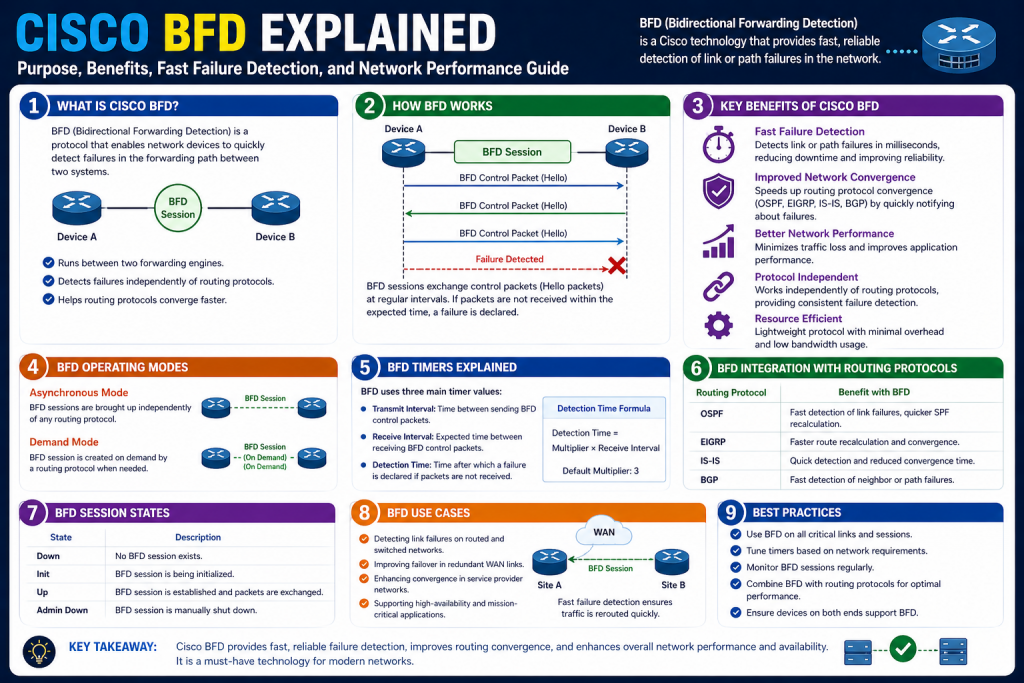
Bidirectional Forwarding Detection, commonly referred to as BFD, is a lightweight and highly efficient network protocol designed to detect faults between two forwarding devices such as routers or switches. Its primary purpose is to provide extremely fast detection of connectivity issues so that corrective actions can be taken immediately. In modern networking environments where uptime and performance are critical, even a delay of a few seconds can lead to noticeable disruptions. BFD addresses this challenge by operating at very high speeds and ensuring that failures are identified within milliseconds.
In traditional network setups, routers rely on routing protocols to determine whether a path is still valid. These protocols use timers to monitor neighbor relationships. However, these timers are often not fast enough for today’s real-time applications. BFD enhances this process by introducing a dedicated mechanism for failure detection that operates independently of routing protocols. This separation allows networks to achieve both speed and stability without overloading routing processes.
The importance of BFD continues to grow as networks become more complex and distributed. From enterprise environments to service provider infrastructures, BFD plays a key role in maintaining seamless communication across systems.
The Need for Rapid Fault Detection
Modern networks support a wide range of applications that require continuous connectivity. Services such as voice communication, video conferencing, cloud computing, and online transactions depend on stable and uninterrupted network performance. Even a brief interruption can lead to degraded user experience, lost data, or financial impact.
Before the introduction of BFD, routing protocols like OSPF, EIGRP, and BGP were responsible for detecting failures. These protocols use hello packets and dead timers to determine whether a neighbor is still reachable. While this method works, it often takes several seconds to detect a failure. In some cases, this delay is unacceptable.
Reducing timer values can improve detection speed, but it comes with trade-offs. Extremely low timers can increase CPU usage and lead to instability, especially in large networks. This creates a need for a more efficient and scalable solution.
BFD was developed to address these limitations. By using lightweight packets and operating at high frequency, it can detect failures much faster without placing a heavy burden on network resources. This capability makes it ideal for environments where performance and reliability are critical.
Origins and Development of BFD
BFD was standardized by the Internet Engineering Task Force in 2010 as a solution for rapid fault detection. As networks evolved and the demand for high-speed communication increased, it became clear that existing mechanisms were not sufficient. The goal of BFD was to create a simple, protocol-independent method for detecting failures across different types of networks.
One of the key design principles behind BFD was simplicity. The protocol was designed to be easy to implement and compatible with various routing protocols and technologies. This flexibility has contributed to its widespread adoption across different vendors and platforms.
Another important aspect of BFD’s development was its focus on efficiency. The protocol uses minimal bandwidth and processing power, allowing it to operate effectively even in large-scale deployments. This balance between speed and efficiency has made BFD a standard feature in modern networking.
Core Concept of Bidirectional Monitoring
The term bidirectional in BFD refers to the way devices monitor each other. In a BFD session, two devices establish a relationship where both sides continuously send and receive control packets. These packets act as signals that confirm the availability of the communication path.
If both devices continue to receive packets as expected, the connection is considered healthy. However, if one device stops receiving packets within a specified time, it assumes that the path has failed. This triggers an immediate response.
This bidirectional approach ensures that failures are detected regardless of direction. Whether the issue occurs on the sending side, receiving side, or somewhere along the path, BFD can quickly identify the problem.
The continuous exchange of packets creates a reliable mechanism for monitoring connectivity. Because these packets are small and sent at frequent intervals, they provide real-time insight into the state of the network.
Understanding Forwarding Plane Detection
One of the distinguishing features of BFD is that it operates in the forwarding plane rather than relying solely on the control plane. The forwarding plane is responsible for the actual movement of data packets through the network.
By working in this layer, BFD can detect failures that may not be visible to control plane protocols. For example, a routing protocol might still consider a neighbor reachable even if there is a problem in the data forwarding path. BFD eliminates this gap by directly monitoring the path used for traffic.
This capability makes BFD particularly useful in complex network environments where multiple layers and technologies are involved. It ensures that failures affecting actual data transmission are detected quickly and accurately.
Key Features of Cisco BFD
Cisco BFD includes several features that make it an essential tool for network reliability. One of the most important features is its speed. BFD can detect failures in milliseconds, which is significantly faster than traditional methods.
Another key feature is its protocol independence. BFD does not rely on any specific routing protocol, allowing it to work seamlessly with multiple protocols at the same time. This makes it a versatile solution for diverse network environments.
Efficiency is another important characteristic. BFD packets are small and require minimal processing, reducing the impact on network resources. This allows it to scale effectively in large networks without causing performance issues.
BFD also supports flexible configuration. Network administrators can adjust parameters such as transmission intervals and detection multipliers to suit their specific requirements. This level of control allows for fine-tuning based on network conditions.
Role of BFD in Network Convergence
Network convergence is the process by which routers adapt to changes in the network and determine new paths for data transmission. When a failure occurs, routers must quickly identify the issue and update their routing tables to maintain connectivity.
BFD plays a critical role in this process by providing rapid failure detection. Once a problem is detected, BFD immediately notifies the associated routing protocols. These protocols then begin the process of recalculating routes.
Without BFD, the detection phase of convergence can take longer, leading to delays in recovery. This can result in packet loss and degraded performance. By reducing detection time, BFD helps minimize the overall convergence time.
This improvement is especially important in environments where high availability is required. Faster convergence means that users experience fewer disruptions and applications continue to function smoothly.
Interaction with Routing Protocols
Although BFD is responsible for detecting failures, it does not make routing decisions. Instead, it works alongside routing protocols by providing them with timely information about network conditions.
When a BFD session detects a failure, it sends a notification to the routing protocol associated with that session. The routing protocol then takes action by recalculating routes and updating the routing table.
This separation of responsibilities allows each component to focus on its specific role. BFD handles detection, while routing protocols handle decision-making. This approach improves efficiency and simplifies network design.
Protocols such as OSPF, EIGRP, and BGP can all benefit from BFD. By integrating BFD, these protocols can respond more quickly to changes in the network.
Advantages of Using Cisco BFD
The use of Cisco BFD provides several advantages in network environments. One of the most significant benefits is improved reliability. By detecting failures quickly, BFD helps ensure that networks remain operational even when issues occur.
Another advantage is reduced downtime. Faster detection leads to faster recovery, minimizing the impact of failures on users and applications. This is particularly important for businesses that rely on continuous connectivity.
BFD also enhances performance. By enabling rapid convergence, it helps maintain optimal data flow and reduces latency. This results in a better overall user experience.
Scalability is another key benefit. Because BFD is lightweight and efficient, it can be deployed in large networks without causing excessive overhead. This makes it suitable for both small and large environments.
Real-World Applications of BFD
BFD is widely used in various types of networks to improve reliability and performance. In enterprise networks, it is often used to enhance the behavior of routing protocols and ensure fast recovery from failures.
In service provider networks, BFD plays a crucial role in maintaining high availability. These networks must support a large number of users and services, making fast fault detection essential.
Data centers also benefit from BFD. With the increasing use of virtualization and cloud technologies, data centers require efficient mechanisms for maintaining connectivity. BFD helps ensure that traffic is quickly rerouted in case of failures.
In addition, BFD is used in scenarios involving redundant paths. By monitoring multiple paths simultaneously, it ensures that backup routes are ready to take over when needed.
Challenges Without BFD
Without BFD, networks rely solely on routing protocols for failure detection. This can lead to slower detection times and increased convergence delays. In environments with strict performance requirements, this can be a significant limitation.
Long detection times can result in packet loss, service interruptions, and reduced application performance. Users may experience delays, dropped connections, or degraded quality in real-time services.
In addition, adjusting routing protocol timers to achieve faster detection can introduce instability. This makes it difficult to balance speed and reliability using traditional methods alone.
BFD addresses these challenges by providing a dedicated solution for fast and reliable failure detection.
Importance for Network Professionals
Understanding BFD is essential for anyone working in networking. As networks continue to evolve, the ability to maintain high availability and performance becomes increasingly important.
BFD is commonly included in certification exams and training programs because of its significance in modern network design. Network professionals are expected to understand how it works and how it can be implemented effectively.
By mastering BFD, professionals can design networks that are more resilient and capable of handling failures efficiently. This knowledge is valuable in both enterprise and service provider environments.
Overview of BFD Operation
Bidirectional Forwarding Detection operates through a continuous and structured exchange of control messages between two network devices. These devices form a logical relationship known as a BFD session. The purpose of this session is to constantly verify that the communication path between them remains active and reliable.
Unlike traditional mechanisms that depend on relatively slow timers, BFD functions at a much higher frequency. It sends small packets at very short intervals, often measured in milliseconds. This rapid communication allows devices to detect failures almost instantly.
The operation of BFD can be understood as a cycle that includes session establishment, packet exchange, failure detection, notification, and recovery. Each stage plays a specific role in ensuring that the network remains stable and responsive.
BFD Session Establishment
The first step in BFD operation is the creation of a session between two devices. A session is essentially an agreement between the devices to monitor each other’s status.
When BFD is enabled on two neighboring routers, they begin by exchanging control packets to initiate communication. During this phase, each device shares information such as desired transmission intervals and detection parameters.
Once both sides agree on the session parameters, the session transitions into an active state. This state indicates that both devices are ready to begin continuous monitoring.
Sessions can be established over various types of connections, including physical links, logical interfaces, and even across routed paths. This flexibility allows BFD to be used in a wide range of network scenarios.
Control Packet Exchange
After a session is established, the devices begin exchanging control packets at regular intervals. These packets are often referred to as hello packets, although in BFD terminology they are simply control messages.
Each packet contains important information, including the state of the sender and timing values. These messages are intentionally small to minimize bandwidth usage and processing overhead.
The frequency of packet transmission is determined by configuration settings. In many cases, packets are sent every few milliseconds, allowing for extremely fast detection of issues.
Both devices in the session continuously send and receive these packets. This ongoing exchange creates a real-time monitoring system that ensures the health of the connection is always known.
Timing and Detection Mechanism
One of the most important aspects of BFD is its timing mechanism. Each device maintains a timer that determines how long it should wait before considering the connection to be down.
This timer is influenced by two key parameters: the transmission interval and the detection multiplier. The transmission interval defines how often packets are sent, while the detection multiplier determines how many missed packets will trigger a failure condition.
For example, if packets are sent every 10 milliseconds and the detection multiplier is set to three, the device will declare a failure if it misses three consecutive packets. This means a failure can be detected in as little as 30 milliseconds.
This approach provides a balance between speed and reliability. By adjusting these parameters, network administrators can fine-tune BFD to meet the specific needs of their environment.
BFD Session States
BFD sessions operate through a series of defined states that represent the current status of the connection. These states help devices coordinate their monitoring activities.
The initial state is known as down. In this state, no active session exists, and devices are not yet monitoring each other.
When communication begins, the session moves to the init state. This indicates that one device has started the process but is still waiting for confirmation from the other side.
Once both devices acknowledge each other, the session enters the up state. This is the normal operating state where continuous monitoring occurs.
If a problem is detected, the session transitions back to the down state. This triggers notifications to routing protocols and initiates recovery processes.
These state transitions are critical for maintaining accurate information about network conditions.
Fault Detection Process
The core function of BFD is to detect failures quickly and accurately. This is achieved through the continuous monitoring of incoming control packets.
If a device fails to receive packets within the expected time frame, it assumes that the connection has been lost. This could be due to a physical link failure, a device malfunction, or an issue somewhere along the path.
Because BFD operates at high speed, it can identify these problems almost immediately. This rapid detection is one of the main reasons BFD is so valuable in modern networks.
Once a failure is detected, the device does not attempt to fix the issue itself. Instead, it focuses on informing other components of the network so that appropriate action can be taken.
Notification to Routing Protocols
After detecting a failure, BFD sends a notification to any routing protocols that are using the session. This communication is essential for triggering the next stage of the recovery process.
Routing protocols rely on accurate information about network conditions to make decisions. By providing immediate updates, BFD ensures that these protocols can respond without delay.
For example, if BFD detects that a link used by a routing protocol is no longer available, it will signal the protocol to stop using that path. The protocol will then search for an alternative route.
This collaboration between BFD and routing protocols allows networks to adapt quickly to changes and maintain connectivity.
Convergence and Route Recalculation
Once a routing protocol receives a failure notification from BFD, it begins the process of convergence. This involves recalculating routes and updating the routing table to reflect the new network topology.
During this phase, the protocol identifies the best available alternative paths and redirects traffic accordingly. The speed of this process is greatly improved by the rapid detection capabilities of BFD.
Without BFD, routing protocols would need to rely on their own timers to detect failures. This would delay the start of convergence and increase the overall recovery time.
By accelerating the detection phase, BFD helps ensure that convergence happens as quickly as possible.
Recovery and Stabilization
After the network has adapted to the failure, BFD continues to play a role in ensuring stability. Once the issue is resolved and connectivity is restored, the BFD session is reestablished.
Devices resume the exchange of control packets and verify that the connection is once again reliable. The session returns to the up state, indicating normal operation.
This continuous monitoring ensures that any future issues are detected just as quickly. It also provides confidence that the network is functioning correctly after a disruption.
Stabilization is an important part of the overall process, as it confirms that the network has fully recovered.
Types of BFD Sessions
BFD supports different types of sessions to accommodate various network configurations. One common type is asynchronous mode, where devices independently send control packets at regular intervals.
Another type is demand mode, which reduces the frequency of packet transmission when the connection is stable. In this mode, devices rely on other mechanisms to verify connectivity and only use BFD when necessary.
Asynchronous mode is the most widely used because it provides continuous monitoring. Demand mode is less common but can be useful in environments where reducing overhead is a priority.
These options give network administrators the flexibility to choose the approach that best fits their needs.
Echo Function in BFD
BFD includes an optional feature known as the echo function. This mechanism allows a device to send packets that are looped back by the receiving device.
The purpose of the echo function is to test the forwarding path more directly. Instead of relying solely on control packets, it verifies that data can travel through the network and return successfully.
This provides an additional layer of assurance that the path is functioning correctly. It is particularly useful in scenarios where deeper validation of the forwarding plane is required.
However, the echo function is not always necessary and may not be supported in all configurations.
Scalability and Efficiency
One of the strengths of BFD is its ability to scale effectively in large networks. Because the protocol uses small packets and minimal processing, it can support a large number of sessions without overwhelming network resources.
This efficiency is especially important in environments such as service provider networks, where thousands of connections may need to be monitored simultaneously.
BFD achieves this scalability by keeping its design simple and focused. It avoids unnecessary complexity and concentrates on its core function of failure detection.
As a result, it can be deployed widely without causing significant performance issues.
Security Considerations
While BFD is primarily focused on performance, it is also important to consider security. Because BFD relies on the exchange of control packets, it can be vulnerable to certain types of attacks if not properly configured.
For example, an attacker could attempt to disrupt BFD sessions by sending false packets or blocking legitimate ones. This could lead to incorrect failure detection and unnecessary route changes.
To mitigate these risks, network administrators can implement security measures such as authentication and filtering. These measures help ensure that only trusted devices can participate in BFD sessions.
Proper configuration and monitoring are essential for maintaining both performance and security.
Practical Example of BFD Operation
Consider a network with two routers connected by a high-speed link. BFD is enabled on both devices to monitor the connection.
The routers establish a session and begin exchanging control packets every few milliseconds. As long as the packets are received on time, the connection is considered healthy.
If the link fails, one router will stop receiving packets. Within a short period, it will detect the failure and notify the routing protocol.
The routing protocol will then select an alternative path and update the routing table. Traffic is redirected, and communication continues with minimal disruption.
Once the link is restored, the BFD session is reestablished, and normal monitoring resumes.
Introduction to BFD Implementation
After understanding what Bidirectional Forwarding Detection is and how it operates internally, the next step is learning how it is implemented in real network environments. Implementation is where theory meets practice. It involves enabling the protocol, configuring it on specific interfaces, verifying its operation, and optimizing it based on network requirements.
Cisco BFD is designed to be straightforward to deploy, but it still requires careful planning. Every participating device must be configured correctly, and parameters must be aligned between neighboring routers. Even though BFD is lightweight, improper configuration can lead to instability or unnecessary resource usage.
A successful implementation ensures that BFD enhances network performance without introducing new challenges. This section explores the process, considerations, and strategies for deploying BFD effectively.
Preparing for BFD Deployment
Before enabling BFD, it is important to evaluate the network environment. This includes identifying which routers and links will benefit from fast failure detection. Not every interface may require BFD, so selective deployment is often the best approach.
Network administrators should begin by creating a clear inventory of devices and connections. Understanding the topology helps determine where BFD will provide the most value. For example, critical links that carry high volumes of traffic or support real-time applications are ideal candidates.
Another important consideration is hardware capability. While most modern Cisco devices support BFD, older equipment may have limitations. It is essential to verify compatibility and ensure that devices can handle the desired configuration.
Planning also involves deciding on timer values and detection parameters. These settings should be chosen carefully to balance speed and stability.
Enabling BFD Globally
The first step in configuration is enabling BFD at a global level on each participating router. This action activates the protocol and allows it to be used on interfaces.
Global configuration ensures that the router is ready to establish BFD sessions. Without this step, interface-level configuration will not function properly.
Once enabled globally, BFD becomes available for use across the device. However, it does not automatically start monitoring all interfaces. Additional configuration is required to define where it will operate.
This separation between global and interface-level configuration provides flexibility and control.
Configuring BFD on Interfaces
After enabling BFD globally, the next step is to apply it to specific interfaces. Routers typically have multiple interfaces, and BFD must be configured individually on each one that requires monitoring.
Interface configuration involves specifying parameters such as transmission interval, minimum receive interval, and detection multiplier. These values determine how frequently packets are sent and how quickly failures are detected.
It is important to ensure that both ends of a connection use compatible settings. Mismatched parameters can prevent sessions from forming or lead to inconsistent behavior.
Applying BFD to the correct interfaces ensures that critical paths are monitored effectively. This targeted approach avoids unnecessary overhead on less important links.
Understanding Configuration Parameters
BFD configuration includes several parameters that influence its behavior. The transmission interval defines how often control packets are sent. Shorter intervals result in faster detection but increase the number of packets transmitted.
The minimum receive interval specifies how often a device expects to receive packets from its neighbor. This value helps synchronize communication between devices.
The detection multiplier determines how many missed packets will trigger a failure condition. A higher multiplier provides more tolerance for packet loss, while a lower value results in faster detection.
These parameters must be carefully balanced. Extremely aggressive settings can lead to false positives, while overly relaxed settings may delay failure detection.
Fine-tuning these values is essential for achieving optimal performance.
Verifying BFD Configuration
After configuration is complete, verification is a critical step. Network administrators must confirm that BFD sessions are established and operating correctly.
Verification commands provide information about session status, interface details, and timer values. These tools help identify issues such as mismatched configurations or connectivity problems.
A properly functioning session should show a status of up, indicating that both devices are successfully exchanging control packets.
If sessions remain in a down or init state, troubleshooting is required. This may involve checking interface settings, connectivity, or parameter alignment.
Regular verification ensures that BFD continues to operate as expected over time.
Troubleshooting Common Issues
While BFD is designed to be reliable, issues can still arise during deployment. One common problem is mismatched configuration between devices. If timer values or parameters differ significantly, sessions may fail to establish.
Another issue is network congestion. Although BFD packets are small, excessive traffic can still cause packet loss. This may lead to false failure detection if settings are too aggressive.
Hardware limitations can also affect performance. Devices with limited processing power may struggle to handle large numbers of BFD sessions.
Troubleshooting involves analyzing session status, reviewing configuration, and monitoring network conditions. Adjustments may be needed to ensure stable operation.
A systematic approach helps resolve issues efficiently.
Best Practices for BFD Deployment
Implementing BFD successfully requires following best practices. One important guideline is to deploy BFD selectively. Not all links require rapid failure detection, so focusing on critical paths is more efficient.
Another best practice is to use reasonable timer values. While it may be tempting to configure extremely low intervals, this can lead to instability. Choosing balanced settings ensures both speed and reliability.
Consistency is also important. Ensuring that configuration parameters match across devices helps prevent issues during session establishment.
Monitoring and maintenance are equally important. Regularly checking BFD sessions and reviewing performance helps identify potential problems early.
Finally, testing changes in a controlled environment before applying them to production networks reduces risk.
Integration with Advanced Network Designs
BFD is often used in advanced network designs that require high availability. In networks with redundant paths, BFD ensures that backup routes are activated quickly when primary paths fail.
In data center environments, BFD supports fast failover between switches and routers. This is particularly important in architectures that rely on load balancing and redundancy.
Service provider networks also benefit from BFD. These environments must deliver consistent performance to large numbers of users, making fast fault detection essential.
BFD integrates seamlessly with various technologies, allowing it to enhance different types of network designs.
Impact on Network Performance
When implemented correctly, BFD has a positive impact on network performance. By reducing failure detection time, it minimizes downtime and ensures that traffic is rerouted quickly.
This leads to improved application performance and better user experience. Real-time services such as voice and video benefit significantly from faster recovery.
However, improper configuration can have negative effects. Excessively aggressive settings can increase CPU usage and cause unnecessary session flapping.
Balancing performance and resource usage is key to maximizing the benefits of BFD.
Security and Stability Considerations
Although BFD is primarily focused on performance, it also plays a role in network stability. Incorrect failure detection can lead to unnecessary route changes, which may disrupt traffic.
To maintain stability, it is important to use appropriate configuration values and monitor network conditions. Avoiding overly aggressive timers helps prevent false detections.
Security is another consideration. BFD sessions should be protected to prevent unauthorized interference. Implementing authentication and filtering can help ensure that only trusted devices participate.
Maintaining both security and stability is essential for reliable network operation.
Future of BFD in Networking
As networks continue to evolve, the role of BFD is expected to grow. With the increasing adoption of cloud computing, virtualization, and software-defined networking, the need for fast and reliable fault detection remains critical.
BFD is well-suited to meet these demands due to its simplicity and efficiency. It can be integrated into new technologies and adapted to changing network requirements.
Future developments may focus on improving scalability, enhancing security features, and supporting new types of network architectures.
Despite these changes, the core purpose of BFD will remain the same: providing rapid and reliable detection of network failures.
Practical Deployment Scenario
Consider a network with multiple routers connected through redundant links. BFD is configured on all critical interfaces to monitor connectivity.
Each router establishes BFD sessions with its neighbors and begins exchanging control packets. The network operates normally, with all sessions in the up state.
If one link fails, BFD quickly detects the loss of packets and notifies the routing protocol. The protocol recalculates routes and directs traffic through an alternative path.
This process happens so quickly that users may not notice any disruption. Once the failed link is restored, BFD reestablishes the session and resumes monitoring.
This scenario demonstrates how BFD enhances reliability and ensures continuous communication.
Importance in Professional Networking Skills
Knowledge of BFD is an essential skill for network professionals. It is commonly included in certification exams and practical training programs.
Understanding how BFD functions in real-world environments gives professionals a strong advantage when designing and maintaining resilient networks. It is not only about knowing the theory behind BFD, but also about being able to configure it correctly, interpret its behavior, and troubleshoot issues when they arise.
In many certification paths, BFD appears as part of advanced routing topics because it directly impacts network convergence and high availability. Candidates are often expected to understand how BFD interacts with routing protocols, how to tune its timers, and how to verify its operation using command-line tools. This practical knowledge ensures that professionals are prepared to handle real network challenges rather than just theoretical scenarios.
Beyond exams, BFD knowledge is valuable in day-to-day network operations. Engineers frequently deal with environments where uptime is critical, and quick failure detection can make a significant difference. Being familiar with BFD allows them to reduce downtime, improve network performance, and support applications that rely on stable connectivity. As networks continue to grow in complexity, having hands-on experience with protocols like BFD becomes an increasingly important part of a network professional’s skill set.
Understanding how to configure, verify, and troubleshoot BFD enables professionals to design more resilient networks. This expertise is valuable in both enterprise and service provider environments.
As networks become more complex, the ability to implement efficient fault detection mechanisms becomes increasingly important.
Mastering BFD contributes to overall networking proficiency.
Conclusion
Cisco Bidirectional Forwarding Detection is a powerful and efficient protocol that significantly improves network reliability. By providing rapid fault detection, it allows networks to respond quickly to failures and maintain continuous connectivity.
Through its lightweight design and protocol independence, BFD integrates seamlessly with routing protocols and enhances their performance. Its ability to operate in the forwarding plane ensures accurate detection of real network issues.
Implementing BFD requires careful planning, proper configuration, and ongoing monitoring. When deployed correctly, it reduces downtime, improves convergence, and supports high-performance networking.
From enterprise systems to large-scale service provider environments, BFD plays a crucial role in modern network design. Its importance continues to grow as networks demand faster response times and greater resilience.
A strong understanding of BFD equips network professionals with the tools needed to build stable, efficient, and reliable networks that can handle the challenges of today’s digital world.
Continue exploring the technologies and certification concepts that matter most to you.