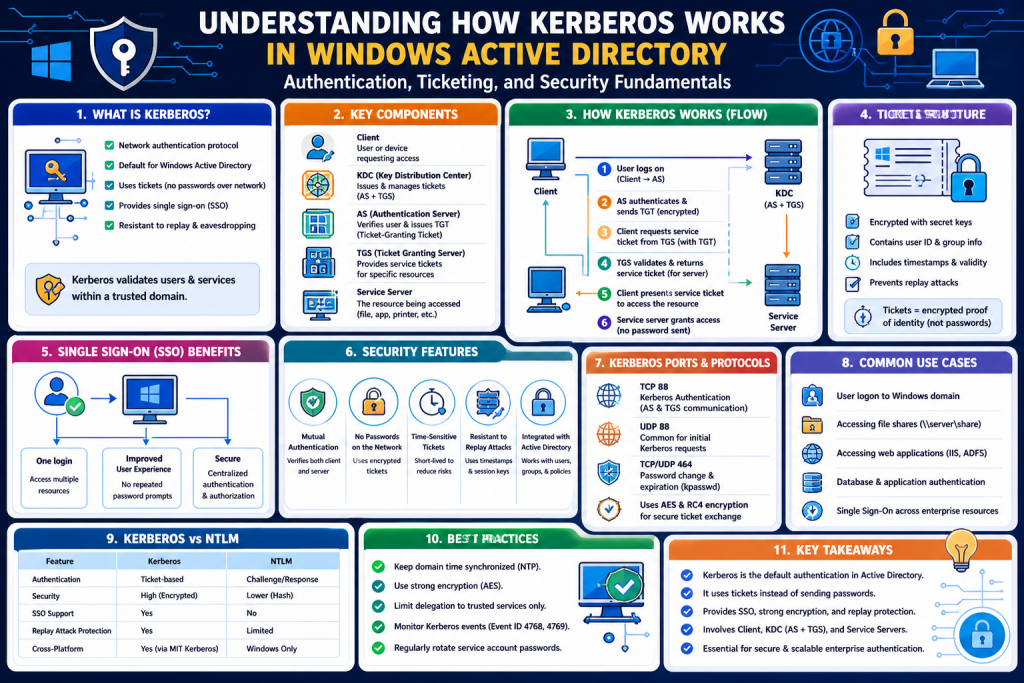
Kerberos is a foundational authentication protocol used within Windows Active Directory environments to securely verify the identity of users and systems. It operates behind the scenes whenever a user logs into a domain-joined computer or attempts to access network resources such as file servers, applications, or databases. Although it is deeply integrated into everyday IT operations, many professionals only interact with its outcomes rather than understanding its internal mechanisms.
The primary goal of Kerberos is to provide a secure method of authentication over networks that may not be completely trusted. Instead of transmitting sensitive information like passwords repeatedly, Kerberos uses encrypted tickets that act as proof of identity. This approach reduces the risk of credential theft and strengthens overall security.
In an Active Directory environment, Kerberos is the default authentication protocol. This means that whenever possible, systems rely on Kerberos rather than older or less secure methods. Its design ensures that both users and services can trust the authentication process, creating a reliable framework for secure communication across the network.
Understanding Kerberos is not just an academic exercise. It has practical implications for troubleshooting, system design, and security management. When authentication issues arise, they are often tied to Kerberos in some way. A clear understanding of how it works can make it much easier to diagnose and resolve these problems.
Why Secure Authentication Is Necessary
In any networked environment, authentication is the first line of defense against unauthorized access. Without a reliable method to verify identity, systems would be vulnerable to misuse, data breaches, and other security threats. This is especially important in enterprise environments where sensitive information is stored and accessed regularly.
Even within internal networks, security cannot be taken for granted. Devices may be compromised, users may unknowingly expose credentials, and attackers may gain access through various means. As a result, every authentication request must be treated as potentially risky.
Kerberos addresses these concerns by ensuring that sensitive information is never exposed unnecessarily. Instead of sending passwords across the network, it relies on encrypted exchanges and time-limited credentials. This significantly reduces the attack surface and makes it much harder for attackers to intercept or reuse authentication data.
Another important aspect of secure authentication is accountability. Organizations need to track who is accessing resources and ensure that permissions are enforced correctly. Kerberos supports this by embedding user identity and group membership information within its tickets, allowing services to make informed access control decisions.
The Evolution of Authentication Protocols
Before Kerberos became widely adopted, many systems relied on simpler authentication methods. These methods often involved transmitting passwords in ways that were not adequately protected. As networks grew and threats became more sophisticated, it became clear that a more secure approach was needed.
Kerberos was developed to address these shortcomings. Its design focuses on minimizing the exposure of sensitive data while maintaining efficiency and usability. Over time, it became the standard for secure authentication in many environments, particularly those using Active Directory.
The transition to Kerberos represented a significant shift in how authentication was handled. Instead of each service verifying users independently, a centralized authority was introduced. This authority is responsible for validating identities and issuing credentials that can be trusted across the network.
This centralized model simplifies management and improves security. Administrators can enforce policies consistently, and users benefit from a seamless authentication experience. Once authenticated, they can access multiple resources without repeatedly entering their credentials.
Core Principles Behind Kerberos
Kerberos is built on several key principles that define how it operates. One of the most important is the concept of mutual authentication. This means that not only does the user prove their identity to the service, but the service also proves its identity to the user. This helps prevent scenarios where users unknowingly connect to malicious systems.
Another principle is the use of encrypted tickets instead of passwords. These tickets are issued by a trusted authority and can be used to access specific resources. Because they are encrypted, they cannot be easily forged or tampered with.
Kerberos also relies heavily on symmetric encryption. In this model, both the sender and receiver use the same secret key to encrypt and decrypt data. This approach is efficient and well-suited for the types of exchanges that occur during authentication.
Time synchronization is another critical element. Each ticket includes timestamps that define when it is valid. Systems must have closely aligned clocks to ensure that these timestamps can be verified accurately. If there is too much difference in time, authentication may fail.
Key Components of the Kerberos System
To understand how Kerberos works, it is helpful to identify the main components involved in the process. Each component has a specific role and contributes to the overall flow of authentication.
The first component is the client. This is the user or device that is attempting to access a resource. The client initiates the authentication process and interacts with the central authority to obtain the necessary credentials.
The second component is the service. This refers to the resource that the client wants to access. It could be a file server, web application, database, or any other system that requires authentication.
The third component is the Key Distribution Center. In a Windows environment, this role is performed by the domain controller. The Key Distribution Center is responsible for verifying identities and issuing tickets.
Within the Key Distribution Center, there are two important services. The Authentication Service handles the initial verification of the client, while the Ticket Granting Service issues tickets for accessing specific resources.
The Role of the Client in Authentication
The client plays an active role in the Kerberos authentication process. Rather than simply sending credentials and waiting for a response, it performs several tasks that contribute to the overall security of the system.
When a user logs in, the client generates an authentication request. This request includes information that proves the user’s identity, such as encrypted data derived from their password. The client then sends this request to the Key Distribution Center.
Once the client receives a response, it stores the information securely in memory. This includes tickets and session keys that will be used for future interactions. By managing these credentials locally, the client reduces the need for repeated communication with the central authority.
The client is also responsible for presenting tickets when accessing services. Each time a resource is requested, the client includes the appropriate ticket to prove its identity. This process is transparent to the user, who experiences it as seamless access to network resources.
The Role of the Key Distribution Center
The Key Distribution Center is the central authority in the Kerberos system. It is responsible for verifying identities and issuing the credentials that clients use to access services. Because of its critical role, it must be highly secure and reliable.
When the Key Distribution Center receives an authentication request, it verifies the information provided by the client. This involves decrypting the request and comparing it with stored data. If the request is valid, the Key Distribution Center issues a Ticket Granting Ticket.
The Ticket Granting Ticket serves as proof that the client has been authenticated. It can be used to request additional tickets for accessing specific services. This eliminates the need for the client to repeatedly prove its identity.
The Key Distribution Center also manages the keys used for encryption. These keys are essential for protecting the integrity and confidentiality of the authentication process. By controlling these keys, the Key Distribution Center ensures that only authorized parties can participate in the system.
The Role of Services in Kerberos
Services are the endpoints that clients want to access. They rely on Kerberos to verify the identity of clients and determine whether access should be granted. This allows services to focus on their primary functions without having to manage authentication independently.
When a service receives a request, it examines the ticket provided by the client. This ticket contains information about the user, including their identity and group memberships. The service uses this information to make access control decisions.
Because the ticket is encrypted with the service’s secret key, the service can trust that it was issued by the Key Distribution Center. This eliminates the need for direct communication with the central authority during each request.
Services also benefit from the efficiency of Kerberos. Since clients manage their own tickets, services do not need to handle repeated authentication requests. This reduces overhead and improves performance.
The Concept of Tickets in Kerberos
Tickets are the core mechanism through which Kerberos operates. They act as secure tokens that represent a user’s identity and permissions. Instead of sending passwords, clients present tickets to prove who they are.
There are two main types of tickets in Kerberos. The first is the Ticket Granting Ticket, which is issued after the initial authentication. The second is the service ticket, which is used to access specific resources.
Each ticket contains encrypted information that can only be read by the intended recipient. This ensures that tickets cannot be forged or altered. It also means that even if a ticket is intercepted, it cannot be used without the proper keys.
Tickets have a limited lifespan, which helps prevent misuse. Once a ticket expires, the client must obtain a new one. This ensures that access is continuously validated and reduces the risk of unauthorized use.
The Importance of Session Keys
In addition to tickets, Kerberos uses session keys to secure communication between clients and services. These keys are generated during the authentication process and are used to encrypt data exchanged between parties.
Session keys provide an additional layer of security. Even if an attacker were able to intercept a ticket, they would still need the corresponding session key to use it. This makes it much more difficult to compromise the system.
Each interaction between a client and a service may involve a different session key. This limits the impact of any potential breach and ensures that communication remains secure.
Time Synchronization and Its Impact
Time plays a crucial role in the Kerberos authentication process. Each ticket includes timestamps that define when it is valid. Systems must have synchronized clocks to ensure that these timestamps can be verified correctly.
If there is a significant difference between system clocks, authentication may fail. This is because the system may interpret a valid ticket as expired or not yet valid. To prevent this, organizations typically use centralized time servers to maintain synchronization.
Time-based validation also helps prevent replay attacks. By limiting the validity of tickets, Kerberos ensures that intercepted data cannot be reused indefinitely. This adds an important layer of protection against certain types of attacks.
How Kerberos Enables Single Sign-On
One of the most significant advantages of Kerberos is its support for single sign-on. This allows users to authenticate once and then access multiple resources without repeatedly entering their credentials.
When a user logs in, they receive a Ticket Granting Ticket. This ticket can be used to request service tickets for various resources. As a result, the user can move seamlessly between different systems without additional authentication prompts.
Single sign-on improves both security and usability. It reduces the likelihood of password fatigue, where users reuse or weaken passwords due to frequent prompts. It also simplifies the user experience, making it easier to work efficiently.
Preparing for the Authentication Flow
Before diving into the detailed steps of Kerberos authentication, it is important to understand how all the components fit together. The client, Key Distribution Center, and services each play a role in a coordinated process that ensures secure access.
The client initiates the process by requesting authentication. The Key Distribution Center verifies the request and issues tickets. The client then uses these tickets to access services, which validate them and grant access.
This flow may seem complex at first, but it follows a logical sequence. Each step builds on the previous one, creating a chain of trust that extends from the user to the resource.
By understanding these foundational concepts, it becomes much easier to grasp the detailed workings of Kerberos. This knowledge provides a strong base for exploring more advanced topics and troubleshooting real-world issues.
The Initial Login and Authentication Request
The Kerberos authentication process begins the moment a user signs in to a domain-joined system. At this stage, the user provides credentials, typically a username and password. Unlike older authentication systems, the password is not transmitted across the network in plain form. Instead, the client system immediately uses the password to generate a cryptographic key.
This key becomes the foundation for secure communication with the Key Distribution Center. The client prepares an authentication request that includes identifying information such as the username and a timestamp. The timestamp is important because it helps ensure that the request is fresh and not a replay of an earlier attempt.
The client encrypts part of this request using the key derived from the user’s password. This encrypted data proves that the client possesses the correct password without actually revealing it. The request is then sent to the Authentication Service, which is a component of the Key Distribution Center located on the domain controller.
From the user’s perspective, this entire process happens instantly during login. Behind the scenes, however, several cryptographic operations are taking place to ensure that the identity being presented is legitimate and secure.
The Role of the Authentication Service
When the Authentication Service receives the request, it begins the process of verifying the user’s identity. It looks up the user in the directory and retrieves the stored version of the user’s secret key, which is derived from the same password.
Using this stored key, the Authentication Service attempts to decrypt the encrypted portion of the client’s request. If the decryption is successful and the timestamp is valid, the system can be confident that the client knows the correct password. This confirmation forms the basis of authentication.
At this point, the Authentication Service does not grant access to any specific resource. Instead, it issues a Ticket Granting Ticket. This ticket serves as a kind of master credential that the client can use to request access to other services without having to re-enter the password.
The Ticket Granting Ticket is encrypted using a secret key that only the Ticket Granting Service can read. This ensures that the client cannot tamper with it. Along with the ticket, the Authentication Service also sends a session key encrypted with the user’s key. The client decrypts this session key using its password-derived key and stores it for future use.
Understanding the Ticket Granting Ticket
The Ticket Granting Ticket, often referred to as the TGT, is one of the most important elements in the Kerberos process. It represents proof that the user has been successfully authenticated by the system.
The TGT contains several pieces of information, including the user’s identity, a timestamp, and a session key. All of this data is encrypted, ensuring that it cannot be read or altered by unauthorized parties. Because the ticket is encrypted with the Key Distribution Center’s secret key, only the Ticket Granting Service can decrypt it.
The client stores the TGT in memory, typically in a secure cache. This storage is temporary and tied to the user’s session. As long as the ticket remains valid, the client can use it to request access to various services without repeating the initial authentication process.
This design is what enables single sign-on. The user logs in once, and the system handles subsequent authentication requests automatically using the stored ticket.
Requesting Access to a Service
After obtaining a Ticket Granting Ticket, the client is ready to request access to a specific resource. This could be anything from a shared folder to a web application hosted within the domain.
To initiate this process, the client sends a request to the Ticket Granting Service. This request includes the TGT and an authenticator. The authenticator is a piece of data generated by the client that includes a timestamp and is encrypted using the session key obtained earlier.
The inclusion of the authenticator adds an extra layer of security. It proves that the request is coming from the same client that originally received the TGT and that the request is recent. This helps prevent replay attacks.
The Ticket Granting Service decrypts the TGT using its secret key and retrieves the session key. It then uses this session key to decrypt the authenticator. If everything matches and the timestamp is valid, the request is considered legitimate.
Issuing a Service Ticket
Once the Ticket Granting Service has validated the request, it proceeds to issue a service ticket. This ticket is specifically tailored for the resource that the client wants to access.
The service ticket contains information about the user, such as their identity and group memberships. It also includes a new session key that will be used for communication between the client and the service.
This ticket is encrypted using the secret key of the target service. This ensures that only the intended service can decrypt and read the ticket. Along with the ticket, the Ticket Granting Service sends a copy of the session key encrypted with the client’s session key.
The client decrypts this information and stores the service ticket along with the new session key. At this point, the client is fully prepared to authenticate with the target service.
Presenting the Service Ticket to the Resource
With the service ticket in hand, the client initiates a request to the target resource. This request includes the service ticket and another authenticator generated by the client.
The authenticator is encrypted using the session key shared between the client and the service. It includes a timestamp and other identifying information, ensuring that the request is both recent and legitimate.
When the service receives the request, it decrypts the service ticket using its secret key. This reveals the session key and the user’s identity. The service then uses the session key to decrypt the authenticator.
If the information in the authenticator matches the ticket and the timestamp is valid, the service can trust the client’s identity. At this point, authentication is complete, and the service can proceed to authorize access based on its own policies.
Authorization and Access Control
Authentication and authorization are closely related but distinct processes. While Kerberos handles authentication, the service itself is responsible for authorization.
Once the service has verified the client’s identity, it examines the information contained in the ticket. This typically includes the user’s group memberships, which are used to determine permissions.
The service compares this information against its access control rules to decide whether the user should be granted access. If the user has the necessary permissions, access is granted. Otherwise, the request is denied.
This separation of authentication and authorization allows for greater flexibility. Kerberos ensures that identities are verified securely, while individual services enforce their own access policies.
Mutual Authentication Between Client and Service
One of the defining features of Kerberos is mutual authentication. This means that not only does the service verify the client, but the client also verifies the service.
After successfully decrypting the client’s request, the service can send a response that includes proof of its identity. This response is encrypted using the session key shared with the client.
When the client receives this response, it decrypts it and verifies that it matches the expected values. This confirmation assures the client that it is communicating with a legitimate service and not an imposter.
Mutual authentication is especially important in preventing man-in-the-middle attacks, where an attacker attempts to intercept and manipulate communication between two parties.
The Lifecycle of Kerberos Tickets
Kerberos tickets are not valid indefinitely. Each ticket has a defined lifetime, which is included as part of its encrypted data. This lifetime determines how long the ticket can be used before it expires.
The Ticket Granting Ticket typically has a longer lifespan than service tickets. This allows the client to request multiple service tickets without re-authenticating. However, once the TGT expires, the user must log in again or renew the ticket.
Service tickets have shorter lifespans, reflecting the need for more frequent validation of access. This helps ensure that permissions remain up to date and reduces the risk of unauthorized access.
In some cases, tickets can be renewed without requiring the user to re-enter credentials. This is handled automatically by the client, provided that certain conditions are met.
Handling Ticket Expiration and Renewal
When a ticket approaches its expiration time, the client may attempt to renew it. This process involves sending a request to the Key Distribution Center, similar to the original request but with additional information indicating that it is a renewal.
If the renewal is allowed, the Key Distribution Center issues a new ticket with an extended lifetime. This allows the user to continue accessing resources without interruption.
If renewal is not possible, the user may be required to authenticate again. This ensures that long-running sessions do not remain active indefinitely, which could pose a security risk.
Administrators can configure ticket lifetimes and renewal policies based on organizational needs. Balancing convenience and security is key when setting these parameters.
Protecting Against Replay Attacks
Replay attacks occur when an attacker captures valid authentication data and attempts to reuse it to gain unauthorized access. Kerberos includes several mechanisms to prevent this type of attack.
One of the primary defenses is the use of timestamps. Each authenticator includes a timestamp that must fall within a specific time window. If the timestamp is outside this window, the request is rejected.
Additionally, services can maintain a record of recent requests to detect duplicates. If the same authenticator is used more than once, it can be identified as a replay attempt and blocked.
The use of session keys also adds protection. Even if a ticket is intercepted, the attacker would need the corresponding session key to create a valid authenticator.
The Importance of Secure Ticket Storage
The client stores tickets in memory for the duration of the user’s session. This storage must be protected to prevent unauthorized access.
If an attacker gains access to these tickets, they could potentially use them to impersonate the user. This is why modern systems implement various security measures to protect the ticket cache.
These measures may include isolating memory, restricting access to sensitive processes, and using additional authentication factors. Proper system configuration and security practices are essential to maintaining the integrity of the Kerberos process.
Performance and Efficiency of Kerberos
Kerberos is designed to be both secure and efficient. By using tickets and session keys, it reduces the need for repeated authentication requests. This minimizes network traffic and improves performance.
The distribution of workload between the client and the Key Distribution Center also contributes to efficiency. Clients handle much of the processing, allowing the central system to scale more effectively.
Because tickets can be reused within their validity period, users experience faster access to resources. This makes Kerberos well-suited for large and dynamic environments where performance is critical.
Visualizing the Complete Authentication Flow
When viewed as a whole, the Kerberos authentication process follows a logical sequence of steps. The client begins by authenticating with the Key Distribution Center and obtaining a Ticket Granting Ticket. It then uses this ticket to request service tickets for specific resources.
Each interaction involves encrypted communication and validation of identity. The use of tickets creates a chain of trust that extends from the initial login to the final access request.
By breaking down the process into these steps, it becomes easier to understand how Kerberos provides secure and efficient authentication. This understanding is essential for managing and troubleshooting Active Directory environments effectively.
Advanced Concepts in Kerberos Authentication
As environments grow more complex, Kerberos extends beyond simple authentication and begins to support more advanced scenarios. These include delegation, cross-domain authentication, and integration with various enterprise services. Understanding these advanced concepts is essential for administrators who manage large-scale Active Directory infrastructures.
Kerberos is not limited to verifying identity; it also enables systems to act on behalf of users in a controlled and secure manner. This capability is particularly useful in multi-tier applications where one service needs to access another service using the credentials of the original user. Instead of exposing credentials, Kerberos provides a mechanism to delegate access securely.
Another advanced aspect of Kerberos is its ability to function across multiple domains. In large organizations, resources are often distributed across different domains or forests. Kerberos supports trust relationships that allow authentication requests to be validated across these boundaries without compromising security.
These advanced capabilities make Kerberos a flexible and powerful protocol, capable of supporting a wide range of enterprise scenarios.
Understanding Delegation in Kerberos
Delegation is a feature that allows a service to access another service on behalf of a user. This is commonly used in applications that require interaction with multiple backend systems. For example, a web application may need to query a database using the identity of the user who initiated the request.
In a Kerberos environment, delegation must be carefully controlled. Allowing unrestricted delegation could lead to security risks, as a compromised service might impersonate users across the network. To mitigate this risk, Kerberos supports different types of delegation.
Unconstrained delegation allows a service to act on behalf of a user to any service. While this is flexible, it is also risky and generally discouraged in modern environments.
Constrained delegation provides a more secure alternative. It allows a service to delegate user credentials only to specific services defined by administrators. This limits the potential impact of a compromised service.
Resource-based constrained delegation takes this concept further by allowing the target service to define which services are allowed to delegate to it. This approach provides greater control and is widely used in modern deployments.
Cross-Domain and Cross-Forest Authentication
In large organizations, it is common to have multiple domains or even multiple forests within Active Directory. Kerberos supports authentication across these boundaries through trust relationships.
A trust relationship allows one domain to accept authentication requests from another domain. When a user in one domain attempts to access a resource in another, Kerberos facilitates the process by issuing referral tickets.
These referral tickets guide the client to the appropriate Key Distribution Center in the target domain. The client then obtains a service ticket from that domain, allowing access to the resource.
This process may involve multiple steps, especially in complex environments with multiple trust relationships. However, it remains transparent to the user, who experiences seamless access to resources.
Cross-forest authentication follows a similar process but requires additional configuration. Forest trusts must be established, and administrators must ensure that permissions and policies are aligned across environments.
Service Principal Names and Their Importance
Service Principal Names, often referred to as SPNs, are critical to the functioning of Kerberos. An SPN uniquely identifies a service instance within the network. It allows the Key Distribution Center to associate a service request with the correct account.
When a client requests access to a service, it specifies the SPN of that service. The Key Distribution Center uses this information to locate the service account and generate a service ticket.
If SPNs are misconfigured or duplicated, authentication can fail. This is a common issue in Kerberos environments and can be difficult to diagnose without a clear understanding of how SPNs work.
Proper management of SPNs is essential for ensuring reliable authentication. Administrators must ensure that each service has a unique and correctly configured SPN.
Common Kerberos Errors and Their Causes
Despite its robust design, Kerberos is not immune to issues. Understanding common errors and their causes can help administrators resolve problems more effectively.
One frequent issue is related to time synchronization. If the clocks of the client, server, and Key Distribution Center are not aligned, authentication may fail. This is because Kerberos relies heavily on timestamps to validate requests.
Another common problem involves ticket expiration. If a ticket has expired, the client must obtain a new one before accessing services. Failure to do so can result in access being denied.
SPN misconfiguration is another source of errors. Duplicate or missing SPNs can prevent the Key Distribution Center from issuing valid service tickets.
Network connectivity issues can also disrupt Kerberos authentication. Since the process involves multiple exchanges between the client and the Key Distribution Center, any interruption can cause failures.
Tools for Monitoring and Troubleshooting Kerberos
Administrators have access to various tools that can help monitor and troubleshoot Kerberos authentication. These tools provide visibility into the ticket cache, authentication requests, and system logs.
One commonly used approach is to inspect the ticket cache on the client system. This allows administrators to see which tickets are currently stored and whether they are valid.
Event logs are another valuable resource. They contain detailed information about authentication attempts, including errors and warnings. By analyzing these logs, administrators can identify patterns and pinpoint issues.
Command-line utilities also play an important role. These tools allow administrators to request, renew, and purge tickets, as well as test connectivity with the Key Distribution Center.
By combining these tools, administrators can gain a comprehensive understanding of how Kerberos is functioning within their environment.
Security Considerations and Best Practices
While Kerberos provides strong security, it must be implemented and managed correctly to be effective. Administrators should follow best practices to minimize risks and ensure reliable operation.
One important practice is maintaining accurate time synchronization across all systems. This can be achieved by using centralized time servers and monitoring for discrepancies.
Another key consideration is protecting the Key Distribution Center. Since it is the central authority for authentication, it is a critical component of the network. Proper security measures must be in place to prevent unauthorized access.
Limiting delegation is also essential. Administrators should use constrained or resource-based delegation instead of unconstrained delegation whenever possible.
Regularly reviewing and updating SPNs can help prevent configuration issues. Automated tools and scripts can assist in identifying duplicates or inconsistencies.
Finally, monitoring and logging should be enabled to detect unusual activity. This allows administrators to respond quickly to potential threats.
Kerberos and Modern Security Threats
As cyber threats continue to evolve, Kerberos remains a target for attackers. Understanding how it can be exploited is important for developing effective defenses.
One type of attack involves ticket theft. If an attacker gains access to a valid ticket, they may be able to impersonate the user. This is why protecting the ticket cache is so important.
Another attack method involves forging tickets using compromised keys. This requires access to sensitive information, such as the secret keys used by the Key Distribution Center.
Pass-the-ticket attacks are also a concern. In these scenarios, attackers reuse captured tickets to access resources without needing the user’s password.
Defending against these threats requires a combination of strong security practices, monitoring, and regular updates. Implementing multi-factor authentication can also add an additional layer of protection.
Integration with Other Technologies
Kerberos does not operate in isolation. It is often integrated with other technologies to provide a comprehensive security solution.
In Windows environments, it works closely with Active Directory to manage user identities and permissions. It also integrates with various applications and services that rely on secure authentication.
Cloud and hybrid environments have introduced new challenges and opportunities for Kerberos. While traditional Kerberos is designed for on-premises networks, it can be extended to work with cloud-based systems through additional configurations.
This integration allows organizations to maintain consistent authentication practices across different environments, ensuring a seamless user experience.
The Importance of Understanding Kerberos in Administration
For system administrators, understanding Kerberos is not optional. It is a critical skill that impacts many aspects of network management.
When authentication issues arise, they often involve Kerberos in some way. Without a clear understanding of how it works, troubleshooting can become time-consuming and frustrating.
Knowledge of Kerberos also helps in designing secure systems. By understanding its strengths and limitations, administrators can make informed decisions about configuration and policy.
In addition, many advanced features in Active Directory rely on Kerberos. Familiarity with these features allows administrators to take full advantage of the platform.
Visualizing Kerberos in Real-World Scenarios
To better understand Kerberos, it can be helpful to visualize how it operates in real-world scenarios. Consider a user accessing a file server, then a web application, and finally a database.
In each case, the user does not re-enter credentials. Instead, the client uses the Ticket Granting Ticket to obtain service tickets for each resource. These tickets are presented to the respective services, which validate them and grant access.
This seamless experience is made possible by the underlying Kerberos process. While the user sees only a smooth workflow, the system is performing multiple secure exchanges in the background.
By visualizing these interactions, the complexity of Kerberos becomes more manageable and easier to understand.
Future of Kerberos in Evolving Networks
As technology continues to evolve, Kerberos remains a relevant and widely used authentication protocol. Its design principles are still applicable in modern environments, and it continues to be supported and enhanced.
However, new authentication methods are emerging, particularly in cloud-based systems. These methods often complement Kerberos rather than replace it, providing additional flexibility and security.
Organizations must adapt to these changes while maintaining strong authentication practices. Kerberos will likely continue to play a role in hybrid environments, where on-premises and cloud systems coexist.
Understanding Kerberos provides a strong foundation for adapting to these changes and integrating new technologies effectively.
Conclusion
Kerberos is a powerful and sophisticated authentication protocol that underpins security in Windows Active Directory environments. From the initial login process to advanced features like delegation and cross-domain authentication, it provides a comprehensive framework for verifying identity and controlling access.
By using encrypted tickets instead of passwords, Kerberos significantly reduces the risk of credential exposure. Its reliance on trusted authorities, session keys, and time-based validation ensures that authentication remains both secure and efficient.
While the protocol can appear complex at first, breaking it down into its core components and processes makes it much easier to understand. Each step in the authentication flow serves a specific purpose, contributing to a chain of trust that protects users and resources.
For administrators, a deep understanding of Kerberos is essential. It enables effective troubleshooting, supports secure system design, and helps defend against modern security threats. As networks continue to grow and evolve, the principles behind Kerberos remain as relevant as ever.
Ultimately, Kerberos is more than just an authentication protocol. It is a critical part of the infrastructure that keeps modern networks secure, reliable, and efficient.
Continue exploring the technologies and certification concepts that matter most to you.