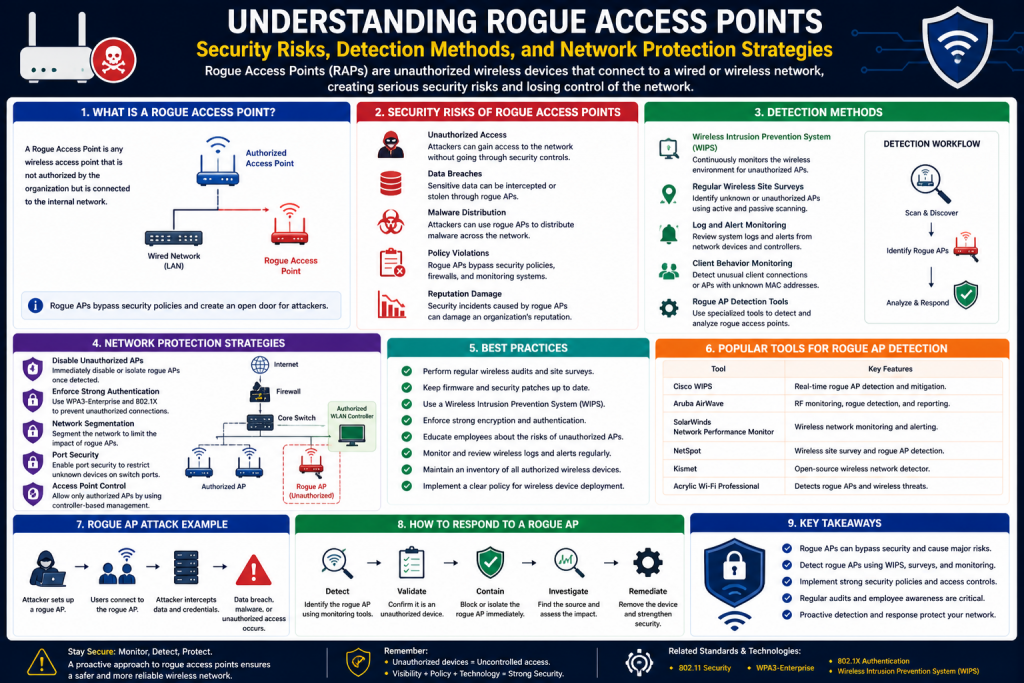
Wireless connectivity has become an essential part of modern life, enabling communication, business operations, and access to information from virtually anywhere. However, the widespread use of Wi-Fi networks has also introduced new security challenges. One of the most concerning among these is the presence of rogue access points, which can silently compromise both personal and organizational data.
A rogue access point is any wireless access point that is connected to a network without proper authorization. It may be installed by an employee, a visitor, or a malicious attacker. Regardless of how it is introduced, it creates a vulnerability that can be exploited to gain unauthorized access to network resources. These devices often operate unnoticed, making them particularly dangerous.
The concept may sound technical, but the underlying risk is simple. When users connect to a wireless network, they trust that it is legitimate and secure. Rogue access points take advantage of this trust, creating opportunities for attackers to intercept data or gain entry into systems.
Why Rogue Access Points Matter
The importance of understanding rogue access points lies in their potential impact. In both personal and professional environments, sensitive data is constantly transmitted over wireless networks. This includes login credentials, financial information, emails, and confidential business data.
When a rogue access point is present, it can act as a gateway for attackers. Instead of directly hacking into systems, they position themselves between the user and the network. This allows them to monitor traffic, capture information, and even manipulate data in transit.
For organizations, the consequences can be severe. A single unauthorized device can compromise the entire network, leading to data breaches, financial losses, and reputational damage. For individuals, the risks include identity theft, account compromise, and loss of privacy.
Understanding How Rogue Access Points Work
To understand the threat, it is helpful to look at how rogue access points function. At a basic level, they operate like any other wireless access point. They broadcast a network name, known as an SSID, and allow devices to connect.
The difference lies in their purpose and configuration. A legitimate access point is managed by authorized personnel and secured according to established policies. A rogue access point, on the other hand, is not subject to these controls.
Some rogue access points are connected directly to an internal network. This gives them access to sensitive systems and data. Others operate independently, simply mimicking legitimate networks to trick users into connecting.
Once a device connects to a rogue access point, all of its network traffic can be observed by the attacker. This includes websites visited, data transmitted, and login information entered. In some cases, the attacker can also modify the data, injecting malicious content or redirecting the user to fraudulent websites.
Common Types of Rogue Access Points
Rogue access points can take several forms, each with its own characteristics and risks. Understanding these types helps in recognizing and addressing the threat.
Unauthorized Access Points
Unauthorized access points are often created without malicious intent. For example, an employee might connect a personal router to the company network to improve wireless coverage or bypass restrictions. While the intention may be harmless, the result is a device that is not properly secured or monitored.
These access points can introduce vulnerabilities because they may use weak passwords, outdated firmware, or insecure configurations. They can also bypass network security measures, creating a hidden entry point for attackers.
In many cases, unauthorized access points are discovered during routine network scans or security audits. However, if they go unnoticed, they can remain active for long periods, increasing the risk of exploitation.
Impersonating Access Points
Impersonating access points are deliberately created to deceive users. Attackers set up devices that broadcast the same or similar SSID as a legitimate network. This makes it difficult for users to distinguish between the real network and the fake one.
When a user connects to an impersonating access point, they believe they are accessing a trusted network. In reality, their data is being routed through the attacker’s device. This allows the attacker to capture sensitive information and monitor activity.
These access points are commonly found in public places such as cafes, airports, and hotels. Attackers take advantage of the high volume of users and the expectation of free Wi-Fi.
Aggressive Access Points
Aggressive access points are designed to interfere with legitimate networks. They may use high transmission power or other techniques to dominate the wireless environment. This can cause devices to connect to the rogue access point instead of the intended network.
While less common, aggressive access points can be used in targeted attacks where the goal is to disrupt normal connectivity and force users onto a malicious network.
The Human Factor in Rogue Access Point Attacks
One of the key reasons rogue access points are effective is the role of human behavior. People often prioritize convenience over security, especially when they need quick access to the internet.
For example, a user in a coffee shop may see multiple Wi-Fi networks with similar names. Instead of verifying which one is legitimate, they may simply choose the one with the strongest signal or the most familiar name. This creates an opportunity for attackers to exploit.
Social engineering techniques can also be used in conjunction with rogue access points. Attackers may place signs displaying a network name and password, making the network appear official. Users who trust this information may connect without hesitation.
Education and awareness are essential in addressing this issue. Users need to understand the risks and adopt safer practices when connecting to wireless networks.
Risks Associated with Rogue Access Points
The risks posed by rogue access points are wide-ranging and can affect both individuals and organizations.
For individuals, the primary concern is the exposure of personal data. Attackers can capture login credentials, credit card information, and other sensitive details. This information can then be used for identity theft or financial fraud.
For organizations, the stakes are even higher. A rogue access point can provide direct access to internal systems, bypassing security controls. This can lead to data breaches, loss of intellectual property, and disruption of operations.
In addition, rogue access points can be used as a launching point for further attacks. Once inside the network, attackers can move laterally, targeting additional systems and escalating their privileges.
Detecting Rogue Access Points
Identifying rogue access points can be challenging, but there are several indicators that can help.
One common sign is the presence of duplicate network names. If multiple networks with similar SSIDs are visible, it may indicate that one of them is a rogue access point.
Unusual network behavior can also be a clue. For example, if a connection is slow, unstable, or does not provide internet access, it may be suspicious. Similarly, if a network requires unexpected login steps or requests sensitive information, it should be treated with caution.
In organizational environments, network monitoring tools can be used to detect unauthorized devices. These tools can identify new access points, track their activity, and alert administrators to potential threats.
The Role of Network Security Measures
Organizations use a variety of security measures to protect against rogue access points. These include intrusion detection systems, intrusion prevention systems, and wireless network controllers.
Intrusion detection systems monitor network activity for signs of suspicious behavior. They can identify unauthorized access points and alert administrators. Intrusion prevention systems go a step further by actively blocking or mitigating threats.
Wireless network controllers provide centralized management of access points. They can detect rogue devices, classify them, and take appropriate action. This may include isolating the device or preventing it from connecting to the network.
Despite these measures, no system is foolproof. Continuous monitoring and regular updates are necessary to maintain security.
Real-World Scenarios and Examples
Rogue access points are not just a theoretical threat. They are used in real-world attacks that affect both individuals and organizations.
In public places, attackers often set up fake Wi-Fi networks to capture user data. These networks may have names similar to the official network, making them difficult to distinguish. Users who connect may unknowingly expose their information.
In corporate environments, unauthorized access points are sometimes introduced by employees. These devices can create vulnerabilities that are exploited by attackers. In some cases, attackers themselves may gain physical access to a location and install a rogue device.
These scenarios highlight the importance of vigilance and proactive security measures.
Building Awareness and Responsibility
Addressing the threat of rogue access points requires a combination of technology and human awareness. While security tools play a critical role, they are not enough on their own.
Users must take responsibility for their own security by adopting safe practices. This includes verifying network names, avoiding open networks, and being cautious when entering sensitive information.
Organizations must also invest in training and education. Employees should be aware of the risks and understand the importance of following security policies.
By combining awareness with effective security measures, it is possible to reduce the risk posed by rogue access points.
Introduction to Rogue Access Point Attacks
While understanding what a rogue access point is provides a solid foundation, it is equally important to explore how these devices are actually used in attacks. Rogue access point attacks are not just theoretical risks—they are practical, widely used methods for intercepting data and compromising systems. What makes them particularly dangerous is how simple they are to execute and how difficult they can be to detect.
Attackers do not always rely on breaking into networks through complex vulnerabilities. Instead, they often take advantage of human behavior and weak wireless practices. By setting up a rogue access point, they create an environment where users willingly connect and expose their own data. This indirect method allows attackers to bypass many traditional security defenses.
In this section, the focus is on the different types of rogue access point attacks, how they are carried out, and the techniques used to exploit unsuspecting users.
The Core Concept Behind the Attack
At the heart of every rogue access point attack is a simple idea: deception. The attacker creates a wireless network that appears legitimate and waits for users to connect. Once a connection is established, the attacker gains visibility into the user’s network activity.
This approach is effective because most devices are designed to connect automatically to known or trusted networks. If a rogue access point uses the same network name as a legitimate one, devices may connect without any user interaction. This behavior significantly increases the success rate of the attack.
In addition, many users do not verify network authenticity before connecting. They assume that a familiar name guarantees safety, which is exactly what attackers rely on.
Stand-Alone Rogue Access Point Attacks
One of the most common forms of attack involves stand-alone rogue access points. These are independent devices set up by attackers to mimic legitimate networks. They are often deployed in public places where users expect free Wi-Fi access.
The attacker configures the rogue access point with a network name identical or very similar to a real one. In some cases, they also replicate the login page or captive portal used by the legitimate network. This makes the fake network appear authentic.
When users connect, they may be presented with a login screen asking for credentials. These credentials are then captured by the attacker. In other cases, users may be prompted to enter payment information for access, which is also stolen.
A key characteristic of stand-alone attacks is that they often do not provide real internet access. The primary goal is data collection, not connectivity. Users may notice that the connection is slow or non-functional, but by the time they realize something is wrong, their information may already be compromised.
Pass-Through or Man-in-the-Middle Attacks
A more advanced form of rogue access point attack involves pass-through functionality, commonly known as a man-in-the-middle attack. In this scenario, the rogue access point actually connects to the legitimate network and forwards traffic between the user and the internet.
This creates the illusion of a normal, functioning connection. Users can browse websites, check emails, and perform other online activities without realizing that their data is being intercepted.
The attacker sits in the middle of the communication, capturing and potentially modifying the data as it passes through. This allows them to collect sensitive information such as usernames, passwords, credit card numbers, and session cookies.
Because the connection appears normal, these attacks are particularly difficult to detect. Users have no obvious reason to suspect that their data is being monitored.
Evil Twin Attacks
An evil twin attack is a specific type of impersonation attack where the rogue access point is designed to closely replicate a legitimate network. The attacker may even use the same hardware type, encryption settings, and signal strength to make the fake network indistinguishable from the real one.
In many cases, attackers use techniques to force users off the legitimate network, such as deauthentication attacks. This causes devices to disconnect and then automatically reconnect to the stronger or more available signal, which is often the rogue access point.
Once connected, the attacker can carry out various forms of data interception and manipulation. Because the network appears identical to the original, users are unlikely to notice any difference.
Data Interception Techniques
After a user connects to a rogue access point, the attacker can employ several techniques to capture and analyze data. These techniques vary in complexity but are all aimed at extracting valuable information.
One common method is packet sniffing. This involves capturing the data packets transmitted between the user’s device and the network. If the data is not encrypted, it can be read directly. Even when encryption is used, certain types of information may still be exposed.
Another technique is session hijacking. In this case, the attacker captures session cookies that are used to maintain a user’s logged-in state. By obtaining these cookies, the attacker can impersonate the user and gain access to their accounts without needing a password.
Attackers may also use DNS spoofing to redirect users to malicious websites. For example, when a user attempts to visit a legitimate site, they may be redirected to a fake version designed to capture login credentials.
Credential Harvesting and Phishing
Rogue access point attacks are often combined with phishing techniques to maximize their effectiveness. When users connect to a fake network, they may be presented with a captive portal that looks like a legitimate login page.
This page may ask for email credentials, social media logins, or even corporate authentication details. Because the page appears authentic, users may enter their information without hesitation.
The attacker then collects these credentials and can use them for further attacks. This may include accessing accounts, sending phishing emails, or attempting to gain access to other systems.
In some cases, the attacker may also use the captured information to perform identity theft or financial fraud.
Malware Distribution Through Rogue Access Points
In addition to capturing data, rogue access points can be used to distribute malware. Once a user is connected, the attacker can inject malicious content into web pages or prompt the user to download software.
This software may appear legitimate, such as a browser update or security tool, but it actually contains malware. Once installed, it can compromise the user’s device, allowing the attacker to monitor activity, steal data, or gain remote control.
Malware distribution adds another layer of risk to rogue access point attacks, as it can have long-term consequences beyond the initial data exposure.
Attacks in Public Environments
Public spaces are a prime target for rogue access point attacks. Locations such as cafes, airports, hotels, and shopping centers often provide free Wi-Fi, making them attractive to users and attackers alike.
In these environments, users are less likely to verify network authenticity. They may connect quickly to check emails or browse the internet, assuming that the network is safe.
Attackers take advantage of this behavior by setting up rogue access points with names that match the venue’s official network. In some cases, they may even position themselves physically close to the target area to ensure a strong signal.
Because of the high volume of users, attackers can collect a large amount of data in a short period of time.
Attacks Within Organizations
Rogue access point attacks are not limited to public spaces. They can also occur within organizations, where the stakes are often higher.
An attacker may gain physical access to a building and connect a rogue device to the internal network. This creates a hidden entry point that can be used to bypass security controls.
Alternatively, an employee may unknowingly introduce a rogue access point by connecting an unauthorized device. This can create vulnerabilities that are exploited by attackers.
Once inside the network, attackers can move laterally, targeting additional systems and escalating their privileges. This can lead to widespread compromise and significant damage.
Challenges in Detection
One of the biggest challenges with rogue access point attacks is detection. These devices are often small, portable, and easy to conceal. They can be hidden in bags, placed in inconspicuous locations, or even integrated into other devices.
From a technical perspective, detecting a rogue access point requires monitoring the wireless environment and identifying unauthorized devices. This can be difficult in large or complex networks.
In addition, attackers may use techniques to avoid detection, such as changing network names or operating intermittently. This makes it harder for security systems to identify and track them.
The Role of Automation in Attacks
Modern tools have made it easier than ever to carry out rogue access point attacks. Automated software can handle tasks such as network cloning, data capture, and traffic analysis.
This means that attackers do not need advanced technical skills to launch effective attacks. With minimal effort, they can set up a rogue access point and begin collecting data.
The availability of these tools has contributed to the increasing prevalence of rogue access point attacks, making them a growing concern for both individuals and organizations.
Behavioral Indicators of an Attack
While technical detection can be challenging, there are behavioral indicators that may suggest a rogue access point attack is in progress.
Users may notice unusual network behavior, such as frequent disconnections, slow speeds, or unexpected login prompts. They may also encounter warnings from their browser about insecure connections.
In some cases, websites may appear differently or behave unexpectedly. This can be a sign that traffic is being intercepted or modified.
Recognizing these signs can help users take action before significant damage occurs.
The Importance of Awareness
Ultimately, the success of rogue access point attacks depends heavily on user behavior. Attackers rely on users to connect to their networks and provide the information they seek.
By increasing awareness and understanding of these attacks, users can reduce their risk. Simple actions, such as verifying network names and avoiding open connections, can make a significant difference.
Organizations also play a critical role by educating employees and implementing security measures to detect and prevent rogue access points.
Introduction to Prevention and Mitigation
After understanding what rogue access points are and how attackers use them, the next step is learning how to defend against them. Prevention is not based on a single solution but rather a combination of awareness, technical controls, and consistent security practices. Because rogue access point attacks rely heavily on deception and user behavior, both individuals and organizations must play an active role in reducing risk.
Wireless security is often overlooked because it operates invisibly in the background. However, this invisibility is exactly what attackers exploit. By making small changes in how networks are managed and how users interact with them, it is possible to significantly reduce the likelihood of falling victim to these attacks.
The Importance of Encryption in Wireless Security
One of the most effective defenses against rogue access point attacks is encryption. Encryption ensures that even if data is intercepted, it cannot be easily read or used by attackers.
When browsing the internet, users should always ensure that the websites they visit use secure protocols. Secure connections protect the data being transmitted between the device and the website, making it much more difficult for attackers to extract meaningful information.
Modern browsers provide visual indicators, such as a lock icon, to show that a connection is secure. Users should pay attention to these indicators and avoid entering sensitive information on websites that do not use secure connections.
Encryption does not eliminate the risk entirely, especially in advanced attacks, but it adds a critical layer of protection that significantly reduces exposure.
Using Virtual Private Networks for Added Security
A virtual private network provides an additional layer of security by encrypting all network traffic between the user’s device and a secure server. This creates a private tunnel that protects data from interception, even when using public or untrusted networks.
When connected to a virtual private network, all data is routed through the encrypted tunnel before reaching its destination. This means that even if a rogue access point is present, the attacker cannot easily access the contents of the data.
Virtual private networks are particularly useful when traveling or working remotely, where users are more likely to rely on public Wi-Fi. They help ensure that sensitive activities, such as online banking or accessing corporate systems, remain protected.
However, it is important to choose a trustworthy provider and understand that a virtual private network is just one part of a broader security strategy.
Verifying Wireless Networks Before Connecting
One of the simplest yet most effective ways to prevent rogue access point attacks is to verify the authenticity of a wireless network before connecting. This step is often overlooked, but it can prevent many attacks.
Users should confirm the correct network name with a reliable source, such as a staff member or official signage. They should be cautious of networks with similar names or unexpected variations, as these may be attempts to mimic legitimate networks.
Automatic connection settings should also be reviewed. Many devices are configured to automatically connect to known networks, which can be exploited by attackers. Disabling this feature or managing known networks carefully can reduce the risk.
Taking a few extra seconds to verify a network can make a significant difference in preventing unauthorized access.
Avoiding Open and Unsecured Networks
Open networks, which do not require a password, are particularly vulnerable to rogue access point attacks. These networks provide little to no security, making it easy for attackers to intercept data.
Whenever possible, users should avoid connecting to open networks, especially when performing sensitive tasks. If a connection is necessary, it should be used with caution, and additional security measures such as encryption or virtual private networks should be employed.
Even when a network appears legitimate, it is important to remember that other users on the same network may pose a risk. Public networks should always be treated as potentially insecure environments.
Implementing Network Access Control in Organizations
For organizations, one of the most effective ways to prevent rogue access points is through network access control. This approach ensures that only authorized devices can connect to the network.
Network access control systems verify the identity and compliance of devices before granting access. This helps prevent unauthorized devices, including rogue access points, from being connected to the network.
By enforcing strict access policies, organizations can reduce the likelihood of accidental or intentional introduction of rogue devices. This is particularly important in environments with a large number of users and devices.
Monitoring and Detecting Rogue Devices
Continuous monitoring is essential for identifying and responding to rogue access points. Organizations can use specialized tools to scan the wireless environment and detect unauthorized devices.
Wireless intrusion detection systems and wireless intrusion prevention systems play a key role in this process. These systems can identify suspicious activity, classify devices, and alert administrators to potential threats.
In some cases, these systems can also take action to contain or block rogue access points. This helps minimize the impact of an attack and prevent further exploitation.
Regular network audits and security assessments also contribute to effective detection. By reviewing network configurations and device inventories, organizations can identify anomalies and address them promptly.
Securing Network Infrastructure
Proper configuration of network infrastructure is critical in preventing rogue access points. This includes securing routers, switches, and access points with strong passwords and up-to-date firmware.
Unused ports should be disabled, and physical access to network equipment should be restricted. This reduces the risk of unauthorized devices being connected to the network.
Segmentation is another important strategy. By dividing the network into smaller segments, organizations can limit the spread of an attack. Even if a rogue access point is introduced, its impact can be contained within a specific segment.
These measures help create a more resilient network that is better equipped to withstand threats.
Educating Users and Employees
Technology alone is not enough to prevent rogue access point attacks. User awareness and education are equally important.
Individuals should be trained to recognize the risks associated with wireless networks and understand how to identify suspicious activity. This includes recognizing duplicate network names, unexpected login prompts, and unusual connection behavior.
Organizations should provide regular training sessions and updates to ensure that employees remain informed about current threats. Clear policies should also be established regarding the use of personal devices and network equipment.
By fostering a culture of security awareness, organizations can reduce the likelihood of human error and improve overall resilience.
Safe Browsing Practices
Adopting safe browsing practices is another key aspect of prevention. Users should avoid entering sensitive information on unfamiliar websites and be cautious when downloading files or software.
Browser warnings should not be ignored. If a browser indicates that a connection is not secure, it is best to avoid proceeding unless absolutely necessary.
Using updated software and security tools, such as antivirus programs and firewalls, can also help protect against threats that may arise from rogue access points.
These practices contribute to a safer online experience and reduce the risk of exploitation.
Responding to Suspected Rogue Access Points
If a rogue access point is suspected, it is important to take immediate action. For individuals, this may involve disconnecting from the network and avoiding further interaction.
Passwords for sensitive accounts should be changed, especially if they were entered while connected to the suspicious network. Monitoring accounts for unusual activity can also help identify potential compromise.
For organizations, the response should include isolating the device, investigating its origin, and assessing the impact. Security teams should analyze network logs and identify any data that may have been exposed.
A well-defined incident response plan can help ensure that these steps are carried out efficiently and effectively.
The Role of Policy and Governance
Strong policies and governance frameworks are essential for managing wireless security. Organizations should establish clear guidelines for network usage, device management, and security practices.
These policies should be regularly reviewed and updated to reflect changes in technology and threat landscapes. Compliance with these policies should be enforced to ensure consistency.
Governance also involves accountability. Assigning responsibility for network security helps ensure that issues are addressed promptly and that best practices are followed.
Adapting to Emerging Threats
The threat landscape is constantly evolving, and rogue access point attacks are no exception. As technology advances, attackers develop new techniques to bypass security measures.
Organizations and individuals must stay informed about emerging threats and adapt their strategies accordingly. This includes keeping software up to date, adopting new security tools, and continuously improving practices.
Proactive adaptation is key to maintaining security in an ever-changing environment.
Building a Comprehensive Defense Strategy
Effective prevention requires a comprehensive approach that combines multiple layers of security. No single measure is sufficient on its own.
. Relying on just one control, such as encryption or a firewall, creates gaps that attackers can exploit. Instead, a layered defense strategy ensures that if one line of protection fails, others remain in place to reduce the overall risk.
This approach often includes a mix of technical safeguards and user-focused practices. On the technical side, organizations can deploy monitoring systems, enforce strict access controls, and segment networks to limit exposure. Regular updates and patch management also play a critical role in closing vulnerabilities that could otherwise be targeted.
At the same time, user awareness is equally important. Even the most advanced security systems can be undermined by simple human mistakes, such as connecting to an unverified network or ignoring security warnings. Training users to recognize threats and follow safe practices adds a vital layer of defense.
Consistency is another key factor. Security measures must be applied uniformly and reviewed regularly to remain effective. As threats evolve, so too must the strategies used to defend against them. A comprehensive, layered approach provides resilience, making it significantly harder for attackers to succeed.
By integrating encryption, monitoring, access control, user education, and safe practices, it is possible to create a robust defense against rogue access point attacks.
This layered approach ensures that even if one measure fails, others remain in place to provide protection.
Conclusion
Rogue access points represent a serious and persistent threat in the world of wireless networking. Their ability to exploit trust, operate discreetly, and intercept sensitive data makes them a powerful tool for attackers. From simple unauthorized devices to sophisticated man-in-the-middle setups, these threats can affect both individuals and organizations in significant ways.
However, the risk can be managed with the right approach. Understanding how rogue access points work and how attacks are carried out provides a strong foundation for defense. Building on this knowledge, implementing practical prevention strategies can greatly reduce vulnerability.
Key measures such as using encryption, adopting virtual private networks, verifying network authenticity, and avoiding unsecured connections all contribute to safer wireless usage. For organizations, additional controls such as network access management, continuous monitoring, and infrastructure security are essential.
Equally important is the role of awareness. Educating users about the risks and encouraging responsible behavior can prevent many attacks before they occur. Technology and human vigilance must work together to create an effective defense.
As wireless connectivity continues to grow, so does the importance of securing it. By staying informed, adopting best practices, and maintaining a proactive mindset, individuals and organizations can protect themselves against rogue access point attacks and ensure a safer digital environment.
Continue exploring the technologies and certification concepts that matter most to you.