In modern networking, managing how devices communicate with one another is a fundamental responsibility. As networks grow in size and complexity, administrators need efficient ways to control traffic without creating overly complicated configurations. One of the most practical tools used for this purpose is the wildcard mask.
A wildcard mask is primarily used in access control lists to define which parts of an IP address should be evaluated and which parts can be ignored. This selective matching makes it easier to apply rules to groups of devices rather than handling each one individually. Instead of writing hundreds of entries, a single rule can control an entire network segment.
Understanding wildcard masks is essential for anyone working with routing, switching, or network security. While the concept may seem confusing at first, it becomes much clearer once you understand how IP addresses are structured and how matching works at the binary level.
What is a Wildcard Mask
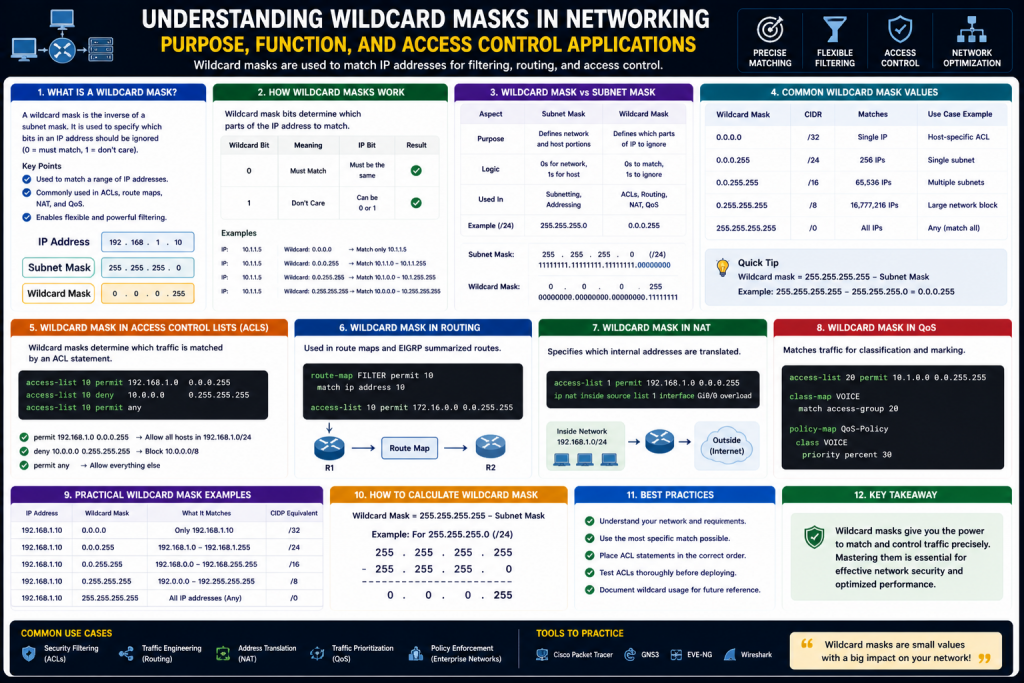
A wildcard mask is a 32-bit value that determines how an IP address is compared against a rule in an access control list. It tells the network device which bits must match exactly and which bits can vary.
The logic behind wildcard masks is straightforward. Each bit in the mask corresponds to a bit in the IP address. If the bit in the mask is set to zero, the corresponding bit in the IP address must match exactly. If the bit is set to one, the router ignores that bit.
This behavior allows administrators to define flexible rules. Instead of requiring an exact match for the entire IP address, they can specify only the important portions. This is especially useful when dealing with large networks where multiple devices share a common prefix.
Why Wildcard Masks Matter in Networking
As networks scale, managing individual IP addresses becomes impractical. Imagine trying to block or allow access for hundreds of devices one by one. Not only would this take a long time, but it would also increase the chances of configuration errors.
Wildcard masks solve this problem by enabling grouping. They allow administrators to apply a single rule to an entire subnet or range of addresses. This reduces complexity and improves efficiency.
Another important reason wildcard masks matter is security. By carefully defining which traffic is allowed or denied, administrators can protect sensitive resources and enforce organizational policies. Without wildcard masks, implementing these controls would be far more difficult.
Understanding IP Address Structure
To fully understand wildcard masks, it is important to first understand how IP addresses are structured. An IPv4 address consists of four octets separated by dots. Each octet represents eight bits, resulting in a total of 32 bits.
For example, an IP address might look like this:
172.16.56.5
In many cases, the first portion of the address identifies the network, while the last portion identifies the host. Devices within the same network share the same network portion but have different host values.
Wildcard masks take advantage of this structure by allowing administrators to focus on the network portion while ignoring the host portion when necessary.
The Core Principle Behind Wildcard Masks
The key idea behind wildcard masks is the concept of matching versus ignoring. When a router evaluates a packet, it compares the packet’s IP address with the rule defined in the access control list. The wildcard mask determines how this comparison is performed.
To understand this more clearly, think of the wildcard mask as a set of instructions that tells the router which parts of the IP address are important and which parts are not. Each bit in the wildcard mask directly corresponds to a bit in the IP address. When the mask contains a zero, the router must check that bit and ensure it matches exactly with the rule. When the mask contains a one, the router skips that bit entirely, treating it as irrelevant for the comparison process.
This mechanism allows network administrators to create rules that are either very specific or very broad, depending on their needs. For example, they can enforce strict matching for the network portion of an address while allowing flexibility in the host portion. This is particularly useful in large networks where many devices share a common network prefix but have different host identifiers.
As a result, wildcard masks provide a balance between control and efficiency. They reduce the need for multiple rules, simplify configuration, and make it easier to manage traffic flow without sacrificing accuracy in how packets are filtered.
If a bit in the wildcard mask is zero, the router checks that bit in the IP address. If it does not match, the rule does not apply. If the bit is one, the router skips that bit entirely.
This means that a wildcard mask essentially defines a pattern. Any IP address that fits the pattern will match the rule.
This approach provides a powerful way to control traffic while keeping configurations manageable.
Comparing Wildcard Masks and Subnet Masks
Wildcard masks are often confused with subnet masks, but they serve different purposes. A subnet mask is used to divide a network into smaller segments by defining which portion of the IP address represents the network and which portion represents the host.
A wildcard mask, on the other hand, is used for matching addresses in access control lists. It determines which bits should be considered during the comparison process.
One important difference is that subnet masks use ones to indicate the network portion, while wildcard masks use zeros to indicate bits that must match. This inverse relationship is why wildcard masks are sometimes referred to as inverse masks.
Understanding this distinction is crucial, as using the wrong type of mask can lead to incorrect configurations.
Binary Logic and Wildcard Masks
Although wildcard masks are typically written in decimal format, they operate at the binary level. Each octet in the mask corresponds to eight bits, and each bit plays a role in the matching process.
For example, a wildcard mask of 0.0.0.255 can be represented in binary as:
00000000.00000000.00000000.11111111
In this case, the first three octets are all zeros, meaning those bits must match exactly. The last octet is all ones, meaning those bits can vary.
This binary perspective helps explain why wildcard masks are so flexible. By adjusting individual bits, administrators can create highly specific or very broad matching rules.
Practical Example of a Wildcard Mask
Consider a scenario where an administrator wants to block all traffic from the network 172.16.56.0. This network includes all IP addresses from 172.16.56.0 to 172.16.56.255.
Instead of writing a separate rule for each address, the administrator can use a wildcard mask to match the entire range.
By using a wildcard mask of 0.0.0.255, the router is instructed to check only the first three octets. The last octet is ignored, meaning any value in that position will still match the rule.
This allows a single entry to control access for all devices in the network.
Benefits of Using Wildcard Masks
Wildcard masks offer several advantages in network management. One of the biggest benefits is efficiency. By reducing the number of rules needed, they make configurations easier to create and maintain.
Another benefit is flexibility. Administrators can design rules that match specific patterns, allowing for precise control over traffic.
Wildcard masks also improve scalability. As networks grow, the ability to manage groups of devices with a single rule becomes increasingly important.
Finally, they enhance consistency. By applying the same rule to multiple devices, administrators can ensure that policies are enforced uniformly across the network.
Common Use Cases for Wildcard Masks
Wildcard masks are widely used in access control lists to filter traffic based on IP addresses. They are also used in routing configurations to define which networks should be included or excluded from certain operations.
In enterprise environments, wildcard masks are often used to control communication between departments. For example, an organization might use them to restrict access to sensitive systems or to separate different types of traffic.
They are also useful in troubleshooting, as they allow administrators to quickly isolate specific segments of the network.
Simplifying Network Management
One of the main reasons wildcard masks are so valuable is their ability to simplify network management. Instead of dealing with individual IP addresses, administrators can think in terms of groups and patterns.
This shift in perspective makes it easier to design and implement policies. It also reduces the likelihood of errors, as there are fewer entries to manage.
In large networks, this simplicity can save a significant amount of time and effort.
Challenges and Learning Curve
Despite their advantages, wildcard masks can be challenging for beginners. The inverse relationship with subnet masks and the reliance on binary logic can make them difficult to understand at first.
However, with practice, these challenges become easier to overcome. Many administrators find that working through examples and visualizing the binary representation helps reinforce their understanding.
Once the concept clicks, wildcard masks become a powerful and intuitive tool.
The Role of Wildcard Masks in Network Security
Security is one of the most important aspects of networking, and wildcard masks play a key role in enforcing security policies. By controlling which traffic is allowed or denied, they help protect systems from unauthorized access.
For example, an administrator can use wildcard masks to block traffic from untrusted networks or to limit access to critical resources. This level of control is essential for maintaining a secure environment.
When used correctly, wildcard masks can significantly enhance the overall security posture of a network.
Building a Strong Foundation
Learning about wildcard masks is an important step in building a strong foundation in networking. They are a fundamental concept that appears in many areas, including routing, switching, and security.
By understanding how they work and how to use them effectively, you can improve your ability to design and manage networks.
This knowledge also prepares you for more advanced topics, as many networking technologies build on the same principles.
Introduction to Practical Application
After understanding the theory behind wildcard masks, the next step is to explore how they function in real networking environments. In practice, wildcard masks are not just abstract concepts; they are actively used by network administrators to control traffic, enforce security policies, and manage communication between devices.
In real-world networks, especially enterprise environments, there are often hundreds or thousands of devices connected across multiple subnets. Managing such a large infrastructure requires tools that can simplify configuration without sacrificing control. Wildcard masks provide that balance by allowing administrators to define rules that apply to entire groups of IP addresses.
This section focuses on how wildcard masks are used in practical scenarios, how they interact with access control lists, and how administrators can design efficient configurations using them.
Role of Wildcard Masks in Access Control Lists
Access control lists, commonly known as ACLs, are one of the primary areas where wildcard masks are used. An ACL is a set of rules that determines whether network traffic should be permitted or denied based on specific criteria such as source IP, destination IP, or protocol type.
When a packet arrives at a router or switch, the device checks it against the ACL rules in sequence. Each rule includes an IP address and a wildcard mask. The wildcard mask tells the device how to compare the packet’s IP address with the rule.
If the packet matches the rule, the specified action is taken. If it does not match, the device moves on to the next rule. This process continues until a match is found or the end of the list is reached.
Wildcard masks make this process efficient by allowing a single rule to match multiple IP addresses, reducing the number of entries required in the ACL.
Step-by-Step Packet Matching Process
To understand how wildcard masks work in practice, it helps to look at the step-by-step process a router follows when evaluating a packet.
First, the router extracts the relevant IP address from the packet, usually the source address.
Next, it takes the IP address defined in the ACL rule and compares it with the packet’s address.
Then, it applies the wildcard mask to determine which bits must match and which bits can be ignored.
If all the required bits match, the rule is considered a match, and the corresponding action is applied.
If not, the router proceeds to the next rule in the ACL.
This process happens very quickly, allowing routers to handle large volumes of traffic efficiently.
Real-World Scenario: Blocking a Subnet
Consider a scenario where a network administrator wants to block all traffic from a specific department. The department uses the IP range 172.16.56.0 to 172.16.56.255.
Without wildcard masks, the administrator would need to create a rule for each individual IP address. This would be inefficient and difficult to maintain.
By using a wildcard mask of 0.0.0.255, the administrator can create a single rule that matches all addresses in that range. The router checks only the first three octets and ignores the last one, effectively covering the entire subnet.
This approach not only simplifies configuration but also ensures that any new devices added to the subnet are automatically included in the rule.
Allowing Specific Hosts Within a Blocked Network
In some cases, administrators may need to create exceptions within a broader rule. For example, they might want to block an entire subnet but allow a specific server within that subnet to communicate.
This can be achieved by combining multiple ACL entries. One rule can deny traffic from the subnet, while another rule placed above it can permit traffic from the specific host.
For the specific host, a wildcard mask of 0.0.0.0 is used, meaning every bit must match exactly.
Because ACLs are processed from top to bottom, the order of rules is critical. The router will apply the first matching rule it encounters, so exceptions must be placed before general rules.
Matching Multiple Subnets
Wildcard masks can also be used to match multiple subnets with a single rule. This is done by carefully selecting which bits to ignore.
For example, if an administrator wants to match two adjacent subnets, they can use a wildcard mask that ignores the bit that differentiates those subnets.
This technique requires a solid understanding of binary representation, as it involves identifying which bits need to vary and which must remain constant.
While this approach can reduce the number of rules, it also increases complexity, so it should be used carefully.
Understanding Partial Matching
Wildcard masks allow for partial matching of IP addresses, which is one of their most powerful features. Instead of matching the entire address, administrators can focus on specific portions.
For instance, they might want to match all devices within a particular building or department, regardless of the specific host address. By ignoring certain bits, they can create rules that apply broadly while still maintaining control.
Partial matching is especially useful in hierarchical network designs, where IP addressing is structured to reflect organizational units.
Designing Efficient ACLs
Efficiency is a key consideration when designing ACLs. Poorly designed ACLs can lead to performance issues, as the router must process each rule sequentially.
Wildcard masks help improve efficiency by reducing the number of rules needed. Instead of listing every possible address, administrators can use masks to group addresses together.
However, efficiency is not just about reducing the number of rules. It also involves organizing rules logically, placing the most frequently matched rules at the top, and avoiding unnecessary complexity.
A well-designed ACL strikes a balance between simplicity and precision.
Troubleshooting Wildcard Mask Configurations
Even experienced administrators can make mistakes when working with wildcard masks. Incorrect configurations can lead to unexpected behavior, such as blocking legitimate traffic or allowing unauthorized access.
When troubleshooting, it is important to verify both the IP address and the wildcard mask in each rule. Converting the values to binary can help identify mismatches.
Testing configurations in a controlled environment can also help catch errors before they affect production systems.
In addition, logging features can provide insight into which rules are being matched, making it easier to diagnose issues.
Interaction with Routing Decisions
Wildcard masks are not limited to ACLs. They are also used in certain routing protocols to define which networks should be included in routing updates.
For example, when configuring routing processes, administrators may use wildcard masks to specify a range of networks that should participate in the protocol.
This allows for flexible and scalable routing configurations, especially in large networks with multiple subnets.
By using wildcard masks, administrators can ensure that routing information is distributed efficiently without having to list each network individually.
Security Implications of Wildcard Masks
Wildcard masks play a critical role in network security. By controlling which traffic is allowed or denied, they help protect systems from unauthorized access.
However, misconfigured wildcard masks can create security vulnerabilities. For example, a mask that is too broad might allow traffic from unintended sources.
To maintain security, administrators should carefully review their configurations and follow best practices. This includes using the principle of least privilege, where only the necessary traffic is allowed.
Regular audits and monitoring can also help identify potential issues and ensure that security policies are being enforced correctly.
Handling Dynamic Environments
In networks where IP addresses are assigned dynamically, wildcard masks can present challenges. Since devices may receive different IP addresses over time, rules based on specific ranges may not always apply as expected.
In such environments, administrators may need to use additional techniques, such as grouping devices based on roles or using authentication-based controls.
Despite these challenges, wildcard masks can still be useful when combined with proper network design and planning.
Advanced Pattern Matching Techniques
Experienced administrators often use advanced techniques to create more sophisticated matching patterns. This might involve using non-standard wildcard masks to match specific combinations of IP addresses.
For example, a mask could be designed to match every other subnet or a specific range within an octet. These techniques require a deep understanding of binary logic and should be used with caution.
While advanced patterns can reduce the number of rules, they can also make configurations harder to understand and maintain.
Best Practices for Using Wildcard Masks
To use wildcard masks effectively, administrators should follow several best practices.
Always verify the mask to ensure it matches the intended range of addresses.
Keep configurations as simple as possible to reduce the risk of errors.
Use clear documentation to explain the purpose of each rule.
Test changes in a lab environment before deploying them in production.
Regularly review and update ACLs to reflect changes in the network.
By following these guidelines, administrators can maximize the benefits of wildcard masks while minimizing potential issues.
Real-World Use Cases Across Industries
Wildcard masks are used in a wide range of industries, from corporate networks to educational institutions and service providers.
In corporate environments, they are often used to segment traffic between departments and protect sensitive data.
In educational networks, they can help manage access to shared resources and control student traffic.
In service provider networks, they are used to manage large numbers of customers and ensure efficient routing.
These real-world applications demonstrate the versatility and importance of wildcard masks in modern networking.
Preparing for Advanced Networking Concepts
Understanding how wildcard masks work in real scenarios is an important step toward mastering more advanced networking topics. Many technologies, including routing protocols and security mechanisms, rely on similar principles.
By gaining hands-on experience with wildcard masks, administrators can build a strong foundation that will support their growth in the field.
This knowledge also prepares them for certifications and professional roles that require a deep understanding of network configuration.
Introduction to Advanced Understanding
After exploring the fundamentals and real-world usage of wildcard masks, it is important to examine their limitations, alternatives, and more advanced considerations. While wildcard masks are powerful and flexible, they are not always the best solution in every networking scenario. Understanding when to use them—and when not to—is just as important as knowing how they work.
In modern networking environments, administrators must balance simplicity, scalability, and security. Wildcard masks contribute to this balance, but they are only one tool among many. This section explores how wildcard masks fit into the broader networking landscape and how they compare to other approaches.
Limitations of Wildcard Masks
Despite their usefulness, wildcard masks have several limitations that can make them challenging in certain situations. One of the primary limitations is complexity. While simple wildcard masks are easy to understand, more advanced configurations can become difficult to interpret, especially when dealing with non-standard patterns.
Another limitation is readability. Unlike CIDR notation, which clearly defines network boundaries, wildcard masks require administrators to mentally translate the values into ranges. This can make configurations harder to review and troubleshoot.
Wildcard masks also depend heavily on proper IP addressing design. If a network is poorly structured, creating efficient wildcard mask rules becomes more difficult. In such cases, administrators may need to rely on multiple rules instead of a single, clean configuration.
Finally, wildcard masks are primarily used in specific contexts such as ACLs and certain routing configurations. They are not a universal solution for all networking tasks, which limits their applicability.
When Not to Use Wildcard Masks
There are situations where wildcard masks may not be the best choice. In smaller networks, for example, using simple subnet-based rules may be more straightforward. When the number of devices is limited, the added complexity of wildcard masks may not provide significant benefits.
In environments where precise control is required, specifying exact IP addresses can be more effective. This approach eliminates ambiguity and ensures that only the intended devices are affected.
Wildcard masks may also be less suitable in dynamic environments where IP addresses frequently change. In such cases, rules based on static ranges may not remain accurate over time.
Additionally, when working with teams that have varying levels of experience, simpler methods may reduce the risk of misconfiguration.
Subnet Masks as an Alternative
Subnet masks are one of the most common alternatives to wildcard masks. They are used to define the boundary between the network and host portions of an IP address.
Subnet masks are generally easier to understand because they follow a consistent pattern. A series of ones indicates the network portion, while zeros indicate the host portion. This clarity makes subnet masks a preferred choice for many networking tasks.
In scenarios where the goal is to define network segments rather than filter traffic, subnet masks are often more appropriate. They provide a clear and intuitive way to organize IP addresses.
While subnet masks do not offer the same level of flexibility as wildcard masks in ACLs, they are an essential part of network design and are often used alongside wildcard masks.
CIDR Notation and Its Advantages
Classless Inter-Domain Routing, commonly known as CIDR, is another widely used method for representing IP address ranges. CIDR notation uses a slash followed by a number to indicate how many bits belong to the network portion.
For example, an address written as 172.16.56.0/24 indicates that the first 24 bits are fixed, and the remaining bits can vary.
CIDR notation is concise and easy to read, making it a popular choice for documentation and configuration. It also integrates seamlessly with routing protocols and IP address planning.
Compared to wildcard masks, CIDR is more intuitive, especially for those who are new to networking. However, wildcard masks still provide greater flexibility in certain ACL scenarios.
Access Control Lists Without Wildcard Masks
In some cases, administrators may choose to configure access control lists using exact IP addresses instead of wildcard masks. This approach provides maximum precision, as each rule applies to a specific device.
While this method can be effective for small networks or critical systems, it does not scale well. As the number of devices increases, the number of rules required also grows, making the configuration harder to manage.
This highlights the trade-off between precision and scalability. Wildcard masks offer scalability, while exact matches offer precision. The choice depends on the specific needs of the network.
Dynamic Host Configuration and Its Impact
In networks that use dynamic host configuration, devices are assigned IP addresses automatically. This can create challenges for wildcard mask configurations, as the assigned addresses may change over time.
When IP addresses are not fixed, rules based on specific ranges may no longer apply to the intended devices. This can lead to inconsistent behavior and potential security issues.
To address this, administrators may use techniques such as DHCP reservations, which assign fixed addresses to specific devices. Alternatively, they may rely on other forms of identification, such as MAC addresses or user authentication.
Understanding how dynamic addressing interacts with wildcard masks is important for maintaining accurate and reliable configurations.
Routing Protocols and Automation
As networks become more complex, manual configuration becomes less practical. Routing protocols such as OSPF and EIGRP automate many aspects of network management, including the exchange of routing information.
These protocols use their own methods for identifying networks, often relying on subnet masks or CIDR notation. While wildcard masks may still be used in certain configurations, their role is reduced in highly automated environments.
Automation helps improve scalability and reduces the likelihood of human error. However, it also requires a solid understanding of underlying concepts, including wildcard masks, to ensure proper configuration.
Security Considerations and Risks
Wildcard masks play a significant role in network security, but they must be used carefully. A misconfigured wildcard mask can either block legitimate traffic or allow unauthorized access.
For example, a mask that is too broad may unintentionally include IP addresses that should not be permitted. Conversely, a mask that is too restrictive may prevent necessary communication.
To minimize these risks, administrators should follow security best practices. This includes using the principle of least privilege, where only the required traffic is allowed.
Regular audits and monitoring are also essential. By reviewing ACLs and analyzing traffic patterns, administrators can identify and correct potential issues before they become serious problems.
Advanced Wildcard Mask Techniques
For experienced network administrators, wildcard masks offer opportunities for advanced configurations. By carefully selecting which bits to ignore, it is possible to create rules that match complex patterns of IP addresses.
For example, a wildcard mask can be used to match every other subnet or a specific range within an octet. These techniques require a deep understanding of binary logic and should be used with caution.
While advanced patterns can reduce the number of rules, they can also make configurations more difficult to understand. Documentation becomes especially important in these cases to ensure that other administrators can interpret the rules correctly.
Balancing Simplicity and Flexibility
One of the key challenges in network design is finding the right balance between simplicity and flexibility. Wildcard masks provide a high degree of flexibility, but they can also introduce complexity.
In many cases, a simpler approach may be more effective, especially if it meets the requirements of the network. Overly complex configurations can be difficult to maintain and may increase the risk of errors.
Administrators should aim to use wildcard masks in a way that enhances clarity rather than complicates it. This often involves choosing straightforward patterns and avoiding unnecessary complexity.
Documentation and Maintainability
As networks grow and evolve, maintaining clear documentation becomes increasingly important. Wildcard mask configurations should be well-documented to ensure that their purpose and behavior are understood.
This includes describing the intended range of IP addresses, the reason for the rule, and any dependencies or exceptions.
Good documentation not only helps with troubleshooting but also ensures continuity when multiple administrators are involved. It reduces the risk of misinterpretation and makes it easier to update configurations as needed.
Testing and Validation
Before deploying wildcard mask configurations in a production environment, it is essential to test them thoroughly. This helps identify potential issues and ensures that the rules behave as expected.
Testing can be done in a lab environment or using simulation tools. By creating controlled scenarios, administrators can observe how the wildcard mask interacts with different IP addresses.
Validation should also include checking for unintended matches or conflicts with other rules. This step is critical for maintaining both functionality and security.
Future Trends in Network Management
As networking technology continues to evolve, the role of wildcard masks may change. Automation, software-defined networking, and cloud-based solutions are transforming how networks are managed.
These technologies often rely on higher-level abstractions, reducing the need for manual configuration. However, the underlying principles of IP addressing and traffic control remain relevant.
Understanding wildcard masks provides a foundation that can be applied to new technologies. Even as tools and methods change, the core concepts continue to play a role in network design and operation.
Building Expertise Over Time
Mastering wildcard masks takes time and practice. For beginners, it is important to start with simple examples and gradually work toward more complex scenarios.
Hands-on experience is invaluable. By experimenting with different configurations and observing their effects, administrators can develop a deeper understanding of how wildcard masks work.
Over time, recognizing patterns and applying best practices becomes second nature. This expertise contributes to more effective network management and problem-solving.
Conclusion
Wildcard masks are a powerful and flexible tool for controlling network traffic, particularly in access control lists. They allow administrators to define which parts of an IP address must match and which can vary, enabling efficient and scalable configurations.
However, they are not without limitations. Their complexity and reliance on binary logic can make them challenging to use, especially in advanced scenarios. Alternatives such as subnet masks and CIDR notation often provide simpler solutions for certain tasks.
The key to using wildcard masks effectively lies in understanding their strengths and weaknesses. By applying best practices, maintaining clear documentation, and testing configurations thoroughly, administrators can avoid common pitfalls and ensure reliable performance.
As networking continues to evolve, the principles behind wildcard masks remain relevant. They form an important part of the foundation that supports modern network design and security.
By mastering wildcard masks and knowing when to use them, network professionals can build more efficient, secure, and scalable systems that meet the demands of today’s interconnected world.
Continue exploring the technologies and certification concepts that matter most to you.