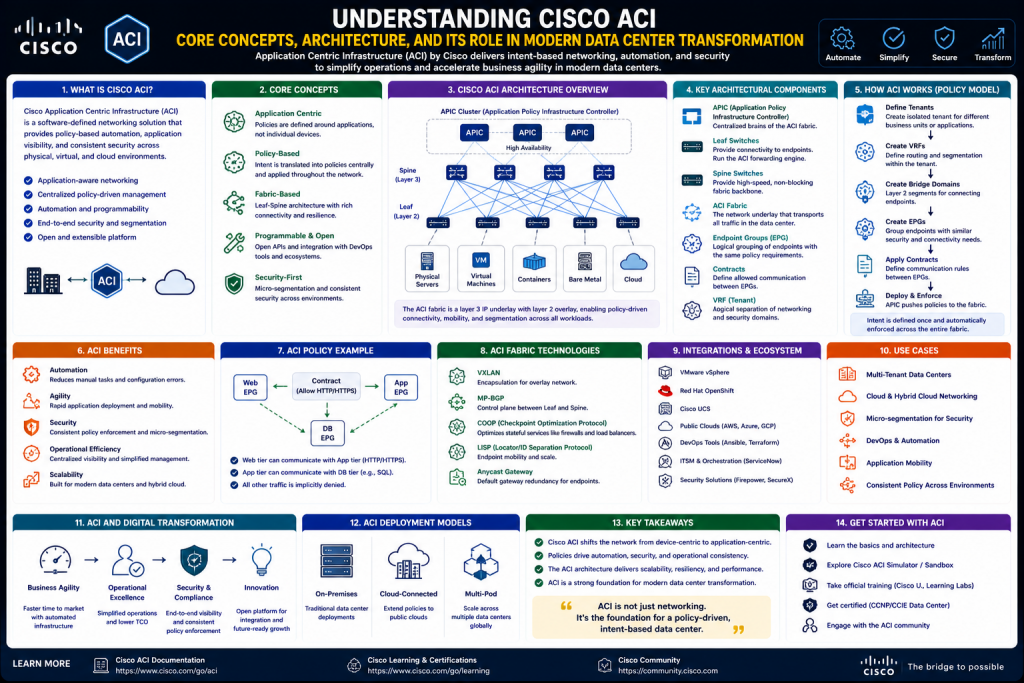
Modern data centers are the backbone of today’s digital world. Every application, website, and cloud service depends on highly efficient infrastructure that can process and deliver data at incredible speed. Organizations such as Amazon and Microsoft operate massive data centers that handle millions of user requests every second. Managing these environments requires more than traditional networking methods. It demands automation, scalability, and intelligent control systems.
In earlier days, data centers were relatively simple. Networks were smaller, applications were limited, and the number of connected devices was manageable. Network engineers could configure routers and switches manually using command-line interfaces. While this approach worked at the time, it quickly became inefficient as businesses expanded their digital operations.
Today’s data centers must support virtualization, cloud computing, big data, and real-time applications. These requirements have significantly increased complexity. Networks must be able to adapt dynamically to changing workloads, provide strong security, and maintain high availability. This is where advanced technologies like Cisco ACI play a critical role.
Challenges in Traditional Network Management
Traditional network management relies heavily on manual configuration. Engineers log into individual devices, enter commands, and make changes one device at a time. This process is not only time-consuming but also prone to human error. A single incorrect configuration can disrupt services or create vulnerabilities that attackers can exploit.
Another challenge is maintaining consistency across the network. In large environments with hundreds or thousands of devices, ensuring that every configuration is accurate and up to date becomes extremely difficult. Documentation must be carefully maintained, but even then, discrepancies can occur.
Scalability is another major issue. As organizations grow, they need to add more devices and expand their networks. With traditional methods, scaling requires significant effort and planning. Each new device must be configured manually, which slows down deployment and increases operational costs.
Security also becomes harder to manage. Modern data centers must protect sensitive data and ensure that only authorized users and applications can access specific resources. Implementing security policies across a large network manually is complex and often leads to gaps in protection.
The Evolution Toward Software Defined Networking
To overcome these challenges, the networking industry began shifting toward software-defined networking. This approach separates the control plane from the data plane, allowing network administrators to manage the network through centralized software rather than individual devices.
Software-defined networking introduces automation, which reduces the need for manual intervention. Instead of configuring each device separately, administrators define policies that are applied across the entire network. This ensures consistency and reduces the likelihood of errors.
Automation also enables faster deployment. New applications and services can be provisioned quickly, allowing organizations to respond to changing business needs more effectively. This agility is essential in today’s competitive environment.
Introduction to Cisco ACI
Cisco ACI, or Application Centric Infrastructure, is a solution developed by Cisco Systems to address the challenges of modern data center networking. It is designed to provide a centralized, automated, and application-focused approach to network management.
Unlike traditional networking models that focus on individual devices, Cisco ACI focuses on the needs of applications. This means that instead of configuring switches and routers manually, administrators define how applications should communicate and what resources they require. The system then automatically configures the network to meet those requirements.
Cisco ACI combines hardware and software components to create a unified solution. It integrates high-performance switching with advanced management tools, enabling organizations to build scalable and efficient data center networks.
Core Principles of Application Centric Infrastructure
The concept of application centric infrastructure is based on several key principles. One of the most important is policy-based management. In this approach, administrators define policies that describe how the network should behave. These policies include rules for communication, security, and performance.
Another principle is automation. Once policies are defined, the system automatically applies them across the network. This eliminates the need for manual configuration and ensures consistency.
Abstraction is also a key component. Cisco ACI abstracts the complexity of the underlying hardware, allowing administrators to interact with the network through a simplified interface. This makes it easier to manage large environments and reduces the learning curve for new engineers.
Key Components of Cisco ACI Architecture
Cisco ACI consists of several components that work together to provide a comprehensive networking solution. One of the main components is the Application Policy Infrastructure Controller, often referred to as APIC. This controller acts as the central management point for the network. It allows administrators to define policies, monitor performance, and manage configurations.
Another important component is the Cisco Nexus switches. These switches form the physical backbone of the network and are designed to support high-performance data center environments. They are optimized for scalability and reliability, making them suitable for large deployments.
Cisco ACI also includes a range of software tools and dashboards that provide visibility into network operations. These tools allow administrators to monitor traffic, analyze performance, and identify potential issues.
Transition from Command Line to Graphical Management
One of the most noticeable changes introduced by Cisco ACI is the shift from command-line interfaces to graphical management tools. Traditional networking relied heavily on CLI, which required specialized knowledge and careful attention to detail.
With Cisco ACI, administrators can manage the network through intuitive dashboards and interfaces. These tools provide visual representations of the network, making it easier to understand its structure and behavior.
Graphical management also simplifies complex tasks. Instead of entering multiple commands, administrators can perform actions with a few clicks. This reduces the risk of errors and speeds up operations.
Importance of Centralized Control
Centralized control is a fundamental aspect of Cisco ACI. By managing the network from a single point, organizations can achieve greater consistency and efficiency. Policies can be applied uniformly across all devices, ensuring that configurations are aligned with organizational requirements.
Centralized control also improves visibility. Administrators can see the entire network in one place, making it easier to identify issues and monitor performance. This holistic view is essential for managing large and complex environments.
In addition, centralized management supports better collaboration. Teams can work together more effectively when they have access to the same information and tools.
Enhancing Operational Efficiency
Cisco ACI significantly improves operational efficiency by automating routine tasks. Activities such as provisioning, configuration, and troubleshooting can be handled automatically, reducing the workload on network engineers.
This allows engineers to focus on more strategic initiatives, such as optimizing performance and developing new services. It also reduces the time required to deploy new applications, enabling organizations to respond more quickly to business needs.
Automation also helps reduce downtime. By detecting and resolving issues بسرعة, Cisco ACI ensures that services remain available and reliable.
Reducing Complexity in Large Networks
As networks grow, complexity increases. Managing thousands of devices and connections can be overwhelming, especially with traditional methods. Cisco ACI addresses this challenge by simplifying network management.
Through abstraction and automation, ACI reduces the number of manual tasks required to maintain the network. It also provides tools that make it easier to understand and manage complex environments.
This simplification is particularly valuable in data centers, where efficiency and reliability are critical.
Role of Cisco ACI in Modern IT Environments
Cisco ACI plays a vital role in modern IT environments by enabling organizations to build flexible and scalable networks. It supports a wide range of applications and services, from cloud computing to big data analytics.
By providing a unified approach to network management, Cisco ACI helps organizations align their IT infrastructure with business objectives. This alignment is essential for achieving long-term success.
In addition, Cisco ACI supports integration with other technologies and platforms. This allows organizations to create comprehensive solutions that meet their specific needs.
Preparing for Future Networking Demands
The demand for data and connectivity continues to grow. Emerging technologies such as artificial intelligence, Internet of Things, and edge computing are placing new demands on data center networks.
Cisco ACI is designed to meet these challenges by providing a flexible and scalable foundation. Its automation and policy-based approach enable organizations to adapt quickly to changing requirements.
By investing in technologies like Cisco ACI, organizations can ensure that their networks are ready for the future.
Understanding the Need for Advanced Data Center Management
Modern data centers are no longer simple facilities that store servers and networking equipment. They have evolved into highly dynamic environments that support cloud computing, virtualization, big data processing, and real-time applications. Organizations depend on these data centers to deliver services quickly, reliably, and securely.
As businesses grow, so does the complexity of their infrastructure. Thousands of servers, storage systems, and networking devices must work together seamlessly. Managing this scale manually is not practical. Even small configuration errors can lead to service disruptions, performance issues, or security vulnerabilities.
To address these challenges, organizations need intelligent systems that can automate processes, maintain consistency, and adapt to changing conditions. Cisco ACI is designed to meet these requirements by providing a comprehensive approach to data center management.
The Role of Spine Leaf Architecture in Modern Networks
One of the key foundations of modern data centers is the spine leaf architecture. This design replaces traditional three-tier architectures with a more efficient and scalable model.
In a spine leaf architecture, the network is divided into two layers. The leaf layer connects directly to servers and endpoints, while the spine layer acts as the backbone that interconnects all leaf switches. Each leaf switch connects to every spine switch, creating a highly interconnected fabric.
This design ensures that there is always a predictable and consistent path between devices. It reduces latency and improves performance, especially for traffic that moves within the data center.
Benefits of Spine Leaf Design in Data Centers
The spine leaf architecture offers several important advantages. It provides high bandwidth, allowing large volumes of data to be transferred . This is essential for applications that require real-time processing or handle large datasets.
Another benefit is redundancy. Because multiple paths exist between devices, the network can continue to operate even if one path fails. Traffic can be rerouted automatically, ensuring continuous service availability.
Scalability is also a major advantage. Organizations can expand their networks by adding more spine or leaf switches without disrupting existing connections. This makes it easier to accommodate growth and changing requirements.
However, the increased number of connections and devices also introduces complexity. Managing such a network manually would be extremely challenging, which is why automation becomes essential.
How Cisco ACI Simplifies Spine Leaf Management
Cisco ACI is specifically designed to work with spine leaf architectures. It simplifies management by providing centralized control and automation.
Instead of configuring each switch individually, administrators define policies that describe how the network should behave. These policies are then applied automatically across all devices in the fabric.
This approach eliminates the need for repetitive manual tasks and ensures that configurations remain consistent. It also reduces the likelihood of errors, which can be costly in large environments.
Automated Provisioning of Network Resources
One of the most powerful features of Cisco ACI is automated provisioning. In traditional networks, deploying a new application or service requires manual configuration of multiple devices. This process can take hours or even days.
With Cisco ACI, provisioning becomes much faster and more efficient. Administrators define the requirements of an application, such as connectivity, security policies, and performance needs. The system then automatically configures the network to meet those requirements.
This capability is particularly valuable in cloud environments, where resources must be deployed quickly and dynamically. It allows organizations to respond to business needs without delays.
Supporting Multi Tenant Environments
Data centers often serve multiple users or organizations, especially in cloud computing environments. Each user requires a separate and secure network environment.
Cisco ACI supports multi tenancy by allowing administrators to create isolated virtual networks within the same physical infrastructure. Each tenant has its own policies, configurations, and resources, ensuring privacy and security.
This feature is essential for service providers and large enterprises that need to manage multiple environments simultaneously. It also simplifies operations by allowing all tenants to be managed from a single platform.
Enhancing Security Through Policy Based Controls
Security is a critical aspect of data center management. Cisco ACI enhances security by using policy based controls to regulate network traffic.
Administrators can define rules that specify which devices and applications are allowed to communicate. These policies are enforced automatically across the network, reducing the risk of unauthorized access.
Cisco ACI also supports micro segmentation, which provides fine grained control over traffic within the network. This means that even devices within the same network segment can have restricted communication based on defined policies.
Micro segmentation helps prevent the spread of threats by limiting lateral movement within the network. It is an important tool for protecting sensitive data and maintaining compliance with security standards.
Intelligent Traffic Management and Optimization
Efficient traffic management is essential for maintaining performance in a data center. Cisco ACI includes features that optimize the flow of data across the network.
The system can analyze traffic patterns and make adjustments to improve performance. For example, if a particular path becomes congested, traffic can be rerouted through less busy paths.
This dynamic approach ensures that applications receive the bandwidth they need and that users experience minimal delays. It also helps prevent bottlenecks that could degrade performance.
Self Healing Capabilities in Cisco ACI
One of the most advanced features of Cisco ACI is its self healing capability. The system can detect issues and respond automatically without requiring manual intervention.
If a device fails or a connection is disrupted, Cisco ACI can reroute traffic through alternative paths. This ensures that services remain available even in the face of hardware failures.
Self healing also applies to performance issues. If the system detects congestion or unusual behavior, it can take corrective actions to restore normal operation.
These capabilities improve reliability and reduce downtime, which is critical for organizations that depend on continuous service availability.
Real Time Monitoring and Analytics
Cisco ACI provides comprehensive monitoring and analytics tools that give administrators deep insights into network performance.
These tools collect data on traffic patterns, device status, and application performance. Administrators can use this information to identify trends, detect anomalies, and troubleshoot issues.
Real time monitoring allows organizations to respond quickly to problems, minimizing their impact. It also supports proactive management by enabling administrators to address potential issues before they become critical.
Simplifying Troubleshooting and Maintenance
Troubleshooting network issues can be complex, especially in large environments. Cisco ACI simplifies this process by providing centralized visibility and detailed analytics.
Administrators can quickly identify the root cause of problems and take corrective action. The system also provides tools that help automate troubleshooting tasks, reducing the time required to resolve issues.
Maintenance is also simplified. Updates and changes can be applied centrally, ensuring consistency across the network. This reduces the risk of errors and improves overall efficiency.
Integration with Cloud and Virtual Environments
Modern data centers often integrate with cloud platforms and virtual environments. Cisco ACI is designed to support these integrations seamlessly.
It can extend network policies to virtual machines and cloud resources, ensuring consistent management across hybrid environments. This allows organizations to maintain control and visibility even as they adopt cloud technologies.
Integration with virtualization platforms also enables more efficient resource utilization. Workloads can be moved dynamically without disrupting network configurations.
Supporting Business Continuity and Disaster Recovery
Business continuity is a critical consideration for any organization. Cisco ACI supports this by providing features that enhance resilience and reliability.
Redundant paths and self healing capabilities ensure that services remain available even during failures. Automated provisioning also allows organizations to quickly restore services in the event of a disaster.
These features help minimize downtime and ensure that critical operations can continue without interruption.
Improving Operational Agility
In today’s fast paced business environment, organizations must be able to adapt quickly to changing conditions. Cisco ACI improves agility by enabling rapid deployment and flexible management.
New applications and services can be deployed بسرعة, allowing organizations to respond to opportunities and challenges more effectively. Automation reduces the time and effort required for routine tasks, freeing up resources for innovation.
This agility is a key advantage in competitive industries where speed and flexibility are essential.
Aligning Network Operations with Business Goals
Cisco ACI helps align network operations with business objectives by focusing on application requirements. This ensures that the network supports the needs of the organization effectively.
By simplifying management and improving performance, Cisco ACI enables organizations to deliver better services to their users. It also supports strategic initiatives such as digital transformation and cloud adoption.
The Shift Toward Intelligent Infrastructure
As organizations continue to rely more heavily on digital services, the expectations placed on data centers have increased significantly. Networks are no longer static systems that simply move data from one point to another. They are expected to be intelligent, adaptive, and capable of supporting rapidly changing business needs.
Cisco ACI represents a major step in this evolution. By combining automation, centralized management, and an application focused approach, it transforms the data center into a responsive and intelligent environment. This shift allows organizations to move away from reactive management and toward proactive, predictive operations.
Instead of waiting for problems to occur, modern infrastructure powered by Cisco ACI can anticipate issues and respond before they impact users. This level of intelligence is essential in environments where downtime and performance issues can have serious consequences.
Enabling Cloud Like Operations in Private Data Centers
Many organizations aim to achieve the same level of efficiency and flexibility in their private data centers that is found in public cloud environments. Companies such as Amazon and Microsoft have set high standards for scalability and automation.
Cisco ACI helps organizations bring these capabilities into their own environments. It allows them to provision resources quickly, scale applications dynamically, and manage infrastructure through centralized policies.
This cloud like model improves agility and reduces the time required to deploy new services. It also ensures that resources are used efficiently, which is important for controlling costs and maximizing performance.
Supporting Hybrid and Multi Cloud Strategies
Modern IT environments often span multiple platforms, including on premises data centers and public cloud services. Managing these hybrid and multi cloud environments can be challenging, especially when it comes to maintaining consistent policies and visibility.
Cisco ACI addresses this challenge by providing a unified approach to network management. Policies defined within the ACI environment can be extended across different platforms, ensuring consistency regardless of where applications are deployed.
This capability simplifies operations and reduces the complexity associated with managing multiple environments. It also allows organizations to take advantage of the flexibility offered by cloud computing while maintaining control over their infrastructure.
Accelerating Application Deployment
In today’s fast moving digital landscape, the ability to deploy applications quickly is a significant competitive advantage. Traditional network management processes often slow down deployment because they require manual configuration and coordination between different teams.
Cisco ACI streamlines this process by automating network provisioning. When a new application is introduced, administrators can define its requirements and allow the system to handle the configuration automatically.
This reduces deployment times from days or hours to minutes. It also ensures that applications are deployed consistently, reducing the risk of errors and improving overall reliability.
Enhancing Developer and Operations Collaboration
One of the key goals of modern IT practices is to improve collaboration between development and operations teams. This approach, often associated with DevOps, emphasizes automation, consistency, and shared responsibility.
Cisco ACI supports this model by providing a common platform for managing network resources. Developers can define the requirements of their applications, while operations teams ensure that these requirements are implemented correctly.
This collaboration reduces friction between teams and helps organizations deliver applications more efficiently. It also improves communication and alignment, which are essential for successful project execution.
Improving Security and Compliance Posture
Security is a top priority for any organization that manages sensitive data. Cisco ACI enhances security by enabling granular control over network traffic and enforcing policies consistently across the environment.
Developed by Cisco Systems, ACI uses a policy-driven model that allows administrators to define exactly how different applications and systems can communicate with each other.
This fine level of control is achieved through techniques such as micro segmentation, which divides the network into smaller, isolated segments. Each segment can have its own security rules, ensuring that only authorized traffic is allowed. This greatly reduces the attack surface and limits the ability of threats to move laterally داخل the network if a breach occurs.
Cisco ACI also simplifies the implementation of security policies by applying them automatically across the entire infrastructure. This ensures consistency and eliminates gaps that might arise from manual configuration. In addition, integrated monitoring and analytics tools help detect unusual behavior and potential threats in real time, allowing for faster response and mitigation.
By combining automation, visibility, and strict policy enforcement, Cisco ACI provides a strong security framework that helps organizations protect their data, maintain compliance, and build trust in their network infrastructure.
Micro segmentation allows administrators to isolate applications and limit communication between different parts of the network. This reduces the attack surface and helps prevent the spread of threats.
In addition to improving security, Cisco ACI also supports compliance with regulatory requirements. By providing detailed visibility and control, it helps organizations demonstrate that they are meeting industry standards and protecting sensitive information.
Reducing Operational Costs Over Time
Operating a large data center can be expensive, especially when relying on manual processes. Cisco ACI reduces operational costs by automating routine tasks and improving efficiency.
Developed by Cisco Systems, ACI introduces a policy-based approach that eliminates repetitive manual configurations and replaces them with centralized, automated workflows.
This automation reduces the need for large operational teams, as fewer engineers are required to manage complex network environments. Tasks such as provisioning, configuration updates, and policy enforcement can be completed بسرعة and consistently from a single interface. This not only saves time but also minimizes human error, which can lead to costly outages or security issues.
Cisco ACI also helps optimize resource utilization by dynamically adjusting network behavior based on real-time demands. Instead of overprovisioning hardware to handle peak loads, organizations can use their existing infrastructure more efficiently. This leads to lower capital and operational expenditures over time.
Additionally, faster troubleshooting and built-in analytics reduce downtime and maintenance costs. By identifying issues early and resolving them automatically or with minimal intervention, ACI helps maintain continuous service availability. Overall, these capabilities contribute to a more cost-effective and scalable data center environment.
Automation reduces the need for manual intervention, which lowers labor costs and minimizes the risk of errors. It also speeds up processes such as provisioning and troubleshooting, reducing downtime and improving productivity.
Over time, these improvements lead to significant cost savings. Organizations can allocate resources more effectively and invest in innovation rather than maintenance.
Increasing Reliability and Uptime
Reliability is critical in data center operations. Even short periods of downtime can result in lost revenue, damaged reputation, and decreased customer satisfaction.
Cisco ACI improves reliability through features such as redundancy, automated failover, and self healing capabilities. If a component fails, the system can reroute traffic and maintain service availability.
This ensures that applications remain accessible even in the face of hardware failures or network disruptions. It also reduces the need for manual intervention, allowing issues to be resolved more quickly.
Simplifying Network Scaling and Expansion
As organizations grow, their data center infrastructure must scale to accommodate increased demand. Traditional scaling methods can be complex and time consuming, requiring careful planning and manual configuration.
Cisco ACI simplifies scaling by allowing new devices and resources to be added seamlessly. Policies defined within the system are automatically applied to new components, ensuring consistency and reducing setup time.
This makes it easier for organizations to expand their infrastructure without introducing additional complexity. It also supports long term growth by providing a flexible and scalable foundation.
Providing Deep Visibility and Insights
Understanding what is happening داخل the network is essential for effective management. Cisco ACI provides detailed visibility into network performance, traffic patterns, and application behavior.
. Built by Cisco Systems, ACI offers centralized dashboards and analytics tools that give administrators a comprehensive view of the entire data center environment in real time.
This visibility allows IT teams to monitor how applications interact with the network, identify bottlenecks, and detect unusual activity before it becomes a major issue. By analyzing traffic patterns, administrators can optimize resource allocation and ensure that critical applications receive the bandwidth and performance they require. It also helps in quickly pinpointing the root cause of problems, reducing the time needed for troubleshooting and resolution.
In addition, Cisco ACI supports proactive management by using telemetry and analytics to highlight trends and predict potential failures. This enables teams to take preventive action rather than reacting after disruptions occur. Enhanced visibility also strengthens security by making it easier to detect suspicious behavior and enforce policies consistently. Overall, the deep insights provided by Cisco ACI empower organizations to maintain high performance, improve reliability, and deliver a better experience to users.
Administrators can use this information to identify trends, detect anomalies, and make informed decisions. Advanced analytics tools help predict potential issues and optimize performance.
This level of insight is particularly valuable in large environments, where manual monitoring would be impractical. It enables organizations to maintain high performance and respond quickly to changing conditions.
Supporting Emerging Technologies
The technology landscape is constantly evolving, with new innovations such as artificial intelligence, machine learning, and the Internet of Things becoming increasingly important.
These advancements are transforming how data is generated, processed, and consumed across industries, creating both opportunities and challenges for modern data centers. Organizations must now handle massive volumes of data, support real-time processing, and ensure seamless connectivity between devices, applications, and users.
Technologies like artificial intelligence and machine learning require high-performance infrastructure capable of handling complex computations and large datasets. At the same time, the Internet of Things introduces a vast number of connected devices that continuously generate data, increasing the demand for scalable and efficient networking solutions. To meet these requirements, data centers must be more flexible, automated, and responsive than ever before.
Solutions such as those developed by Cisco Systems help organizations adapt to these changes by providing intelligent network management and automation capabilities. These tools enable dynamic resource allocation, improved traffic management, and enhanced security, ensuring that emerging technologies can operate efficiently. As innovation continues to accelerate, organizations that invest in adaptable and scalable infrastructure will be better positioned to leverage new technologies and maintain a competitive edge in the digital economy.
These technologies place additional demands on data center networks, requiring high performance, low latency, and scalable infrastructure. Cisco ACI is designed to support these requirements, making it a future ready solution.
By providing a flexible and adaptive platform, Cisco ACI ensures that organizations can adopt new technologies without major changes to their infrastructure. This helps them stay competitive and take advantage of emerging opportunities.
Enhancing User Experience and Service Delivery
Ultimately, the goal of any data center is to deliver services that meet user expectations. Cisco ACI contributes to this goal by improving performance, reliability, and responsiveness.
Applications run more smoothly when the network is optimized and free from congestion. Automated management ensures that resources are allocated efficiently, reducing delays and improving overall performance.
This leads to a better user experience, which is essential for maintaining customer satisfaction and loyalty.
Aligning IT Infrastructure with Business Strategy
Cisco ACI helps bridge the gap between IT operations and business objectives. By focusing on application requirements and automating network management, it ensures that the infrastructure supports organizational goals.
. Developed by Cisco Systems, ACI introduces a policy-driven approach that allows IT teams to translate business needs into technical configurations without dealing with low-level device commands.
This alignment is especially important in environments where speed and adaptability are critical. When business units require new applications or services, Cisco ACI enables rapid deployment by automating the necessary network configurations. This reduces delays and ensures that IT can respond quickly to changing demands. It also minimizes the risk of miscommunication between teams, as policies clearly define how resources should be allocated and managed.
Furthermore, Cisco ACI enhances collaboration between different departments by providing a unified platform where network, security, and application teams can work together more effectively. It improves visibility into how applications interact with the network, helping organizations optimize performance and deliver better user experiences. By connecting technical operations with strategic objectives, Cisco ACI allows businesses to innovate more confidently while maintaining control, efficiency, and long-term scalability.
This alignment allows businesses to innovate more effectively and respond to market changes بسرعة. It also improves communication between technical and non technical stakeholders, making it easier to plan and execute strategies.
Preparing Organizations for the Future
As digital transformation continues, organizations must be prepared to adapt to new challenges and opportunities. Cisco ACI provides the tools and capabilities needed to navigate this changing landscape.
It enables businesses to shift from rigid, hardware-focused networking toward a more flexible, software-driven approach that aligns with modern application demands. With its policy-based management model, organizations can define how applications should behave and allow the system to automatically enforce those requirements across the entire network.
This approach not only simplifies operations but also improves consistency and reduces the risk of configuration errors. As workloads become more dynamic, Cisco ACI allows infrastructure to scale efficiently without requiring extensive manual intervention. It also supports integration with cloud platforms, making it easier for organizations to extend their data centers into hybrid and multi-cloud environments.
In addition, Cisco ACI enhances visibility by providing detailed insights into network performance and application behavior. These insights help IT teams make informed decisions, optimize resource usage, and respond quickly to emerging issues. By combining automation, scalability, and intelligent management, Cisco ACI ensures that organizations remain agile and competitive in an increasingly digital world while maintaining strong security and operational efficiency.
Its emphasis on automation, scalability, and flexibility makes it well suited for modern and future environments. Organizations that adopt Cisco ACI can build resilient and efficient infrastructures that support long term success.
Conclusion
Cisco ACI has transformed the way data centers are managed by introducing a more intelligent, automated, and application focused approach. It addresses the limitations of traditional networking by simplifying operations, improving security, and enhancing performance.
Through features such as centralized control, policy based management, and self healing capabilities, Cisco ACI enables organizations to operate their data centers with greater efficiency and reliability. It supports modern requirements such as cloud integration, rapid deployment, and multi tenant environments while preparing businesses for future technological advancements.
By adopting Cisco ACI, organizations can reduce complexity, lower operational costs, and improve service delivery. It provides a strong foundation for innovation and growth, ensuring that data centers remain capable of meeting the demands of an increasingly digital world.
Continue exploring the technologies and certification concepts that matter most to you.